



‘It’s Not Too Late’: Human Rights Watch’s Elaine Pearson on India’s Eroding Checks and Balances

India is often called the world’s largest democracy. But what happens when the institutions meant to check executive power stop doing so? In this interview with The Polis Project’s Suchitra Vijayan, Elaine Pearson, Human Rights Watch’s Asia director, traces what her organization calls an “authoritarian playbook” under Prime Minister Narendra Modi and his Bharatiya Janata Party, or BJP.
The 95-page report by HRW draws on more than 40 interviews conducted between January 2025 and September 2026 with current and former judges and former government officials
Human Rights Watch’s Asia director, Elaine Pearson, explains how weakened checks on executive power reinforce one another, why India’s international partners look away, and what gives her hope.
This interview has been edited for length and clarity.
Suchitra Vijayan: Human Rights Watch has documented abuses under the Modi government for more than a decade. Why produce this report now? What does it establish that we didn’t already know? Why call it an “authoritarian playbook”?
Elaine Pearson: Warnings about India’s direction aren’t new, and we have documented many of these abuses ourselves over the years. But we felt it was time to step back and ask a bigger question: What is happening to the institutions meant to safeguard people’s rights? And what happens when they fail?
This research shows more than a string of isolated incidents. We trace a pattern across the whole system, going back more than a decade. Parliament rushes through laws with little scrutiny. It has suspended opposition members en masse. Investigative agencies have targeted critics and political opponents. Legal changes and political appointments have weakened the commissions that oversee elections, information, corruption and human rights. The judiciary has faced interference and failed to defend freedoms in key cases.
That’s why we use the phrase “authoritarian playbook.” This is not a series of unconnected excesses. It’s a well-planned strategy to consolidate power and undermine democratic norms. Once you undermine those checks and balances, abuses against critics, activists, journalists and religious minorities can follow with very little accountability.
The phrase shifts the question from what has gone wrong to what is being dismantled. India’s partners love to call it the world’s largest democracy. That democracy is being seriously tested, and partners can no longer treat this as business as usual.
Suchitra Vijayan: The report identifies four developments: undermining parliamentary procedure, weaponizing federal investigative agencies, weakening institutions such as the Election Commission and the human rights commissions, and interfering with the judiciary. How do they intersect? Are these individual failures, or a coordinated pattern?
Elaine Pearson: It is a coordinated pattern of democratic erosion. We started with the institutions that are supposed to hold power to account and asked how each had fared since 2014. These four developments feed one another.
First, Parliament was sidelined. Bills usually need approval from both houses, unless they are money bills, which regulate financial matters. The BJP administration used money bills aggressively to dodge the upper house, and those bills had consequences for basic rights. One expanded the Enforcement Directorate’s powers. Afterward, cases against politicians jumped more than 600%, and a majority targeted the opposition.
Meanwhile, political appointments and legal changes weakened the bodies that should have stepped in, such as the Election Commission and the human rights commissions. The courts too often delayed cases, denied bail or stayed silent, while judges who ruled against the government faced consequences.
Look at the voter-roll revision. It deleted more than 130 million names from the rolls, disproportionately targeting Muslims and poor people. The commission faced allegations of bias, but the courts didn’t stop the revision, and the human rights bodies said nothing. That’s not one institution failing. It’s the whole system of checks and balances failing at once. The pattern spans a decade and keeps producing the same outcome: The people who might hold power to account face the consequences instead.
What distinguishes this period is the scale, the coordination and the intent. The data show it. Between 16% and 28% of bills went to parliamentary committees for scrutiny, compared with 60% to 71% under previous governments. The mass suspension of 146 lawmakers was unprecedented. Earlier governments abused institutions, too. This government is reshaping the very institutions meant to check it.
Suchitra Vijayan: Justice D.Y. Chandrachud, in his Aadhaar dissent, called the use of the money bill route an abuse of constitutional process. What is a money bill, how has the BJP used it, and why is its misuse so serious?
Elaine Pearson: A money bill is a special kind of law meant only for financial matters, such as taxes and government borrowing. Under Article [number] of the Constitution, it can pass the lower house without the upper house’s approval. The lower house speaker decides what counts as a money bill, and that decision is final. The Constitution says a money bill can contain only financial provisions, so it was designed as a narrow exception.
But the BJP did not have a majority in the upper house between 2014 and 2024. In that period, we’ve documented that the government used the money bill route for laws that didn’t qualify. Parliament passed Aadhaar, India’s national ID law, as a money bill in 2016 after only three hours of discussion. Amendments to the Foreign Contribution (Regulation) Act, which authorities frequently use against critics and nongovernmental organizations, slipped through the same way. So did the changes that allowed opaque political funding through anonymous electoral bonds. In 2019, amendments to the money laundering law expanded the Enforcement Directorate’s powers to arrest, search and seize, and made bail nearly impossible.
The consequences are serious. The upper house loses its chance to veto, so a chamber controlled by the ruling party can make law alone. Committees and experts are sidelined. It becomes harder to challenge laws with serious consequences for privacy, free speech, and liberty. That’s why Justice Chandrachud called it an abuse of constitutional process. The Supreme Court still hasn’t resolved the challenge to this practice, so the loophole remains open. Parliamentary checks work only if the government can’t bypass them whenever they become inconvenient.
Suchitra Vijayan: Is it Human Rights Watch’s position that this procedure directly violates fundamental rights?
Elaine Pearson: It violates the constitutional provisions that allow money bills only in very limited circumstances. As I’ve explained, numerous bills that should have had the upper house’s scrutiny passed without it. The government used the procedure to bypass those checks and balances.
Suchitra Vijayan: The National Investigation Agency predates Modi, and governments, including previous Congress and BJP governments, have long used terrorism laws against minorities and dissenters. A lawyer you interviewed calls the agency a “communal, anti-Muslim force” under the BJP and says its charge sheets feed an anti-Muslim narrative that courts are willing to join. What has changed since 2014?
Elaine Pearson: The National Investigation Agency and the misuse of counterterrorism laws did not begin under Modi. We saw this under previous governments, including the 2008 expansion of the Unlawful Activities (Prevention) Act, or UAPA. What has changed is the scale and scope of these powers. The 2019 amendments expanded the agency’s jurisdiction and the government’s ability to designate individuals as terrorists.
The political context matters just as much. Counterterrorism frameworks increasingly intersect with narratives that cast Muslim mobilization, certain forms of dissent and civil society activism as threats to national security. The prosecutions in the Bhima Koregaon and Delhi riots cases raise serious questions about whether authorities are using counterterrorism laws to prosecute violence or to suppress dissent. The UAPA makes bail so difficult that people can spend years in prison without a trial, so judicial oversight is critical. As we note in the report, in January 2025 an NIA court even questioned nongovernmental organizations that were giving legal aid to the accused.
The concern isn’t only who is being investigated. It’s whether expanded state powers, communalized political narratives and insufficiently effective judicial safeguards together make the process itself punitive. That’s where the erosion of democratic safeguards is particularly troubling.
Suchitra Vijayan: The Enforcement Directorate filed 193 cases against politicians between April 2015 and 2025. Whom does it target, when does it act, and what happens to those cases?
Elaine Pearson: The concern isn’t that the Enforcement Directorate shouldn’t investigate corruption. Of course it should. The question is whether it does so impartially. As we document in the report, cases against politicians have increased strikingly and disproportionately involve opposition figures. Raids and arrests often coincide with elections.
Critics have consistently dubbed this the BJP’s “washing machine.” Politicians facing corruption allegations join the BJP, and then their cases get dropped, stall, or disappear. Media reports show that at least 23 prominent opposition politicians got a reprieve once they joined the BJP. One lawmaker who switched sides said, “I get to sleep soundly as there are no inquiries.”
When the target list is lopsided, the timing tracks elections, and cases vanish after defection, the investigation stops being about corruption. That raises serious questions about whether the government is using anti-corruption enforcement selectively to intimidate or weaken the opposition.
Suchitra Vijayan: Supreme Court judges told you courts once protected free speech, subject to narrow exceptions, but now emphasize the exceptions. How did this inversion happen, and what does it say about courts’ willingness to defend the Constitution against the government’s political priorities?
Elaine Pearson: We’re seeing an inversion of constitutional reasoning. Instead of treating liberty as the rule and restrictions as the exception, courts increasingly put national security and public order first. Look at the Delhi riots cases, where student activists have spent years in jail under the counterterrorism law without trial. Look at the restrictions on journalists and human rights activists in Kashmir. These cases raise troubling questions. Are the courts rigorously protecting the space for dissent and institutional criticism? Or are they deferring to the government’s framing of dissent as a security threat, rather than scrutinizing it?
Suchitra Vijayan: The Supreme Court also took action against a school textbook over its references to judicial corruption. How does Human Rights Watch assess the judiciary’s role? Where has the court failed to act as a check on executive power?
Elaine Pearson: The judiciary’s record is mixed. The Supreme Court has intervened in some cases to check executive power. But its failures to act have often been most consequential when fundamental rights are at stake. Delays, restrictive bail rulings under the counterterrorism law and reluctance to decisively address certain challenges to executive action have left people deprived of liberty for years.
The court’s intervention over a textbook discussing judicial corruption raised questions about its tolerance of scrutiny. Judicial deference becomes complicity when courts stop rigorously testing the state’s claims, particularly when liberty, equality and fundamental freedoms are at stake. Ultimately, judicial independence protects people from abuse of power.
Suchitra Vijayan: Journalists, civil society groups, academics, lawyers and international institutions have documented all this, yet the government still invokes India’s status as the world’s largest democracy, and many governments treat it as a vital partner. Why hasn’t the evidence prompted a reckoning? Is it geopolitics, the global normalization of authoritarian practices, or a failure to recognize how democracies are dismantled from within?
Elaine Pearson: It’s a combination of all three. Geopolitics plays a role. Many governments see India as a counterweight to China, a trading partner and a strategic ally. That has made them reluctant to confront the Modi administration over democratic backsliding.
The legacy of colonialism also shapes how Indian authorities receive these conversations. Governments in the Global South are understandably skeptical of Western governments lecturing on democracy and human rights, given the West’s own history and continuing double standards. But India’s politicians sometimes use that legitimate critique to deflect scrutiny. Western governments, in turn, sometimes use it to excuse their own inconsistency and silence.
We’re also seeing a broader rise in authoritarian populism and far-right movements, in India and globally. That normalizes attacks on institutions, minorities, the press, and political dissent.
The danger is that democratic erosion is incremental. Elections continue. The courts function. Parliament meets. The government invokes democratic legitimacy even as it progressively weakens the conditions that make democracy meaningful: a free press, independent institutions, rights for minorities and the ability to criticize or dissent without fear. The slow pace makes it easier for the international community to normalize what’s happening. By the time the erosion becomes undeniable, many of the safeguards needed to reverse it may already be compromised. That’s what I think we’re seeing in India today.
Suchitra Vijayan: Can India still meaningfully be described as a constitutional democracy? How would you characterize its political system under Modi?
Elaine Pearson: The V-Dem Institute, which ranks democracies, categorizes India as an electoral autocracy in its 2026 report. It ranks India 106th of 179 countries on its Electoral Democracy Index. This is an important time in the battle for India’s democratic future. Its democratic institutions are at risk. The Modi government has eroded the rule of law, promoted Hindu majoritarianism, rolled back human rights protections and undermined the rights of marginalized communities. All of this has deepened the authoritarian slide. The wrongful deletion of millions of voters from the rolls and concerns about the Election Commission’s credibility raise the question of whether the next election will be free and fair.
But I want to end on a more hopeful note. Despite the clampdown and everything we’ve documented over this decade, civil society organizations, journalists and human rights activists continue to raise their voices, resist and document what’s happening. They do so despite the risk of arrest, prosecution and harassment. The ongoing protests also tell us that not all hope is lost.
Many people in India aren’t ready to give up the freedoms the Constitution guarantees. They fought long and hard for those freedoms, and once again they are defending them on the streets. These people are willing to put their bodies on the line for what they believe in. As long as they show that courage, it’s not too late to reverse some of these changes.
Join us
Suchitra Vijayan is the founder and executive director of The Polis Project and the author of Midnight’s Borders: A People’s History of Modern India and How Long Can the Moon Be Caged? Voices of Indian Political Prisoners.
Related Posts
‘It’s Not Too Late’: Human Rights Watch’s Elaine Pearson on India’s Eroding Checks and Balances
By Suchitra Vijayan
November 24, 2026
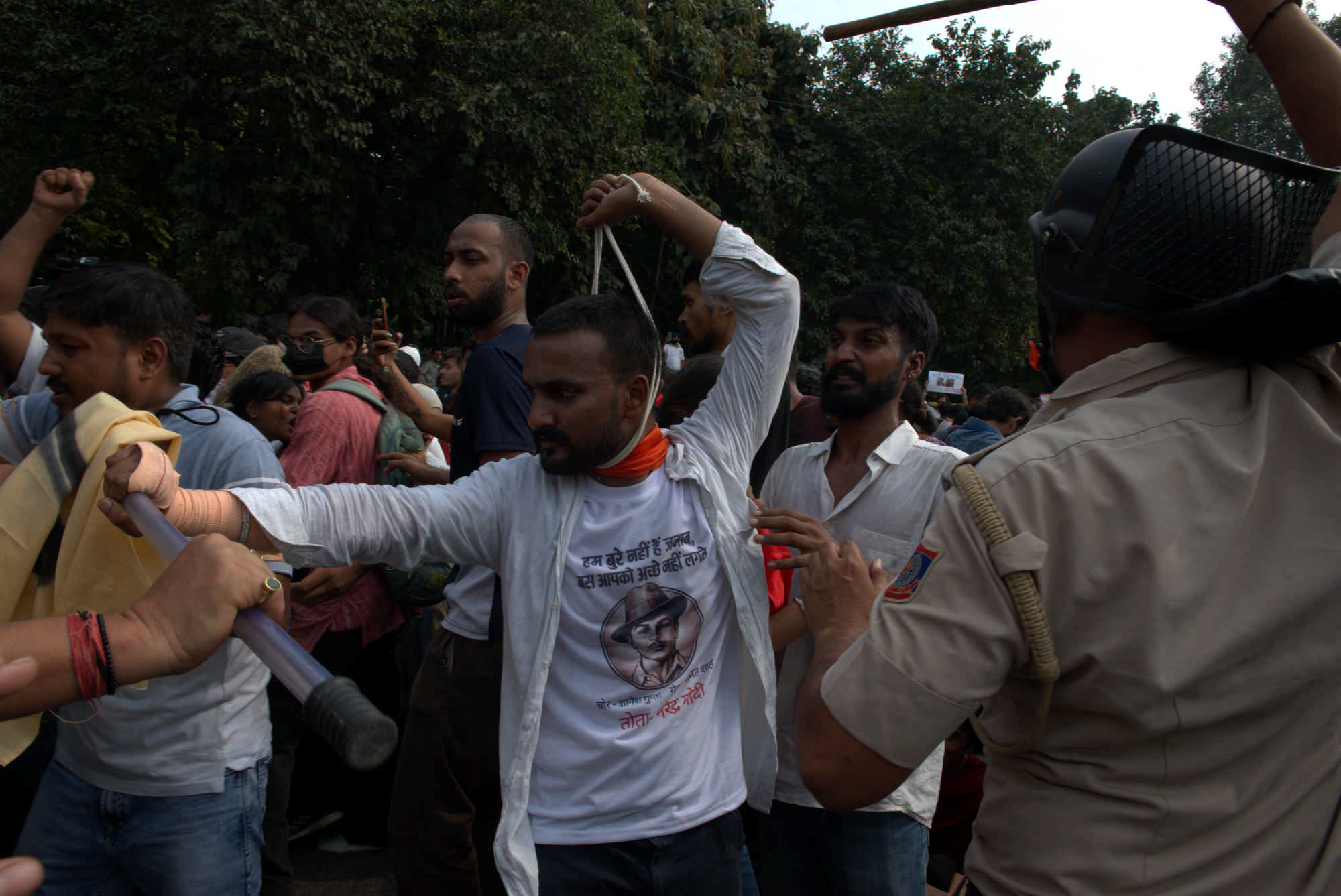
Photo Credit: Ritesh Uttamchandani
India is often called the world’s largest democracy. But what happens when the institutions meant to check executive power stop doing so? In this interview with The Polis Project’s Suchitra Vijayan, Elaine Pearson, Human Rights Watch’s Asia director, traces what her organization calls an “authoritarian playbook” under Prime Minister Narendra Modi and his Bharatiya Janata Party, or BJP.
The 95-page report by HRW draws on more than 40 interviews conducted between January 2025 and September 2026 with current and former judges and former government officials
Human Rights Watch’s Asia director, Elaine Pearson, explains how weakened checks on executive power reinforce one another, why India’s international partners look away, and what gives her hope.
This interview has been edited for length and clarity.
Suchitra Vijayan: Human Rights Watch has documented abuses under the Modi government for more than a decade. Why produce this report now? What does it establish that we didn’t already know? Why call it an “authoritarian playbook”?
Elaine Pearson: Warnings about India’s direction aren’t new, and we have documented many of these abuses ourselves over the years. But we felt it was time to step back and ask a bigger question: What is happening to the institutions meant to safeguard people’s rights? And what happens when they fail?
This research shows more than a string of isolated incidents. We trace a pattern across the whole system, going back more than a decade. Parliament rushes through laws with little scrutiny. It has suspended opposition members en masse. Investigative agencies have targeted critics and political opponents. Legal changes and political appointments have weakened the commissions that oversee elections, information, corruption and human rights. The judiciary has faced interference and failed to defend freedoms in key cases.
That’s why we use the phrase “authoritarian playbook.” This is not a series of unconnected excesses. It’s a well-planned strategy to consolidate power and undermine democratic norms. Once you undermine those checks and balances, abuses against critics, activists, journalists and religious minorities can follow with very little accountability.
The phrase shifts the question from what has gone wrong to what is being dismantled. India’s partners love to call it the world’s largest democracy. That democracy is being seriously tested, and partners can no longer treat this as business as usual.
Suchitra Vijayan: The report identifies four developments: undermining parliamentary procedure, weaponizing federal investigative agencies, weakening institutions such as the Election Commission and the human rights commissions, and interfering with the judiciary. How do they intersect? Are these individual failures, or a coordinated pattern?
Elaine Pearson: It is a coordinated pattern of democratic erosion. We started with the institutions that are supposed to hold power to account and asked how each had fared since 2014. These four developments feed one another.
First, Parliament was sidelined. Bills usually need approval from both houses, unless they are money bills, which regulate financial matters. The BJP administration used money bills aggressively to dodge the upper house, and those bills had consequences for basic rights. One expanded the Enforcement Directorate’s powers. Afterward, cases against politicians jumped more than 600%, and a majority targeted the opposition.
Meanwhile, political appointments and legal changes weakened the bodies that should have stepped in, such as the Election Commission and the human rights commissions. The courts too often delayed cases, denied bail or stayed silent, while judges who ruled against the government faced consequences.
Look at the voter-roll revision. It deleted more than 130 million names from the rolls, disproportionately targeting Muslims and poor people. The commission faced allegations of bias, but the courts didn’t stop the revision, and the human rights bodies said nothing. That’s not one institution failing. It’s the whole system of checks and balances failing at once. The pattern spans a decade and keeps producing the same outcome: The people who might hold power to account face the consequences instead.
What distinguishes this period is the scale, the coordination and the intent. The data show it. Between 16% and 28% of bills went to parliamentary committees for scrutiny, compared with 60% to 71% under previous governments. The mass suspension of 146 lawmakers was unprecedented. Earlier governments abused institutions, too. This government is reshaping the very institutions meant to check it.
Suchitra Vijayan: Justice D.Y. Chandrachud, in his Aadhaar dissent, called the use of the money bill route an abuse of constitutional process. What is a money bill, how has the BJP used it, and why is its misuse so serious?
Elaine Pearson: A money bill is a special kind of law meant only for financial matters, such as taxes and government borrowing. Under Article [number] of the Constitution, it can pass the lower house without the upper house’s approval. The lower house speaker decides what counts as a money bill, and that decision is final. The Constitution says a money bill can contain only financial provisions, so it was designed as a narrow exception.
But the BJP did not have a majority in the upper house between 2014 and 2024. In that period, we’ve documented that the government used the money bill route for laws that didn’t qualify. Parliament passed Aadhaar, India’s national ID law, as a money bill in 2016 after only three hours of discussion. Amendments to the Foreign Contribution (Regulation) Act, which authorities frequently use against critics and nongovernmental organizations, slipped through the same way. So did the changes that allowed opaque political funding through anonymous electoral bonds. In 2019, amendments to the money laundering law expanded the Enforcement Directorate’s powers to arrest, search and seize, and made bail nearly impossible.
The consequences are serious. The upper house loses its chance to veto, so a chamber controlled by the ruling party can make law alone. Committees and experts are sidelined. It becomes harder to challenge laws with serious consequences for privacy, free speech, and liberty. That’s why Justice Chandrachud called it an abuse of constitutional process. The Supreme Court still hasn’t resolved the challenge to this practice, so the loophole remains open. Parliamentary checks work only if the government can’t bypass them whenever they become inconvenient.
Suchitra Vijayan: Is it Human Rights Watch’s position that this procedure directly violates fundamental rights?
Elaine Pearson: It violates the constitutional provisions that allow money bills only in very limited circumstances. As I’ve explained, numerous bills that should have had the upper house’s scrutiny passed without it. The government used the procedure to bypass those checks and balances.
Suchitra Vijayan: The National Investigation Agency predates Modi, and governments, including previous Congress and BJP governments, have long used terrorism laws against minorities and dissenters. A lawyer you interviewed calls the agency a “communal, anti-Muslim force” under the BJP and says its charge sheets feed an anti-Muslim narrative that courts are willing to join. What has changed since 2014?
Elaine Pearson: The National Investigation Agency and the misuse of counterterrorism laws did not begin under Modi. We saw this under previous governments, including the 2008 expansion of the Unlawful Activities (Prevention) Act, or UAPA. What has changed is the scale and scope of these powers. The 2019 amendments expanded the agency’s jurisdiction and the government’s ability to designate individuals as terrorists.
The political context matters just as much. Counterterrorism frameworks increasingly intersect with narratives that cast Muslim mobilization, certain forms of dissent and civil society activism as threats to national security. The prosecutions in the Bhima Koregaon and Delhi riots cases raise serious questions about whether authorities are using counterterrorism laws to prosecute violence or to suppress dissent. The UAPA makes bail so difficult that people can spend years in prison without a trial, so judicial oversight is critical. As we note in the report, in January 2025 an NIA court even questioned nongovernmental organizations that were giving legal aid to the accused.
The concern isn’t only who is being investigated. It’s whether expanded state powers, communalized political narratives and insufficiently effective judicial safeguards together make the process itself punitive. That’s where the erosion of democratic safeguards is particularly troubling.
Suchitra Vijayan: The Enforcement Directorate filed 193 cases against politicians between April 2015 and 2025. Whom does it target, when does it act, and what happens to those cases?
Elaine Pearson: The concern isn’t that the Enforcement Directorate shouldn’t investigate corruption. Of course it should. The question is whether it does so impartially. As we document in the report, cases against politicians have increased strikingly and disproportionately involve opposition figures. Raids and arrests often coincide with elections.
Critics have consistently dubbed this the BJP’s “washing machine.” Politicians facing corruption allegations join the BJP, and then their cases get dropped, stall, or disappear. Media reports show that at least 23 prominent opposition politicians got a reprieve once they joined the BJP. One lawmaker who switched sides said, “I get to sleep soundly as there are no inquiries.”
When the target list is lopsided, the timing tracks elections, and cases vanish after defection, the investigation stops being about corruption. That raises serious questions about whether the government is using anti-corruption enforcement selectively to intimidate or weaken the opposition.
Suchitra Vijayan: Supreme Court judges told you courts once protected free speech, subject to narrow exceptions, but now emphasize the exceptions. How did this inversion happen, and what does it say about courts’ willingness to defend the Constitution against the government’s political priorities?
Elaine Pearson: We’re seeing an inversion of constitutional reasoning. Instead of treating liberty as the rule and restrictions as the exception, courts increasingly put national security and public order first. Look at the Delhi riots cases, where student activists have spent years in jail under the counterterrorism law without trial. Look at the restrictions on journalists and human rights activists in Kashmir. These cases raise troubling questions. Are the courts rigorously protecting the space for dissent and institutional criticism? Or are they deferring to the government’s framing of dissent as a security threat, rather than scrutinizing it?
Suchitra Vijayan: The Supreme Court also took action against a school textbook over its references to judicial corruption. How does Human Rights Watch assess the judiciary’s role? Where has the court failed to act as a check on executive power?
Elaine Pearson: The judiciary’s record is mixed. The Supreme Court has intervened in some cases to check executive power. But its failures to act have often been most consequential when fundamental rights are at stake. Delays, restrictive bail rulings under the counterterrorism law and reluctance to decisively address certain challenges to executive action have left people deprived of liberty for years.
The court’s intervention over a textbook discussing judicial corruption raised questions about its tolerance of scrutiny. Judicial deference becomes complicity when courts stop rigorously testing the state’s claims, particularly when liberty, equality and fundamental freedoms are at stake. Ultimately, judicial independence protects people from abuse of power.
Suchitra Vijayan: Journalists, civil society groups, academics, lawyers and international institutions have documented all this, yet the government still invokes India’s status as the world’s largest democracy, and many governments treat it as a vital partner. Why hasn’t the evidence prompted a reckoning? Is it geopolitics, the global normalization of authoritarian practices, or a failure to recognize how democracies are dismantled from within?
Elaine Pearson: It’s a combination of all three. Geopolitics plays a role. Many governments see India as a counterweight to China, a trading partner and a strategic ally. That has made them reluctant to confront the Modi administration over democratic backsliding.
The legacy of colonialism also shapes how Indian authorities receive these conversations. Governments in the Global South are understandably skeptical of Western governments lecturing on democracy and human rights, given the West’s own history and continuing double standards. But India’s politicians sometimes use that legitimate critique to deflect scrutiny. Western governments, in turn, sometimes use it to excuse their own inconsistency and silence.
We’re also seeing a broader rise in authoritarian populism and far-right movements, in India and globally. That normalizes attacks on institutions, minorities, the press, and political dissent.
The danger is that democratic erosion is incremental. Elections continue. The courts function. Parliament meets. The government invokes democratic legitimacy even as it progressively weakens the conditions that make democracy meaningful: a free press, independent institutions, rights for minorities and the ability to criticize or dissent without fear. The slow pace makes it easier for the international community to normalize what’s happening. By the time the erosion becomes undeniable, many of the safeguards needed to reverse it may already be compromised. That’s what I think we’re seeing in India today.
Suchitra Vijayan: Can India still meaningfully be described as a constitutional democracy? How would you characterize its political system under Modi?
Elaine Pearson: The V-Dem Institute, which ranks democracies, categorizes India as an electoral autocracy in its 2026 report. It ranks India 106th of 179 countries on its Electoral Democracy Index. This is an important time in the battle for India’s democratic future. Its democratic institutions are at risk. The Modi government has eroded the rule of law, promoted Hindu majoritarianism, rolled back human rights protections and undermined the rights of marginalized communities. All of this has deepened the authoritarian slide. The wrongful deletion of millions of voters from the rolls and concerns about the Election Commission’s credibility raise the question of whether the next election will be free and fair.
But I want to end on a more hopeful note. Despite the clampdown and everything we’ve documented over this decade, civil society organizations, journalists and human rights activists continue to raise their voices, resist and document what’s happening. They do so despite the risk of arrest, prosecution and harassment. The ongoing protests also tell us that not all hope is lost.
Many people in India aren’t ready to give up the freedoms the Constitution guarantees. They fought long and hard for those freedoms, and once again they are defending them on the streets. These people are willing to put their bodies on the line for what they believe in. As long as they show that courage, it’s not too late to reverse some of these changes.
SUPPORT US
We like bringing the stories that don’t get told to you. For that, we need your support. However small, we would appreciate it.
Suchitra Vijayan is the founder and executive director of The Polis Project and the author of Midnight’s Borders: A People’s History of Modern India and How Long Can the Moon Be Caged? Voices of Indian Political Prisoners.
Related Posts

India Out of Work: Santosh Mehrotra on the India Unemployment Crisis
The Polis Project, Aabha Muralidharan