




“India Out of Work”: Santosh Mehrotra on Jobs, Growth, and the Crisis Behind the GDP Narrative

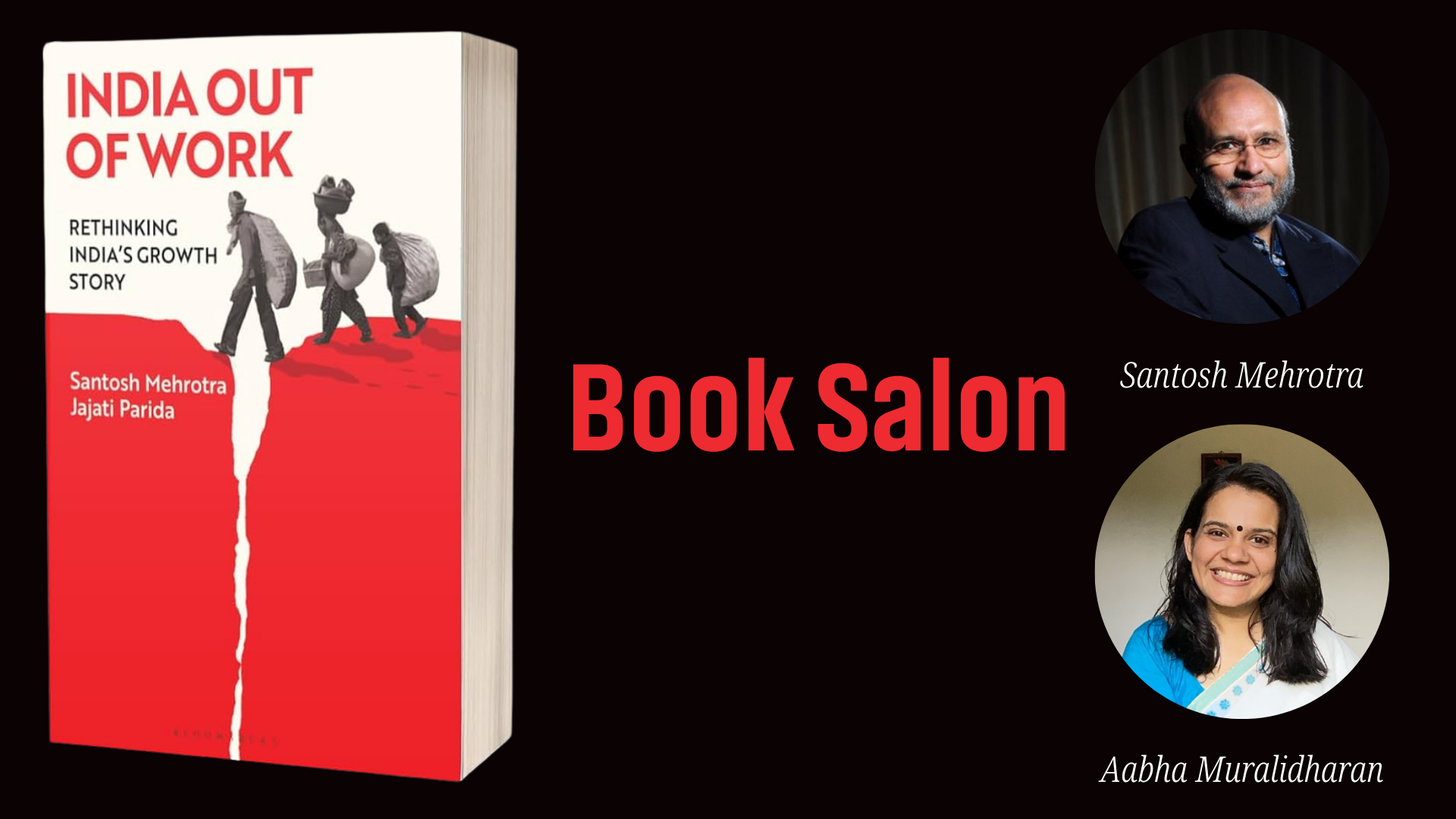
In a conversation with The Polis Project, the economist Santosh Mehrotra discusses his book, India Out of Work: Rethinking India’s Growth Story, with researcher Aabha Muralidharan and argues that India’s high-growth narrative has obscured an employment crisis, deepening inequality, and a shrinking window to benefit from its demographic dividend.
Santosh Mehrotra is a development economist, whose research and writings have had most influence in the areas of labour, employment, skill development, on the relationship between human development and economic growth, child poverty, and the economics of education.
Aabha Muralidharan is a researcher and photographer who looks at issues of colonialism, gender and political theory.
This conversation has been edited for clarity and length.
Abha Muralidharan: Why did you and Jayati Parida call the book India Out of Work? What needs rethinking about India’s growth story?
Santosh Mehrotra: The title reflects the reality on the ground. Between 2012 and now, the number of unemployed people went from ten million to about thirty million. The number of NEETs—young people aged fifteen to twenty-nine not in education, employment, or training, many of them discouraged workers who looked for work, found none and dropped out—went from fifty million in 2012 to over one hundred million.
Real wages are not growing, and wealth and income inequality has risen sharply. Inequality fell from independence to 1980 and has risen since. We now are one of the most unequal countries in the world. One reason inequality is rising so sharply is that jobs for the bottom fifty percent are not growing fast enough.
At the top, concentration across industries has grown remarkably, as Viral Acharya of NYU’s Stern School has shown in a paper for Brookings, and as Simon Commander et al. have found. Ownership across services and industry has been concentrated in the hands of five big corporate houses. Having spread their wings across a slew of sectors, they’ve deepened their hold within each, at the expense of smaller companies and the unorganized sector.
So the unorganized sector is suffering, and jobs are not growing. That drives the title. We cannot continue to focus on the pace of growth, which is the obsession of the media, the government, and government economists. Those of us outside the government—and the opposition—are saying that the pattern of growth needs to change. There has to be a specific focus on employment generation through an industrial policy.
Muralidharan: When we hear that India is growing, what is being measured? What becomes invisible when GDP is treated as the dominant measure of progress?
Mehrotra: GDP measures output, expenditure, or income. But if inequality is rising sharply, the incomes of the top 10 or 20 percent can grow while those of the bottom 80 percent do not. Average per-capita income can still rise.
A focus on GDP also pushes human development out of view. We talk about India being one of the world’s largest economies. How does that affect the ordinary person if jobs are not growing and real wages are not rising? Notice I said real wages. A lower inflation rate means little to workers if their wages are growing no faster than prices.
Muralidharan: You argue that India is running out of time to benefit from its demographic dividend. What does that mean?
Mehrotra: A demographic dividend is the period when the working-age share of a population rises while the share of dependents—children and older people—falls. It is a potential dividend. If young people find productive work, their incomes and savings rise, investment increases, and the economy can grow faster.
But “if young people who are entering the labor force don’t get jobs or don’t get quality jobs, then the dividend can become a nightmare.”
India has been in this period since around 1980. We have not made enough of it, and the window is closing as the population ages. The danger is that India will grow old before it becomes rich.
Muralidharan: Your book challenges the idea that growth in India has always been jobless. What changed?
Mehrotra: We have done better before, and we can do it again. From roughly 2003 to 2015, when India was growing rapidly, the economy was creating about 7.5 million new non-farm jobs a year. Workers were moving out of agriculture and into manufacturing, construction, and services. For the first time, the absolute number of workers in agriculture began to decline.
That process slowed, and the shocks after 2016 made matters worse. Demonetization hit cash-dependent small businesses hard. Then came a badly designed and poorly implemented Goods and Services Tax, followed by the pandemic. I am not saying all India’s problems began with this government. I am saying we were on a different trajectory, and those shocks had consequences for employment.
Muralidharan: Is “deindustrialization” the right term for what happened?
Mehrotra: No. I do not say India has deindustrialized. The absolute value of manufacturing is still growing. The problem is that manufacturing has not grown as a share of the economy at the rate we need. Its contribution to gross value added has fallen.
Manufacturing must be a leading source of growth because India needs large numbers of non-farm jobs. Services have grown, but they cannot, by themselves, absorb everyone entering the labor force. The issue is not that industry has disappeared. It is that we have not built enough labor-intensive manufacturing.
Muralidharan: If manufacturing is not absorbing workers, where do they go?
Mehrotra: Some become unemployed. Some look for work, cannot find it, and leave the labor force. Some take up low-productivity work in services. And many have gone back to agriculture.
The book shows a very large rise in the number of people working in agriculture after years in which that number had been falling. These are workers who should have had opportunities outside farming. Productivity and incomes in agriculture are already low. “They don’t want to be in agriculture, but they’re there because there is no alternative. That is the tragedy.”
Muralidharan: What The Polis Project saw at Jantar Mantar made this part of the book difficult for me to read. We can romanticize protest and revolution, but what we saw there was tragedy—young people who did not see a future in front of them. What does the return to agriculture mean in the daily life of a rural household?
Mehrotra: It means more people trying to make a living from work that was already underproductive. Men who had worked in cities or in small enterprises return home. Some began cultivating land that had been left fallow. Remittances stop, but the household has more people to feed.
Women may work the family farm while men open a small shop. If a household has some savings, it might buy a cow or buffalo and sell milk or ghee. Demand for work under MGNREGA rises. Families diversify their livelihoods, but they are doing so under pressure. That should not be mistaken for the creation of good jobs.
Muralidharan: How does that pressure fall on girls and women?
Mehrotra: Many girls have received more education than their mothers. They want to work outside the home. Instead, because non-farm jobs are not available, some join their mothers in agriculture or help in a family business without pay.
So when we hear that female labor-force participation has increased, we must ask: what kind of work? If the increase comes from unpaid family labor, it is not the same as women gaining secure, paid employment.
“These girls now who are educated—young girls—are joining agriculture when that’s the last thing that they want to do.” This is the dashing of the revolution of rising expectations.
Muralidharan: Kerala complicates this story. It has high literacy, yet many educated young people cannot find the work they want. How do you understand that?
Mehrotra: Kerala has educated its young people but has not created enough non-farm jobs to match their aspirations. Many seek work in the Gulf, elsewhere in India, or in other countries. At the same time, workers from poorer states migrate to Kerala and other southern states for jobs.
Migration itself is not the problem. The problem is that people should also be able to find decent work closer to home. States with fewer opportunities need greater investment in health, education, infrastructure, and industry. Otherwise, workers continue to migrate because they have little choice, while wage growth remains under pressure.
Muralidharan: You also connect unemployment to the way India expanded education. What went wrong?
Mehrotra: “We are a Brahmanical society. The sooner we internalize this fact, we the elite of our country, the better it is for us.” Look at the language in which you and I are having this conversation. Then look at whose education was neglected after independence: overwhelmingly the communities that had long been excluded.
India invested too little in mass school education for decades. Later, enrolment expanded rapidly, which was necessary, but quality did not keep pace. Higher education grew quickly, much of it through private colleges, while vocational education and training remained neglected.
Young people have degrees and expectations of formal employment, but many have not received the education or training employers seek—and the economy is not producing enough jobs for them in any case. You cannot understand their protests without understanding that gap between education, expectation, and work.
Abha Muralidharan: The conversation about rural work also raises a question about exports. Could the U.S. sanctions legislation targeting countries that buy Russian energy affect Indian workers, particularly in labor-intensive industries?
Santosh Mehrotra: India’s exports to the United States include labor-intensive goods—leather and footwear, textiles and garments, gems and jewelry. Those are precisely the industries in which trade barriers can have consequences for employment. But I do not think India should rush into a trade agreement on unfavorable terms because of the threat of tariffs.
The United States has its own political and economic pressures. India should continue negotiating hard. It should not assume that maintaining access to the American market requires it to surrender its position on Russian oil or its broader economic interests. My concern is that a weak agreement could damage the very sectors in which India needs to create jobs.
Muralidharan: You argue that domestic investment has weakened while India continues to look to foreign direct investment. What does that mean for employment?
Mehrotra: If our own companies are not investing, why would we assume foreign investment will solve the problem? During the earlier high-growth period, investment was substantially higher as a share of GDP. “The top of the range in the last twelve years is barely the bottom of the range of the preceding ten years.”
Foreign direct investment does not automatically create large numbers of jobs. Its effects depend on where it goes. Investment in labor-intensive export industries is different from investment in capital-intensive or import-intensive businesses serving the domestic market.
But the larger issue is demand. If non-farm jobs are not growing and real wages are stagnant, households cannot spend enough to sustain broad-based demand. Firms can be profitable and still hesitate to invest when they do not expect demand to grow. That is why employment, wages, domestic investment, and industrial policy have to be considered together.
Muralidharan: Ranjana Padhi, joining the conversation, asks a question about what kind of industry India should build. In Odisha, she writes, mining, steel, and alumina projects are extracting natural resources while land acquisition undermines the livelihoods of Adivasi and Dalit communities. Young people then migrate for work: there is an extraction of labor as well as resources. How do we protect forests, mountains, and coastlines while pursuing industrial development?
Mehrotra: She and I are on the same page. An industrial policy will not work without investment in rural areas. MGNREGA could help mobilize labor to conserve water, land, and forests. That work is essential to improving rural livelihoods and responding to climate change.
It requires a holistic approach—jal, jungle, jameen, jalvayu, janvar: water, forest, land, climate, and animals. Without that, agricultural incomes will not rise, and rural workers will continue to migrate under exploitative conditions. This is a political question, not just an economic one.
Muralidharan: An audience member asks whether India is again building capacity without preparing workers—this time in artificial intelligence. How concerned are you?
Mehrotra: Very concerned. India’s software companies are not retraining workers at the speed the coming changes require. We have also invested too little in research and development. We celebrate the number of start-ups, but how many are building deep technological capacity?
For a long time, India has benefited from supplying skilled labor to global companies. That cannot be the whole strategy for the future. We need to invest in research, workers’ skills, and the capacity to develop technology rather than only supply labor to those who own it.
Muralidharan: I want to connect the employment crisis to the Special Intensive Revision of electoral rolls. How do you see joblessness, political representation, and the risk that people may be removed from the rolls as related?
Mehrotra: When young people cannot find work, their frustration becomes a political question. We saw the political consequences of that frustration in the 2024 election. My concern is that, instead of addressing what voters are saying about jobs, the government and the Election Commission are pursuing an electoral-roll revision that could remove eligible voters.
I regard the way the revision is being carried out as deeply troubling. There have been warnings about errors in efforts to identify supposedly ineligible people. The stakes are fundamental: if someone who has the right to vote is removed from the roll, that person loses a means of holding the government accountable. That is why I connect the employment crisis to the question of who gets to participate in elections
Muralidharan: Finally, what is the most important lesson India can take from China?
Mehrotra: China had an industrial policy and an employment policy attached to it. That helped it make use of its demographic dividend. India needs to take employment as seriously as it takes the headline growth rate.
Join us
Aabha Muralidharan is a researcher and photographer who looks at issues of colonialism, gender and political theory.

“India Out of Work”: Santosh Mehrotra on Jobs, Growth, and the Crisis Behind the GDP Narrative
By The Polis Project, Aabha Muralidharan
September 17, 2026
In a conversation with The Polis Project, the economist Santosh Mehrotra discusses his book, India Out of Work: Rethinking India’s…
In a conversation with The Polis Project, the economist Santosh Mehrotra discusses his book, India Out of Work: Rethinking India’s Growth Story, with researcher Aabha Muralidharan and argues that India’s high-growth narrative has obscured an employment crisis, deepening inequality, and a shrinking window to benefit from its demographic dividend.
Santosh Mehrotra is a development economist, whose research and writings have had most influence in the areas of labour, employment, skill development, on the relationship between human development and economic growth, child poverty, and the economics of education.
Aabha Muralidharan is a researcher and photographer who looks at issues of colonialism, gender and political theory.
This conversation has been edited for clarity and length.
Abha Muralidharan: Why did you and Jayati Parida call the book India Out of Work? What needs rethinking about India’s growth story?
Santosh Mehrotra: The title reflects the reality on the ground. Between 2012 and now, the number of unemployed people went from ten million to about thirty million. The number of NEETs—young people aged fifteen to twenty-nine not in education, employment, or training, many of them discouraged workers who looked for work, found none and dropped out—went from fifty million in 2012 to over one hundred million.
Real wages are not growing, and wealth and income inequality has risen sharply. Inequality fell from independence to 1980 and has risen since. We now are one of the most unequal countries in the world. One reason inequality is rising so sharply is that jobs for the bottom fifty percent are not growing fast enough.
At the top, concentration across industries has grown remarkably, as Viral Acharya of NYU’s Stern School has shown in a paper for Brookings, and as Simon Commander et al. have found. Ownership across services and industry has been concentrated in the hands of five big corporate houses. Having spread their wings across a slew of sectors, they’ve deepened their hold within each, at the expense of smaller companies and the unorganized sector.
So the unorganized sector is suffering, and jobs are not growing. That drives the title. We cannot continue to focus on the pace of growth, which is the obsession of the media, the government, and government economists. Those of us outside the government—and the opposition—are saying that the pattern of growth needs to change. There has to be a specific focus on employment generation through an industrial policy.
Muralidharan: When we hear that India is growing, what is being measured? What becomes invisible when GDP is treated as the dominant measure of progress?
Mehrotra: GDP measures output, expenditure, or income. But if inequality is rising sharply, the incomes of the top 10 or 20 percent can grow while those of the bottom 80 percent do not. Average per-capita income can still rise.
A focus on GDP also pushes human development out of view. We talk about India being one of the world’s largest economies. How does that affect the ordinary person if jobs are not growing and real wages are not rising? Notice I said real wages. A lower inflation rate means little to workers if their wages are growing no faster than prices.
Muralidharan: You argue that India is running out of time to benefit from its demographic dividend. What does that mean?
Mehrotra: A demographic dividend is the period when the working-age share of a population rises while the share of dependents—children and older people—falls. It is a potential dividend. If young people find productive work, their incomes and savings rise, investment increases, and the economy can grow faster.
But “if young people who are entering the labor force don’t get jobs or don’t get quality jobs, then the dividend can become a nightmare.”
India has been in this period since around 1980. We have not made enough of it, and the window is closing as the population ages. The danger is that India will grow old before it becomes rich.
Muralidharan: Your book challenges the idea that growth in India has always been jobless. What changed?
Mehrotra: We have done better before, and we can do it again. From roughly 2003 to 2015, when India was growing rapidly, the economy was creating about 7.5 million new non-farm jobs a year. Workers were moving out of agriculture and into manufacturing, construction, and services. For the first time, the absolute number of workers in agriculture began to decline.
That process slowed, and the shocks after 2016 made matters worse. Demonetization hit cash-dependent small businesses hard. Then came a badly designed and poorly implemented Goods and Services Tax, followed by the pandemic. I am not saying all India’s problems began with this government. I am saying we were on a different trajectory, and those shocks had consequences for employment.
Muralidharan: Is “deindustrialization” the right term for what happened?
Mehrotra: No. I do not say India has deindustrialized. The absolute value of manufacturing is still growing. The problem is that manufacturing has not grown as a share of the economy at the rate we need. Its contribution to gross value added has fallen.
Manufacturing must be a leading source of growth because India needs large numbers of non-farm jobs. Services have grown, but they cannot, by themselves, absorb everyone entering the labor force. The issue is not that industry has disappeared. It is that we have not built enough labor-intensive manufacturing.
Muralidharan: If manufacturing is not absorbing workers, where do they go?
Mehrotra: Some become unemployed. Some look for work, cannot find it, and leave the labor force. Some take up low-productivity work in services. And many have gone back to agriculture.
The book shows a very large rise in the number of people working in agriculture after years in which that number had been falling. These are workers who should have had opportunities outside farming. Productivity and incomes in agriculture are already low. “They don’t want to be in agriculture, but they’re there because there is no alternative. That is the tragedy.”
Muralidharan: What The Polis Project saw at Jantar Mantar made this part of the book difficult for me to read. We can romanticize protest and revolution, but what we saw there was tragedy—young people who did not see a future in front of them. What does the return to agriculture mean in the daily life of a rural household?
Mehrotra: It means more people trying to make a living from work that was already underproductive. Men who had worked in cities or in small enterprises return home. Some began cultivating land that had been left fallow. Remittances stop, but the household has more people to feed.
Women may work the family farm while men open a small shop. If a household has some savings, it might buy a cow or buffalo and sell milk or ghee. Demand for work under MGNREGA rises. Families diversify their livelihoods, but they are doing so under pressure. That should not be mistaken for the creation of good jobs.
Muralidharan: How does that pressure fall on girls and women?
Mehrotra: Many girls have received more education than their mothers. They want to work outside the home. Instead, because non-farm jobs are not available, some join their mothers in agriculture or help in a family business without pay.
So when we hear that female labor-force participation has increased, we must ask: what kind of work? If the increase comes from unpaid family labor, it is not the same as women gaining secure, paid employment.
“These girls now who are educated—young girls—are joining agriculture when that’s the last thing that they want to do.” This is the dashing of the revolution of rising expectations.
Muralidharan: Kerala complicates this story. It has high literacy, yet many educated young people cannot find the work they want. How do you understand that?
Mehrotra: Kerala has educated its young people but has not created enough non-farm jobs to match their aspirations. Many seek work in the Gulf, elsewhere in India, or in other countries. At the same time, workers from poorer states migrate to Kerala and other southern states for jobs.
Migration itself is not the problem. The problem is that people should also be able to find decent work closer to home. States with fewer opportunities need greater investment in health, education, infrastructure, and industry. Otherwise, workers continue to migrate because they have little choice, while wage growth remains under pressure.
Muralidharan: You also connect unemployment to the way India expanded education. What went wrong?
Mehrotra: “We are a Brahmanical society. The sooner we internalize this fact, we the elite of our country, the better it is for us.” Look at the language in which you and I are having this conversation. Then look at whose education was neglected after independence: overwhelmingly the communities that had long been excluded.
India invested too little in mass school education for decades. Later, enrolment expanded rapidly, which was necessary, but quality did not keep pace. Higher education grew quickly, much of it through private colleges, while vocational education and training remained neglected.
Young people have degrees and expectations of formal employment, but many have not received the education or training employers seek—and the economy is not producing enough jobs for them in any case. You cannot understand their protests without understanding that gap between education, expectation, and work.
Abha Muralidharan: The conversation about rural work also raises a question about exports. Could the U.S. sanctions legislation targeting countries that buy Russian energy affect Indian workers, particularly in labor-intensive industries?
Santosh Mehrotra: India’s exports to the United States include labor-intensive goods—leather and footwear, textiles and garments, gems and jewelry. Those are precisely the industries in which trade barriers can have consequences for employment. But I do not think India should rush into a trade agreement on unfavorable terms because of the threat of tariffs.
The United States has its own political and economic pressures. India should continue negotiating hard. It should not assume that maintaining access to the American market requires it to surrender its position on Russian oil or its broader economic interests. My concern is that a weak agreement could damage the very sectors in which India needs to create jobs.
Muralidharan: You argue that domestic investment has weakened while India continues to look to foreign direct investment. What does that mean for employment?
Mehrotra: If our own companies are not investing, why would we assume foreign investment will solve the problem? During the earlier high-growth period, investment was substantially higher as a share of GDP. “The top of the range in the last twelve years is barely the bottom of the range of the preceding ten years.”
Foreign direct investment does not automatically create large numbers of jobs. Its effects depend on where it goes. Investment in labor-intensive export industries is different from investment in capital-intensive or import-intensive businesses serving the domestic market.
But the larger issue is demand. If non-farm jobs are not growing and real wages are stagnant, households cannot spend enough to sustain broad-based demand. Firms can be profitable and still hesitate to invest when they do not expect demand to grow. That is why employment, wages, domestic investment, and industrial policy have to be considered together.
Muralidharan: Ranjana Padhi, joining the conversation, asks a question about what kind of industry India should build. In Odisha, she writes, mining, steel, and alumina projects are extracting natural resources while land acquisition undermines the livelihoods of Adivasi and Dalit communities. Young people then migrate for work: there is an extraction of labor as well as resources. How do we protect forests, mountains, and coastlines while pursuing industrial development?
Mehrotra: She and I are on the same page. An industrial policy will not work without investment in rural areas. MGNREGA could help mobilize labor to conserve water, land, and forests. That work is essential to improving rural livelihoods and responding to climate change.
It requires a holistic approach—jal, jungle, jameen, jalvayu, janvar: water, forest, land, climate, and animals. Without that, agricultural incomes will not rise, and rural workers will continue to migrate under exploitative conditions. This is a political question, not just an economic one.
Muralidharan: An audience member asks whether India is again building capacity without preparing workers—this time in artificial intelligence. How concerned are you?
Mehrotra: Very concerned. India’s software companies are not retraining workers at the speed the coming changes require. We have also invested too little in research and development. We celebrate the number of start-ups, but how many are building deep technological capacity?
For a long time, India has benefited from supplying skilled labor to global companies. That cannot be the whole strategy for the future. We need to invest in research, workers’ skills, and the capacity to develop technology rather than only supply labor to those who own it.
Muralidharan: I want to connect the employment crisis to the Special Intensive Revision of electoral rolls. How do you see joblessness, political representation, and the risk that people may be removed from the rolls as related?
Mehrotra: When young people cannot find work, their frustration becomes a political question. We saw the political consequences of that frustration in the 2024 election. My concern is that, instead of addressing what voters are saying about jobs, the government and the Election Commission are pursuing an electoral-roll revision that could remove eligible voters.
I regard the way the revision is being carried out as deeply troubling. There have been warnings about errors in efforts to identify supposedly ineligible people. The stakes are fundamental: if someone who has the right to vote is removed from the roll, that person loses a means of holding the government accountable. That is why I connect the employment crisis to the question of who gets to participate in elections
Muralidharan: Finally, what is the most important lesson India can take from China?
Mehrotra: China had an industrial policy and an employment policy attached to it. That helped it make use of its demographic dividend. India needs to take employment as seriously as it takes the headline growth rate.
SUPPORT US
We like bringing the stories that don’t get told to you. For that, we need your support. However small, we would appreciate it.
Aabha Muralidharan is a researcher and photographer who looks at issues of colonialism, gender and political theory.
Related Posts

To Bloom Like Jirhul and Cry “Hool!”: A Profile of Poet Jacinta Kerketta
Varsha Prakash, Arjun Rai Gupta