




Sayad Bibi Shareef spent the night with her two sons at her late husband’s grave at Shahi Thump graveyard, near Turbat, a city in Balochistan, on July 3 this year.
Shareef was afraid her home would be raided by the Counter Terrorism Department (CTD), an anti-terrorism and intelligence wing in Pakistan, mere hours after she had been released from their detention.
Shareef, an active member of the Baloch Yakjehti Committee (BYC), a rights movement in Balochistan, Pakistan’s insurgency-ridden province, had been detained by the CTD only two days earlier on July 1 and released the night before.
Her arrest wasn’t an isolated incident but a part of the wider crackdown on BYC.
As is the case with several activists who have repeatedly been detained after being released or were required to appear from the CTD weekly, Shareef received a call informing her the agency’s officers were coming to take her for further questioning.
She refused to leave at that hour and told them she would appear the next morning. Her children, she said, were frightened that she would be taken away again. With nowhere to go, Shareef made her way to the graveyard with her kids.
When she returned home the following morning, neighbours told her that CTD and the police had raided her house three times during the night.
Speaking at a press conference in Turbat on the morning of July 3, Shareef said she had already been appearing before the CTD every week for nearly a year. She was later detained under the Maintenance of Public Order – a colonial-era law under which the government can detain individuals without a formal trial if perceived as a threat to public safety or peace. BYC’s leadership including Mahrang Baloch and Sibghatullah Shah G were detained under the same law in March 2025 and sentenced to life imprisonment in June 2026.
Shareef was released on August 31. During detention, she was pressured to hold a press conference announcing her withdrawal from BYC, which she refused, she told the Polis Project.
Reportedly, she had been threatened that her children would be placed on the Fourth Schedule, a legal watch list under Pakistan’s Anti-Terrorism Act, which carries restrictions on movement and other activities. Shareef responded to the threats with a three-day hunger strike, even refusing water.
“I used to take sleeping pills, but still couldn’t manage to sleep. In those times, I could only write on the jail walls, and then the jailer, during his visits, would shout at me and wash them away,” she said.
After her release, Shareef said she continued to struggle with health problems that began in jail.
But for her and her family, the ordeal didn’t start with her detention. Shareef’s brother, Muhammad Haneef Shareef, a renowned Baloch writer and filmmaker, was picked up by Pakistani authorities in 2005. He was a student activist and a member of Balochistan Student Organization (BSO).
Shareef campaigned for her brother’s release then, at a time when few Baloch women took to the streets and held sit-in protests. After nine months of disappearance, he was released and he sought and found asylum abroad.
Shareef joined the Baloch Yakhjeti Movement (BYC), a grassroots movement led by Baloch women demanding answers about missing persons, extrajudicial killings, and the rights of the Baloch.

She is still placed on the Fourth Schedule and has to appear before the CTD every Monday. The CTD also threatened her brother that she should not use her phone or contact anyone from BYC or continue her activism.
Her story reflects a concern increasingly raised by families and activists in the province: that those who began by searching for forcedly disappeared people are now finding themselves navigating criminal cases, restrictions, and court proceedings of their own.
A Movement around Unanswered Questions
Led prominently by young Baloch women, BYC transformed the issue of missing persons from individual family tragedies into a wider political movement.
Salman Hussain, a professor of anthropology at York University, said this “connectedness to people who are direct victims,” is the strength of movements like BYC. “And if victimhood is the ground on which this is going to, where it attracts support, broader support from people, or broader sympathy, and then it’s translated into broader grievances about self rule, about resources, you know, rights, whatever. But its starting point is that connectedness. Connectedness.”
Balochistan, Pakistan’s largest but least populated province, has faced decades of conflict between separatist groups and the state over political autonomy, resources and representation.
The insurgency has continued alongside long-standing complaints among Baloch communities about political and economic marginalization, despite the province’s significant natural resources.
Alongside the security conflict, rights groups and international observers have documented allegations of enforced disappearances in the province for years.
For decades, families of missing persons in Balochistan have gathered outside government offices, courts, press clubs and roads carrying photographs of missing relatives and demanding answers.
Many say their first attempts were not protests. They were applications. They went to police stations for FIRs. They approached the courts. They appeared before government commissions.
Police Stations to Courtrooms
Saira Baloch’s brother, Asif, and cousin, Rasheed, were picked up in 2018 along with eight other friends from a picnic spot in Nushki, Balochistan, without a warrant. According to her, everyone except Asif and Rasheed were released.
Saira, then a teenager, started leading efforts for the release of her brother and cousin, accompanying her mother to the police station in Khuzdar. She says the police refused to register a case.
“The officer told us that no case would be registered against state institutions,” she said. The family returned home without an FIR. For the next two and a half years, they waited for news.
None came.
In 2021, Saira approached the Balochistan High Court and a joint investigation team, formed by a government-appointed commission investigating the disappearances. She hoped the legal system would provide answers that the police had not.
“The court would hear me and pass orders that law enforcement agencies should appear before court,” she said. “But that has never happened.”
As formal channels failed to provide information about her brothers, Saira joined other families searching for missing relatives. She participated in demonstrations in Khuzdar, Quetta and Islamabad, including the long march organized by the BYC in 2023.
But years after beginning her search, Saira found herself appearing before courts not as someone seeking justice, but as someone defending herself.
In 2024, Saira was named in an FIR connected to a protest in Khuzdar. She denied participating in the demonstration. Since then, she said, at least six more FIRs have been registered against her.
“And I believe there are more cases that I do not even know about,” she said.
An arrest warrant was issued against her on April 23, 2024. She is currently on bail and continues to appear before courts.
The legal proceedings have changed the direction of her life. Saira, now 24, recently completed her high school studies and hoped to continue her education at a university. Instead, she said she spent her time travelling between cities for hearings, divided between her own court appearances and searching for her brothers.
“Sometimes two or three times a month, I travel from Quetta to Khuzdar just to prove my innocence in court,” she said. Her name has also been placed on the Fourth Schedule, she added.

For families like hers, the imprisonment of Mahrang Baloch and Sibghatullah Shah has deepened existing fears.
“They only protested with families like ours,” she said. “They [authorities] wanted to discourage us.”
Saira’s experience is not isolated.
Other families the Polis Project interviewed described similar journeys: a missing relative, attempts to seek help from authorities, participation in protests, and eventually legal cases connected to activism.
Sadia Baloch said her brother Salman was forcibly disappeared by CTD personnel from Quetta’s Hazarganji area in 2022.Since then, she has participated in protests demanding his recovery.
She said an FIR was registered against her this year after families of missing persons organized an Eid rally in Khuzdar.
“When we raise our voice for our loved ones, we are threatened, arrested or booked in FIRs,” she said.
For Sadia, the sentencing of BYC leaders carries a message beyond the courtroom.
“Mahrang was a strong voice for us,” she said. “Her struggle gave families courage.”
Adeeba Baloch’s father, Zaheer Baloch, was picked up while travelling near Hub Chowki, a city in Balochistan near Karachi, in 2015.
For years she waited for answers and made unsuccessful attempts to register a police case and eventually took to the streets – joining protests, including the BYC’s long march to Islamabad in 2023.
In March 2025, a case was registered against Adeeba for protesting in her hometown Panjgur. Two months later, she experienced another loss – her younger brother Zeeshan was taken on June 29, only a day after her wedding.
His body was found the next morning. In May 2026, she alleged that her husband, Toheed, and his brother were also forcibly disappeared.
She said she was pressured to hold a press conference announcing that she would no longer participate in protests. After the press conference, she said, both men were released.
Similarly Hakmeen, a high school student from Kharan, faces three FIRs after protesting the disappearance of her brother Raheem-ul-Din, who has been missing since 2016. She says her family spent years waiting for his return.
Her father died in February 2025 without seeing his son again. During his final illness, she says, he told the family that if Raheem was not recovered, they should use his own death as a final appeal for justice.
After his death, the family placed his body on the road in protest, demanding answers about Raheem-ul-Din’s disappearance.
The crackdown against BYC has taken many shapes – from life imprisonment of the leadership to threatening members and victim families with a similar fate if they continue their activism.
“The motive behind the crackdown on the BYC is clear to us. The state does not want a peaceful struggle; it wants bloodshed, continued disappearances and the dumping of mutilated bodies, along with airstrikes and drone attacks,” said Sabiha Baloch, a central leader of the Baloch Yakjehti Committee (BYC).
She said the BYC had given people hope that they could do something for their missing family members — that they could organise and struggle for them. “But the state has strangled that peaceful struggle through legal battles, Fourth Schedule cases and FIRs. This has further disheartened people from pursuing peaceful forms of resistance.”
Lack of Accountability and Number Games
Pakistan’s Commission of Inquiry on Enforced Disappearances (COIED) has reported thousands of cases since its establishment in 2011. The commission says it has received 10,636 cases of alleged enforced disappearances between March 2011 and September 2025, of which 8,986 cases had been disposed of, often without thorough investigation, and 1,650 remained under investigation. In Balochistan, COIED claims it has received 2,752 cases, of which 2,284 have been disposed of or officially closed.
Rights groups monitoring Balochistan have reported significantly higher figures than the official numbers. The Human Rights Council of Balochistan (HRCB), which documents cases through families, local networks and public reporting, reported 1,482 alleged enforced disappearances and 598 killings in 2025 alone. Moreover, Paank, the human rights wing of Balochistan National Movement, a political organization campaigning for independence and rights of Baloch people, documented 556 enforced disappearances and 227 extrajudicial and custodial killings in Balochistan during the first half of 2026.
Pakistani politicians have often downplayed the issue. They have claimed that the numbers of enforced disappearances in the province are too few, and have also claimed, without evidence, that those missing have joined the insurgency.
The Human Rights Commission of Pakistan (HRCP) has also raised concerns about continued enforced disappearances, restrictions on civic space, and the shrinking space for political activity in Balochistan.
Exhausted by legal channels that failed to provide answers, many families joined public demonstrations.
The Baloch Yakjehti Committee (BYC) emerged in 2020 as a leading voice demanding accountability over enforced disappearances and human rights violations.
The movement gained prominence through large protests, including the 2023 long march from Balochistan to Islamabad.
At the centre of this movement was Mahrang Baloch.
A doctor turned rights activist, Baloch became one of the most recognized faces of Balochistan’s rights movement. She was nominated for the Nobel Peace Prize, included among the BBC’s 100 Women in 2024, and recognised as a TIME100 Next leader.
But on June 22 this year, an anti-terrorism court in Quetta sentenced Mahrang Baloch and BYC leader Sibghatullah Shah G to life imprisonment in connection with the death of Shabbir Ahmed, a Frontier Corps soldier, during a BYC gathering in Gwadar in 2024.
The authorities claimed that the case concerned violence against a state official, not political dissent. A security official alleged that Baloch was giving a “very provocative speech” during the protest in Gwadar, resulting in 30 to 40 people striking the paramilitary soldiers’ vehicles with sticks and stones, which resulted in Ahmed’s death.
Critics, on the other hand, claimed the sentencing of BYC leaders was an attack on dissent in Balochistan.
“BYC has become very much a political force,” said Hussain.
“[It] disturbs not only that colonial logic of rule, but also from the state’s perspective, BYC is not only a short-term problem, but a long-term issue, where it’s challenging and destabilizing those established structures of rule in Balochistan,” said Hussain.
BYC members and rights organisations, however, argued that the conviction represented a broader pattern in which activists demanding accountability for disappearances were increasingly being pushed into criminal proceedings.
The conviction raised a question that families of missing persons have been asking in different forms for years: What happens when those demanding answers become accused themselves?
“The state does not want a peaceful struggle”
Sabiha Baloch said the crackdown on BYC had left people disillusioned and alleged that the state was closing off peaceful avenues of protest.
“Families who had lost faith in courts and commissions had hoped that peaceful protests could help bring their loved ones back. But the state has taken away even that right, leaving people completely helpless.”
Across Balochistan, activists say the use of multiple FIRs has created a cycle in which individuals remain occupied with legal proceedings while their original demands — information about missing relatives and accountability for alleged abuses — remain unresolved.
Jadain Dashti, a lawyer representing Mahrang Baloch, told the Polis Project that the cases against BYC leadership reflected broader concerns about the use of criminal law against rights activists.
“More than 20 FIRs had been registered against BYC leaders, creating a prolonged legal burden for activists.”
According to Dashti, the repeated cases were not only about individual allegations but about restricting the ability of activists to organize.
Two months after Mahrang Baloch and Shah G’s life imprisonment, Gulzadi Baloch, a member of BYC, was sentenced to life imprisonment by a court in Quetta.
In 2023, Gulzadi participated in the Baloch Long March to Islamabad, the Pakistani capital. The March rose BYC to prominence as the grassroots movement in Balochistan mobilizing and campaigning for rights. When more than a couple of dozen Baloch women were arrested and attempted to be “deported” to Balochistan, Gulzadi’s words from the bus symbolized the movement.
“We just want our loved ones back – we want nothing else from Pakistan. We just want an end to our genocide, we want nothing else. We do not want gas, we do not want electricity, neither do we want Saindak’s gold, nor we want Gwadar’s deep port. We just want our brothers back, we want the right to live,” Gulzadi Baloch said.

When Seeking Answers Becomes a Crime: Balochistan’s Shrinking Space for Dissent
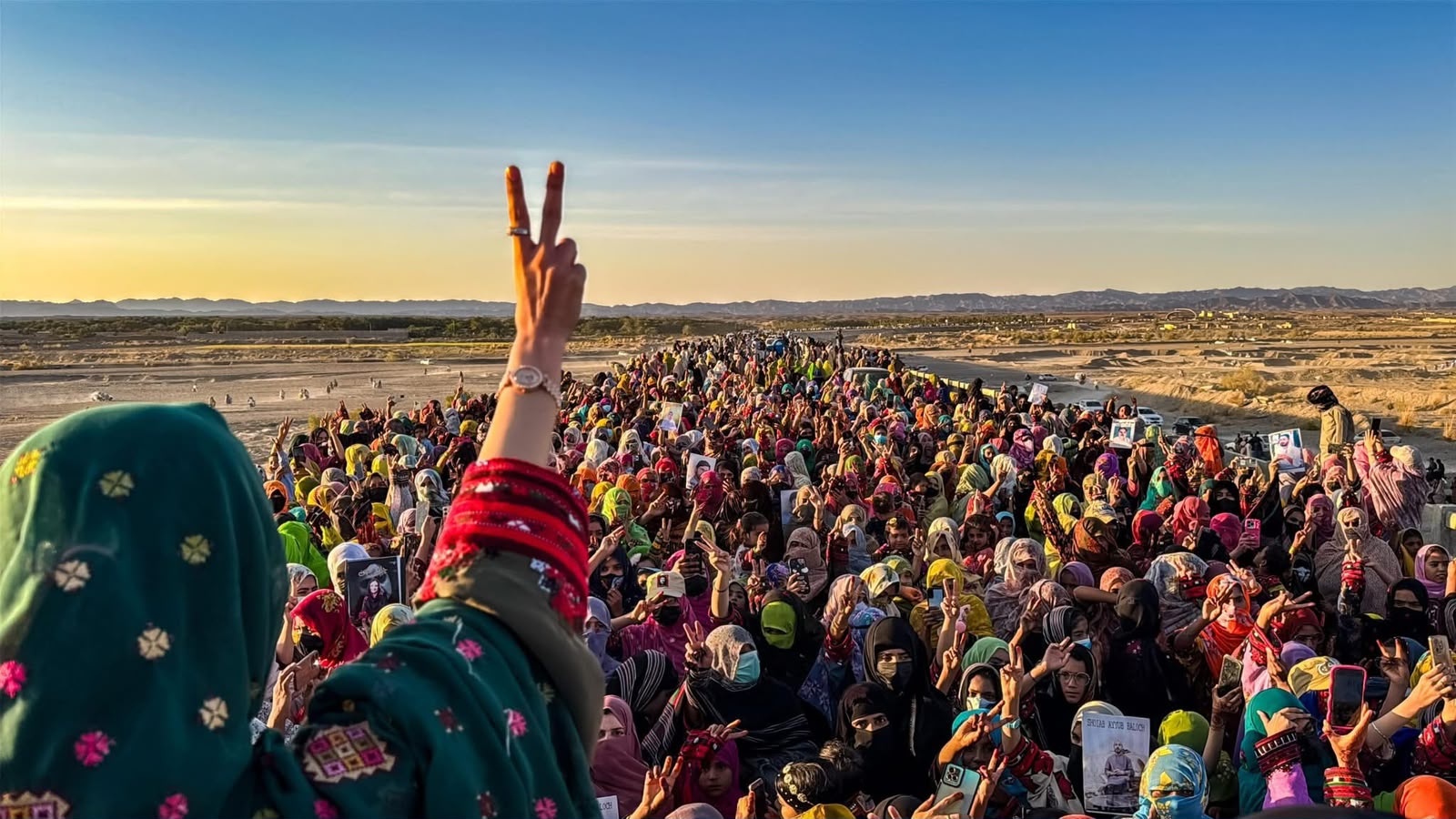
Adeeba Baloch holds a victory sign before the crowd protesting for the release of BYC leaders in Panjgur, March 2025. Photo: BYC
Sayad Bibi Shareef spent the night with her two sons at her late husband’s grave at Shahi Thump graveyard, near Turbat, a city in Balochistan, on July 3 this year.
Shareef was afraid her home would be raided by the Counter Terrorism Department (CTD), an anti-terrorism and intelligence wing in Pakistan, mere hours after she had been released from their detention.
Shareef, an active member of the Baloch Yakjehti Committee (BYC), a rights movement in Balochistan, Pakistan’s insurgency-ridden province, had been detained by the CTD only two days earlier on July 1 and released the night before.
Her arrest wasn’t an isolated incident but a part of the wider crackdown on BYC.
As is the case with several activists who have repeatedly been detained after being released or were required to appear from the CTD weekly, Shareef received a call informing her the agency’s officers were coming to take her for further questioning.
She refused to leave at that hour and told them she would appear the next morning. Her children, she said, were frightened that she would be taken away again. With nowhere to go, Shareef made her way to the graveyard with her kids.
When she returned home the following morning, neighbours told her that CTD and the police had raided her house three times during the night.
Speaking at a press conference in Turbat on the morning of July 3, Shareef said she had already been appearing before the CTD every week for nearly a year. She was later detained under the Maintenance of Public Order – a colonial-era law under which the government can detain individuals without a formal trial if perceived as a threat to public safety or peace. BYC’s leadership including Mahrang Baloch and Sibghatullah Shah G were detained under the same law in March 2025 and sentenced to life imprisonment in June 2026.
Shareef was released on August 31. During detention, she was pressured to hold a press conference announcing her withdrawal from BYC, which she refused, she told the Polis Project.
Reportedly, she had been threatened that her children would be placed on the Fourth Schedule, a legal watch list under Pakistan’s Anti-Terrorism Act, which carries restrictions on movement and other activities. Shareef responded to the threats with a three-day hunger strike, even refusing water.
“I used to take sleeping pills, but still couldn’t manage to sleep. In those times, I could only write on the jail walls, and then the jailer, during his visits, would shout at me and wash them away,” she said.
After her release, Shareef said she continued to struggle with health problems that began in jail.
But for her and her family, the ordeal didn’t start with her detention. Shareef’s brother, Muhammad Haneef Shareef, a renowned Baloch writer and filmmaker, was picked up by Pakistani authorities in 2005. He was a student activist and a member of Balochistan Student Organization (BSO).
Shareef campaigned for her brother’s release then, at a time when few Baloch women took to the streets and held sit-in protests. After nine months of disappearance, he was released and he sought and found asylum abroad.
Shareef joined the Baloch Yakhjeti Movement (BYC), a grassroots movement led by Baloch women demanding answers about missing persons, extrajudicial killings, and the rights of the Baloch.
She is still placed on the Fourth Schedule and has to appear before the CTD every Monday. The CTD also threatened her brother that she should not use her phone or contact anyone from BYC or continue her activism.
Her story reflects a concern increasingly raised by families and activists in the province: that those who began by searching for forcedly disappeared people are now finding themselves navigating criminal cases, restrictions, and court proceedings of their own.
A Movement around Unanswered Questions
Led prominently by young Baloch women, BYC transformed the issue of missing persons from individual family tragedies into a wider political movement.
Salman Hussain, a professor of anthropology at York University, said this “connectedness to people who are direct victims,” is the strength of movements like BYC. “And if victimhood is the ground on which this is going to, where it attracts support, broader support from people, or broader sympathy, and then it’s translated into broader grievances about self rule, about resources, you know, rights, whatever. But its starting point is that connectedness. Connectedness.”
Balochistan, Pakistan’s largest but least populated province, has faced decades of conflict between separatist groups and the state over political autonomy, resources and representation.
The insurgency has continued alongside long-standing complaints among Baloch communities about political and economic marginalization, despite the province’s significant natural resources.
Alongside the security conflict, rights groups and international observers have documented allegations of enforced disappearances in the province for years.
For decades, families of missing persons in Balochistan have gathered outside government offices, courts, press clubs and roads carrying photographs of missing relatives and demanding answers.
Many say their first attempts were not protests. They were applications. They went to police stations for FIRs. They approached the courts. They appeared before government commissions.
Police Stations to Courtrooms
Saira Baloch’s brother, Asif, and cousin, Rasheed, were picked up in 2018 along with eight other friends from a picnic spot in Nushki, Balochistan, without a warrant. According to her, everyone except Asif and Rasheed were released.
Saira, then a teenager, started leading efforts for the release of her brother and cousin, accompanying her mother to the police station in Khuzdar. She says the police refused to register a case.
“The officer told us that no case would be registered against state institutions,” she said. The family returned home without an FIR. For the next two and a half years, they waited for news.
None came.
In 2021, Saira approached the Balochistan High Court and a joint investigation team, formed by a government-appointed commission investigating the disappearances. She hoped the legal system would provide answers that the police had not.
“The court would hear me and pass orders that law enforcement agencies should appear before court,” she said. “But that has never happened.”
As formal channels failed to provide information about her brothers, Saira joined other families searching for missing relatives. She participated in demonstrations in Khuzdar, Quetta and Islamabad, including the long march organized by the BYC in 2023.
But years after beginning her search, Saira found herself appearing before courts not as someone seeking justice, but as someone defending herself.
In 2024, Saira was named in an FIR connected to a protest in Khuzdar. She denied participating in the demonstration. Since then, she said, at least six more FIRs have been registered against her.
“And I believe there are more cases that I do not even know about,” she said.
An arrest warrant was issued against her on April 23, 2024. She is currently on bail and continues to appear before courts.
The legal proceedings have changed the direction of her life. Saira, now 24, recently completed her high school studies and hoped to continue her education at a university. Instead, she said she spent her time travelling between cities for hearings, divided between her own court appearances and searching for her brothers.
“Sometimes two or three times a month, I travel from Quetta to Khuzdar just to prove my innocence in court,” she said. Her name has also been placed on the Fourth Schedule, she added.
For families like hers, the imprisonment of Mahrang Baloch and Sibghatullah Shah has deepened existing fears.
“They only protested with families like ours,” she said. “They [authorities] wanted to discourage us.”
Saira’s experience is not isolated.
Other families the Polis Project interviewed described similar journeys: a missing relative, attempts to seek help from authorities, participation in protests, and eventually legal cases connected to activism.
Sadia Baloch said her brother Salman was forcibly disappeared by CTD personnel from Quetta’s Hazarganji area in 2022.Since then, she has participated in protests demanding his recovery.
She said an FIR was registered against her this year after families of missing persons organized an Eid rally in Khuzdar.
“When we raise our voice for our loved ones, we are threatened, arrested or booked in FIRs,” she said.
For Sadia, the sentencing of BYC leaders carries a message beyond the courtroom.
“Mahrang was a strong voice for us,” she said. “Her struggle gave families courage.”
Adeeba Baloch’s father, Zaheer Baloch, was picked up while travelling near Hub Chowki, a city in Balochistan near Karachi, in 2015.
For years she waited for answers and made unsuccessful attempts to register a police case and eventually took to the streets – joining protests, including the BYC’s long march to Islamabad in 2023.
In March 2025, a case was registered against Adeeba for protesting in her hometown Panjgur. Two months later, she experienced another loss – her younger brother Zeeshan was taken on June 29, only a day after her wedding.
His body was found the next morning. In May 2026, she alleged that her husband, Toheed, and his brother were also forcibly disappeared.
She said she was pressured to hold a press conference announcing that she would no longer participate in protests. After the press conference, she said, both men were released.
Similarly Hakmeen, a high school student from Kharan, faces three FIRs after protesting the disappearance of her brother Raheem-ul-Din, who has been missing since 2016. She says her family spent years waiting for his return.
Her father died in February 2025 without seeing his son again. During his final illness, she says, he told the family that if Raheem was not recovered, they should use his own death as a final appeal for justice.
After his death, the family placed his body on the road in protest, demanding answers about Raheem-ul-Din’s disappearance.
The crackdown against BYC has taken many shapes – from life imprisonment of the leadership to threatening members and victim families with a similar fate if they continue their activism.
“The motive behind the crackdown on the BYC is clear to us. The state does not want a peaceful struggle; it wants bloodshed, continued disappearances and the dumping of mutilated bodies, along with airstrikes and drone attacks,” said Sabiha Baloch, a central leader of the Baloch Yakjehti Committee (BYC).
She said the BYC had given people hope that they could do something for their missing family members — that they could organise and struggle for them. “But the state has strangled that peaceful struggle through legal battles, Fourth Schedule cases and FIRs. This has further disheartened people from pursuing peaceful forms of resistance.”
Lack of Accountability and Number Games
Pakistan’s Commission of Inquiry on Enforced Disappearances (COIED) has reported thousands of cases since its establishment in 2011. The commission says it has received 10,636 cases of alleged enforced disappearances between March 2011 and September 2025, of which 8,986 cases had been disposed of, often without thorough investigation, and 1,650 remained under investigation. In Balochistan, COIED claims it has received 2,752 cases, of which 2,284 have been disposed of or officially closed.
Rights groups monitoring Balochistan have reported significantly higher figures than the official numbers. The Human Rights Council of Balochistan (HRCB), which documents cases through families, local networks and public reporting, reported 1,482 alleged enforced disappearances and 598 killings in 2025 alone. Moreover, Paank, the human rights wing of Balochistan National Movement, a political organization campaigning for independence and rights of Baloch people, documented 556 enforced disappearances and 227 extrajudicial and custodial killings in Balochistan during the first half of 2026.
Pakistani politicians have often downplayed the issue. They have claimed that the numbers of enforced disappearances in the province are too few, and have also claimed, without evidence, that those missing have joined the insurgency.
The Human Rights Commission of Pakistan (HRCP) has also raised concerns about continued enforced disappearances, restrictions on civic space, and the shrinking space for political activity in Balochistan.
Exhausted by legal channels that failed to provide answers, many families joined public demonstrations.
The Baloch Yakjehti Committee (BYC) emerged in 2020 as a leading voice demanding accountability over enforced disappearances and human rights violations.
The movement gained prominence through large protests, including the 2023 long march from Balochistan to Islamabad.
At the centre of this movement was Mahrang Baloch.
A doctor turned rights activist, Baloch became one of the most recognized faces of Balochistan’s rights movement. She was nominated for the Nobel Peace Prize, included among the BBC’s 100 Women in 2024, and recognised as a TIME100 Next leader.
But on June 22 this year, an anti-terrorism court in Quetta sentenced Mahrang Baloch and BYC leader Sibghatullah Shah G to life imprisonment in connection with the death of Shabbir Ahmed, a Frontier Corps soldier, during a BYC gathering in Gwadar in 2024.
The authorities claimed that the case concerned violence against a state official, not political dissent. A security official alleged that Baloch was giving a “very provocative speech” during the protest in Gwadar, resulting in 30 to 40 people striking the paramilitary soldiers’ vehicles with sticks and stones, which resulted in Ahmed’s death.
Critics, on the other hand, claimed the sentencing of BYC leaders was an attack on dissent in Balochistan.
“BYC has become very much a political force,” said Hussain.
“[It] disturbs not only that colonial logic of rule, but also from the state’s perspective, BYC is not only a short-term problem, but a long-term issue, where it’s challenging and destabilizing those established structures of rule in Balochistan,” said Hussain.
BYC members and rights organisations, however, argued that the conviction represented a broader pattern in which activists demanding accountability for disappearances were increasingly being pushed into criminal proceedings.
The conviction raised a question that families of missing persons have been asking in different forms for years: What happens when those demanding answers become accused themselves?
“The state does not want a peaceful struggle”
Sabiha Baloch said the crackdown on BYC had left people disillusioned and alleged that the state was closing off peaceful avenues of protest.
“Families who had lost faith in courts and commissions had hoped that peaceful protests could help bring their loved ones back. But the state has taken away even that right, leaving people completely helpless.”
Across Balochistan, activists say the use of multiple FIRs has created a cycle in which individuals remain occupied with legal proceedings while their original demands — information about missing relatives and accountability for alleged abuses — remain unresolved.
Jadain Dashti, a lawyer representing Mahrang Baloch, told the Polis Project that the cases against BYC leadership reflected broader concerns about the use of criminal law against rights activists.
“More than 20 FIRs had been registered against BYC leaders, creating a prolonged legal burden for activists.”
According to Dashti, the repeated cases were not only about individual allegations but about restricting the ability of activists to organize.
Two months after Mahrang Baloch and Shah G’s life imprisonment, Gulzadi Baloch, a member of BYC, was sentenced to life imprisonment by a court in Quetta.
In 2023, Gulzadi participated in the Baloch Long March to Islamabad, the Pakistani capital. The March rose BYC to prominence as the grassroots movement in Balochistan mobilizing and campaigning for rights. When more than a couple of dozen Baloch women were arrested and attempted to be “deported” to Balochistan, Gulzadi’s words from the bus symbolized the movement.
“We just want our loved ones back – we want nothing else from Pakistan. We just want an end to our genocide, we want nothing else. We do not want gas, we do not want electricity, neither do we want Saindak’s gold, nor we want Gwadar’s deep port. We just want our brothers back, we want the right to live,” Gulzadi Baloch said.