




The canteen was loud when Sunita waved me over. Around us, students carried plates of samosas and jalebis, and tea flowed as the place buzzed with conversation. I had barely sat down when she pushed her phone across the table: “You have to see this!”
A reel was already playing. A major Indian political leader, rendered by AI as a muscular superhero, strode through a warlike landscape. “Living God”, the caption read. The reels had already garnered over 5 million views. We scrolled through thousands of comments—namaste emojis, hearts, and many declarations of devotion.
Then Sunita said, “For me too, he is no less than a God.” She was not joking. What he had done for the country, she told me, made this kind of devotion feel not just natural but justified. The line I had assumed separated religion from politics, having been brought up in a secular democracy, did not exist for her. “Why should politicians representing the interests of the religious majority not be worshipped?” Sunita asked.
Sunita’s question was provocative. And the answer is not a comfortable one. The people on the other side of “the religious majority” are not an abstraction. The majority’s god is everyone else’s State. This situation is what political theorist Alexis de Tocqueville, in his book Democracy in America, described as the tyranny of the majority – a situation where the personal faith of the religious majority becomes like a legally enforced, inescapable law for minority groups.
In contemporary India, where relationships between various religious communities are being shaped by political polarization and divisive anti-minority rhetoric, the category of “majority” cannot be neutral.
To deify and worship a politician as the embodiment of the majority is to lay stakes on who the country belongs to, and whom it merely tolerates: who gets lynched, whose homes are demolished, and who loses citizenship. Amnesty International’s 2025 human rights report on India tries to sum it up: “Religious and ethnic minorities faced escalating persecution, including Muslims targeted through discriminatory laws on marriage. Mass forced evictions of Muslims in Assam state left thousands homeless, and punitive demolitions in Maharashtra and Jammu and Kashmir continued. Rohingyas and Bengali-origin Muslims were unlawfully deported or pushed back, and new immigration rules stripped asylum seekers of protection.”
And there is a second cost to the practice of political deification. A politician can be argued with, voted out, or proven wrong. A god cannot. To make a leader divine is to place him beyond the ordinary, unglamorous right to critique, to say he was wrong, which is essential to democracy. What looks, post after post, like admiration and devotion is also the quiet foreclosing of dissent.
It is noteworthy that alongside the rise of the deification of ruling political figures, India has been sliding on indices tracking global rights and democracies. Varieties of Democracy (V-Dem), which produces the largest global dataset on democracy, has categorized India under “electoral autocracy” since 2017.
Back in 1949, Dr B.R. Ambedkar addressed political deification in his concluding remarks to the Constituent Assembly: “… in India, Bhakti or what may be called the path of devotion or hero-worship, plays a part in its politics unequaled in magnitude by the part it plays in the politics of any other country in the world. Bhakti in religion may be a road to the salvation of the soul. But in politics, Bhakti or hero-worship is a sure road to degradation and to eventual dictatorship.”
I had been seeing an array of mythmaking and hero-worshipping videos appear in my social media feed for weeks: short AI-generated clips, mostly featuring popular Indian politicians as gods, warriors, and superheroes, many of which garnered millions of views. The content of the reels had become ordinary, accepted ideas. In real life, the experience at the canteen was the proof; no one who had glanced at Sunita’s screen looked surprised. These hyper-real videos were what the feed looked like.
A few days later, I met Chandini (name changed), a friend of Sunita’s, at the same university. For this postgraduate student, sharing such reels was a way to publicly declare her opinions. She said she would share the reels on her Instagram stories and then watch who responded — who replied, who liked, and who joined the conversation. The reels worked like a test. Quickly, and without her having to ask, the interactions with the reels revealed who else on campus thought the way she did.
She described it the way you might describe a playlist or a hobby that attracts people with similar interests. For Chandini, reposting a leader-as-god reel was a useful way to find like-minded people. And it worked: one reply to her posts had turned into a conversation, the conversation into a friendship — a classmate she’d grown close to, whose politics and ideology, it turned out, lined up with her own.
“It helps you know who thinks like you,” she announced.
What unsettled me was the ease of it all. She sorted her peers by their devotion to a politician the way someone else might sort them by taste in music. And the devotion was real. The reels, she said, were not telling her anything new; they gave shape to something she had pictured for a long time. “I have often thought that a temple must be built dedicated to him,” she said, referring to Prime Minister Narendra Modi. A temple – for a man currently in office.
Yash was not an influencer. When I found his page, he had fewer than a thousand followers and posted modest videos about Indian society and current affairs. Then, in January this year, he posted a reel of the Prime Minister, Narendra Modi, as a superhero, saving the world from ruin. The text on the reel reads: “When the world is ending, but suddenly you hear this आकाशवाणी (Hindi for voice from the sky). As one reads the text, the viral ‘Angena Gatram’ meme audio plays. The caption proclaims: Lord Modi avatar padhaar rahe hain, which translates to Lord Modi, an incarnation of God, is coming.
While his other reels maxed out in the low thousands. This one crossed 5.8 million views in a matter of days, with more than 450,000 likes, 400,000 shares, and over 5,000 comments. Nothing else he had ever made had gone viral. The leader-as-God reel was proof that this content was profitable.
And he was not alone. The same leader, in the same heroic and divine registers, was pulling comparable numbers across other small accounts– 2.5 million views on one, 1.5 million on another, and several with engagement in the hundreds of thousands, most of them posted within the same few weeks of January.

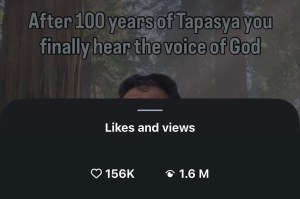

Engagement metrics from three popular reels on Instagram, and the numbers of likes and views those reels received.
The algorithm had taken small creators posting this content and handed them an audience of millions.
When I reached out to Yash over Instagram DM, he spoke on the condition that he would not be named. He talked less about the leader and more about the reach. Visibility, for a creator, confers legitimacy, draws brand deals, and becomes the thing you can turn into a living. The reel had given him all of it at once. He kept dropping a laughing emoji into our chat; when I asked why he used the emoji, he said he still couldn’t believe how well it had done. But whenever I steered toward what the reel actually said — a politician remade as a god — he waved it off. It was “just an edit,” he told me, as if that settled what it meant. Then he’d circle back to the numbers and reach.
Anthropologist Sahana Udupa has spent years mapping the online sphere of Hindu-nationalist users already mobilized to promote and defend this brand of nationalism — a readership primed, in other words, to receive exactly the reels Yash and others were making. In other words, “Internet Hindus” – as an audience — are not waiting to be convinced of any idea; instead, they are waiting to amplify.
The algorithm did not create the appetite for this content; instead, it fed an audience already mobilized to receive it.
The next creator I spoke to is Hari. While Yash had replied in a couple of days, Hari took a week, then left days of silence between messages, each one short and carefully worded. While Yash talked about reach, Hari talked about faith. Like Yash, Hari was also a small-time creator who, at the time, had a little over 2,000 followers. He had also posted a small number of short videos about Indian society and politics. “I see him as God,” he texted. “He has done so much for our country.” Talking about the politician.
For Hari, the reels were a sincere reflection of his belief. He made gods of politicians because he believed they owed it. And yet the rest of it worked exactly as it had for Chandini: posting the content showed him who stood where. From the comments and reposts, he could read his audience, who shared the belief and who did not, and steer toward those who did. Devotion and audience-building were the same act.
Hari’s caution never quite left him. He grew guarded whenever I tried to push the conversation toward religion or politics, or to call Hindutva by name, and the gaps between his replies stretched. When he did reply, though, his fealty to Modi came through: “He has put India on the global map.”
It was the pattern across nearly every creator I tried to speak with. Most never replied at all. The few who did kept their answers short and watched their words — and yet the reels they made said everything they would not. In the end, the hesitation told me as much as the reels did; the reluctance of these creators to share any information with me suggested they were mindful of those consuming their content, and particularly mindful of those asking questions.
What is striking in Prof. Udupa’s account is who does the feeding. This is not only a party machine pushing propaganda from the top down. It is what she calls “enterprise Hindutva” — a decentralized, almost entrepreneurial labor carried out by ordinary users, people who make the content because they believe it, because it finds them an audience, because it pays, or all three at once. Yash and Hari, it turned out, were textbook cases.
Not everyone who shares these reels does so for the same reasons, and not everyone agrees with them. In the comment sections, plenty of users called the reels ridiculous, overblown, and unintentionally funny, and then shared them anyway. They tagged friends, reposted the clips as a joke, and passed them along. This is the deniability Udupa describes, turned into circulation: the homage and the joke move through the same feed, and the algorithm cannot tell them apart. It counts the share either way. And that is the point. A reel does not need to be believed to travel — it only needs to be liked, saved, or shared. The ironic share and the devout one register identically.
What changes is not just any single viewer’s mind but the nature of the feed. A leader-as-god reel that first looks startling, bizarre, or even laughable the first time, seemed commonplace by the hundredth share, not because anyone argued for it, but because it kept appearing. This is close to what Guy Debord meant by the spectacle: a world arranged less around what people believe than around the images that keep moving in front of them. Belief, in the end, is almost beside the point. The images do the work.
As we left the canteen that evening, Sunita opened the reel one more time and scrolled through the comments. New ones surfaced as she watched. The like count ticked up.
“People really believe this,” she said.
She was not talking about the comment section.


‘No Less Than a God’: The Deification of Political Persona in India
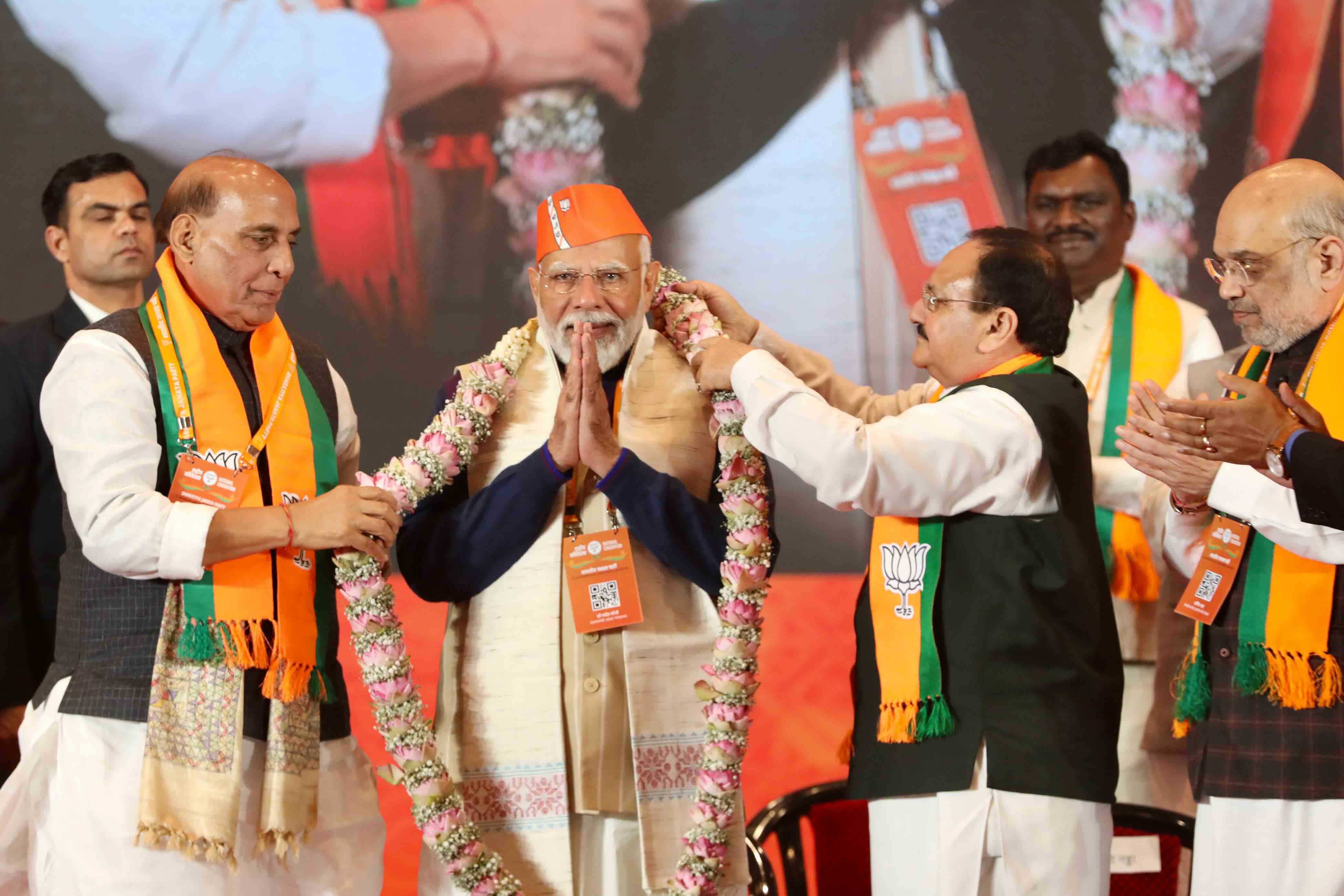
Indian Prime Minister Narendra Modi at the BJP National Convention in New Delhi. Image Credit: Official Website of the BJP
The canteen was loud when Sunita waved me over. Around us, students carried plates of samosas and jalebis, and tea flowed as the place buzzed with conversation. I had barely sat down when she pushed her phone across the table: “You have to see this!”
A reel was already playing. A major Indian political leader, rendered by AI as a muscular superhero, strode through a warlike landscape. “Living God”, the caption read. The reels had already garnered over 5 million views. We scrolled through thousands of comments—namaste emojis, hearts, and many declarations of devotion.
Then Sunita said, “For me too, he is no less than a God.” She was not joking. What he had done for the country, she told me, made this kind of devotion feel not just natural but justified. The line I had assumed separated religion from politics, having been brought up in a secular democracy, did not exist for her. “Why should politicians representing the interests of the religious majority not be worshipped?” Sunita asked.
Sunita’s question was provocative. And the answer is not a comfortable one. The people on the other side of “the religious majority” are not an abstraction. The majority’s god is everyone else’s State. This situation is what political theorist Alexis de Tocqueville, in his book Democracy in America, described as the tyranny of the majority – a situation where the personal faith of the religious majority becomes like a legally enforced, inescapable law for minority groups.
In contemporary India, where relationships between various religious communities are being shaped by political polarization and divisive anti-minority rhetoric, the category of “majority” cannot be neutral.
To deify and worship a politician as the embodiment of the majority is to lay stakes on who the country belongs to, and whom it merely tolerates: who gets lynched, whose homes are demolished, and who loses citizenship. Amnesty International’s 2025 human rights report on India tries to sum it up: “Religious and ethnic minorities faced escalating persecution, including Muslims targeted through discriminatory laws on marriage. Mass forced evictions of Muslims in Assam state left thousands homeless, and punitive demolitions in Maharashtra and Jammu and Kashmir continued. Rohingyas and Bengali-origin Muslims were unlawfully deported or pushed back, and new immigration rules stripped asylum seekers of protection.”
And there is a second cost to the practice of political deification. A politician can be argued with, voted out, or proven wrong. A god cannot. To make a leader divine is to place him beyond the ordinary, unglamorous right to critique, to say he was wrong, which is essential to democracy. What looks, post after post, like admiration and devotion is also the quiet foreclosing of dissent.
It is noteworthy that alongside the rise of the deification of ruling political figures, India has been sliding on indices tracking global rights and democracies. Varieties of Democracy (V-Dem), which produces the largest global dataset on democracy, has categorized India under “electoral autocracy” since 2017.
Back in 1949, Dr B.R. Ambedkar addressed political deification in his concluding remarks to the Constituent Assembly: “… in India, Bhakti or what may be called the path of devotion or hero-worship, plays a part in its politics unequaled in magnitude by the part it plays in the politics of any other country in the world. Bhakti in religion may be a road to the salvation of the soul. But in politics, Bhakti or hero-worship is a sure road to degradation and to eventual dictatorship.”
I had been seeing an array of mythmaking and hero-worshipping videos appear in my social media feed for weeks: short AI-generated clips, mostly featuring popular Indian politicians as gods, warriors, and superheroes, many of which garnered millions of views. The content of the reels had become ordinary, accepted ideas. In real life, the experience at the canteen was the proof; no one who had glanced at Sunita’s screen looked surprised. These hyper-real videos were what the feed looked like.
A few days later, I met Chandini (name changed), a friend of Sunita’s, at the same university. For this postgraduate student, sharing such reels was a way to publicly declare her opinions. She said she would share the reels on her Instagram stories and then watch who responded — who replied, who liked, and who joined the conversation. The reels worked like a test. Quickly, and without her having to ask, the interactions with the reels revealed who else on campus thought the way she did.
She described it the way you might describe a playlist or a hobby that attracts people with similar interests. For Chandini, reposting a leader-as-god reel was a useful way to find like-minded people. And it worked: one reply to her posts had turned into a conversation, the conversation into a friendship — a classmate she’d grown close to, whose politics and ideology, it turned out, lined up with her own.
“It helps you know who thinks like you,” she announced.
What unsettled me was the ease of it all. She sorted her peers by their devotion to a politician the way someone else might sort them by taste in music. And the devotion was real. The reels, she said, were not telling her anything new; they gave shape to something she had pictured for a long time. “I have often thought that a temple must be built dedicated to him,” she said, referring to Prime Minister Narendra Modi. A temple – for a man currently in office.
Yash was not an influencer. When I found his page, he had fewer than a thousand followers and posted modest videos about Indian society and current affairs. Then, in January this year, he posted a reel of the Prime Minister, Narendra Modi, as a superhero, saving the world from ruin. The text on the reel reads: “When the world is ending, but suddenly you hear this आकाशवाणी (Hindi for voice from the sky). As one reads the text, the viral ‘Angena Gatram’ meme audio plays. The caption proclaims: Lord Modi avatar padhaar rahe hain, which translates to Lord Modi, an incarnation of God, is coming.
While his other reels maxed out in the low thousands. This one crossed 5.8 million views in a matter of days, with more than 450,000 likes, 400,000 shares, and over 5,000 comments. Nothing else he had ever made had gone viral. The leader-as-God reel was proof that this content was profitable.
And he was not alone. The same leader, in the same heroic and divine registers, was pulling comparable numbers across other small accounts– 2.5 million views on one, 1.5 million on another, and several with engagement in the hundreds of thousands, most of them posted within the same few weeks of January.
Engagement metrics from three popular reels on Instagram, and the numbers of likes and views those reels received.
The algorithm had taken small creators posting this content and handed them an audience of millions.
When I reached out to Yash over Instagram DM, he spoke on the condition that he would not be named. He talked less about the leader and more about the reach. Visibility, for a creator, confers legitimacy, draws brand deals, and becomes the thing you can turn into a living. The reel had given him all of it at once. He kept dropping a laughing emoji into our chat; when I asked why he used the emoji, he said he still couldn’t believe how well it had done. But whenever I steered toward what the reel actually said — a politician remade as a god — he waved it off. It was “just an edit,” he told me, as if that settled what it meant. Then he’d circle back to the numbers and reach.
Anthropologist Sahana Udupa has spent years mapping the online sphere of Hindu-nationalist users already mobilized to promote and defend this brand of nationalism — a readership primed, in other words, to receive exactly the reels Yash and others were making. In other words, “Internet Hindus” – as an audience — are not waiting to be convinced of any idea; instead, they are waiting to amplify.
The algorithm did not create the appetite for this content; instead, it fed an audience already mobilized to receive it.
The next creator I spoke to is Hari. While Yash had replied in a couple of days, Hari took a week, then left days of silence between messages, each one short and carefully worded. While Yash talked about reach, Hari talked about faith. Like Yash, Hari was also a small-time creator who, at the time, had a little over 2,000 followers. He had also posted a small number of short videos about Indian society and politics. “I see him as God,” he texted. “He has done so much for our country.” Talking about the politician.
For Hari, the reels were a sincere reflection of his belief. He made gods of politicians because he believed they owed it. And yet the rest of it worked exactly as it had for Chandini: posting the content showed him who stood where. From the comments and reposts, he could read his audience, who shared the belief and who did not, and steer toward those who did. Devotion and audience-building were the same act.
Hari’s caution never quite left him. He grew guarded whenever I tried to push the conversation toward religion or politics, or to call Hindutva by name, and the gaps between his replies stretched. When he did reply, though, his fealty to Modi came through: “He has put India on the global map.”
It was the pattern across nearly every creator I tried to speak with. Most never replied at all. The few who did kept their answers short and watched their words — and yet the reels they made said everything they would not. In the end, the hesitation told me as much as the reels did; the reluctance of these creators to share any information with me suggested they were mindful of those consuming their content, and particularly mindful of those asking questions.
What is striking in Prof. Udupa’s account is who does the feeding. This is not only a party machine pushing propaganda from the top down. It is what she calls “enterprise Hindutva” — a decentralized, almost entrepreneurial labor carried out by ordinary users, people who make the content because they believe it, because it finds them an audience, because it pays, or all three at once. Yash and Hari, it turned out, were textbook cases.
Not everyone who shares these reels does so for the same reasons, and not everyone agrees with them. In the comment sections, plenty of users called the reels ridiculous, overblown, and unintentionally funny, and then shared them anyway. They tagged friends, reposted the clips as a joke, and passed them along. This is the deniability Udupa describes, turned into circulation: the homage and the joke move through the same feed, and the algorithm cannot tell them apart. It counts the share either way. And that is the point. A reel does not need to be believed to travel — it only needs to be liked, saved, or shared. The ironic share and the devout one register identically.
What changes is not just any single viewer’s mind but the nature of the feed. A leader-as-god reel that first looks startling, bizarre, or even laughable the first time, seemed commonplace by the hundredth share, not because anyone argued for it, but because it kept appearing. This is close to what Guy Debord meant by the spectacle: a world arranged less around what people believe than around the images that keep moving in front of them. Belief, in the end, is almost beside the point. The images do the work.
As we left the canteen that evening, Sunita opened the reel one more time and scrolled through the comments. New ones surfaced as she watched. The like count ticked up.
“People really believe this,” she said.
She was not talking about the comment section.