




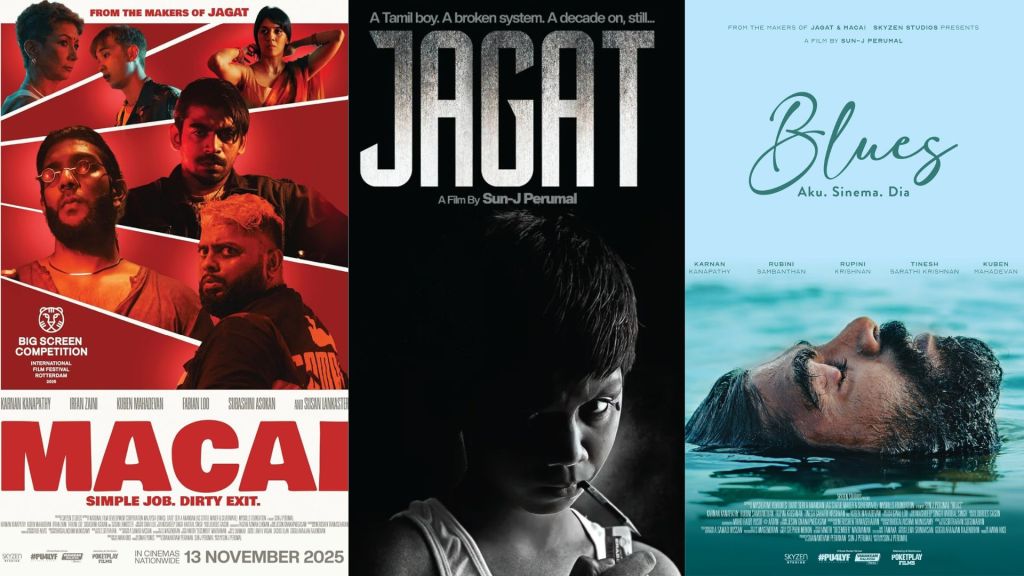
“It’s suffocating. I am afraid I will drown.” These words are achingly uttered by Karthi, the protagonist of Shanjey “Sun-J” Kumar Perumal’s 2024 film, Blues. Karthi, a Malaysian Tamil man, lies in the abyss of the ocean. The chaos of Kuala Lumpur empties his body of his soul. In the solace of his room, he writes his thoughts on paper, only for his agitated fingers to tear up his words.
In another scene, these same bruised fingers tremble during a film shoot under the scorching sun as they desperately grip the sound equipment, trying to catch the enthusiastic voices of Malaysian Tamil actors mimicking alien Kollywood dialogues on a local film set.
Through the emotional dictations of its protagonist, Karthi, the film expresses the agonizing isolations Tamils experience when they immerse themselves in the pursuit of art, in a racial-capitalist nation that exists to cannibalize their souls. In lucid poetics, Blues bleeds into film certain axioms of Sun-J’s own being, and the materiality that birthed him.
For the character Karthi, Sun-J draws upon his own isolating journey in creating his first feature film Jagat.
Released over a decade ago, Jagat (2015) captured a new film consciousness that critically depicted working-class Tamil alienation in neocolonial Malaya (West Malaysia). Centered on a young Tamil boy named Appoy, Jagat explores the displacement of a working-class Tamil family on the outskirts of the capitalist industrialization of 1990s Malaya, delving into the chaos of a post-indentured Tamil society exiled by both British plantation imperialism and Malay neocolonial comprador nationalism.
An augmentation of genres from coming-of-age autobiography to crime drama, the film is a creative genesis in Malaysian Tamil artistic expression that, until then, had largely re-visualized Kollywood orthodoxies. The film piercingly narrates this political annihilation through the inhumane emasculation of Tamil men who drown in the chasm of Malayan lands as exploits of labor, criminality, and addiction.
As Appoy, the eleven-year-old protagonist, is stifled from expressing himself by his overworked manual labouring father, while Appoy’s two uncles, one a former addict and another a budding gangster, all struggle to live as dignified Tamil men in the Malay supremacist capitalist vortex.
Sun-J’s work not only agitated the conventionalism of Malaysian Tamil films but also made history in Malaysian cinema by becoming the first non-Malay language film to win the 28th Malaysian Film Festival for Best Film and Best New Director in 2016. Jagat had initially been disqualified from those categories because it was not in Malay, the national language of Malaysia. It was only after much backlash from Malaysian film workers and the public that the film was renominated, subsequently winning, and challenging the festival’s Malay ethnocentrism and the identity of Malaysian cinema itself.
Despite its award-winning status, the Malaysian Tamil community’s ambivalence towards Jagat was reflected in the low box office turnout, making the film a sleeper hit. Having long been devoured by the aesthetics of Kollywood, Jagat, which expressed the realism of Tamil existence in Malaya through a film language that wasn’t dictated by commercial Kollywood hero-centricism, romantic cliches, fast-paced editing, and simplified resolutions, was not easily accepted by them.
Ironically, certain sections of Malay and Chinese audiences celebrated the film more than their Tamil counterparts. “Even when I want to dedicate myself to making films for this community, this community doesn’t want to watch those films,” expressed Sun-J. “So what identity am I even going to show them?”
Expressing the post-indentured lives of displaced Tamil proletariats, a history of cyclical exploitation, needed Jagat’s grammar to adapt to the dialecticisms of landlessness, becoming liminal instead of conclusive, refusing to yield to fabricated emancipation for viewer satisfaction, because just as the characters of the films, till this very moment, the Tamil proletariat suffers in imperial hell.
The abandonment of his film by his community afflicted, angered, and alienated Sun-J. He emerged from five years of angst, as it neither served him nor his art. “I have forgiven myself.”
Through his internal journey of forgiveness, Sun-J has emerged with two new feature films—Blues, initially titled Neer Mel Neruppu (Fire on Water), and Macai—which he perceives as the spiritual successors of Jagat. Both films are a continued speculative lyricism on the alienated Tamil man and the paths into which Malaysian neocolonialism incarcerates him: Blues expresses the lonely struggles of an independent filmmaker, while Macai articulates the life of a drug mule forced into criminality. The films premiered at the Rotterdam Film Festival of 2023 and 2024, respectively.
Just as Sun-J has endured an emotional and creative transformation since Jagat, the Malaysian Tamil film industry and Malaysian cinema as a whole have gone through their own metamorphosis, emerging into a significantly different world from the one Jagat was born into. In 2024, Blues had its unofficial Malaysian premiere at the 2nd Kota Bharu Film Festival, in the state of Kelantan, where cinema theaters face strict control under state-mandated sharia, to an audience of less than a hundred people who welcomed Sun-J’s fresh meta perspective on filmmaking.
Yet when Blues and Macai were officially released in theaters, just like Jagat, they received a lukewarm welcome from the larger Malaysian Tamil audience, while gaining critical praise from the Malaysian film scene. Macai had even recently received five nominations at the 11th Kuala Lumpur Film Critics Awards, winning Best Film and Best Cinematography.
Childhood and Tamil Cinema
“There is no visual grammar for how people came from Tamil Nadu to Malaysia,” said Sun-J. It was a few days before Deepavali last year, as we sat across from one another on his apartment rooftop, overlooking the light-polluted nausea of Kuala Lumpur’s nightscape.
Shanjey “Sun-J” Kumar Perumal was born in 1980 in Parit Buntar, Perak, West Malaysia, where he lived in a small rented house by the river, on the outskirts of the town. His childhood home led the way to the rubber estates where most Malaysian Tamils had lived and worked for nearly two centuries.
A descendant of Tamil indentured labourers, Sun-J’s ancestors were among the many Tamil workers forcefully brought to colonial Malaya from Tamil Nadu by British imperialists in the 19th century. Exploiting Tamil Nadu’s caste-feudal structure, the British extracted and exiled hundreds of thousands of Dalit bonded labourers and other oppressed class members to work in their plantations across their many colonies around the world.
Sun-J’s childhood in the 80s and 90s was defined by Prime Minister Mahathir Mohamad’s authoritarian, neoliberal development of neocolonial Malaysia. As rubber plantations were destroyed for more lucrative capital investments, Tamil plantation workers—now rendered irrelevant to capitalist goals—were violently displaced to urban areas.
Today, Malaysian Tamils, both indentured and non-indentured descent, account for about 7% of the total Malaysian population, with a vast majority of them politically alienated by the neocolonial government that buries them deep beneath inescapable poverty. In this cyclical landlessness, Sun-J’s maternal family rooted themselves in the Val d’Or Estate in Penang’s Seberang Perai, while his paternal family rooted themselves in Parit Buntar for nearly four generations.
Despite living outside the estates, Sun-J formed strong friendships with the children of the plantations of Penang and Perak, who taught him about the realities of the plantation. From ages five to eight, his family and he had lived in a squatter area in Jalan Abdul Raof. His father would later buy a landed house in Taman Kerian, a working-class suburb that was surrounded by factories.
The atmosphere of the industrial area was, to Sun-J, a demonic entity that haunted his psyche and galvanised the softness of his father into steel. Malaysian racial segregation expressed itself through the housing plan. The first five of ten rows of houses were full of Malays; the sixth row, where Sun-J’s family lived, was balanced with Chinese, Malays, and Tamils; and the subsequent rows gradually increased in the number of Tamil residents, with the 10th row full of Tamils.
Sun-J and his friends often crossed the huge drain in their suburb to reach an uncultivated land beside the KTM station. On it, they built an igloo made of bamboo sticks, placing an avarakkai plant over it as shade. Lying beneath it, away from the wickedness of industrialization, Sun-J found his redemption in the mercy of nature. His reverence for the celestiality of land, despite its brutality, is consciously embedded into each frame of Jagat, through each character’s interaction with the soil of this earth.
“Some have said that I could have made the film dirty, but I say that while my childhood was harsh, the environment was beautiful,” Sun-J stated. “That’s Malaysia’s environment. The environment was a lullaby to me. Poetry of expression is influenced by landscape and lifestyle.”
Sun-J’s father would attend night classes at the same school where he worked as a gardener, coming home to tell his son stories of Hang Tuah, a mythical feudal Malay folk hero who has been refashioned as a national symbol, planting a soft seed within Sun-J to become a storyteller himself. The classes morphed his father into a devoted Malaysian patriot, raising his sons to see themselves not as descendants of immigrants but as sons of this soil.
Yet, the national school Sun-J attended had Malay teachers who despised the mere presence of Tamil children. Slurs like keling (derogatory term to mean “Indians”) and hindu-pariah (low-caste Hindu) were thrown at Sun-J, who, until the age of 26, did not even know that he was of Dalit descent.
In the early 80s, Sun-J, still a small child, was hoisted onto his father’s shoulders as his family walked to the nearest theater to watch Bharathiraja’s Mann Vaasanai (1983). This was his first memory of watching cinema in the theaters. As Sun-J was being introduced to Tamil Nadu cinema, Bharathiraja’s era was introducing Mann Vaasanai (scent of the soil) films—a genre articulating inflated caste-feudal cultural pride of the new landowning castes—to Kollywood.
The 80s Mann Vaasanai films would be succeeded by the highly neoliberalised films of the 90s, which transmutated with the rise of Hindu fascism in India, reflected through the films of Mani Ratnam’s Roja (1992 ) and Shankar’s Gentlemen (1993). Sun-J grew up between these two decades, being a devoted Rajini fan, enamored with the actor’s grit and dark skin, while loving the early days of Vijay’s films and Yuvan’s music, when even the larger public rejected their work.
It is within this contestation between Tamil Nadu’s capitalist development and caste-feudal reorganization that Sun-J, a boy who himself was enduring the chaos of Mahathir’s capitalist industrialization and Malay semi-feudalism, was brought into the world of neocolonial Tamil Nadu cinema.
The presence of Tamil Nadu cinema had long cemented itself in Malaya, entangling both lands, politics, and people, generations before Sun-J.
Kollywood’s Grip over the Malaysian Imaginary, and the Road to Jagat
In 1995, Sun-J attended Club Belia, a community meeting where Murugaiyya—a part-time reporter—warned against the emergence of Astro Vaanavil, a new local channel that would broadcast Indian-Tamil entertainment straight to Malaya. He had alarmed the crowd by saying that Astro would pose great difficulties for communal gatherings.
Astro (All-Asian Satellite Television and Radio Operator), like almost every media entity in Malaysia, is government-controlled, with ruling parties holding large stakes in the broadcaster. Astro domesticated films, negating the distance between the audience and Kollywood.
According to Sun-J, Astro strengthened Kollywood imperialism in Malaya, working against the creation of anything local that would inspire an intellectual society. In a period where Tamil plantation workers were being evicted from the estate they’ve lived on for generations, their television cables were streaming pop-Tamil entertainment to the homes they had little ownership of.
“When I was 5 years old, Kollywood films only played on Thursday and Saturday on TV2,” he recounted. Today, Malaysian Tamils have constant access to not only Kollywood but Tamil Nadu’s popular culture, through Astro, streaming platforms, and social media.
Between 2012 and 2014, after Sun-J had established himself as a filmmaker, he and his industry friends would get together to struggle against Astro, which at the time had 11 channels from Tamil Nadu—and not a single local channel. “We fought for there to be one local channel and for Dr. Rajamani Chellamuthu, a senior vice president of Astro, to be sacked, stating that he had suppressed Malaysian artists. We fought for many years for this, and after a while, Astro called us to speak. They banned all the artists that were with us.”
Sun-J warned Astro then that streaming platforms would hold a monopoly over television, and that the only chance for Astro to survive was to develop local artists. “They didn’t listen, but now they have started to develop local programs. But it’s too late, and the programs are bad.” Most of Astro’s series and tele-movies, like Kalyaanam 2 Kaathal and House Husband, while entertaining, explore the petty bourgeois domestic lifestyles and aspirations of Malaysian Tamils, with shallow aesthetics and hollow narrative inquiry into identity and culture. Astro also notoriously exploits and underpays its crew workers.
The post-1996 Astro generation that grew up under the constant streaming of Kollywood films not only has their media consumption dominated by Indian-Tamil productions but also their distorted sense of identity and expression of it. “They dress like Dhanush, they say machi, soup boy. In those days, Malaysian Tamils had our own slang. Now they speak like Indian Tamils.”
Sun-J studied Communications at Universiti Sains Malaysia, where the uninspiring theoretical education often led him to cut classes and make experimental short films instead. At university, he was introduced to world cinema through Zhang Yimou’s Red Lantern (1991), which deeply enamored him.
But unbeknownst to Sun-J, he had already been bewitched by the director fifteen years before. Sun-J grew up watching highly commercial movies from Kollywood, Hollywood, and Hong Kong. Yet a film that captured his attention as a child was Zhang’s Red Shogun (1987), which played once on TV2. The film, which was about a young boy recounting his grandparents’ love story, evoked in Sun-J speculations of his own grandparents from the plantations: How they may have dressed, how they may have spoken, and how they may have lived. The histories of the Tamil plantation workers were yet to be carved through the language of film.
After graduating, Sun-J joined Nadaswara in 2003, a local production company that created Tamil television programs. Working at a studio that distributed media to state television meant that Sun-J had no creative liberty. Despite Sun-J wanting to create exceptional work, sometimes even putting his own money towards enhancing programs, the production company prioritized mediocrity. In the end, Sun-J began to unconsciously self-censor his work, finally realizing he needed to escape the rigid industry before it consumed him.
Jagat (2011) was Sun-J’s first short film after leaving television, and it expressed everything he had been restricted from exploring—the debauchery of swearing, alcohol, and the realism of working-class Tamil life that state-controlled media censored. It won Best Cinematography at the International Toronto Tamil Film Festival.
Sun-J began developing his feature film Jagat in 2005 and completed it nearly 10 years later, after production had faced many monetary and emotional challenges. Initially written as a black comedy, the story gained a life of its own, overpowering Sun-J as he grappled with its political depth. “I don’t believe in narratives. I’m not a good writer. Even during Jagat, I didn’t know how to write a story, but I learned. Now I am breaking the form of the story and transitioning towards poetry. Blues and Macai have a narrative, but my other films will be more about experience. I am going towards whatever I felt in my childhood.”
Even so, Sun-J wonders whether the younger generations, culturally stagnated by their addiction to Kollywood, would even understand his films. “For Malaysian film culture to occur, I must create a big cultural revolution. I don’t have the will for that.”
Malaysian Tamil Cinema
Bahurudeen’s horror film, Ratha Pei (1968), the first-ever Malaysian Tamil film, was adapted from a popular local stage play and filmed in Chennai. A year later, the state-administered May 13 race riots galvanised Malay supremacy, infusing Malayanisation throughout the federation. Non-Malay aspects of cinema were also replaced by and for the burgeoning Malay bourgeois.
In the midst of Malayanisation, Sugan Pansha’s Naan Oru Malaysian (I Am A Malaysian) (1991), the first-ever Malaysian Tamil film to be shot in Malaya, was created. Pansha’s film heavily adapted Kollywood’s Hindu religiosity, patriarchal chauvinism, and liberal class resolutions, while ignoring the real contradiction between the displacement of Tamil estate workers by the very country the protagonist was patriotic for.
However, 90s Malaysian New Wave films like U-Wei Haji’s Jogho (1997) were keen on introspecting the tension between the Malay state and marginalised Malays; it was these works that influenced Sun-J: “They were creating their own Malay identity, and it gave me the confidence that I could create mine.”
The Malaysian Tamil industry saw a boom with 19 films being theatrically released that decade, most of them in the genres of horror and kitsch comedy films like Gana Pragasam’s Ganavin No. 10. Singgakottai K.L. Gana’s films in particular engaged audiences with his eclectic approach, satirically applying the high melodrama of Kollywood masala films with the everyday lives of Malaysian Tamils. Deepak Kumaran Menon’s Chemman Chaalai (2005) presented a Satyajit Ray-esque interpretation of plantation life.
In the 2010s, including Jagat, 57 local Tamil films were released officially, with Vimala Perumal’s Vedigundu Pasangge (2018) being the highest-grossing, only replaced in 2024 by Karthik Shaamalan’s C4 Cinta. Both Perumal and Shaamalan’s films are perfect amalgamations of Kollywood’s methodological liberalism with Malaysia’s ideological liberalism, creating an obfuscated Tamil reality.
Obfuscation is a national pledge; in the same decade, horror films became incredibly lucrative for Malay cinema till the emergence of hypernationalist films like Mat Kilau (2022), a Malay supremacist distortion of colonial history.
Sun-J believes that alternative filmmaking is necessary to counter the supremacist expressions of Mat Kilau. “Let it happen organically, maybe it’ll happen in 20 years, maybe a Malaysian identity may never arrive.”
Kollywood’s parasitic possession of Tamil society is generational. “Their father would have been an MGR or Shivaji fan; then it was Kamal and Rajini. We have to be a slave to someone,” said Sun-J. This generational curse becomes harder to break with Malaysian Tamil audiences being socially alienated from understanding the political reality of Tamil Nadu, while being incredibly reluctant to watch locally produced Tamil films rooted in their own political reality.
This cultural alienation has festered to the extent that many Malaysian Tamils are showing their political support for Vijay’s TVK, BJP’s B Team in Tamil Nadu. Malaysia’s Vijay Fan Club officially operates as the TVK’s Malaysian IT Wing, aiding in propagating not just TVK but also cementing the RSS’s presence here. Prime Minister Anwar Ibrahim, too, has congratulated Vijay on his victory, while continuously ignoring and igniting ethnic tensions between Malays and Tamils.
Despite the efforts contributed to marketing and distribution, Malaysian Tamil audiences remain unrelenting in their apathy or worse, animosity, towards local films, be they critical or commercial. This was evident in how audiences’ enthusiasm for Simple Manusan, released in February 2025, was sidetracked when the Kollywood film Dragon premiered that same month. Sun-J hypothesises that at least some support can be garnered from older generations, who grew up buying CDs of local films, but the younger generation growing up with streaming services is harder to attract.
To Sun-J, the film industry is not just an economic system but a conscious entity that shapes a society’s culture and intellect. When the world and people around him are so deprived of art, so apathetic towards identity, he wonders how they can even fathom the need for a film industry when their consciousness fears itself so much. “They are all in a dream world, and they are begging not to be removed from that dream world. Thought has become a burden to them,” he said.
In 2022, Sun-J wrote a long apology post on Facebook to Malaysian Tamil artists, asking their forgiveness for his many years of brutal criticism of the Malaysian Tamil film industry. His criticism was mostly rooted in the local films’ overt emphasis on mimicking Kollywood rather than telling the realities of Malaysian Tamils. “Maybe I had unknowingly or knowingly taken on the burden of thinking that I would be the one to change this industry. It’s hurting me, and it’s hurting you, so that’s why I say we have nothing to do with each other,” he stated. After this, he felt freed from the shackles he had bound himself to, his body and mind liberated from being responsible for people who chose to remain loyal to Kollywood, and he could finally devote himself fully to his art.
Macai is a reflection of this total emancipation, in both consciousness and creative praxis, alchemising Sun-J’s metaphysical analysis of the state surveillance Tamil men endure through technicolor aesthetics. As Sun-J ruptures from the mainstream film praxis, many new filmmakers have emerged alongside him, carving their own paths for a native Malaysian Tamil film grammar.
Films like Gogularaajan Rajendran’s upcoming Aararo Ariraro, Ananth Subramaniam’s Bleat (2025), Krityishaa Karunagaran’s Varum Kaalam Vasantha Kaalam (2024), Kavivarman’s Nivaivu (2023), Shobaan and Haren’s Simple Manusan (2025) boldly experiment in style and substance to express Malayan Tamil realities, emotions, and imaginations. This year, Sun-J was the festival director of Naadodi (Nomad) Film Festival, one of Malaysia’s first Tamil transnational film festivals.
Towards Tamilness
Since Sun-J was raised as a Malaysian nationalist, his upbringing created a void between him and his Tamilness. This chasm naturally led him to want to assimilate into Malay culture, giving in to the aggressive Malay Muslim hegemony that the Malaysian government imposes against the various nationalities of this land. It was only after his marriage in 2016 that he started to learn more about the complex roots of Tamilness through the metaphysical and philosophical works of Vallalar, Manickavasagam, and Thiruvalluvar.
Sun-J orients himself towards the emancipation and the absolution of Tamil. He stands free of the national identity of Malaysian, of the ethnic identity of Tamil. To Sun-J, all identities lead to a form of fascism. “We, at the root, have an identity crisis. Are we Tamils? Are we Hindus? Tamils are different, and Hindus are different,” he exclaimed, frustrated at how in Malaysia, basic categories such as ethnicity and religion are muddled, leaving people confused about who they really are. In Tamil Nadu, Ponggal is celebrated as the primary festival of the Tamils, while Deepavali is seen as a peripheral religious holiday for the Hindus. This phenomenon is completely reversed in Malaysia, where Deepavali is a central part of Tamil (Hindu) cultural expression.
Sun-J hates his own name because, like many other Malaysian Tamil Hindu children, he was given a Sanskrit name over a Tamil one, which is why he chose a Tamil name for his son, Arrievan.
Tamil Nadu has figures like Periyar, Barathiyar, and Vallalar, but since no such prolific figures have emerged in the Malaysian Tamil diaspora and because the reactionary politics of this land severs meaningful transnationalism between the diaspora and motherland, the Tamils here remain adrift in alienation, clinging onto fictions, fabrications, and even fascism. But Sun-J refutes this reactionary prison and chooses to emancipate his identity through his cinema, the Tamil language, Vallalar’s spirituality, and Valluvar’s principle of Aram.
Aram was an intrinsic part of Sun-J’s lineage. In the 1970s, His grandfather sacrificed his life to save Chinese schoolchildren during a ferry accident; this had etched in their family the innate need for Aram in human existence. Although the death of his grandfather had left Sun-J’s father, Perumal, to take sole responsibility for his family at the age of twenty-one, Perumal had never once complained about the burden of it all; instead, he chose to raise his sons to revere the sacrificial humanity of their grandfather.
Although Sun-J acknowledges that he cannot be compared to Vallalar, he finds a form of solace in the rebellious nature of Vallalar, who struggled against the Vedas, sastras, caste, and oppression. Sun-J’s rebelliousness found its roots in Vallalar. In many ways, Sun-J’s spirituality has saved him from abandoning his cinema.
Join us
Miriyam Ilavenil is an investigative journalist, editor, researcher and translator. She writes political analysis and cultural criticism centering indentureship, revolutionary movements, counter insurgency, fascism, and imperialism. She is currently the Associate Editor at South Asian Avant-Garde.
Related Posts

Sun-J Perumal and the Making of Malaysian Tamil Cinema
By Miriyam Ilavenil
June 25, 2026

Sun-J Perumal's work not only agitates the conventionalism of Malaysian Tamil films but also made history in Malaysian cinema.
“It’s suffocating. I am afraid I will drown.” These words are achingly uttered by Karthi, the protagonist of Shanjey “Sun-J” Kumar Perumal’s 2024 film, Blues. Karthi, a Malaysian Tamil man, lies in the abyss of the ocean. The chaos of Kuala Lumpur empties his body of his soul. In the solace of his room, he writes his thoughts on paper, only for his agitated fingers to tear up his words.
In another scene, these same bruised fingers tremble during a film shoot under the scorching sun as they desperately grip the sound equipment, trying to catch the enthusiastic voices of Malaysian Tamil actors mimicking alien Kollywood dialogues on a local film set.
Through the emotional dictations of its protagonist, Karthi, the film expresses the agonizing isolations Tamils experience when they immerse themselves in the pursuit of art, in a racial-capitalist nation that exists to cannibalize their souls. In lucid poetics, Blues bleeds into film certain axioms of Sun-J’s own being, and the materiality that birthed him.
For the character Karthi, Sun-J draws upon his own isolating journey in creating his first feature film Jagat.
Released over a decade ago, Jagat (2015) captured a new film consciousness that critically depicted working-class Tamil alienation in neocolonial Malaya (West Malaysia). Centered on a young Tamil boy named Appoy, Jagat explores the displacement of a working-class Tamil family on the outskirts of the capitalist industrialization of 1990s Malaya, delving into the chaos of a post-indentured Tamil society exiled by both British plantation imperialism and Malay neocolonial comprador nationalism.
An augmentation of genres from coming-of-age autobiography to crime drama, the film is a creative genesis in Malaysian Tamil artistic expression that, until then, had largely re-visualized Kollywood orthodoxies. The film piercingly narrates this political annihilation through the inhumane emasculation of Tamil men who drown in the chasm of Malayan lands as exploits of labor, criminality, and addiction.
As Appoy, the eleven-year-old protagonist, is stifled from expressing himself by his overworked manual labouring father, while Appoy’s two uncles, one a former addict and another a budding gangster, all struggle to live as dignified Tamil men in the Malay supremacist capitalist vortex.
Sun-J’s work not only agitated the conventionalism of Malaysian Tamil films but also made history in Malaysian cinema by becoming the first non-Malay language film to win the 28th Malaysian Film Festival for Best Film and Best New Director in 2016. Jagat had initially been disqualified from those categories because it was not in Malay, the national language of Malaysia. It was only after much backlash from Malaysian film workers and the public that the film was renominated, subsequently winning, and challenging the festival’s Malay ethnocentrism and the identity of Malaysian cinema itself.
Despite its award-winning status, the Malaysian Tamil community’s ambivalence towards Jagat was reflected in the low box office turnout, making the film a sleeper hit. Having long been devoured by the aesthetics of Kollywood, Jagat, which expressed the realism of Tamil existence in Malaya through a film language that wasn’t dictated by commercial Kollywood hero-centricism, romantic cliches, fast-paced editing, and simplified resolutions, was not easily accepted by them.
Ironically, certain sections of Malay and Chinese audiences celebrated the film more than their Tamil counterparts. “Even when I want to dedicate myself to making films for this community, this community doesn’t want to watch those films,” expressed Sun-J. “So what identity am I even going to show them?”
Expressing the post-indentured lives of displaced Tamil proletariats, a history of cyclical exploitation, needed Jagat’s grammar to adapt to the dialecticisms of landlessness, becoming liminal instead of conclusive, refusing to yield to fabricated emancipation for viewer satisfaction, because just as the characters of the films, till this very moment, the Tamil proletariat suffers in imperial hell.
The abandonment of his film by his community afflicted, angered, and alienated Sun-J. He emerged from five years of angst, as it neither served him nor his art. “I have forgiven myself.”
Through his internal journey of forgiveness, Sun-J has emerged with two new feature films—Blues, initially titled Neer Mel Neruppu (Fire on Water), and Macai—which he perceives as the spiritual successors of Jagat. Both films are a continued speculative lyricism on the alienated Tamil man and the paths into which Malaysian neocolonialism incarcerates him: Blues expresses the lonely struggles of an independent filmmaker, while Macai articulates the life of a drug mule forced into criminality. The films premiered at the Rotterdam Film Festival of 2023 and 2024, respectively.
Just as Sun-J has endured an emotional and creative transformation since Jagat, the Malaysian Tamil film industry and Malaysian cinema as a whole have gone through their own metamorphosis, emerging into a significantly different world from the one Jagat was born into. In 2024, Blues had its unofficial Malaysian premiere at the 2nd Kota Bharu Film Festival, in the state of Kelantan, where cinema theaters face strict control under state-mandated sharia, to an audience of less than a hundred people who welcomed Sun-J’s fresh meta perspective on filmmaking.
Yet when Blues and Macai were officially released in theaters, just like Jagat, they received a lukewarm welcome from the larger Malaysian Tamil audience, while gaining critical praise from the Malaysian film scene. Macai had even recently received five nominations at the 11th Kuala Lumpur Film Critics Awards, winning Best Film and Best Cinematography.
Childhood and Tamil Cinema
“There is no visual grammar for how people came from Tamil Nadu to Malaysia,” said Sun-J. It was a few days before Deepavali last year, as we sat across from one another on his apartment rooftop, overlooking the light-polluted nausea of Kuala Lumpur’s nightscape.
Shanjey “Sun-J” Kumar Perumal was born in 1980 in Parit Buntar, Perak, West Malaysia, where he lived in a small rented house by the river, on the outskirts of the town. His childhood home led the way to the rubber estates where most Malaysian Tamils had lived and worked for nearly two centuries.
A descendant of Tamil indentured labourers, Sun-J’s ancestors were among the many Tamil workers forcefully brought to colonial Malaya from Tamil Nadu by British imperialists in the 19th century. Exploiting Tamil Nadu’s caste-feudal structure, the British extracted and exiled hundreds of thousands of Dalit bonded labourers and other oppressed class members to work in their plantations across their many colonies around the world.
Sun-J’s childhood in the 80s and 90s was defined by Prime Minister Mahathir Mohamad’s authoritarian, neoliberal development of neocolonial Malaysia. As rubber plantations were destroyed for more lucrative capital investments, Tamil plantation workers—now rendered irrelevant to capitalist goals—were violently displaced to urban areas.
Today, Malaysian Tamils, both indentured and non-indentured descent, account for about 7% of the total Malaysian population, with a vast majority of them politically alienated by the neocolonial government that buries them deep beneath inescapable poverty. In this cyclical landlessness, Sun-J’s maternal family rooted themselves in the Val d’Or Estate in Penang’s Seberang Perai, while his paternal family rooted themselves in Parit Buntar for nearly four generations.
Despite living outside the estates, Sun-J formed strong friendships with the children of the plantations of Penang and Perak, who taught him about the realities of the plantation. From ages five to eight, his family and he had lived in a squatter area in Jalan Abdul Raof. His father would later buy a landed house in Taman Kerian, a working-class suburb that was surrounded by factories.
The atmosphere of the industrial area was, to Sun-J, a demonic entity that haunted his psyche and galvanised the softness of his father into steel. Malaysian racial segregation expressed itself through the housing plan. The first five of ten rows of houses were full of Malays; the sixth row, where Sun-J’s family lived, was balanced with Chinese, Malays, and Tamils; and the subsequent rows gradually increased in the number of Tamil residents, with the 10th row full of Tamils.
Sun-J and his friends often crossed the huge drain in their suburb to reach an uncultivated land beside the KTM station. On it, they built an igloo made of bamboo sticks, placing an avarakkai plant over it as shade. Lying beneath it, away from the wickedness of industrialization, Sun-J found his redemption in the mercy of nature. His reverence for the celestiality of land, despite its brutality, is consciously embedded into each frame of Jagat, through each character’s interaction with the soil of this earth.
“Some have said that I could have made the film dirty, but I say that while my childhood was harsh, the environment was beautiful,” Sun-J stated. “That’s Malaysia’s environment. The environment was a lullaby to me. Poetry of expression is influenced by landscape and lifestyle.”
Sun-J’s father would attend night classes at the same school where he worked as a gardener, coming home to tell his son stories of Hang Tuah, a mythical feudal Malay folk hero who has been refashioned as a national symbol, planting a soft seed within Sun-J to become a storyteller himself. The classes morphed his father into a devoted Malaysian patriot, raising his sons to see themselves not as descendants of immigrants but as sons of this soil.
Yet, the national school Sun-J attended had Malay teachers who despised the mere presence of Tamil children. Slurs like keling (derogatory term to mean “Indians”) and hindu-pariah (low-caste Hindu) were thrown at Sun-J, who, until the age of 26, did not even know that he was of Dalit descent.
In the early 80s, Sun-J, still a small child, was hoisted onto his father’s shoulders as his family walked to the nearest theater to watch Bharathiraja’s Mann Vaasanai (1983). This was his first memory of watching cinema in the theaters. As Sun-J was being introduced to Tamil Nadu cinema, Bharathiraja’s era was introducing Mann Vaasanai (scent of the soil) films—a genre articulating inflated caste-feudal cultural pride of the new landowning castes—to Kollywood.
The 80s Mann Vaasanai films would be succeeded by the highly neoliberalised films of the 90s, which transmutated with the rise of Hindu fascism in India, reflected through the films of Mani Ratnam’s Roja (1992 ) and Shankar’s Gentlemen (1993). Sun-J grew up between these two decades, being a devoted Rajini fan, enamored with the actor’s grit and dark skin, while loving the early days of Vijay’s films and Yuvan’s music, when even the larger public rejected their work.
It is within this contestation between Tamil Nadu’s capitalist development and caste-feudal reorganization that Sun-J, a boy who himself was enduring the chaos of Mahathir’s capitalist industrialization and Malay semi-feudalism, was brought into the world of neocolonial Tamil Nadu cinema.
The presence of Tamil Nadu cinema had long cemented itself in Malaya, entangling both lands, politics, and people, generations before Sun-J.
Kollywood’s Grip over the Malaysian Imaginary, and the Road to Jagat
In 1995, Sun-J attended Club Belia, a community meeting where Murugaiyya—a part-time reporter—warned against the emergence of Astro Vaanavil, a new local channel that would broadcast Indian-Tamil entertainment straight to Malaya. He had alarmed the crowd by saying that Astro would pose great difficulties for communal gatherings.
Astro (All-Asian Satellite Television and Radio Operator), like almost every media entity in Malaysia, is government-controlled, with ruling parties holding large stakes in the broadcaster. Astro domesticated films, negating the distance between the audience and Kollywood.
According to Sun-J, Astro strengthened Kollywood imperialism in Malaya, working against the creation of anything local that would inspire an intellectual society. In a period where Tamil plantation workers were being evicted from the estate they’ve lived on for generations, their television cables were streaming pop-Tamil entertainment to the homes they had little ownership of.
“When I was 5 years old, Kollywood films only played on Thursday and Saturday on TV2,” he recounted. Today, Malaysian Tamils have constant access to not only Kollywood but Tamil Nadu’s popular culture, through Astro, streaming platforms, and social media.
Between 2012 and 2014, after Sun-J had established himself as a filmmaker, he and his industry friends would get together to struggle against Astro, which at the time had 11 channels from Tamil Nadu—and not a single local channel. “We fought for there to be one local channel and for Dr. Rajamani Chellamuthu, a senior vice president of Astro, to be sacked, stating that he had suppressed Malaysian artists. We fought for many years for this, and after a while, Astro called us to speak. They banned all the artists that were with us.”
Sun-J warned Astro then that streaming platforms would hold a monopoly over television, and that the only chance for Astro to survive was to develop local artists. “They didn’t listen, but now they have started to develop local programs. But it’s too late, and the programs are bad.” Most of Astro’s series and tele-movies, like Kalyaanam 2 Kaathal and House Husband, while entertaining, explore the petty bourgeois domestic lifestyles and aspirations of Malaysian Tamils, with shallow aesthetics and hollow narrative inquiry into identity and culture. Astro also notoriously exploits and underpays its crew workers.
The post-1996 Astro generation that grew up under the constant streaming of Kollywood films not only has their media consumption dominated by Indian-Tamil productions but also their distorted sense of identity and expression of it. “They dress like Dhanush, they say machi, soup boy. In those days, Malaysian Tamils had our own slang. Now they speak like Indian Tamils.”
Sun-J studied Communications at Universiti Sains Malaysia, where the uninspiring theoretical education often led him to cut classes and make experimental short films instead. At university, he was introduced to world cinema through Zhang Yimou’s Red Lantern (1991), which deeply enamored him.
But unbeknownst to Sun-J, he had already been bewitched by the director fifteen years before. Sun-J grew up watching highly commercial movies from Kollywood, Hollywood, and Hong Kong. Yet a film that captured his attention as a child was Zhang’s Red Shogun (1987), which played once on TV2. The film, which was about a young boy recounting his grandparents’ love story, evoked in Sun-J speculations of his own grandparents from the plantations: How they may have dressed, how they may have spoken, and how they may have lived. The histories of the Tamil plantation workers were yet to be carved through the language of film.
After graduating, Sun-J joined Nadaswara in 2003, a local production company that created Tamil television programs. Working at a studio that distributed media to state television meant that Sun-J had no creative liberty. Despite Sun-J wanting to create exceptional work, sometimes even putting his own money towards enhancing programs, the production company prioritized mediocrity. In the end, Sun-J began to unconsciously self-censor his work, finally realizing he needed to escape the rigid industry before it consumed him.
Jagat (2011) was Sun-J’s first short film after leaving television, and it expressed everything he had been restricted from exploring—the debauchery of swearing, alcohol, and the realism of working-class Tamil life that state-controlled media censored. It won Best Cinematography at the International Toronto Tamil Film Festival.
Sun-J began developing his feature film Jagat in 2005 and completed it nearly 10 years later, after production had faced many monetary and emotional challenges. Initially written as a black comedy, the story gained a life of its own, overpowering Sun-J as he grappled with its political depth. “I don’t believe in narratives. I’m not a good writer. Even during Jagat, I didn’t know how to write a story, but I learned. Now I am breaking the form of the story and transitioning towards poetry. Blues and Macai have a narrative, but my other films will be more about experience. I am going towards whatever I felt in my childhood.”
Even so, Sun-J wonders whether the younger generations, culturally stagnated by their addiction to Kollywood, would even understand his films. “For Malaysian film culture to occur, I must create a big cultural revolution. I don’t have the will for that.”
Malaysian Tamil Cinema
Bahurudeen’s horror film, Ratha Pei (1968), the first-ever Malaysian Tamil film, was adapted from a popular local stage play and filmed in Chennai. A year later, the state-administered May 13 race riots galvanised Malay supremacy, infusing Malayanisation throughout the federation. Non-Malay aspects of cinema were also replaced by and for the burgeoning Malay bourgeois.
In the midst of Malayanisation, Sugan Pansha’s Naan Oru Malaysian (I Am A Malaysian) (1991), the first-ever Malaysian Tamil film to be shot in Malaya, was created. Pansha’s film heavily adapted Kollywood’s Hindu religiosity, patriarchal chauvinism, and liberal class resolutions, while ignoring the real contradiction between the displacement of Tamil estate workers by the very country the protagonist was patriotic for.
However, 90s Malaysian New Wave films like U-Wei Haji’s Jogho (1997) were keen on introspecting the tension between the Malay state and marginalised Malays; it was these works that influenced Sun-J: “They were creating their own Malay identity, and it gave me the confidence that I could create mine.”
The Malaysian Tamil industry saw a boom with 19 films being theatrically released that decade, most of them in the genres of horror and kitsch comedy films like Gana Pragasam’s Ganavin No. 10. Singgakottai K.L. Gana’s films in particular engaged audiences with his eclectic approach, satirically applying the high melodrama of Kollywood masala films with the everyday lives of Malaysian Tamils. Deepak Kumaran Menon’s Chemman Chaalai (2005) presented a Satyajit Ray-esque interpretation of plantation life.
In the 2010s, including Jagat, 57 local Tamil films were released officially, with Vimala Perumal’s Vedigundu Pasangge (2018) being the highest-grossing, only replaced in 2024 by Karthik Shaamalan’s C4 Cinta. Both Perumal and Shaamalan’s films are perfect amalgamations of Kollywood’s methodological liberalism with Malaysia’s ideological liberalism, creating an obfuscated Tamil reality.
Obfuscation is a national pledge; in the same decade, horror films became incredibly lucrative for Malay cinema till the emergence of hypernationalist films like Mat Kilau (2022), a Malay supremacist distortion of colonial history.
Sun-J believes that alternative filmmaking is necessary to counter the supremacist expressions of Mat Kilau. “Let it happen organically, maybe it’ll happen in 20 years, maybe a Malaysian identity may never arrive.”
Kollywood’s parasitic possession of Tamil society is generational. “Their father would have been an MGR or Shivaji fan; then it was Kamal and Rajini. We have to be a slave to someone,” said Sun-J. This generational curse becomes harder to break with Malaysian Tamil audiences being socially alienated from understanding the political reality of Tamil Nadu, while being incredibly reluctant to watch locally produced Tamil films rooted in their own political reality.
This cultural alienation has festered to the extent that many Malaysian Tamils are showing their political support for Vijay’s TVK, BJP’s B Team in Tamil Nadu. Malaysia’s Vijay Fan Club officially operates as the TVK’s Malaysian IT Wing, aiding in propagating not just TVK but also cementing the RSS’s presence here. Prime Minister Anwar Ibrahim, too, has congratulated Vijay on his victory, while continuously ignoring and igniting ethnic tensions between Malays and Tamils.
Despite the efforts contributed to marketing and distribution, Malaysian Tamil audiences remain unrelenting in their apathy or worse, animosity, towards local films, be they critical or commercial. This was evident in how audiences’ enthusiasm for Simple Manusan, released in February 2025, was sidetracked when the Kollywood film Dragon premiered that same month. Sun-J hypothesises that at least some support can be garnered from older generations, who grew up buying CDs of local films, but the younger generation growing up with streaming services is harder to attract.
To Sun-J, the film industry is not just an economic system but a conscious entity that shapes a society’s culture and intellect. When the world and people around him are so deprived of art, so apathetic towards identity, he wonders how they can even fathom the need for a film industry when their consciousness fears itself so much. “They are all in a dream world, and they are begging not to be removed from that dream world. Thought has become a burden to them,” he said.
In 2022, Sun-J wrote a long apology post on Facebook to Malaysian Tamil artists, asking their forgiveness for his many years of brutal criticism of the Malaysian Tamil film industry. His criticism was mostly rooted in the local films’ overt emphasis on mimicking Kollywood rather than telling the realities of Malaysian Tamils. “Maybe I had unknowingly or knowingly taken on the burden of thinking that I would be the one to change this industry. It’s hurting me, and it’s hurting you, so that’s why I say we have nothing to do with each other,” he stated. After this, he felt freed from the shackles he had bound himself to, his body and mind liberated from being responsible for people who chose to remain loyal to Kollywood, and he could finally devote himself fully to his art.
Macai is a reflection of this total emancipation, in both consciousness and creative praxis, alchemising Sun-J’s metaphysical analysis of the state surveillance Tamil men endure through technicolor aesthetics. As Sun-J ruptures from the mainstream film praxis, many new filmmakers have emerged alongside him, carving their own paths for a native Malaysian Tamil film grammar.
Films like Gogularaajan Rajendran’s upcoming Aararo Ariraro, Ananth Subramaniam’s Bleat (2025), Krityishaa Karunagaran’s Varum Kaalam Vasantha Kaalam (2024), Kavivarman’s Nivaivu (2023), Shobaan and Haren’s Simple Manusan (2025) boldly experiment in style and substance to express Malayan Tamil realities, emotions, and imaginations. This year, Sun-J was the festival director of Naadodi (Nomad) Film Festival, one of Malaysia’s first Tamil transnational film festivals.
Towards Tamilness
Since Sun-J was raised as a Malaysian nationalist, his upbringing created a void between him and his Tamilness. This chasm naturally led him to want to assimilate into Malay culture, giving in to the aggressive Malay Muslim hegemony that the Malaysian government imposes against the various nationalities of this land. It was only after his marriage in 2016 that he started to learn more about the complex roots of Tamilness through the metaphysical and philosophical works of Vallalar, Manickavasagam, and Thiruvalluvar.
Sun-J orients himself towards the emancipation and the absolution of Tamil. He stands free of the national identity of Malaysian, of the ethnic identity of Tamil. To Sun-J, all identities lead to a form of fascism. “We, at the root, have an identity crisis. Are we Tamils? Are we Hindus? Tamils are different, and Hindus are different,” he exclaimed, frustrated at how in Malaysia, basic categories such as ethnicity and religion are muddled, leaving people confused about who they really are. In Tamil Nadu, Ponggal is celebrated as the primary festival of the Tamils, while Deepavali is seen as a peripheral religious holiday for the Hindus. This phenomenon is completely reversed in Malaysia, where Deepavali is a central part of Tamil (Hindu) cultural expression.
Sun-J hates his own name because, like many other Malaysian Tamil Hindu children, he was given a Sanskrit name over a Tamil one, which is why he chose a Tamil name for his son, Arrievan.
Tamil Nadu has figures like Periyar, Barathiyar, and Vallalar, but since no such prolific figures have emerged in the Malaysian Tamil diaspora and because the reactionary politics of this land severs meaningful transnationalism between the diaspora and motherland, the Tamils here remain adrift in alienation, clinging onto fictions, fabrications, and even fascism. But Sun-J refutes this reactionary prison and chooses to emancipate his identity through his cinema, the Tamil language, Vallalar’s spirituality, and Valluvar’s principle of Aram.
Aram was an intrinsic part of Sun-J’s lineage. In the 1970s, His grandfather sacrificed his life to save Chinese schoolchildren during a ferry accident; this had etched in their family the innate need for Aram in human existence. Although the death of his grandfather had left Sun-J’s father, Perumal, to take sole responsibility for his family at the age of twenty-one, Perumal had never once complained about the burden of it all; instead, he chose to raise his sons to revere the sacrificial humanity of their grandfather.
Although Sun-J acknowledges that he cannot be compared to Vallalar, he finds a form of solace in the rebellious nature of Vallalar, who struggled against the Vedas, sastras, caste, and oppression. Sun-J’s rebelliousness found its roots in Vallalar. In many ways, Sun-J’s spirituality has saved him from abandoning his cinema.
SUPPORT US
We like bringing the stories that don’t get told to you. For that, we need your support. However small, we would appreciate it.
Miriyam Ilavenil is an investigative journalist, editor, researcher and translator. She writes political analysis and cultural criticism centering indentureship, revolutionary movements, counter insurgency, fascism, and imperialism. She is currently the Associate Editor at South Asian Avant-Garde.
Related Posts

To Bloom Like Jirhul and Cry “Hool!”: A Profile of Poet Jacinta Kerketta
Varsha Prakash, Arjun Rai Gupta