





It was the onset of the harsh summer month of March in the central Indian state of Chhattisgarh. In the state’s southern region, Bastar, the forest was heavy with the sweet scent of Mahuva flowers. The Gond tribe spent the early mornings here with their families, gathering the fallen Mahuva. But five Gond youth were notably missing— unable to participate in this community activity—as they had been undertrials in a Jagdalpur prison.
On March 10, they were brought for their scheduled ‘peshi’ (appearance) at the Jagdalpur district court. The premises house the National Investigation Agency’s special court, which handles cases related to the banned Maoist party in the Bastar division.
Four young men stood in pairs; one woman was restrained separately, under the watch of a policewoman. These handcuffed Gond youth—first-generation literates who grew up facing forced displacements and state-backed violence—had led peaceful protests for their community rights over the land and forest. Then, the Indian state deployed its most powerful legal machinery against them: stacking multiple criminal cases, invoking anti-terror laws and ultimately deploying the National Investigation Agency to investigate and prosecute them.
The defense lawyers of the incarcerated youth claim that these cases are fabricated.
One of the youth at the Jagdalpur court that March day was 24-year-old Raghu Midiami. He broke into a familiar smile at his lawyer, revealing four broken front teeth. Before the police closed in on them in court, Raghu raised his hand to show his crooked ring finger to the lawyer and quickly whispered that he needed medical attention. “Please inform someone from my family to come and sign the papers [for medical treatment],” he said.
The crooked finger had resulted from a motorcycle accident that also injured his legs and right hand. The police picked Raghu up while he was recovering in his rented room in Dantewada, where he had been attending college since 2024. They accused him of having links with the banned Maoist movement. Since February 2025, Raghu has been lodged in Jagdalpur jail, nearly 140 kilometers from his village in Sukma, making it difficult for his family to visit.

The Bastar region is part of the “red corridor” of the Maoist-led insurgency. It was once a stronghold of the Maoists, who are also known as Naxals, and categorized as Left Wing Extremism (LWE) by the Indian government. It is also one of India’s most militarized regions and is inhabited by indigenous communities.
For the government, Raghu is one of the 2,218 alleged Maoists and their associates that the central home minister said were “arrested and sent to jail” in the government’s final push to make the country “Naxal-free” by March 2026. But in Bastar, Raghu is the young Adivasi leader of the Mulwasi Bachao Manch [Platform to Save the Indigenous People]. This grassroots platform emerged from protests against the rapid spread of paramilitary camps through remote villages inhabited by Adivasis (a collective term for indigenous and tribal communities). Raghu’s arrest, like those of several others who challenged militarization and violation of tribal rights in the region, raises a key question for Bastar: where does counterinsurgency end, and the criminalization of dissent begin?
From Adivasi Leaders to Political Prisoners
The State took notice of Raghu Midiami after protests erupted in Silger village in May 2021 against a paramilitary camp. The agitation catapulted Raghu into prominence as he was leading the Mulwasi Bachao Manch (MBM), a youth platform that had begun mobilizing villagers across the region. The organization was eventually banned. And Raghu, the president of MBM, was accused in eight cases and jailed.
The leaders and members of MBM have been incarcerated for nearly two years, awaiting trials. 
In the Jagdalpur courtroom, alongside Raghu was 26-year-old Dasrath Modiam, known among friends as Dasru. His shoulders were slightly slumped in court as he listened to the lawyer relay news from home: his maternal uncle had died.
“In the past year, four members of my family passed away,” Dasrath said.
He was arrested in December 2024 in two cases registered in Bijapur, accusing him of offenses including rioting, attempted murder, unlawful assembly, illegal possession of arms and ammunition, and causing explosions that endangered life and property. Adivasi villagers commonly refer to these as “Naxali cases”, reflecting the types of criminal charges frequently used against people accused of links with the Maoist insurgency. Thousands of villagers across Bastar have faced similar cases over the years, many of whom were later granted bail or acquitted.
Less than six months after being arrested in the two cases, Dasrath was added as an accused in a case being investigated by the National Investigation Agency (NIA), with charges under the Unlawful Activities (Prevention) Act (UAPA). He and others in the case were accused of being members of a terrorist organization, which is the Maoist party in this case, as well as assisting and raising funds for them. Charges under the UAPA have stringent bail provisions, and civil liberties activists often critique the law for creating situations where prolonged pre-trial detention can itself become the punishment.
Since Dasrath’s arrest, he has lost his mother, an uncle, a grandmother, and now another uncle. He did not get to see any of them for the final time or attend their last rites; his bail plea to attend his mother’s funeral was denied by the court.
Dasrath wanted a good life – to travel around, “perhaps even become a photographer,” he had said with a laugh when this reporter met him in May 2023. He insisted on hanging the camera around his neck as he accompanied me to meet a few protestors.
Now, life is radically different for Dasrath. Court hearings and appeals punctuate his time as an undertrial. “Only two witnesses remain [to be examined] in my Bijapur case,” he said about his trial’s progress. “After that, only the NIA case will remain.”
Then, he added softly, “Please tell my wife to meet me here.”
Standing beside Raghu and Dasrath was 26-year-old Suneeta Pottam, dressed in a neatly pressed blue kurta, hair oiled and neatly plaited.
Only a handful of witnesses remain to be examined in two cases pending against her in Bijapur, she noted to the lawyers, both as a factual statement and as an expression of hope. Of the total 16 cases against her, Suneeta has already been acquitted in 13. But it’s the third pending case—the one being probed by the NIA—that poses a greater challenge.
In addition to stringent bail conditions under the UAPA, the NIA also boasts a high conviction rate. But an investigation by The Wire revealed that these convictions include guilty pleas, which are often extracted from prisoners exhausted from prolonged incarceration with delayed or no trials.
Advocates Arvind Chowdhury and Isha Khandelwal listened carefully to Suneeta at the court. Chowdhury nodded without meeting Suneeta’s eyes; Khandelwal squeezed her hand reassuringly. They were familiar with NIA prosecutions.

30-year-old Gajendra Mandavi said little during the exchange with lawyers, offering only a faint nod to familiar faces. Beside him stood the tallest and youngest among the five, 21-year-old Laxman Kunjam, waiting to hear updates on his bail application pending before the High Court. Both Gajendra and Laxman were arrested on May 25, 2023.
In Bastar, the line between activist and criminal is drawn by the state. For the five young Adivasis from Sukma and Bijapur, that line was crossed when they began organizing tribal villagers to demand their rights. As they languish in Jagdalpur jail under NIA investigation, 37 other youths associated with the MBM are in Sukma, Dantewada, and Bijapur jails under the “Naxali cases”.
Activists and lawyers say that the state police conveniently use trumped-up charges against persons whom they feel are a ‘nuisance’ to the police or administration. While such instances have often been reported before, The Polis Project could not independently assess these cases.
Insurgency in Bastar
The Maoist movement emerged in the resource-rich hinterlands of Adivasi communities across Chhattisgarh, Jharkhand, Odisha, West Bengal, Andhra Pradesh, Madhya Pradesh, and a few other states in the late 20th century. In the Indian government’s words: “Rooted in socio-economic inequalities and fueled by Maoist ideology, LWE has historically affected some of the most remote, underdeveloped, and tribal-dominated regions of the country. The movement has aimed to undermine the Indian state through armed rebellion and parallel governance structures…”
The Maoist movement entered Bastar in the 1980s and gradually drew support from sections of Adivasi communities in North and South Bastar, as well as the Surguja Division of North Chhattisgarh, bordering Jharkhand. Bastar is an economically backward and remote region, covering nearly 40,000 square kilometers of rugged terrain with rich forest cover.
The now-banned Communist Party of India (Maoist), the key actor of the armed insurgency, garnered support by focusing on issues like regional inequality, poor development, and land alienation. While a committee of the Planning Commission had identified these issues in a 2008 report, the state’s anti-Naxal operations—far from addressing the problems— took a stringent ‘law and order’ approach.
The then-Prime Minister, Manmohan Singh, described ‘Naxalism’ as a major ‘internal security threat’. The federal government thus deployed paramilitary forces in Chhattisgarh to fight Maoists. Civilians have been swept up by this broad mandate, and the paramilitary forces and state-backed militias have reportedly committed a range of atrocities and human rights violations.
The state’s counterinsurgency tactics included the establishment of hundreds of paramilitary camps, often located just two to three kilometers apart; large-scale search operations aimed at “flushing out” armed insurgents and their suspected supporters; frequent ambushes and encounters in areas designated “Naxal-sensitive.”
Officials justified these measures as necessary for ‘development’, the first instance of which was the construction of an extensive network of wide roads cutting through villages, forests, and agricultural land. This aggressive ‘development’ came with a human cost, where several civilians, including women and children, were killed and injured in indiscriminate firing by counterinsurgency forces and by unexploded mortar shells left behind after operations. These raised alarm over extralegal killings over the years. Additionally, several villagers were detained on suspicion of having links with insurgents.
In August 2024, the Indian State set March 31, 2026, as the final deadline to “eradicate” the insurgency. Over the two ensuing years, the Maoist movement appeared to be fraying, struggling to consolidate and regroup in the face of an expanding grid of paramilitary camps, sustained mortar fire, and drone strikes. In a press statement of March 30, 2026, the Union Ministry of Home Affairs claimed to have achieved its goal, with hundreds dead and thousands arrested, including Maoist leaders: “Naxal-free India is one of the most historic and important sucessess of the Modi government,” declared the statement.

Brutal Past: Counterinsurgency Operations and Militia Violence
Bastar’s people have experienced prolonged violence, the scars of which are still painfully visible today. Much of this violence unfolded during the period of Salwa Judum — a vigilante movement initiated by the state government and backed by the central government between 2005 and 2007. The phrase ‘Salwa Judum’, translated from the Gondi language, is often described as “purification hunt.” The State portrayed it as a “spontaneous people’s movement against Maoist atrocities”, while civil rights groups and researchers documented extensive abuses during the campaign.
“I spent nearly a year and a half along with my family in the forests near Korcholi to escape violence,” Suneeta said, recalling the days of Salwa Judum. Violence from different sides of the conflict shaped her life.
“I was less than three years old when Salwa Judum started,” said Lakhan Punem, now a 2nd-year undergraduate student at a government college in Dantewada district, about 60 kilometers from his village. “I have heard from my family that they never got to know what happened to my older brother, who was only 17 when the Naga battalion picked him up.” Lakhan added that his brother was picked up while traveling from their village, Kawadgaon in Bijapur, to Bachheli, a town in the nearby Dantewada district. The federal government deployed the Naga Battalion for anti-Naxal operations.
A public interest litigation filed in 2007 in the Supreme Court challenged Salwa Judum, while an accompanying writ petition enlisted cases of arson, rape, and violence against the operations during the period.
According to the writ petition, “…as of January 2007, according to official figures, 47,238 people were living in 20 Salwa Judum ‘relief camps’, or base camps as they were popularly called”. Of the 1,354 villages in Dantewada district, 644 were affected by Salwa Judum. The petition also noted 99 allegations of rape, 500 murders, and 103 cases of arson.
In 2011, the Supreme Court held that Salwa Judum violated the constitutional rights to equality and life with dignity. The court ordered its disbandment and directed action against the perpetrators of violence, arson, and rape. It also prohibited deploying tribal communities as Special Police Officers in counter-insurgency operations. The Supreme Court further directed the Chhattisgarh government to prevent the operation of any group, including Salwa Judum and the Koya Commandos, that sought to take the law into private hands.
However, the state government circumvented the judgment by absorbing the Special Police Officers into a newly created Chhattisgarh Armed Auxiliary Force, essentially legalizing the force under a new name. Salwa Judum, thus outlawed on paper, continued as armed auxiliary forces, District Reserve Guards, and other vigilante groups.
The District Reserve Guard comprised surrendered Maoists or those who had been removed or demoted from the CPI(Maoist) Party due to their conduct. Stealth operations began to take shape, alongside a band of ‘secret police’ (gopniya sainik) created by the District Reserve Guard, to pass information in exchange for money and the promise of a permanent job in the force. While this helped breach the Maoist network, it also opened new fissures within what had once been a tightly knit Adivasi community, setting off a cycle of retaliatory violence. Reports of killings of ‘police informers’ and ‘secret police’ by the Maoists became regular news.
According to official records, 59 ‘gopniya sainiks’ (secret police) and 346 members of the District Force, which also includes the exclusive District Reserve Guard, have been killed by Maoists between 2001 and 2025.
The atrocities against civilians, including rape and sexual assault, continued even after the supposed end of Salwa Judum. For instance, in 2012, paramilitary and police forces killed 17 Adivasis in Sarekeguda village in Bijapur, as per a judicial commission finding.
Suneeta Pottam has been fighting against atrocities against civilians from her village for nearly a decade. In 2015, Suneeta, then 19 years old, was probably the first young Adivasi girl to have filed a petition accusing security forces of extrajudicial killings and rape. She reached as far as Delhi to further appeal to the Supreme Court for protection against threats by the local police against the petitioners.

The Backstory: Fraught Childhood, Affected Education
At the age of eight, Suneeta and many other children had to abandon their studies when the primary schools in their villages were closed down. Around 400 schools were shut down in the conflict-affected parts of Bastar, and education in many interior areas effectively collapsed for nearly two decades after 2005. In several remote villages, schools and anganwadi centers were often the only cement structures, with most homes built of mud and thatch.
Rebel groups began demolishing schools and health centers, alleging that security forces were using them as bases. The chilling effect was profound: even institutions that were never occupied ceased to function, as teachers and staff feared reprisals and attacks.
To revive education, the government started portable cabin schools, known locally as “pota cabin schools”. These served as residential education centers for up to 500 students from classes 6 to 12 under one roof. Far removed from their villages, these schools were located near district headquarters and paramilitary security camps.
Many who became active in Mulwasi Bachao Manch studied in the ‘pota cabin’ schools.
Raghu Midiami studied for a few years at the village primary school and at a nearby residential Ashram school. When Salwa Judum started, he left his village to study at a public school in Bachheli, over 50 kilometers away, where he graduated from high school.
Sunita Tamo, an active member of MBM from Belnar village in Bijapur district, studied up to class 10 at the pota-cabin school in Pusnar, a few kilometers away from home.
“I did not like staying away from home, but what can we do? Our family would tell us to stay on as it was not safe to be in the village,” said Sunita.
“Far removed from the situation in the villages, we were mostly lost among our friends in the residential schools, visiting our home only occasionally during breaks,” said Lakhan Punem, a young member of MBM who joined the organization in the final years of his high school. He is now pursuing an undergraduate degree.
Suneeta Pottam had to abandon her primary schooling when Salwa Judum activists raided her village, forcing the villagers to shift to Judum camps set up in various places. “As kids, we watched our villages being burnt and my uncle being beaten up, as we fled our village,” Suneeta told me during a protest in Burji.
Many from Suneeta’s village—including her family—preferred to stay in the forests. When her family and others returned from their makeshift forest dwellings after a year in 2006, the situation in the region was far from normal. Extrajudicial killings by security personnel were on the rise over the years, she said.
As a team of women activists reached Bastar in 2015 to investigate atrocities against women, Suneeta contacted them for support. With their help, she filed a writ petition in the Chhattisgarh High Court against the extrajudicial killings of six persons in 2016 in the villages of Kadenar, Palnar, Korcholi, and Andri of Bijapur district. “She gave the women in Bastar hope for seeking justice as she marched out, despite risks to her own safety, to petition before the High Court,” recollected Rinchin, an activist from Chhattisgarh and a member of the group Women against Sexual Violence and State Repression (WSS); in 2017, WSS published a book, Bearing Witness, documenting sexual violence in Bastar.
Although not much moved in the court, other than increased harassment of the petitioners, Suneeta continued to raise her concerns through different avenues. She joined the MBM in its nascent stage in 2021, leading protests in Burji, Pusnar, and elsewhere.
Eventually, keen to complete her studies, Suneeta moved to Raipur in February 2024 to enroll in Class 10 through the state open school system. Three months later, on June 3, the police arrived after tracking her movements and took her into custody. She was brought to Jagdalpur jail. She appeared for her exams from prison.

Turning Point for Protests in Bastar
In May 2021, Adivasis started protesting after the Chhattisgarh government set up a paramilitary security camp in Silger overnight without consulting the villagers. Under the Panchayati Raj Extension to Scheduled Areas Act (PESA), 1996, Gram Sabhas must be consulted before land acquisition in Scheduled Areas.
The security camp was established to facilitate the reactivation of an old state highway by widening it to a two-lane road, which villagers said would encroach on their agricultural land and result in substantial deforestation. Leading up to this, resentment across Bastar had been building over the widening of roads and the establishment of security camps within village boundaries. Since 2024, 37 paramilitary security camps have come up in Bijapur district and around 16 in Sukma.
After five days of protest, on May 17, the police opened fire on the protesters. Three people were killed, including a 14-year-old, who died instantly, and a pregnant woman who was injured in the stampede.
The police firing became a turning point in Bastar. What began as a local demand for constitutional safeguards evolved into a youth-led movement against land appropriation and militarization in the region. Youth protesters formed the Mulwasi Bachao Manch; protests spread, and demonstrations persisted for years. At the height of the movement, there were 30 protest sites across Bastar’s North and South districts.
On October 30, 2024, the Chhattisgarh government designated the MBM as unlawful for one year under the state security law (Chhattisgarh Special Public Security Act, 2005), effectively criminalizing the movement. The organization was “opposing and instigating the general public against the development works being carried out by the central and state governments in the Maoist-affected areas and the security force camps being built to conduct these development works,” the government notification alleged. But the roots of the state’s actions run deeper into Bastar’s history and Adivasi resistance.

Changing Face of Adivasi Protests: From Elder-driven to Youth-led
Rallies, chakka-jam (road blockades), gherao (picketing) of police stations, and other forms of civil protest against state excesses are common across Bastar. Villagers have repeatedly protested arbitrary arrests, prolonged incarceration, brutal beatings, and alleged extrajudicial killings by police and paramilitary forces, often carried out in the name of counterinsurgency operations. Yet such protests had rarely drawn any meaningful response from the state.
Until a few years ago, Adivasi protests were marked by elderly men with the ‘tangia’ (hatchet) hung over their shoulders and women in their lungis (wrapped skirts) and blouses, with a towel slung over their shoulders. They would walk in single file, hesitantly, to the local police station, often in grim silence and with stern faces. They would register their complaint in Gondi, a language the station-in-charge usually didn’t understand. The officer would refuse to take note of their complaint and even drive them away by calling in paramilitary personnel from security camps. Interested news reporters, primarily non-Gondi-speaking, would also struggle to understand the Adivasi side of the story.
The Silger protest showed a characteristic shift in the protestors. Young boys in shirts and trousers or in denims, and young girls in salwar suits and skirts, gathered at the protest. They were spirited and passionate, yet calm, assertive, and collective in their approach.
The ‘sian’ (elders) in the village safely left the leadership to these youngsters. “It’s good the youth feel the same about loss of land and forests the way we do,” said an elderly man in Gondi at a protest site in Gorna village of Bastar when this reporter met him in 2023.
As first-generation literates, the youth needed no intermediaries to engage with the administration; they could speak directly and assertively with government representatives in the official language, Hindi. And they translated back to the gathered crowd in Gondi to seek their response. The youth leaders drafted letters to district authorities, setting out their demands in writing.
They also engaged with the largely non-Gondi-speaking media – both local and national – holding video interviews. Mulwasi leaders even came forward to hold video conferences with the chief minister, who invited them for talks to defuse the escalating protest in June 2021.
Speaking to the then chief minister, Bhupesh Baghel of the Indian National Congress, the MBM representatives placed several demands, including an appropriate probe into the Silger firing and withdrawal of the camp. The chief minister promised the magisterial inquiry report into the firing within three weeks, but it has not been made public to date.

Initially, media attention toward the protests was sparse, but tech-savvy youth filled the gap. They posted photos and videos on social media platforms and in WhatsApp groups, alongside regional and national journalists and activists. Some ran YouTube channels or released songs depicting confrontations with security forces.
The grassroots network carried news from remote villages far beyond, drawing journalists and activists. As visibility grew, young leaders were invited to speak in Delhi and Mumbai about atrocities against Adivasis and Bastar’s unrest.
This visibility undercut the government’s development narrative — new roads, mining expansion.
Chhattisgarh is about 44% forested. Beneath this cover lie rich mineral deposits — iron ore, aluminum, gold, titanium, limestone — that drive much of the state’s economy.
These forests are also home to Adivasis, who make up 33% of the state’s population; their lifeways and folklore are tied to the hills, rivers, and ancestral spirits believed to dwell there.
Minerals contribute roughly 9.5% of the state’s GDP. But the absence of road infrastructure has long deterred mining companies. Many proposed routes cross “extremely Naxal-sensitive” zones, where Maoist attacks on workers and kidnappings of contractors have reportedly stalled construction and deterred bidders. Frustration grew among industry players, with some threatening to pull out of the state altogether. Building wide roads capable of carrying mineral transport trucks was increasingly seen as a necessity by the government.
But in the forested villages of south Bastar, road construction was more than an infrastructure project. It meant clearing forests that sustained community life: Mahua trees for flowers and liquor, Tendu and tamarind trees for seasonal income, and other trees families had tended for generations. It also consumed agricultural land, while gravel from newly built roads often spilled onto adjoining fields, reducing their productivity.
Combined with the expansion of security camps into forested villages, the road-building drive fuelled growing unease among Adivasi communities across parts of Bastar.
With little or no monitoring of road quality, there were instances of widespread corruption. In Bijapur, on the 52 km Gangaloor-Nelasnar road where MBM protested against security camps and the making of wide roads, the exposure of corruption cost the life of a local journalist, Mukesh Chandrakar, in 2025.
“We are not opposed to roads being constructed, but why build such wide roads that eat into our agricultural land, forcing our generational trees to be cut down?” rued 55-year-old Chhanu Punem from Burji village as he walked in a rally back in February 2022. Over 5000 villagers had come to commemorate the Bhumkal Diwas, a 1910 tribal revolt led by Gunda Dhur, a Dhurwa Adivasi from Bastar.
“These roads are not for us – these are being constructed for Adanis and Ambanis for their trucks to devour our sacred hills for the minerals,” added Dasnamore, referring to major business groups with mining interests whose names have come to symbolize corporate involvement in the region.
While he spoke, a slogan reverberated through the rally: “Jal-jungle jameen kiska hai, hamara hai, hamara hai (To whom does the Water-Forest-land belong? To us … to us)”.
As the young led with slogans, the older people followed them quietly.

Emerging Out of a Fractured Society
In 2020–21, when schools shut down during the COVID-19 lockdown, many Adivasi students spent extended periods back in their villages with their families and communities. The promise of remote schooling never materialized; most did not have smartphones, and network connectivity was extremely poor.
Instead, they joined their families in farm work and gathering forest produce. This drew them deeper into community life — closely connected to the rhythms of the forest and land. They also witnessed firsthand the fears and state control that their community had long learned to negotiate to survive in the conflict region.
“It’s here we realized the difficulties our elders in the village go through, and the kind of violence they were facing if they objected to security personnel forcibly entering their homes during search operations,” said Suresh Avlam.
The police reportedly beat Suneeta Pottam’s father and filed cases against them as they had taken out a rally objecting to trees being cut down to make way for road construction in the area.
“How can we sit and study in peace when our parents are being beaten up?” said a class 10 student studying in a government school in Gangaloor. She was accompanying a group of 90 children who, like her, left their residential schools in Bijapur to join the protest in Burji when they heard their family members had been beaten.
After Silger protests erupted, young people such as Raghu, Suneeta, and Dasru found themselves unexpectedly thrust into leadership, becoming prominent figures in the protests that swept across South Bastar over the next two years.
All the charges against those associated with the Mulwasi Bachao Manch arose in the 2021-24 period, when the group was active.
None of the cases helped deter the other youth from continuing to raise the issue of their alienation from land and forests. Then, in 2023, the government brought in the NIA.
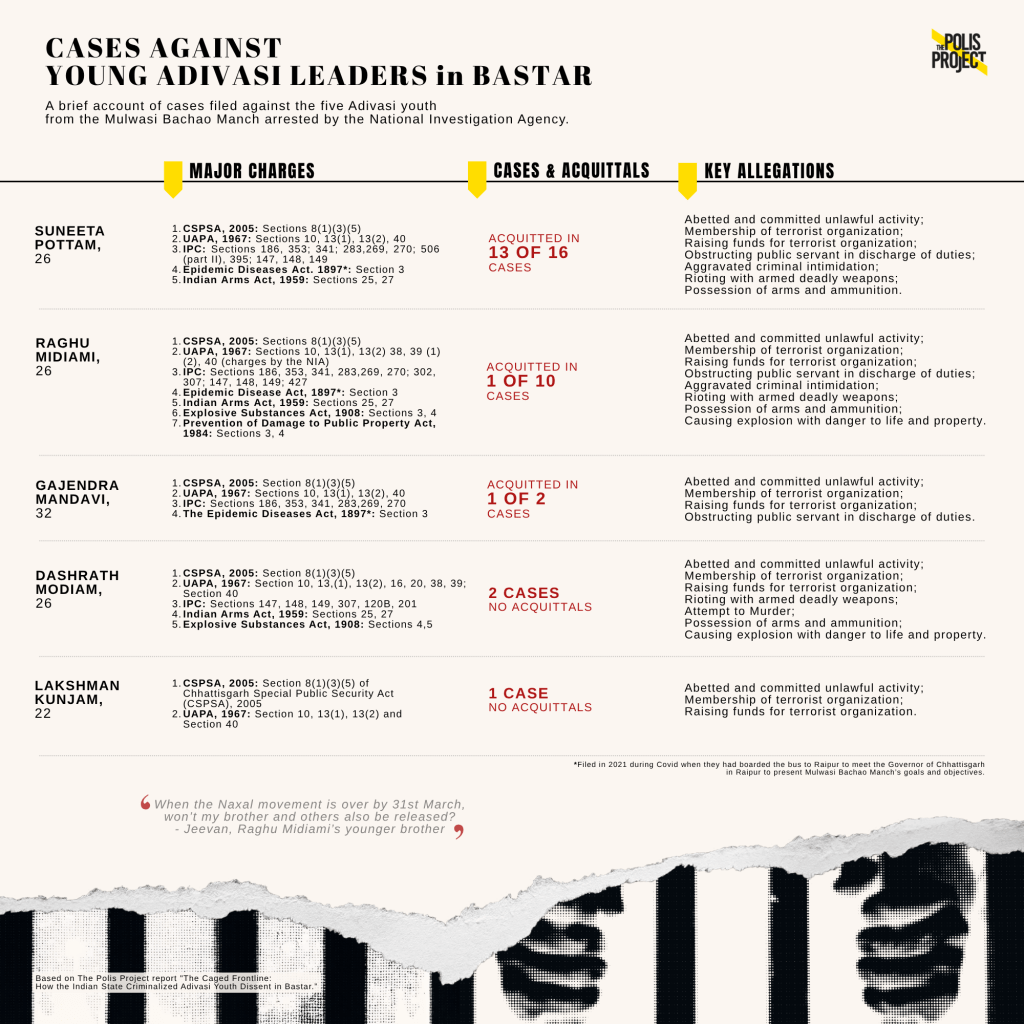
A police complaint from Bijapur against Gajendra Mandavi and Laxman Kunjam was taken over by the NIA in 2023, accusing them of exchanging Rs 600,000 on behalf of the banned CPI (Maoist). Around two years later, the NIA brought additional charges against Suneeta, Raghu, and Dasrath, accusing them of having formed the MBM at the behest of the Maoist party “to stage protest against the opening of the new police camps and other development activities [sic]”. The allegation added that to execute these protests, the Maoist party had handed them cash worth Rs 800,000.
Noted Adivasi rights activist Soni Sori said that the NIA was brought in to cast a chilling effect on dissent, and illustrated her point through an older case. In 2017, 121 villagers from Burkapal in Sukma district were arrested and tried in the NIA court as alleged Maoists, in connection with an ambush by Maoists killing 25 central paramilitary personnel. But all the accused were acquitted due to the absence of evidence after being jailed for five years.
“When the State is unable to get hold of real culprits, it puts the noose on innocent villagers to showcase that it is performing well,” said Sori.
Sori had herself faced severe torture in jail when she was arrested in 2011 on sedition charges, accused of being an intermediary for the Maoists. She was sexually assaulted in prison before being released on bail by the Supreme Court in 2013 and was eventually acquitted in 2022. Meanwhile, she continued to face more cases during her activism and continued to be acquitted.
It is the long years spent in jail until acquittal that appear to be the actual punishment for activists like Sori.
MBM leader Suresh Avlam was released on bail in August 2025 after spending one and a half years in custody. Earlier this year, he spoke of a constant fear of arrest on warrants from old cases. “I wish they had charged me with all the cases together and not when I’m out after one-and-a-half years,” he said, exasperated. His advocate in Bijapur promised not to let him get arrested; “Unka setting hai (he has his ways in the court)”, he had mentioned. But the advocate demanded a sum too large for Avlam to pay. So, he went off the grid – switched off his phone and left to work as a laborer in neighboring Andhra Pradesh state.
Many others like him, Ashu Madkam, Mahesh Sori, and Azad, continue to live under the shadow of surveillance, unsure when the next knock on the door might come. “At least twice every week, I receive a phone call from a person who claims to be from the local police station, claiming my name is listed as a Maoist suspect and that I should surrender,” said Mahesh Sori.
Ashu Madkam (25) was picked up twice by the NIA for investigation; his personal belongings, including a laptop, were seized. He said he often receives phone calls from his nearest police station asking him to surrender there. “But I’m not a Naxalite, why should I surrender?” he asked. Ashu has a case against him; he led a protest in Bechhapal against road construction, and according to the police report, ‘Maoist parchas’ (Maoist statements) and other incriminating documents were seized from the protest site. Thus, a case was filed against him and 14 others.
So why did the State perceive these youth protest leaders as serious threats to its security? The way criminal cases were filed against them and terror charges were added has raised concerns over the weaponization of legal systems. The UN Special Rapporteur on Human Rights Defenders wrote to the Indian government that Raghu and fellow MBM members were “targeted for exercising their right to freedom of expression” and assembly, with the aim of “silencing their denunciation” of alleged state abuses. Rights group Campaign Against State Repression similarly noted that no evidence justified Raghu’s prolonged detention, calling claims of Maoist funding an attempt to “criminalize democratic dissent.”

Suspects in the Eyes of the State
As the influence of the MBM and its activists grew, the police alleged that the youth were being instigated by the Maoists and acting as a front to serve the interests of the proscribed party.
Speaking to this reporter back in February 2023, P. Sunderraj, Inspector General of Police, Bastar Range, had insisted that the Maoists mobilized the protests. “Under Maoist threat, villagers cannot come forward in a gram sabha (village council) and openly say they want roads, because they would have to face the terror that the Maoists would unleash,” he said.
He claimed that, in private conversations, villagers had expressed to the authorities the need for roads and security camps to help them overcome the fear of Maoists. “So we do have consent,” Sunderraj said, justifying the camp that came up in Silger.
When this reporter asked a few of the MBM leaders about the allegation that the protests were Maoist-instigated, they rejected it outright. “This is our forest, our land, our people. If we do not protect these, who will?” they asked in return.
Much later, in 2025, I met Ramesh (name changed on request) — a panchayat member from Rekhapalli village — to ascertain whether there was any truth to the police’s claim of Maoist involvement. He said it would be impossible for villagers to carry out any public activity in these areas without the Maoists being aware of it. While clarifying that Maoists were not orchestrating the protests, he underlined that the villagers were deeply concerned about the rapid acquisition of their land for road construction; any objection from them was met with brute force. The villagers held extensive meetings to decide on a course of action, as the government was not holding consultations with the gram panchayats, Ramesh said.
Bastar has a long history of Adivasi rebellions dating back to the 1800s, in defense of their forests and land. “The Maoists came to Bastar only in the 1980s,” said Sarju Tekam, an Adivasi leader from Chhattisgarh, when this reporter met him in Gidam during the annual commemoration of the Bhumkal Rebellion in February 2023. “We have a much longer history [before the Maoists] of protecting our land and forests,” he added.
Manish Kunjam, former Member of Legislative Assembly from the Konta constituency in Sukma district and a prominent voice in Bastar, did not entirely rule out the possibility of Maoist influence among sections of the youth. However, he argued that the protests against the camps and road construction were peaceful and centered on constitutional rights. “The youth are demanding implementation of provisions such as the PESA Act. Bandook thodi na le kar virodh kar rahe hain (they are not protesting with guns).”
The PESA law extends limited self-governance to Adivasi-majority Scheduled Areas, recognizing the authority of ‘Gram Sabhas’ (village councils) over land, forests, and local resources. In Bastar, on issues of land acquisition, mining, and militarisation, PESA is often invoked as a legal safeguard for Adivasi consent and community control. But its effective implementation is questionable.

Crackdown Intensifies in Bastar
The Indian National Congress suffered a decisive defeat in the 2023 state assembly elections, bringing the Bharatiya Janata Party back to power in Chhattisgarh. One of the key promises of the new government was to eliminate Naxalism, with the Union Home Minister publicly setting 31 March, 2026 as a target date for the formal end of the Maoist insurgency.
In this changing political climate, the activities of Mulwasi Bachao Manch increasingly came under scrutiny.
With its growing presence across several parts of Bastar, the platform had become one of the first to document and publicize allegations of excesses by security forces during the anti-Naxal operations. In 2023, the operations that deployed drones for dropping missiles in civilian areas were halted as villagers, with the help of the Mulwasi Bachao Manch, circulated photos and videos of debris from the attacks on social media. This attracted national media and international attention as questions were raised in the European Parliament on the “indigenous environmental defenders who are suffering persecution.”
More protests followed, and cases of atrocities were brought forth. For instance, Suneeta led a rally when a six-month-old baby died of a bullet injury on January 1, 2024. Raghu brought to light the death of three men in Rekhapalli village on 8 November 2024, two of whom were civilians. He also shared news regarding the detention of several villagers with the media, including four MBM members – Joga Madvi, Dewa Sodhi, Sukka Sodhi and Sukka Kunjam.
The Chhattisgarh government then imposed a ban on MBM through a notice issued by the Home Department dated October 30, 2024. “…Moolvasi Bachao Manch is continuously opposing and instigating the general public against the development works being carried out by the Central and State Governments in the Maoist affected areas and the security camps being built to conduct these development works,” it said.
The notice accused the MBM of “disturbing public order, peace and endangering the safety of citizens,” thus justifying declaring it an “unlawful organization” for a period of one year, under the Chhattisgarh Special Public Security Act, 2005. It was made public only in November and published in the Chhattisgarh Gazette. The Act allows for a ban to be imposed ‘with immediate effect,’ soon after the gazette notification.
The protestors were unaware of the ban for weeks, until security forces cracked down on several protest sites and began rounding up the protestors. But it was still not officially claimed that MBM had any Maoist links.
“Nowhere in the notice does the government state that MBM is an arm or frontal organization of the banned CPI (Maoist) party,” observed Shalini Gera, an advocate at the Chhattisgarh High Court and closely associated with the People’s Union of Civil Liberties.
According to Gera, the government’s accusation that the MBM was inciting people against development activities did not, technically, constitute a valid ground for a ban. “MBM’s protests, as far as we are aware, are lawfully conducted by seeking consent from the gram panchayat (village council) as mandated under the PESA Act,” Gera noted that the government cannot ban a group for demanding what is legitimate and within their constitutional right.
The Act provides for a banned party to present its defense before the Advisory Board. Hence, MBM submitted a written statement dated 22 November 2024, signed by its then-president, Raghu, seeking an opportunity to respond to the allegations and to reconsider the ban.
The statute prescribes a time-bound review process: the state government must refer the notification to a three-member Advisory Board within six weeks, which is required to submit its report within three months, explained advocate Isha Khandelwal. However, there was no response from the Advisory Board, which was constituted two days before the official notice declaring the ban.
The Chhattisgarh High Court dismissed a petition challenging the ban, observing that the ‘matter was premature’ in view of the pending statutory process before the Advisory Board.
With the Advisory Board not responding to MBM and the court declining to intervene in the government’s ban, the police started cracking down on the members. Over 50 youth leaders were picked up after the ban was imposed. Other than two persons who were arrested for being members of MBM, charges slapped against the rest included “being involved in Naxal activities, such as disrupting road construction activities, helping the banned party in laying explosives, holding Maoist documents,” according to the police complaint.
Ashu Madkam, who managed a protest site in Bijapur, was picked up by NIA officials twice to be questioned on his involvement with the MBM. He and 13 others were accused of ‘illegally staging protests, obstructing the under-construction Nelsanar-Gangalur main road and hindering government schemes’. The police also claimed they recovered correspondence between the protestors and “Maoist cadres”. However, they were not arrested.
Several MBM members, such as Sahdev Barsa and Munna Oym, caved under pressure. Some, like Ashu, reported regular threatening calls for arrest or surrender; in another case, from Sukma district, family members were allegedly held in Chintalnar police station, being pressured to produce the MBM person, said Umesh from Tadmetla. Once these MBM members approached the local police stations, their names were registered in their respective stations as ‘Naxal members’, Sahdev said. These ‘members’ would be actively surveilled and were warned that in the event of any ‘Naxal activity’ in the region, they would be the first to be taken in, said Sahdev, wondering if he had walked into a trap.

The Legal Quagmire
The government did not extend the ban when the year-long period ended. While this came as a relief to the MBM members, it remains unclear to those in jail, including their family members, what their fate would be.
The Manch was free to carry out activities within the constitutional provisions, state Home Minister Vijay Sharma said in an interview. But critics say that the youth were already functioning within the bounds of the Constitution.
When asked about the cases against MBM members who are still in jail, Dr Jitendera Yadav, Superintendent of Police, Bijapur, said, “Those cases are within the purview of the court and will have to go through the usual legal process.” He added, however, that “there will not, or rather cannot be, any new cases for being members of the Manch as the ban has been lifted.”
Meanwhile, there’s been major upheaval in the region. Most of the senior members of the CPI(Maoist) party have either been killed or have surrendered to the state governments, declaring a ‘suspension’ of the armed struggle.
The March 31, 2026, deadline for the ‘elimination’ of Maoism from the country has passed. Nearly a thousand undertrial prisoners are in jails. While the CPI (Maoist) struggles to remain relevant, asserting that it would continue to advocate for Adivasis and other marginalized communities without taking up arms, Adivasi communities are grappling to hold on to their claims over land and forests. These are increasingly subject to state control as the government advances a roadmap to open the region to private mining operators.
In a cabinet meeting held on December 10, 2025, the Government of Chhattisgarh approved a procedure for the withdrawal of criminal cases against surrendered Maoists. However, no corresponding procedure has been laid down for the withdrawal or systematic review of cases involving individuals—many of them civilians—who have been arrested in alleged “Naxal cases” over the years and continue to languish in prolonged detention.
There have been attempts by the government to induce or pressure such undertrials to “surrender” to secure withdrawal of cases, as some of the undertrial prisoners shared with this reporter. “Such practices are highly questionable as they are illegal and unethical,” observed Advocate Khandelwal. Such practices risk coercing individuals into false admissions of association or guilt to secure release.
It was also announced at the cabinet meeting that a district-level committee would be formed to submit its report to the police headquarters after scrutinizing all cases; the police headquarters’ proposal would then be sent to the Law Department. The fate of the cases will thus be decided by a sub-committee of the Council of Ministers, whose final decision on the matter will be upheld.
“Committees, in absence of a binding authority and operating through bureaucratic procedure with a limited mandate, fail to deliver relief to the affected,” argued Khandelwal, recounting the earlier committees – Nirmala Buch Committee and Justice Patnaik Committee – that failed in similar matters.
Acting through the Public Prosecutor, the state has the power to seek withdrawal from prosecution as a matter of public policy or for other valid considerations under the Bharatiya Nagarik Suraksha Sanhita, 2023 (the new criminal procedure code), subject to the supervisory consent of the competent court, Khandelwal further noted. She argued that the question is not one of legal incapacity, but of political will, as the state possesses the necessary legal tools.
Regarding the NIA case, she said that, given the involvement of a central agency, the federal government would need to approve any withdrawal. “The larger question of political will remains pertinent for both the state and the Center,” she added with a wry smile.

A Long Wait for Return
In the meantime, the landscape in Bastar has changed. Villages have been pushed aside to make way for wide, strikingly shiny, black asphalt roads; every two to three kilometers, security camps are surrounded by concertina wire and green net along the walls.
The two-way Tarrem-Silger-Jagargonda road, where Raghu led the protest, has been completed, and so has the two-way Gangaloor-Nelasnar road, where Suneeta led the protest.
Since the Silger movement, the Government of Chhattisgarh has auctioned 41 mineral blocks, nine of which are in the Bastar region. In mid-2025, the Bailadila hill range, which had been operated solely by the National Mineral Development Corporation, a public sector company, was opened to private parties. Three iron ore blocks of the Bailadila Deposit, spanning a total area of 2525 Ha, were also auctioned in March 2025 to two private companies.
“When Suneeta returns home, she will not recognize the place,” said Savitri Punem, shaking her head. Savitri is Suneeta’s close friend and visits her regularly in prison. Raghu’s younger half-brother, Jeevan, is keen to resume his studies in Bachheli once his brother is released. “If the Naxal movement is over by 31st March, won’t my brother and others also be released?” he had asked. After Raghu’s arrest, Jeevan had to give up his studies to step in and help the family with their 10-acre land.
Married for over seven years to her childhood friend, Dasru’s wife, Kamala, waits forlornly for his return. Her village, Pedda Korma, is located over 150 kilometers from the jail, and she is not able to visit him as often. “It is not easy on my resources to travel all the way to Jagdalpur for a meeting that lasts less than half an hour,” she said.
“If you meet him, tell him I’m waiting for him here to return soon,” she said, breaking into a shy smile as she bid me goodbye.

The Caged Frontline: How the Indian State Criminalized Adivasi Youth Dissent in Bastar

Adivasi gathering in Silger village, Chattisgarh, in 2022. Photo by Sakhi
It was the onset of the harsh summer month of March in the central Indian state of Chhattisgarh. In the state’s southern region, Bastar, the forest was heavy with the sweet scent of Mahuva flowers. The Gond tribe spent the early mornings here with their families, gathering the fallen Mahuva. But five Gond youth were notably missing— unable to participate in this community activity—as they had been undertrials in a Jagdalpur prison.
On March 10, they were brought for their scheduled ‘peshi’ (appearance) at the Jagdalpur district court. The premises house the National Investigation Agency’s special court, which handles cases related to the banned Maoist party in the Bastar division.
Four young men stood in pairs; one woman was restrained separately, under the watch of a policewoman. These handcuffed Gond youth—first-generation literates who grew up facing forced displacements and state-backed violence—had led peaceful protests for their community rights over the land and forest. Then, the Indian state deployed its most powerful legal machinery against them: stacking multiple criminal cases, invoking anti-terror laws and ultimately deploying the National Investigation Agency to investigate and prosecute them.
The defense lawyers of the incarcerated youth claim that these cases are fabricated.
One of the youth at the Jagdalpur court that March day was 24-year-old Raghu Midiami. He broke into a familiar smile at his lawyer, revealing four broken front teeth. Before the police closed in on them in court, Raghu raised his hand to show his crooked ring finger to the lawyer and quickly whispered that he needed medical attention. “Please inform someone from my family to come and sign the papers [for medical treatment],” he said.
The crooked finger had resulted from a motorcycle accident that also injured his legs and right hand. The police picked Raghu up while he was recovering in his rented room in Dantewada, where he had been attending college since 2024. They accused him of having links with the banned Maoist movement. Since February 2025, Raghu has been lodged in Jagdalpur jail, nearly 140 kilometers from his village in Sukma, making it difficult for his family to visit.
The Bastar region is part of the “red corridor” of the Maoist-led insurgency. It was once a stronghold of the Maoists, who are also known as Naxals, and categorized as Left Wing Extremism (LWE) by the Indian government. It is also one of India’s most militarized regions and is inhabited by indigenous communities.
For the government, Raghu is one of the 2,218 alleged Maoists and their associates that the central home minister said were “arrested and sent to jail” in the government’s final push to make the country “Naxal-free” by March 2026. But in Bastar, Raghu is the young Adivasi leader of the Mulwasi Bachao Manch [Platform to Save the Indigenous People]. This grassroots platform emerged from protests against the rapid spread of paramilitary camps through remote villages inhabited by Adivasis (a collective term for indigenous and tribal communities). Raghu’s arrest, like those of several others who challenged militarization and violation of tribal rights in the region, raises a key question for Bastar: where does counterinsurgency end, and the criminalization of dissent begin?
From Adivasi Leaders to Political Prisoners
The State took notice of Raghu Midiami after protests erupted in Silger village in May 2021 against a paramilitary camp. The agitation catapulted Raghu into prominence as he was leading the Mulwasi Bachao Manch (MBM), a youth platform that had begun mobilizing villagers across the region. The organization was eventually banned. And Raghu, the president of MBM, was accused in eight cases and jailed.
The leaders and members of MBM have been incarcerated for nearly two years, awaiting trials.
In the Jagdalpur courtroom, alongside Raghu was 26-year-old Dasrath Modiam, known among friends as Dasru. His shoulders were slightly slumped in court as he listened to the lawyer relay news from home: his maternal uncle had died.
“In the past year, four members of my family passed away,” Dasrath said.
He was arrested in December 2024 in two cases registered in Bijapur, accusing him of offenses including rioting, attempted murder, unlawful assembly, illegal possession of arms and ammunition, and causing explosions that endangered life and property. Adivasi villagers commonly refer to these as “Naxali cases”, reflecting the types of criminal charges frequently used against people accused of links with the Maoist insurgency. Thousands of villagers across Bastar have faced similar cases over the years, many of whom were later granted bail or acquitted.
Less than six months after being arrested in the two cases, Dasrath was added as an accused in a case being investigated by the National Investigation Agency (NIA), with charges under the Unlawful Activities (Prevention) Act (UAPA). He and others in the case were accused of being members of a terrorist organization, which is the Maoist party in this case, as well as assisting and raising funds for them. Charges under the UAPA have stringent bail provisions, and civil liberties activists often critique the law for creating situations where prolonged pre-trial detention can itself become the punishment.
Since Dasrath’s arrest, he has lost his mother, an uncle, a grandmother, and now another uncle. He did not get to see any of them for the final time or attend their last rites; his bail plea to attend his mother’s funeral was denied by the court.
Dasrath wanted a good life – to travel around, “perhaps even become a photographer,” he had said with a laugh when this reporter met him in May 2023. He insisted on hanging the camera around his neck as he accompanied me to meet a few protestors.
Now, life is radically different for Dasrath. Court hearings and appeals punctuate his time as an undertrial. “Only two witnesses remain [to be examined] in my Bijapur case,” he said about his trial’s progress. “After that, only the NIA case will remain.”
Then, he added softly, “Please tell my wife to meet me here.”
Standing beside Raghu and Dasrath was 26-year-old Suneeta Pottam, dressed in a neatly pressed blue kurta, hair oiled and neatly plaited.
Only a handful of witnesses remain to be examined in two cases pending against her in Bijapur, she noted to the lawyers, both as a factual statement and as an expression of hope. Of the total 16 cases against her, Suneeta has already been acquitted in 13. But it’s the third pending case—the one being probed by the NIA—that poses a greater challenge.
In addition to stringent bail conditions under the UAPA, the NIA also boasts a high conviction rate. But an investigation by The Wire revealed that these convictions include guilty pleas, which are often extracted from prisoners exhausted from prolonged incarceration with delayed or no trials.
Advocates Arvind Chowdhury and Isha Khandelwal listened carefully to Suneeta at the court. Chowdhury nodded without meeting Suneeta’s eyes; Khandelwal squeezed her hand reassuringly. They were familiar with NIA prosecutions.
30-year-old Gajendra Mandavi said little during the exchange with lawyers, offering only a faint nod to familiar faces. Beside him stood the tallest and youngest among the five, 21-year-old Laxman Kunjam, waiting to hear updates on his bail application pending before the High Court. Both Gajendra and Laxman were arrested on May 25, 2023.
In Bastar, the line between activist and criminal is drawn by the state. For the five young Adivasis from Sukma and Bijapur, that line was crossed when they began organizing tribal villagers to demand their rights. As they languish in Jagdalpur jail under NIA investigation, 37 other youths associated with the MBM are in Sukma, Dantewada, and Bijapur jails under the “Naxali cases”.
Activists and lawyers say that the state police conveniently use trumped-up charges against persons whom they feel are a ‘nuisance’ to the police or administration. While such instances have often been reported before, The Polis Project could not independently assess these cases.
Insurgency in Bastar
The Maoist movement emerged in the resource-rich hinterlands of Adivasi communities across Chhattisgarh, Jharkhand, Odisha, West Bengal, Andhra Pradesh, Madhya Pradesh, and a few other states in the late 20th century. In the Indian government’s words: “Rooted in socio-economic inequalities and fueled by Maoist ideology, LWE has historically affected some of the most remote, underdeveloped, and tribal-dominated regions of the country. The movement has aimed to undermine the Indian state through armed rebellion and parallel governance structures…”
The Maoist movement entered Bastar in the 1980s and gradually drew support from sections of Adivasi communities in North and South Bastar, as well as the Surguja Division of North Chhattisgarh, bordering Jharkhand. Bastar is an economically backward and remote region, covering nearly 40,000 square kilometers of rugged terrain with rich forest cover.
The now-banned Communist Party of India (Maoist), the key actor of the armed insurgency, garnered support by focusing on issues like regional inequality, poor development, and land alienation. While a committee of the Planning Commission had identified these issues in a 2008 report, the state’s anti-Naxal operations—far from addressing the problems— took a stringent ‘law and order’ approach.
The then-Prime Minister, Manmohan Singh, described ‘Naxalism’ as a major ‘internal security threat’. The federal government thus deployed paramilitary forces in Chhattisgarh to fight Maoists. Civilians have been swept up by this broad mandate, and the paramilitary forces and state-backed militias have reportedly committed a range of atrocities and human rights violations.
The state’s counterinsurgency tactics included the establishment of hundreds of paramilitary camps, often located just two to three kilometers apart; large-scale search operations aimed at “flushing out” armed insurgents and their suspected supporters; frequent ambushes and encounters in areas designated “Naxal-sensitive.”
Officials justified these measures as necessary for ‘development’, the first instance of which was the construction of an extensive network of wide roads cutting through villages, forests, and agricultural land. This aggressive ‘development’ came with a human cost, where several civilians, including women and children, were killed and injured in indiscriminate firing by counterinsurgency forces and by unexploded mortar shells left behind after operations. These raised alarm over extralegal killings over the years. Additionally, several villagers were detained on suspicion of having links with insurgents.
In August 2024, the Indian State set March 31, 2026, as the final deadline to “eradicate” the insurgency. Over the two ensuing years, the Maoist movement appeared to be fraying, struggling to consolidate and regroup in the face of an expanding grid of paramilitary camps, sustained mortar fire, and drone strikes. In a press statement of March 30, 2026, the Union Ministry of Home Affairs claimed to have achieved its goal, with hundreds dead and thousands arrested, including Maoist leaders: “Naxal-free India is one of the most historic and important sucessess of the Modi government,” declared the statement.
Brutal Past: Counterinsurgency Operations and Militia Violence
Bastar’s people have experienced prolonged violence, the scars of which are still painfully visible today. Much of this violence unfolded during the period of Salwa Judum — a vigilante movement initiated by the state government and backed by the central government between 2005 and 2007. The phrase ‘Salwa Judum’, translated from the Gondi language, is often described as “purification hunt.” The State portrayed it as a “spontaneous people’s movement against Maoist atrocities”, while civil rights groups and researchers documented extensive abuses during the campaign.
“I spent nearly a year and a half along with my family in the forests near Korcholi to escape violence,” Suneeta said, recalling the days of Salwa Judum. Violence from different sides of the conflict shaped her life.
“I was less than three years old when Salwa Judum started,” said Lakhan Punem, now a 2nd-year undergraduate student at a government college in Dantewada district, about 60 kilometers from his village. “I have heard from my family that they never got to know what happened to my older brother, who was only 17 when the Naga battalion picked him up.” Lakhan added that his brother was picked up while traveling from their village, Kawadgaon in Bijapur, to Bachheli, a town in the nearby Dantewada district. The federal government deployed the Naga Battalion for anti-Naxal operations.
A public interest litigation filed in 2007 in the Supreme Court challenged Salwa Judum, while an accompanying writ petition enlisted cases of arson, rape, and violence against the operations during the period.
According to the writ petition, “…as of January 2007, according to official figures, 47,238 people were living in 20 Salwa Judum ‘relief camps’, or base camps as they were popularly called”. Of the 1,354 villages in Dantewada district, 644 were affected by Salwa Judum. The petition also noted 99 allegations of rape, 500 murders, and 103 cases of arson.
In 2011, the Supreme Court held that Salwa Judum violated the constitutional rights to equality and life with dignity. The court ordered its disbandment and directed action against the perpetrators of violence, arson, and rape. It also prohibited deploying tribal communities as Special Police Officers in counter-insurgency operations. The Supreme Court further directed the Chhattisgarh government to prevent the operation of any group, including Salwa Judum and the Koya Commandos, that sought to take the law into private hands.
However, the state government circumvented the judgment by absorbing the Special Police Officers into a newly created Chhattisgarh Armed Auxiliary Force, essentially legalizing the force under a new name. Salwa Judum, thus outlawed on paper, continued as armed auxiliary forces, District Reserve Guards, and other vigilante groups.
The District Reserve Guard comprised surrendered Maoists or those who had been removed or demoted from the CPI(Maoist) Party due to their conduct. Stealth operations began to take shape, alongside a band of ‘secret police’ (gopniya sainik) created by the District Reserve Guard, to pass information in exchange for money and the promise of a permanent job in the force. While this helped breach the Maoist network, it also opened new fissures within what had once been a tightly knit Adivasi community, setting off a cycle of retaliatory violence. Reports of killings of ‘police informers’ and ‘secret police’ by the Maoists became regular news.
According to official records, 59 ‘gopniya sainiks’ (secret police) and 346 members of the District Force, which also includes the exclusive District Reserve Guard, have been killed by Maoists between 2001 and 2025.
The atrocities against civilians, including rape and sexual assault, continued even after the supposed end of Salwa Judum. For instance, in 2012, paramilitary and police forces killed 17 Adivasis in Sarekeguda village in Bijapur, as per a judicial commission finding.
Suneeta Pottam has been fighting against atrocities against civilians from her village for nearly a decade. In 2015, Suneeta, then 19 years old, was probably the first young Adivasi girl to have filed a petition accusing security forces of extrajudicial killings and rape. She reached as far as Delhi to further appeal to the Supreme Court for protection against threats by the local police against the petitioners.
The Backstory: Fraught Childhood, Affected Education
At the age of eight, Suneeta and many other children had to abandon their studies when the primary schools in their villages were closed down. Around 400 schools were shut down in the conflict-affected parts of Bastar, and education in many interior areas effectively collapsed for nearly two decades after 2005. In several remote villages, schools and anganwadi centers were often the only cement structures, with most homes built of mud and thatch.
Rebel groups began demolishing schools and health centers, alleging that security forces were using them as bases. The chilling effect was profound: even institutions that were never occupied ceased to function, as teachers and staff feared reprisals and attacks.
To revive education, the government started portable cabin schools, known locally as “pota cabin schools”. These served as residential education centers for up to 500 students from classes 6 to 12 under one roof. Far removed from their villages, these schools were located near district headquarters and paramilitary security camps.
Many who became active in Mulwasi Bachao Manch studied in the ‘pota cabin’ schools.
Raghu Midiami studied for a few years at the village primary school and at a nearby residential Ashram school. When Salwa Judum started, he left his village to study at a public school in Bachheli, over 50 kilometers away, where he graduated from high school.
Sunita Tamo, an active member of MBM from Belnar village in Bijapur district, studied up to class 10 at the pota-cabin school in Pusnar, a few kilometers away from home.
“I did not like staying away from home, but what can we do? Our family would tell us to stay on as it was not safe to be in the village,” said Sunita.
“Far removed from the situation in the villages, we were mostly lost among our friends in the residential schools, visiting our home only occasionally during breaks,” said Lakhan Punem, a young member of MBM who joined the organization in the final years of his high school. He is now pursuing an undergraduate degree.
Suneeta Pottam had to abandon her primary schooling when Salwa Judum activists raided her village, forcing the villagers to shift to Judum camps set up in various places. “As kids, we watched our villages being burnt and my uncle being beaten up, as we fled our village,” Suneeta told me during a protest in Burji.
Many from Suneeta’s village—including her family—preferred to stay in the forests. When her family and others returned from their makeshift forest dwellings after a year in 2006, the situation in the region was far from normal. Extrajudicial killings by security personnel were on the rise over the years, she said.
As a team of women activists reached Bastar in 2015 to investigate atrocities against women, Suneeta contacted them for support. With their help, she filed a writ petition in the Chhattisgarh High Court against the extrajudicial killings of six persons in 2016 in the villages of Kadenar, Palnar, Korcholi, and Andri of Bijapur district. “She gave the women in Bastar hope for seeking justice as she marched out, despite risks to her own safety, to petition before the High Court,” recollected Rinchin, an activist from Chhattisgarh and a member of the group Women against Sexual Violence and State Repression (WSS); in 2017, WSS published a book, Bearing Witness, documenting sexual violence in Bastar.
Although not much moved in the court, other than increased harassment of the petitioners, Suneeta continued to raise her concerns through different avenues. She joined the MBM in its nascent stage in 2021, leading protests in Burji, Pusnar, and elsewhere.
Eventually, keen to complete her studies, Suneeta moved to Raipur in February 2024 to enroll in Class 10 through the state open school system. Three months later, on June 3, the police arrived after tracking her movements and took her into custody. She was brought to Jagdalpur jail. She appeared for her exams from prison.
Turning Point for Protests in Bastar
In May 2021, Adivasis started protesting after the Chhattisgarh government set up a paramilitary security camp in Silger overnight without consulting the villagers. Under the Panchayati Raj Extension to Scheduled Areas Act (PESA), 1996, Gram Sabhas must be consulted before land acquisition in Scheduled Areas.
The security camp was established to facilitate the reactivation of an old state highway by widening it to a two-lane road, which villagers said would encroach on their agricultural land and result in substantial deforestation. Leading up to this, resentment across Bastar had been building over the widening of roads and the establishment of security camps within village boundaries. Since 2024, 37 paramilitary security camps have come up in Bijapur district and around 16 in Sukma.
After five days of protest, on May 17, the police opened fire on the protesters. Three people were killed, including a 14-year-old, who died instantly, and a pregnant woman who was injured in the stampede.
The police firing became a turning point in Bastar. What began as a local demand for constitutional safeguards evolved into a youth-led movement against land appropriation and militarization in the region. Youth protesters formed the Mulwasi Bachao Manch; protests spread, and demonstrations persisted for years. At the height of the movement, there were 30 protest sites across Bastar’s North and South districts.
On October 30, 2024, the Chhattisgarh government designated the MBM as unlawful for one year under the state security law (Chhattisgarh Special Public Security Act, 2005), effectively criminalizing the movement. The organization was “opposing and instigating the general public against the development works being carried out by the central and state governments in the Maoist-affected areas and the security force camps being built to conduct these development works,” the government notification alleged. But the roots of the state’s actions run deeper into Bastar’s history and Adivasi resistance.
Changing Face of Adivasi Protests: From Elder-driven to Youth-led
Rallies, chakka-jam (road blockades), gherao (picketing) of police stations, and other forms of civil protest against state excesses are common across Bastar. Villagers have repeatedly protested arbitrary arrests, prolonged incarceration, brutal beatings, and alleged extrajudicial killings by police and paramilitary forces, often carried out in the name of counterinsurgency operations. Yet such protests had rarely drawn any meaningful response from the state.
Until a few years ago, Adivasi protests were marked by elderly men with the ‘tangia’ (hatchet) hung over their shoulders and women in their lungis (wrapped skirts) and blouses, with a towel slung over their shoulders. They would walk in single file, hesitantly, to the local police station, often in grim silence and with stern faces. They would register their complaint in Gondi, a language the station-in-charge usually didn’t understand. The officer would refuse to take note of their complaint and even drive them away by calling in paramilitary personnel from security camps. Interested news reporters, primarily non-Gondi-speaking, would also struggle to understand the Adivasi side of the story.
The Silger protest showed a characteristic shift in the protestors. Young boys in shirts and trousers or in denims, and young girls in salwar suits and skirts, gathered at the protest. They were spirited and passionate, yet calm, assertive, and collective in their approach.
The ‘sian’ (elders) in the village safely left the leadership to these youngsters. “It’s good the youth feel the same about loss of land and forests the way we do,” said an elderly man in Gondi at a protest site in Gorna village of Bastar when this reporter met him in 2023.
As first-generation literates, the youth needed no intermediaries to engage with the administration; they could speak directly and assertively with government representatives in the official language, Hindi. And they translated back to the gathered crowd in Gondi to seek their response. The youth leaders drafted letters to district authorities, setting out their demands in writing.
They also engaged with the largely non-Gondi-speaking media – both local and national – holding video interviews. Mulwasi leaders even came forward to hold video conferences with the chief minister, who invited them for talks to defuse the escalating protest in June 2021.
Speaking to the then chief minister, Bhupesh Baghel of the Indian National Congress, the MBM representatives placed several demands, including an appropriate probe into the Silger firing and withdrawal of the camp. The chief minister promised the magisterial inquiry report into the firing within three weeks, but it has not been made public to date.
Initially, media attention toward the protests was sparse, but tech-savvy youth filled the gap. They posted photos and videos on social media platforms and in WhatsApp groups, alongside regional and national journalists and activists. Some ran YouTube channels or released songs depicting confrontations with security forces.
The grassroots network carried news from remote villages far beyond, drawing journalists and activists. As visibility grew, young leaders were invited to speak in Delhi and Mumbai about atrocities against Adivasis and Bastar’s unrest.
This visibility undercut the government’s development narrative — new roads, mining expansion.
Chhattisgarh is about 44% forested. Beneath this cover lie rich mineral deposits — iron ore, aluminum, gold, titanium, limestone — that drive much of the state’s economy.
These forests are also home to Adivasis, who make up 33% of the state’s population; their lifeways and folklore are tied to the hills, rivers, and ancestral spirits believed to dwell there.
Minerals contribute roughly 9.5% of the state’s GDP. But the absence of road infrastructure has long deterred mining companies. Many proposed routes cross “extremely Naxal-sensitive” zones, where Maoist attacks on workers and kidnappings of contractors have reportedly stalled construction and deterred bidders. Frustration grew among industry players, with some threatening to pull out of the state altogether. Building wide roads capable of carrying mineral transport trucks was increasingly seen as a necessity by the government.
But in the forested villages of south Bastar, road construction was more than an infrastructure project. It meant clearing forests that sustained community life: Mahua trees for flowers and liquor, Tendu and tamarind trees for seasonal income, and other trees families had tended for generations. It also consumed agricultural land, while gravel from newly built roads often spilled onto adjoining fields, reducing their productivity.
Combined with the expansion of security camps into forested villages, the road-building drive fuelled growing unease among Adivasi communities across parts of Bastar.
With little or no monitoring of road quality, there were instances of widespread corruption. In Bijapur, on the 52 km Gangaloor-Nelasnar road where MBM protested against security camps and the making of wide roads, the exposure of corruption cost the life of a local journalist, Mukesh Chandrakar, in 2025.
“We are not opposed to roads being constructed, but why build such wide roads that eat into our agricultural land, forcing our generational trees to be cut down?” rued 55-year-old Chhanu Punem from Burji village as he walked in a rally back in February 2022. Over 5000 villagers had come to commemorate the Bhumkal Diwas, a 1910 tribal revolt led by Gunda Dhur, a Dhurwa Adivasi from Bastar.
“These roads are not for us – these are being constructed for Adanis and Ambanis for their trucks to devour our sacred hills for the minerals,” added Dasnamore, referring to major business groups with mining interests whose names have come to symbolize corporate involvement in the region.
While he spoke, a slogan reverberated through the rally: “Jal-jungle jameen kiska hai, hamara hai, hamara hai (To whom does the Water-Forest-land belong? To us … to us)”.
As the young led with slogans, the older people followed them quietly.
Emerging Out of a Fractured Society
In 2020–21, when schools shut down during the COVID-19 lockdown, many Adivasi students spent extended periods back in their villages with their families and communities. The promise of remote schooling never materialized; most did not have smartphones, and network connectivity was extremely poor.
Instead, they joined their families in farm work and gathering forest produce. This drew them deeper into community life — closely connected to the rhythms of the forest and land. They also witnessed firsthand the fears and state control that their community had long learned to negotiate to survive in the conflict region.
“It’s here we realized the difficulties our elders in the village go through, and the kind of violence they were facing if they objected to security personnel forcibly entering their homes during search operations,” said Suresh Avlam.
The police reportedly beat Suneeta Pottam’s father and filed cases against them as they had taken out a rally objecting to trees being cut down to make way for road construction in the area.
“How can we sit and study in peace when our parents are being beaten up?” said a class 10 student studying in a government school in Gangaloor. She was accompanying a group of 90 children who, like her, left their residential schools in Bijapur to join the protest in Burji when they heard their family members had been beaten.
After Silger protests erupted, young people such as Raghu, Suneeta, and Dasru found themselves unexpectedly thrust into leadership, becoming prominent figures in the protests that swept across South Bastar over the next two years.
All the charges against those associated with the Mulwasi Bachao Manch arose in the 2021-24 period, when the group was active.
None of the cases helped deter the other youth from continuing to raise the issue of their alienation from land and forests. Then, in 2023, the government brought in the NIA.
A police complaint from Bijapur against Gajendra Mandavi and Laxman Kunjam was taken over by the NIA in 2023, accusing them of exchanging Rs 600,000 on behalf of the banned CPI (Maoist). Around two years later, the NIA brought additional charges against Suneeta, Raghu, and Dasrath, accusing them of having formed the MBM at the behest of the Maoist party “to stage protest against the opening of the new police camps and other development activities [sic]”. The allegation added that to execute these protests, the Maoist party had handed them cash worth Rs 800,000.
Noted Adivasi rights activist Soni Sori said that the NIA was brought in to cast a chilling effect on dissent, and illustrated her point through an older case. In 2017, 121 villagers from Burkapal in Sukma district were arrested and tried in the NIA court as alleged Maoists, in connection with an ambush by Maoists killing 25 central paramilitary personnel. But all the accused were acquitted due to the absence of evidence after being jailed for five years.
“When the State is unable to get hold of real culprits, it puts the noose on innocent villagers to showcase that it is performing well,” said Sori.
Sori had herself faced severe torture in jail when she was arrested in 2011 on sedition charges, accused of being an intermediary for the Maoists. She was sexually assaulted in prison before being released on bail by the Supreme Court in 2013 and was eventually acquitted in 2022. Meanwhile, she continued to face more cases during her activism and continued to be acquitted.
It is the long years spent in jail until acquittal that appear to be the actual punishment for activists like Sori.
MBM leader Suresh Avlam was released on bail in August 2025 after spending one and a half years in custody. Earlier this year, he spoke of a constant fear of arrest on warrants from old cases. “I wish they had charged me with all the cases together and not when I’m out after one-and-a-half years,” he said, exasperated. His advocate in Bijapur promised not to let him get arrested; “Unka setting hai (he has his ways in the court)”, he had mentioned. But the advocate demanded a sum too large for Avlam to pay. So, he went off the grid – switched off his phone and left to work as a laborer in neighboring Andhra Pradesh state.
Many others like him, Ashu Madkam, Mahesh Sori, and Azad, continue to live under the shadow of surveillance, unsure when the next knock on the door might come. “At least twice every week, I receive a phone call from a person who claims to be from the local police station, claiming my name is listed as a Maoist suspect and that I should surrender,” said Mahesh Sori.
Ashu Madkam (25) was picked up twice by the NIA for investigation; his personal belongings, including a laptop, were seized. He said he often receives phone calls from his nearest police station asking him to surrender there. “But I’m not a Naxalite, why should I surrender?” he asked. Ashu has a case against him; he led a protest in Bechhapal against road construction, and according to the police report, ‘Maoist parchas’ (Maoist statements) and other incriminating documents were seized from the protest site. Thus, a case was filed against him and 14 others.
So why did the State perceive these youth protest leaders as serious threats to its security? The way criminal cases were filed against them and terror charges were added has raised concerns over the weaponization of legal systems. The UN Special Rapporteur on Human Rights Defenders wrote to the Indian government that Raghu and fellow MBM members were “targeted for exercising their right to freedom of expression” and assembly, with the aim of “silencing their denunciation” of alleged state abuses. Rights group Campaign Against State Repression similarly noted that no evidence justified Raghu’s prolonged detention, calling claims of Maoist funding an attempt to “criminalize democratic dissent.”
Suspects in the Eyes of the State
As the influence of the MBM and its activists grew, the police alleged that the youth were being instigated by the Maoists and acting as a front to serve the interests of the proscribed party.
Speaking to this reporter back in February 2023, P. Sunderraj, Inspector General of Police, Bastar Range, had insisted that the Maoists mobilized the protests. “Under Maoist threat, villagers cannot come forward in a gram sabha (village council) and openly say they want roads, because they would have to face the terror that the Maoists would unleash,” he said.
He claimed that, in private conversations, villagers had expressed to the authorities the need for roads and security camps to help them overcome the fear of Maoists. “So we do have consent,” Sunderraj said, justifying the camp that came up in Silger.
When this reporter asked a few of the MBM leaders about the allegation that the protests were Maoist-instigated, they rejected it outright. “This is our forest, our land, our people. If we do not protect these, who will?” they asked in return.
Much later, in 2025, I met Ramesh (name changed on request) — a panchayat member from Rekhapalli village — to ascertain whether there was any truth to the police’s claim of Maoist involvement. He said it would be impossible for villagers to carry out any public activity in these areas without the Maoists being aware of it. While clarifying that Maoists were not orchestrating the protests, he underlined that the villagers were deeply concerned about the rapid acquisition of their land for road construction; any objection from them was met with brute force. The villagers held extensive meetings to decide on a course of action, as the government was not holding consultations with the gram panchayats, Ramesh said.
Bastar has a long history of Adivasi rebellions dating back to the 1800s, in defense of their forests and land. “The Maoists came to Bastar only in the 1980s,” said Sarju Tekam, an Adivasi leader from Chhattisgarh, when this reporter met him in Gidam during the annual commemoration of the Bhumkal Rebellion in February 2023. “We have a much longer history [before the Maoists] of protecting our land and forests,” he added.
Manish Kunjam, former Member of Legislative Assembly from the Konta constituency in Sukma district and a prominent voice in Bastar, did not entirely rule out the possibility of Maoist influence among sections of the youth. However, he argued that the protests against the camps and road construction were peaceful and centered on constitutional rights. “The youth are demanding implementation of provisions such as the PESA Act. Bandook thodi na le kar virodh kar rahe hain (they are not protesting with guns).”
The PESA law extends limited self-governance to Adivasi-majority Scheduled Areas, recognizing the authority of ‘Gram Sabhas’ (village councils) over land, forests, and local resources. In Bastar, on issues of land acquisition, mining, and militarisation, PESA is often invoked as a legal safeguard for Adivasi consent and community control. But its effective implementation is questionable.
Crackdown Intensifies in Bastar
The Indian National Congress suffered a decisive defeat in the 2023 state assembly elections, bringing the Bharatiya Janata Party back to power in Chhattisgarh. One of the key promises of the new government was to eliminate Naxalism, with the Union Home Minister publicly setting 31 March, 2026 as a target date for the formal end of the Maoist insurgency.
In this changing political climate, the activities of Mulwasi Bachao Manch increasingly came under scrutiny.
With its growing presence across several parts of Bastar, the platform had become one of the first to document and publicize allegations of excesses by security forces during the anti-Naxal operations. In 2023, the operations that deployed drones for dropping missiles in civilian areas were halted as villagers, with the help of the Mulwasi Bachao Manch, circulated photos and videos of debris from the attacks on social media. This attracted national media and international attention as questions were raised in the European Parliament on the “indigenous environmental defenders who are suffering persecution.”
More protests followed, and cases of atrocities were brought forth. For instance, Suneeta led a rally when a six-month-old baby died of a bullet injury on January 1, 2024. Raghu brought to light the death of three men in Rekhapalli village on 8 November 2024, two of whom were civilians. He also shared news regarding the detention of several villagers with the media, including four MBM members – Joga Madvi, Dewa Sodhi, Sukka Sodhi and Sukka Kunjam.
The Chhattisgarh government then imposed a ban on MBM through a notice issued by the Home Department dated October 30, 2024. “…Moolvasi Bachao Manch is continuously opposing and instigating the general public against the development works being carried out by the Central and State Governments in the Maoist affected areas and the security camps being built to conduct these development works,” it said.
The notice accused the MBM of “disturbing public order, peace and endangering the safety of citizens,” thus justifying declaring it an “unlawful organization” for a period of one year, under the Chhattisgarh Special Public Security Act, 2005. It was made public only in November and published in the Chhattisgarh Gazette. The Act allows for a ban to be imposed ‘with immediate effect,’ soon after the gazette notification.
The protestors were unaware of the ban for weeks, until security forces cracked down on several protest sites and began rounding up the protestors. But it was still not officially claimed that MBM had any Maoist links.
“Nowhere in the notice does the government state that MBM is an arm or frontal organization of the banned CPI (Maoist) party,” observed Shalini Gera, an advocate at the Chhattisgarh High Court and closely associated with the People’s Union of Civil Liberties.
According to Gera, the government’s accusation that the MBM was inciting people against development activities did not, technically, constitute a valid ground for a ban. “MBM’s protests, as far as we are aware, are lawfully conducted by seeking consent from the gram panchayat (village council) as mandated under the PESA Act,” Gera noted that the government cannot ban a group for demanding what is legitimate and within their constitutional right.
The Act provides for a banned party to present its defense before the Advisory Board. Hence, MBM submitted a written statement dated 22 November 2024, signed by its then-president, Raghu, seeking an opportunity to respond to the allegations and to reconsider the ban.
The statute prescribes a time-bound review process: the state government must refer the notification to a three-member Advisory Board within six weeks, which is required to submit its report within three months, explained advocate Isha Khandelwal. However, there was no response from the Advisory Board, which was constituted two days before the official notice declaring the ban.
The Chhattisgarh High Court dismissed a petition challenging the ban, observing that the ‘matter was premature’ in view of the pending statutory process before the Advisory Board.
With the Advisory Board not responding to MBM and the court declining to intervene in the government’s ban, the police started cracking down on the members. Over 50 youth leaders were picked up after the ban was imposed. Other than two persons who were arrested for being members of MBM, charges slapped against the rest included “being involved in Naxal activities, such as disrupting road construction activities, helping the banned party in laying explosives, holding Maoist documents,” according to the police complaint.
Ashu Madkam, who managed a protest site in Bijapur, was picked up by NIA officials twice to be questioned on his involvement with the MBM. He and 13 others were accused of ‘illegally staging protests, obstructing the under-construction Nelsanar-Gangalur main road and hindering government schemes’. The police also claimed they recovered correspondence between the protestors and “Maoist cadres”. However, they were not arrested.
Several MBM members, such as Sahdev Barsa and Munna Oym, caved under pressure. Some, like Ashu, reported regular threatening calls for arrest or surrender; in another case, from Sukma district, family members were allegedly held in Chintalnar police station, being pressured to produce the MBM person, said Umesh from Tadmetla. Once these MBM members approached the local police stations, their names were registered in their respective stations as ‘Naxal members’, Sahdev said. These ‘members’ would be actively surveilled and were warned that in the event of any ‘Naxal activity’ in the region, they would be the first to be taken in, said Sahdev, wondering if he had walked into a trap.
The Legal Quagmire
The government did not extend the ban when the year-long period ended. While this came as a relief to the MBM members, it remains unclear to those in jail, including their family members, what their fate would be.
The Manch was free to carry out activities within the constitutional provisions, state Home Minister Vijay Sharma said in an interview. But critics say that the youth were already functioning within the bounds of the Constitution.
When asked about the cases against MBM members who are still in jail, Dr Jitendera Yadav, Superintendent of Police, Bijapur, said, “Those cases are within the purview of the court and will have to go through the usual legal process.” He added, however, that “there will not, or rather cannot be, any new cases for being members of the Manch as the ban has been lifted.”
Meanwhile, there’s been major upheaval in the region. Most of the senior members of the CPI(Maoist) party have either been killed or have surrendered to the state governments, declaring a ‘suspension’ of the armed struggle.
The March 31, 2026, deadline for the ‘elimination’ of Maoism from the country has passed. Nearly a thousand undertrial prisoners are in jails. While the CPI (Maoist) struggles to remain relevant, asserting that it would continue to advocate for Adivasis and other marginalized communities without taking up arms, Adivasi communities are grappling to hold on to their claims over land and forests. These are increasingly subject to state control as the government advances a roadmap to open the region to private mining operators.
In a cabinet meeting held on December 10, 2025, the Government of Chhattisgarh approved a procedure for the withdrawal of criminal cases against surrendered Maoists. However, no corresponding procedure has been laid down for the withdrawal or systematic review of cases involving individuals—many of them civilians—who have been arrested in alleged “Naxal cases” over the years and continue to languish in prolonged detention.
There have been attempts by the government to induce or pressure such undertrials to “surrender” to secure withdrawal of cases, as some of the undertrial prisoners shared with this reporter. “Such practices are highly questionable as they are illegal and unethical,” observed Advocate Khandelwal. Such practices risk coercing individuals into false admissions of association or guilt to secure release.
It was also announced at the cabinet meeting that a district-level committee would be formed to submit its report to the police headquarters after scrutinizing all cases; the police headquarters’ proposal would then be sent to the Law Department. The fate of the cases will thus be decided by a sub-committee of the Council of Ministers, whose final decision on the matter will be upheld.
“Committees, in absence of a binding authority and operating through bureaucratic procedure with a limited mandate, fail to deliver relief to the affected,” argued Khandelwal, recounting the earlier committees – Nirmala Buch Committee and Justice Patnaik Committee – that failed in similar matters.
Acting through the Public Prosecutor, the state has the power to seek withdrawal from prosecution as a matter of public policy or for other valid considerations under the Bharatiya Nagarik Suraksha Sanhita, 2023 (the new criminal procedure code), subject to the supervisory consent of the competent court, Khandelwal further noted. She argued that the question is not one of legal incapacity, but of political will, as the state possesses the necessary legal tools.
Regarding the NIA case, she said that, given the involvement of a central agency, the federal government would need to approve any withdrawal. “The larger question of political will remains pertinent for both the state and the Center,” she added with a wry smile.
A Long Wait for Return
In the meantime, the landscape in Bastar has changed. Villages have been pushed aside to make way for wide, strikingly shiny, black asphalt roads; every two to three kilometers, security camps are surrounded by concertina wire and green net along the walls.
The two-way Tarrem-Silger-Jagargonda road, where Raghu led the protest, has been completed, and so has the two-way Gangaloor-Nelasnar road, where Suneeta led the protest.
Since the Silger movement, the Government of Chhattisgarh has auctioned 41 mineral blocks, nine of which are in the Bastar region. In mid-2025, the Bailadila hill range, which had been operated solely by the National Mineral Development Corporation, a public sector company, was opened to private parties. Three iron ore blocks of the Bailadila Deposit, spanning a total area of 2525 Ha, were also auctioned in March 2025 to two private companies.
“When Suneeta returns home, she will not recognize the place,” said Savitri Punem, shaking her head. Savitri is Suneeta’s close friend and visits her regularly in prison. Raghu’s younger half-brother, Jeevan, is keen to resume his studies in Bachheli once his brother is released. “If the Naxal movement is over by 31st March, won’t my brother and others also be released?” he had asked. After Raghu’s arrest, Jeevan had to give up his studies to step in and help the family with their 10-acre land.
Married for over seven years to her childhood friend, Dasru’s wife, Kamala, waits forlornly for his return. Her village, Pedda Korma, is located over 150 kilometers from the jail, and she is not able to visit him as often. “It is not easy on my resources to travel all the way to Jagdalpur for a meeting that lasts less than half an hour,” she said.
“If you meet him, tell him I’m waiting for him here to return soon,” she said, breaking into a shy smile as she bid me goodbye.