




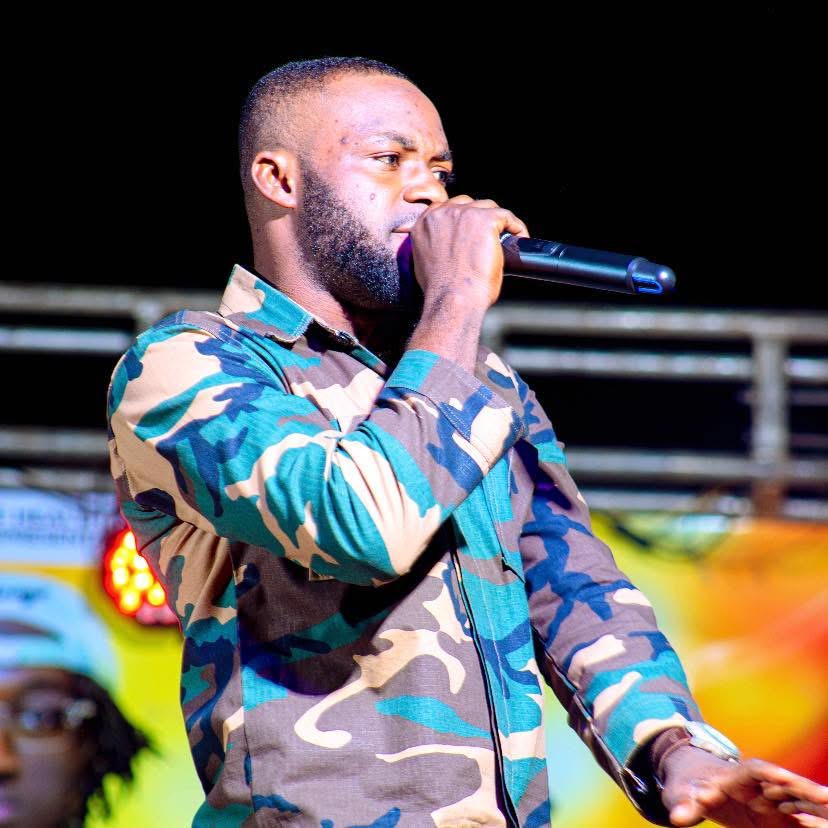
On some Wednesdays, 30-year-old Imoro Gadafi Wuni boards a vehicle in Bolgatanga to go to Bawku, a two-hour drive in Ghana’s Upper East Region, near the borders with Togo and Burkina Faso. The town’s highway runs through Kusasi land, which means that as a Mamprusi, he cannot travel without a military escort. He takes it when he needs to visit his mother. Sometimes he waits a week in Bolgatanga because the escort is not on schedule. He is a Tamale-based rapper who goes by Rap Gh.
His earliest memory of the conflict is gunshots in Bawku in 2011. He was in junior high school. By 2017, he had left Bawku for senior high school. He came back in 2020, around the time of a funeral for the Mamprusi chief who died in 1981. Under custom, a new chief cannot be installed until the old one’s funeral is completed.
That year, the dormant conflict resurrected. It calmed slightly in early 2021, and he stayed, hosting the “Highest Concert,” a street carnival he hoped would become annual. By November, after a murder on their street, he was calling from Tamale asking his mother and siblings to leave. His mother said no. The house was the only thing their father had left her.
Since then, he has lost several loved ones. In 2023, his uncle was one of three men shot while returning from a court hearing in Bolgatanga. His friend Abdul Aziz, in his mid-twenties, also died that year, about five hours after they met up in Tamale. Rap Gh found out on Facebook. Some faceless accounts posted about the attack and laughed.
He was not the only one in Bawku getting news that way.
His number one fan, Arafat, 24, who shared everything he posted on Facebook, died in a 2024 military and civilian confrontation. That same year, his best friend, Abdul Razak, popularly known as “Spain Borga,” came to collect his graduation certificate from Tamale Technical University. Spain Borga left Rap Gh’s house in the morning for Bawku. Rap Gh received the call before noon. Again, Facebook carried the images.
Bawku is a market town. For decades, traders from northern Togo and Burkina Faso crossed the border regularly for the market. But this is no longer the case. The conflict between the town’s two main ethnic groups—the Kusasi and the Mamprusi—over who should be the Bawku Naba (paramount chief) has made the border crossing too uncertain and dangerous.
The longstanding dispute has outlasted colonial administrators, military governments, civilian courts, and national mediation. However, between eruptions on the ground, it has found a new space to inhabit: Facebook, in real time, carried by named and unnamed accounts posting from inside Bawku and from diaspora cities. Facebook has emerged as the town’s primary information system—naming the dead before families are told, tracking shooting directions, warning which roads to avoid while showering each other with violent and derogatory language.
The town’s layout carries the history of the conflict in its geography. The Mamprusi, who are generally believed to have come as traders and administrators, settled at the center. The Kusasi, generally considered the indigenous inhabitants, surround them. The banks, markets, Presbyterian Hospital, and Nursing Training College are on the Mamprusi side. The education directorate, Municipal Assembly, Senior High School, and the district court are on the Kusasi side. A few military camps circle the Mamprusi quarter at the town center. The police station sits in the middle, although the officers have threatened to resign if they are not transferred out of the region.
The town has now hardened into separate Mamprusi and Kusasi territories, and movement between them is no longer possible. Smaller ethnic groups—the Bissa, Moshie, Bimoba, and Hausa—who happen to live on one side, stay there; suspicion of association alone carries the same risk as being an enemy.
The History of this Conflict
This conflict in Bawku began with a meeting.
As of 1824, the Kusasi, generally considered the indigenous inhabitants of the wider Bawku land, operated under the authority of a Tindana, a spiritual custodian responsible for shrines and land. The Nayiri—King and overlord of the Mamprugu kingdom—seated in Nalerigu, in Ghana’s North East Region, had the traditional authority to appoint and enskin Mamprusi chiefs across Mamprugu territories, including those in Bawku.
For generations, the two systems coexisted. The Nayiri-appointed Mamprusi chief governed the town and trade. The Kusasi held the land and the shrines.
When the British arrived in the early 20th century, they decided that only one system could count. Their colonial policy created a six-decade-long communal conflict between the Mamprusi and the Kusasi over the paramount chieftaincy of the Bawku municipality.
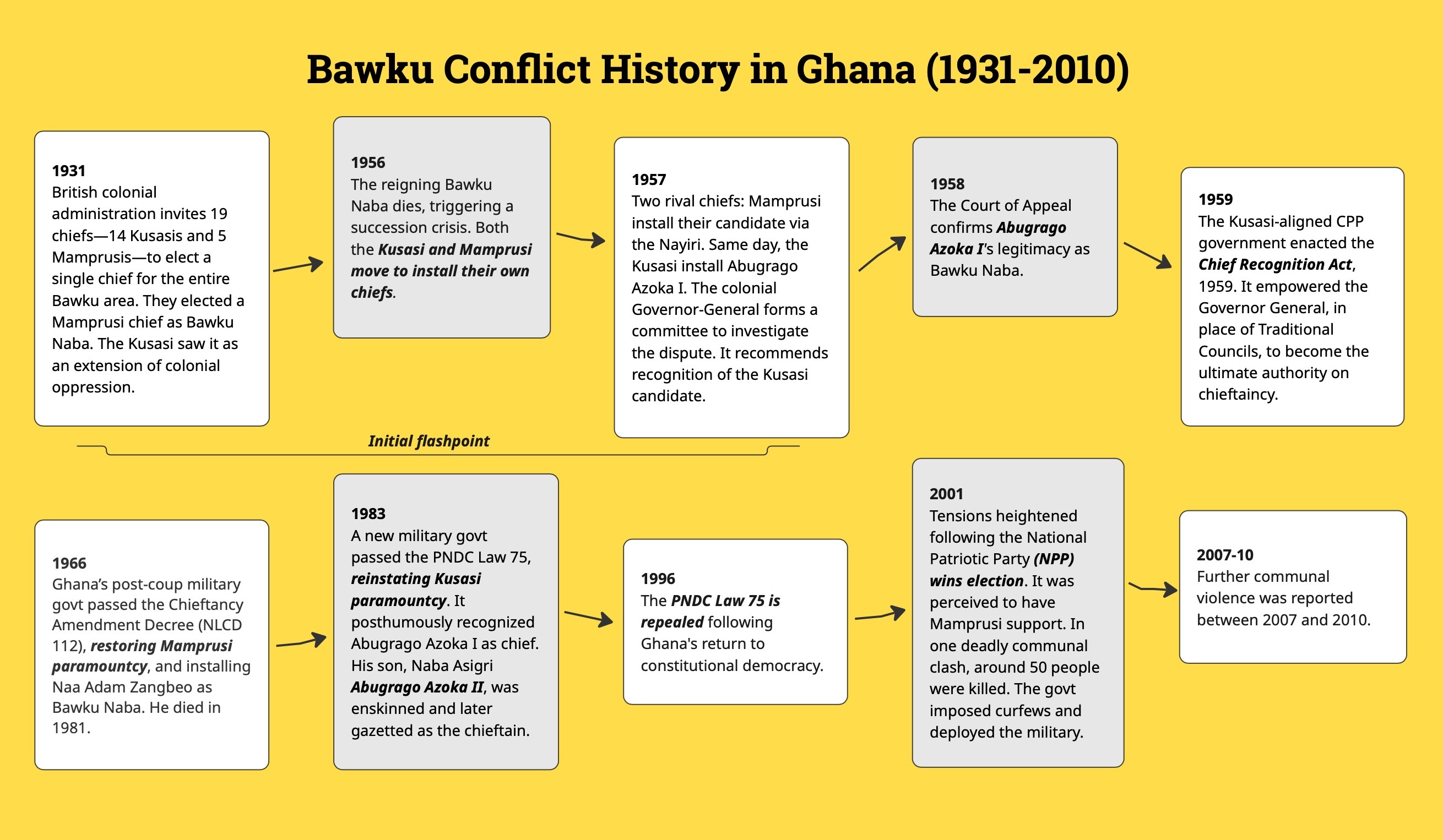
In 1931, British colonial administrator J.K.G. Syme invited 19 chiefs—5 Mamprusis and 14 mainly Kusasis —to elect a single chief to govern the entire Bawku area. Naa Bugri Mamboda, a Mamprusi chief, was elected. Their side called it a legitimate election. The Kusasi described it as triple colonization: subjection to the British Empire, to the Mamprusi king Nayiri, and to the Mamprusis directly above them “on their own land.”
By selecting the Mamprusi “overlord” model for indirect rule, colonial administrators placed the Kusasi under a chief they did not recognize as theirs, on land they considered ancestral.
When the Bawku Naba died in 1956, the Kusasi refused to recognize a Mampusi successor and installed their own, Abugrago Azoka I. A government-appointed committee recognized him as chief. After a legal tussle between the Mampusi and the Kusasi, widely seen as the initial flashpoint of the Bawku conflict, the Court of Appeal confirmed Abugrago Azoka I’s legitimacy in 1958.
Since then, both of Ghana’s leading political parties have used the conflict as a mobilization tool during election cycles and managed it into dormancy when it suited them. Successive governments and courts of law have seesawed between legitimizing Mamprusi and Kusasi chiefs for the town, causing several deadly communal violence over the years.
The Mamprusi took the Bawku dispute to the Ghanaian Supreme Court for the first time in 2003. They challenged the constitutional validity of the 1983 PNDC Law 75—that installed a Kusasi chief in the town. However, the applicant discontinued the suit before any hearing on the merits as he discovered PNDC Law 75 had actually been repealed in 1996.
The Court granted leave to withdraw, while also prohibiting the re-filing of the suit. While the suit’s discontinuation created controversy, the conflict persisted on the ground, with an estimated 200 people killed by 2023.
In February 2023, citing the 1931 meeting with the British, the Mamprusi Nayiri enskinned Alhaji Seidu Abagre as a rival Bawku Naba to the gazetted Azoka II. The Bolgatanga High Court issued an arrest warrant for Nayiri and his kingmakers for illegally installing a chief, and another for Seidu Abagre, for holding himself out as chief without authority.
However, the courts eventually set the warrants aside. And in October the following year, Seidu Abagre’s arrival in Bawku resulted in clashes, leaving another 26 people dead. The government announced an appeal for the Seidu Abagre case in 2024 and abandoned it.
In December 2025, after months of talks with delegations from both sides, the overlord of the Asante Kingdom presented a mediation report to the President, concluding that Azoka II, the Kusasi enskinned chief, is the legitimate Bawku Naba under the 1992 Constitution. The Interior Minister pledged the government’s support for Azoka II even as a curfew remained in place amid tensions.
The Ghana Armed Forces, following mediation recommendations, removed Seidu Abagre from Bawku on Christmas Eve; he was granted bail of 100,000 cedis in February and is standing trial for acting as chief without qualifications.
This mediation report landed on a town that had been following every development on Facebook for months. Both sides had been posting through the talks: leaks from delegations, speculation about outcomes, premature celebrations, and accusations of betrayal before any findings were announced.
When the conclusion of Azoka II’s legitimacy arrived, Facebook was still rife with misinformation. The news was met with Facebook Live celebrations in Kusasi areas, Mamprusi Lives with gunshots in the background, and accusations in the comment sections. The leader of the Mamprusi delegation has not returned home since. His house in Nalerigu was burned because his own side considers him a traitor. He is hiding in Accra, according to people on Facebook.
Since 1958, one can thus see a repeated pattern: institution of a government committee, followed by a court ruling, then perhaps a military decree or invocation of a constitutional provision, ultimately a mediation report. Each decision is superseded or ignored by the next government, the next coup, or the next political change. Neither of Ghana’s political parties has resolved the conflict because doing so would require dismantling the patronage structures that the conflict sustains.
The dispute outlived every ruling. What changed was how people learned about the conflict, the legal changes, and the violent outbursts.
The Role of Facebook on the Kusasi Side
Simon Asimiga was six years old and herding cattle when the NPP won the 2000 elections. He said targeted killings began in Bawku shortly after. The NPP has historically aligned with the Mamprusi on matters related to Bawku; its current presidential flagbearer is also Mamprusi. The incumbent NDC enjoys Kusasi support.
The 2003 Supreme Court case brought a pause to the violence emerging from the ethnic conflict. But, with the NPP leaving office in 2008, the Mamprusi struck again, killing “Alhaji Oga,” widely considered the most influential Kusasi figure and the most likely candidate for the next Kusasi Bawku Naba. “People were shooting sporadically where Alhaji Oga was sitting, and they ended up killing my father too. I was in Primary 3 when it happened.”
Asimiga, now 31, is a Kusasi radio presenter at Source FM in the Bawku Municipality.
He believes the current phase of the Bawku conflict, which began in 2021, started on Facebook. His older brother’s former classmate created an anonymous account in 2012 under the name “Naa Lubzure.” Two years later, the account disappeared, and a new page, “Bawku Links,” emerged: both Mamprusi in allegiance, consistent in inciting violence against the Kusasi, and growing a following by regularly posting about the conflict. During the Asantehene’s 2025 mediation process, for example, the page publicly declared that the only acceptable outcome was for Bawku to be handed to the Mamprusis, and that anything less would mean chaos.
The now-deleted page shared images of murdered Kusasis, alongside calls to find and kill those still alive, and for attacks and road blockages at Walewale—a Mamprusi town on the Bolgatanga highway. What happens in Bawku, thus, does not stay in Bawku. Retaliation travels down the road. When two students at Nalerigu Senior High School were shot dead by unidentified assailants, a student at Bawku Senior High School was shot later that evening in what was widely understood as a retaliatory attack.
The arrest on January 31, 2026, of Raphael Azare Kariyama on suspicion of running Bawku Links seemed to confirm what Asimiga had long suspected. He believes Kariyama is his older brother’s former classmate, the person behind both accounts. “It’s the same person who started everything we are dealing with today,” he said. “Before Naa Lubzure, nobody was posting about Bawku on Facebook.”
Asimiga started reporting on Bawku on Facebook in 2021. His radio show is in Kusaal, the Kusasi language. He admits the early days of reporting were not balanced. “When we started, we were ignorant, only reporting information that favored us and harmed the opposite side.”
A training with the Media Foundation for West Africa shifted this. He said he learned to set emotion aside and report what was happening on both sides.
But this new knowledge did not make him neutral in anyone’s eyes. In 2023, the then Municipal Chief Executive, Hon. Hamza Amadu, threatened Asimiga, saying, “I will deal with you,” in a widely circulated phone confrontation. This was after Asimiga questioned his claim of being the best Bawku MCE in a long while.
On a Mamprusi-run radio station that streams on Facebook, Gumah FM, Hon Amadu claims it is a misrepresentation of what he actually said. Yet Asimiga’s image circulated on Facebook and TikTok, and he has since been “marked [on those platforms] as someone to be eliminated.”
Asimiga has also lost more family to the violence. In 2023, his aunt’s limbs were broken. Her two children and husband were shot and set on fire on a communal farm with eight others. The man suspected of carrying out the attack, a Mamprusi national security operative named Fatawu Nambe, was also killed that year when he led a team to burn the palace of a Kusasi chief in a neighborhood called Azaanga, according to Asimiga.
People share information with Asimiga because he has built a platform. As traditional media seems fatigued by news from Bawku, people rely more on his radio platform.
Our interview started around 10 pm, after Asimiga finished a TikTok live and a football game. He told me that earlier in the morning, three people had died and two were receiving treatment near his house—information I had not come across despite researching all day.
His TikTok live streams average 500 viewers as he reads updates from Bawku in real time. He said the death counts coming out of the town are inaccurate. “Sometimes I can say that both sides bury their dead before the police arrive,” he said, explaining why the official tolls might be wrong. Out of shame, he means—shame at having to record that their side has succumbed to the other. “Everything is ego here.”
Sometimes people film themselves killing others and send it to the other side on WhatsApp. “Here in Bawku, if you allow yourself to be killed, you don’t get justice.”
He tries to verify each piece of information before posting. In the past, he had published false information and deleted it once corrected. Now he moves more slowly. He knows he can be arrested for publishing misinformation. His DMs and comment sections are full of insults exchanged across ethnic lines. Still, he feels the need to broadcast.

The Role of Facebook on the Mamprusi Side
Nash, a Mamprusi, runs the T Blow Nash Facebook account under his own name. He calls the Bawku conflict “a human disaster we caused ourselves,” framing it as an “economic” problem “before anything else.” Nash alleges, for example, that three million cedis in the MP Common Fund meant for the entire town went only to the Kusasi side recently. He cannot remember when the last humanitarian aid or National Disaster Management funding reached the Mamprusi in Bawku.
In 2020, Nash said he was accidentally added to a Facebook group called “Kusasi Youth Association,” a closed group for trusted Kusasis, including politicians. He said they were planning attacks on the Mamprusi. He discreetly alerted the Mamprusis, who had larger platforms. He had warned that a weapon would be tested in an empty well at 4 pm. Nobody listened until it happened. When a filling station was about to be burnt, he shared the information with them. The social commentators were too afraid to post it. The filling station burned.
So he started posting the information himself.
Nash does not position himself as a journalist. He positions himself as the person who posts because no one else will—and because not posting, as he learned in 2020, has serious consequences.
His sources come from every neighborhood in Bawku, and from the southern cities where most Bawku people have relocated—Accra and Kumasi. He describes them as wallflowers, ready to snap and send, never publicly tied to him. Nash’s informants never bring him information about harm planned towards Kusasis. A network that wide, and it still only ever sees one direction.
He explained that people who pass information across ethnic lines have a name in Bawku: double sim, after the dual SIM card phones that can hold two networks at once. They do not last long.
He also admitted to publishing misinformation. Once, a shooting by armed robbers came to him framed as part of the conflict. Another time, a killing outside Kumasi was pinned to the wrong location entirely. He apologized both times. It still caused damage, he says, because unlike the faceless accounts, his face is everywhere.
He knows what moves his audience. His best-performing posts are the ones that upset the Kusasis. “If I write something they dislike, I receive hundreds of reactions.” Praising the Mamprusi does the same. He is aware of the dynamic, and feeds into it for engagement, which he says leads to “more awareness about serious issues.”
The more than 200 accounts fueling the conflict from both sides use his image when it suits them. At the time of the interview, a video threat was circulating with his photograph, promising to “hunt him.” There is no way of determining who is behind the anonymous, faceless accounts that post these threats. He has started deactivating his account periodically for his own safety.
Nash left Bawku in 2021 and stopped his twice-yearly visits after he was accused of direct involvement in the conflict. His picture has circulated three times on Facebook, marked with fake police logos and the word “WANTED,” linking him to gang activity at Walewale on the Bolgatanga highway, and to the burning of a Yutong bus he said he knew nothing about.
Nash claims that the police held a docket on him from 2022 to 2024 in connection with one such bus-burning incident. Yet, he had stopped going to Bawku in 2021. In the last year alone, he has been arrested four times. Each time, they asked for his sources. He gave them the information from the Kusang Youth Group WhatsApp. And the authorities never make use of it. Once, he took a lie detector test and spent 21 days in detention at the Signals Bureau.
He believes the military is scared. “Kusasis are giving them instructions. Neighboring towns are being pressured to align with the Kusasi or face the same conditions the Mamprusi are living under.” For example, over 2,000 tubers of yams meant for Mamprusi markets spoiled in December because escorts were delayed, sometimes never coming at all.
When there are bans on wearing smocks and riding motorcycles, two of the most common things in Bawku and its environs, the Kusasi are not punished for ignoring them, Nash insisted.

The Platform Rewards Speed and Outrage
Many of the people who are fighting the most loudly on Facebook are not even in Bawku. According to Asimiga, they reside in Saudi Arabia, Germany, the US, and the UK. These people are hiding behind anonymous accounts, inciting from a distance, with nobody on the ground to lose.
His view on what would stop the conflict is direct. Arrest the most influential figures on both sides. Cut the funding. “In the 80s, President Rawlings arrested his own party members for fueling the conflict. That is the political will that is missing.”
Nash agreed, “arrest the politicians involved.”
Asimiga goes further. “The Mamprusi are caged in the center of the town. They need an escort to enter and leave Bawku, and yet somehow they still get weapons to kill. That should mean that the security agencies are also contributing to [the conflict].” He is convinced that arms seized from one side are sold to the other. “The authorities are failing the masses. The same people sent here to bring order and peace are the people redistributing the weapons. They have taken advantage of the conflict to make money.”
An investigation by iWatch Africa gives weight to concerns raised by Asimiga. Several reports have identified Ghana as a key transit point in the regional trade of illicit arms and explosives.
Asimiga said some people need compensation. Others need to be relocated entirely, their history and identity in Bawku wiped, because as long as they remain, they are targets. “I am safer within Bawku, among my people who know that my reporting is helping them, than if I were to go anywhere else in this country.”
Both Asimiga and Nash post under their real names and faces. They are exceptions, operating with a certain level of accountability. Still, neither of them is a neutral witness—they are active participants who have developed a sense of self-awareness about their roles. That partial self-awareness is exactly what makes Facebook governance so difficult to fix—even the most accountable people in the system are still deeply embedded within its architecture.
When a clash between the military and the Kusasi destroyed the Kusasi Bawku Naba’s statue, Nash posted a video of the remnants to mock the chief. When the regional police canceled the Mamprusi Damba festival celebrations, Asimiga’s response was to ridicule the Mamprusis. Both men will tell you they have gotten better. But their Facebook activity is still in the grey.
Before 2021, they were friends. Nash says Asimiga uses his radio show to attack him personally. Asimiga says he only responds to what Nash posts “with advice”.
On the other hand, the accounts that move the fastest—the ones that circulate death notices before families are told, share images of the dead, that mark men as wanted with fake police logos—belong to no one. They are pseudonyms, profile photos of dead comrades, and ethnic crests, run by people abroad and in Accra.
The platform rewards speed and outrage equally. The ones with the least accountability post the most. The ones with the most to lose post the most carefully. That vacuum is where the damage happens. Nash and Asimiga have both publicly apologized for publishing wrong information. The faceless accounts have never apologized for anything because there is no face to hold responsible.
Even so, it is exposure—being out in the open, with a name and a face that cannot be hidden—and not ethics that gets people to slow down. Asimiga verifies his posts now because he can be arrested under a slew of provisions under the Criminal Offences Act, which criminalizes the publication of false news, or under the Electronic Communications Act, which covers false statements made through electronic communications, or under the Cybersecurity Act, which addresses malicious online communications that incite damage to property and harm.
Nash deactivates his account periodically because his photograph keeps appearing on wanted posters. Their restraint is motivated by self-preservation, not principle.
Facebook Never Goes Quiet—Even When the Fighting Slows
Asimiga does not ignore the Mamprusi pages. “Sometimes I see something they post about us, and I know that if you had sympathy for Kusasis, by the time you finish watching the video, you will now be moved to kill us.” He knows that “it is false, but I also know that 10,000 people have already seen and believed it. By the time I post the correction, the damage is done.”
Nash reads the Kusasi pages too. He knows which ones post first, which ones are most likely to be accurate, and which ones exist only to provoke. “When I see something on their side, the first thing I ask is who benefits from this being posted right now.”
There are no unbiased journalists stationed in Bawku. National outlets report when the death toll becomes impossible to ignore, and move on when the headlines become repetitive.
After the National Media Commission warned in 2022 that it would sanction radio stations found to be stoking the conflict, broadcasters pulled back. But the pages did not. What remains inside the town is Facebook, TikTok live streams, and WhatsApp forwards.
When the media withdraws, it leaves behind an empty information space that political operatives, biased reporters, and anonymous accounts fill without competition—or regulation. Asimiga knows this. He stays in Bawku partly because leaving would mean abandoning one of the few verification functions the Kusasis have. He is not a neutral, but he is present, and presence in Bawku has become its own form of accountability, albeit imperfect and endangered.
Outside Bawku, the conflict is a news event that arrives and leaves. Inside it, Facebook is the only system running continuously. That it also spreads the wrong information, hardens division, and has gotten people arrested and threatened is not entirely a malfunction. It is what happens when a ubiquitous platform becomes infrastructure in a place the state has decided to manage rather than resolve.
Maximus Ametorgoh, a digital marketing analyst and technology expert, argues that the role of the platforms is algorithmic and the platforms themselves must intervene. He advocates for a government partnership with Facebook and TikTok to flag and suppress Bawku-related content, with independent oversight from national security and civil society to ensure the share and repost tools are not applied broadly. “While freedoms are enjoyed under the constitution, once speech is creating conflict and unrest, limitations need to be employed.”
It is a reasonable-sounding proposal that assumes the state can be trusted to draw that line without politicizing it. The state that held Nash’s docket for two years for a crime he was not around to commit. The state whose security operatives Asimiga believes are redistributing seized weapons. The state that arrested a chief on Christmas Eve and called it peace.
Facebook does not go quiet when the fighting slows. The accounts that were posting death counts switch to posting rumors about the next escalation. The diaspora accounts stay watching, ready.
The state has sent soldiers, imposed curfews, commissioned committees, and received mediation reports. It has arrested chiefs and released them, deskinned and enskinned them again. But the state leaves.
Facebook is the only institution in Bawku that has never left, never declared the situation too dangerous, or filed a report. Facebook is no longer a feature in the Bawku conflict—it is the administrator. Facebook is the state.
Back in Bawku, Source FM, Asimiga’s employer and the station that gave Rap GH his first interview, no longer plays his music. “Music was my only source of income, and now the conflict has taken it away from me.” Two years of stillness, with no gigs, pushed Rap GH toward nursing school in Nalerigu. He is in his final year now.
Outside Bawku, whenever he runs into people from home, they all say the same thing: they are tired, they want the conflict to stop. He believes them, and also believes that someone, somewhere benefits from it continuing.
He still has the numbers of the friends he started making music with in 2015. He wants to record a peace song with them, but he has not said this to them. He watches their WhatsApp stories. They watch his. But no one calls. There is no open hostility, just the fact that they are Kusasi. He is Mamprusi.
He sees them on Facebook, too.


In Ghana’s Bawku, Facebook Is the State

Amid rising violence between the Mamprusi and Kusasi in Bawku, Facebook has emerged as the town's primary information system—naming the dead before families are told, tracking shooting directions, warning which roads to avoid while showering each other with violent and derogatory language.
On some Wednesdays, 30-year-old Imoro Gadafi Wuni boards a vehicle in Bolgatanga to go to Bawku, a two-hour drive in Ghana’s Upper East Region, near the borders with Togo and Burkina Faso. The town’s highway runs through Kusasi land, which means that as a Mamprusi, he cannot travel without a military escort. He takes it when he needs to visit his mother. Sometimes he waits a week in Bolgatanga because the escort is not on schedule. He is a Tamale-based rapper who goes by Rap Gh.
His earliest memory of the conflict is gunshots in Bawku in 2011. He was in junior high school. By 2017, he had left Bawku for senior high school. He came back in 2020, around the time of a funeral for the Mamprusi chief who died in 1981. Under custom, a new chief cannot be installed until the old one’s funeral is completed.
That year, the dormant conflict resurrected. It calmed slightly in early 2021, and he stayed, hosting the “Highest Concert,” a street carnival he hoped would become annual. By November, after a murder on their street, he was calling from Tamale asking his mother and siblings to leave. His mother said no. The house was the only thing their father had left her.
Since then, he has lost several loved ones. In 2023, his uncle was one of three men shot while returning from a court hearing in Bolgatanga. His friend Abdul Aziz, in his mid-twenties, also died that year, about five hours after they met up in Tamale. Rap Gh found out on Facebook. Some faceless accounts posted about the attack and laughed.
He was not the only one in Bawku getting news that way.
His number one fan, Arafat, 24, who shared everything he posted on Facebook, died in a 2024 military and civilian confrontation. That same year, his best friend, Abdul Razak, popularly known as “Spain Borga,” came to collect his graduation certificate from Tamale Technical University. Spain Borga left Rap Gh’s house in the morning for Bawku. Rap Gh received the call before noon. Again, Facebook carried the images.
Bawku is a market town. For decades, traders from northern Togo and Burkina Faso crossed the border regularly for the market. But this is no longer the case. The conflict between the town’s two main ethnic groups—the Kusasi and the Mamprusi—over who should be the Bawku Naba (paramount chief) has made the border crossing too uncertain and dangerous.
The longstanding dispute has outlasted colonial administrators, military governments, civilian courts, and national mediation. However, between eruptions on the ground, it has found a new space to inhabit: Facebook, in real time, carried by named and unnamed accounts posting from inside Bawku and from diaspora cities. Facebook has emerged as the town’s primary information system—naming the dead before families are told, tracking shooting directions, warning which roads to avoid while showering each other with violent and derogatory language.
The town’s layout carries the history of the conflict in its geography. The Mamprusi, who are generally believed to have come as traders and administrators, settled at the center. The Kusasi, generally considered the indigenous inhabitants, surround them. The banks, markets, Presbyterian Hospital, and Nursing Training College are on the Mamprusi side. The education directorate, Municipal Assembly, Senior High School, and the district court are on the Kusasi side. A few military camps circle the Mamprusi quarter at the town center. The police station sits in the middle, although the officers have threatened to resign if they are not transferred out of the region.
The town has now hardened into separate Mamprusi and Kusasi territories, and movement between them is no longer possible. Smaller ethnic groups—the Bissa, Moshie, Bimoba, and Hausa—who happen to live on one side, stay there; suspicion of association alone carries the same risk as being an enemy.
The History of this Conflict
This conflict in Bawku began with a meeting.
As of 1824, the Kusasi, generally considered the indigenous inhabitants of the wider Bawku land, operated under the authority of a Tindana, a spiritual custodian responsible for shrines and land. The Nayiri—King and overlord of the Mamprugu kingdom—seated in Nalerigu, in Ghana’s North East Region, had the traditional authority to appoint and enskin Mamprusi chiefs across Mamprugu territories, including those in Bawku.
For generations, the two systems coexisted. The Nayiri-appointed Mamprusi chief governed the town and trade. The Kusasi held the land and the shrines.
When the British arrived in the early 20th century, they decided that only one system could count. Their colonial policy created a six-decade-long communal conflict between the Mamprusi and the Kusasi over the paramount chieftaincy of the Bawku municipality.
In 1931, British colonial administrator J.K.G. Syme invited 19 chiefs—5 Mamprusis and 14 mainly Kusasis —to elect a single chief to govern the entire Bawku area. Naa Bugri Mamboda, a Mamprusi chief, was elected. Their side called it a legitimate election. The Kusasi described it as triple colonization: subjection to the British Empire, to the Mamprusi king Nayiri, and to the Mamprusis directly above them “on their own land.”
By selecting the Mamprusi “overlord” model for indirect rule, colonial administrators placed the Kusasi under a chief they did not recognize as theirs, on land they considered ancestral.
When the Bawku Naba died in 1956, the Kusasi refused to recognize a Mampusi successor and installed their own, Abugrago Azoka I. A government-appointed committee recognized him as chief. After a legal tussle between the Mampusi and the Kusasi, widely seen as the initial flashpoint of the Bawku conflict, the Court of Appeal confirmed Abugrago Azoka I’s legitimacy in 1958.
Since then, both of Ghana’s leading political parties have used the conflict as a mobilization tool during election cycles and managed it into dormancy when it suited them. Successive governments and courts of law have seesawed between legitimizing Mamprusi and Kusasi chiefs for the town, causing several deadly communal violence over the years.
The Mamprusi took the Bawku dispute to the Ghanaian Supreme Court for the first time in 2003. They challenged the constitutional validity of the 1983 PNDC Law 75—that installed a Kusasi chief in the town. However, the applicant discontinued the suit before any hearing on the merits as he discovered PNDC Law 75 had actually been repealed in 1996.
The Court granted leave to withdraw, while also prohibiting the re-filing of the suit. While the suit’s discontinuation created controversy, the conflict persisted on the ground, with an estimated 200 people killed by 2023.
In February 2023, citing the 1931 meeting with the British, the Mamprusi Nayiri enskinned Alhaji Seidu Abagre as a rival Bawku Naba to the gazetted Azoka II. The Bolgatanga High Court issued an arrest warrant for Nayiri and his kingmakers for illegally installing a chief, and another for Seidu Abagre, for holding himself out as chief without authority.
However, the courts eventually set the warrants aside. And in October the following year, Seidu Abagre’s arrival in Bawku resulted in clashes, leaving another 26 people dead. The government announced an appeal for the Seidu Abagre case in 2024 and abandoned it.
In December 2025, after months of talks with delegations from both sides, the overlord of the Asante Kingdom presented a mediation report to the President, concluding that Azoka II, the Kusasi enskinned chief, is the legitimate Bawku Naba under the 1992 Constitution. The Interior Minister pledged the government’s support for Azoka II even as a curfew remained in place amid tensions.
The Ghana Armed Forces, following mediation recommendations, removed Seidu Abagre from Bawku on Christmas Eve; he was granted bail of 100,000 cedis in February and is standing trial for acting as chief without qualifications.
This mediation report landed on a town that had been following every development on Facebook for months. Both sides had been posting through the talks: leaks from delegations, speculation about outcomes, premature celebrations, and accusations of betrayal before any findings were announced.
When the conclusion of Azoka II’s legitimacy arrived, Facebook was still rife with misinformation. The news was met with Facebook Live celebrations in Kusasi areas, Mamprusi Lives with gunshots in the background, and accusations in the comment sections. The leader of the Mamprusi delegation has not returned home since. His house in Nalerigu was burned because his own side considers him a traitor. He is hiding in Accra, according to people on Facebook.
Since 1958, one can thus see a repeated pattern: institution of a government committee, followed by a court ruling, then perhaps a military decree or invocation of a constitutional provision, ultimately a mediation report. Each decision is superseded or ignored by the next government, the next coup, or the next political change. Neither of Ghana’s political parties has resolved the conflict because doing so would require dismantling the patronage structures that the conflict sustains.
The dispute outlived every ruling. What changed was how people learned about the conflict, the legal changes, and the violent outbursts.
The Role of Facebook on the Kusasi Side
Simon Asimiga was six years old and herding cattle when the NPP won the 2000 elections. He said targeted killings began in Bawku shortly after. The NPP has historically aligned with the Mamprusi on matters related to Bawku; its current presidential flagbearer is also Mamprusi. The incumbent NDC enjoys Kusasi support.
The 2003 Supreme Court case brought a pause to the violence emerging from the ethnic conflict. But, with the NPP leaving office in 2008, the Mamprusi struck again, killing “Alhaji Oga,” widely considered the most influential Kusasi figure and the most likely candidate for the next Kusasi Bawku Naba. “People were shooting sporadically where Alhaji Oga was sitting, and they ended up killing my father too. I was in Primary 3 when it happened.”
Asimiga, now 31, is a Kusasi radio presenter at Source FM in the Bawku Municipality.
He believes the current phase of the Bawku conflict, which began in 2021, started on Facebook. His older brother’s former classmate created an anonymous account in 2012 under the name “Naa Lubzure.” Two years later, the account disappeared, and a new page, “Bawku Links,” emerged: both Mamprusi in allegiance, consistent in inciting violence against the Kusasi, and growing a following by regularly posting about the conflict. During the Asantehene’s 2025 mediation process, for example, the page publicly declared that the only acceptable outcome was for Bawku to be handed to the Mamprusis, and that anything less would mean chaos.
The now-deleted page shared images of murdered Kusasis, alongside calls to find and kill those still alive, and for attacks and road blockages at Walewale—a Mamprusi town on the Bolgatanga highway. What happens in Bawku, thus, does not stay in Bawku. Retaliation travels down the road. When two students at Nalerigu Senior High School were shot dead by unidentified assailants, a student at Bawku Senior High School was shot later that evening in what was widely understood as a retaliatory attack.
The arrest on January 31, 2026, of Raphael Azare Kariyama on suspicion of running Bawku Links seemed to confirm what Asimiga had long suspected. He believes Kariyama is his older brother’s former classmate, the person behind both accounts. “It’s the same person who started everything we are dealing with today,” he said. “Before Naa Lubzure, nobody was posting about Bawku on Facebook.”
Asimiga started reporting on Bawku on Facebook in 2021. His radio show is in Kusaal, the Kusasi language. He admits the early days of reporting were not balanced. “When we started, we were ignorant, only reporting information that favored us and harmed the opposite side.”
A training with the Media Foundation for West Africa shifted this. He said he learned to set emotion aside and report what was happening on both sides.
But this new knowledge did not make him neutral in anyone’s eyes. In 2023, the then Municipal Chief Executive, Hon. Hamza Amadu, threatened Asimiga, saying, “I will deal with you,” in a widely circulated phone confrontation. This was after Asimiga questioned his claim of being the best Bawku MCE in a long while.
On a Mamprusi-run radio station that streams on Facebook, Gumah FM, Hon Amadu claims it is a misrepresentation of what he actually said. Yet Asimiga’s image circulated on Facebook and TikTok, and he has since been “marked [on those platforms] as someone to be eliminated.”
Asimiga has also lost more family to the violence. In 2023, his aunt’s limbs were broken. Her two children and husband were shot and set on fire on a communal farm with eight others. The man suspected of carrying out the attack, a Mamprusi national security operative named Fatawu Nambe, was also killed that year when he led a team to burn the palace of a Kusasi chief in a neighborhood called Azaanga, according to Asimiga.
People share information with Asimiga because he has built a platform. As traditional media seems fatigued by news from Bawku, people rely more on his radio platform.
Our interview started around 10 pm, after Asimiga finished a TikTok live and a football game. He told me that earlier in the morning, three people had died and two were receiving treatment near his house—information I had not come across despite researching all day.
His TikTok live streams average 500 viewers as he reads updates from Bawku in real time. He said the death counts coming out of the town are inaccurate. “Sometimes I can say that both sides bury their dead before the police arrive,” he said, explaining why the official tolls might be wrong. Out of shame, he means—shame at having to record that their side has succumbed to the other. “Everything is ego here.”
Sometimes people film themselves killing others and send it to the other side on WhatsApp. “Here in Bawku, if you allow yourself to be killed, you don’t get justice.”
He tries to verify each piece of information before posting. In the past, he had published false information and deleted it once corrected. Now he moves more slowly. He knows he can be arrested for publishing misinformation. His DMs and comment sections are full of insults exchanged across ethnic lines. Still, he feels the need to broadcast.
The Role of Facebook on the Mamprusi Side
Nash, a Mamprusi, runs the T Blow Nash Facebook account under his own name. He calls the Bawku conflict “a human disaster we caused ourselves,” framing it as an “economic” problem “before anything else.” Nash alleges, for example, that three million cedis in the MP Common Fund meant for the entire town went only to the Kusasi side recently. He cannot remember when the last humanitarian aid or National Disaster Management funding reached the Mamprusi in Bawku.
In 2020, Nash said he was accidentally added to a Facebook group called “Kusasi Youth Association,” a closed group for trusted Kusasis, including politicians. He said they were planning attacks on the Mamprusi. He discreetly alerted the Mamprusis, who had larger platforms. He had warned that a weapon would be tested in an empty well at 4 pm. Nobody listened until it happened. When a filling station was about to be burnt, he shared the information with them. The social commentators were too afraid to post it. The filling station burned.
So he started posting the information himself.
Nash does not position himself as a journalist. He positions himself as the person who posts because no one else will—and because not posting, as he learned in 2020, has serious consequences.
His sources come from every neighborhood in Bawku, and from the southern cities where most Bawku people have relocated—Accra and Kumasi. He describes them as wallflowers, ready to snap and send, never publicly tied to him. Nash’s informants never bring him information about harm planned towards Kusasis. A network that wide, and it still only ever sees one direction.
He explained that people who pass information across ethnic lines have a name in Bawku: double sim, after the dual SIM card phones that can hold two networks at once. They do not last long.
He also admitted to publishing misinformation. Once, a shooting by armed robbers came to him framed as part of the conflict. Another time, a killing outside Kumasi was pinned to the wrong location entirely. He apologized both times. It still caused damage, he says, because unlike the faceless accounts, his face is everywhere.
He knows what moves his audience. His best-performing posts are the ones that upset the Kusasis. “If I write something they dislike, I receive hundreds of reactions.” Praising the Mamprusi does the same. He is aware of the dynamic, and feeds into it for engagement, which he says leads to “more awareness about serious issues.”
The more than 200 accounts fueling the conflict from both sides use his image when it suits them. At the time of the interview, a video threat was circulating with his photograph, promising to “hunt him.” There is no way of determining who is behind the anonymous, faceless accounts that post these threats. He has started deactivating his account periodically for his own safety.
Nash left Bawku in 2021 and stopped his twice-yearly visits after he was accused of direct involvement in the conflict. His picture has circulated three times on Facebook, marked with fake police logos and the word “WANTED,” linking him to gang activity at Walewale on the Bolgatanga highway, and to the burning of a Yutong bus he said he knew nothing about.
Nash claims that the police held a docket on him from 2022 to 2024 in connection with one such bus-burning incident. Yet, he had stopped going to Bawku in 2021. In the last year alone, he has been arrested four times. Each time, they asked for his sources. He gave them the information from the Kusang Youth Group WhatsApp. And the authorities never make use of it. Once, he took a lie detector test and spent 21 days in detention at the Signals Bureau.
He believes the military is scared. “Kusasis are giving them instructions. Neighboring towns are being pressured to align with the Kusasi or face the same conditions the Mamprusi are living under.” For example, over 2,000 tubers of yams meant for Mamprusi markets spoiled in December because escorts were delayed, sometimes never coming at all.
When there are bans on wearing smocks and riding motorcycles, two of the most common things in Bawku and its environs, the Kusasi are not punished for ignoring them, Nash insisted.
The Platform Rewards Speed and Outrage
Many of the people who are fighting the most loudly on Facebook are not even in Bawku. According to Asimiga, they reside in Saudi Arabia, Germany, the US, and the UK. These people are hiding behind anonymous accounts, inciting from a distance, with nobody on the ground to lose.
His view on what would stop the conflict is direct. Arrest the most influential figures on both sides. Cut the funding. “In the 80s, President Rawlings arrested his own party members for fueling the conflict. That is the political will that is missing.”
Nash agreed, “arrest the politicians involved.”
Asimiga goes further. “The Mamprusi are caged in the center of the town. They need an escort to enter and leave Bawku, and yet somehow they still get weapons to kill. That should mean that the security agencies are also contributing to [the conflict].” He is convinced that arms seized from one side are sold to the other. “The authorities are failing the masses. The same people sent here to bring order and peace are the people redistributing the weapons. They have taken advantage of the conflict to make money.”
An investigation by iWatch Africa gives weight to concerns raised by Asimiga. Several reports have identified Ghana as a key transit point in the regional trade of illicit arms and explosives.
Asimiga said some people need compensation. Others need to be relocated entirely, their history and identity in Bawku wiped, because as long as they remain, they are targets. “I am safer within Bawku, among my people who know that my reporting is helping them, than if I were to go anywhere else in this country.”
Both Asimiga and Nash post under their real names and faces. They are exceptions, operating with a certain level of accountability. Still, neither of them is a neutral witness—they are active participants who have developed a sense of self-awareness about their roles. That partial self-awareness is exactly what makes Facebook governance so difficult to fix—even the most accountable people in the system are still deeply embedded within its architecture.
When a clash between the military and the Kusasi destroyed the Kusasi Bawku Naba’s statue, Nash posted a video of the remnants to mock the chief. When the regional police canceled the Mamprusi Damba festival celebrations, Asimiga’s response was to ridicule the Mamprusis. Both men will tell you they have gotten better. But their Facebook activity is still in the grey.
Before 2021, they were friends. Nash says Asimiga uses his radio show to attack him personally. Asimiga says he only responds to what Nash posts “with advice”.
On the other hand, the accounts that move the fastest—the ones that circulate death notices before families are told, share images of the dead, that mark men as wanted with fake police logos—belong to no one. They are pseudonyms, profile photos of dead comrades, and ethnic crests, run by people abroad and in Accra.
The platform rewards speed and outrage equally. The ones with the least accountability post the most. The ones with the most to lose post the most carefully. That vacuum is where the damage happens. Nash and Asimiga have both publicly apologized for publishing wrong information. The faceless accounts have never apologized for anything because there is no face to hold responsible.
Even so, it is exposure—being out in the open, with a name and a face that cannot be hidden—and not ethics that gets people to slow down. Asimiga verifies his posts now because he can be arrested under a slew of provisions under the Criminal Offences Act, which criminalizes the publication of false news, or under the Electronic Communications Act, which covers false statements made through electronic communications, or under the Cybersecurity Act, which addresses malicious online communications that incite damage to property and harm.
Nash deactivates his account periodically because his photograph keeps appearing on wanted posters. Their restraint is motivated by self-preservation, not principle.
Facebook Never Goes Quiet—Even When the Fighting Slows
Asimiga does not ignore the Mamprusi pages. “Sometimes I see something they post about us, and I know that if you had sympathy for Kusasis, by the time you finish watching the video, you will now be moved to kill us.” He knows that “it is false, but I also know that 10,000 people have already seen and believed it. By the time I post the correction, the damage is done.”
Nash reads the Kusasi pages too. He knows which ones post first, which ones are most likely to be accurate, and which ones exist only to provoke. “When I see something on their side, the first thing I ask is who benefits from this being posted right now.”
There are no unbiased journalists stationed in Bawku. National outlets report when the death toll becomes impossible to ignore, and move on when the headlines become repetitive.
After the National Media Commission warned in 2022 that it would sanction radio stations found to be stoking the conflict, broadcasters pulled back. But the pages did not. What remains inside the town is Facebook, TikTok live streams, and WhatsApp forwards.
When the media withdraws, it leaves behind an empty information space that political operatives, biased reporters, and anonymous accounts fill without competition—or regulation. Asimiga knows this. He stays in Bawku partly because leaving would mean abandoning one of the few verification functions the Kusasis have. He is not a neutral, but he is present, and presence in Bawku has become its own form of accountability, albeit imperfect and endangered.
Outside Bawku, the conflict is a news event that arrives and leaves. Inside it, Facebook is the only system running continuously. That it also spreads the wrong information, hardens division, and has gotten people arrested and threatened is not entirely a malfunction. It is what happens when a ubiquitous platform becomes infrastructure in a place the state has decided to manage rather than resolve.
Maximus Ametorgoh, a digital marketing analyst and technology expert, argues that the role of the platforms is algorithmic and the platforms themselves must intervene. He advocates for a government partnership with Facebook and TikTok to flag and suppress Bawku-related content, with independent oversight from national security and civil society to ensure the share and repost tools are not applied broadly. “While freedoms are enjoyed under the constitution, once speech is creating conflict and unrest, limitations need to be employed.”
It is a reasonable-sounding proposal that assumes the state can be trusted to draw that line without politicizing it. The state that held Nash’s docket for two years for a crime he was not around to commit. The state whose security operatives Asimiga believes are redistributing seized weapons. The state that arrested a chief on Christmas Eve and called it peace.
Facebook does not go quiet when the fighting slows. The accounts that were posting death counts switch to posting rumors about the next escalation. The diaspora accounts stay watching, ready.
The state has sent soldiers, imposed curfews, commissioned committees, and received mediation reports. It has arrested chiefs and released them, deskinned and enskinned them again. But the state leaves.
Facebook is the only institution in Bawku that has never left, never declared the situation too dangerous, or filed a report. Facebook is no longer a feature in the Bawku conflict—it is the administrator. Facebook is the state.
Back in Bawku, Source FM, Asimiga’s employer and the station that gave Rap GH his first interview, no longer plays his music. “Music was my only source of income, and now the conflict has taken it away from me.” Two years of stillness, with no gigs, pushed Rap GH toward nursing school in Nalerigu. He is in his final year now.
Outside Bawku, whenever he runs into people from home, they all say the same thing: they are tired, they want the conflict to stop. He believes them, and also believes that someone, somewhere benefits from it continuing.
He still has the numbers of the friends he started making music with in 2015. He wants to record a peace song with them, but he has not said this to them. He watches their WhatsApp stories. They watch his. But no one calls. There is no open hostility, just the fact that they are Kusasi. He is Mamprusi.
He sees them on Facebook, too.