




Haque, in his mid-50s, was blindfolded with his hands cuffed and put in a vehicle belonging to India’s Border Security Force (BSF). It had been a few hours on the road; he didn’t know where he was being taken. He said his body was bruised from being beaten in custody, along with 38 other people with whom he was detained. They were picked up from the Matia Transit Camp, India’s largest immigrant detention center, located in the northeastern state of Assam.
In 1997, a Foreigners Tribunal ruled that Haque (name changed for his safety), a Bengali Muslim, was a foreigner–stripping him of citizenship. The quasi-judicial Foreigners Tribunals in Assam determine whether individuals, who have been labeled as ‘Doubtful Voters’ due to state allegations that their voter registration paperwork is flawed, are Indian citizens or undocumented immigrants. He was later detained for being an alleged “illegal immigrant” for three years before being released on bail and required to check in regularly with the police.
Haque’s family has lived in India for generations. The family has a document showing that Haque’s father had paid revenue tax on land the family owned in the 1940s, from before India won independence from colonial Britain. His son works in Mumbai. He got on the first train to Assam as soon as he got a phone call about his father. “That day I became so nervous,” he said.
The BSF had picked up Haque on May 24, 2025. At around 11 pm, the group of detainees finally arrived at a BSF building, but they did not know exactly where they were. The BSF personnel gave each detainee two bananas and some cash, then separated the detainees into three groups, who were then sent on different paths. Haque’s group was in a jungle, with the Brahmaputra River flowing nearby. At gunpoint, BSF officers pushed them forward and forced them to walk around the river, along a dirt path, as foxes and other wild animals prowled around them, Haque narrated. “We were very scared,” he recalled. “We didn’t know what they were going to do. Were they going to throw us in the river, throw us to the jungle, or kill us? Who knows?”
The group walked several kilometers until they saw a road. As they walked, he saw a Madrasa on one side and a police station further down, Haque said. The morning call to prayer began playing from a nearby mosque, and Haque noticed that everyone in the area was wearing skullcaps.
They were in Bangladesh.
Ramped-up Crackdown on ‘Foreigners’
While India has not released any official numbers, the Border Guard of Bangladesh says Indian authorities forced approximately 2,479 people across the border between May 2025 and January 2026, with over 100 of them being Indian citizens.
India currently uses a mechanism known as “push-back” to forcibly send suspected “illegal immigrants” across the border, bypassing the standard legal deportation process.
Assam’s Chief Minister has been openly candid about its purpose. Sarma stated that migrants were being “pushed back” specifically to avoid legal procedure, calling it an “operation” by the Government of India in which Assam was a stakeholder. “Earlier, we used to arrest them, produce them in courts and follow the legal procedure. But now, we are pushing them back right from the border,” he said in May 2025, after over a hundred Rohingya and Bengali-speaking persons were pushed into Bangladesh.
Over the last year, crackdowns on those suspected of being Bangladeshis have intensified across India. But the crackdowns weren’t just in border states like Assam. In Gujarat, nearly 1000 citizens, the majority Bengali Muslims, were detained. In Delhi, an additional 121 Bengali Muslims were detained. In Odisha, 444 migrant workers were also detained. In Rajasthan, over 1000. Many of the detainees were subsequently released after their citizenship was verified.
India has long had a contentious relationship with foreigners and those accused of being foreigners for decades. But the crackdown escalated after April 2025, when 26 people were killed in a militant attack in Kashmir, sparking cross-border violence between India and Pakistan. Domestically, authorities and vigilantes responded by targeting Muslim minorities throughout India. Pakistani nationals had their visas revoked, and nearly 800 were deported. Amid this, Kashmiris reported being evicted from rented apartments and experiencing increased police harassment. A ramped-up crackdown on “illegal immigrants” in view of “national security” ensued; Bengali migrant workers, especially Muslims, faced sweeping actions across the country.
Rohingya refugees, a predominantly Muslim ethnic minority from Myanmar, also reported increased harassment by the Indian police. Hundreds have been detained and pushed into Bangladesh as part of the crackdown. “When India carried out surgical strikes [against Pakistan], it was the same day Rohingya refugees in Delhi were detained,” said Priyali Sur, executive director of the Azadi Project, which advocates for Rohingya refugees in India. After 40 Rohingyas were detained in Delhi, they were flown to an island in the Indian Ocean and then ferried across the sea via boat before allegedly being forced to jump off into the ocean near the Myanmar shore and swim.

The evictions and detentions across the country prompted UN human rights experts to demand India stop the practice and “stressed that ‘national security’ and ‘foreign nationality’ should never be used as a pretext to justify the forced eviction of communities without legal safeguards.” The lack of due process in “push-backs” has also been flagged by rights groups, such as the Human Rights Watch.
However, India continues its “push-back” practice. On the other hand, Bangladesh has lodged formal objections to India’s “push-back” policy, which it describes as “push-in,” while also raising the matter with the UN refugee agency and ordering the BGB to resist such moves. Bangladesh’s junior minister of foreign affairs has said that the practice of “push-in” violates international law and the India-Bangladesh treaty on border control. “We will in no way accept push-ins of people,” she said. As a result, many people are often stranded at the Zero Line (no man’s land at the India-Bangladesh border). In a recent case at the Benapole border near West Bengal, 10 people, including women and children, were left stranded at the Zero Line for several days. As of the publication of this report, the two countries’ border guards were unable to resolve this case.
For years, people like Haque lived in a precarious position of statelessness. After being declared foreigners, they could not be deported to Bangladesh either. According to Guwahati-based attorney Sauradeep Dey, who has represented several Rohingya refugees, for a deportation to take place, the individual’s home country must accept them as its citizens. It left those who were declared foreigners in limbo. Although such people were accused of being Bangladeshi, they had never set foot in that country, leading to years of detention in India, Dey said. After a Covid-era court order, many were released on bail but stripped of numerous rights, such as eligibility for government rations and the right to vote. It was after the militant attack in Kashmir that the Indian government started forcefully removing those declared foreigners from the country. During such a routine check in 2025, Haque was expelled from India.
“How can you send someone to another country without that country accepting?” Dey questioned. “After having lived here for so many years, the push-back takes on a whole new meaning.”
Lawfare over Citizenship, a Playbook for India’s Eastern Border
In nationalist countries ruled by majorities across the globe, the law is often used to classify and divide populations through the issuing and withholding of citizenship, creating a hierarchy of rights and legally sanctioned discrimination. This is particularly prevalent in Assam, which shares a border with Bangladesh.
Assam’s approach to identifying and expelling “foreigners” has long been shaped by a distinct mix of regional anxieties and national politics. The state has witnessed mass mobilizations and episodes of violence driven by fears that migration from Bangladesh could overwhelm local culture and strain economic resources. These concerns formed the backbone of the Assam Movement of the late 1970s and 1980s. The 1985 Assam Accords created government mechanisms to oust suspected foreigners and seal the border with Bangladesh. Later, the National Register of Citizens (NRC), used to identify legal residents, was updated in 2018–19, leaving out nearly two million people, many of them Bengali-speaking. Thousands have since been subjected to proceedings before Foreigners’ Tribunals, with many sent to detention centers.
The subsequent introduction of the controversial Citizenship Amendment Act (CAA) in 2019 added a controversial religious dimension to this process, leaving Bengali Muslims particularly vulnerable to being labeled “foreigners”. The law offers a pathway to citizenship for Hindus, Sikhs, Buddhists, Jains, Parsis, and Christians fleeing persecution in neighboring countries, but excludes Muslims. Thus, non-Muslims excluded from the NRC may still be able to seek relief under the CAA.
These frameworks have created a far-reaching system of verification, detention, and eviction in Assam, where long-standing concerns over land, language, and identity intersect with a broader Hindu nationalist project. These overlapping forces fall most heavily on Bengali Muslim communities.
According to the Assam state government, by 2024, nearly 150,000 people, the majority Muslim, had been stripped of citizenship and rendered stateless since the signing of the 1985 Assam Accords. Another 1.9 million people whose names were left off the 2019 NRC are also at risk of statelessness.
Concerns around the NRC prompted the international organization Genocide Watch to issue a “genocide warning” for Assam. “This is a classic case of denial of citizenship in order to deprive a minority ethnic and religious group of its rights. It could become a prelude to another genocide like Myanmar’s genocide against its Rohingya Muslims,” it said.
Subsequently, the Immigrants and Foreigners Act, 2025, created an exemption for Hindu, Sikh, Buddhist, Jain, Parsi, and Christian minorities from Afghanistan, Bangladesh, and Pakistan who entered India before December 31, 2024, without valid documents. Rights groups raised concerns that the legislation significantly expanded state power over migrants, refugees, and anyone suspected of being a foreigner. Amnesty International warned that provisions allowing detention and deportation of undocumented individuals could place refugees like the Rohingyas at risk of being returned to countries where they face persecution, which amounts to a violation of the international principle of non-refoulement.
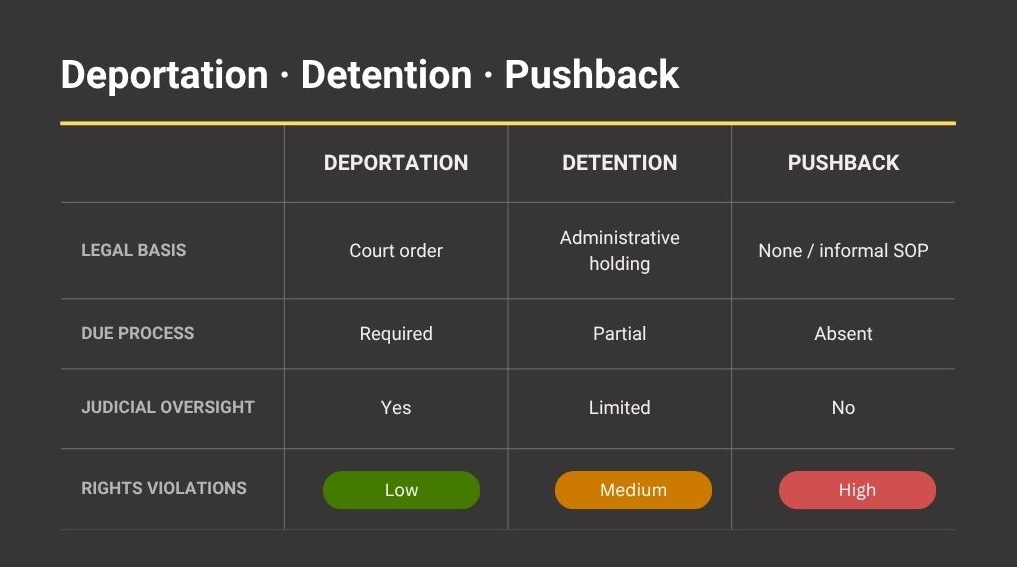
The current phase of the crackdown against undocumented foreigners, following the 2025 escalation, is also happening under a political climate rife with anti-Bengali Muslim rhetoric across India, and particularly in the border state of Assam. Apart from detention and deportation, punitive demolitions have taken place. Violent eviction drives bulldozed homes of thousands of Bengali Muslims, including 660 families in Goalpara on June 16, 2025, with another 1080 families evicted from there just three weeks later, 93 families in Nalbari district, and 1400 families in Dhubri district to make way for a power plant.
In the lead-up to state elections this year in Assam, Chief Minister Himanta Biswa Sarma of the Bharatiya Janata Party (BJP) stated his intent to remove Bengali Muslims from the region on multiple occasions. In January, he threatened to expel 10,000 – 15,000 Bengali Muslims annually, making it an election agenda. Sarma rewon the elections with a sweeping majority, owing to what political observers called a “sharp religious polarization of the electorate.”
Following this, the BJP also won in West Bengal, another border state, for the first time. Suvendu Adhikari was sworn in as Chief Minister on May 9, and within days, the new government moved aggressively on “illegal immigration” — a central campaign promise of the Hindu nationalist party. It has set up detention centers in Malda and Murshidabad districts, which have a significant Muslim population and border Bangladesh. These centers are meant to temporarily hold undocumented people suspected of being foreigners before deportation. Adhikari has further directed all 23 district magistrates to establish detention centers.
The government’s stated framework is an aggressive “detect, delete, deport” policy, under the Immigration and Foreigners Act and a Union Home Ministry directive from May 2025. However, such policies are being treated as high-priority and being implemented in the stark absence of credible, publicly available data on undocumented Bangladeshi nationals and Rohingyas in West Bengal.
“Under its hardline, anti-immigrant and anti-refugee policy of detect-delete-deport, the new BJP-led government in West Bengal has ordered the creation of new holding centers for Rohingya refugees and Bangladeshis. This has raised immense concerns among the Rohingya refugee population living there and also among the ‘Muslim citizens’ in the state who may not have the necessary documents to prove citizenship,” said Priyali Sur of the Azadi Project.
Unlike Assam, where suspected foreigners are produced before Foreigners’ Tribunals, detainees in West Bengal will reportedly not be presented in court. This could increase the possibility of Indian citizens being wrongly identified as Bangladeshi and deported, which has already happened several times. A recent case illustrates the risk: the Calcutta High Court set aside the federal government’s decision to deport two women and their families from Birbhum district to Bangladesh and ordered their return. The petitioners had alleged that the families, working as daily wage earners in Delhi’s Rohini area for over two decades, were picked up by police on suspicion of being illegal Bangladeshis and pushed across the border without due process.
“This entire move seems to be borrowed from the Assam playbook, where high on the Hindu nationalist agenda, the country’s largest detention center was built targeting “undocumented people”, Rohingya refugees and Bangladeshis. They were detained and held in prison-like facilities for years in terrible and anti-humane conditions, and then one day randomly and illegally deported without due process,” Sur noted. The Azadi Project’s upcoming report will share evidence-based data points on the illegal nature of these detentions and deportations, she added.
“Authoritative regimes follow a playbook,” Sur said, explaining that it includes the accounting of who is and isn’t a citizen, followed by the removal of rights such as voting, and then the stripping of citizenship. “It’s actually scary. What has happened to the Rohingya community in Myanmar should not be a repeat for Muslims in India,” she said.
Rohingyas Pay a High Price Amid Crackdown
While the foreigner distinction is used to target Bengali Muslims particularly, that doesn’t preclude other minorities like the Rohingyas from also being swept up in the crackdown.
Rohingya refugees don’t get protection under the Immigrants and Foreigners Act, 2025, as they are Muslims and from Myanmar–both excluded from the purview of this law. The BJP-led Indian government sees Rohingya refugees within a broader category of “illegal Muslim immigrants,” often grouping them with undocumented migrants from Bangladesh.
For the Rohingyas, the push-backs that started in April 2025 were not the first time they had been subject to a state policy of violent removal. Myanmar stripped the ethnic minority of their citizenship in 1982 before embarking on what a UN fact-finding mission concluded to be a “textbook campaign of ethnic cleansing.”
“The Myanmar government pre-planned to drive out our community through systematic genocide, step by step,” said Fazal, a Rohingya refugee who was expelled from India to Bangladesh. His name has been changed for his safety.
In 1982, Myanmar passed a law that effectively stripped all Rohingyas of citizenship and rendered the entire ethnic minority stateless. The law was the groundwork for institutionalized discrimination and waves of mass displacement since the 1990’s, ultimately leading to a genocide that started in 2017. Since then, over 1 million Rohingyas have fled to neighboring Bangladesh. The majority live in the world’s largest refugee camp in Cox’s Bazar, a town located in southern Bangladesh near the border with Myanmar.
Fazal met this reporter at his home in Cox’s Bazar, Bangladesh. Born in Myanmar without citizenship, Fazal grew up in the absence of his father–a government employee who was killed right before Fazal was born. “Without citizenship, it’s like you are alive, but you have no energy. You survive, but there is no heart,” he said.
When the ethnic violence worsened in 2012, Fazal fled home and joined his two brothers, who were already living in Bangladesh. He eventually went to India, where he studied and found a job as a social worker to help improve the living conditions of other Rohingya refugees. But after a few years, he said he was forced to return to Bangladesh following threats from the local police. He continued his human rights work upon returning to Cox’s Bazar and tried to go back to India in December 202o after receiving death threats from gangs in the camp. At a border checkpoint, however, he was arrested by the Assam police and sent to Matia Transit Camp for four years.
India’s policy regarding Rohingya refugees is fraught. Nearly 22,500 Rohingya are registered with the UNHCR in India. However, this offers little protection; the Indian government has told the Supreme Court that it does not recognize UNHCR-issued refugee cards because India is not a signatory to the 1951 Convention. Unlike Tibetan or Sri Lankan refugees who receive long-term visas, Rohingyas face arbitrary detention and deportation as “illegal immigrants.”
According to attorney Sauradeep Dey, there were attempts to deport Rohingyas to their home country, “but the Myanmar government had refused to accept them…They could not identify these people as their citizens.” He added, “They were in limbo at that point.”
Fazal remembers his four years of being in this limbo at the camp as grueling. “I was broken,” he said. “The jail destroyed my life. I’m not mentally strong right now…my condition at present is such that I am not able to take decisions quickly. I still have that anxiety and trauma. I still fear something bad might happen.”
From inside the detention center, Fazal worked with an organization to distribute blankets, clothing, and other items to his fellow detainees and to connect them with attorneys. Many were like him: facing indefinite detention with no way to get in touch with their families. It culminated in a September 2024 hunger strike, during which Fazal, along with over 100 others, refused to eat until they were released from detention. “Police used to threaten us that they would beat us with sticks. They have threatened me a lot,” Fazal recalled.
India’s intensified crackdown following the April 2025 attack in Kashmir affected Rohingya communities across the country, including Fazal and other detainees at Assam’s Matia Transit Camp.
One day in late May 2025, around midnight, armed BSF personnel marched Fazal and others from the camp to the border and pushed them into a small village in Bangladesh. As he crossed over, the guards warned that they would shoot him if he ever tried to return to India, he recalled.
Describing that night across the border, Fazal said that he and two others waited at a tea stall, not sure what to do. Later, a man who looked after a nearby mosque came by and informed the police, who then took them to the local police station. After about a week, an NGO arrived and took Fazal to the refugee camp at Cox’s Bazar.
It was here that Fazal was reunited with his wife and young children, whom he hadn’t seen in years. At present, they rent a small room while they try to figure out their next steps. But life is not easy in the camp. Sharp reductions in US foreign-aid funding, alongside cuts by other international donors, have led to decreased food assistance and closures of health facilities and schools across Cox’s Bazar. Bangladesh has warned that the country cannot indefinitely sustain the cost of hosting more than one million Rohingya refugees without greater international support, while continuing to press for their eventual repatriation to Myanmar.
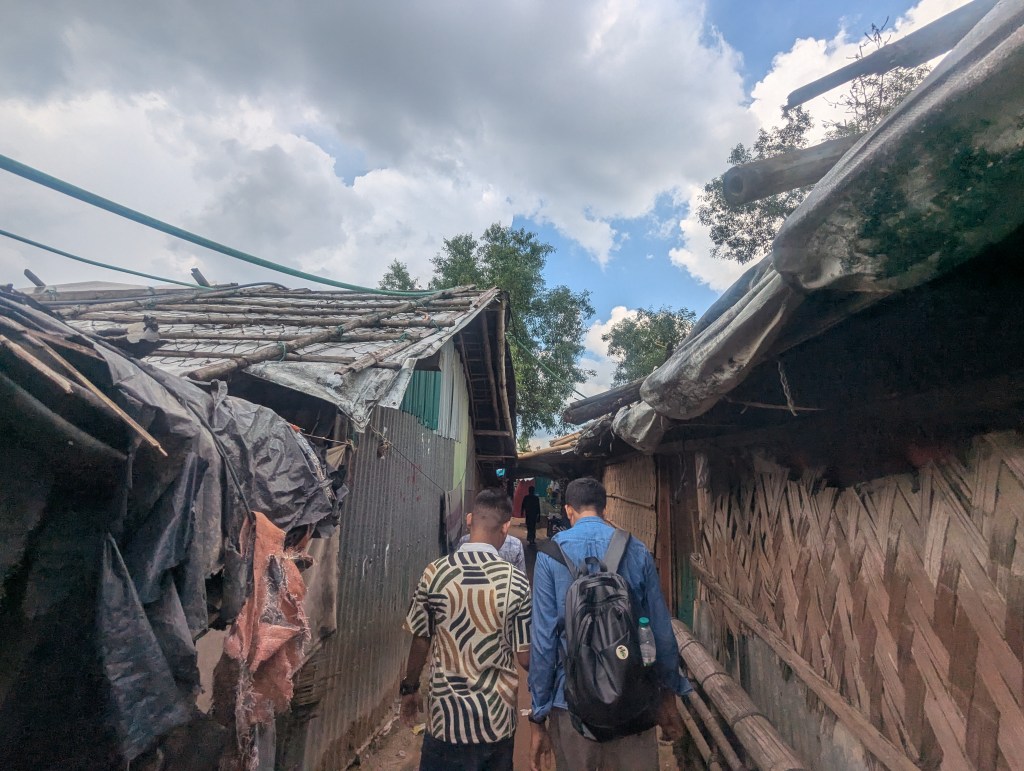
The deteriorating living conditions were apparent as Fazal walked this reporter down narrow dirt paths to meet others at the refugee camp. The bamboo homes were packed together densely, with clothes hanging from the walls to air-dry. Shared bathrooms and small shops were adjacent to UN-run schools where countless children were running around, playing, or chasing stray chickens.
This camp also housed Begum (name changed), who requested anonymity due to her precarious situation. She spoke fondly of her childhood in Myanmar. She tended to vegetables and livestock on her family’s farm while spending her leisure time jumping into Myanmar’s numerous hot-water springs. In 2010, her family was expelled from their village. The government has since taken over their land, she said. As her family arrived in Cox’s Bazar, violence followed them. Security forces there demolished their temporary bamboo home twice.
In 2012, Begum’s family finally decided to leave for India. But while crossing the border, they were arrested. Her husband was sent to a men’s prison while their two children were detained with Begum. They were detained at Assam’s Matia camp for 12 years and five months. Her two-month-old daughter ended up spending her entire childhood in detention. “I thought I would die in jail,” Begum said.

One afternoon, the warden gathered all the Rohingyas who were detained in Matia camp and locked them in a room together. Security guards allegedly took the little money Begum had, along with all her clothes and jewelry, before forcing her and the others onto a bus. At around 1 am that night, they arrived at a BSF encampment near the border. It was dark, and they were scared. She was with her husband and kids. The BSF forced them across an opening in the border fence. They were in a paddy field and walked all night through waist-high water. They stayed at a Bangladesh border police encampment for about 15 days until UNHCR officials arrived, brought them to Cox’s Bazar, and set them up in a small room with a ration card.
Begum and her family are now one of the few lucky ones. In May 2026, they moved to Canada along with eight other families, through an UN refugee program. They joined the approximately 1000 Rohingya refugees who were able to relocate there. Her family has settled in the mid-sized town of Kitchener, about 100 kilometers west of Toronto, where the majority of Rohingya refugees in Canada live. They are on track to obtain permanent residency in Canada, while the government provides them with rental and food assistance. Her son is preparing to start school soon. For the first time in over a decade, she feels good about her children having a chance at a normal life, even as the transition to a new country brings new challenges.
Fazal, however, is not as fortunate. His and his family’s future remains uncertain.
“Everyone in my family is depressed,” Fazal said. “My wife is also ill. She has a sinus problem. I don’t have any work. My children don’t get to go to school. I don’t think there is any future for them… I have no income to pay the rent, buy medicine and to run the family. My wife needs to have medicine daily.” He spoke softly, with long pauses between sentences, as he concentrated on remembering details. The years spent fleeing violence, migrating from one country to another, and his time in detention have all taken a toll.
“Whether I am inside the jail or outside I have always been vocal about injustice,” he said. “Now I am introspecting that I spoiled my life while doing those things.”
Who Gets to Belong?
The fates of these individuals, shadowed by the uncertainty of the future and the trauma of the past, point to a deeper problem of how majoritarianism produces statelessness for minorities across borders. According to Sur, “A change in the global order and the way immigrants are being treated everywhere gives India the authority to carry out unprecedented violation of human rights… things they probably feared earlier due to global condemnations. The same countries that would have pressured them in the past have questionable practices in the present.”
“What’s more dangerous is that the BJP-led governments at the center and the states are systemically bringing in policies and legal measures to target Muslims, both citizens and non-citizens,” she said. “These policies clearly have one agenda – build an anti-Muslim narrative, increase a Hindu vote-base, and further disenfranchise Muslims citizens.”
Citizenship in India has become a battleground for its Muslim minority. Two years after being pushed into Bangladesh, Haque is still fighting for his citizenship. He awaits the outcome of his case as it makes its way through the courts, hoping he can reunite with his family. Meanwhile, his son says he wants to become a lawyer to represent people like his father.
“I thought that I myself would become an advocate and fight for my father’s case, and I will fight for others to be free,” Haque’s son said. “Others must not endure the injustice being done to us.”

India’s Deportation Regime: Minorities, Rohingya Refugees, and Due Process are All Casualties
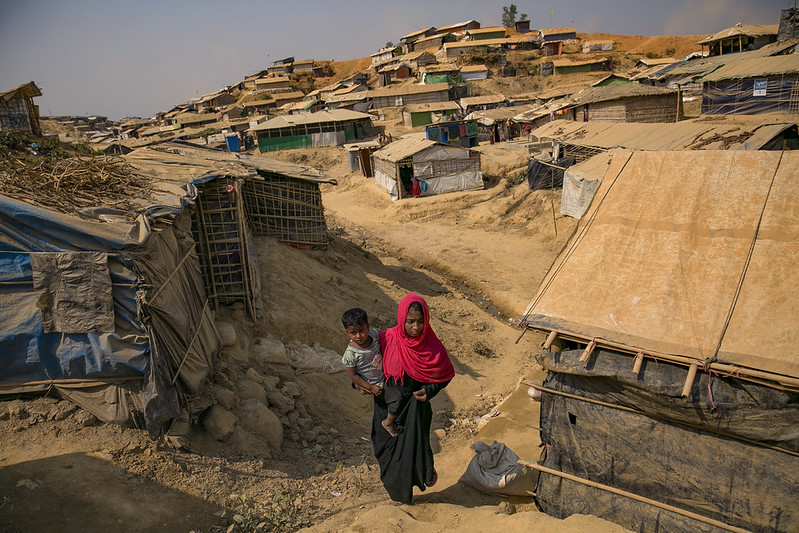
Rohingya refugee camp at Cox's Bazar, Bangladesh. Photo by UN Women (CC BY-NC-ND 2.0)
Haque, in his mid-50s, was blindfolded with his hands cuffed and put in a vehicle belonging to India’s Border Security Force (BSF). It had been a few hours on the road; he didn’t know where he was being taken. He said his body was bruised from being beaten in custody, along with 38 other people with whom he was detained. They were picked up from the Matia Transit Camp, India’s largest immigrant detention center, located in the northeastern state of Assam.
In 1997, a Foreigners Tribunal ruled that Haque (name changed for his safety), a Bengali Muslim, was a foreigner–stripping him of citizenship. The quasi-judicial Foreigners Tribunals in Assam determine whether individuals, who have been labeled as ‘Doubtful Voters’ due to state allegations that their voter registration paperwork is flawed, are Indian citizens or undocumented immigrants. He was later detained for being an alleged “illegal immigrant” for three years before being released on bail and required to check in regularly with the police.
Haque’s family has lived in India for generations. The family has a document showing that Haque’s father had paid revenue tax on land the family owned in the 1940s, from before India won independence from colonial Britain. His son works in Mumbai. He got on the first train to Assam as soon as he got a phone call about his father. “That day I became so nervous,” he said.
The BSF had picked up Haque on May 24, 2025. At around 11 pm, the group of detainees finally arrived at a BSF building, but they did not know exactly where they were. The BSF personnel gave each detainee two bananas and some cash, then separated the detainees into three groups, who were then sent on different paths. Haque’s group was in a jungle, with the Brahmaputra River flowing nearby. At gunpoint, BSF officers pushed them forward and forced them to walk around the river, along a dirt path, as foxes and other wild animals prowled around them, Haque narrated. “We were very scared,” he recalled. “We didn’t know what they were going to do. Were they going to throw us in the river, throw us to the jungle, or kill us? Who knows?”
The group walked several kilometers until they saw a road. As they walked, he saw a Madrasa on one side and a police station further down, Haque said. The morning call to prayer began playing from a nearby mosque, and Haque noticed that everyone in the area was wearing skullcaps.
They were in Bangladesh.
Ramped-up Crackdown on ‘Foreigners’
While India has not released any official numbers, the Border Guard of Bangladesh says Indian authorities forced approximately 2,479 people across the border between May 2025 and January 2026, with over 100 of them being Indian citizens.
India currently uses a mechanism known as “push-back” to forcibly send suspected “illegal immigrants” across the border, bypassing the standard legal deportation process.
Assam’s Chief Minister has been openly candid about its purpose. Sarma stated that migrants were being “pushed back” specifically to avoid legal procedure, calling it an “operation” by the Government of India in which Assam was a stakeholder. “Earlier, we used to arrest them, produce them in courts and follow the legal procedure. But now, we are pushing them back right from the border,” he said in May 2025, after over a hundred Rohingya and Bengali-speaking persons were pushed into Bangladesh.
Over the last year, crackdowns on those suspected of being Bangladeshis have intensified across India. But the crackdowns weren’t just in border states like Assam. In Gujarat, nearly 1000 citizens, the majority Bengali Muslims, were detained. In Delhi, an additional 121 Bengali Muslims were detained. In Odisha, 444 migrant workers were also detained. In Rajasthan, over 1000. Many of the detainees were subsequently released after their citizenship was verified.
India has long had a contentious relationship with foreigners and those accused of being foreigners for decades. But the crackdown escalated after April 2025, when 26 people were killed in a militant attack in Kashmir, sparking cross-border violence between India and Pakistan. Domestically, authorities and vigilantes responded by targeting Muslim minorities throughout India. Pakistani nationals had their visas revoked, and nearly 800 were deported. Amid this, Kashmiris reported being evicted from rented apartments and experiencing increased police harassment. A ramped-up crackdown on “illegal immigrants” in view of “national security” ensued; Bengali migrant workers, especially Muslims, faced sweeping actions across the country.
Rohingya refugees, a predominantly Muslim ethnic minority from Myanmar, also reported increased harassment by the Indian police. Hundreds have been detained and pushed into Bangladesh as part of the crackdown. “When India carried out surgical strikes [against Pakistan], it was the same day Rohingya refugees in Delhi were detained,” said Priyali Sur, executive director of the Azadi Project, which advocates for Rohingya refugees in India. After 40 Rohingyas were detained in Delhi, they were flown to an island in the Indian Ocean and then ferried across the sea via boat before allegedly being forced to jump off into the ocean near the Myanmar shore and swim.
The evictions and detentions across the country prompted UN human rights experts to demand India stop the practice and “stressed that ‘national security’ and ‘foreign nationality’ should never be used as a pretext to justify the forced eviction of communities without legal safeguards.” The lack of due process in “push-backs” has also been flagged by rights groups, such as the Human Rights Watch.
However, India continues its “push-back” practice. On the other hand, Bangladesh has lodged formal objections to India’s “push-back” policy, which it describes as “push-in,” while also raising the matter with the UN refugee agency and ordering the BGB to resist such moves. Bangladesh’s junior minister of foreign affairs has said that the practice of “push-in” violates international law and the India-Bangladesh treaty on border control. “We will in no way accept push-ins of people,” she said. As a result, many people are often stranded at the Zero Line (no man’s land at the India-Bangladesh border). In a recent case at the Benapole border near West Bengal, 10 people, including women and children, were left stranded at the Zero Line for several days. As of the publication of this report, the two countries’ border guards were unable to resolve this case.
For years, people like Haque lived in a precarious position of statelessness. After being declared foreigners, they could not be deported to Bangladesh either. According to Guwahati-based attorney Sauradeep Dey, who has represented several Rohingya refugees, for a deportation to take place, the individual’s home country must accept them as its citizens. It left those who were declared foreigners in limbo. Although such people were accused of being Bangladeshi, they had never set foot in that country, leading to years of detention in India, Dey said. After a Covid-era court order, many were released on bail but stripped of numerous rights, such as eligibility for government rations and the right to vote. It was after the militant attack in Kashmir that the Indian government started forcefully removing those declared foreigners from the country. During such a routine check in 2025, Haque was expelled from India.
“How can you send someone to another country without that country accepting?” Dey questioned. “After having lived here for so many years, the push-back takes on a whole new meaning.”
Lawfare over Citizenship, a Playbook for India’s Eastern Border
In nationalist countries ruled by majorities across the globe, the law is often used to classify and divide populations through the issuing and withholding of citizenship, creating a hierarchy of rights and legally sanctioned discrimination. This is particularly prevalent in Assam, which shares a border with Bangladesh.
Assam’s approach to identifying and expelling “foreigners” has long been shaped by a distinct mix of regional anxieties and national politics. The state has witnessed mass mobilizations and episodes of violence driven by fears that migration from Bangladesh could overwhelm local culture and strain economic resources. These concerns formed the backbone of the Assam Movement of the late 1970s and 1980s. The 1985 Assam Accords created government mechanisms to oust suspected foreigners and seal the border with Bangladesh. Later, the National Register of Citizens (NRC), used to identify legal residents, was updated in 2018–19, leaving out nearly two million people, many of them Bengali-speaking. Thousands have since been subjected to proceedings before Foreigners’ Tribunals, with many sent to detention centers.
The subsequent introduction of the controversial Citizenship Amendment Act (CAA) in 2019 added a controversial religious dimension to this process, leaving Bengali Muslims particularly vulnerable to being labeled “foreigners”. The law offers a pathway to citizenship for Hindus, Sikhs, Buddhists, Jains, Parsis, and Christians fleeing persecution in neighboring countries, but excludes Muslims. Thus, non-Muslims excluded from the NRC may still be able to seek relief under the CAA.
These frameworks have created a far-reaching system of verification, detention, and eviction in Assam, where long-standing concerns over land, language, and identity intersect with a broader Hindu nationalist project. These overlapping forces fall most heavily on Bengali Muslim communities.
According to the Assam state government, by 2024, nearly 150,000 people, the majority Muslim, had been stripped of citizenship and rendered stateless since the signing of the 1985 Assam Accords. Another 1.9 million people whose names were left off the 2019 NRC are also at risk of statelessness.
Concerns around the NRC prompted the international organization Genocide Watch to issue a “genocide warning” for Assam. “This is a classic case of denial of citizenship in order to deprive a minority ethnic and religious group of its rights. It could become a prelude to another genocide like Myanmar’s genocide against its Rohingya Muslims,” it said.
Subsequently, the Immigrants and Foreigners Act, 2025, created an exemption for Hindu, Sikh, Buddhist, Jain, Parsi, and Christian minorities from Afghanistan, Bangladesh, and Pakistan who entered India before December 31, 2024, without valid documents. Rights groups raised concerns that the legislation significantly expanded state power over migrants, refugees, and anyone suspected of being a foreigner. Amnesty International warned that provisions allowing detention and deportation of undocumented individuals could place refugees like the Rohingyas at risk of being returned to countries where they face persecution, which amounts to a violation of the international principle of non-refoulement.
The current phase of the crackdown against undocumented foreigners, following the 2025 escalation, is also happening under a political climate rife with anti-Bengali Muslim rhetoric across India, and particularly in the border state of Assam. Apart from detention and deportation, punitive demolitions have taken place. Violent eviction drives bulldozed homes of thousands of Bengali Muslims, including 660 families in Goalpara on June 16, 2025, with another 1080 families evicted from there just three weeks later, 93 families in Nalbari district, and 1400 families in Dhubri district to make way for a power plant.
In the lead-up to state elections this year in Assam, Chief Minister Himanta Biswa Sarma of the Bharatiya Janata Party (BJP) stated his intent to remove Bengali Muslims from the region on multiple occasions. In January, he threatened to expel 10,000 – 15,000 Bengali Muslims annually, making it an election agenda. Sarma rewon the elections with a sweeping majority, owing to what political observers called a “sharp religious polarization of the electorate.”
Following this, the BJP also won in West Bengal, another border state, for the first time. Suvendu Adhikari was sworn in as Chief Minister on May 9, and within days, the new government moved aggressively on “illegal immigration” — a central campaign promise of the Hindu nationalist party. It has set up detention centers in Malda and Murshidabad districts, which have a significant Muslim population and border Bangladesh. These centers are meant to temporarily hold undocumented people suspected of being foreigners before deportation. Adhikari has further directed all 23 district magistrates to establish detention centers.
The government’s stated framework is an aggressive “detect, delete, deport” policy, under the Immigration and Foreigners Act and a Union Home Ministry directive from May 2025. However, such policies are being treated as high-priority and being implemented in the stark absence of credible, publicly available data on undocumented Bangladeshi nationals and Rohingyas in West Bengal.
“Under its hardline, anti-immigrant and anti-refugee policy of detect-delete-deport, the new BJP-led government in West Bengal has ordered the creation of new holding centers for Rohingya refugees and Bangladeshis. This has raised immense concerns among the Rohingya refugee population living there and also among the ‘Muslim citizens’ in the state who may not have the necessary documents to prove citizenship,” said Priyali Sur of the Azadi Project.
Unlike Assam, where suspected foreigners are produced before Foreigners’ Tribunals, detainees in West Bengal will reportedly not be presented in court. This could increase the possibility of Indian citizens being wrongly identified as Bangladeshi and deported, which has already happened several times. A recent case illustrates the risk: the Calcutta High Court set aside the federal government’s decision to deport two women and their families from Birbhum district to Bangladesh and ordered their return. The petitioners had alleged that the families, working as daily wage earners in Delhi’s Rohini area for over two decades, were picked up by police on suspicion of being illegal Bangladeshis and pushed across the border without due process.
“This entire move seems to be borrowed from the Assam playbook, where high on the Hindu nationalist agenda, the country’s largest detention center was built targeting “undocumented people”, Rohingya refugees and Bangladeshis. They were detained and held in prison-like facilities for years in terrible and anti-humane conditions, and then one day randomly and illegally deported without due process,” Sur noted. The Azadi Project’s upcoming report will share evidence-based data points on the illegal nature of these detentions and deportations, she added.
“Authoritative regimes follow a playbook,” Sur said, explaining that it includes the accounting of who is and isn’t a citizen, followed by the removal of rights such as voting, and then the stripping of citizenship. “It’s actually scary. What has happened to the Rohingya community in Myanmar should not be a repeat for Muslims in India,” she said.
Rohingyas Pay a High Price Amid Crackdown
While the foreigner distinction is used to target Bengali Muslims particularly, that doesn’t preclude other minorities like the Rohingyas from also being swept up in the crackdown.
Rohingya refugees don’t get protection under the Immigrants and Foreigners Act, 2025, as they are Muslims and from Myanmar–both excluded from the purview of this law. The BJP-led Indian government sees Rohingya refugees within a broader category of “illegal Muslim immigrants,” often grouping them with undocumented migrants from Bangladesh.
For the Rohingyas, the push-backs that started in April 2025 were not the first time they had been subject to a state policy of violent removal. Myanmar stripped the ethnic minority of their citizenship in 1982 before embarking on what a UN fact-finding mission concluded to be a “textbook campaign of ethnic cleansing.”
“The Myanmar government pre-planned to drive out our community through systematic genocide, step by step,” said Fazal, a Rohingya refugee who was expelled from India to Bangladesh. His name has been changed for his safety.
In 1982, Myanmar passed a law that effectively stripped all Rohingyas of citizenship and rendered the entire ethnic minority stateless. The law was the groundwork for institutionalized discrimination and waves of mass displacement since the 1990’s, ultimately leading to a genocide that started in 2017. Since then, over 1 million Rohingyas have fled to neighboring Bangladesh. The majority live in the world’s largest refugee camp in Cox’s Bazar, a town located in southern Bangladesh near the border with Myanmar.
Fazal met this reporter at his home in Cox’s Bazar, Bangladesh. Born in Myanmar without citizenship, Fazal grew up in the absence of his father–a government employee who was killed right before Fazal was born. “Without citizenship, it’s like you are alive, but you have no energy. You survive, but there is no heart,” he said.
When the ethnic violence worsened in 2012, Fazal fled home and joined his two brothers, who were already living in Bangladesh. He eventually went to India, where he studied and found a job as a social worker to help improve the living conditions of other Rohingya refugees. But after a few years, he said he was forced to return to Bangladesh following threats from the local police. He continued his human rights work upon returning to Cox’s Bazar and tried to go back to India in December 202o after receiving death threats from gangs in the camp. At a border checkpoint, however, he was arrested by the Assam police and sent to Matia Transit Camp for four years.
India’s policy regarding Rohingya refugees is fraught. Nearly 22,500 Rohingya are registered with the UNHCR in India. However, this offers little protection; the Indian government has told the Supreme Court that it does not recognize UNHCR-issued refugee cards because India is not a signatory to the 1951 Convention. Unlike Tibetan or Sri Lankan refugees who receive long-term visas, Rohingyas face arbitrary detention and deportation as “illegal immigrants.”
According to attorney Sauradeep Dey, there were attempts to deport Rohingyas to their home country, “but the Myanmar government had refused to accept them…They could not identify these people as their citizens.” He added, “They were in limbo at that point.”
Fazal remembers his four years of being in this limbo at the camp as grueling. “I was broken,” he said. “The jail destroyed my life. I’m not mentally strong right now…my condition at present is such that I am not able to take decisions quickly. I still have that anxiety and trauma. I still fear something bad might happen.”
From inside the detention center, Fazal worked with an organization to distribute blankets, clothing, and other items to his fellow detainees and to connect them with attorneys. Many were like him: facing indefinite detention with no way to get in touch with their families. It culminated in a September 2024 hunger strike, during which Fazal, along with over 100 others, refused to eat until they were released from detention. “Police used to threaten us that they would beat us with sticks. They have threatened me a lot,” Fazal recalled.
India’s intensified crackdown following the April 2025 attack in Kashmir affected Rohingya communities across the country, including Fazal and other detainees at Assam’s Matia Transit Camp.
One day in late May 2025, around midnight, armed BSF personnel marched Fazal and others from the camp to the border and pushed them into a small village in Bangladesh. As he crossed over, the guards warned that they would shoot him if he ever tried to return to India, he recalled.
Describing that night across the border, Fazal said that he and two others waited at a tea stall, not sure what to do. Later, a man who looked after a nearby mosque came by and informed the police, who then took them to the local police station. After about a week, an NGO arrived and took Fazal to the refugee camp at Cox’s Bazar.
It was here that Fazal was reunited with his wife and young children, whom he hadn’t seen in years. At present, they rent a small room while they try to figure out their next steps. But life is not easy in the camp. Sharp reductions in US foreign-aid funding, alongside cuts by other international donors, have led to decreased food assistance and closures of health facilities and schools across Cox’s Bazar. Bangladesh has warned that the country cannot indefinitely sustain the cost of hosting more than one million Rohingya refugees without greater international support, while continuing to press for their eventual repatriation to Myanmar.
The deteriorating living conditions were apparent as Fazal walked this reporter down narrow dirt paths to meet others at the refugee camp. The bamboo homes were packed together densely, with clothes hanging from the walls to air-dry. Shared bathrooms and small shops were adjacent to UN-run schools where countless children were running around, playing, or chasing stray chickens.
This camp also housed Begum (name changed), who requested anonymity due to her precarious situation. She spoke fondly of her childhood in Myanmar. She tended to vegetables and livestock on her family’s farm while spending her leisure time jumping into Myanmar’s numerous hot-water springs. In 2010, her family was expelled from their village. The government has since taken over their land, she said. As her family arrived in Cox’s Bazar, violence followed them. Security forces there demolished their temporary bamboo home twice.
In 2012, Begum’s family finally decided to leave for India. But while crossing the border, they were arrested. Her husband was sent to a men’s prison while their two children were detained with Begum. They were detained at Assam’s Matia camp for 12 years and five months. Her two-month-old daughter ended up spending her entire childhood in detention. “I thought I would die in jail,” Begum said.
One afternoon, the warden gathered all the Rohingyas who were detained in Matia camp and locked them in a room together. Security guards allegedly took the little money Begum had, along with all her clothes and jewelry, before forcing her and the others onto a bus. At around 1 am that night, they arrived at a BSF encampment near the border. It was dark, and they were scared. She was with her husband and kids. The BSF forced them across an opening in the border fence. They were in a paddy field and walked all night through waist-high water. They stayed at a Bangladesh border police encampment for about 15 days until UNHCR officials arrived, brought them to Cox’s Bazar, and set them up in a small room with a ration card.
Begum and her family are now one of the few lucky ones. In May 2026, they moved to Canada along with eight other families, through an UN refugee program. They joined the approximately 1000 Rohingya refugees who were able to relocate there. Her family has settled in the mid-sized town of Kitchener, about 100 kilometers west of Toronto, where the majority of Rohingya refugees in Canada live. They are on track to obtain permanent residency in Canada, while the government provides them with rental and food assistance. Her son is preparing to start school soon. For the first time in over a decade, she feels good about her children having a chance at a normal life, even as the transition to a new country brings new challenges.
Fazal, however, is not as fortunate. His and his family’s future remains uncertain.
“Everyone in my family is depressed,” Fazal said. “My wife is also ill. She has a sinus problem. I don’t have any work. My children don’t get to go to school. I don’t think there is any future for them… I have no income to pay the rent, buy medicine and to run the family. My wife needs to have medicine daily.” He spoke softly, with long pauses between sentences, as he concentrated on remembering details. The years spent fleeing violence, migrating from one country to another, and his time in detention have all taken a toll.
“Whether I am inside the jail or outside I have always been vocal about injustice,” he said. “Now I am introspecting that I spoiled my life while doing those things.”
Who Gets to Belong?
The fates of these individuals, shadowed by the uncertainty of the future and the trauma of the past, point to a deeper problem of how majoritarianism produces statelessness for minorities across borders. According to Sur, “A change in the global order and the way immigrants are being treated everywhere gives India the authority to carry out unprecedented violation of human rights… things they probably feared earlier due to global condemnations. The same countries that would have pressured them in the past have questionable practices in the present.”
“What’s more dangerous is that the BJP-led governments at the center and the states are systemically bringing in policies and legal measures to target Muslims, both citizens and non-citizens,” she said. “These policies clearly have one agenda – build an anti-Muslim narrative, increase a Hindu vote-base, and further disenfranchise Muslims citizens.”
Citizenship in India has become a battleground for its Muslim minority. Two years after being pushed into Bangladesh, Haque is still fighting for his citizenship. He awaits the outcome of his case as it makes its way through the courts, hoping he can reunite with his family. Meanwhile, his son says he wants to become a lawyer to represent people like his father.
“I thought that I myself would become an advocate and fight for my father’s case, and I will fight for others to be free,” Haque’s son said. “Others must not endure the injustice being done to us.”