



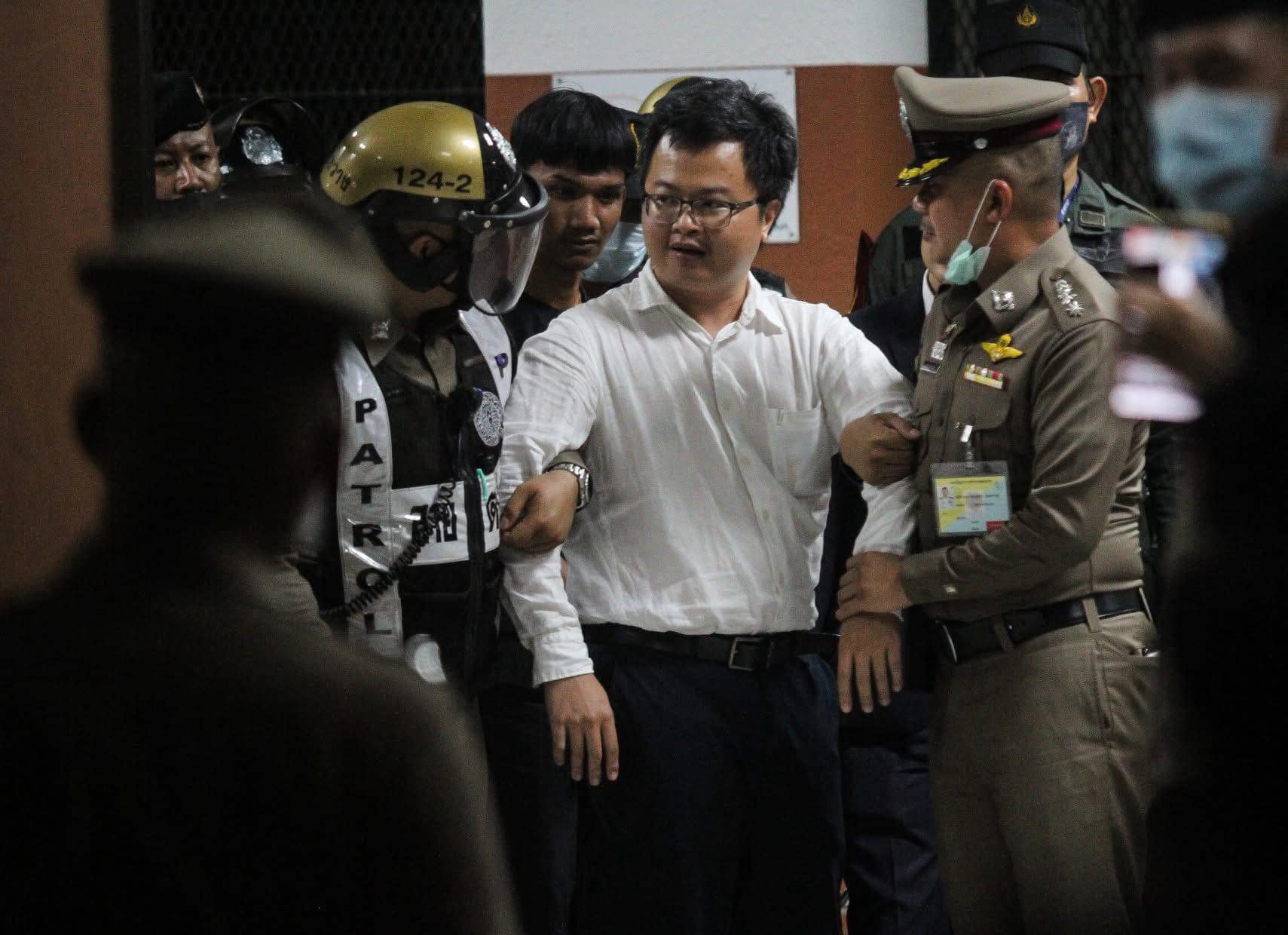
A boy no older than five runs toward the sound of ankle shackles striking the floor. It means his father is coming. He learned this sound before he learned the word for “father.” His mother taught him the Thai word for court even before he learned to say “dad”—because this was a place they went so often.
He has no memory of them living together as a family. There was no home to remember.
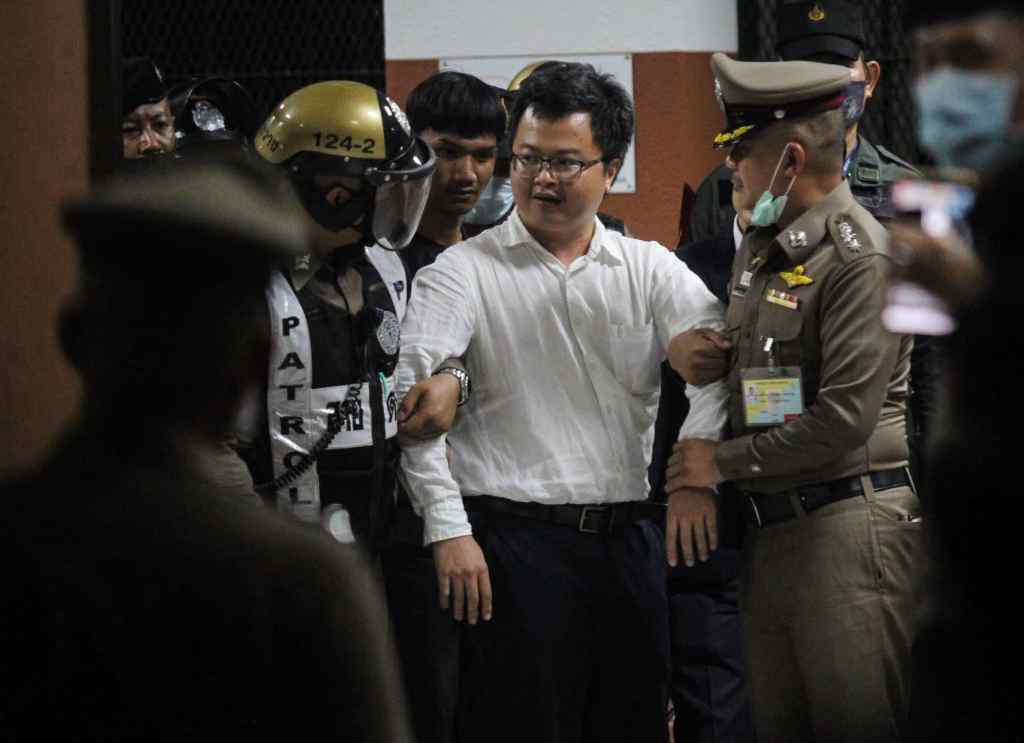
His father is Arnon Nampa, sentenced to more than 31 years and 9 months across 11 convictions under Thailand’s harsh lèse-majesté (royal defamation) laws.

Nampa is a human rights lawyer. In August 2020, at Bangkok’s Democracy Monument, he stood before hundreds of thousands of protesters dressed as wizards in a demonstration titled “Cast a Spell to Protect Democracy.” Long before Nampa ever stood on that stage, he had spent ten years defending people charged under the same law—going in and out of the courts and the prisons, sitting across from political prisoners and watching the process fail them.
He asked four questions that broke decades of taboo: why more than a billion dollars of taxpayers’ money was allocated to the monarchy during COVID-19; why certain military units had been transferred into the King’s personal command; why the Constitution approved in a referendum was amended at the King’s request before promulgation; and whether Article 112—the lèse-majesté law—was consistent with democratic values.
For the first time in Thai history, monarchical powers were questioned in public. Within days, thousands, especially students, took to the streets. To crush the movement, the Thai state went after students, many of them children under the age of 18. Since July 2020, Thai authorities have charged at least 268 children for peacefully exercising freedom of expression and assembly, including at least 20 children under 18 under Article 112, Thailand’s lèse-majesté law, which criminalizes criticism of the monarchy and can carry three to 15 years in prison per charge. Thai authorities have “stretched the letter of the law to absurdity”, according to the International Federation of Human Rights, with some people prosecuted under it for criticizing the government’s COVID-19 vaccine management, wearing crop tops, insulting the previous monarch, or even quoting a UN statement about Article 112.

What does this law do to a family?
Lookwa, Arnon’s partner, says money is the first thing to go after the arrests. Where there was one income, there is now none. Lookwa’s tone quickly shifts; she leaves the first person behind. My partner becomes the partners, my children the children; and by the time she finished, her story had become the story of all the others lost to prison. The father in prison, the mother at work, and the children cared for by whoever is left. She has seen women in these families work until their bodies fail. Right now, about four other fathers are in prison under Article 112, gone since their children were infants. These six children have never had their fathers at home.
Between 2020 and October 2022, at the height of the youth-led democracy movements, thousands joined mass defiance to demand curbs on the monarchy’s powers. Thai authorities charged and arrested at least 1998 protesters. Families who had never marched, never organized, and wanted no part of protests found themselves in a situation they couldn’t have imagined. Participation in a single protest upended their lives, made their loyalty to the monarchy a permanent test, one they must keep answering.
The surveillance, Lookwa says, is constant and unending. The police sit outside the house of those arrested for years while the case grinds on, sometimes in plain sight, sometimes not, and the family’s name goes onto a national security watchlist long before the court has ruled. For families, she says, the heaviest burden is not the sentence, but the years of being watched.
And bail, if it comes, offers little relief. Arnon was released once on several conditions: an ankle monitor and home by seven every evening, for ten months. In those ten months, the family did not once have a moment of lightness. Things often taken for granted–an outing, a trip to the seaside, or a dinner together in a restaurant– all became impossible dreams for a family living with a nightmare.
There are others who are made to wear the monitor for years. Rubber-strapped, badly made and heavy, the chafing wears at the skin until it splits open. Many are forbidden to leave the country. The punishment moves into the house and stays.
Children learn to whisper when they speak about their father, and fathers learn to write letters from prison to their children. “When one member of the family is subjected to these kinds of conditions,” she says, “the whole family loses the ability to live fully and do ordinary things together.”

Arnon’s children have asked a version of these questions for over years: “When will Daddy come home?” “Can we visit again?”
In Letter 59, written in February 2024, Arnon writes: “Today I fear my children will forget me.”
When Arnon was first imprisoned, their eldest child was in kindergarten. The four-year-old was seeing her father in court–handcuffed, barefoot, shackled. She decided she disliked judges, police officers, and prison guards, because in a child’s mind, they were the ones keeping her father from coming home. Arnon’s family decided that children should not grow up hating someone they cannot yet fully understand. So instead, she drew pictures of her father over and over again, in a brown prison uniform, with his head shaved. Many times, she drew him with wings—she wanted him to fly away.
Each time a new judgment came, and by 2026 there had been eleven, the child would go to court and ask, “How many more years has Dad been given this time?” Each time, as the number kept growing, her heart broke a little. “Dad probably will not be away for that long…we…are trying to help him.” Lookwa would reassure her, even though she knew she could not bring him home now.
That girl is older now, almost ten. But Lookwa has started telling her to say as little as possible about her father at school. What if a friend repeats it? Or if a teacher or another parent feels strongly against what Arnon stands for.
There is something profoundly violent about a child learning not to speak about her father, to hide him away from the world, and to learn so young what aspects of a life can be made visible and what aspects of a life have to be put away.
To live like that, to constantly rearrange pieces of yourself to fit other people’s expectations, is its own kind of hell. It trains a child to become a careful curator of their own existence, measuring every word and every silence. These are not things a child should learn.
The younger child, the boy, was nine months old when Arnon was sentenced. Every time the boy hears the sound of ankle shackles on the floor, he runs toward it. Not in fear, but in recognition and love— he found comfort in those chains. Lookwa still does not know, she says. How do you describe a father to a child who has only known him through his absence?
On February 20, 2026, Courtroom 801, Criminal Court in Bangkok, was overflowing with Embassy representatives, politicians, human rights workers, and members of the public. Three defendants, Pimsiri, Somyot, and Phromsorn, were granted bail pending appeal. Arnon was not. All four were convicted in this case for the same offense: speeches they delivered at that single 2020 protest event, which the court treated as violating Section 112 of Thailand’s Criminal Code (the lèse‑majesté law), alongside additional convictions for violations of the Emergency Decree and unauthorized use of loudspeakers at the same rally. Arnon’s sentence in this case was also 2 years 8 months, but it was compounded with his prior 11th Section 112 conviction across multiple cases, bringing his cumulative prison time to 31 years and 9 months (sometimes reported as “more than 31 years”), which is why he was the only one denied bail and faces the dramatically longer total term.
Arnon is not an exception; he is one of many, says a Front Line Defenders protection coordinator who asked not to be named for security reasons — one case among hundreds, the state using the lèse-majesté law as its instrument.
Under Article 112, anyone can file a complaint anywhere in the country. Royalist groups comb through social media posts, then lodge complaints in far-off provinces, so that someone in Bangkok must answer to a charge filed a day’s drive away. Many of the people now in prison were reported by strangers who had no stake in their lives at all.
Once a case reaches court, the defense is often limited in the evidence and witnesses it can call, which can make it difficult to test whether the statement was true. Thai courts have interpreted Article 112 expansively, often focusing on whether speech was taken to offend the monarchy, and in some cases extending the law beyond its text to cover remarks about persons closely associated with protected royals. At the stage of indictment, almost no one is let go: the cases go forward nearly 100% of the time.
Since 2020, Thai courts have imposed sentences under Article 112 that have shattered all previous records, moving from a period of rare, short-term prosecutions to a wave in which more than 291 people have been charged, many facing cumulative prison terms of 18 years or longer, and single convictions reaching 43½ and then 50 years.
Youth leaders, artists, musicians, academics, and lawyers have been charged, tried, imprisoned, and driven into exile. Pimsiri Petchnamrob, sentenced alongside Arnon in February 2026, spent years denied permission to leave Thailand, unable to attend a UN Human Rights Council session in Geneva.
The movement that produced them has changed. “The wave of political verdicts has created a ‘fear normal’ in Thai society,” says Paroj Nutchanon, a prominent Thai pro-democracy activist and student leader. Those who remain have shifted their demands. Openly calling for monarchy reform—the radical, public act that defined 2020—is today voiced by only a handful of people. What has emerged instead is a broad and now firmly established demand for amnesty covering all political defendants, including those charged under Articles 112 and 110, the latter being Thailand’s offense of violence or attempted violence against the king, queen, heir-apparent, or regent.
“Even though this sounds bleak,” says Nutchanon, “in another sense, it has made prisoners like Arnon a kind of line marking the boundary of freedom in Thailand. His case asks a very simple question: Does freedom actually exist here?”
When the first verdict arrived, Lookwa says, she and Arnon said only one thing to each other: “It will be severe, and it will be long.” There was no sentimentality, no remorse or regret. They did not wonder if they had done anything wrong or if they should have thought of the children first. They did not ask each other to stop doing this work. Lookwa says they had already chosen and would choose the same life again.
Arnon’s family has never stood in the background, simply waiting for him to come home. Whatever can be said in his place, demanded in his place, fought for in his place, they do. What they are waiting for, she says, is not only Arnon, but also the change he fought for to arrive.

In a letter dated November 15, 2023, written from prison, Arnon wrote:
What is being done to me now is a process of punishment, and of bearing punishment, but it is not an admission of wrongdoing. There is no confession in it, no acceptance that what my friends and I have fought for was ever, in any absolute sense, wrong.
We saw the problems in this country, and we stepped forward to fight for change—to win freedom and equality. That is not a crime. It does not require repentance. And even if we must endure punishment, that still does not mean we are in the wrong.
I am facing more than twenty cases, and together they may carry sentences of over eighty years. But not a single day of that would mean accepting guilt. My imprisonment is proof that something is deeply wrong in this country—and that there are still people willing to keep fighting.
Lookwa returns to this passage. She calls it the one she loves most deeply—the one she goes back to when things feel impossible.

What does it take to write those words in a cell, knowing your daughter is drawing you with wings, knowing your son has learned to recognize you by the sound of metal on stone? I think of what it means to choose, with full knowledge of the cost you paid, and to still keep speaking.
“He believed that his actions were for the good of the country, and that they were necessary and right,” says Nutchanon. “Even though he knew very well that the country does not always work that way, he has continued to stand firm—even from inside prison.”
Nutchanon believes that the day Arnon walks free will capture the attention of all of Thai society. “It may even feel something like the fall of the Berlin Wall,” he says—the moment that marked the end of an era, the moment freedom moved forward by one step.
That day has not come. His boy still runs toward the sound of shackles on stone.
Arnon Nampa remains in prison. All eleven convictions are under appeal. His family continues to fight.

Arnon Nampa: Democracy Crusader Who Dared to Question Thai Monarchy
A boy no older than five runs toward the sound of ankle shackles striking the floor. It means his father is coming. He learned this sound before he learned the word for “father.” His mother taught him the Thai word for court even before he learned to say “dad”—because this was a place they went so often.
He has no memory of them living together as a family. There was no home to remember.
His father is Arnon Nampa, sentenced to more than 31 years and 9 months across 11 convictions under Thailand’s harsh lèse-majesté (royal defamation) laws.
Nampa is a human rights lawyer. In August 2020, at Bangkok’s Democracy Monument, he stood before hundreds of thousands of protesters dressed as wizards in a demonstration titled “Cast a Spell to Protect Democracy.” Long before Nampa ever stood on that stage, he had spent ten years defending people charged under the same law—going in and out of the courts and the prisons, sitting across from political prisoners and watching the process fail them.
He asked four questions that broke decades of taboo: why more than a billion dollars of taxpayers’ money was allocated to the monarchy during COVID-19; why certain military units had been transferred into the King’s personal command; why the Constitution approved in a referendum was amended at the King’s request before promulgation; and whether Article 112—the lèse-majesté law—was consistent with democratic values.
For the first time in Thai history, monarchical powers were questioned in public. Within days, thousands, especially students, took to the streets. To crush the movement, the Thai state went after students, many of them children under the age of 18. Since July 2020, Thai authorities have charged at least 268 children for peacefully exercising freedom of expression and assembly, including at least 20 children under 18 under Article 112, Thailand’s lèse-majesté law, which criminalizes criticism of the monarchy and can carry three to 15 years in prison per charge. Thai authorities have “stretched the letter of the law to absurdity”, according to the International Federation of Human Rights, with some people prosecuted under it for criticizing the government’s COVID-19 vaccine management, wearing crop tops, insulting the previous monarch, or even quoting a UN statement about Article 112.
What does this law do to a family?
Lookwa, Arnon’s partner, says money is the first thing to go after the arrests. Where there was one income, there is now none. Lookwa’s tone quickly shifts; she leaves the first person behind. My partner becomes the partners, my children the children; and by the time she finished, her story had become the story of all the others lost to prison. The father in prison, the mother at work, and the children cared for by whoever is left. She has seen women in these families work until their bodies fail. Right now, about four other fathers are in prison under Article 112, gone since their children were infants. These six children have never had their fathers at home.
Between 2020 and October 2022, at the height of the youth-led democracy movements, thousands joined mass defiance to demand curbs on the monarchy’s powers. Thai authorities charged and arrested at least 1998 protesters. Families who had never marched, never organized, and wanted no part of protests found themselves in a situation they couldn’t have imagined. Participation in a single protest upended their lives, made their loyalty to the monarchy a permanent test, one they must keep answering.
The surveillance, Lookwa says, is constant and unending. The police sit outside the house of those arrested for years while the case grinds on, sometimes in plain sight, sometimes not, and the family’s name goes onto a national security watchlist long before the court has ruled. For families, she says, the heaviest burden is not the sentence, but the years of being watched.
And bail, if it comes, offers little relief. Arnon was released once on several conditions: an ankle monitor and home by seven every evening, for ten months. In those ten months, the family did not once have a moment of lightness. Things often taken for granted–an outing, a trip to the seaside, or a dinner together in a restaurant– all became impossible dreams for a family living with a nightmare.
There are others who are made to wear the monitor for years. Rubber-strapped, badly made and heavy, the chafing wears at the skin until it splits open. Many are forbidden to leave the country. The punishment moves into the house and stays.
Children learn to whisper when they speak about their father, and fathers learn to write letters from prison to their children. “When one member of the family is subjected to these kinds of conditions,” she says, “the whole family loses the ability to live fully and do ordinary things together.”
Arnon’s children have asked a version of these questions for over years: “When will Daddy come home?” “Can we visit again?”
In Letter 59, written in February 2024, Arnon writes: “Today I fear my children will forget me.”
When Arnon was first imprisoned, their eldest child was in kindergarten. The four-year-old was seeing her father in court–handcuffed, barefoot, shackled. She decided she disliked judges, police officers, and prison guards, because in a child’s mind, they were the ones keeping her father from coming home. Arnon’s family decided that children should not grow up hating someone they cannot yet fully understand. So instead, she drew pictures of her father over and over again, in a brown prison uniform, with his head shaved. Many times, she drew him with wings—she wanted him to fly away.
Each time a new judgment came, and by 2026 there had been eleven, the child would go to court and ask, “How many more years has Dad been given this time?” Each time, as the number kept growing, her heart broke a little. “Dad probably will not be away for that long…we…are trying to help him.” Lookwa would reassure her, even though she knew she could not bring him home now.
That girl is older now, almost ten. But Lookwa has started telling her to say as little as possible about her father at school. What if a friend repeats it? Or if a teacher or another parent feels strongly against what Arnon stands for.
There is something profoundly violent about a child learning not to speak about her father, to hide him away from the world, and to learn so young what aspects of a life can be made visible and what aspects of a life have to be put away.
To live like that, to constantly rearrange pieces of yourself to fit other people’s expectations, is its own kind of hell. It trains a child to become a careful curator of their own existence, measuring every word and every silence. These are not things a child should learn.
The younger child, the boy, was nine months old when Arnon was sentenced. Every time the boy hears the sound of ankle shackles on the floor, he runs toward it. Not in fear, but in recognition and love— he found comfort in those chains. Lookwa still does not know, she says. How do you describe a father to a child who has only known him through his absence?
On February 20, 2026, Courtroom 801, Criminal Court in Bangkok, was overflowing with Embassy representatives, politicians, human rights workers, and members of the public. Three defendants, Pimsiri, Somyot, and Phromsorn, were granted bail pending appeal. Arnon was not. All four were convicted in this case for the same offense: speeches they delivered at that single 2020 protest event, which the court treated as violating Section 112 of Thailand’s Criminal Code (the lèse‑majesté law), alongside additional convictions for violations of the Emergency Decree and unauthorized use of loudspeakers at the same rally. Arnon’s sentence in this case was also 2 years 8 months, but it was compounded with his prior 11th Section 112 conviction across multiple cases, bringing his cumulative prison time to 31 years and 9 months (sometimes reported as “more than 31 years”), which is why he was the only one denied bail and faces the dramatically longer total term.
Arnon is not an exception; he is one of many, says a Front Line Defenders protection coordinator who asked not to be named for security reasons — one case among hundreds, the state using the lèse-majesté law as its instrument.
Under Article 112, anyone can file a complaint anywhere in the country. Royalist groups comb through social media posts, then lodge complaints in far-off provinces, so that someone in Bangkok must answer to a charge filed a day’s drive away. Many of the people now in prison were reported by strangers who had no stake in their lives at all.
Once a case reaches court, the defense is often limited in the evidence and witnesses it can call, which can make it difficult to test whether the statement was true. Thai courts have interpreted Article 112 expansively, often focusing on whether speech was taken to offend the monarchy, and in some cases extending the law beyond its text to cover remarks about persons closely associated with protected royals. At the stage of indictment, almost no one is let go: the cases go forward nearly 100% of the time.
Since 2020, Thai courts have imposed sentences under Article 112 that have shattered all previous records, moving from a period of rare, short-term prosecutions to a wave in which more than 291 people have been charged, many facing cumulative prison terms of 18 years or longer, and single convictions reaching 43½ and then 50 years.
Youth leaders, artists, musicians, academics, and lawyers have been charged, tried, imprisoned, and driven into exile. Pimsiri Petchnamrob, sentenced alongside Arnon in February 2026, spent years denied permission to leave Thailand, unable to attend a UN Human Rights Council session in Geneva.
The movement that produced them has changed. “The wave of political verdicts has created a ‘fear normal’ in Thai society,” says Paroj Nutchanon, a prominent Thai pro-democracy activist and student leader. Those who remain have shifted their demands. Openly calling for monarchy reform—the radical, public act that defined 2020—is today voiced by only a handful of people. What has emerged instead is a broad and now firmly established demand for amnesty covering all political defendants, including those charged under Articles 112 and 110, the latter being Thailand’s offense of violence or attempted violence against the king, queen, heir-apparent, or regent.
“Even though this sounds bleak,” says Nutchanon, “in another sense, it has made prisoners like Arnon a kind of line marking the boundary of freedom in Thailand. His case asks a very simple question: Does freedom actually exist here?”
When the first verdict arrived, Lookwa says, she and Arnon said only one thing to each other: “It will be severe, and it will be long.” There was no sentimentality, no remorse or regret. They did not wonder if they had done anything wrong or if they should have thought of the children first. They did not ask each other to stop doing this work. Lookwa says they had already chosen and would choose the same life again.
Arnon’s family has never stood in the background, simply waiting for him to come home. Whatever can be said in his place, demanded in his place, fought for in his place, they do. What they are waiting for, she says, is not only Arnon, but also the change he fought for to arrive.
In a letter dated November 15, 2023, written from prison, Arnon wrote:
What is being done to me now is a process of punishment, and of bearing punishment, but it is not an admission of wrongdoing. There is no confession in it, no acceptance that what my friends and I have fought for was ever, in any absolute sense, wrong.
We saw the problems in this country, and we stepped forward to fight for change—to win freedom and equality. That is not a crime. It does not require repentance. And even if we must endure punishment, that still does not mean we are in the wrong.
I am facing more than twenty cases, and together they may carry sentences of over eighty years. But not a single day of that would mean accepting guilt. My imprisonment is proof that something is deeply wrong in this country—and that there are still people willing to keep fighting.
Lookwa returns to this passage. She calls it the one she loves most deeply—the one she goes back to when things feel impossible.
What does it take to write those words in a cell, knowing your daughter is drawing you with wings, knowing your son has learned to recognize you by the sound of metal on stone? I think of what it means to choose, with full knowledge of the cost you paid, and to still keep speaking.
“He believed that his actions were for the good of the country, and that they were necessary and right,” says Nutchanon. “Even though he knew very well that the country does not always work that way, he has continued to stand firm—even from inside prison.”
Nutchanon believes that the day Arnon walks free will capture the attention of all of Thai society. “It may even feel something like the fall of the Berlin Wall,” he says—the moment that marked the end of an era, the moment freedom moved forward by one step.
That day has not come. His boy still runs toward the sound of shackles on stone.
Arnon Nampa remains in prison. All eleven convictions are under appeal. His family continues to fight.