





In a first-of-its-kind international complaint, Brussels-based legal advocacy group The Hind Rajab Foundation (HRF) filed an urgent complaint on 30 May 2026 with the Indian authorities, demanding the arrest of an Israeli military reservist, Eitan Gilboa, who was vacationing in the state of Himachal Pradesh.
The complaints, filed with the Indian police, the Ministry of Home Affairs, and the Bureau of Immigration, invoked India’s obligations under the Geneva Conventions Act, 1960, and the principle of universal jurisdiction. Universal jurisdiction allows the prosecution of individuals accused of war crimes regardless of the place of crime, or the nationality of the perpetrators or victims.
Based on the evidence it collected, the HRF said that Gilboa “personally carried out and celebrated the systematic demolition of entire residential blocks in Gaza”, which constitutes war crimes. This move has squarely put the question of India’s international obligations to the Narendra Modi-led government, which has been rapidly deepening its economic and defense ties with Israel.
Since 2024, HRF has monitored and documented the conduct of 1000 Israeli military personnel through open-source material, witness accounts, and other sources. The organization has filed more than 80 complaints and legal petitions across 28 countries against Israeli military personnel and officials accused of involvement in alleged war crimes and crimes against humanity in Gaza. India is one of the most recent jurisdictions in the global majority countries where HRF has sought to test the reach of universal jurisdiction laws against Israeli military personnel and officials.
The Case Against Eitan Gilboa
In a detailed report submitted to Indian authorities, HRF said that Eitan Gilboa, a reservist in the 271st Combat Engineering Battalion of the Israel Defense Forces, carried out and celebrated the systematic demolition of residential blocks in Gaza.
According to HRF, Gilboa was born in Gaza during the period of Israeli occupation and left with his family following Israel’s 2005 withdrawal from the territory. The organization said that, viewing their departure as an “expulsion”, Gilboa and several of his siblings returned to Gaza after the October 7, 2023, attack by Hamas.
Gilboa had completed his initial military service in July 2023; he then reenlisted and served as a reservist in the 271st Battalion of the 14th Brigade from at least November 2023 until May 2025, the report said. He was sent to Gaza approximately in December 2023, then to Lebanon in October 2024.
The 271st Combat Engineering Battalion, of which Gilboa was purportedly a member, is part of the Golani Brigade and has been actively deployed in Gaza since October 7, 2023. According to Open Source Intelligence (OSINT) analysis, the battalion has been involved in widespread infrastructure destruction across Khan Younis, Rafah, and Gaza City and engaged in the demolition of multi-story residential buildings, hospitals, schools, and civilian shelters.
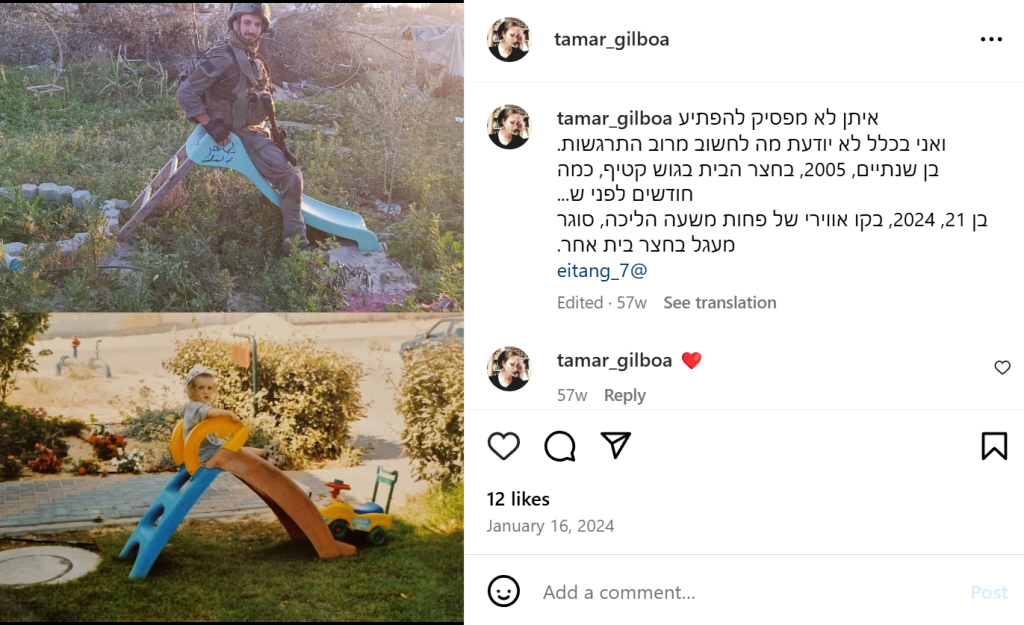
During his Gaza deployment, HRF said he documented his presence in Khan Younis, Rafah, Beit Hanoun, and Beit Lahia. He staged photographs recreating scenes from his childhood, juxtaposing himself against the ruins of Palestinian children’s playgrounds. HRF also published social media videos and photos that show Gilboa ordering the demolition of Palestinian homes. Gilboa’s mother, Tamar Gilboa, publicly shared these photos and videos on Instagram and Facebook.
The complaint further mentioned specific instances of Gilboa celebrating and participating in the destruction of civilian infrastructure in Gaza, including in Khan Younis and Rafah.
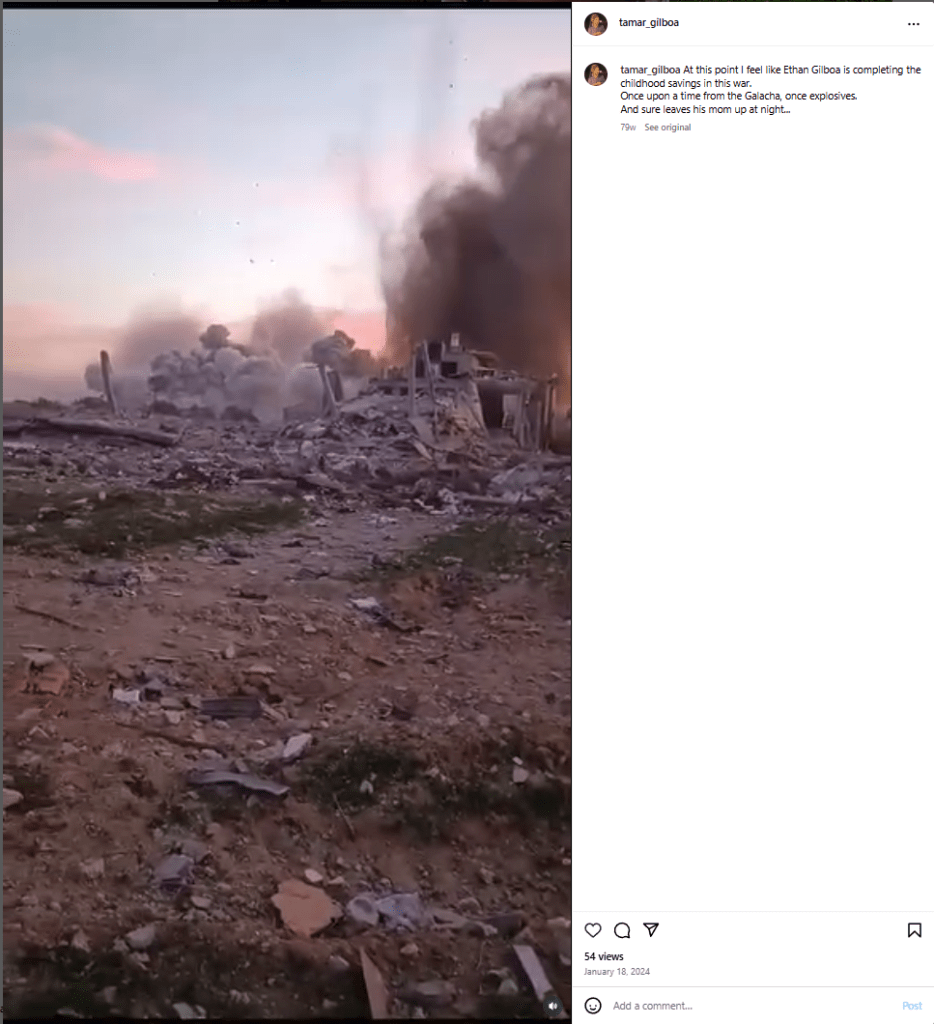
According to the foundation’s investigative dossier, on 16 January 2024, Tamar Gilboa published a video of a controlled demolition of an entire residential area in Khan Younis featuring her son and teammates, with the caption stating “Eitan shows them what the IDF is” as soldiers cheered enthusiastically after the explosion.
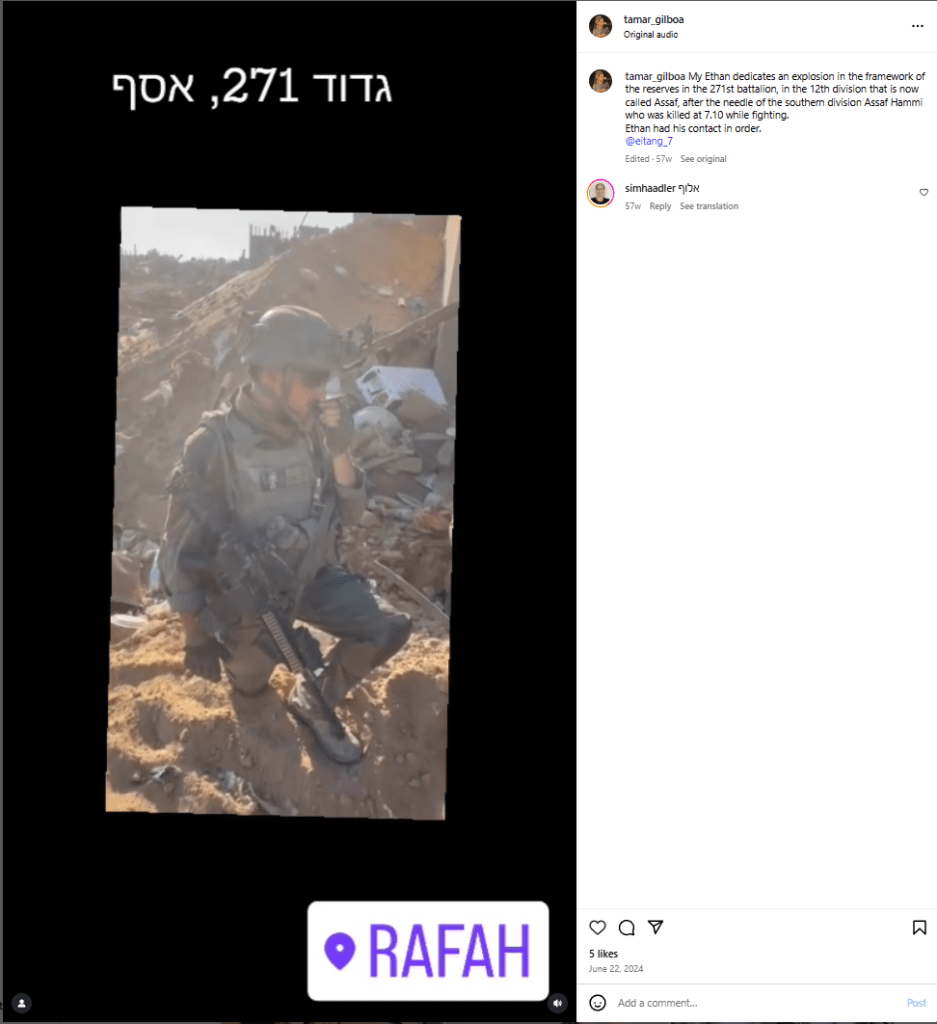
In June 2024, she published another video from Rafah depicting the detonation of multiple residential buildings, with Gilboa seen ordering the detonation himself; the demolition was explicitly dedicated to Colonel Assaf Hamami, commander of the Southern Brigade of the Gaza Division, who was killed on 7 October 2023.
On 25 July 2024, Gilboa’s mother published a video from Gaza showing the detonation of an entire residential block, actively triggering the explosion with the caption “We will always remember you,” also dedicated to Colonel Assaf Hamami. Between January 2024 and May 2025, multiple videos showed systematic detonation of residential blocks across various locations in Gaza, with demolitions explicitly dedicated to fallen soldiers as acts of revenge and no military justification offered.
Under international law, these acts could also constitute crimes against humanity or acts of genocide, though HRF’s complaint focuses primarily on the charges of war crimes under Indian domestic law.
The HRF report argues that Gilboa’s actions constitute war crimes under the Geneva Conventions Act, 1960 in India. This legal basis is critical: Section 3 of the Act makes grave breaches of the Geneva Conventions punishable offenses under Indian law, with imprisonment of up to 14 years. Section 3 applies regardless of nationality or citizenship and includes acts committed outside India. Section 4 further states that when such an offense is committed outside India, the accused may be dealt with as if the offense had been committed anywhere in India where they are found. “That provision is central to HRF’s universal-jurisdiction argument,” said the lawyer working on the case with HRF. “It means India has the legal authority to prosecute Gilboa even though the alleged crimes occurred in Gaza, because he was found on Indian soil.”
The complaint also references Article 146 of the Fourth Geneva Convention, which requires signatory countries to “search for and prosecute individuals alleged to have committed grave breaches, regardless of nationality.” HRF argues that by failing to act, India would be violating its own treaty obligations.
HRF additionally invoked Article 51(c) of the Indian Constitution, which directs the state to “foster respect for international law and treaty obligations.” The foundation contends that allowing Gilboa to remain in India without prosecution contradicts this constitutional mandate.
Israeli soldiers post photos and videos of themselves in Gaza, often carrying out controversial activities like excitedly rummaging through Palestinian properties. The military has attempted to rein in such public postings and media coverage of active soldiers as widespread condemnation and legal actions (like HRF’s) have mounted against them overseas.

The Hummus Trail: India as Post-Service Haven for Israeli Soldiers
The HRF located Gilboa as vacationing in Old Manali and Gondla Village, in Himachal Pradesh.
The Himalayan state has emerged as a popular destination for Israeli nationals, mostly former or current IDF soldiers. Over 50,000 Israelis visit India annually and travel along what is now termed as the “Hummus Trail”, a network of popular backpacking destinations across Southeast Asia and India following their mandatory military service— seeking “respite” after taking part in operations in the occupied Palestinian territories.
Old Manali is a well-known stop on that route, with hostels, cafés, and guesthouses that cater heavily to Israeli travelers. Israeli tourist enclaves have also sprung up in places like Kasol and Dharamkot, where Hebrew signage, Chabad houses, and businesses cater specifically to Israelis.
In its complaint, HRF used Gilboa’s reported location in Himachal Pradesh to argue that Indian authorities had a concrete opportunity to act while he was still within Indian jurisdiction. The complaint was framed as a request for immediate intervention while the accused was physically present in the country.
The Indian National Congress, the principal opposition party in India, has criticized the current government’s closeness with Israel and called Israel’s action in Gaza “genocidal”. The party is in power in the Himachal Pradesh government. But its spokesperson refused to comment on whether it could take action in Gilboa’s case or any such future cases.
Sources in HRF said Gilboa may have left India for Israel after news of the complaint became public. If confirmed, his departure would underline the narrow window in which Indian authorities could have moved on the complaint and the speed with which such cases can collapse without prompt state action.
When Israeli soldiers travel across the world, and particularly in India, Thailand, Sri Lanka, and countries in Latin America, they are moving through jurisdictions with lax visa regimes, where institutional mechanisms for accountability are often weak, where governments may be politically aligned with Israel, and where local communities have little information about the wars these soldiers have just fought.
A lawyer working in collaboration with HRF on Gilboa’s case told The Polis Project that, in places such as India, Sri Lanka, or Thailand, there is far greater wariness about the process. However, creating legal records is important, even though “government responses are not robust in the Global South”. Such legal initiatives also aim to ensure that countries don’t become safe havens for war criminals.
HRF’s filings span jurisdictions across Europe, the Americas, Asia, and the Middle East. Responses from these states have varied widely. While some courts and prosecutors have opened preliminary inquiries or reviewed evidence submitted by complainants, few cases have progressed to arrests or prosecutions, exposing both the possibilities and limitations of using domestic legal systems to pursue accountability for international crimes.
Some of HRF’s complaints have progressed beyond initial review stages. In Peru, prosecutors opened preliminary investigations into Israeli soldiers following complaints filed by the organization. In Canada, a complaint submitted jointly by HRF and two other legal groups led to the detention and questioning of an Israeli military reservist and comedian, Guy Hochman, upon his arrival in Toronto. He told The Jerusalem Post that his Canadian visa was eventually revoked.
HRF’s Demands to Indian Authorities
In its filing, HRF urged Indian authorities to arrest Gilboa and to register a formal police complaint (First Information Report) against him under Section 3 of the Geneva Conventions Act, 1960. The complaint argued that the Act confers jurisdiction on Indian authorities over grave breaches committed outside India when the accused is found on Indian soil. If an arrest is not immediately possible, HRF urged that the Ministry of Home Affairs and the Bureau of Immigration act on Gilboa’s presence in Himachal Pradesh and remove him from Indian territory pending further proceedings.
The complaint also requested that Gilboa be placed on the Wanted List maintained by the National Investigation Agency and that his visa be canceled under the Foreigners Act, 1946.
The demands were framed as a test of whether India is willing to use its domestic law to enforce international humanitarian obligations. HRF said the complaint was not only about Gilboa, but about whether countries in the Global South will allow tourism routes like the “Hummus Trail” to become channels of impunity. HRF called on India to ensure the application of universal jurisdiction, recognizing that Gilboa’s crimes affect the international community as a whole. The call aligns with similar actions taken by Spain, Belgium, and Argentina in past decades, where courts have pursued cases against individuals accused of war crimes and crimes against humanity.
Bracq, who has previously represented Palestinian families in international litigation, emphasized that the battle for accountability extends beyond European and North American courts to the Global South, where many Israeli soldiers travel knowing they are unlikely to face legal consequences. She said the “Hummus Trail” has become a path through which soldiers accused of grave crimes can move through jurisdictions with little scrutiny.
HRF General Director Dyab Abou Jahjah said in a comment shared by the organization: “Eitan Gilboa is not a tourist. He is a war criminal currently enjoying the hospitality of India while fleeing the consequences of his crimes.” Jahjah, a Lebanese political activist, said that India “must not allow Indian soil to become a safe haven for those who celebrate the destruction of civilian lives.”
In the face of government inaction, the lawyer working on the case argued that there is another dimension to understanding and quantifying what success means in such legal cases: the departure itself, and the fear it generates. If Gilboa has indeed left India, he now understands there is no “safe haven”, and that scrutiny and accountability will follow.
“Success cannot be measured solely by convictions or court orders. It must also be measured by the disruption of impunity, by the narrowing of spaces where war criminals can move without consequence,” the lawyer added.

Indian Government’s Inaction and Indo-Israel Ties
According to the lawyer working on Gilboa’s case, the Indian government failed to take any meaningful action. The only response the organization received was a single email reply from the Bureau of Immigration, which requested HRF’s contact information and did not follow up.
Internal documents obtained by HRF show that the complaint was forwarded to the Ministry of Home Affairs’ Foreigners Division, which typically handles visa cancellations and deportation proceedings. Still, no action was taken within the 30-day window typically allotted for such responses.
The lawyer for HRF noted that India does not accept “universal jurisdiction”, but it does recognize treaty-based jurisdiction, such as under the four Geneva Conventions and the Apartheid Convention. In its UN Sixth Committee statement in 2024, India argued that universal jurisdiction “lacks proper legal backing,” that jurisdiction over war crimes is treaty-based rather than customary, and proposed reading it narrowly as a state’s power to prosecute its own nationals, while warning against the principle’s misuse. This restrictive stance, combined with the requirement that the central government approves any prosecution under the Geneva Conventions Act, gives India ample political and procedural cover to decline to act on the Hind Rajab Foundation’s complaint against Gilboa, especially given New Delhi’s close ties with Israel.
Nonetheless, India’s own Geneva Conventions Act, 1960—implementing its grave-breaches obligations—permits Indian courts to prosecute grave breaches committed by any person, of any nationality, anywhere in the world, so long as that person is found on Indian soil, meaning prosecution of Gilboa is legally conceivable even if politically improbable.
However, the legal framework is less important in this matter compared to political will, the lawyer said, adding that the power lies “overwhelmingly with the executive”.
The Supreme Court of India underscored this deference to the executive in September 2024 when it dismissed a petition seeking the cancellation of arms-export licenses granted to public sector entities to send weapons to Israel amid the Gaza war. The petition argued that continuation of the export licenses would constitute complicity against the Genocide Convention and other international obligations of India. While noting that existing laws already confer sufficient powers on the Union government to suspend or revoke such licenses if it chooses, the court declined to direct any action, observing that such decisions require the executive to weigh a range of policy, diplomatic, and economic considerations.
Critics argue that India’s inaction reflects broader geopolitical considerations, including its growing strategic partnership with Israel and its reliance on Israeli technology for defense, agriculture, and counterterrorism operations.
India has become a major arms customer and close ally of Israel, reflecting growing ideological and defense alignment. Today, the India-Israel relationship is cemented by massive defense contracts, with India accounting for roughly 37% of Israel’s international arms sales.
Historically, India maintained a staunchly pro-Palestine stance as a leader of the Non-Aligned Movement. Under Prime Minister Narendra Modi, that position has shifted dramatically. Observers note that the Hindutva movement in India and Israeli Zionism share nationalist approaches and geopolitical outlooks, which have helped position India as Israel’s closest ally in the region.
PM Modi concluded a two-day state visit to Israel on February 25-26, 2026, marking a landmark moment in bilateral relations. During the visit, India and Israel agreed to elevate their ties to a “Special Strategic Partnership for Peace, Innovation and Prosperity,” reflecting broader cooperation in defense, technology, trade, and people-to-people exchanges.
The government of India has also faced ongoing pressure from activists and civil society groups over its arms shipments to Israel, which have continued throughout the genocide in Gaza. India has also banned HRF’s film “The Voice of Hind Rajab,” citing threats to the relationship with Israel.
The lawyer quoted earlier said it is important to have a broader conversation about what success means when dealing with institutions that cannot always be relied upon to deliver justice. “Courts may not save you. Governments may not act. But legal processes can still serve other functions. They can create records, generate pressure, expose complicity, and narrow the spaces in which impunity operates.”


‘No Safe Haven for War Criminals’: Why a Legal Advocacy Group Urged India to Take Action Against Israeli Reservist
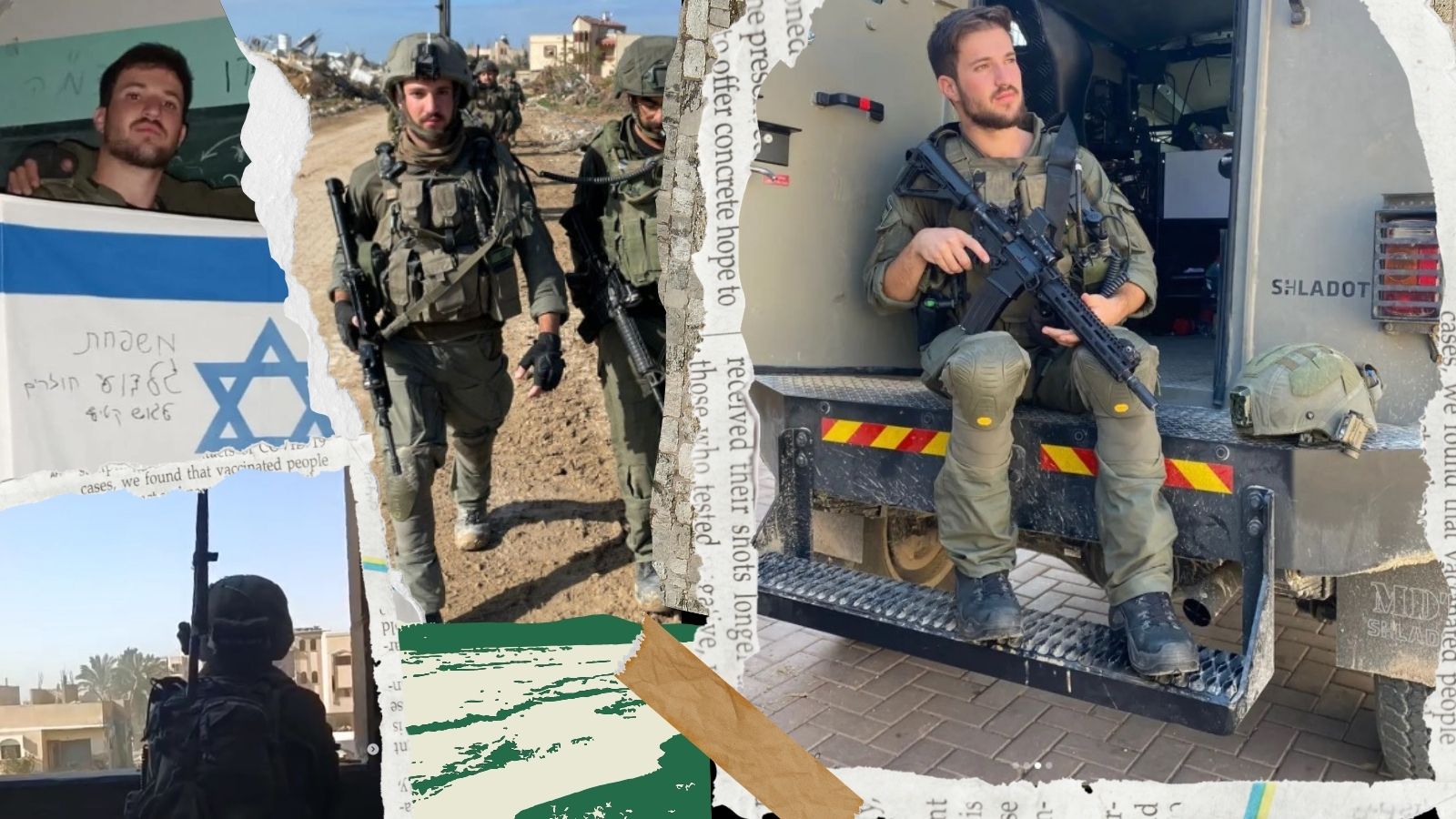
Photos used are sourced from social media by the Hind Rajab Foundation.
In a first-of-its-kind international complaint, Brussels-based legal advocacy group The Hind Rajab Foundation (HRF) filed an urgent complaint on 30 May 2026 with the Indian authorities, demanding the arrest of an Israeli military reservist, Eitan Gilboa, who was vacationing in the state of Himachal Pradesh.
The complaints, filed with the Indian police, the Ministry of Home Affairs, and the Bureau of Immigration, invoked India’s obligations under the Geneva Conventions Act, 1960, and the principle of universal jurisdiction. Universal jurisdiction allows the prosecution of individuals accused of war crimes regardless of the place of crime, or the nationality of the perpetrators or victims.
Based on the evidence it collected, the HRF said that Gilboa “personally carried out and celebrated the systematic demolition of entire residential blocks in Gaza”, which constitutes war crimes. This move has squarely put the question of India’s international obligations to the Narendra Modi-led government, which has been rapidly deepening its economic and defense ties with Israel.
Since 2024, HRF has monitored and documented the conduct of 1000 Israeli military personnel through open-source material, witness accounts, and other sources. The organization has filed more than 80 complaints and legal petitions across 28 countries against Israeli military personnel and officials accused of involvement in alleged war crimes and crimes against humanity in Gaza. India is one of the most recent jurisdictions in the global majority countries where HRF has sought to test the reach of universal jurisdiction laws against Israeli military personnel and officials.
The Case Against Eitan Gilboa
In a detailed report submitted to Indian authorities, HRF said that Eitan Gilboa, a reservist in the 271st Combat Engineering Battalion of the Israel Defense Forces, carried out and celebrated the systematic demolition of residential blocks in Gaza.
According to HRF, Gilboa was born in Gaza during the period of Israeli occupation and left with his family following Israel’s 2005 withdrawal from the territory. The organization said that, viewing their departure as an “expulsion”, Gilboa and several of his siblings returned to Gaza after the October 7, 2023, attack by Hamas.
Gilboa had completed his initial military service in July 2023; he then reenlisted and served as a reservist in the 271st Battalion of the 14th Brigade from at least November 2023 until May 2025, the report said. He was sent to Gaza approximately in December 2023, then to Lebanon in October 2024.
The 271st Combat Engineering Battalion, of which Gilboa was purportedly a member, is part of the Golani Brigade and has been actively deployed in Gaza since October 7, 2023. According to Open Source Intelligence (OSINT) analysis, the battalion has been involved in widespread infrastructure destruction across Khan Younis, Rafah, and Gaza City and engaged in the demolition of multi-story residential buildings, hospitals, schools, and civilian shelters.
During his Gaza deployment, HRF said he documented his presence in Khan Younis, Rafah, Beit Hanoun, and Beit Lahia. He staged photographs recreating scenes from his childhood, juxtaposing himself against the ruins of Palestinian children’s playgrounds. HRF also published social media videos and photos that show Gilboa ordering the demolition of Palestinian homes. Gilboa’s mother, Tamar Gilboa, publicly shared these photos and videos on Instagram and Facebook.
The complaint further mentioned specific instances of Gilboa celebrating and participating in the destruction of civilian infrastructure in Gaza, including in Khan Younis and Rafah.
According to the foundation’s investigative dossier, on 16 January 2024, Tamar Gilboa published a video of a controlled demolition of an entire residential area in Khan Younis featuring her son and teammates, with the caption stating “Eitan shows them what the IDF is” as soldiers cheered enthusiastically after the explosion.
In June 2024, she published another video from Rafah depicting the detonation of multiple residential buildings, with Gilboa seen ordering the detonation himself; the demolition was explicitly dedicated to Colonel Assaf Hamami, commander of the Southern Brigade of the Gaza Division, who was killed on 7 October 2023.
On 25 July 2024, Gilboa’s mother published a video from Gaza showing the detonation of an entire residential block, actively triggering the explosion with the caption “We will always remember you,” also dedicated to Colonel Assaf Hamami. Between January 2024 and May 2025, multiple videos showed systematic detonation of residential blocks across various locations in Gaza, with demolitions explicitly dedicated to fallen soldiers as acts of revenge and no military justification offered.
Under international law, these acts could also constitute crimes against humanity or acts of genocide, though HRF’s complaint focuses primarily on the charges of war crimes under Indian domestic law.
The HRF report argues that Gilboa’s actions constitute war crimes under the Geneva Conventions Act, 1960 in India. This legal basis is critical: Section 3 of the Act makes grave breaches of the Geneva Conventions punishable offenses under Indian law, with imprisonment of up to 14 years. Section 3 applies regardless of nationality or citizenship and includes acts committed outside India. Section 4 further states that when such an offense is committed outside India, the accused may be dealt with as if the offense had been committed anywhere in India where they are found. “That provision is central to HRF’s universal-jurisdiction argument,” said the lawyer working on the case with HRF. “It means India has the legal authority to prosecute Gilboa even though the alleged crimes occurred in Gaza, because he was found on Indian soil.”
The complaint also references Article 146 of the Fourth Geneva Convention, which requires signatory countries to “search for and prosecute individuals alleged to have committed grave breaches, regardless of nationality.” HRF argues that by failing to act, India would be violating its own treaty obligations.
HRF additionally invoked Article 51(c) of the Indian Constitution, which directs the state to “foster respect for international law and treaty obligations.” The foundation contends that allowing Gilboa to remain in India without prosecution contradicts this constitutional mandate.
Israeli soldiers post photos and videos of themselves in Gaza, often carrying out controversial activities like excitedly rummaging through Palestinian properties. The military has attempted to rein in such public postings and media coverage of active soldiers as widespread condemnation and legal actions (like HRF’s) have mounted against them overseas.
The Hummus Trail: India as Post-Service Haven for Israeli Soldiers
The HRF located Gilboa as vacationing in Old Manali and Gondla Village, in Himachal Pradesh.
The Himalayan state has emerged as a popular destination for Israeli nationals, mostly former or current IDF soldiers. Over 50,000 Israelis visit India annually and travel along what is now termed as the “Hummus Trail”, a network of popular backpacking destinations across Southeast Asia and India following their mandatory military service— seeking “respite” after taking part in operations in the occupied Palestinian territories.
Old Manali is a well-known stop on that route, with hostels, cafés, and guesthouses that cater heavily to Israeli travelers. Israeli tourist enclaves have also sprung up in places like Kasol and Dharamkot, where Hebrew signage, Chabad houses, and businesses cater specifically to Israelis.
In its complaint, HRF used Gilboa’s reported location in Himachal Pradesh to argue that Indian authorities had a concrete opportunity to act while he was still within Indian jurisdiction. The complaint was framed as a request for immediate intervention while the accused was physically present in the country.
The Indian National Congress, the principal opposition party in India, has criticized the current government’s closeness with Israel and called Israel’s action in Gaza “genocidal”. The party is in power in the Himachal Pradesh government. But its spokesperson refused to comment on whether it could take action in Gilboa’s case or any such future cases.
Sources in HRF said Gilboa may have left India for Israel after news of the complaint became public. If confirmed, his departure would underline the narrow window in which Indian authorities could have moved on the complaint and the speed with which such cases can collapse without prompt state action.
When Israeli soldiers travel across the world, and particularly in India, Thailand, Sri Lanka, and countries in Latin America, they are moving through jurisdictions with lax visa regimes, where institutional mechanisms for accountability are often weak, where governments may be politically aligned with Israel, and where local communities have little information about the wars these soldiers have just fought.
A lawyer working in collaboration with HRF on Gilboa’s case told The Polis Project that, in places such as India, Sri Lanka, or Thailand, there is far greater wariness about the process. However, creating legal records is important, even though “government responses are not robust in the Global South”. Such legal initiatives also aim to ensure that countries don’t become safe havens for war criminals.
HRF’s filings span jurisdictions across Europe, the Americas, Asia, and the Middle East. Responses from these states have varied widely. While some courts and prosecutors have opened preliminary inquiries or reviewed evidence submitted by complainants, few cases have progressed to arrests or prosecutions, exposing both the possibilities and limitations of using domestic legal systems to pursue accountability for international crimes.
Some of HRF’s complaints have progressed beyond initial review stages. In Peru, prosecutors opened preliminary investigations into Israeli soldiers following complaints filed by the organization. In Canada, a complaint submitted jointly by HRF and two other legal groups led to the detention and questioning of an Israeli military reservist and comedian, Guy Hochman, upon his arrival in Toronto. He told The Jerusalem Post that his Canadian visa was eventually revoked.
HRF’s Demands to Indian Authorities
In its filing, HRF urged Indian authorities to arrest Gilboa and to register a formal police complaint (First Information Report) against him under Section 3 of the Geneva Conventions Act, 1960. The complaint argued that the Act confers jurisdiction on Indian authorities over grave breaches committed outside India when the accused is found on Indian soil. If an arrest is not immediately possible, HRF urged that the Ministry of Home Affairs and the Bureau of Immigration act on Gilboa’s presence in Himachal Pradesh and remove him from Indian territory pending further proceedings.
The complaint also requested that Gilboa be placed on the Wanted List maintained by the National Investigation Agency and that his visa be canceled under the Foreigners Act, 1946.
The demands were framed as a test of whether India is willing to use its domestic law to enforce international humanitarian obligations. HRF said the complaint was not only about Gilboa, but about whether countries in the Global South will allow tourism routes like the “Hummus Trail” to become channels of impunity. HRF called on India to ensure the application of universal jurisdiction, recognizing that Gilboa’s crimes affect the international community as a whole. The call aligns with similar actions taken by Spain, Belgium, and Argentina in past decades, where courts have pursued cases against individuals accused of war crimes and crimes against humanity.
Bracq, who has previously represented Palestinian families in international litigation, emphasized that the battle for accountability extends beyond European and North American courts to the Global South, where many Israeli soldiers travel knowing they are unlikely to face legal consequences. She said the “Hummus Trail” has become a path through which soldiers accused of grave crimes can move through jurisdictions with little scrutiny.
HRF General Director Dyab Abou Jahjah said in a comment shared by the organization: “Eitan Gilboa is not a tourist. He is a war criminal currently enjoying the hospitality of India while fleeing the consequences of his crimes.” Jahjah, a Lebanese political activist, said that India “must not allow Indian soil to become a safe haven for those who celebrate the destruction of civilian lives.”
In the face of government inaction, the lawyer working on the case argued that there is another dimension to understanding and quantifying what success means in such legal cases: the departure itself, and the fear it generates. If Gilboa has indeed left India, he now understands there is no “safe haven”, and that scrutiny and accountability will follow.
“Success cannot be measured solely by convictions or court orders. It must also be measured by the disruption of impunity, by the narrowing of spaces where war criminals can move without consequence,” the lawyer added.
Indian Government’s Inaction and Indo-Israel Ties
According to the lawyer working on Gilboa’s case, the Indian government failed to take any meaningful action. The only response the organization received was a single email reply from the Bureau of Immigration, which requested HRF’s contact information and did not follow up.
Internal documents obtained by HRF show that the complaint was forwarded to the Ministry of Home Affairs’ Foreigners Division, which typically handles visa cancellations and deportation proceedings. Still, no action was taken within the 30-day window typically allotted for such responses.
The lawyer for HRF noted that India does not accept “universal jurisdiction”, but it does recognize treaty-based jurisdiction, such as under the four Geneva Conventions and the Apartheid Convention. In its UN Sixth Committee statement in 2024, India argued that universal jurisdiction “lacks proper legal backing,” that jurisdiction over war crimes is treaty-based rather than customary, and proposed reading it narrowly as a state’s power to prosecute its own nationals, while warning against the principle’s misuse. This restrictive stance, combined with the requirement that the central government approves any prosecution under the Geneva Conventions Act, gives India ample political and procedural cover to decline to act on the Hind Rajab Foundation’s complaint against Gilboa, especially given New Delhi’s close ties with Israel.
Nonetheless, India’s own Geneva Conventions Act, 1960—implementing its grave-breaches obligations—permits Indian courts to prosecute grave breaches committed by any person, of any nationality, anywhere in the world, so long as that person is found on Indian soil, meaning prosecution of Gilboa is legally conceivable even if politically improbable.
However, the legal framework is less important in this matter compared to political will, the lawyer said, adding that the power lies “overwhelmingly with the executive”.
The Supreme Court of India underscored this deference to the executive in September 2024 when it dismissed a petition seeking the cancellation of arms-export licenses granted to public sector entities to send weapons to Israel amid the Gaza war. The petition argued that continuation of the export licenses would constitute complicity against the Genocide Convention and other international obligations of India. While noting that existing laws already confer sufficient powers on the Union government to suspend or revoke such licenses if it chooses, the court declined to direct any action, observing that such decisions require the executive to weigh a range of policy, diplomatic, and economic considerations.
Critics argue that India’s inaction reflects broader geopolitical considerations, including its growing strategic partnership with Israel and its reliance on Israeli technology for defense, agriculture, and counterterrorism operations.
India has become a major arms customer and close ally of Israel, reflecting growing ideological and defense alignment. Today, the India-Israel relationship is cemented by massive defense contracts, with India accounting for roughly 37% of Israel’s international arms sales.
Historically, India maintained a staunchly pro-Palestine stance as a leader of the Non-Aligned Movement. Under Prime Minister Narendra Modi, that position has shifted dramatically. Observers note that the Hindutva movement in India and Israeli Zionism share nationalist approaches and geopolitical outlooks, which have helped position India as Israel’s closest ally in the region.
PM Modi concluded a two-day state visit to Israel on February 25-26, 2026, marking a landmark moment in bilateral relations. During the visit, India and Israel agreed to elevate their ties to a “Special Strategic Partnership for Peace, Innovation and Prosperity,” reflecting broader cooperation in defense, technology, trade, and people-to-people exchanges.
The government of India has also faced ongoing pressure from activists and civil society groups over its arms shipments to Israel, which have continued throughout the genocide in Gaza. India has also banned HRF’s film “The Voice of Hind Rajab,” citing threats to the relationship with Israel.
The lawyer quoted earlier said it is important to have a broader conversation about what success means when dealing with institutions that cannot always be relied upon to deliver justice. “Courts may not save you. Governments may not act. But legal processes can still serve other functions. They can create records, generate pressure, expose complicity, and narrow the spaces in which impunity operates.”