Centre agrees to drop NEET protest cases as CJP calls off protests; Patna sees fresh wave of student arrests

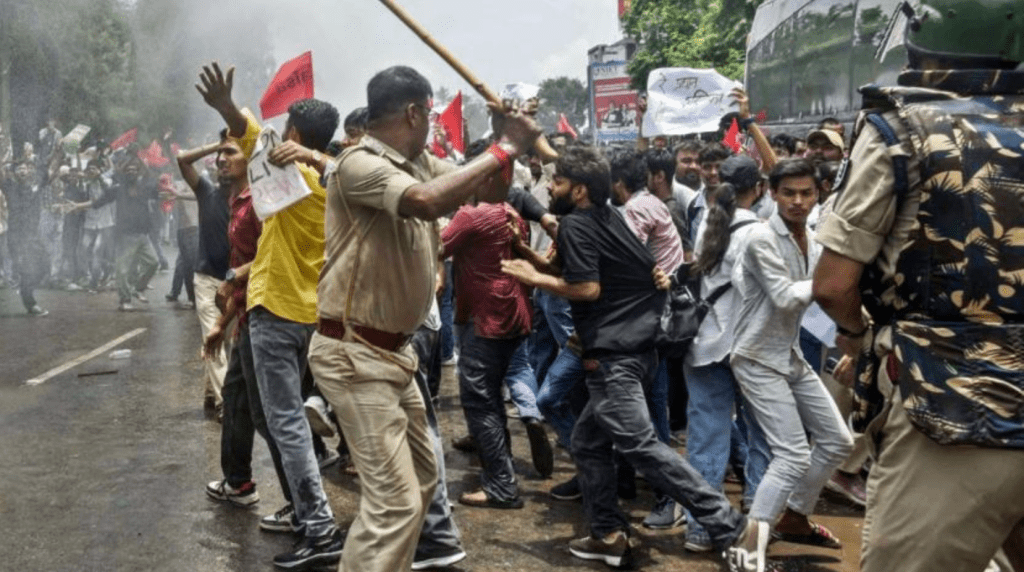
Policemen carry out baton charge on students including AISA supporters during a protest march against the irregularities and examination paper leaks, in Patna, Bihar, July 22, 2026

PATNA, July 27 — Even as the Modi government in New Delhi has agreed to withdraw criminal cases against students who protested this month over irregularities in national entrance examinations, lawyers say that the police across Patna are carrying out a fresh wave of arrests and filing blanket cases with open FIRs that list named and unnamed accused.

Four days after students across Bihar filled the streets over a leaked medical-entrance exam, as part of the countrywide wave of protests tied to the Coakroach Janta Party (CJP) -led student agitation in Delhi, police officers in Patna named 285 people in cases registered at three stations: Kotwali, Gandhi Maidan and the Secretariat and, alongside them, opened 24 cases against about 5,000 unnamed people they could not identify. The cases carry largely overlapping charges under the Bharatiya Nyaya Sanhita and the Prevention of Damage to Public Property Act.

In the early hours of Sunday, July 26, after the Delhi settlement was announced and the CJP called off its national protests, about 87 students and other young people were produced before a magistrate at his Chhajubagh residence and sent to judicial custody at Beur Central Jail after 1 a.m, according to lawyers at the scene. The students were booked under various FIRs, and the detainees were not told the grounds for their arrest, were not given a copy of the first information report (FIR), and the remand was ordered without their counsel being heard, despite an application filed opposing it.

Already inside Beur Central Jail are the movement’s public faces: CPI(ML) Liberation MLA Sandeep Saurav and AISA student leaders arrested in the July 23 crackdown. Reports name AISA’s Dhananjay, Dipankar Mishra, Saba Afreen, and Kumar Divyam among those arrested, while CPI(ML) also said Naushad was among the detained leaders in the wider sweep. 

The crackdown in Bihar sits uneasily beside the political settlement struck in Delhi. On Saturday, Union Education Minister Dharmendra Pradhan resigned, and the government told protest leaders it would withdraw cases against demonstrators, pay compensation to the families of aspirants who died by suicide, and put its exam-reform plan in writing. Prime Minister Narendra Modi also announced a high-powered task force on examination reforms under the leadership of Nandan Nilekani.

The young people being detained in Bihar’s jails that weekend were, on paper, precisely the people the settlement was meant to free. On the ground in Patna, lawyers say that whatever was agreed in Delhi’s meeting rooms has not been implemented here.  

In Bhagalpur, police detained 52 people over the same unrest and, after producing them in court, released 16 for being minors who had already spent the intervening hours in custody. In Patna, lawyers working with the detained say minors and at least a dozen young women were among those held at Rupaspur station. Several of the children were kept for 20 to 24 hours before being handed back to parents who were made to furnish identity papers to release them. Under juvenile law, lawyers say, minors should not be held in ordinary police custody at all.

Lawyers say the arrest process has been marked by obfuscation. At some police stations, they say, officers told them the matter belonged to another jurisdiction; elsewhere, they were refused FIR copies, denied confirmation that an FIR had been filed, or blocked from meeting detainees. The result is a custody process in which young protesters are left without basic information about what they are accused of or where they are being held. Many of the detained, the lawyers say, come from poor and marginalized families, and some had never been at a protest. A number of those still inside have competitive examinations this week. 

The police account, carried by Hindustan Times, contradicts eyewitness accounts: it says 87 people held for questioning were released once no involvement was found. 

The FIR names a few hundred people while listing 5,000 “unknown” slots which can be filled in any time, muddying the official record from what happens to any individual in a cell: the same night can be reported as the release of the uninvolved and remand without charge, with nothing on paper obliged to reconcile the two. The unnamed thousands are tried and tested mechanisms by which what is reported need not match what transpired.

In Chhapra, a police vehicle was set alight; in Siwan, police said, firing during a clash left three protesters with bullet wounds and more than 40 officers injured. Officers say the arrests rest on CCTV footage, and a law-and-order DSP, Krishna Murari Prasad, said unnamed “rioters” were still being identified from it. 

Lawyers say they have been refused copies of FIRs, refused confirmation that a case even exists, and told at some stations that the matter belongs to another jurisdiction. A charge you are not allowed to read is a charge you cannot fight.

Through the weekend, the work of accounting for who was where and of filing the applications against remand was done by lawyers and volunteers of the People’s Union for Civil Liberties. 

In Kolkata, the crackdown has also begun to widen beyond Bihar. West Bengal authorities invoked the state’s Public Safety and Control of Anti-Social Activities Act, 2026, after violence linked to a NEET protest, arresting 11 people including 10 Muslims, according to police-reported arrest data in a move that drew concern from rights advocates over preventive detention and possible profiling.

What is emerging is a broader pattern of protest policing: mass FIRs, preventive detention, hurried remand hearings and allegations that basic criminal-procedure safeguards are being treated as optional. In Bihar, the question is no longer only how many students were arrested, but whether the state can show that each arrest was lawful and reviewable.

Join us

Suchitra Vijayan is the founder and executive director of The Polis Project and the author of Midnight’s Borders: A People’s History of Modern India and How Long Can the Moon Be Caged? Voices of Indian Political Prisoners.

Centre agrees to drop NEET protest cases as CJP calls off protests; Patna sees fresh wave of student arrests

By July 27, 2026
Policemen carry out baton charge on students including AISA supporters during a protest march against the irregularities and examination paper leaks, in Patna, Bihar, July 22, 2026

PATNA, July 27 — Even as the Modi government in New Delhi has agreed to withdraw criminal cases against students who protested this month over irregularities in national entrance examinations, lawyers say that the police across Patna are carrying out a fresh wave of arrests and filing blanket cases with open FIRs that list named and unnamed accused.

Four days after students across Bihar filled the streets over a leaked medical-entrance exam, as part of the countrywide wave of protests tied to the Coakroach Janta Party (CJP) -led student agitation in Delhi, police officers in Patna named 285 people in cases registered at three stations: Kotwali, Gandhi Maidan and the Secretariat and, alongside them, opened 24 cases against about 5,000 unnamed people they could not identify. The cases carry largely overlapping charges under the Bharatiya Nyaya Sanhita and the Prevention of Damage to Public Property Act.

In the early hours of Sunday, July 26, after the Delhi settlement was announced and the CJP called off its national protests, about 87 students and other young people were produced before a magistrate at his Chhajubagh residence and sent to judicial custody at Beur Central Jail after 1 a.m, according to lawyers at the scene. The students were booked under various FIRs, and the detainees were not told the grounds for their arrest, were not given a copy of the first information report (FIR), and the remand was ordered without their counsel being heard, despite an application filed opposing it.

Already inside Beur Central Jail are the movement’s public faces: CPI(ML) Liberation MLA Sandeep Saurav and AISA student leaders arrested in the July 23 crackdown. Reports name AISA’s Dhananjay, Dipankar Mishra, Saba Afreen, and Kumar Divyam among those arrested, while CPI(ML) also said Naushad was among the detained leaders in the wider sweep. 

The crackdown in Bihar sits uneasily beside the political settlement struck in Delhi. On Saturday, Union Education Minister Dharmendra Pradhan resigned, and the government told protest leaders it would withdraw cases against demonstrators, pay compensation to the families of aspirants who died by suicide, and put its exam-reform plan in writing. Prime Minister Narendra Modi also announced a high-powered task force on examination reforms under the leadership of Nandan Nilekani.

The young people being detained in Bihar’s jails that weekend were, on paper, precisely the people the settlement was meant to free. On the ground in Patna, lawyers say that whatever was agreed in Delhi’s meeting rooms has not been implemented here.  

In Bhagalpur, police detained 52 people over the same unrest and, after producing them in court, released 16 for being minors who had already spent the intervening hours in custody. In Patna, lawyers working with the detained say minors and at least a dozen young women were among those held at Rupaspur station. Several of the children were kept for 20 to 24 hours before being handed back to parents who were made to furnish identity papers to release them. Under juvenile law, lawyers say, minors should not be held in ordinary police custody at all.

Lawyers say the arrest process has been marked by obfuscation. At some police stations, they say, officers told them the matter belonged to another jurisdiction; elsewhere, they were refused FIR copies, denied confirmation that an FIR had been filed, or blocked from meeting detainees. The result is a custody process in which young protesters are left without basic information about what they are accused of or where they are being held. Many of the detained, the lawyers say, come from poor and marginalized families, and some had never been at a protest. A number of those still inside have competitive examinations this week. 

The police account, carried by Hindustan Times, contradicts eyewitness accounts: it says 87 people held for questioning were released once no involvement was found. 

The FIR names a few hundred people while listing 5,000 “unknown” slots which can be filled in any time, muddying the official record from what happens to any individual in a cell: the same night can be reported as the release of the uninvolved and remand without charge, with nothing on paper obliged to reconcile the two. The unnamed thousands are tried and tested mechanisms by which what is reported need not match what transpired.

In Chhapra, a police vehicle was set alight; in Siwan, police said, firing during a clash left three protesters with bullet wounds and more than 40 officers injured. Officers say the arrests rest on CCTV footage, and a law-and-order DSP, Krishna Murari Prasad, said unnamed “rioters” were still being identified from it. 

Lawyers say they have been refused copies of FIRs, refused confirmation that a case even exists, and told at some stations that the matter belongs to another jurisdiction. A charge you are not allowed to read is a charge you cannot fight.

Through the weekend, the work of accounting for who was where and of filing the applications against remand was done by lawyers and volunteers of the People’s Union for Civil Liberties. 

In Kolkata, the crackdown has also begun to widen beyond Bihar. West Bengal authorities invoked the state’s Public Safety and Control of Anti-Social Activities Act, 2026, after violence linked to a NEET protest, arresting 11 people including 10 Muslims, according to police-reported arrest data in a move that drew concern from rights advocates over preventive detention and possible profiling.

What is emerging is a broader pattern of protest policing: mass FIRs, preventive detention, hurried remand hearings and allegations that basic criminal-procedure safeguards are being treated as optional. In Bihar, the question is no longer only how many students were arrested, but whether the state can show that each arrest was lawful and reviewable.

SUPPORT US

We like bringing the stories that don’t get told to you. For that, we need your support. However small, we would appreciate it.


Suchitra Vijayan is the founder and executive director of The Polis Project and the author of Midnight’s Borders: A People’s History of Modern India and How Long Can the Moon Be Caged? Voices of Indian Political Prisoners.