An Open Letter to the People of Azad Jammu & Kashmir

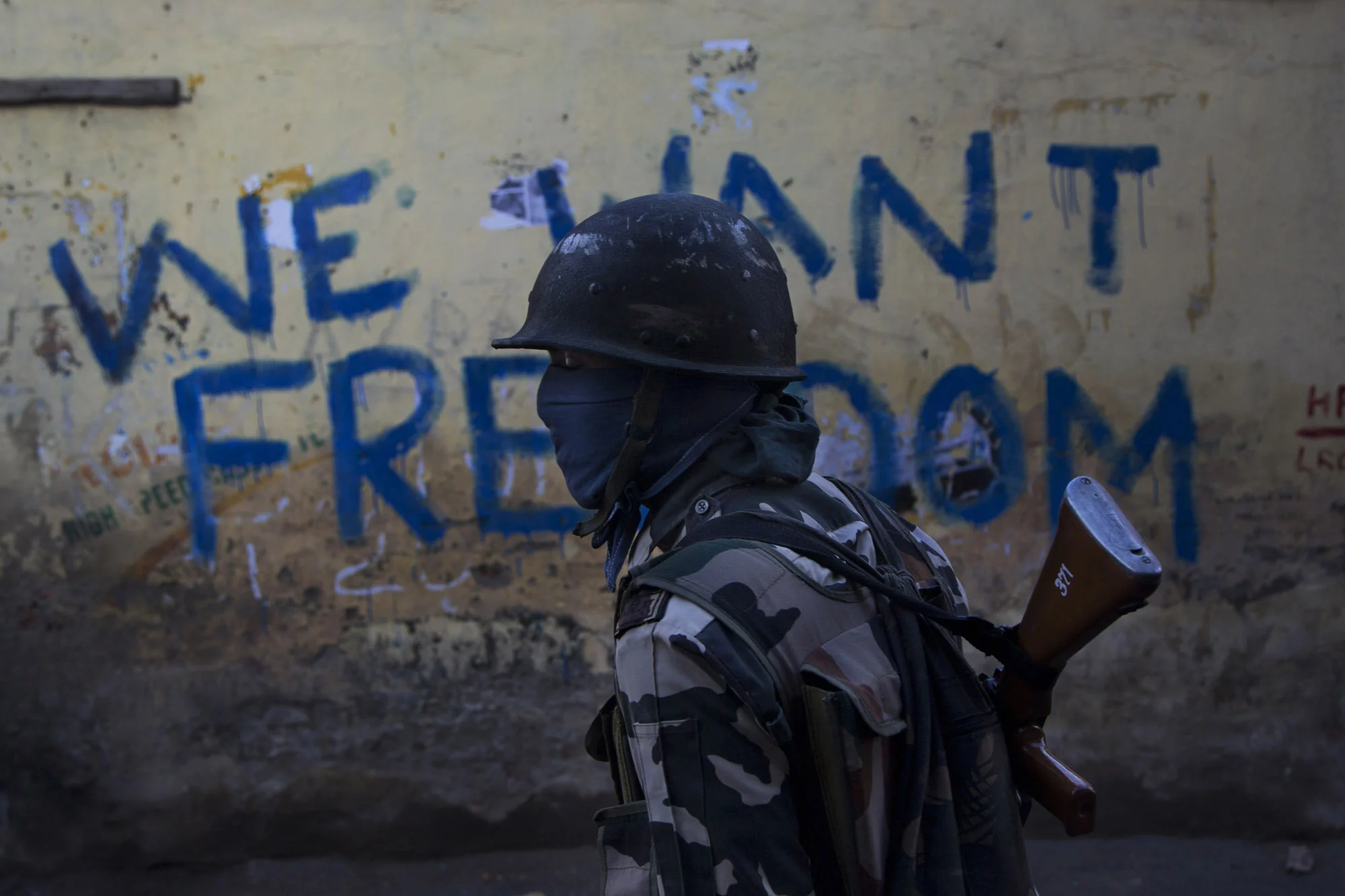
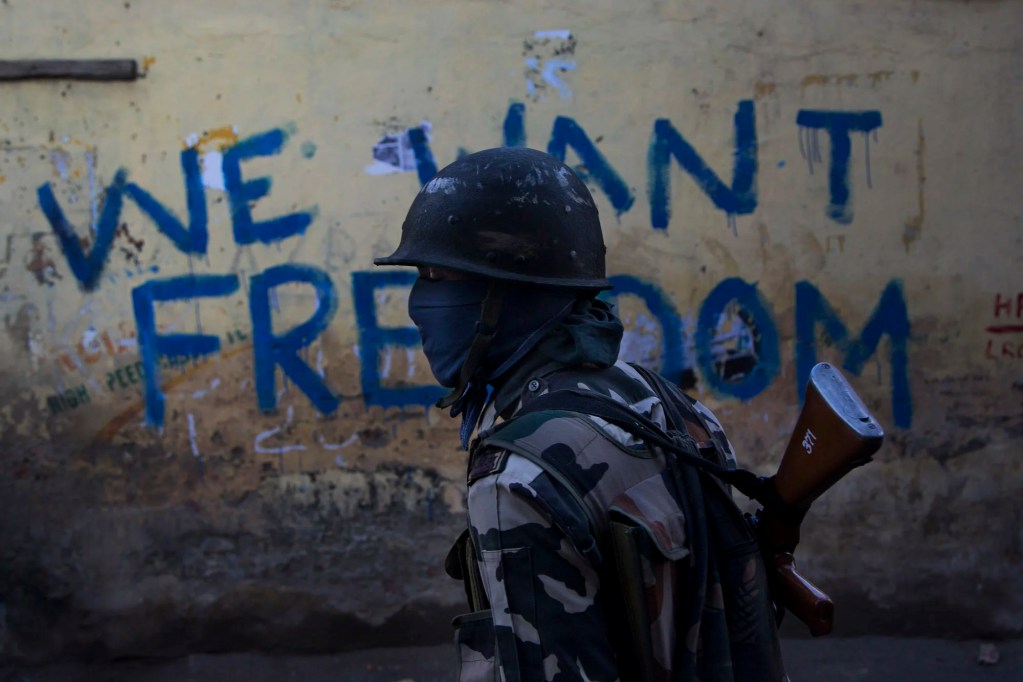
An Indian paramilitary soldier walks past graffiti on a wall in Srinagar, Indian-controlled Kashmir, Aug. 29, 2016.(AP Photo/Dar Yasin)

The Polis Project is publishing this open letter by Kashmiris on the Indian-administered side, writing in solidarity with protesters living under Pakistani administration.

Editorial Note

Pakistan-administered Kashmir, also called Azad Jammu and Kashmir, has erupted in protests since early June. On June 5, the authorities banned the Jammu Kashmir Joint Awami Action Committee (JAAC) under anti-terrorism legislation. They also suspended internet and mobile services, deployed paramilitary forces, arrested organizers, and sealed the organization’s central office. More than 100 people were arrested during the first two days of the crackdown. By June 19, police reported that they had detained 515 people.

The JAAC is a broad civil society coalition. It has organized around demands for subsidized flour, a fair share of hydropower revenue, reduced privileges for political elites, and better public services. Its most immediate demand is around the structure of the regional assembly. Of its 45 elected seats, 12 represent refugees from Indian-administered Kashmir who live elsewhere in Pakistan. JAAC argues that parties based in Pakistan use these seats to influence the formation of the regional government.

Regional elections are continuing amid this repression. Before voting began on July 27, Amnesty International said that at least 40 people had been killed since June. JAAC added that more than 30 protesters were killed on July 27 and 28. The communications blackout has disrupted banking, education, businesses, travel and access to essential supplies. 

Across the Line of Control, India has built an even more extensive system of control. On August 5, 2019, the Indian government revoked Jammu and Kashmir’s limited constitutional autonomy, dissolved its statehood, and divided it into two union territories governed directly from New Delhi. It imposed one of the longest internet shutdowns in the world.

Indian authorities continue to use the Unlawful Activities Prevention Act and the Jammu and Kashmir Public Safety Act to hold people for long periods without trial. 

The two sides are not the same, and India’s militarization of Kashmir has its own scale and history. But both treat independent Kashmiri politics as a threat, and use anti-terror laws, internet shutdowns, arrests and censorship to limit what Kashmiris can demand.

Pakistan criticizes India for denying Kashmiris self-determination, while suppressing those who reject rule by Pakistan. India cites elections and development as proof of a normal life, while criminalizing any demand that challenges its control.

The U.N. proposed a plebiscite in 1948 to determine whether the former princely state would accede to India or Pakistan. Nearly 80 years later, no vote has taken place. 


An Open Letter to the People of Azad Jammu & Kashmir

Kashmiris for Kashmiris

To our beloved brethren and elders in Azad Jammu & Kashmir,

It has been more than seventy years since the ceasefire line and nation-state system have separated us. Our natural relationship has been broken. Our history, land, lives, and our futures have been divided by outsiders. Today, as you face bullets for simply demanding your rights, we want you to know you are not alone. We mourn with you from afar even if we cannot show our grief and solidarity in the streets. We want you to know that our historical, cultural, and spiritual ties are not broken.

We are with you. We are grieving with our Shaheeds, who faced the bullets like heroes. We see your grief, your anger, and your Azm, your resolve.

We feel it deeply because your struggle is familiar to us.

Many of you have firmly believed that your relationship with Pakistan would ensure dignity, belonging, and respect we deserve as a people. We had truly hoped and prayed that your experience would be different from ours.You have struggled hard for the dream of dignity and accountability in how your people and resources are governed. You deserve to be heard on your own terms without being labeled terrorists, foreign-backed, and miscreants. Your struggle should not become fodder for competing nationalisms or weaponized against your own rightful aspirations. You, the proud people, the keepers of the name Azad, our meeras, should not be made pawns in anyone else’s story.

We have been a witness to how your situation has steadily worsened through suppression of dissent, the dispossession of resources, and the denial of meaningful political voice. You are categorical in saying your fight is about belonging with dignity and seeking basic rights for your people, but you are being met with arrogant power. This must stop. We Kashmiris on the other side of the ceasefire line know this truth in its bitterest form. We had hoped better from Pakistan.

In Indian-administered Kashmir, we cannot speak openly, but we send our love, our prayers and solidarity in this extremely testing time. The distance imposed by dividing lines has not diminished our kinship, even if we have not met face to face in years. We are mourning the death of democratic processes with you. Your pain, your courage, your voice reaches us.

We stand with your demand to live with dignity and to shape your own future as you want.
Kashmiris for Kashmiris.

Always.

Join us

An Open Letter to the People of Azad Jammu & Kashmir

By July 31, 2026
An Indian paramilitary soldier walks past graffiti on a wall in Srinagar, Indian-controlled Kashmir, Aug. 29, 2016.(AP Photo/Dar Yasin)

The Polis Project is publishing this open letter by Kashmiris on the Indian-administered side, writing in solidarity with protesters living under Pakistani administration.

Editorial Note

Pakistan-administered Kashmir, also called Azad Jammu and Kashmir, has erupted in protests since early June. On June 5, the authorities banned the Jammu Kashmir Joint Awami Action Committee (JAAC) under anti-terrorism legislation. They also suspended internet and mobile services, deployed paramilitary forces, arrested organizers, and sealed the organization’s central office. More than 100 people were arrested during the first two days of the crackdown. By June 19, police reported that they had detained 515 people.

The JAAC is a broad civil society coalition. It has organized around demands for subsidized flour, a fair share of hydropower revenue, reduced privileges for political elites, and better public services. Its most immediate demand is around the structure of the regional assembly. Of its 45 elected seats, 12 represent refugees from Indian-administered Kashmir who live elsewhere in Pakistan. JAAC argues that parties based in Pakistan use these seats to influence the formation of the regional government.

Regional elections are continuing amid this repression. Before voting began on July 27, Amnesty International said that at least 40 people had been killed since June. JAAC added that more than 30 protesters were killed on July 27 and 28. The communications blackout has disrupted banking, education, businesses, travel and access to essential supplies. 

Across the Line of Control, India has built an even more extensive system of control. On August 5, 2019, the Indian government revoked Jammu and Kashmir’s limited constitutional autonomy, dissolved its statehood, and divided it into two union territories governed directly from New Delhi. It imposed one of the longest internet shutdowns in the world.

Indian authorities continue to use the Unlawful Activities Prevention Act and the Jammu and Kashmir Public Safety Act to hold people for long periods without trial. 

The two sides are not the same, and India’s militarization of Kashmir has its own scale and history. But both treat independent Kashmiri politics as a threat, and use anti-terror laws, internet shutdowns, arrests and censorship to limit what Kashmiris can demand.

Pakistan criticizes India for denying Kashmiris self-determination, while suppressing those who reject rule by Pakistan. India cites elections and development as proof of a normal life, while criminalizing any demand that challenges its control.

The U.N. proposed a plebiscite in 1948 to determine whether the former princely state would accede to India or Pakistan. Nearly 80 years later, no vote has taken place. 


An Open Letter to the People of Azad Jammu & Kashmir

Kashmiris for Kashmiris

To our beloved brethren and elders in Azad Jammu & Kashmir,

It has been more than seventy years since the ceasefire line and nation-state system have separated us. Our natural relationship has been broken. Our history, land, lives, and our futures have been divided by outsiders. Today, as you face bullets for simply demanding your rights, we want you to know you are not alone. We mourn with you from afar even if we cannot show our grief and solidarity in the streets. We want you to know that our historical, cultural, and spiritual ties are not broken.

We are with you. We are grieving with our Shaheeds, who faced the bullets like heroes. We see your grief, your anger, and your Azm, your resolve.

We feel it deeply because your struggle is familiar to us.

Many of you have firmly believed that your relationship with Pakistan would ensure dignity, belonging, and respect we deserve as a people. We had truly hoped and prayed that your experience would be different from ours.You have struggled hard for the dream of dignity and accountability in how your people and resources are governed. You deserve to be heard on your own terms without being labeled terrorists, foreign-backed, and miscreants. Your struggle should not become fodder for competing nationalisms or weaponized against your own rightful aspirations. You, the proud people, the keepers of the name Azad, our meeras, should not be made pawns in anyone else’s story.

We have been a witness to how your situation has steadily worsened through suppression of dissent, the dispossession of resources, and the denial of meaningful political voice. You are categorical in saying your fight is about belonging with dignity and seeking basic rights for your people, but you are being met with arrogant power. This must stop. We Kashmiris on the other side of the ceasefire line know this truth in its bitterest form. We had hoped better from Pakistan.

In Indian-administered Kashmir, we cannot speak openly, but we send our love, our prayers and solidarity in this extremely testing time. The distance imposed by dividing lines has not diminished our kinship, even if we have not met face to face in years. We are mourning the death of democratic processes with you. Your pain, your courage, your voice reaches us.

We stand with your demand to live with dignity and to shape your own future as you want.
Kashmiris for Kashmiris.

Always.
SUPPORT US

We like bringing the stories that don’t get told to you. For that, we need your support. However small, we would appreciate it.