




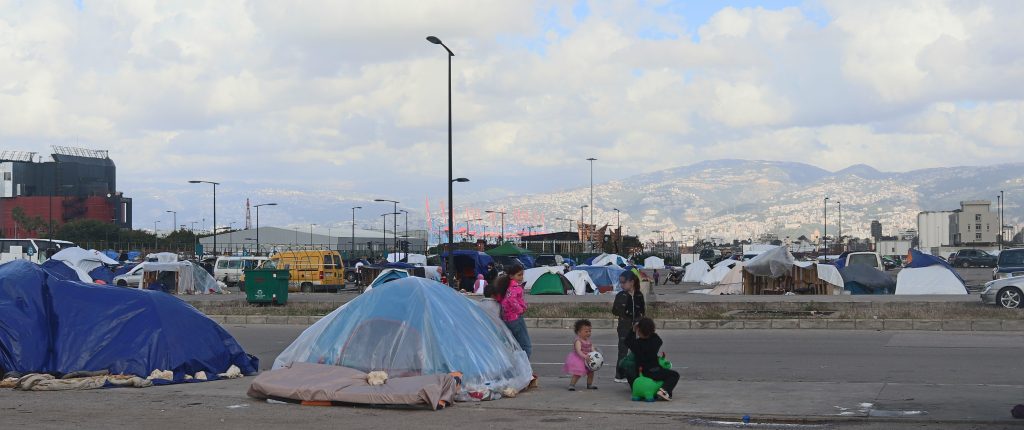
Amid long lines of cars and vans, Samima Begum, a factory worker from Bangladesh, walked along the coastal highway from Nabatiye, a city in south Lebanon, until she found a ride to Saida, a city 45 km from Beirut. Most Bangladeshis, and other migrants, who fled South Lebanon, are sheltering in Saida.
Over a million people have been displaced in the past five months, as a result of renewed hostilities between Israel and Lebanon which sparked widespread panic from the suburbs of Beirut to the South and Bekaa Valley. As soon as the bombing began, residents began to flee even before the “evacuation notices” were issued. All roads leading to Beirut and beyond were crammed with cars filled with people.
“I didn’t expect the war to return so soon. Yet, I knew what to do- [I had to] just leave,” said Begum, recalling her experience of the 2024 war between Lebanon and Israel. Last time, she had been displaced for over five months. So when the war began again, she packed a few of her belongings, reached out to some friends in Saida, and hoped it would be a short while until she returned home to Nabatiye which she shared with her husband.
Today, five months later, as only a handful of South Lebanon’s residents are slowly returning to the ruins of their homes, Nabatiye, which had turned into a ghost town, remains empty. Other major cities in South Lebanon that have been targeted by Israel with forced evacuation orders and relentless bombing, such as Tyre, are also beginning to see some residents return. Yet, Begum has not returned, and is still staying at a cramped apartment in Saida that she had rented with nine other Bangladeshis.
In 2024, migrant workers found themselves excluded and abandoned.They were barred from accessing official shelters set up by the Lebanese government in schools, stadiums and other public spaces, which were reserved exclusively for Lebanese nationals. This time, however, official shelters in Lebanon are obliged to be open to all, regardless of nationality. Yet, echoing the experiences of exclusion from official shelters in the past, migrants still face exclusion and discrimination.
Michael Petro, Director of the Migrant Worker Project at Jesuit Refugee Service, an international organization working with refugees, is managing a community center and church that has doubled as a displacement shelter, one of the only two displacement shelters in the country explicitly welcoming migrants. “Officially, this year the law has meant to include all. But, for various reasons, including a lack of capacity, the official policy does not always translate to the ground,” he said, referring to how migrants were being excluded in shelters.
An estimated 176,504 migrant workers in Lebanon, who are also subject to mass displacement and indiscriminate strikes, and exclusion from the government’s social services has led to a multifaceted crisis. Unofficial estimates put the numbers much higher, and these migrant workers, hailing from African and South and Southeast Asian countries have emerged among the most vulnerable during the war in Lebanon, along with other minorities.
Hiba, who did not want to share her full name, a Sudanese refugee who lived with her migrant worker husband in Bint Jbeil in South Lebanon, 115 km from Beirut, also left at the start of the hostilities. Now she has nowhere to “return” to, as the town has been wiped out under constant Israeli bombardment. Eight months pregnant when she fled to Beirut, Hiba is now counting her days to find a stable, domestic life with her newborn. Orphaned early in her life and fleeing a civil war in Khartoum, Sudan, Hiba joined her husband in Lebanon only last year in the hope of a better life.
“I feel like the war keeps following me,” she said.
“Yellow Line”, Displaced Lives
Meanwhile, for Hiba and Begum, who lived in villages where Israel has imposed a “yellow line” , return seems far. Villages they inhabited alongside others such as a no-go for residents from these villages. The “yellow line” has forcibly displaced residents, and the handful who remain are constantly under the threat of indiscriminate bombings. Israel continued military operations within and beyond the “yellow line”, issuing more forced evacuation orders and destroying these villages.
An agreement signed between the United States, Israel, and Lebanon at the end of June extended the “ceasefire” that was initially in place since April 17. Despite this agreement, Israeli troops have remained on ground, as it does not mandate withdrawal of troops. The Israeli Defense Minister, Israel Katz has further said, “We did not ask anyone’s permission to enter Lebanon, and we do not need permission to stay in Lebanon.”.
Despite the new framework agreement, there has been little change on the ground, where civilians continue to be displaced. The agreement requires Lebanon to “cease all hostile or negative actions in international political or legal forums”, which has sparked the concern that Israel cannot be held accountable under international courts for its war crimes against Lebanon.

Kristine Beckerle, Deputy Regional Director for the Middle East and North Africa at Amnesty International shared, in a report a week into the new framework, “Within the space of just a week – the Israeli military obliterated entire families, including a dozen children, in Lebanon, demonstrating a callous disregard for civilian lives. How many more families will have to pull the body parts of their children from the rubble before this devastating cycle of war crimes ends?”
“The international community must act now: states must impose an immediate comprehensive arms embargo on Israel and use universal and extraterritorial jurisdiction to investigate and prosecute those responsible,” Beckerle added.
So, there is no promise of return yet.
Hiba’s husband, Ahmed, worked as a concierge at a residential building in Bint Jbeil, which is now nearly razed to the ground. A sense of shock has set in for the couple, alongside sudden loss of livelihood. “I came to Lebanon almost a decade ago, and have faced so many wars in my life. Finally my wife joined me last year and we were looking forward to some stability,” Ahmed said.
As a migrant worker whose rights are governed by the kafala system, Ahmed has little protection. His employer has decided to withhold wages, citing the war. He is now taking on petty daily jobs when he can, hoping to find a more stable source of income to provide for his family.
Although Hiba is a UNHCR registered refugee, the document failed to get her access to maternal healthcare services in the subsidized public hospitals. Her husband, too, has no access to social security services, being a worker under the kafala. She is now living in a Jesuit Refugee Service shelter with her newborn among at least 120 migrants, and like other pregnant women in the shelter, has faced a host of issues.
Kafala System Add to Workers’ Woes
Several reports of workers abandoned by employers, withholding of wages, or heightened abuse show how the war has intensified the exploitative working conditions under the kafala system.The kafala is a prevalent migration sponsorship system in Lebanon and other Gulf countries that binds a worker to their employer, with the latter acting as a guarantor for the migrant worker. This means the employer or sponsor determines work conditions, legal status, and pay for a worker, among other things, leaving employees entirely dependent on them.
In Lebanon, similar to several Gulf countries, migrant workers, including domestic workers and others, such as agricultural workers, are excluded from the country’s labour legislation and solely dependent on the kafala. Since about 70% of migrants in Lebanon consist of women who are often involved in domestic work, the kafala often results in gendered captivity where the employer itself becomes the law.
Cases of abuse and exploitation were common even before the war, and for migrant workers who are women, this included sexual harassment, besides issues such as physical abuse, wage theft, and recruitment debt. For women, most of whom are domestic workers, and many who live with employees, there is heightened vulnerability. The system makes it notoriously difficult to enforce contracts and moreover, workers also need permission from their employers or sponsors to change their jobs. Workers, then, are left with no choice but to put up with their employers’ whims.
Begum, who is also bound by the system, has not heard back from her employers yet. “Everything depends on your luck. I have had relatively good working conditions in “peace” times, so even if the contract is suspended during war, I would prefer to go back to my employer when I can,” she said.
Hence, even when the work environment is abusive, a worker cannot leave an employer without their consent, as they risk losing their status of legal residency in the country and possible detention by authorities and deportation.
Manisa Kumari, a migrant worker from Nepal who moved to Lebanon two decades ago, did not trust the official system.
“I practically had to run away from my first employer, who used to physically abuse me, and locked me up at home. I was terrified, because I didn’t know anyone here either. My embassy refused to help,” she said.
Marginalized Further due to War
Like Hiba, 13,000 pregnant women were recorded as displaced in Lebanon, per the UNFPA, and in urgent need of access to life-saving healthcare.
“Even before Israel’s latest military escalation in Lebanon, migrants’ access to healthcare was severely limited by language barriers, systematic discrimination, cost of health services and residency status. Now, with nearly a fifth of the country’s population forcibly displaced, migrants are becoming even more pushed to the sidelines, with devastating consequences to their health and survival, ” shared AbdelHalim Abdallah, project coordinator at Doctors Without Borders or Médecins Sans Frontières (MSF) in Beirut.
Begum, too, was exhausted. Her troubles as a migrant worker in Lebanon stretched far beyond the current war. She said, “After living through the currency crisis, COVID, one war in 2024 and the displacement now, it is increasingly hard to place my hope in recovery.”
She said that her home town in Sylhet, Bangladesh, remains poverty-stricken, which makes the choice to go home impossible after spending almost a decade in Lebanon.
“This time, it feels impossible to overcome the crisis,” Begum said.
Reports of migrant worker deaths across the Gulf emerged early on in the war, the war has brought on more horrors for migrant workers in the region, including that of mass targeting and deportations. Yet, migrant workers continue to put their lives on line, with no protections or basic labour rights guaranteed. “While the geopolitical focus remains on military targets, migrant workers – the backbone of the Gulf Cooperation Council (GCC), Jordanian, and Lebanese economies – are the invisible casualties,” noted Women In Migration Network Network.
For Myra, a domestic worker from the Philippines who has been organizing for migrant workers in Lebanon, the question about the precarity of her existence remains the bigger one.
“And even if we do overcome another war, will we [as migrant workers] still have justice?” she asked.
When contacted for comment, the Ministry of Social Affairs as well as the Ministry of Labour in Lebanon did not respond. In the past, the Lebanese government has only provided limited protections to migrant workers, despite ongoing advocacy and organizing by collective migrant worker groups in the country, besides condemnation from several international rights groups.
Community Comes Together to Help
In the absence of official support from Lebanon and their home countries, community leaders are at the forefront to deal with war-related exigencies. “They aid the community with emergency response and humanitarian assistance, coordinating rent payments, medical assistance, or even preventing evictions. Some have even been housing displaced people in their own homes,” said Dara Foi’Elle, policy and communications manager at Migrant Workers’ Action, a collective of migrant domestic workers of multiple nationalities.
Begum relies on her Bangladeshi network-led initiatives to sustain, without which she said she would have nowhere to turn to. In 2024, she connected with Rashed Akter, an active community organizer based in Saida. Akter manages a shop that has become a safe space for Bangladeshis to meet up and collect food supplies paid for by mutual support networks.
Akter himself has become the point of contact for most Bangladeshis in trouble in South Lebanon. “It is the least I can do for my brothers and sisters. I am always updating our common Whatsapp groups with information and for now, as most don’t have jobs or even homes to return to, I am trying to organize more affordable flats to rent,” he said.
Egna Legna, an Ethiopian domestic workers’ collective, has been especially visible in distributing food to migrants sheltering in informal shelters, or flats rented collectively. Another group, the Great Oven have also been involved in initiatives such as crowdfunding, running a collective kitchen, and others, in Beqaa Valley, bordering Syria, under relentless bombing since early March.
Akter, reflecting on the need for such initiatives, said, “We are having to rely on each other for survival.” He indicated that initiatives by the Lebanese government geared toward migrant workers were non-existent.
Kumari, too, relied on people from her Nepali community to seek a way forward after escaping her abusive employer. While raising awareness about labour rights and encouraging active participation in worker organizing amid the small community of 1,000 Nepalese migrants, Kumari feels reassured of what the future holds by what she calls “the new generation’s consciousness.”
“Look, our youth managed to topple the government back home. At least, in the case of Lebanon, there is a decrease in the number of new arrivals as awareness has been raised about the brutality of kafala,” Kumari said.
Community Leaders Face Risks
Migrant community leaders from the Nepali community have faced crackdowns in the past and are under the stress of deportation in case of major visibility. “For those of us who have somehow made it a home and continue to live here, we want a better future. Even if that means putting up a tough fight.” said Kumari.
Myra, a founding member of Alliance of Domestic Workers for several years, said that the Alliance has not been very active during this war, despite providing community aid in 2024. The community leaders, who are domestic workers themselves, lack a steady income and are struggling to pay rent, and the humanitarian aid is not enough, felt Myra.
“We are preserving our energy. As a workers rights group, we are focussed on systemic issues we face as domestic workers with limited rights,” she added, referring to why the group has been absent from organizing emergency aid at this time.
Migrant Workers Action has pushed for a legal recourse for accountability to workers since their formation in 2022, such as allowing work permits independent from private sponsors, and labour rights protections codified into Lebanese labour law. “These are starting points that will automatically include them into the national social security system, the insurance system, and provide access to health and educational services,” Foi’Elle said.
“What migrants are asking for is clear—abolishing the kafala system,” Foi’Elle added.

Between War and Exploitation: Migrant Workers Trapped in Lebanon amid Israel’s Attacks
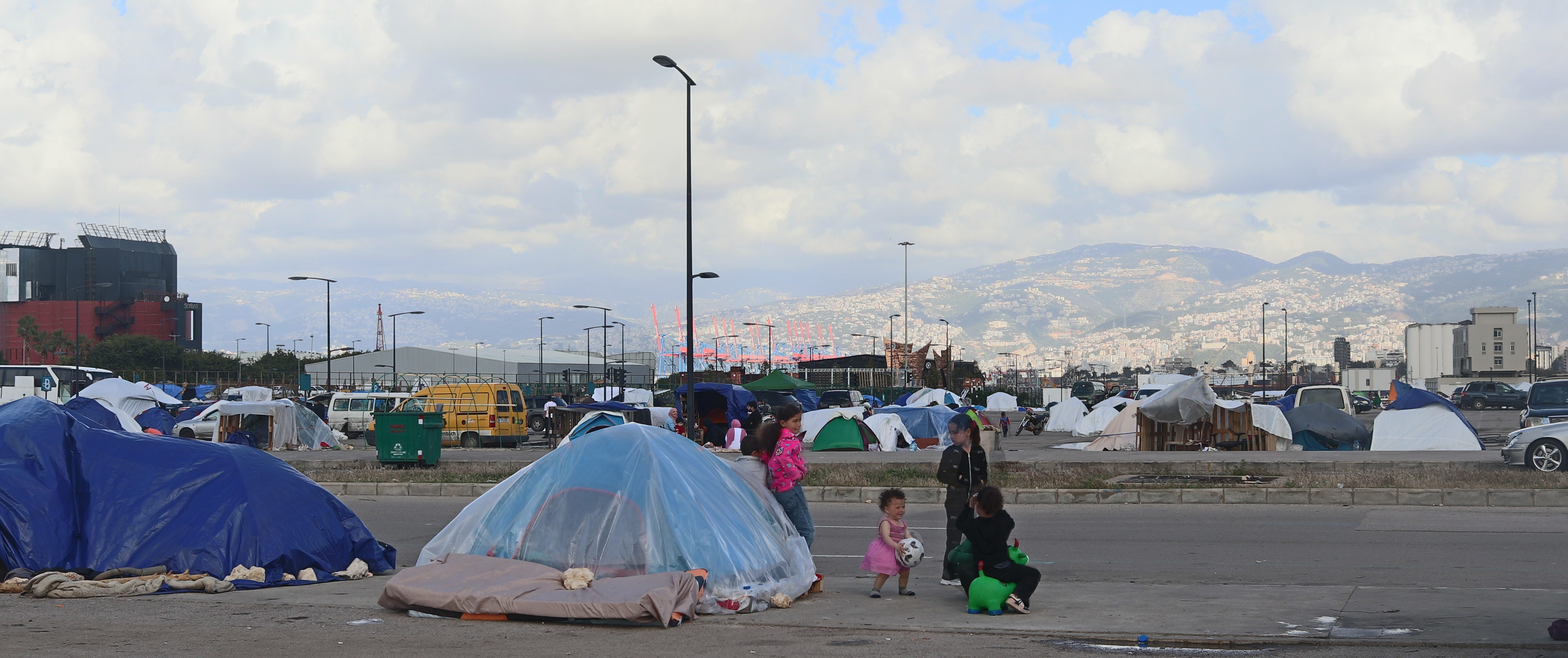
A makeshift camp (now demolished) in the heart of Beirut where few Bangladeshi migrants had found shelter. Photo: Mehk Chakraborty
Amid long lines of cars and vans, Samima Begum, a factory worker from Bangladesh, walked along the coastal highway from Nabatiye, a city in south Lebanon, until she found a ride to Saida, a city 45 km from Beirut. Most Bangladeshis, and other migrants, who fled South Lebanon, are sheltering in Saida.
Over a million people have been displaced in the past five months, as a result of renewed hostilities between Israel and Lebanon which sparked widespread panic from the suburbs of Beirut to the South and Bekaa Valley. As soon as the bombing began, residents began to flee even before the “evacuation notices” were issued. All roads leading to Beirut and beyond were crammed with cars filled with people.
“I didn’t expect the war to return so soon. Yet, I knew what to do- [I had to] just leave,” said Begum, recalling her experience of the 2024 war between Lebanon and Israel. Last time, she had been displaced for over five months. So when the war began again, she packed a few of her belongings, reached out to some friends in Saida, and hoped it would be a short while until she returned home to Nabatiye which she shared with her husband.
Today, five months later, as only a handful of South Lebanon’s residents are slowly returning to the ruins of their homes, Nabatiye, which had turned into a ghost town, remains empty. Other major cities in South Lebanon that have been targeted by Israel with forced evacuation orders and relentless bombing, such as Tyre, are also beginning to see some residents return. Yet, Begum has not returned, and is still staying at a cramped apartment in Saida that she had rented with nine other Bangladeshis.
In 2024, migrant workers found themselves excluded and abandoned.They were barred from accessing official shelters set up by the Lebanese government in schools, stadiums and other public spaces, which were reserved exclusively for Lebanese nationals. This time, however, official shelters in Lebanon are obliged to be open to all, regardless of nationality. Yet, echoing the experiences of exclusion from official shelters in the past, migrants still face exclusion and discrimination.
Michael Petro, Director of the Migrant Worker Project at Jesuit Refugee Service, an international organization working with refugees, is managing a community center and church that has doubled as a displacement shelter, one of the only two displacement shelters in the country explicitly welcoming migrants. “Officially, this year the law has meant to include all. But, for various reasons, including a lack of capacity, the official policy does not always translate to the ground,” he said, referring to how migrants were being excluded in shelters.
An estimated 176,504 migrant workers in Lebanon, who are also subject to mass displacement and indiscriminate strikes, and exclusion from the government’s social services has led to a multifaceted crisis. Unofficial estimates put the numbers much higher, and these migrant workers, hailing from African and South and Southeast Asian countries have emerged among the most vulnerable during the war in Lebanon, along with other minorities.
Hiba, who did not want to share her full name, a Sudanese refugee who lived with her migrant worker husband in Bint Jbeil in South Lebanon, 115 km from Beirut, also left at the start of the hostilities. Now she has nowhere to “return” to, as the town has been wiped out under constant Israeli bombardment. Eight months pregnant when she fled to Beirut, Hiba is now counting her days to find a stable, domestic life with her newborn. Orphaned early in her life and fleeing a civil war in Khartoum, Sudan, Hiba joined her husband in Lebanon only last year in the hope of a better life.
“I feel like the war keeps following me,” she said.
“Yellow Line”, Displaced Lives
Meanwhile, for Hiba and Begum, who lived in villages where Israel has imposed a “yellow line” , return seems far. Villages they inhabited alongside others such as a no-go for residents from these villages. The “yellow line” has forcibly displaced residents, and the handful who remain are constantly under the threat of indiscriminate bombings. Israel continued military operations within and beyond the “yellow line”, issuing more forced evacuation orders and destroying these villages.
An agreement signed between the United States, Israel, and Lebanon at the end of June extended the “ceasefire” that was initially in place since April 17. Despite this agreement, Israeli troops have remained on ground, as it does not mandate withdrawal of troops. The Israeli Defense Minister, Israel Katz has further said, “We did not ask anyone’s permission to enter Lebanon, and we do not need permission to stay in Lebanon.”.
Despite the new framework agreement, there has been little change on the ground, where civilians continue to be displaced. The agreement requires Lebanon to “cease all hostile or negative actions in international political or legal forums”, which has sparked the concern that Israel cannot be held accountable under international courts for its war crimes against Lebanon.
Kristine Beckerle, Deputy Regional Director for the Middle East and North Africa at Amnesty International shared, in a report a week into the new framework, “Within the space of just a week – the Israeli military obliterated entire families, including a dozen children, in Lebanon, demonstrating a callous disregard for civilian lives. How many more families will have to pull the body parts of their children from the rubble before this devastating cycle of war crimes ends?”
“The international community must act now: states must impose an immediate comprehensive arms embargo on Israel and use universal and extraterritorial jurisdiction to investigate and prosecute those responsible,” Beckerle added.
So, there is no promise of return yet.
Hiba’s husband, Ahmed, worked as a concierge at a residential building in Bint Jbeil, which is now nearly razed to the ground. A sense of shock has set in for the couple, alongside sudden loss of livelihood. “I came to Lebanon almost a decade ago, and have faced so many wars in my life. Finally my wife joined me last year and we were looking forward to some stability,” Ahmed said.
As a migrant worker whose rights are governed by the kafala system, Ahmed has little protection. His employer has decided to withhold wages, citing the war. He is now taking on petty daily jobs when he can, hoping to find a more stable source of income to provide for his family.
Although Hiba is a UNHCR registered refugee, the document failed to get her access to maternal healthcare services in the subsidized public hospitals. Her husband, too, has no access to social security services, being a worker under the kafala. She is now living in a Jesuit Refugee Service shelter with her newborn among at least 120 migrants, and like other pregnant women in the shelter, has faced a host of issues.
Kafala System Add to Workers’ Woes
Several reports of workers abandoned by employers, withholding of wages, or heightened abuse show how the war has intensified the exploitative working conditions under the kafala system.The kafala is a prevalent migration sponsorship system in Lebanon and other Gulf countries that binds a worker to their employer, with the latter acting as a guarantor for the migrant worker. This means the employer or sponsor determines work conditions, legal status, and pay for a worker, among other things, leaving employees entirely dependent on them.
In Lebanon, similar to several Gulf countries, migrant workers, including domestic workers and others, such as agricultural workers, are excluded from the country’s labour legislation and solely dependent on the kafala. Since about 70% of migrants in Lebanon consist of women who are often involved in domestic work, the kafala often results in gendered captivity where the employer itself becomes the law.
Cases of abuse and exploitation were common even before the war, and for migrant workers who are women, this included sexual harassment, besides issues such as physical abuse, wage theft, and recruitment debt. For women, most of whom are domestic workers, and many who live with employees, there is heightened vulnerability. The system makes it notoriously difficult to enforce contracts and moreover, workers also need permission from their employers or sponsors to change their jobs. Workers, then, are left with no choice but to put up with their employers’ whims.
Begum, who is also bound by the system, has not heard back from her employers yet. “Everything depends on your luck. I have had relatively good working conditions in “peace” times, so even if the contract is suspended during war, I would prefer to go back to my employer when I can,” she said.
Hence, even when the work environment is abusive, a worker cannot leave an employer without their consent, as they risk losing their status of legal residency in the country and possible detention by authorities and deportation.
Manisa Kumari, a migrant worker from Nepal who moved to Lebanon two decades ago, did not trust the official system.
“I practically had to run away from my first employer, who used to physically abuse me, and locked me up at home. I was terrified, because I didn’t know anyone here either. My embassy refused to help,” she said.
Marginalized Further due to War
Like Hiba, 13,000 pregnant women were recorded as displaced in Lebanon, per the UNFPA, and in urgent need of access to life-saving healthcare.
“Even before Israel’s latest military escalation in Lebanon, migrants’ access to healthcare was severely limited by language barriers, systematic discrimination, cost of health services and residency status. Now, with nearly a fifth of the country’s population forcibly displaced, migrants are becoming even more pushed to the sidelines, with devastating consequences to their health and survival, ” shared AbdelHalim Abdallah, project coordinator at Doctors Without Borders or Médecins Sans Frontières (MSF) in Beirut.
Begum, too, was exhausted. Her troubles as a migrant worker in Lebanon stretched far beyond the current war. She said, “After living through the currency crisis, COVID, one war in 2024 and the displacement now, it is increasingly hard to place my hope in recovery.”
She said that her home town in Sylhet, Bangladesh, remains poverty-stricken, which makes the choice to go home impossible after spending almost a decade in Lebanon.
“This time, it feels impossible to overcome the crisis,” Begum said.
Reports of migrant worker deaths across the Gulf emerged early on in the war, the war has brought on more horrors for migrant workers in the region, including that of mass targeting and deportations. Yet, migrant workers continue to put their lives on line, with no protections or basic labour rights guaranteed. “While the geopolitical focus remains on military targets, migrant workers – the backbone of the Gulf Cooperation Council (GCC), Jordanian, and Lebanese economies – are the invisible casualties,” noted Women In Migration Network Network.
For Myra, a domestic worker from the Philippines who has been organizing for migrant workers in Lebanon, the question about the precarity of her existence remains the bigger one.
“And even if we do overcome another war, will we [as migrant workers] still have justice?” she asked.
When contacted for comment, the Ministry of Social Affairs as well as the Ministry of Labour in Lebanon did not respond. In the past, the Lebanese government has only provided limited protections to migrant workers, despite ongoing advocacy and organizing by collective migrant worker groups in the country, besides condemnation from several international rights groups.
Community Comes Together to Help
In the absence of official support from Lebanon and their home countries, community leaders are at the forefront to deal with war-related exigencies. “They aid the community with emergency response and humanitarian assistance, coordinating rent payments, medical assistance, or even preventing evictions. Some have even been housing displaced people in their own homes,” said Dara Foi’Elle, policy and communications manager at Migrant Workers’ Action, a collective of migrant domestic workers of multiple nationalities.
Begum relies on her Bangladeshi network-led initiatives to sustain, without which she said she would have nowhere to turn to. In 2024, she connected with Rashed Akter, an active community organizer based in Saida. Akter manages a shop that has become a safe space for Bangladeshis to meet up and collect food supplies paid for by mutual support networks.
Akter himself has become the point of contact for most Bangladeshis in trouble in South Lebanon. “It is the least I can do for my brothers and sisters. I am always updating our common Whatsapp groups with information and for now, as most don’t have jobs or even homes to return to, I am trying to organize more affordable flats to rent,” he said.
Egna Legna, an Ethiopian domestic workers’ collective, has been especially visible in distributing food to migrants sheltering in informal shelters, or flats rented collectively. Another group, the Great Oven have also been involved in initiatives such as crowdfunding, running a collective kitchen, and others, in Beqaa Valley, bordering Syria, under relentless bombing since early March.
Akter, reflecting on the need for such initiatives, said, “We are having to rely on each other for survival.” He indicated that initiatives by the Lebanese government geared toward migrant workers were non-existent.
Kumari, too, relied on people from her Nepali community to seek a way forward after escaping her abusive employer. While raising awareness about labour rights and encouraging active participation in worker organizing amid the small community of 1,000 Nepalese migrants, Kumari feels reassured of what the future holds by what she calls “the new generation’s consciousness.”
“Look, our youth managed to topple the government back home. At least, in the case of Lebanon, there is a decrease in the number of new arrivals as awareness has been raised about the brutality of kafala,” Kumari said.
Community Leaders Face Risks
Migrant community leaders from the Nepali community have faced crackdowns in the past and are under the stress of deportation in case of major visibility. “For those of us who have somehow made it a home and continue to live here, we want a better future. Even if that means putting up a tough fight.” said Kumari.
Myra, a founding member of Alliance of Domestic Workers for several years, said that the Alliance has not been very active during this war, despite providing community aid in 2024. The community leaders, who are domestic workers themselves, lack a steady income and are struggling to pay rent, and the humanitarian aid is not enough, felt Myra.
“We are preserving our energy. As a workers rights group, we are focussed on systemic issues we face as domestic workers with limited rights,” she added, referring to why the group has been absent from organizing emergency aid at this time.
Migrant Workers Action has pushed for a legal recourse for accountability to workers since their formation in 2022, such as allowing work permits independent from private sponsors, and labour rights protections codified into Lebanese labour law. “These are starting points that will automatically include them into the national social security system, the insurance system, and provide access to health and educational services,” Foi’Elle said.
“What migrants are asking for is clear—abolishing the kafala system,” Foi’Elle added.