



Editor’s Note: Asma Abu Hasanein is a Palestinian writer and artist from Northern Gaza whose life since October 2023 has been defined by the relentless, grinding repetition of displacements. She returned to the North in February 2025, and within months, Israeli bombing resumed, and she faced displacement again. Since the IDF launched its ground invasion of Gaza on October 27, 2023, the depopulation of northern Gaza has been a systematic strategy. Beginning in October 2024, Israel intensified its destruction of the urban and agricultural environment in northern Gaza and implemented a policy of starvation, destruction, and extreme, deliberate displacement, ordering residents of Gaza City, Beit Hanoun, Beit Lahiya, and Jabalya to move south, in accordance with a plan developed by former senior military officers known as the Generals’ Plan, which sought to entirely empty the area of its residents in the long term. The principal IDF divisions executing this campaign on the ground are the 98th Division (paratroopers and commandos), the 162nd Division, the 36th Division, the 99th Division, and the Givati Brigade, rotating through Shejaiya, Beit Hanoun, Jabaliya, and Gaza City over the course of more than two years, leveling neighborhoods, demolishing buildings, and systematically dismantling tunnel networks alongside the civilian infrastructure above them. Since the IDF breached the ceasefire on March 18, 2025, it issued 47 evacuation orders through which it forcibly displaced 684,000 Palestinians into an ever-shrinking space, placing 82.6% of Gaza’s territory within Israeli-militarized zones where Palestinians cannot stay.
For months, returning to northern Gaza felt like a fragile dream we barely dared to believe in. After Israeli forces sealed the passage between the North and South Gaza, going back seemed impossible. So when we finally returned in February 2025, it felt like reclaiming a lost part of ourselves. The streets were scarred, the buildings destroyed; still, it was home.
What we did not know then was that only months later, we would be forced to face a repeat of that nightmare and leave yet again.
On the morning of September 9, 2025, the crisp autumn calm was shattered by the sudden, piercing hum of a quadcopter hovering over our camp in Sheikh Radwan, North Gaza. People stepped outside their homes and tents, looking up, wondering what the buzzing machine wanted.
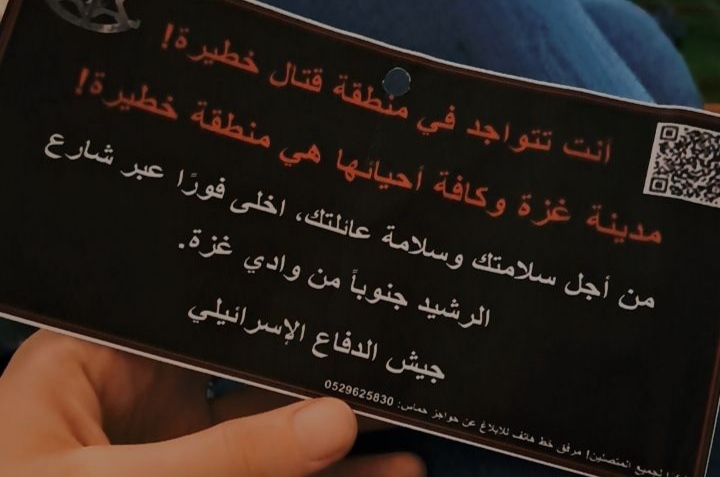
Suddenly, leaflets began raining down from above, drifting through the air over the camp, each carrying the same message: “Leave the area and head South!”
A drone returned the next day.
And the day after that.
Soon, it was hovering above the neighborhood almost all day, dropping more leaflets. It broadcast commands through loudspeakers, ordering us to evacuate.
This time was different. Everyone in our neighborhood had already experienced displacement, exhaustion, humiliation, and crushing financial cost. We knew what it meant to leave everything behind and move to a place where thousands of others were already struggling to survive. It was the terror of not knowing where you would sleep or how you would find water the next day. So, many of us decided to stay; my father was among those who strongly refused to leave.
“I will not leave,” he said. And so we stayed with him.
Soon, the Israeli army began using another strategy. One night, a phone call spread quickly through the neighborhood: the entire street had to be evacuated immediately because a nearby house would be bombed.
People rushed outside with their children and waited in neighboring streets until the strike happened. Then we returned.
The next day, it happened again.
Another house. Another evacuation. Another explosion.
This cycle repeated many times, but eventually the warnings stopped coming. Houses began to be bombed without warning.

The Second Displacement
On September 11, one of the burning illumination flares dropped by the Israeli army landed on the camp. The flare ignited part of the tents, rapidly spreading flames through the fabric-based makeshift shelters.
Slowly, one by one, families began to leave the camp.
I watched as trucks carried away mattresses, bags, and pieces of furniture tied together with ropes. The tents gradually vanished until the once-crowded area began to feel strangely empty.
Next, transportation to the North nearly came to a halt.
A few trucks that still arrived demanded enormous sums of money because of the danger involved in transport. But most drivers simply refused to come. No cars, buses, or trucks were there to take us and our belongings to the south.
Food also began to run out. To buy bread or water meant walking long distances under the constant threat of bombardment. And our lives became a daily negotiation with survival.
We relied mostly on canned food stored earlier, baked bread over a small fire, and rationed what little we had. No one knew what the coming days might bring.

It was not long before the neighborhood started to feel like a ghost city. Only our family and a few others remained. We kept calling truck drivers to take us to the South, but it did not work.
Going to the South with at least the necessities is crucial for survival there, and hence, a truck is required. But from the very first day of displacement, there had been a waiting list for these trucks, and being late to reserve a place meant ending up at the very bottom of the list. That’s where we were.
Some of our relatives were a little luckier. They found a truck, and we agreed that it would first take them and their belongings to the south, then return for us. But that night, one of the burning bombs hit the truck, and it was damaged. In the morning, they tried to repair it, and the vehicle managed to take them to the South. But on the way back to us, the truck broke down and could no longer return, so we remained trapped in the North.

Drawing Hope on Broken Walls
One afternoon, I stood in the hollow space behind my grandmother’s house, the part where bulldozers had torn down the walls. From there, I could see the entire street behind us.
Another truck arrived. A family climbed into the back with their belongings stacked beside them. When the truck finally drove away, the silence it left behind felt enormous.
I looked around at the shattered walls surrounding me. They seemed to mirror the ruins I felt inside my own chest.
But if we lose hope, what will remain of us?
With that in mind, I felt the urgency to do something, even if it were small, that might bring a little life back to this broken place and prove I still existed. Anything other than hiding and waiting for the end.
I have always loved drawing, especially flowers and scenes from nature. There is something about them that carries quiet hope. A single flower can convince your heart that life still wants to bloom.
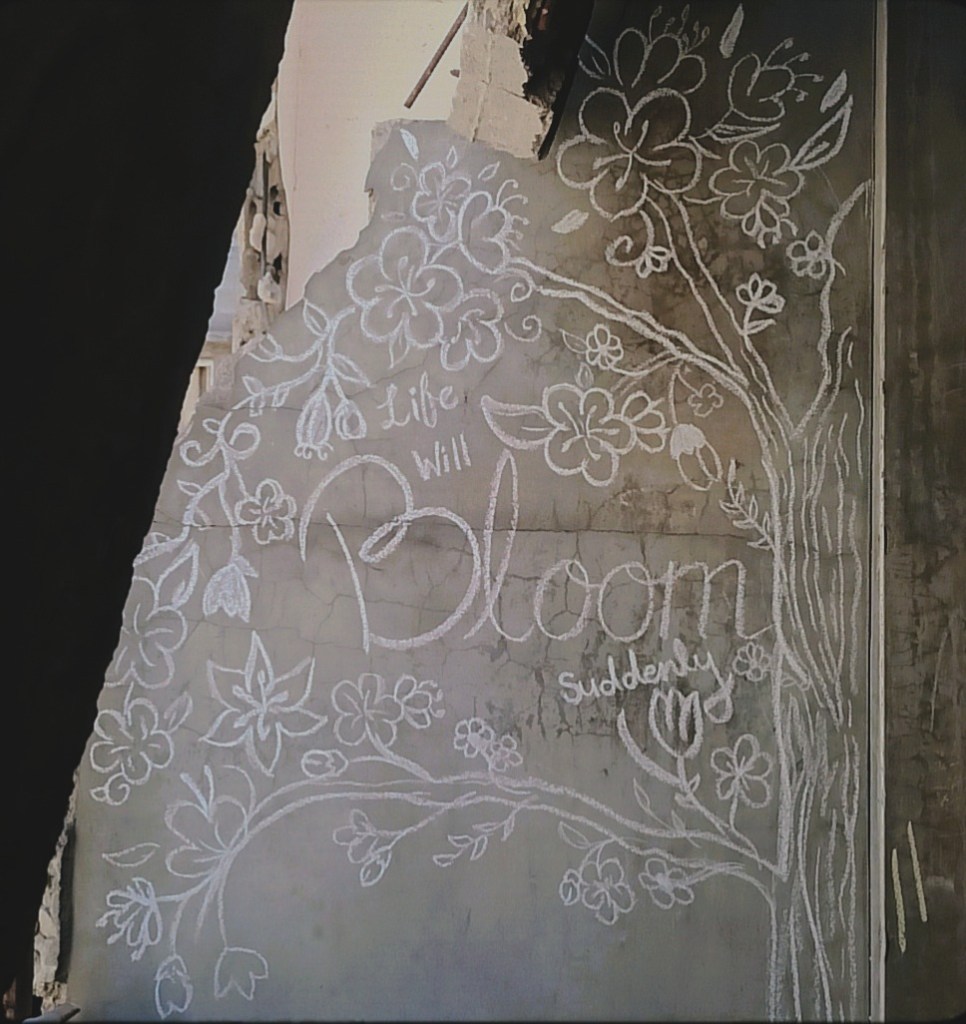
On the floor, I noticed fragments of white plaster scattered from earlier bombardments. I picked one up and began to draw.
My mother filmed me that day. There were only seven of us left in the house, and outside, the deafening roar of warplanes filled the empty neighborhood.
While the world around us was collapsing, I covered the cracked walls with small drawings and messages of hope.
Flowers.
Leaves.
Simple lines of life.
Perhaps the house would survive after we left, unlike our own home, which the occupation forces had already erased. And maybe, just maybe, those drawings would still be there one day, as a quiet proof that even in the middle of war, someone once tried to plant hope among the ruins.
The Longest Night
On September 15, something happened that changed everything.
That morning, my sister left to take her final high school exams, which would determine her chance of entering university.
While she was gone, a water truck pulled into the street behind our house. Everyone gathered around it – children, women, and elderly men. They carried empty containers, waiting patiently for their turn. It was the first time in a while that a water truck had reached this now-isolated area.
Then a bomb struck the water truck. The barrels exploded, sending water, metal, and dust into the air. Screams echoed through the nearly-empty neighborhood. An ambulance arrived soon after, taking the wounded to the hospital.
That was the moment my father finally broke. For the first time during the war (since 2023), I saw fear in his eyes.
He told us to leave, even if we had to walk. But we decided to postpone it until the next day, trusting the truck’s promise that it would surely come.
But that night became the hardest night of the war. Israeli ground forces were preparing to enter the area. From inside the house, we could hear the distant rumble of tanks approaching. Meanwhile, warplanes constantly circled above us.
In Gaza, when a ground invasion begins, the army often creates a “fire belt” — a continuous wave of air, land, and sea strikes meant to secure the area before troops move in.
That night, we were inside that area.
Because the upper floor of my grandmother’s house had no windows or doors left, my mother woke us and told us to move downstairs. We gathered in a small room with a single window covered by a sheet of metal.
And with every explosion, the metal trembled violently.
None of us slept that night; we all whispered the same prayer: ‘Let morning come.’
The next day, the air felt different–heavy and thick with the smell of gunpowder.
When we stepped out of the small room where we had spent the night—what I had begun calling ‘the grave’—we moved cautiously toward the second floor. A drone could be hovering outside at any moment.
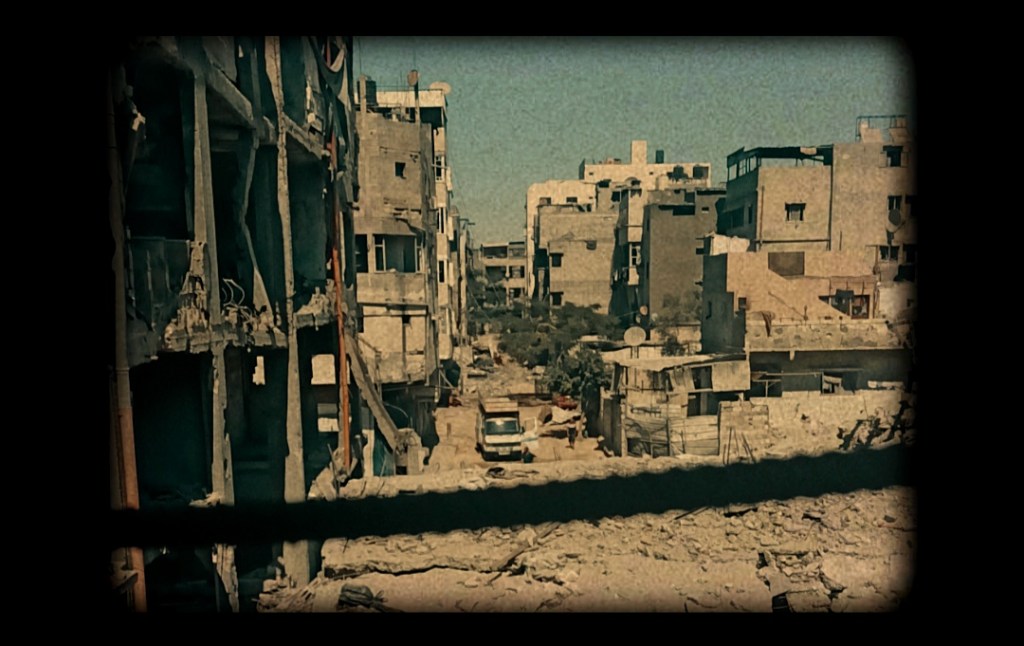
When I finally looked through the window, the sight was unsettling. The neighborhood looked completely abandoned. No voices. No movement. It felt as if the soul of the place had been torn away overnight.
We packed quietly, taking only what we absolutely needed in small backpacks. And just as the first light of the sun spread across the broken buildings, we stepped outside and began walking south.
My father stayed behind.
The Long Road to South Gaza
The road stretched endlessly before us.
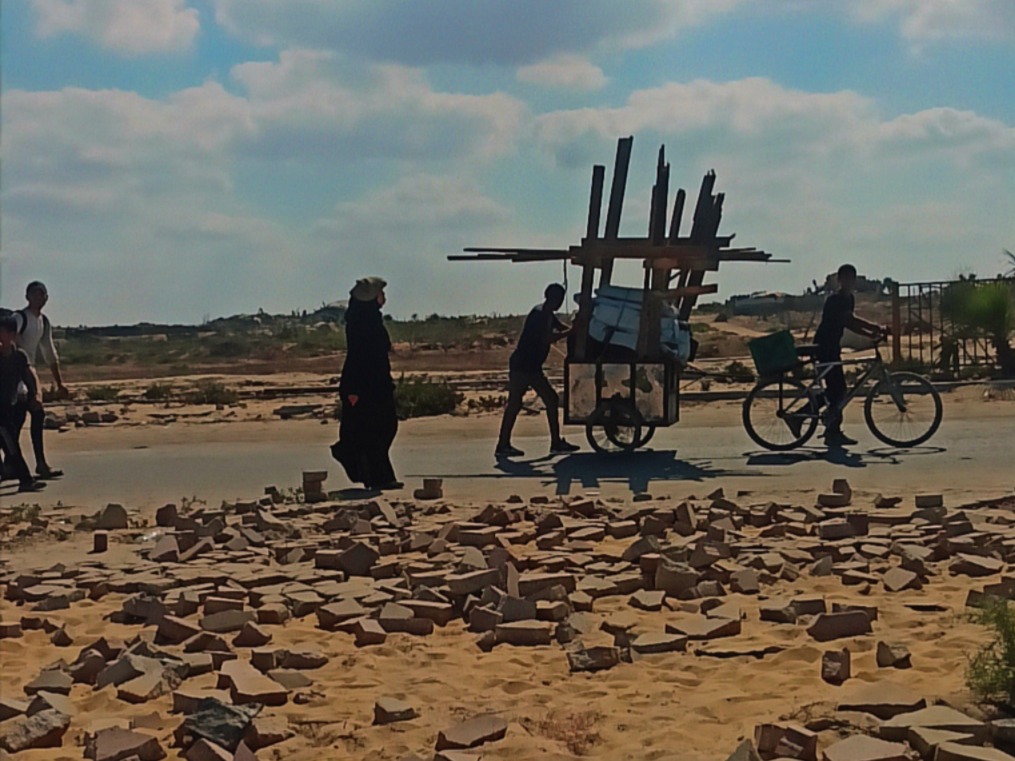
It was crowded with people just like us, families who had no choice but to walk south on foot. South Gaza was not truly safe; everyone knew that. It had simply become another stop in the long journey of forced displacement. Still, we walked as the enemy had left us no other choice.
As we moved along the road, I kept turning back to look at the city behind me. With every step, it grew smaller, but the sounds followed us. Explosions thundered, and warplanes roared frighteningly close overhead, so low that we could see them clearly with the naked eye.
Each time a powerful blast echoed across the sky, I turned instinctively toward the north, thinking of my father.
Was he safe? Had he left yet? Had the tanks reached the neighborhood? When would he catch up with us? The questions circled endlessly in my mind as we walked.
The sun climbed higher. Hours passed. Soon our stops became more frequent than our steps. Exhaustion weighed heavily on our bodies. I could barely walk twenty meters without collapsing onto the nearest curb or stone to rest.
The thirst spread through us slowly at first, then fiercely. Along that long, empty road, no one had water to spare. Everyone was protecting what little they had left.
At one point, we sat beside the sea, hoping the sight of it might offer some relief. And in that moment, I found myself wishing something impossible with all my heart – that the sea water might somehow turn sweet.
We were not okay. We were exhausted, thirsty, and our legs could barely carry us after hours of walking, but we kept going. There was no other option.
We are still not okay. But we keep moving forward anyway.
Not because things are better or the road ahead is clear, but because standing still will not lead us anywhere. Remaining where we are, trapped inside the same grief and exhaustion, would only cause us to wither under the weight of despair.
Our lives are already fractured by loss, by broken homes, by the relentless sound of war. And yet life has a special way of insisting on itself.
One day, from a small, unnoticed crack, somewhere in an empty corner no one pays attention to, you may find a flower beginning to bloom. Delicate, improbable, but determined. Taking its first fragile step toward light, toward a future it cannot yet see.
So I will choose hope. Even in the midst of all this darkness. Even among the ruins that surround us.
I will choose it again and again. Because what, after all, is life without hope?
Gaza Situation Brief from The Polis Project: Israeli military operations in Gaza constitute, according to a broad coalition of international bodies, a cascade of war crimes and crimes against humanity. Human Rights Watch found that repeated evacuations, mass destruction, and failure to provide safe passage or access to food, shelter, or medical care made the displacement unlawful, concluding that the level of intent and evidence of a state policy amounted to war crimes and crimes against humanity. The assault on Northern Gaza’s healthcare system has been particularly devastating: on December 27, 2024, the Israeli army stormed Kamal Adwan Hospital, then the last remaining major medical facility in northern Gaza, setting it on fire and removing patients and staff. During its assaults on hospitals, the IDF repeatedly cut off water and electricity essential for life support, impeded medical care, arrested health workers, killed civilians, and destroyed equipment. In the fifteen months from October 7, 2023, to the January 2025 ceasefire, Israeli forces killed 609 healthcare workers.
The weaponization of hunger has been no less deliberate: after imposing an eleven-week total aid blockade from March 2025 onward, Israel replaced the UN-led aid system with the Gaza Humanitarian Foundation, and by July 31, 2025, at least 1,373 Palestinians had been killed while attempting to access food, most by the Israeli military. The UN’s Office of the High Commissioner for Human Rights stated that the threat of starvation, together with repeated forced displacements and intolerable, dehumanizing rhetoric by Israel’s leadership to empty the Strip of its population, constitute elements of the most serious crimes under international law.
In September 2024, a UN Special Committee concluded that Israel’s policies and practices were consistent with the characteristics of genocide, and the International Criminal Court has issued arrest warrants for Prime Minister Benjamin Netanyahu and former Defense Minister Yoav Gallant for alleged war crimes and crimes against humanity. It marked one of the most significant international legal interventions of the 21st century, directed at the leadership of a state that has, block by block, erased what was once home for hundreds of thousands.


Letter from Palestine: Between Ruins and Hope, an Undying Dream of Returning Home
Editor’s Note: Asma Abu Hasanein is a Palestinian writer and artist from Northern Gaza whose life since October 2023 has been defined by the relentless, grinding repetition of displacements. She returned to the North in February 2025, and within months, Israeli bombing resumed, and she faced displacement again. Since the IDF launched its ground invasion of Gaza on October 27, 2023, the depopulation of northern Gaza has been a systematic strategy. Beginning in October 2024, Israel intensified its destruction of the urban and agricultural environment in northern Gaza and implemented a policy of starvation, destruction, and extreme, deliberate displacement, ordering residents of Gaza City, Beit Hanoun, Beit Lahiya, and Jabalya to move south, in accordance with a plan developed by former senior military officers known as the Generals’ Plan, which sought to entirely empty the area of its residents in the long term. The principal IDF divisions executing this campaign on the ground are the 98th Division (paratroopers and commandos), the 162nd Division, the 36th Division, the 99th Division, and the Givati Brigade, rotating through Shejaiya, Beit Hanoun, Jabaliya, and Gaza City over the course of more than two years, leveling neighborhoods, demolishing buildings, and systematically dismantling tunnel networks alongside the civilian infrastructure above them. Since the IDF breached the ceasefire on March 18, 2025, it issued 47 evacuation orders through which it forcibly displaced 684,000 Palestinians into an ever-shrinking space, placing 82.6% of Gaza’s territory within Israeli-militarized zones where Palestinians cannot stay.
For months, returning to northern Gaza felt like a fragile dream we barely dared to believe in. After Israeli forces sealed the passage between the North and South Gaza, going back seemed impossible. So when we finally returned in February 2025, it felt like reclaiming a lost part of ourselves. The streets were scarred, the buildings destroyed; still, it was home.
What we did not know then was that only months later, we would be forced to face a repeat of that nightmare and leave yet again.
On the morning of September 9, 2025, the crisp autumn calm was shattered by the sudden, piercing hum of a quadcopter hovering over our camp in Sheikh Radwan, North Gaza. People stepped outside their homes and tents, looking up, wondering what the buzzing machine wanted.
Suddenly, leaflets began raining down from above, drifting through the air over the camp, each carrying the same message: “Leave the area and head South!”
A drone returned the next day.
And the day after that.
Soon, it was hovering above the neighborhood almost all day, dropping more leaflets. It broadcast commands through loudspeakers, ordering us to evacuate.
This time was different. Everyone in our neighborhood had already experienced displacement, exhaustion, humiliation, and crushing financial cost. We knew what it meant to leave everything behind and move to a place where thousands of others were already struggling to survive. It was the terror of not knowing where you would sleep or how you would find water the next day. So, many of us decided to stay; my father was among those who strongly refused to leave.
“I will not leave,” he said. And so we stayed with him.
Soon, the Israeli army began using another strategy. One night, a phone call spread quickly through the neighborhood: the entire street had to be evacuated immediately because a nearby house would be bombed.
People rushed outside with their children and waited in neighboring streets until the strike happened. Then we returned.
The next day, it happened again.
Another house. Another evacuation. Another explosion.
This cycle repeated many times, but eventually the warnings stopped coming. Houses began to be bombed without warning.
The Second Displacement
On September 11, one of the burning illumination flares dropped by the Israeli army landed on the camp. The flare ignited part of the tents, rapidly spreading flames through the fabric-based makeshift shelters.
Slowly, one by one, families began to leave the camp.
I watched as trucks carried away mattresses, bags, and pieces of furniture tied together with ropes. The tents gradually vanished until the once-crowded area began to feel strangely empty.
Next, transportation to the North nearly came to a halt.
A few trucks that still arrived demanded enormous sums of money because of the danger involved in transport. But most drivers simply refused to come. No cars, buses, or trucks were there to take us and our belongings to the south.
Food also began to run out. To buy bread or water meant walking long distances under the constant threat of bombardment. And our lives became a daily negotiation with survival.
We relied mostly on canned food stored earlier, baked bread over a small fire, and rationed what little we had. No one knew what the coming days might bring.
It was not long before the neighborhood started to feel like a ghost city. Only our family and a few others remained. We kept calling truck drivers to take us to the South, but it did not work.
Going to the South with at least the necessities is crucial for survival there, and hence, a truck is required. But from the very first day of displacement, there had been a waiting list for these trucks, and being late to reserve a place meant ending up at the very bottom of the list. That’s where we were.
Some of our relatives were a little luckier. They found a truck, and we agreed that it would first take them and their belongings to the south, then return for us. But that night, one of the burning bombs hit the truck, and it was damaged. In the morning, they tried to repair it, and the vehicle managed to take them to the South. But on the way back to us, the truck broke down and could no longer return, so we remained trapped in the North.
Drawing Hope on Broken Walls
One afternoon, I stood in the hollow space behind my grandmother’s house, the part where bulldozers had torn down the walls. From there, I could see the entire street behind us.
Another truck arrived. A family climbed into the back with their belongings stacked beside them. When the truck finally drove away, the silence it left behind felt enormous.
I looked around at the shattered walls surrounding me. They seemed to mirror the ruins I felt inside my own chest.
But if we lose hope, what will remain of us?
With that in mind, I felt the urgency to do something, even if it were small, that might bring a little life back to this broken place and prove I still existed. Anything other than hiding and waiting for the end.
I have always loved drawing, especially flowers and scenes from nature. There is something about them that carries quiet hope. A single flower can convince your heart that life still wants to bloom.
On the floor, I noticed fragments of white plaster scattered from earlier bombardments. I picked one up and began to draw.
My mother filmed me that day. There were only seven of us left in the house, and outside, the deafening roar of warplanes filled the empty neighborhood.
While the world around us was collapsing, I covered the cracked walls with small drawings and messages of hope.
Flowers.
Leaves.
Simple lines of life.
Perhaps the house would survive after we left, unlike our own home, which the occupation forces had already erased. And maybe, just maybe, those drawings would still be there one day, as a quiet proof that even in the middle of war, someone once tried to plant hope among the ruins.
The Longest Night
On September 15, something happened that changed everything.
That morning, my sister left to take her final high school exams, which would determine her chance of entering university.
While she was gone, a water truck pulled into the street behind our house. Everyone gathered around it – children, women, and elderly men. They carried empty containers, waiting patiently for their turn. It was the first time in a while that a water truck had reached this now-isolated area.
Then a bomb struck the water truck. The barrels exploded, sending water, metal, and dust into the air. Screams echoed through the nearly-empty neighborhood. An ambulance arrived soon after, taking the wounded to the hospital.
That was the moment my father finally broke. For the first time during the war (since 2023), I saw fear in his eyes.
He told us to leave, even if we had to walk. But we decided to postpone it until the next day, trusting the truck’s promise that it would surely come.
But that night became the hardest night of the war. Israeli ground forces were preparing to enter the area. From inside the house, we could hear the distant rumble of tanks approaching. Meanwhile, warplanes constantly circled above us.
In Gaza, when a ground invasion begins, the army often creates a “fire belt” — a continuous wave of air, land, and sea strikes meant to secure the area before troops move in.
That night, we were inside that area.
Because the upper floor of my grandmother’s house had no windows or doors left, my mother woke us and told us to move downstairs. We gathered in a small room with a single window covered by a sheet of metal.
And with every explosion, the metal trembled violently.
None of us slept that night; we all whispered the same prayer: ‘Let morning come.’
The next day, the air felt different–heavy and thick with the smell of gunpowder.
When we stepped out of the small room where we had spent the night—what I had begun calling ‘the grave’—we moved cautiously toward the second floor. A drone could be hovering outside at any moment.
When I finally looked through the window, the sight was unsettling. The neighborhood looked completely abandoned. No voices. No movement. It felt as if the soul of the place had been torn away overnight.
We packed quietly, taking only what we absolutely needed in small backpacks. And just as the first light of the sun spread across the broken buildings, we stepped outside and began walking south.
My father stayed behind.
The Long Road to South Gaza
The road stretched endlessly before us.
It was crowded with people just like us, families who had no choice but to walk south on foot. South Gaza was not truly safe; everyone knew that. It had simply become another stop in the long journey of forced displacement. Still, we walked as the enemy had left us no other choice.
As we moved along the road, I kept turning back to look at the city behind me. With every step, it grew smaller, but the sounds followed us. Explosions thundered, and warplanes roared frighteningly close overhead, so low that we could see them clearly with the naked eye.
Each time a powerful blast echoed across the sky, I turned instinctively toward the north, thinking of my father.
Was he safe? Had he left yet? Had the tanks reached the neighborhood? When would he catch up with us? The questions circled endlessly in my mind as we walked.
The sun climbed higher. Hours passed. Soon our stops became more frequent than our steps. Exhaustion weighed heavily on our bodies. I could barely walk twenty meters without collapsing onto the nearest curb or stone to rest.
The thirst spread through us slowly at first, then fiercely. Along that long, empty road, no one had water to spare. Everyone was protecting what little they had left.
At one point, we sat beside the sea, hoping the sight of it might offer some relief. And in that moment, I found myself wishing something impossible with all my heart – that the sea water might somehow turn sweet.
We were not okay. We were exhausted, thirsty, and our legs could barely carry us after hours of walking, but we kept going. There was no other option.
We are still not okay. But we keep moving forward anyway.
Not because things are better or the road ahead is clear, but because standing still will not lead us anywhere. Remaining where we are, trapped inside the same grief and exhaustion, would only cause us to wither under the weight of despair.
Our lives are already fractured by loss, by broken homes, by the relentless sound of war. And yet life has a special way of insisting on itself.
One day, from a small, unnoticed crack, somewhere in an empty corner no one pays attention to, you may find a flower beginning to bloom. Delicate, improbable, but determined. Taking its first fragile step toward light, toward a future it cannot yet see.
So I will choose hope. Even in the midst of all this darkness. Even among the ruins that surround us.
I will choose it again and again. Because what, after all, is life without hope?
Gaza Situation Brief from The Polis Project: Israeli military operations in Gaza constitute, according to a broad coalition of international bodies, a cascade of war crimes and crimes against humanity. Human Rights Watch found that repeated evacuations, mass destruction, and failure to provide safe passage or access to food, shelter, or medical care made the displacement unlawful, concluding that the level of intent and evidence of a state policy amounted to war crimes and crimes against humanity. The assault on Northern Gaza’s healthcare system has been particularly devastating: on December 27, 2024, the Israeli army stormed Kamal Adwan Hospital, then the last remaining major medical facility in northern Gaza, setting it on fire and removing patients and staff. During its assaults on hospitals, the IDF repeatedly cut off water and electricity essential for life support, impeded medical care, arrested health workers, killed civilians, and destroyed equipment. In the fifteen months from October 7, 2023, to the January 2025 ceasefire, Israeli forces killed 609 healthcare workers.
The weaponization of hunger has been no less deliberate: after imposing an eleven-week total aid blockade from March 2025 onward, Israel replaced the UN-led aid system with the Gaza Humanitarian Foundation, and by July 31, 2025, at least 1,373 Palestinians had been killed while attempting to access food, most by the Israeli military. The UN’s Office of the High Commissioner for Human Rights stated that the threat of starvation, together with repeated forced displacements and intolerable, dehumanizing rhetoric by Israel’s leadership to empty the Strip of its population, constitute elements of the most serious crimes under international law.
In September 2024, a UN Special Committee concluded that Israel’s policies and practices were consistent with the characteristics of genocide, and the International Criminal Court has issued arrest warrants for Prime Minister Benjamin Netanyahu and former Defense Minister Yoav Gallant for alleged war crimes and crimes against humanity. It marked one of the most significant international legal interventions of the 21st century, directed at the leadership of a state that has, block by block, erased what was once home for hundreds of thousands.