





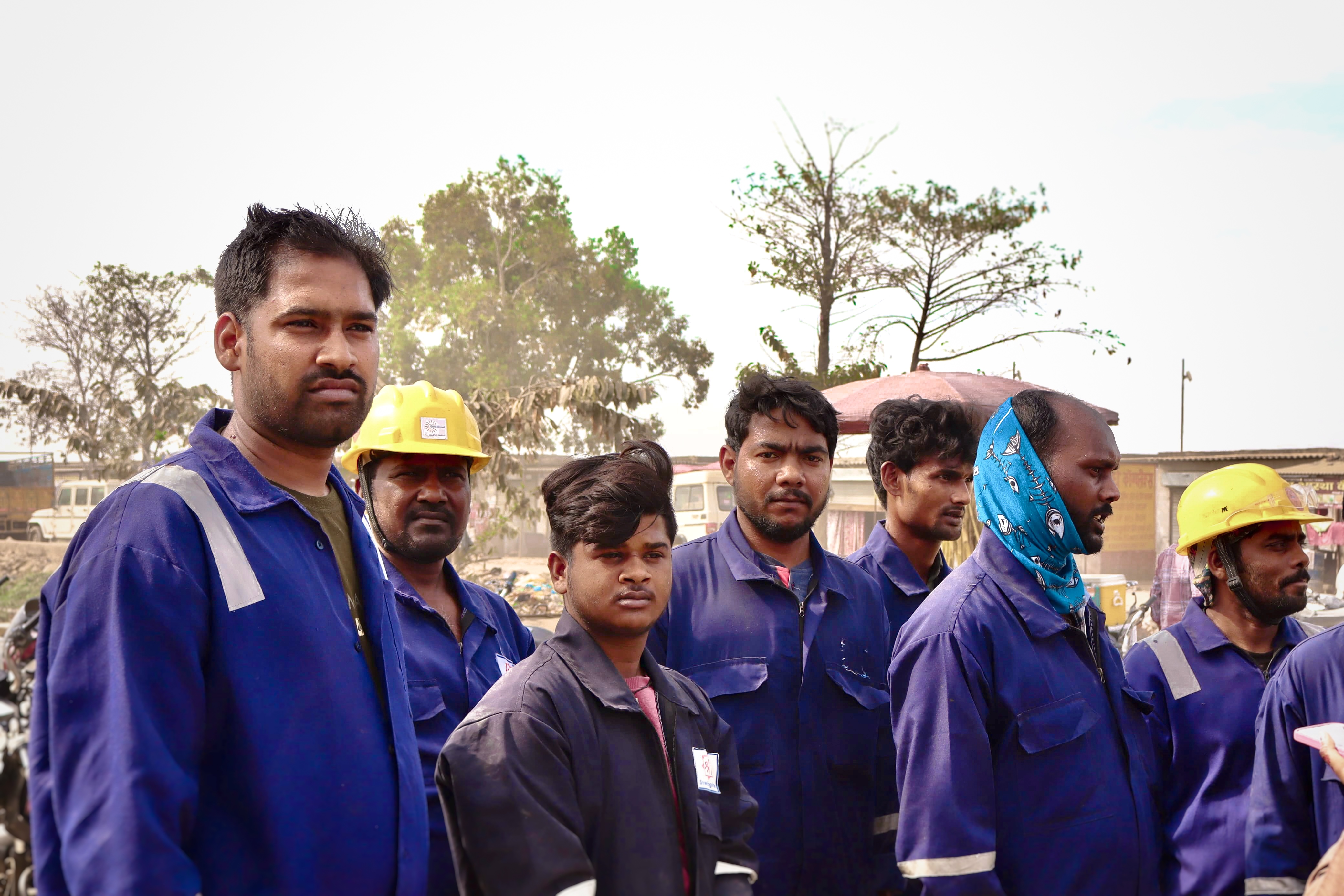
Just after 1:30 pm on March 9, a dozen workers in “Shree Engineering” uniforms walked out through Gate No. 24 of the Indian Oil Corporation Limited (IOCL) refinery in Panipat, Haryana.
“We told them we won’t work because they are not paying us,” said Lal (name changed on request), a worker in his forties from Varanasi.
It was the same gate that had seen thousands of workers face a baton charge and warning gunfire from the Central Industrial Security Force just a week earlier. That standoff had ended in police complaints against unidentified protesters and verbal assurances. By March 9, it was clear nothing had actually changed.
The protesters were mostly contract workers — the labor force that now does the lion’s share of production at one of India’s largest, state-owned oil and petrochemical complexes. They work without the proper wages, overtime pay, protections, or job security given to permanent staff.
Workers who walked out that March afternoon had been expecting their wages for two weeks. “They are paying us only around Rs 550 a day. Earlier, wages would come by the 25th of the month. But we still haven’t been paid,” said Ram Singh*, 38, from Bihar. The latest walkout at Panipat followed a confrontation that had unfolded weeks earlier at the same gates and lasted for five intense days.
The five-day standoff at IOCL presents a window into the concerning transformation of how India’s public sector now runs, with a large portion of contract workers and shrinking labor rights. Across the country’s state-owned refineries, steel plants, and power stations, permanent employment has been steadily hollowed out, replaced by layers of contractors who absorb the risk but not the rights. Contract workers now make up more than a third of India’s organized manufacturing workforce, up from roughly one in five in the early 1990s. In general, in PSUs, permanent staff now supervise, and contract workers operate. The protests at Panipat and the string of industrial actions that followed at plants from Uttar Pradesh to Gujarat expose that publicly and privately owned enterprises are sustaining themselves on labor conditions that the law, at least on paper, was designed to prevent.
A strike that surfaced and settled, without resolution
In the days leading up to February 23, rumors that two workers had died inside the refinery circulated widely. Although unverified, the news spread quickly, deepening a tense atmosphere amid widespread issues of low wages and poor working conditions. On February 23, thousands of contract workers gathered outside Gate 4 of the Panipat Refinery and Petrochemical Complex and began a sit-in; by late morning, the gate was blocked, bringing operations at this major refinery to a halt for the next five days.
An email seeking clarification on the alleged deaths of workers was sent to IOCL, but no response had been received at the time of publication.
At the center of the protest was the demand for an eight-hour workday. Workers said they were routinely forced to work 12-hour shifts, often without official overtime pay. They also raised demands about delayed wages, weekly leave, and basic facilities. They described struggles to cover long distances within the refinery without transport, limited access to drinking water, and a near-absence of functional toilets. “If we need a washroom, we have to walk outside Gate 4, and even that came after a struggle,” said Raju*, a worker in his forties. Raju spent years working in shops around the refinery before joining a contractor to work at the plant.
Many workers described a work regime with little room for rest or clarity on payments. Employed in the insulation department on short-term contracts, several had arrived only months earlier. Accommodation is provided, but food and transport are not.
“They tell us we have to work all 30 days. If we take even one day off, they cut our wage. January’s payment came only in March,” said Kulbhushan*, 22, from Begusarai, who worked 12-hour shifts from 8 am to 8 pm.
“We don’t know what is cut and why. There is no slip, nothing written,” another worker said.
More than 30,000 workers gathered to demonstrate outside the refinery gates. Clashes followed. Workers alleged that on February 28, an altercation with police and Central Industrial Security Force (CISF) personnel escalated into stone-pelting, after which security forces carried out a lathi charge. FIRs were subsequently registered against nearly 2,500 workers, according to a statement by the Central Indian Trade Union (CITU), a major Leftist national trade union body in India.
Anirudh Reddy, a postgraduate student associated with the Mazdoor Adhikar Sangharsh Abhiyan (MASA), a coordination platform of 17 workers’ unions and organizations, was picked up along with the workers on February 27, and his case was recorded through DDR (Daily Diary Report, a station log entry) He said police presence had intensified before the arrests at the protest site, with personnel monitoring and recording workers. “At the police station, we were not told anything. Our bail was rejected, and only the next day were the charges read out,” he said.
Meetings followed between workers, IOCL, and labor authorities. “The administration had agreed to eight hours plus double [wages for] overtime, but implementation remains the issue, and category-based ceilings were not accepted,” said Shreya, a MASA activist involved in the negotiations.
On wages, discussions stalled over these ceilings. These ceilings refer to the government’s wage classification system, where industrial areas are divided into categories, such as A, B, and C, that determine minimum pay scales.
“Category C workers cannot be paid more than this,” she said. Workers demanded to be paid under a higher category than the one applied. The refinery in Panipat is classified as Category C under Haryana’s industrial categorization, but workers and trade unions argue this does not reflect the city’s proximity to Delhi or its cost of living, and have demanded reclassification to Category B. “They are not given any information, whether it’s about wages, deductions, overtime, or even accidents,” she added.
By February 28, the protest ended following verbal assurances from management, with workers returning amid fears of job loss.
At the time of publication, IOCL had not responded to queries regarding the negotiations or the status of these assurances.
The gates cleared. Work resumed. But the issues remained.
Law, liability, and its limits
Advocate Purbayan Chakraborty, associated with the collective of legal professionals, the National Alliance for Justice, Accountability and Rights (NAJAR), said the events at Panipat reveal violations and the limits of law itself. “The law mandates double wages for overtime, under provisions carried forward from the Factories Act and now the Occupational Safety, Health and Working Conditions Code (OSHW code), but workers were being paid their standard rate,” he said.
He was part of an independent fact-finding team that visited the IOCL site in mid-February and was asked to leave by the police shortly after they began speaking to workers.
According to the Occupational Safety, Health and Working Conditions Code (OSHW), 2020, workers should not be required or allowed to work more than 8 hours per day.
Following the protests, some contractors began paying double overtime rates. At the same time, workers who had protested were no longer assigned overtime work. “Employers can comply with the law in a narrow sense by paying notified wages and avoiding overtime. The base wage for an eight-hour shift, translating to only around Rs 14,000 to Rs 23,000 a month depending on skill level, is not at all sufficient to sustain a family,” Chakraborty said. “Overtime is essential to their income and survival.”
On wage liability, he pointed to a shift under newer labor frameworks. “Earlier, laws such as the Contract Labor Act, 1970, placed clearer responsibility on the principal employer in cases of wage default,” he said. Under newer frameworks like the Code on Wages, 2019, liability often rests with the immediate employer, pushing accountability down the chain.
In the Panipat case, he said, the company’s intervention appeared shaped less by legal obligation and more by the disruption caused by the protest. “There was a stoppage of work, so IOCL called in contractors and arrived at some form of settlement,” he said. “Notices were put up at the factory gate, but they did not resolve most of the workers’ demands.” These assurances were not formalized.
“There was no formal settlement under the Industrial Disputes Act,” he added, noting that a legally binding settlement requires agreement between employers and recognized unions. “What happened here was informal and not legally enforceable; these assurances do not have much legal sanctity.”
Judicial interpretation has reinforced this. In its landmark 2001 judgment in Steel Authority of India Ltd v. National Union Waterfront Workers, the Supreme Court held that contract workers do not automatically become employees of the principal employer, even when they perform similar or more extensive work. It also gave workers the right to strike. Subsequent rulings have maintained this position.
A workforce central to production, peripheral in recognition
Economist Kingshuk Sarkar highlighted that what unfolded at Panipat reflects a longer restructuring of labor. “Contractualisation has been increasing over the last 40 years,” Sarkar told The Polis Project. “Workers who retire from permanent positions are increasingly replaced by contract workers.”
The Contract Labor (Regulation and Abolition) Act, 1970, recognized the triangular relationship between worker, contractor, and principal employer, placing ultimate responsibility on the latter in cases of wage default. Over time, this framework weakened. Since the 1990s, contract labor has expanded across sectors, especially in PSUs, diffusing accountability through layers of contractors.
“A contract worker is at least 25% cheaper than a regular worker,” Sarkar said. “Employers do not have to provide benefits like PF, gratuity, or ESI.”
Officially, workdays are recorded as eight hours. In practice, they often extend far beyond that. “There is a difference between what happens and what is shown on paper,” he said.
Trade unions, historically central to industrial bargaining, have struggled to organize contract workers employed through multiple contractors. Many workers remain outside formal structures of negotiation altogether, he noted.
A pattern across sites
For the Migrant Workers Solidarity Network (MWSN), the events at Panipat are part of a broader pattern unfolding across industrial sites in early 2026. Based on direct interactions with workers and material circulating on social media, members of the network said they documented at least 28 major industrial actions between January and March, spanning sectors such as thermal power, petrochemicals, construction, and textiles.
Sourya Majumdar, associated with MWSN, told The Polis Project that while these protests appear dispersed, they are shaped by similar conditions. “In most cases, these are migrant workers brought from other states, largely from eastern India,” said Sourya. “At the same time, there are places where local workers are protesting because they are being replaced. In both cases, this reflects a larger livelihood crisis.”
Across sites, workers reported long hours, delayed wages, and lack of safety. Many protests followed workplace deaths and attempts to suppress information. “That becomes the breaking point,” he said.
The Occupational Safety, Health, and Working Conditions Code, 2020 formally retains the eight-hour workday, but state-level amendments have extended permissible working hours. In states such as Haryana and Andhra Pradesh, under section 65 of the Factories Act, 1948, longer daily shifts and higher overtime ceilings have been allowed, effectively normalizing extended workdays.
Gujarat raised daily working hours from 9 to 12 in 2025. On February 27, 2026, migrant workers at IOCL Vadodara went on strike with similar demands, and an MWSN report noted that the mobilization drew on the Panipat strike. A similar strike had taken place earlier at IOCL Barauni, Bihar, on February 2.
The Industrial Relations Code, 2020 mandates a 60-day strike notice, making legal strikes difficult, especially for contract workers across multiple employers. As formal organizing weakens, mobilization increasingly occurs outside unions. “In many industrial belts, there are no unions,” he said. The four labor codes passed in 2020 and brought into force in 2025 further reshaped labor mobilizations. They left contract workers, who are effectively excluded from union membership, more vulnerable to reprisals for demanding their rights, thereby restricting collective action by workers.
Social media has become a key conduit. Footage from the six-day strike at the Panipat refinery, in which workers in yellow helmets gathered outside the gates, circulated widely online. Workers themselves filmed and shared these videos. “That footage was referenced in other places,” he added.
Similar protests followed: at an Adani plant in Singrauli after a worker’s death; at Alok Industries in Vapi over wage delays; at UltraTech plants in Jharkhand over dismissals and long hours. At an ArcelorMittal Nippon Steel facility in Surat, where over 2,000 workers struck, they explicitly drew on the Panipat protest, echoing its demands and tactics. Videos from the site, filmed and circulated by workers themselves, captured different moments of escalation and helped in spreading the word.
“These incidents are connected through people, spread through social media.” At the same time, he cautioned against attributing mobilization solely to platforms. “The real question is not how a video leads to protest. The question is how much anger already exists that a single video can trigger such a response.”
Migration underpins this labor regime. Workers from Bihar, eastern Uttar Pradesh, and Jharkhand are dispersed across industrial belts, from Panipat to Singrauli to Surat to Vapi, where distance from home and dependence on contractors heighten their vulnerability to long hours and poor conditions. “This mobility enables employers to rely on a workforce that remains easily replaceable and structurally disadvantaged across sites,” Sourya said.
“Workers are watching what is happening elsewhere and recognizing their own conditions in it,” he said.
The data behind the shift
Over the past three decades, contract labor has steadily expanded across India’s industrial workforce, reshaping the composition of employment in both private industry and public sector undertakings (PSUs). Government data reflects a clear structural shift.
Data from successive rounds of the Annual Survey of Industries (ASI) shows that the share of contract workers in organized manufacturing rose from roughly 15–20% in the early 1990s to over 35% by the late 2010s. In several sectors, contract workers now constitute a substantial portion of the shopfloor workforce. This growth has unfolded alongside a stagnation in permanent employment. Periodic Labour Force Survey (PLFS) data indicate that much of recent employment growth has been concentrated in informal and contractual arrangements.
The trend is not confined to private industry. Parliamentary responses and reports on central public sector enterprises (CPSEs) indicate a similar trajectory. It shows a decline in directly employed permanent workers alongside a steady rise in contract labor engagement. In the petroleum sector, companies like IOCL increasingly rely on contract workers for operations, while permanent staff remain in supervisory roles.
Tasks once performed within permanent employment have been systematically outsourced. This has produced a layered labor regime within the same workplace.
If data maps this expansion, legal decisions mark its limits.
Judicial decisions across refineries consistently limit employer liability for contract workers. In the Mathura refinery case (2023), the Delhi High Court restricted relief to minimum wages, holding workers were employees of contractors, not IOCL. In Kanailal Sardar & Ors v. IOCL (2024), the Calcutta High Court similarly rejected Panipat workers’ plea for regularisation, holding that disputed employment status cannot justify automatic absorption.
Recent industrial actions also point to another emerging pattern: the criminalization of labor mobilization and those who support it. Following the April workers’ protests in Noida over wages and working conditions, workers, labor organizers, journalists, and student activists were arrested. The police increasingly framed the mobilization as a conspiracy orchestrated by “outside instigators.” Several of those arrested remain behind bars months later, while others continue to face multiple criminal cases.
Rauf of the Disha Students’ Organization said three of its activists, Akriti Chaudhary, Himanshu Thakur and Yogesh Meena, were implicated in multiple FIRs linked to the Noida protests.
According to him, Akriti was booked under the National Security Act, Himanshu was subjected to custodial torture, and Yogesh, who belongs to a Scheduled Tribe, faced casteist abuse while in custody. “The UP police’s approach to the so-called ‘Noida workers’ conspiracy case’ is extremely telling of the state of workers’ rights and democratic space in the country today,” he said.
Similar developments have emerged elsewhere. Following the Manesar workers’ agitation, Gurgaon Police announced dedicated Labour Liaison and Industrial Coordination Teams (LLICTs) to monitor industrial areas and the movement of “external” elements. The teams will maintain regular contact with factory management, labor officials and trade unions. The move points to a broader shift in the state’s response to industrial unrest, embedding surveillance into its everyday management.
Return to the gate
By the afternoon of March 9, the gates of the refinery had once again become a site of refusal. The earlier strike had ended with mere assurances. The walkout made visible what had not changed.
In the days that followed, a brief stoppage surfaced again on April 1, when sections of energy workers halted work after a new wage agreement appeared to revert to earlier assurances. The disruption signaled unresolved tensions.
For many workers, the decision now is to exit. Kulbhushan has decided to leave, as delayed wages meet rising LPG costs, making it difficult to sustain himself here while supporting his family back home. The refinery produces LPG, a fuel that now defines the constraints of the households its workers return to. “We came here with dreams, and lost even what little we had,” he said.
Others are considering the same. If wages do not arrive, they will return to their villages. Contract and migrant workers across India have started leaving workplaces en masse due to the LPG shortage and rising market prices for cooking fuel amid the war in West Asia and inflation. Migrant workers are the worst hit by this, as they lack the documentation and resources for registered LPG connections.
Inside the state-run refinery in Panipat, production continues.
Outside it, the workforce that sustains it is most clearly visible when it withdraws its labor.
For now, the system holds. Until, once again, it stops.

Labor Protests Reveal Faultlines of Rising Contract Work in India

Credit: Uthara U.R.
Just after 1:30 pm on March 9, a dozen workers in “Shree Engineering” uniforms walked out through Gate No. 24 of the Indian Oil Corporation Limited (IOCL) refinery in Panipat, Haryana.
“We told them we won’t work because they are not paying us,” said Lal (name changed on request), a worker in his forties from Varanasi.
It was the same gate that had seen thousands of workers face a baton charge and warning gunfire from the Central Industrial Security Force just a week earlier. That standoff had ended in police complaints against unidentified protesters and verbal assurances. By March 9, it was clear nothing had actually changed.
The protesters were mostly contract workers — the labor force that now does the lion’s share of production at one of India’s largest, state-owned oil and petrochemical complexes. They work without the proper wages, overtime pay, protections, or job security given to permanent staff.
Workers who walked out that March afternoon had been expecting their wages for two weeks. “They are paying us only around Rs 550 a day. Earlier, wages would come by the 25th of the month. But we still haven’t been paid,” said Ram Singh*, 38, from Bihar. The latest walkout at Panipat followed a confrontation that had unfolded weeks earlier at the same gates and lasted for five intense days.
The five-day standoff at IOCL presents a window into the concerning transformation of how India’s public sector now runs, with a large portion of contract workers and shrinking labor rights. Across the country’s state-owned refineries, steel plants, and power stations, permanent employment has been steadily hollowed out, replaced by layers of contractors who absorb the risk but not the rights. Contract workers now make up more than a third of India’s organized manufacturing workforce, up from roughly one in five in the early 1990s. In general, in PSUs, permanent staff now supervise, and contract workers operate. The protests at Panipat and the string of industrial actions that followed at plants from Uttar Pradesh to Gujarat expose that publicly and privately owned enterprises are sustaining themselves on labor conditions that the law, at least on paper, was designed to prevent.
A strike that surfaced and settled, without resolution
In the days leading up to February 23, rumors that two workers had died inside the refinery circulated widely. Although unverified, the news spread quickly, deepening a tense atmosphere amid widespread issues of low wages and poor working conditions. On February 23, thousands of contract workers gathered outside Gate 4 of the Panipat Refinery and Petrochemical Complex and began a sit-in; by late morning, the gate was blocked, bringing operations at this major refinery to a halt for the next five days.
An email seeking clarification on the alleged deaths of workers was sent to IOCL, but no response had been received at the time of publication.
At the center of the protest was the demand for an eight-hour workday. Workers said they were routinely forced to work 12-hour shifts, often without official overtime pay. They also raised demands about delayed wages, weekly leave, and basic facilities. They described struggles to cover long distances within the refinery without transport, limited access to drinking water, and a near-absence of functional toilets. “If we need a washroom, we have to walk outside Gate 4, and even that came after a struggle,” said Raju*, a worker in his forties. Raju spent years working in shops around the refinery before joining a contractor to work at the plant.
Many workers described a work regime with little room for rest or clarity on payments. Employed in the insulation department on short-term contracts, several had arrived only months earlier. Accommodation is provided, but food and transport are not.
“They tell us we have to work all 30 days. If we take even one day off, they cut our wage. January’s payment came only in March,” said Kulbhushan*, 22, from Begusarai, who worked 12-hour shifts from 8 am to 8 pm.
“We don’t know what is cut and why. There is no slip, nothing written,” another worker said.
More than 30,000 workers gathered to demonstrate outside the refinery gates. Clashes followed. Workers alleged that on February 28, an altercation with police and Central Industrial Security Force (CISF) personnel escalated into stone-pelting, after which security forces carried out a lathi charge. FIRs were subsequently registered against nearly 2,500 workers, according to a statement by the Central Indian Trade Union (CITU), a major Leftist national trade union body in India.
Anirudh Reddy, a postgraduate student associated with the Mazdoor Adhikar Sangharsh Abhiyan (MASA), a coordination platform of 17 workers’ unions and organizations, was picked up along with the workers on February 27, and his case was recorded through DDR (Daily Diary Report, a station log entry) He said police presence had intensified before the arrests at the protest site, with personnel monitoring and recording workers. “At the police station, we were not told anything. Our bail was rejected, and only the next day were the charges read out,” he said.
Meetings followed between workers, IOCL, and labor authorities. “The administration had agreed to eight hours plus double [wages for] overtime, but implementation remains the issue, and category-based ceilings were not accepted,” said Shreya, a MASA activist involved in the negotiations.
On wages, discussions stalled over these ceilings. These ceilings refer to the government’s wage classification system, where industrial areas are divided into categories, such as A, B, and C, that determine minimum pay scales.
“Category C workers cannot be paid more than this,” she said. Workers demanded to be paid under a higher category than the one applied. The refinery in Panipat is classified as Category C under Haryana’s industrial categorization, but workers and trade unions argue this does not reflect the city’s proximity to Delhi or its cost of living, and have demanded reclassification to Category B. “They are not given any information, whether it’s about wages, deductions, overtime, or even accidents,” she added.
By February 28, the protest ended following verbal assurances from management, with workers returning amid fears of job loss.
At the time of publication, IOCL had not responded to queries regarding the negotiations or the status of these assurances.
The gates cleared. Work resumed. But the issues remained.
Law, liability, and its limits
Advocate Purbayan Chakraborty, associated with the collective of legal professionals, the National Alliance for Justice, Accountability and Rights (NAJAR), said the events at Panipat reveal violations and the limits of law itself. “The law mandates double wages for overtime, under provisions carried forward from the Factories Act and now the Occupational Safety, Health and Working Conditions Code (OSHW code), but workers were being paid their standard rate,” he said.
He was part of an independent fact-finding team that visited the IOCL site in mid-February and was asked to leave by the police shortly after they began speaking to workers.
According to the Occupational Safety, Health and Working Conditions Code (OSHW), 2020, workers should not be required or allowed to work more than 8 hours per day.
Following the protests, some contractors began paying double overtime rates. At the same time, workers who had protested were no longer assigned overtime work. “Employers can comply with the law in a narrow sense by paying notified wages and avoiding overtime. The base wage for an eight-hour shift, translating to only around Rs 14,000 to Rs 23,000 a month depending on skill level, is not at all sufficient to sustain a family,” Chakraborty said. “Overtime is essential to their income and survival.”
On wage liability, he pointed to a shift under newer labor frameworks. “Earlier, laws such as the Contract Labor Act, 1970, placed clearer responsibility on the principal employer in cases of wage default,” he said. Under newer frameworks like the Code on Wages, 2019, liability often rests with the immediate employer, pushing accountability down the chain.
In the Panipat case, he said, the company’s intervention appeared shaped less by legal obligation and more by the disruption caused by the protest. “There was a stoppage of work, so IOCL called in contractors and arrived at some form of settlement,” he said. “Notices were put up at the factory gate, but they did not resolve most of the workers’ demands.” These assurances were not formalized.
“There was no formal settlement under the Industrial Disputes Act,” he added, noting that a legally binding settlement requires agreement between employers and recognized unions. “What happened here was informal and not legally enforceable; these assurances do not have much legal sanctity.”
Judicial interpretation has reinforced this. In its landmark 2001 judgment in Steel Authority of India Ltd v. National Union Waterfront Workers, the Supreme Court held that contract workers do not automatically become employees of the principal employer, even when they perform similar or more extensive work. It also gave workers the right to strike. Subsequent rulings have maintained this position.
A workforce central to production, peripheral in recognition
Economist Kingshuk Sarkar highlighted that what unfolded at Panipat reflects a longer restructuring of labor. “Contractualisation has been increasing over the last 40 years,” Sarkar told The Polis Project. “Workers who retire from permanent positions are increasingly replaced by contract workers.”
The Contract Labor (Regulation and Abolition) Act, 1970, recognized the triangular relationship between worker, contractor, and principal employer, placing ultimate responsibility on the latter in cases of wage default. Over time, this framework weakened. Since the 1990s, contract labor has expanded across sectors, especially in PSUs, diffusing accountability through layers of contractors.
“A contract worker is at least 25% cheaper than a regular worker,” Sarkar said. “Employers do not have to provide benefits like PF, gratuity, or ESI.”
Officially, workdays are recorded as eight hours. In practice, they often extend far beyond that. “There is a difference between what happens and what is shown on paper,” he said.
Trade unions, historically central to industrial bargaining, have struggled to organize contract workers employed through multiple contractors. Many workers remain outside formal structures of negotiation altogether, he noted.
A pattern across sites
For the Migrant Workers Solidarity Network (MWSN), the events at Panipat are part of a broader pattern unfolding across industrial sites in early 2026. Based on direct interactions with workers and material circulating on social media, members of the network said they documented at least 28 major industrial actions between January and March, spanning sectors such as thermal power, petrochemicals, construction, and textiles.
Sourya Majumdar, associated with MWSN, told The Polis Project that while these protests appear dispersed, they are shaped by similar conditions. “In most cases, these are migrant workers brought from other states, largely from eastern India,” said Sourya. “At the same time, there are places where local workers are protesting because they are being replaced. In both cases, this reflects a larger livelihood crisis.”
Across sites, workers reported long hours, delayed wages, and lack of safety. Many protests followed workplace deaths and attempts to suppress information. “That becomes the breaking point,” he said.
The Occupational Safety, Health, and Working Conditions Code, 2020 formally retains the eight-hour workday, but state-level amendments have extended permissible working hours. In states such as Haryana and Andhra Pradesh, under section 65 of the Factories Act, 1948, longer daily shifts and higher overtime ceilings have been allowed, effectively normalizing extended workdays.
Gujarat raised daily working hours from 9 to 12 in 2025. On February 27, 2026, migrant workers at IOCL Vadodara went on strike with similar demands, and an MWSN report noted that the mobilization drew on the Panipat strike. A similar strike had taken place earlier at IOCL Barauni, Bihar, on February 2.
The Industrial Relations Code, 2020 mandates a 60-day strike notice, making legal strikes difficult, especially for contract workers across multiple employers. As formal organizing weakens, mobilization increasingly occurs outside unions. “In many industrial belts, there are no unions,” he said. The four labor codes passed in 2020 and brought into force in 2025 further reshaped labor mobilizations. They left contract workers, who are effectively excluded from union membership, more vulnerable to reprisals for demanding their rights, thereby restricting collective action by workers.
Social media has become a key conduit. Footage from the six-day strike at the Panipat refinery, in which workers in yellow helmets gathered outside the gates, circulated widely online. Workers themselves filmed and shared these videos. “That footage was referenced in other places,” he added.
Similar protests followed: at an Adani plant in Singrauli after a worker’s death; at Alok Industries in Vapi over wage delays; at UltraTech plants in Jharkhand over dismissals and long hours. At an ArcelorMittal Nippon Steel facility in Surat, where over 2,000 workers struck, they explicitly drew on the Panipat protest, echoing its demands and tactics. Videos from the site, filmed and circulated by workers themselves, captured different moments of escalation and helped in spreading the word.
“These incidents are connected through people, spread through social media.” At the same time, he cautioned against attributing mobilization solely to platforms. “The real question is not how a video leads to protest. The question is how much anger already exists that a single video can trigger such a response.”
Migration underpins this labor regime. Workers from Bihar, eastern Uttar Pradesh, and Jharkhand are dispersed across industrial belts, from Panipat to Singrauli to Surat to Vapi, where distance from home and dependence on contractors heighten their vulnerability to long hours and poor conditions. “This mobility enables employers to rely on a workforce that remains easily replaceable and structurally disadvantaged across sites,” Sourya said.
“Workers are watching what is happening elsewhere and recognizing their own conditions in it,” he said.
The data behind the shift
Over the past three decades, contract labor has steadily expanded across India’s industrial workforce, reshaping the composition of employment in both private industry and public sector undertakings (PSUs). Government data reflects a clear structural shift.
Data from successive rounds of the Annual Survey of Industries (ASI) shows that the share of contract workers in organized manufacturing rose from roughly 15–20% in the early 1990s to over 35% by the late 2010s. In several sectors, contract workers now constitute a substantial portion of the shopfloor workforce. This growth has unfolded alongside a stagnation in permanent employment. Periodic Labour Force Survey (PLFS) data indicate that much of recent employment growth has been concentrated in informal and contractual arrangements.
The trend is not confined to private industry. Parliamentary responses and reports on central public sector enterprises (CPSEs) indicate a similar trajectory. It shows a decline in directly employed permanent workers alongside a steady rise in contract labor engagement. In the petroleum sector, companies like IOCL increasingly rely on contract workers for operations, while permanent staff remain in supervisory roles.
Tasks once performed within permanent employment have been systematically outsourced. This has produced a layered labor regime within the same workplace.
If data maps this expansion, legal decisions mark its limits.
Judicial decisions across refineries consistently limit employer liability for contract workers. In the Mathura refinery case (2023), the Delhi High Court restricted relief to minimum wages, holding workers were employees of contractors, not IOCL. In Kanailal Sardar & Ors v. IOCL (2024), the Calcutta High Court similarly rejected Panipat workers’ plea for regularisation, holding that disputed employment status cannot justify automatic absorption.
Recent industrial actions also point to another emerging pattern: the criminalization of labor mobilization and those who support it. Following the April workers’ protests in Noida over wages and working conditions, workers, labor organizers, journalists, and student activists were arrested. The police increasingly framed the mobilization as a conspiracy orchestrated by “outside instigators.” Several of those arrested remain behind bars months later, while others continue to face multiple criminal cases.
Rauf of the Disha Students’ Organization said three of its activists, Akriti Chaudhary, Himanshu Thakur and Yogesh Meena, were implicated in multiple FIRs linked to the Noida protests.
According to him, Akriti was booked under the National Security Act, Himanshu was subjected to custodial torture, and Yogesh, who belongs to a Scheduled Tribe, faced casteist abuse while in custody. “The UP police’s approach to the so-called ‘Noida workers’ conspiracy case’ is extremely telling of the state of workers’ rights and democratic space in the country today,” he said.
Similar developments have emerged elsewhere. Following the Manesar workers’ agitation, Gurgaon Police announced dedicated Labour Liaison and Industrial Coordination Teams (LLICTs) to monitor industrial areas and the movement of “external” elements. The teams will maintain regular contact with factory management, labor officials and trade unions. The move points to a broader shift in the state’s response to industrial unrest, embedding surveillance into its everyday management.
Return to the gate
By the afternoon of March 9, the gates of the refinery had once again become a site of refusal. The earlier strike had ended with mere assurances. The walkout made visible what had not changed.
In the days that followed, a brief stoppage surfaced again on April 1, when sections of energy workers halted work after a new wage agreement appeared to revert to earlier assurances. The disruption signaled unresolved tensions.
For many workers, the decision now is to exit. Kulbhushan has decided to leave, as delayed wages meet rising LPG costs, making it difficult to sustain himself here while supporting his family back home. The refinery produces LPG, a fuel that now defines the constraints of the households its workers return to. “We came here with dreams, and lost even what little we had,” he said.
Others are considering the same. If wages do not arrive, they will return to their villages. Contract and migrant workers across India have started leaving workplaces en masse due to the LPG shortage and rising market prices for cooking fuel amid the war in West Asia and inflation. Migrant workers are the worst hit by this, as they lack the documentation and resources for registered LPG connections.
Inside the state-run refinery in Panipat, production continues.
Outside it, the workforce that sustains it is most clearly visible when it withdraws its labor.
For now, the system holds. Until, once again, it stops.