




Islamabad has a master plan. It never included the people who built it.
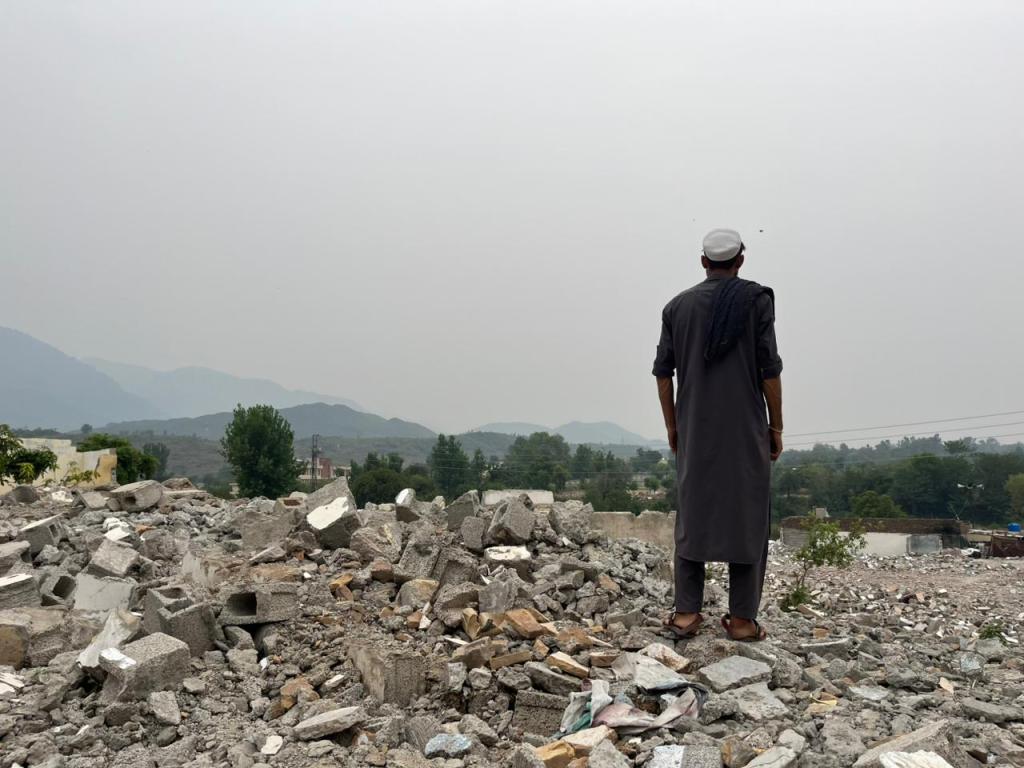
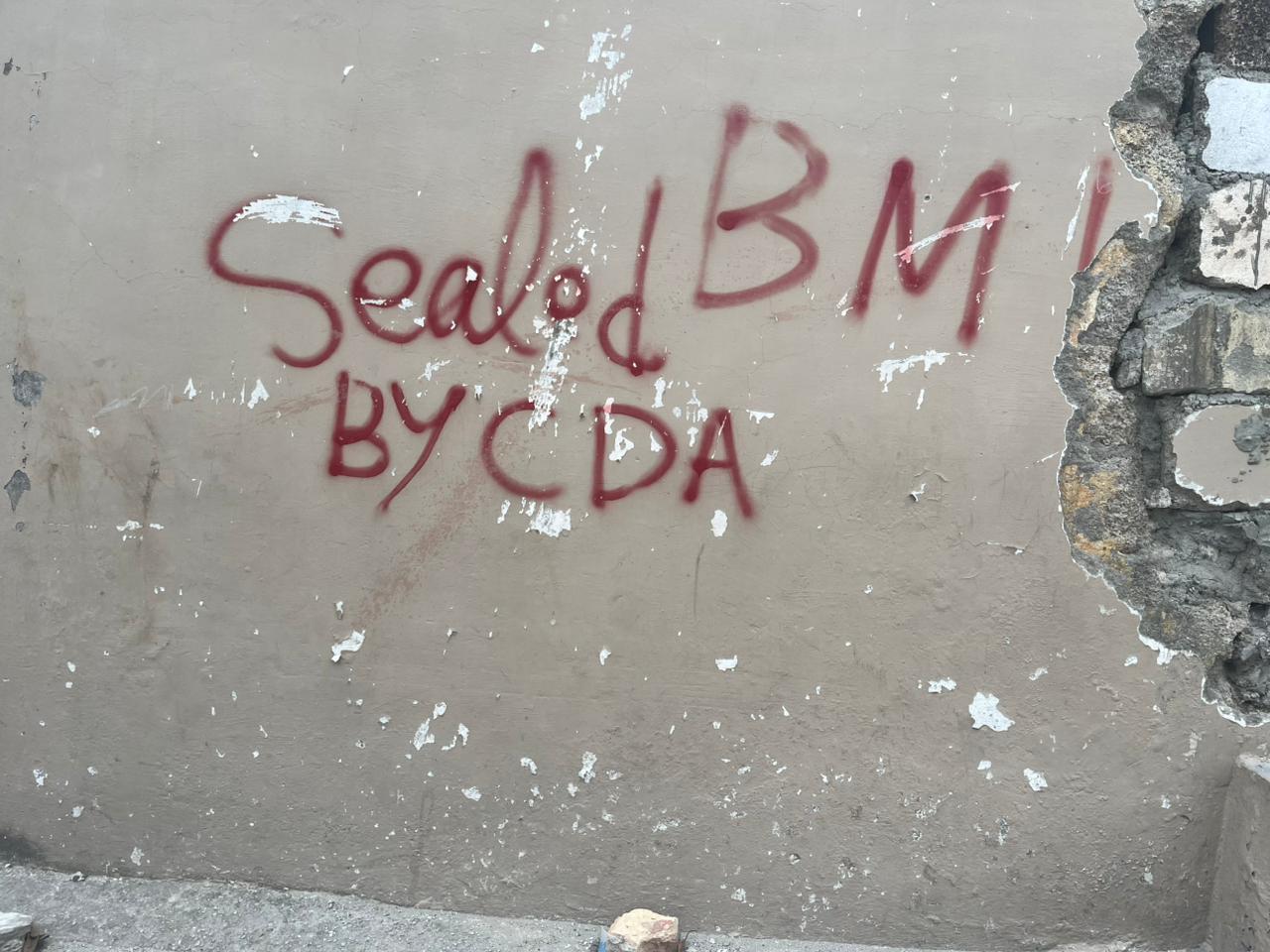
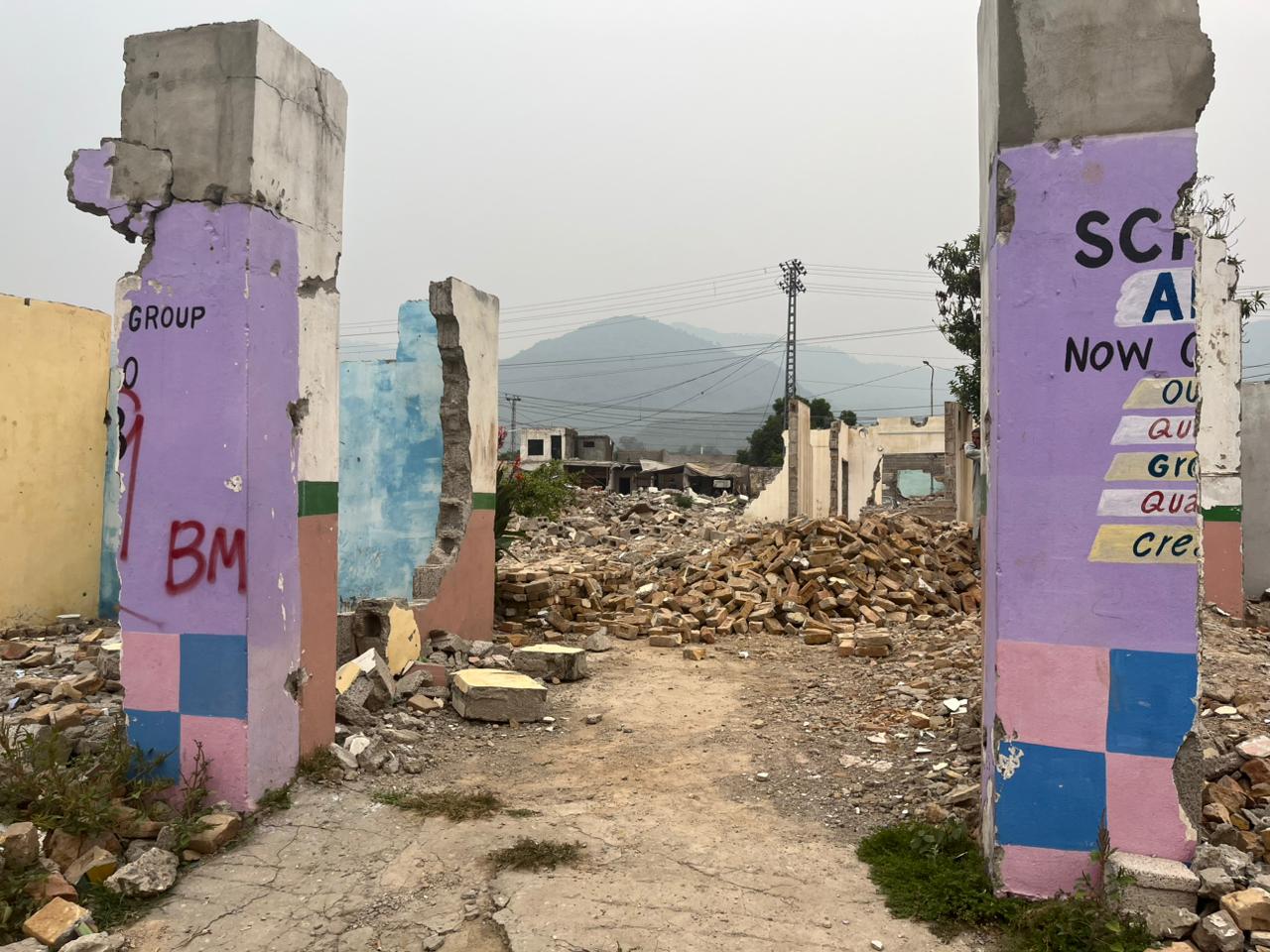
Under the scorching sun of May, Faraz Ali spends his days carrying bricks from the wreckage of demolished homes in Nurpur Shahan, a historic village in Islamabad. The walls are gone. On some surviving surfaces, the words “SEALED BY CDA” remain in red paint.
Faraz works beside a handful of others, bent over debris, salvaging bricks and whatever else may be useful. But he is repeatedly drawn to the road nearby. Each passing vehicle pulls his gaze from the rubble. He watches anxiously, as though trying to detect whether another demolition team is on its way.
He always fears that, without warning, city authorities may arrive at his home next.
“I was born here; my father was born here,” Ali says. “Since the operation started, I have stopped studying. People here were poor—women, young girls, elderly people. Whatever they earned, they spent on building their houses, but the administration ruined everything.”
“It feels like no one lives in this village anymore,” he continues. “The silence is haunting. It is the CDA’s mistake. Why did they let these houses be built in the first place? Why did they not stop them then? They were taking money at that time.”
The operation Faraz describes began in early April this year. By May, the Capital Development Authority (CDA) had demolished 17,640 houses across 13 localities and razed Nurpur Shahan’s one-kilometer historic bazaar near the Bari Imam shrine, including grocery stores, medical shops, banks, and roadside stalls.
The CDA maintains that the state acquired the land in the 1960s for the construction of Islamabad and that it has since been illegally occupied. “Compensation had been paid at the time of acquisition,” the authority has said. “The present operation is against continued occupation and later illegal expansion on land.”
Residents reject that characterization. Many say their families have lived on this land for generations and regard it as ancestral territory rather than state property.
“When people resisted, there were children there. They treated them badly,” Ali says. “I could not do anything. I was helpless.”
His voice trembles as he recalls the scene. After a long pause, he adds: “If you could check the anguish of my heart, I would have gone myself and done something very wrong.”
“They come sometimes in the darkness of night, sometimes in the light of morning,” he says. “There is no way of knowing when they will arrive.”
Authorities have described the proposed resettlement arrangement as a “model village.” Faraz does not see a future in it.
“The map they have given calls it a model village,” he says. “But this model village is nothing. Only the name of this place will remain. Nobody in this village will be living here anymore.”
“A road has become more important than human life”
About a 25-minute drive from Nurpur Shahan, another community in the narrow lanes of Rimsha Colony lives with the same fear.
Rimsha Colony is a Christian-majority katchi abadi, or informal settlement. Inside one home, Tareeza, a mother of five, speaks about the possibility that a planned road will cut through the place where she has lived for nearly two decades. Outside, children run through the lanes as they always have. Inside, conversations revolve around demolitions, officials, and where families will go if bulldozers arrive.
“We feel like we are dying inside,” Tareeza says. “Whatever we earned, we spent on this house. For days now, nobody in the family has been able to think about anything else. We do not even sleep properly.”
Rimsha Colony’s origins are tied to one of the most widely reported incidents in recent history of Pakistan. In 2012, Rimsha Masih, a 14-year-old Christian girl, was falsely accused of blasphemy, triggering fear and violence, which prompted Christian families to flee their homes. The CDA relocated hundreds of families to a site now called Rimsha Colony, ostensibly for their protection.
Over the years, the settlement grew. It is now home to about 25,000 people, most of them Christian.
The same authority that relocated residents to the area now classifies the settlement as an encroachment. Rimsha Colony lies along the planned route of the 10th Avenue project, a major road-development scheme.
“CDA officials came to the colony and told residents they had three days to leave,” Tareeza says. “I asked them why they were doing this. At least talk to us.”
“This is not a cart that you can move from one place to another,” she recalls telling them. “This is our home.”
According to Tareeza, CDA workers said they were following orders and told residents to speak to senior officials. When workers returned, residents protested, and the team left. But the uncertainty remains.
“Who listens to us?” Tareeza asks. “A road has become more important than human life.”
For Attia Bibi, another resident, the threat of demolition is inseparable from the daily work of survival. She cleans houses that are not hers and earns an income that barely lasts the month. Each morning, she gets her children ready for school and travels through Islamabad for domestic work. She helps maintain the city that may soon erase the place she calls home.
“First our houses will go, then the education of our children,” Bibi says.
She repeats the same question more than once, seemingly trying to make sense of it herself: “Is Islamabad only for them?”
Residents of Rimsha Colony work as sanitation workers, domestic helpers, construction laborers, and daily-wage earners. Over time, the settlement has developed small churches, informal schools, and community organizations. Many families took out loans to build their homes.
“Announcements come through the streets: ‘Pack your things and leave,’” Attia says. “We are Pakistani. We have the right to live here. Our children’s future will be destroyed. We have no savings.”
“That road is for them, not for us,” she adds. “It will cut through our colony.”
Never Planned
In 1977, the CDA formally approved a policy to build model villages for the permanent resettlement of displaced communities. Nurpur Shahan was included in the plan. The CDA allotted plots, and residents built homes on them.
The promise was neither fulfilled nor formally withdrawn. It was simply left unaddressed for decades.
In February 2026, the Islamabad High Court found the CDA in willful defiance of its own commitments and issued show-cause notices over what it described as poor governance. Demolition operations continued nonetheless.
The question underlying both Nurpur Shahan and Rimsha Colony is not merely whether particular homes are legally recognized. It is whether Islamabad’s planning regime ever envisioned a place for poor and working-class residents.
In a recent petition before the Federal Constitutional Court, the court asked whether Islamabad’s master plan contained provisions for low-income settlements. Additional Attorney General Aamir Rehman responded that such settlements had not been formally included, although those established before 1995 had been recognized on humanitarian grounds. He also characterized some settlements as being under “mafia control.”
The position was clear: the state had not planned for these communities. Their presence in the city could be treated as criminal, and any recognition afforded to them was framed as charity rather than as a right.
Lawyer Faisal Siddique countered that, despite policies introduced in 2001 and 2016, authorities had continued eviction operations without meaningful implementation of rehabilitation and resettlement measures.
In 2015, the Awami Workers Party filed a petition challenging demolitions in the katchi abadi. The court subsequently issued a stay order barring the CDA from demolishing additional informal settlements in Islamabad. Petitioners argued that the state had a constitutional obligation to provide residents of katchi abadis with shelter and essential services.
Under the Constitution and Pakistan’s National Housing Policy of 2001, residents of informal settlements cannot be evicted without relocation in accordance with resettlement plans.
Rights groups now argue that the current demolition campaign violates the 2015 Supreme Court stay order and have appealed to superior-court judges to halt summary evictions.
A study by Ayesha Shahid and colleagues, using data collected in 2023, estimated that roughly 532,000 people lived in 39 katchi abadis across Islamabad—approximately 23% of the city’s population of 2.36 million. The study found that approximately 17.2% of Islamabad’s residents lived in 29 “unrecognized” settlements, which the CDA classifies as illegal and often refuses to formally acknowledge or map.
The scale of growth is revealing. A CDA survey in 1997 estimated that about 5,000 households, or approximately 31,000 people, lived in Islamabad’s katchi abadis. The 2023 estimate suggests a 17-fold increase over roughly 25 years.
The city has grown. Its workforce has grown with it. But much of that workforce remains outside the legal and spatial imagination of the capital’s planners.
The Right to the City
“Working-class residents of the city, including the historic villagers who existed here before the city existed, have a fundamental right to the city,” says Asim Sajjad Akhtar, a political worker based in Islamabad who has organized against working-class evictions since 1999.
For Akhtar, the language of encroachment obscures a deeper political conflict over who has the right to inhabit and shape the capital.
“The idea of the ‘right to the city’ is deeply contested because, in Islamabad, like many cities in Pakistan, the working-class majority is effectively criminalized,” he says. “They are constantly labeled as encroachers, even when there are court stay orders or legal protections in their favor.”
“The CDA and successive governments often ignore these protections and continue eviction operations regardless,” he adds. “Even in cases where legal injunctions clearly establish that residents have rights, the right to live in the city is denied in practice.”
This is not simply a question of administrative procedure. It is a question of how planning itself produces exclusion.
“In a country where the law is very easily manipulated, it is often in the name of the law that people are disenfranchised or dispossessed,” Akhtar says. “If you want to talk about encroachments, the biggest examples are often the elites who have encroached on green belts or defied zoning regulations wherever they are building.”
Islamabad’s development model, he argues, rests on a familiar pattern. The city sprawls outward, consumes villages, cuts down trees, and then constructs highways to facilitate access to the urban center.
“The city sprawls; you consume villages; you cut down trees,” Akhtar says. “When it sprawls, you build highways to get access to the city center. These huge roads, construction, dust, and dirt—all of it pollutes the environment.”
“This is the development policy of the city: building plazas, increasing consumption, building hotels and restaurants,” he says. “Who is this for? Obviously, it is for those who can afford it.”
Development continues to move forward in Islamabad. Roads widen. New avenues promise quicker movement between Rawalpindi and the Margalla Hills. Commercial projects multiply.
But for residents of places like Nurpur Shahan and Rimsha Colony, the question is not whether the city will develop. It is who will be allowed to remain within it.
“After every kilometer, there is another avenue that will take you from Pindi to Margalla,” Akhtar says. “Why is it necessary? It caters to gratuitous elite desires.”
“We clap for it,” he adds. “But the imagination of development—suburbanization, highways, and cars—is itself a very big question mark. Just because it makes developers, construction companies, and speculators money does not mean that it should be called development.”
“It is based on sacrificing the needs of most of the city’s people, and also its future generations, because it is destroying the environment.”
The CDA’s Position
The CDA rejects the claim that its demolition operations amount to arbitrary displacement. Dr. Anam Fatima, director of municipal administration at the CDA, says the targeted areas are located on land acquired by the state decades ago.
“These are acquired lands,” she says. “Compensation had already been paid at the time of acquisition.”
According to Fatima, Islamabad’s master plan divided the capital into residential, institutional, commercial, green, rural, and public-purpose zones. It also included sectors, model villages, and planned residential areas.
“Low-income housing was addressed through planned settlements, model villages, plots, and rehabilitation schemes—not through unregulated expansion over acquired public land,” she says.
“Public land belongs to the public. Its retrieval benefits the city as a whole by restoring land reserved for public purposes, environmental protection, roads, institutional use, civic infrastructure, and planned development.”
For Ali, Tareeza, Bibi, and hundreds of thousands of other working-class residents, the question remains unresolved: if Islamabad belongs to the public, which public is it being built for?

Who Gets to Call the City Home? Thousands in Islamabad Fear Displacement and Homelessness
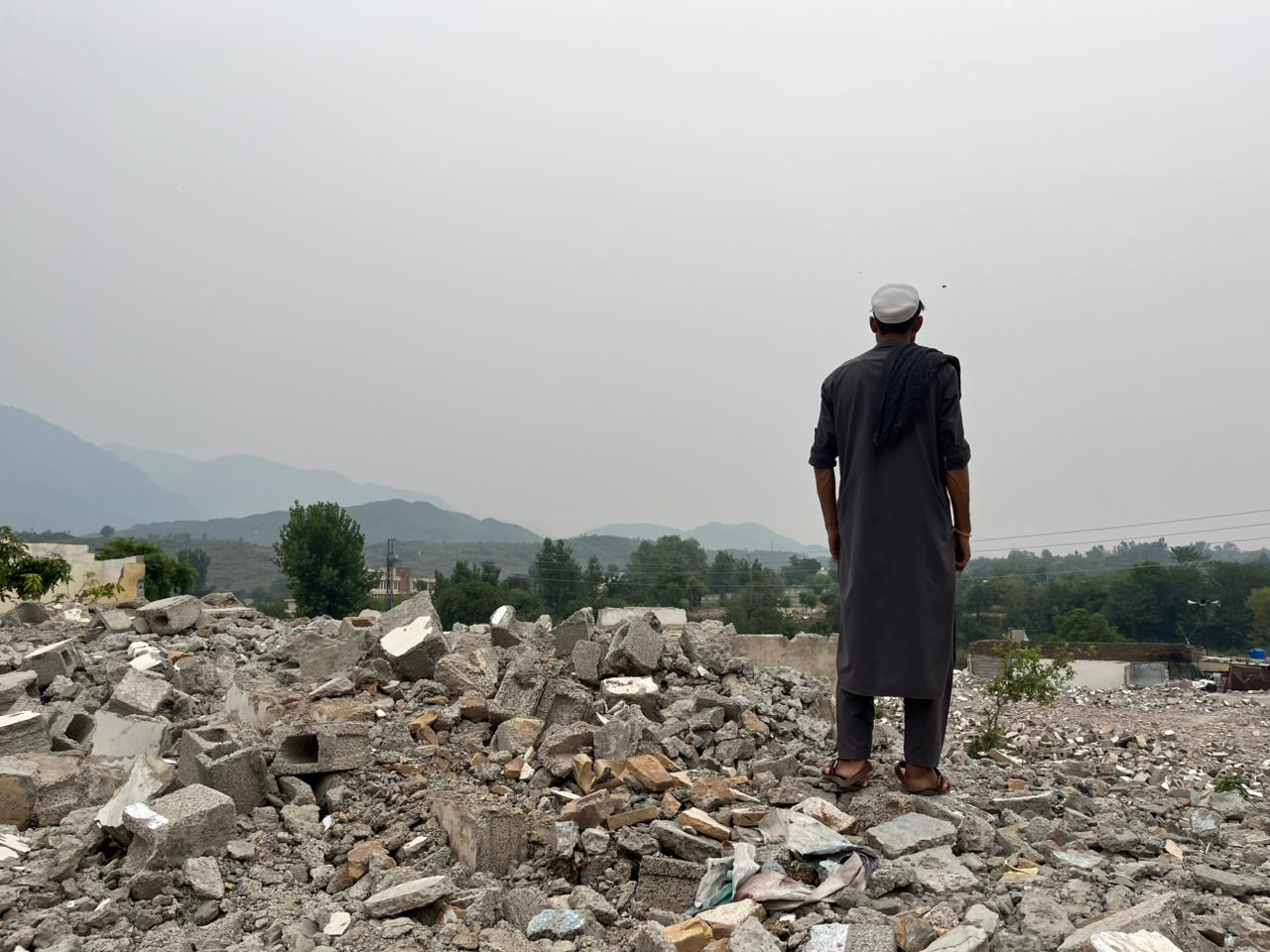
Faraz Ali looks out over demolished homes in Nurpur Shahan. Photo: Saba Chaudhry
Islamabad has a master plan. It never included the people who built it.
Under the scorching sun of May, Faraz Ali spends his days carrying bricks from the wreckage of demolished homes in Nurpur Shahan, a historic village in Islamabad. The walls are gone. On some surviving surfaces, the words “SEALED BY CDA” remain in red paint.
Faraz works beside a handful of others, bent over debris, salvaging bricks and whatever else may be useful. But he is repeatedly drawn to the road nearby. Each passing vehicle pulls his gaze from the rubble. He watches anxiously, as though trying to detect whether another demolition team is on its way.
He always fears that, without warning, city authorities may arrive at his home next.
“I was born here; my father was born here,” Ali says. “Since the operation started, I have stopped studying. People here were poor—women, young girls, elderly people. Whatever they earned, they spent on building their houses, but the administration ruined everything.”
“It feels like no one lives in this village anymore,” he continues. “The silence is haunting. It is the CDA’s mistake. Why did they let these houses be built in the first place? Why did they not stop them then? They were taking money at that time.”
The operation Faraz describes began in early April this year. By May, the Capital Development Authority (CDA) had demolished 17,640 houses across 13 localities and razed Nurpur Shahan’s one-kilometer historic bazaar near the Bari Imam shrine, including grocery stores, medical shops, banks, and roadside stalls.
The CDA maintains that the state acquired the land in the 1960s for the construction of Islamabad and that it has since been illegally occupied. “Compensation had been paid at the time of acquisition,” the authority has said. “The present operation is against continued occupation and later illegal expansion on land.”
Residents reject that characterization. Many say their families have lived on this land for generations and regard it as ancestral territory rather than state property.
“When people resisted, there were children there. They treated them badly,” Ali says. “I could not do anything. I was helpless.”
His voice trembles as he recalls the scene. After a long pause, he adds: “If you could check the anguish of my heart, I would have gone myself and done something very wrong.”
“They come sometimes in the darkness of night, sometimes in the light of morning,” he says. “There is no way of knowing when they will arrive.”
Authorities have described the proposed resettlement arrangement as a “model village.” Faraz does not see a future in it.
“The map they have given calls it a model village,” he says. “But this model village is nothing. Only the name of this place will remain. Nobody in this village will be living here anymore.”
“A road has become more important than human life”
About a 25-minute drive from Nurpur Shahan, another community in the narrow lanes of Rimsha Colony lives with the same fear.
Rimsha Colony is a Christian-majority katchi abadi, or informal settlement. Inside one home, Tareeza, a mother of five, speaks about the possibility that a planned road will cut through the place where she has lived for nearly two decades. Outside, children run through the lanes as they always have. Inside, conversations revolve around demolitions, officials, and where families will go if bulldozers arrive.
“We feel like we are dying inside,” Tareeza says. “Whatever we earned, we spent on this house. For days now, nobody in the family has been able to think about anything else. We do not even sleep properly.”
Rimsha Colony’s origins are tied to one of the most widely reported incidents in recent history of Pakistan. In 2012, Rimsha Masih, a 14-year-old Christian girl, was falsely accused of blasphemy, triggering fear and violence, which prompted Christian families to flee their homes. The CDA relocated hundreds of families to a site now called Rimsha Colony, ostensibly for their protection.
Over the years, the settlement grew. It is now home to about 25,000 people, most of them Christian.
The same authority that relocated residents to the area now classifies the settlement as an encroachment. Rimsha Colony lies along the planned route of the 10th Avenue project, a major road-development scheme.
“CDA officials came to the colony and told residents they had three days to leave,” Tareeza says. “I asked them why they were doing this. At least talk to us.”
“This is not a cart that you can move from one place to another,” she recalls telling them. “This is our home.”
According to Tareeza, CDA workers said they were following orders and told residents to speak to senior officials. When workers returned, residents protested, and the team left. But the uncertainty remains.
“Who listens to us?” Tareeza asks. “A road has become more important than human life.”
For Attia Bibi, another resident, the threat of demolition is inseparable from the daily work of survival. She cleans houses that are not hers and earns an income that barely lasts the month. Each morning, she gets her children ready for school and travels through Islamabad for domestic work. She helps maintain the city that may soon erase the place she calls home.
“First our houses will go, then the education of our children,” Bibi says.
She repeats the same question more than once, seemingly trying to make sense of it herself: “Is Islamabad only for them?”
Residents of Rimsha Colony work as sanitation workers, domestic helpers, construction laborers, and daily-wage earners. Over time, the settlement has developed small churches, informal schools, and community organizations. Many families took out loans to build their homes.
“Announcements come through the streets: ‘Pack your things and leave,’” Attia says. “We are Pakistani. We have the right to live here. Our children’s future will be destroyed. We have no savings.”
“That road is for them, not for us,” she adds. “It will cut through our colony.”
Never Planned
In 1977, the CDA formally approved a policy to build model villages for the permanent resettlement of displaced communities. Nurpur Shahan was included in the plan. The CDA allotted plots, and residents built homes on them.
The promise was neither fulfilled nor formally withdrawn. It was simply left unaddressed for decades.
In February 2026, the Islamabad High Court found the CDA in willful defiance of its own commitments and issued show-cause notices over what it described as poor governance. Demolition operations continued nonetheless.
The question underlying both Nurpur Shahan and Rimsha Colony is not merely whether particular homes are legally recognized. It is whether Islamabad’s planning regime ever envisioned a place for poor and working-class residents.
In a recent petition before the Federal Constitutional Court, the court asked whether Islamabad’s master plan contained provisions for low-income settlements. Additional Attorney General Aamir Rehman responded that such settlements had not been formally included, although those established before 1995 had been recognized on humanitarian grounds. He also characterized some settlements as being under “mafia control.”
The position was clear: the state had not planned for these communities. Their presence in the city could be treated as criminal, and any recognition afforded to them was framed as charity rather than as a right.
Lawyer Faisal Siddique countered that, despite policies introduced in 2001 and 2016, authorities had continued eviction operations without meaningful implementation of rehabilitation and resettlement measures.
In 2015, the Awami Workers Party filed a petition challenging demolitions in the katchi abadi. The court subsequently issued a stay order barring the CDA from demolishing additional informal settlements in Islamabad. Petitioners argued that the state had a constitutional obligation to provide residents of katchi abadis with shelter and essential services.
Under the Constitution and Pakistan’s National Housing Policy of 2001, residents of informal settlements cannot be evicted without relocation in accordance with resettlement plans.
Rights groups now argue that the current demolition campaign violates the 2015 Supreme Court stay order and have appealed to superior-court judges to halt summary evictions.
A study by Ayesha Shahid and colleagues, using data collected in 2023, estimated that roughly 532,000 people lived in 39 katchi abadis across Islamabad—approximately 23% of the city’s population of 2.36 million. The study found that approximately 17.2% of Islamabad’s residents lived in 29 “unrecognized” settlements, which the CDA classifies as illegal and often refuses to formally acknowledge or map.
The scale of growth is revealing. A CDA survey in 1997 estimated that about 5,000 households, or approximately 31,000 people, lived in Islamabad’s katchi abadis. The 2023 estimate suggests a 17-fold increase over roughly 25 years.
The city has grown. Its workforce has grown with it. But much of that workforce remains outside the legal and spatial imagination of the capital’s planners.
The Right to the City
“Working-class residents of the city, including the historic villagers who existed here before the city existed, have a fundamental right to the city,” says Asim Sajjad Akhtar, a political worker based in Islamabad who has organized against working-class evictions since 1999.
For Akhtar, the language of encroachment obscures a deeper political conflict over who has the right to inhabit and shape the capital.
“The idea of the ‘right to the city’ is deeply contested because, in Islamabad, like many cities in Pakistan, the working-class majority is effectively criminalized,” he says. “They are constantly labeled as encroachers, even when there are court stay orders or legal protections in their favor.”
“The CDA and successive governments often ignore these protections and continue eviction operations regardless,” he adds. “Even in cases where legal injunctions clearly establish that residents have rights, the right to live in the city is denied in practice.”
This is not simply a question of administrative procedure. It is a question of how planning itself produces exclusion.
“In a country where the law is very easily manipulated, it is often in the name of the law that people are disenfranchised or dispossessed,” Akhtar says. “If you want to talk about encroachments, the biggest examples are often the elites who have encroached on green belts or defied zoning regulations wherever they are building.”
Islamabad’s development model, he argues, rests on a familiar pattern. The city sprawls outward, consumes villages, cuts down trees, and then constructs highways to facilitate access to the urban center.
“The city sprawls; you consume villages; you cut down trees,” Akhtar says. “When it sprawls, you build highways to get access to the city center. These huge roads, construction, dust, and dirt—all of it pollutes the environment.”
“This is the development policy of the city: building plazas, increasing consumption, building hotels and restaurants,” he says. “Who is this for? Obviously, it is for those who can afford it.”
Development continues to move forward in Islamabad. Roads widen. New avenues promise quicker movement between Rawalpindi and the Margalla Hills. Commercial projects multiply.
But for residents of places like Nurpur Shahan and Rimsha Colony, the question is not whether the city will develop. It is who will be allowed to remain within it.
“After every kilometer, there is another avenue that will take you from Pindi to Margalla,” Akhtar says. “Why is it necessary? It caters to gratuitous elite desires.”
“We clap for it,” he adds. “But the imagination of development—suburbanization, highways, and cars—is itself a very big question mark. Just because it makes developers, construction companies, and speculators money does not mean that it should be called development.”
“It is based on sacrificing the needs of most of the city’s people, and also its future generations, because it is destroying the environment.”
The CDA’s Position
The CDA rejects the claim that its demolition operations amount to arbitrary displacement. Dr. Anam Fatima, director of municipal administration at the CDA, says the targeted areas are located on land acquired by the state decades ago.
“These are acquired lands,” she says. “Compensation had already been paid at the time of acquisition.”
According to Fatima, Islamabad’s master plan divided the capital into residential, institutional, commercial, green, rural, and public-purpose zones. It also included sectors, model villages, and planned residential areas.
“Low-income housing was addressed through planned settlements, model villages, plots, and rehabilitation schemes—not through unregulated expansion over acquired public land,” she says.
“Public land belongs to the public. Its retrieval benefits the city as a whole by restoring land reserved for public purposes, environmental protection, roads, institutional use, civic infrastructure, and planned development.”
For Ali, Tareeza, Bibi, and hundreds of thousands of other working-class residents, the question remains unresolved: if Islamabad belongs to the public, which public is it being built for?