




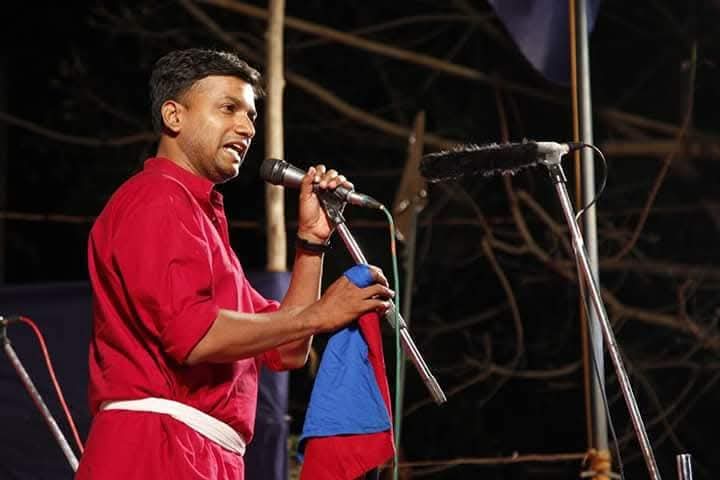
Prison Remains is a series by cultural activist Ramesh Gaichor, translated from Marathi by Harshali Potdar with editorial guidance from Prof. Hany Babu. Drawing on nearly nine years of incarceration as an undertrial, Gaichor writes about the people and everyday lives behind prison walls. Through portraits, narrative essays, and analysis, the series examines how caste, poverty, and state power shape imprisonment, while attending to the relationships, humor, care, and resistance that persist within it. हा निबंध मराठीत वाचा (Read this essay in Marathi)
Translators Note
Translating this piece is a truly enriching experience. Delving into the author’s world through the film, which is so close to him because of shared experiences, offered a completely different angle in translation. The narration of the author’s own experiences and memories is so strong and vivid that, while translating each incident, I found each concept interesting as a translator.
I feel as if I’m translating various lived stories that are, in a way, very much connected to each other. These stories belong to three different worlds, each with its own language and specificity. The first world is the world of the film The Shawshank Redemption; the second is the outside world as a whole; and the third is Taloja Central Prison, where the author has lived through two long incarcerations as an undertrial prisoner. Each world has its own language, which intersects with that of the others throughout the article.
The real challenge was balancing the translation with the poetic character of the writing, the formal and factual process, and the need to convey the film’s plot. I could understand much of the context since I had long heard these stories and the author’s experiences in jail, both personally and politically. Yet, when I got stuck, the author patiently answered my questions and clarified things for me.
Although I translated the entire piece from Marathi to English, it would have been much harder without feedback, review, and final editing assistance from Professor Hany Babu on word choice and sentence structure. As additional sets of eyes refined the translation, so did the different sets of eyes that improved it. This translation became what it is today not only because he was a professor of linguistics and English at Delhi University, but also because he was a political prisoner and co-accused of Ramesh Gaichor, and was also imprisoned for more than five years in the same Taloja Central Prison. He was generous with his time and helped and guided us as we worked on the article. Therefore, this translation exercise became a different learning process for me, both from Ramesh Gaichor and Professor Hany Babu.
आबाद रहेंगे वीराने शादाब रहेंगी ज़ंजीरें
जब तक दीवाने ज़िंदा हैं फूलेंगी फलेंगी ज़ंजीरें
…
क्या होगा जब दीवानों से नाता तोडेंगी ज़ंजीरें
— हाफीज मेरठी
Prisons will remain alive; shackles will thrive
As long as revolutionaries are alive, shackles will blossom and flourish
…
What will happen when the shackles break their bonds with the rebels?
– Hafeez Merathi
These lines of Hafeez Merathi resonate in my mind as I write. Recently, social media platforms were flooded with images of wounded and bloodied Indian students. The police used tear gas and water cannons on the Gen Z students protesting against India’s corrupt education system. They were beaten up mercilessly with nail-studded lathis; even female students were not spared, as the police dragged them until their clothes tore off. Despite such repression, the students and protesters, and various Ambedkarite-Left-liberal organizations, stood firm. The fragrance of their hopefulness wafted through every corner of India in the form of various struggles. That fragrance had spread within me too, because I share an old and deep connection with this sense of optimism—and the rebellion—it evokes. That connection reaches back 25 years, to when I entered the movement for the annihilation of caste, class, and patriarchy through Kabir Kala Manch.
Whether the current Gen Z protests, the farmers’ protest at the Singhu border on the Delhi-Haryana highway, the Shaheen Bagh protests in Delhi against the CAA and NRC, the student movements that emerged after the institutional murders of Rohith Vemula, Jisha, Champa, Payal Tadvi, and Anitha, or the caste-annihilation movements that arose in response to Dalit massacres including Khairlanji, Hathras, and Javkheda—these struggles have unfolded in different places, at different moments, and across different communities, using different forms and media. Yet they are all connected by a political insistence that the present order can be resisted and transformed.
We may not always recognize how deeply the people of Palestine and Gaza, fighting the cruel imperial violence of Israel and the United States, inspire us. Their struggle reminds us that conditions can change when they are confronted, and that the world can be remade through collective resistance.
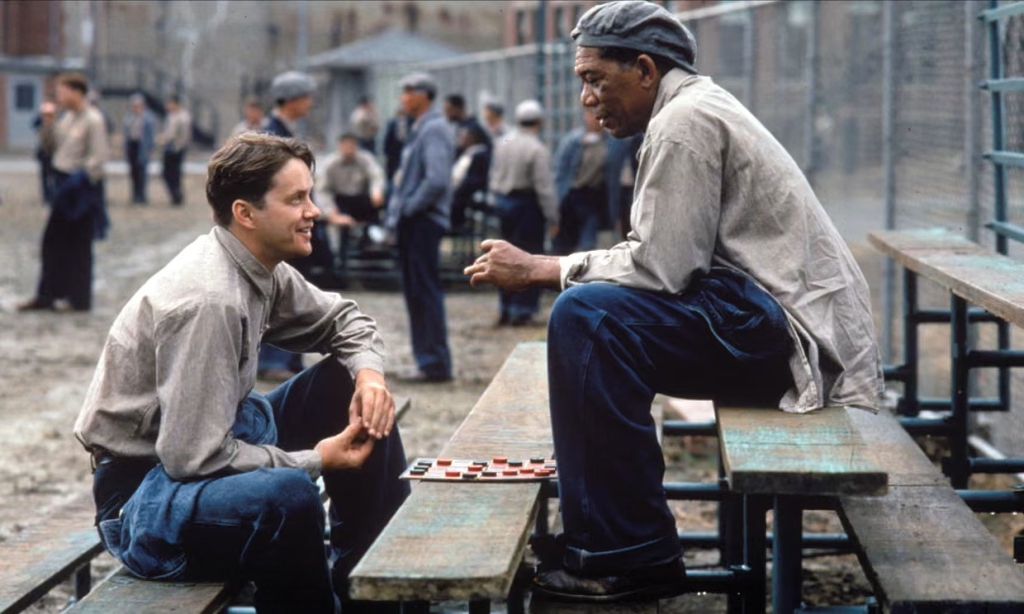
It was this sense of possibility that sustained me through two long periods of incarceration: first from 2013 to 2017, and then from 2020 to 2026. In both instances, I was imprisoned under the Unlawful Activities (Prevention) Act (UAPA), 1967—an anti-terror law that has been repeatedly used to repress dissenting voices. The first time after being released on bail, I happened to watch The Shawshank Redemption. My second arrest came in the Elgar Parishad–Bhima Koregaon case, in which 16 activists, academics, and lawyers were arrested under the UAPA. During that second time in prison, the film became important to me: it helped me remain steady and hold on to the conviction that confinement does not extinguish the possibility of freedom. Released in 1994, The Shawshank Redemption has inspired countless viewers with its story of endurance, friendship, and resistance.
Reform Home or Slaughter House?
The Shawshank Redemption is set in Shawshank Prison in the U.S.; I was imprisoned in Taloja Central Prison in Maharashtra. Despite the cultural and geographical distance between them, the two prisons are not so different in their inhumanity and corruption: the power of the jail administration, illegal businesses, the suffocation of confinement, and the psychological trauma on prisoners. Apart from some exceptions, Taloja’s prison superintendents and additional superintendents resembled their counterparts in the film—ferocious, inhuman, self-serving, and corrupt.
The film opens with a harrowing scene in which newly sentenced prisoners enter Shawshank. The admission process is designed to humiliate and dehumanize them, and although the film captures this accurately, its full severity cannot be understood merely by reading about it or watching it on screen. One feels it when one is stripped naked and ordered to turn around in a circle before others. For someone entering prison for the first time, that shock is not easy to endure.
In the opening scene, a newly arrived prisoner, overwhelmed by the admission process and the hostile environment, breaks down and cries that he wants to go home. Rather than helping him, senior prison officials—representatives of what is called a “reform home”—force him to the ground, kick and beat him nearly to death. He spends the night writhing in pain and dies in the prison hospital. This cold-blooded killing may seem exaggerated in the film, but it reflects a reality I know firsthand from nearly a decade of imprisonment.
I have witnessed many such instances of inhumanity. A jail officer who shows great affection towards his pets may display no compassion for prisoners. Many deaths occur not from serious illness, but because of the negligence of prison doctors.
An elderly prisoner in the barrack next to mine was suffering from severe stomach pain. That night, despite the prisoners repeatedly calling for medical help, no doctor came. It was only after a long delay that a nursing orderly arrived and gave him a painkiller. Often, prisoners are simply given a painkiller such as paracetamol or diclofenac, and the matter is considered dealt with. When these medicines failed to provide any relief, the prisoner was admitted to the prison hospital. At that point, he urgently needed to be taken to a larger hospital outside the prison for adequate treatment. However, the prison authorities did nothing. What was particularly disturbing was that, during the same period, other prisoners who had money and could pay bribes were being sent to hospitals outside. The prisoner was left to suffer for three days and eventually died in the prison hospital itself. In an apparent attempt to cover up his death, his body was taken out in the early hours of the morning and sent to a hospital outside the prison, creating the impression that he had died on the way. I learned what had happened, gathered information relating to the incident, and subsequently lodged a formal complaint with the Maharashtra Human Rights Commission seeking to hold the doctor and superintendent accountable for the death of a prisoner. However, it was difficult for that complaint to succeed because I was detained under the very prison administration against whom I had lodged the complaint. The documents I had requested under the Right to Information Act were not provided to me. The dates of the hearings before the State Human Rights Commission were deliberately concealed from me. Various forms of pressure were exerted on my fellow inmates who were witnesses. As a result, the complaint could not be effectively pursued before the Commission.
Similarly, the custodial death of Father Stan Swamy, my co-accused in the Elgar Bhima Koregaon case and a human rights defender, was also an institutional murder. Whenever we met in prison, he would raise his hand, clench his fist, and, in his trembling voice, say, “Ladenge, Jitenge”—“We will fight, we will win.”In order to protest against this institutional killing, we, the Elgar prisoners, observed a one-day hunger strike and filed a complaint demanding that criminal cases be registered against those responsible for his death. However, nothing substantial came of that complaint.
The jail administration justifies its cruelty, claiming that if prisoners are treated humanely, they will not understand prison as punishment. In doing so, the authorities conveniently forget that the department is officially called “Maharashtra Prisons and Correctional Services,” and that its stated motto is “Reforms and Rehabilitation.” Yet, in the name of discipline and internal security, the administration acts arbitrarily and brutally.
At Taloja Central Prison, for instance, an officer found several prisoners playing cards fashioned from incense-stick packets late at night. The next morning, he beat them up severely with a stick. One prisoner was badly injured and died two days later. The post-mortem report recorded that he had slipped and died, allowing the administration to cover up what I regard as a murder. Such cover-ups seldom produce remorse among the officers responsible; they make them more ruthless and fearless.
Only in a rare instance, an officer and several constables at Byculla Women’s Prison were imprisoned after a woman prisoner died following a brutal assault. But such cases remain exceptional. What is more prevalent is administrative forces beating up prisoners, since custodial deaths are often swept under the rug.
Every moment of prison life is fraught with the dialectics between positivity and negativity. Every day something new and troublesome happens in the prison. You have to fight for even the smallest of things in that limited world. In The Shawshank Redemption, Andy Dufresne asks the prison administration for books, but receives no support. He writes letters and applications to the government, persisting for six years. Eventually, his efforts bring a small grant and a consignment of old books.
During my first imprisonment, from 2013 to 2017, the superintendent would not allow me to obtain books I wished to read, even at my own expense. I had to approach the Mumbai Sessions Court for permission. The prison authorities opposed my application, claiming that the library already had sufficient books. But when the judge examined the list submitted by them, he found it totally inadequate and allowed my request.
The judge who passed that order was Justice B. H. Loya, whose death in 2014 while he was presiding over the politically sensitive Sohrabuddin Sheikh case, became the subject of public controversy and petitions seeking an inquiry. One is not always fortunate enough to encounter such a judicious and rational judge. Even after this prolonged struggle, a jailer once stopped a book at the prison gate and confiscated it simply because its title had words such as “slavery” and “rebellion.” In this strange and suffocating reality, the inability to access books becomes another form of deprivation—one that demands resistance, sometimes alone, like Andy, and sometimes collectively.
“Brooks was here”

In the film, the presence of the elderly, well-respected prisoner Brooks Hatlen lingers long after the film ends. Brooks manages Shawshank’s prison library with care and commitment, which gradually becomes his entire world. Brooks has a close bond with Jake, a crow he keeps inside the prison. In the outside world, keeping an animal or bird as a companion may seem ordinary. But in prison, it takes on an entirely different meaning. For prisoners who have no relatives, friends, or companions waiting for them outside, an animal or bird can become a companion in solitude—a presence with whom one can share a dialogue and keep loneliness at bay.
Having spent about half of a century in prison, when Brookes is granted parole, the prospect of release leaves him deeply shaken. Only then does he realize how completely prison has become his permanent refuge and home; the world outside has become too strange to him. In desperation, he holds a knife to another prisoner’s neck, believing that if he commits a crime he will be sentenced again and allowed to remain inside, but the other prisoners persuade him against it. The next day, helpless and unwilling, Brooks walks out of the prison carrying all his belongings in a single briefcase.
By the time Brooks is released, the world outside has moved on without him. He works diligently in a department store, but his evenings and nights become unbearable. He waits for Jake, the crow he had released into the sky, hoping that it might somehow return. He searches for it in vain among flocks of birds.
The sense of possibility that had once sustained him had diminished, and there was no one around him to restore it. Overwhelmed by loneliness and disorientation, with nothing left to live for, Brooks eventually takes his own life. Before doing so, he carves the words “Brooks was here” into a wooden beam.
Who is responsible for Brooks’s death? If responsibility must be assigned, it lies within an inhuman power structure—and a capitalist social order that has become profoundly self-centered and individualistic. It does not value a person as a whole human being; it treats people as robots, stripped of their feelings and inner life. Such a system has no concern for a person’s full development, vitality, or emotional well-being. It requires only the labor of people like Brooks in order to keep itself running. Brooks’s emotions cannot find a place in this mechanical world. That is not his failure; it is the failure of a power structure that could not create a humane and supportive environment for him.
Personal is Political
Such blatant systemic and structural violence and the dehumanization one faces during and after imprisonment make you feel helpless, but political prisoners like us are used to overcoming this helplessness because of our commitment to political thought. This movie offers no such example of political commitment. Still, many scenes and dialogues felt completely political to me, someone who believes in the slogan “Personal is Political”.
In a striking scene, the protagonist Andy is sent to work in a prison officer’s office. When he realizes that the office is empty, including the warden’s room, he seizes the moment. He locks the officer who assigned him the work in the bathroom, and puts a Mozart record on the turntable.
Ignoring the officer’s threats, Andy turns up the volume and broadcasts “Sull’aria,” the duettino from Mozart’s Le nozze di Figaro, through the prison loudspeaker system, which until then, had only carried orders meant to discipline and control the prisoners.
Across the prison, men stop what they are doing and turn towards the music. For a brief moment, its beauty interrupts their harsh routine. Andy sits on the warden’s chair, his feet resting comfortably on the desk, listening without fear as officers gather outside the locked door. Andy was very well aware of the price he would have to pay for living such a beautiful moment, and still, he did it, not only for himself but for every prisoner. And he did it by dismissing, with his poignant smile, the prison superintendent’s dreaded sight standing outside the glass door. As a cultural activist and political prisoner, I found this amazing. That gaze contained within it a wonderful mix of hopefulness, rebellion, creative pleasure and a moment of happiness of creation, cohesion with the collective. It is the essence of the movie, and life. It is this cohesive moment that has destroyed the biggest of regimes. In the last few days, I’ve seen it organically seep into the revolutionary soil of India.
“Rehabilitated? It’s a bullshit word”
Towards the end of the film, the director Frank Darabont gives us another compelling scene. Ellis Boyd Redding, known as Red, appears before the parole board with a defiance he had never shown in his four decades of imprisonment.
Over the years, Red has faced the board several times, each time answering as expected of him, and his applications of release keep on getting rejected. But at this hearing, he is no longer willing to repent. He appears before the committee as a man shaped by long experience—clear-eyed, firm, and rebellious.
When asked whether he has been rehabilitated, Red replies: “Rehabilitated? It’s just a bullshit word.” He calls it a politician’s word, invented so that young men like the interviewer can wear suits and ties and hold on to their jobs. Red’s anger emerges from a deep psychological conflict—one that, in different ways, confronts almost every prisoner.
From the outside, “prisoner” sounds like a homogeneous class. However, each prisoner is divided by the walls of class, caste, religion, gender, region, and language, as each prisoner in the country is eventually part of this brahmanical, capitalist, patriarchal society. Prisoners are also divided by the crimes for which they are accused. Yet, all stay under one roof. Many of them face baseless accusations. Still, they get implicated and often, can get drawn into the world of crime. For many, there is no one to help them from outside, or nothing positive left in the judicial process. Even so, they cling to the thinnest thread of hope and continue to live within that vast and punishing structure of the prison. What connects these prisoners is their daily struggle and their refusal to surrender entirely to despair. From the innumerable people in prison who continue to live with courage and vitality, I have drawn strength for my own struggle.
In spite of his defiance before the committee, Red’s remaining sentence is pardoned. After 40 years inside the prison, Red’s life outside becomes suffocated and mechanical, exactly like Brooks’s. Another robot. Red was allotted the same room in which Brooks had committed suicide. And before Brooks, many may have knotted the rope around their necks in the same room. And now Red was moving toward that reality. At that moment, Andy’s letter reaches out to him: “Remember Red, hope is a good thing, maybe the best of things, and no good thing ever dies.” Taking that statement literally, he starts walking in the direction Andy gives him and, at last, reaches a calm seashore. And the movie ends.
Where prisons do not exist
The movie ends on the screen, but its story continues in our minds. Perhaps Red finds the peace he has been longing for when he finally reaches that vast, endless seashore. But the reality of my own release from prison—what I felt as I walked out and in the days that followed—was certainly very different from the final moments of The Shawshank Redemption. Standing at the threshold of that enormous prison gate, I found myself caught between happiness and sorrow. After more than five long years of imprisonment, I would finally be able to spend some peaceful time with Harshali. She was going to come to the prison gate to take me home. I would also meet many dear comrades from the movement, people who were like family to me.
But at the same time, a sorrow that had initially been only a faint shadow over that happiness was gradually getting darker. It was beginning to overshadow the joy itself, leaving me deeply troubled. At that time, my co-accused in the Elgar Bhima Koregaon case, Advocate Surendra Gadling, had not yet been granted bail. Gadling—the very man who, in his three decades as a lawyer, had helped countless prisoners pro bono—was himself still behind bars in Taloja Central Prison.
The film’s rebellious protagonist Andy keeps hope alive even in the darkest confines of prison. During the movement, I have encountered not one Andy but many: people who kindle courage and stand in defiance of this brutal regime. I recognize that spirit in the revolutionary movement to annihilate caste, class, and patriarchy, in the martyrs who fought the enemy, and in those who refused to abandon the movement, even in the most terrifying circumstances. In every known and unknown freedom fighter, I find both courage and rebellion.
The hope portrayed in the film was the very hope I needed to draw upon as I faced the many contradictions and struggles that awaited me outside. Even in that somewhat confused, emotionally charged space between hope and despair, I could see, among all those people who had come to the prison gate to receive me, the beginnings of a hopeful movement for tomorrow. Our caravan was carrying me away from the imposing prison walls and that red gate, towards freedom. And yet, my mind remained caught in a strange turmoil, suspended between the world inside the prison and the world outside. For five and a half years, I had been locked away every evening after six. That day, I was no longer confined. I was free. I was with my people. Advocate Gadling, whom I saw slowly disappearing from view behind the prison walls on the day of release, would surely be released one day. And from the ashes of our battered and scattered movement, our phoenix would rise again and take flight. And it would tell us, with hope and rebellion by our side, one day we could free not just one or two prisoners, but an entire country—and even the world—from this prison of fascism. A world where there are no prisons at all…


Hopefulness and Rebellion: The Story of Prison, Me, and The Shawshank Redemption
Prison Remains is a series by cultural activist Ramesh Gaichor, translated from Marathi by Harshali Potdar with editorial guidance from Prof. Hany Babu. Drawing on nearly nine years of incarceration as an undertrial, Gaichor writes about the people and everyday lives behind prison walls. Through portraits, narrative essays, and analysis, the series examines how caste, poverty, and state power shape imprisonment, while attending to the relationships, humor, care, and resistance that persist within it. हा निबंध मराठीत वाचा (Read this essay in Marathi)
Translators Note
Translating this piece is a truly enriching experience. Delving into the author’s world through the film, which is so close to him because of shared experiences, offered a completely different angle in translation. The narration of the author’s own experiences and memories is so strong and vivid that, while translating each incident, I found each concept interesting as a translator.
I feel as if I’m translating various lived stories that are, in a way, very much connected to each other. These stories belong to three different worlds, each with its own language and specificity. The first world is the world of the film The Shawshank Redemption; the second is the outside world as a whole; and the third is Taloja Central Prison, where the author has lived through two long incarcerations as an undertrial prisoner. Each world has its own language, which intersects with that of the others throughout the article.
The real challenge was balancing the translation with the poetic character of the writing, the formal and factual process, and the need to convey the film’s plot. I could understand much of the context since I had long heard these stories and the author’s experiences in jail, both personally and politically. Yet, when I got stuck, the author patiently answered my questions and clarified things for me.
Although I translated the entire piece from Marathi to English, it would have been much harder without feedback, review, and final editing assistance from Professor Hany Babu on word choice and sentence structure. As additional sets of eyes refined the translation, so did the different sets of eyes that improved it. This translation became what it is today not only because he was a professor of linguistics and English at Delhi University, but also because he was a political prisoner and co-accused of Ramesh Gaichor, and was also imprisoned for more than five years in the same Taloja Central Prison. He was generous with his time and helped and guided us as we worked on the article. Therefore, this translation exercise became a different learning process for me, both from Ramesh Gaichor and Professor Hany Babu.
आबाद रहेंगे वीराने शादाब रहेंगी ज़ंजीरें
जब तक दीवाने ज़िंदा हैं फूलेंगी फलेंगी ज़ंजीरें
…
क्या होगा जब दीवानों से नाता तोडेंगी ज़ंजीरें
— हाफीज मेरठी
Prisons will remain alive; shackles will thrive
As long as revolutionaries are alive, shackles will blossom and flourish
…
What will happen when the shackles break their bonds with the rebels?
– Hafeez Merathi
These lines of Hafeez Merathi resonate in my mind as I write. Recently, social media platforms were flooded with images of wounded and bloodied Indian students. The police used tear gas and water cannons on the Gen Z students protesting against India’s corrupt education system. They were beaten up mercilessly with nail-studded lathis; even female students were not spared, as the police dragged them until their clothes tore off. Despite such repression, the students and protesters, and various Ambedkarite-Left-liberal organizations, stood firm. The fragrance of their hopefulness wafted through every corner of India in the form of various struggles. That fragrance had spread within me too, because I share an old and deep connection with this sense of optimism—and the rebellion—it evokes. That connection reaches back 25 years, to when I entered the movement for the annihilation of caste, class, and patriarchy through Kabir Kala Manch.
Whether the current Gen Z protests, the farmers’ protest at the Singhu border on the Delhi-Haryana highway, the Shaheen Bagh protests in Delhi against the CAA and NRC, the student movements that emerged after the institutional murders of Rohith Vemula, Jisha, Champa, Payal Tadvi, and Anitha, or the caste-annihilation movements that arose in response to Dalit massacres including Khairlanji, Hathras, and Javkheda—these struggles have unfolded in different places, at different moments, and across different communities, using different forms and media. Yet they are all connected by a political insistence that the present order can be resisted and transformed.
We may not always recognize how deeply the people of Palestine and Gaza, fighting the cruel imperial violence of Israel and the United States, inspire us. Their struggle reminds us that conditions can change when they are confronted, and that the world can be remade through collective resistance.
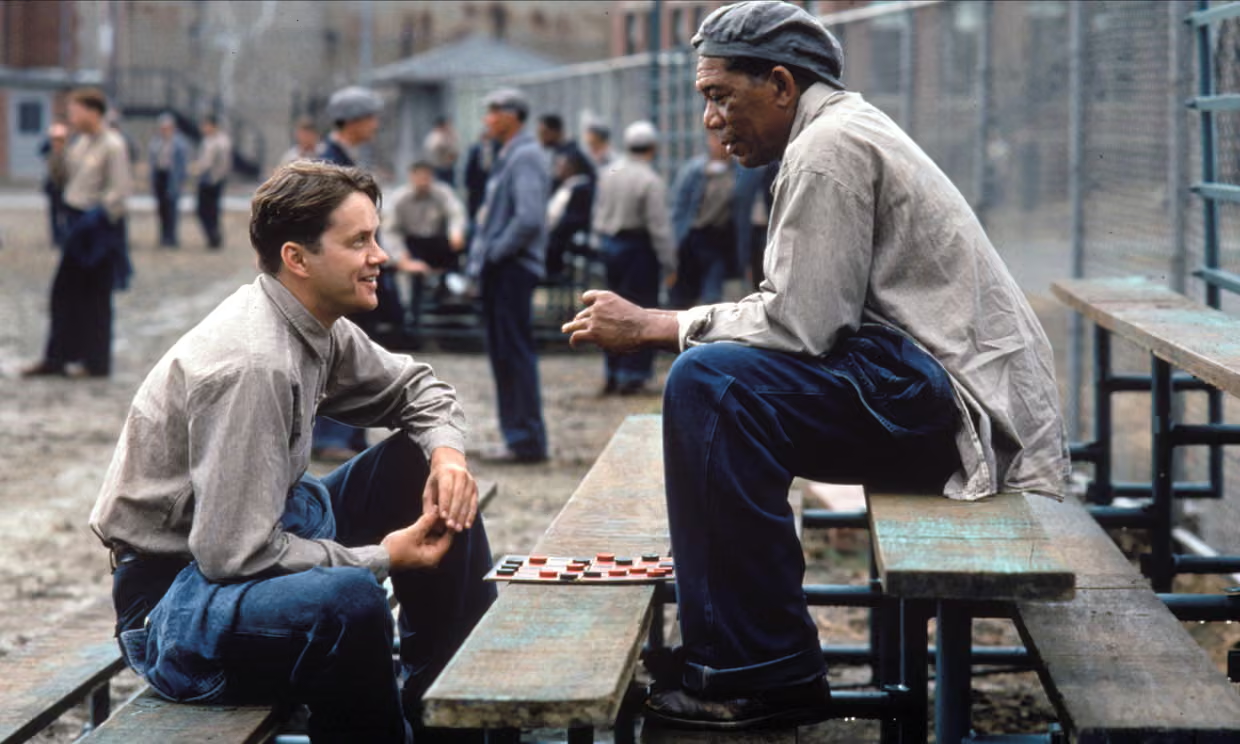
It was this sense of possibility that sustained me through two long periods of incarceration: first from 2013 to 2017, and then from 2020 to 2026. In both instances, I was imprisoned under the Unlawful Activities (Prevention) Act (UAPA), 1967—an anti-terror law that has been repeatedly used to repress dissenting voices. The first time after being released on bail, I happened to watch The Shawshank Redemption. My second arrest came in the Elgar Parishad–Bhima Koregaon case, in which 16 activists, academics, and lawyers were arrested under the UAPA. During that second time in prison, the film became important to me: it helped me remain steady and hold on to the conviction that confinement does not extinguish the possibility of freedom. Released in 1994, The Shawshank Redemption has inspired countless viewers with its story of endurance, friendship, and resistance.
Reform Home or Slaughter House?
The Shawshank Redemption is set in Shawshank Prison in the U.S.; I was imprisoned in Taloja Central Prison in Maharashtra. Despite the cultural and geographical distance between them, the two prisons are not so different in their inhumanity and corruption: the power of the jail administration, illegal businesses, the suffocation of confinement, and the psychological trauma on prisoners. Apart from some exceptions, Taloja’s prison superintendents and additional superintendents resembled their counterparts in the film—ferocious, inhuman, self-serving, and corrupt.
The film opens with a harrowing scene in which newly sentenced prisoners enter Shawshank. The admission process is designed to humiliate and dehumanize them, and although the film captures this accurately, its full severity cannot be understood merely by reading about it or watching it on screen. One feels it when one is stripped naked and ordered to turn around in a circle before others. For someone entering prison for the first time, that shock is not easy to endure.
In the opening scene, a newly arrived prisoner, overwhelmed by the admission process and the hostile environment, breaks down and cries that he wants to go home. Rather than helping him, senior prison officials—representatives of what is called a “reform home”—force him to the ground, kick and beat him nearly to death. He spends the night writhing in pain and dies in the prison hospital. This cold-blooded killing may seem exaggerated in the film, but it reflects a reality I know firsthand from nearly a decade of imprisonment.
I have witnessed many such instances of inhumanity. A jail officer who shows great affection towards his pets may display no compassion for prisoners. Many deaths occur not from serious illness, but because of the negligence of prison doctors.
An elderly prisoner in the barrack next to mine was suffering from severe stomach pain. That night, despite the prisoners repeatedly calling for medical help, no doctor came. It was only after a long delay that a nursing orderly arrived and gave him a painkiller. Often, prisoners are simply given a painkiller such as paracetamol or diclofenac, and the matter is considered dealt with. When these medicines failed to provide any relief, the prisoner was admitted to the prison hospital. At that point, he urgently needed to be taken to a larger hospital outside the prison for adequate treatment. However, the prison authorities did nothing. What was particularly disturbing was that, during the same period, other prisoners who had money and could pay bribes were being sent to hospitals outside. The prisoner was left to suffer for three days and eventually died in the prison hospital itself. In an apparent attempt to cover up his death, his body was taken out in the early hours of the morning and sent to a hospital outside the prison, creating the impression that he had died on the way. I learned what had happened, gathered information relating to the incident, and subsequently lodged a formal complaint with the Maharashtra Human Rights Commission seeking to hold the doctor and superintendent accountable for the death of a prisoner. However, it was difficult for that complaint to succeed because I was detained under the very prison administration against whom I had lodged the complaint. The documents I had requested under the Right to Information Act were not provided to me. The dates of the hearings before the State Human Rights Commission were deliberately concealed from me. Various forms of pressure were exerted on my fellow inmates who were witnesses. As a result, the complaint could not be effectively pursued before the Commission.
Similarly, the custodial death of Father Stan Swamy, my co-accused in the Elgar Bhima Koregaon case and a human rights defender, was also an institutional murder. Whenever we met in prison, he would raise his hand, clench his fist, and, in his trembling voice, say, “Ladenge, Jitenge”—“We will fight, we will win.”In order to protest against this institutional killing, we, the Elgar prisoners, observed a one-day hunger strike and filed a complaint demanding that criminal cases be registered against those responsible for his death. However, nothing substantial came of that complaint.
The jail administration justifies its cruelty, claiming that if prisoners are treated humanely, they will not understand prison as punishment. In doing so, the authorities conveniently forget that the department is officially called “Maharashtra Prisons and Correctional Services,” and that its stated motto is “Reforms and Rehabilitation.” Yet, in the name of discipline and internal security, the administration acts arbitrarily and brutally.
At Taloja Central Prison, for instance, an officer found several prisoners playing cards fashioned from incense-stick packets late at night. The next morning, he beat them up severely with a stick. One prisoner was badly injured and died two days later. The post-mortem report recorded that he had slipped and died, allowing the administration to cover up what I regard as a murder. Such cover-ups seldom produce remorse among the officers responsible; they make them more ruthless and fearless.
Only in a rare instance, an officer and several constables at Byculla Women’s Prison were imprisoned after a woman prisoner died following a brutal assault. But such cases remain exceptional. What is more prevalent is administrative forces beating up prisoners, since custodial deaths are often swept under the rug.
Every moment of prison life is fraught with the dialectics between positivity and negativity. Every day something new and troublesome happens in the prison. You have to fight for even the smallest of things in that limited world. In The Shawshank Redemption, Andy Dufresne asks the prison administration for books, but receives no support. He writes letters and applications to the government, persisting for six years. Eventually, his efforts bring a small grant and a consignment of old books.
During my first imprisonment, from 2013 to 2017, the superintendent would not allow me to obtain books I wished to read, even at my own expense. I had to approach the Mumbai Sessions Court for permission. The prison authorities opposed my application, claiming that the library already had sufficient books. But when the judge examined the list submitted by them, he found it totally inadequate and allowed my request.
The judge who passed that order was Justice B. H. Loya, whose death in 2014 while he was presiding over the politically sensitive Sohrabuddin Sheikh case, became the subject of public controversy and petitions seeking an inquiry. One is not always fortunate enough to encounter such a judicious and rational judge. Even after this prolonged struggle, a jailer once stopped a book at the prison gate and confiscated it simply because its title had words such as “slavery” and “rebellion.” In this strange and suffocating reality, the inability to access books becomes another form of deprivation—one that demands resistance, sometimes alone, like Andy, and sometimes collectively.
“Brooks was here”
In the film, the presence of the elderly, well-respected prisoner Brooks Hatlen lingers long after the film ends. Brooks manages Shawshank’s prison library with care and commitment, which gradually becomes his entire world. Brooks has a close bond with Jake, a crow he keeps inside the prison. In the outside world, keeping an animal or bird as a companion may seem ordinary. But in prison, it takes on an entirely different meaning. For prisoners who have no relatives, friends, or companions waiting for them outside, an animal or bird can become a companion in solitude—a presence with whom one can share a dialogue and keep loneliness at bay.
Having spent about half of a century in prison, when Brookes is granted parole, the prospect of release leaves him deeply shaken. Only then does he realize how completely prison has become his permanent refuge and home; the world outside has become too strange to him. In desperation, he holds a knife to another prisoner’s neck, believing that if he commits a crime he will be sentenced again and allowed to remain inside, but the other prisoners persuade him against it. The next day, helpless and unwilling, Brooks walks out of the prison carrying all his belongings in a single briefcase.
By the time Brooks is released, the world outside has moved on without him. He works diligently in a department store, but his evenings and nights become unbearable. He waits for Jake, the crow he had released into the sky, hoping that it might somehow return. He searches for it in vain among flocks of birds.
The sense of possibility that had once sustained him had diminished, and there was no one around him to restore it. Overwhelmed by loneliness and disorientation, with nothing left to live for, Brooks eventually takes his own life. Before doing so, he carves the words “Brooks was here” into a wooden beam.
Who is responsible for Brooks’s death? If responsibility must be assigned, it lies within an inhuman power structure—and a capitalist social order that has become profoundly self-centered and individualistic. It does not value a person as a whole human being; it treats people as robots, stripped of their feelings and inner life. Such a system has no concern for a person’s full development, vitality, or emotional well-being. It requires only the labor of people like Brooks in order to keep itself running. Brooks’s emotions cannot find a place in this mechanical world. That is not his failure; it is the failure of a power structure that could not create a humane and supportive environment for him.
Personal is Political
Such blatant systemic and structural violence and the dehumanization one faces during and after imprisonment make you feel helpless, but political prisoners like us are used to overcoming this helplessness because of our commitment to political thought. This movie offers no such example of political commitment. Still, many scenes and dialogues felt completely political to me, someone who believes in the slogan “Personal is Political”.
In a striking scene, the protagonist Andy is sent to work in a prison officer’s office. When he realizes that the office is empty, including the warden’s room, he seizes the moment. He locks the officer who assigned him the work in the bathroom, and puts a Mozart record on the turntable.
Ignoring the officer’s threats, Andy turns up the volume and broadcasts “Sull’aria,” the duettino from Mozart’s Le nozze di Figaro, through the prison loudspeaker system, which until then, had only carried orders meant to discipline and control the prisoners.
Across the prison, men stop what they are doing and turn towards the music. For a brief moment, its beauty interrupts their harsh routine. Andy sits on the warden’s chair, his feet resting comfortably on the desk, listening without fear as officers gather outside the locked door. Andy was very well aware of the price he would have to pay for living such a beautiful moment, and still, he did it, not only for himself but for every prisoner. And he did it by dismissing, with his poignant smile, the prison superintendent’s dreaded sight standing outside the glass door. As a cultural activist and political prisoner, I found this amazing. That gaze contained within it a wonderful mix of hopefulness, rebellion, creative pleasure and a moment of happiness of creation, cohesion with the collective. It is the essence of the movie, and life. It is this cohesive moment that has destroyed the biggest of regimes. In the last few days, I’ve seen it organically seep into the revolutionary soil of India.
“Rehabilitated? It’s a bullshit word”
Towards the end of the film, the director Frank Darabont gives us another compelling scene. Ellis Boyd Redding, known as Red, appears before the parole board with a defiance he had never shown in his four decades of imprisonment.
Over the years, Red has faced the board several times, each time answering as expected of him, and his applications of release keep on getting rejected. But at this hearing, he is no longer willing to repent. He appears before the committee as a man shaped by long experience—clear-eyed, firm, and rebellious.
When asked whether he has been rehabilitated, Red replies: “Rehabilitated? It’s just a bullshit word.” He calls it a politician’s word, invented so that young men like the interviewer can wear suits and ties and hold on to their jobs. Red’s anger emerges from a deep psychological conflict—one that, in different ways, confronts almost every prisoner.
From the outside, “prisoner” sounds like a homogeneous class. However, each prisoner is divided by the walls of class, caste, religion, gender, region, and language, as each prisoner in the country is eventually part of this brahmanical, capitalist, patriarchal society. Prisoners are also divided by the crimes for which they are accused. Yet, all stay under one roof. Many of them face baseless accusations. Still, they get implicated and often, can get drawn into the world of crime. For many, there is no one to help them from outside, or nothing positive left in the judicial process. Even so, they cling to the thinnest thread of hope and continue to live within that vast and punishing structure of the prison. What connects these prisoners is their daily struggle and their refusal to surrender entirely to despair. From the innumerable people in prison who continue to live with courage and vitality, I have drawn strength for my own struggle.
In spite of his defiance before the committee, Red’s remaining sentence is pardoned. After 40 years inside the prison, Red’s life outside becomes suffocated and mechanical, exactly like Brooks’s. Another robot. Red was allotted the same room in which Brooks had committed suicide. And before Brooks, many may have knotted the rope around their necks in the same room. And now Red was moving toward that reality. At that moment, Andy’s letter reaches out to him: “Remember Red, hope is a good thing, maybe the best of things, and no good thing ever dies.” Taking that statement literally, he starts walking in the direction Andy gives him and, at last, reaches a calm seashore. And the movie ends.
Where prisons do not exist
The movie ends on the screen, but its story continues in our minds. Perhaps Red finds the peace he has been longing for when he finally reaches that vast, endless seashore. But the reality of my own release from prison—what I felt as I walked out and in the days that followed—was certainly very different from the final moments of The Shawshank Redemption. Standing at the threshold of that enormous prison gate, I found myself caught between happiness and sorrow. After more than five long years of imprisonment, I would finally be able to spend some peaceful time with Harshali. She was going to come to the prison gate to take me home. I would also meet many dear comrades from the movement, people who were like family to me.
But at the same time, a sorrow that had initially been only a faint shadow over that happiness was gradually getting darker. It was beginning to overshadow the joy itself, leaving me deeply troubled. At that time, my co-accused in the Elgar Bhima Koregaon case, Advocate Surendra Gadling, had not yet been granted bail. Gadling—the very man who, in his three decades as a lawyer, had helped countless prisoners pro bono—was himself still behind bars in Taloja Central Prison.
The film’s rebellious protagonist Andy keeps hope alive even in the darkest confines of prison. During the movement, I have encountered not one Andy but many: people who kindle courage and stand in defiance of this brutal regime. I recognize that spirit in the revolutionary movement to annihilate caste, class, and patriarchy, in the martyrs who fought the enemy, and in those who refused to abandon the movement, even in the most terrifying circumstances. In every known and unknown freedom fighter, I find both courage and rebellion.
The hope portrayed in the film was the very hope I needed to draw upon as I faced the many contradictions and struggles that awaited me outside. Even in that somewhat confused, emotionally charged space between hope and despair, I could see, among all those people who had come to the prison gate to receive me, the beginnings of a hopeful movement for tomorrow. Our caravan was carrying me away from the imposing prison walls and that red gate, towards freedom. And yet, my mind remained caught in a strange turmoil, suspended between the world inside the prison and the world outside. For five and a half years, I had been locked away every evening after six. That day, I was no longer confined. I was free. I was with my people. Advocate Gadling, whom I saw slowly disappearing from view behind the prison walls on the day of release, would surely be released one day. And from the ashes of our battered and scattered movement, our phoenix would rise again and take flight. And it would tell us, with hope and rebellion by our side, one day we could free not just one or two prisoners, but an entire country—and even the world—from this prison of fascism. A world where there are no prisons at all…