




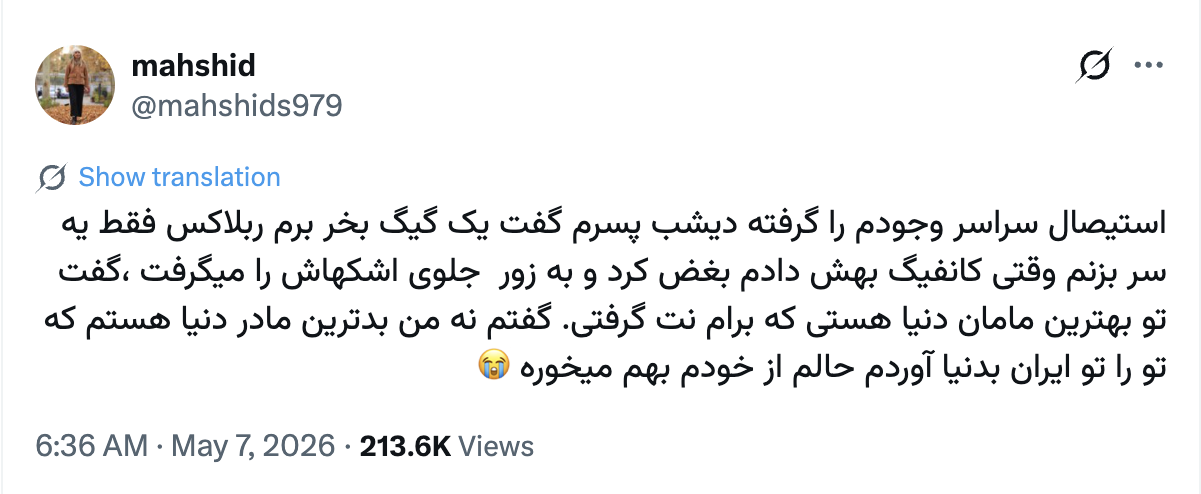
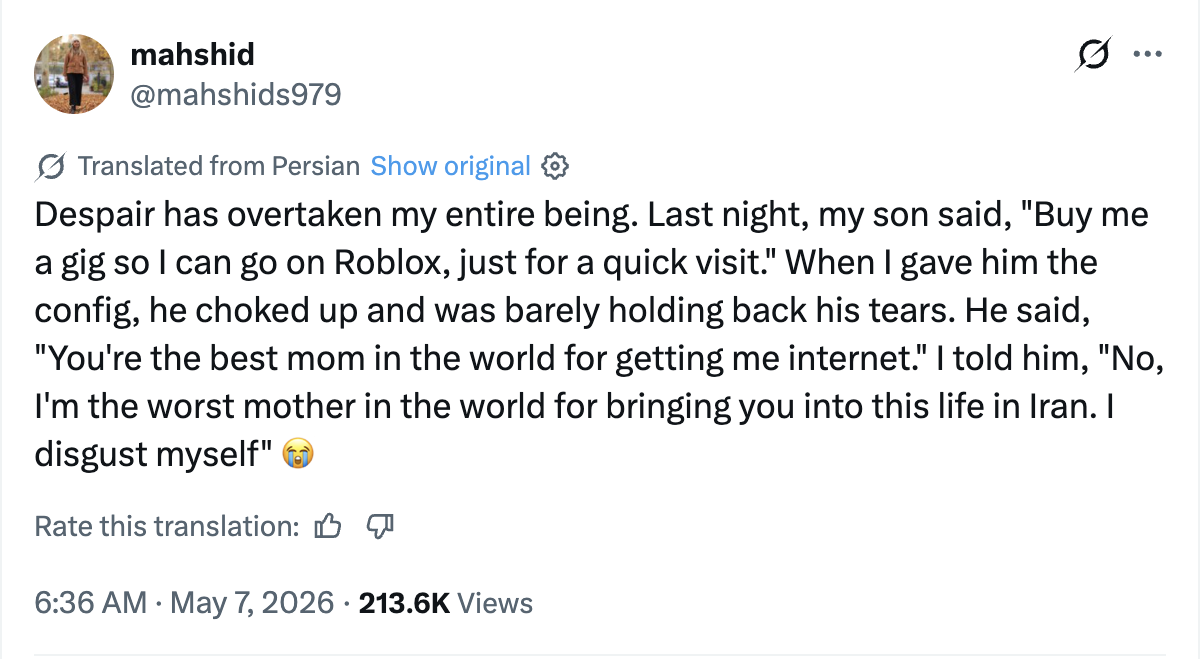
An Iranian mother wrote on X that her son fought back tears when she helped him get online. “You are the best mother in the world,” he told her. She replied: “No. I am the worst mother for bringing you into this world.” The post was viewed millions of times. Another user, a cancer patient, wrote in a comment on Zoomit, an Iranian technology website, that she had lost access to some vital medical information and was having difficulty finding some of her medication.
To the outside world, what was happening in Iran might look like an internet blackout. However, the internet didn’t disappear the same way for everyone. Some people stayed connected; most did not. The shutdown made clear what most Iranians already knew: internet access was a tiered, stratified system.
White SIM cards, unrestricted mobile connections reserved for senior Iranian officials or institutions, reportedly remained fully connected throughout the disruption. For most Iranians, access was cut off or became extremely unstable. A small elite group of leaders and state officials have access to White SIM cards. A smaller group relied on unreliable but expensive VPN, which cost up to five times the normal price. A black market for VPN access also grew, with unofficial and often unverified sellers offering increasingly expensive configurations. Users had no way of knowing who operated these services, where their connections were routed, or what happened to their data. In late April, the government introduced “Internet Pro,” aimed at those it deemed to need connectivity for their jobs, including online businesses, researchers, and others.
The country remained in this condition for nearly three months. NetBlocks estimated the economic loss at over USD 3.2 billion.
A Tiered System
Many Iranians I spoke to said that the tiered system of internet access deepened existing inequalities. But the shutdown’s effects went beyond unequal access and economic loss. Disconnection also served as collective punishment, disrupting millions of people’s daily lives and making communication and coordination much harder: for instance, news reached one part of a city through official channels at noon, while another received fragmented information hours later. It became harder to coordinate protests or even verify basic facts. Most coverage of Iranian internet restrictions focuses on censorship. But what happened in Iran was also about control over who could know what, and when.
The unequal access was intentional, not accidental. A YouTuber who was finally able to resume making videos by using someone else’s Internet Pro told me there were effectively four kinds of internet in Iran during the blackout. “White SIM cards belong to specific people,” he said. “Then there is Internet Pro. Then connection through VPNs. And finally, the domestic intranet.” He said that the quality was in that order.
White SIMs, according to multiple sources I spoke with, went to security personnel, Basij members (a branch of the Islamic Revolutionary Guard Corps (IRGC)), and state-affiliated users. I have not seen an official list. No one I spoke with had seen one. But everyone described the same pattern: the people who never seemed to lose connection were the ones with institutional backing.
This type of privileged access existed long before the recent shutdown. In November last year, an update on X that displayed users’ locations revealed something many Iranians had suspected for some time: government-aligned users had access to unfiltered internet while ordinary users did not. For many people, that was the moment they realized that not everyone was living through the same internet.
Internet Pro, which was officially marketed as “business internet,” cost roughly two million tomans (approximately USD $20 at the time) for 50 gigabytes of international data, valid for one year. But for someone whose livelihood depended on sustained internet use, 50 gigabytes could be consumed in weeks, or even less. Each additional 50 gigabytes cost roughly the same amount. The minimum monthly wage was about eight million tomans (approximately 80 USD), meaning that a single 50-gigabyte package cost roughly a quarter of a month’s minimum wage. For someone like Mehrnoosh, a freelance graphic designer who depended on the internet for work, the cost could quickly become a recurring expense that competed with basic needs such as rent.
Tehran-based Mehrnoosh (name changed for safety reasons) told me she had to choose between buying Internet Pro and paying her rent. “I chose rent,” she said. “But without the internet, I had no work. So I had rent but no income to cover the next month. I borrowed from my sister for eight weeks.”
Mehrnoosh used to make about 25 million tomans a month designing logos and social media graphics for small businesses. Most of her clients found her through Instagram. Most of those clients disappeared once access became unreliable. She tried to find local clients through word of mouth, but without being able to show her portfolio online, she said it felt like asking people to hire her blind. “I spent seven years building my business,” she said. “Seven years of late nights, of learning new software and handling difficult clients. And then it was just gone. My work did not matter to those who cut the connection.”
Offline Communication
When official networks became unavailable, communication shifted. People passed handwritten notes. They met at public places such as bakeries, parks, and the corner store. They stood in lines that used to be for bread and were now also for news. People depended more on face-to-face conversations and informal networks to exchange information.
“I remember the first week of the shutdown,” said Reza, a small business owner in Isfahan who sold handmade crafts through Instagram. He asked me to use only his first name. “I would walk to my neighbor’s house to ask if there was any news. Then my neighbor would walk to someone else. We became a human network. This was necessary if you didn’t want to feel isolated. But many people still went through long periods with no news at all.”
His shop had been open for four years. He had built a following of 40,000 customers on Instagram. He used to sell hand-embroidered textiles and ceramic bowls. Things that took hours to create. “That is gone now,” he said. “Even if the internet comes back, those people have moved on. They found other sellers. I’m not sure I can rebuild. One crisis after another. The sanctions. Then the pandemic. Then the protests. Then the war. Then this blackout.”
Data from the social listening platform LifeWeb show that 19% of Telegram-based businesses never reopened after the most recent prolonged shutdown. The impact on Instagram businesses may have been even greater. Instagram is estimated to host around one million small businesses in Iran, more than 60% of them run by women. For many Iranian women, these businesses were more than a source of income: they offered a way to earn independently from home, without an employer, through a platform they could access with relatively little capital. When the internet was cut off, their economic independence was at risk. Some women were not simply losing customers or sales; they were losing one of the few forms of work that allowed them to earn independently while working from home. Some officials and industry representatives have suggested that as many as 40% of these businesses—roughly 400,000 shops and accounts—have effectively disappeared. These businesses did not just lose weeks or months of sales. Many lost the customer networks they had spent years building.
A woman in Karaj, a city just outside Tehran, told me she used to sell homemade pickles and jams through an Instagram page with over 10,000 followers. She started the business during the pandemic, when her husband lost his job. It was supposed to be temporary, but it became their primary income. “I did not make a single sale in 60 days,” she said. “The jars are still in my kitchen. My husband is looking for work again, but there is no work. Everyone is in the same situation.”
How the Shutdown Affected Activism
I spoke with several people about how the shutdown affected protest organizing. Still, the risks of discussing coordination during an active communications blackout made many reluctant to describe specific incidents or meeting places. They could describe the loss of the basic infrastructure that made collective action possible: the ability to tell others where to go, when to go, and whether it was safe to go at all.
One activist in Tehran put it this way: “People are angry about the conditions, but protesting in the blackout was like going to the street not knowing if anyone else would come.”
That uncertainty was not abstract. Organizing depended on knowing who had received the same information, who was still connected, and whether a meeting point was safe. During the shutdown, activists could arrive at a familiar place and find no one there, with no reliable way to know whether others had stayed home, couldn’t connect, or were waiting somewhere else.
The communication disruptions made organizing much harder. During the 12-day war with the US and Israel, internet access was cut for weeks. The official justification was national security: to protect the country and to prevent the enemy from coordinating. But cybersecurity experts have argued that cutting off public internet access does little to stop sophisticated cyberattacks. The Electronic Commerce Association noted that several major cyberattacks, including attacks on Iranian banks, occurred while the internet was completely shut down.
Different groups criticized the shutdown, but officials publicly denied responsibility. Minister of Communications Sattar Hashemi said the shutdown and stratification were not his ministry’s plan. Yet the shutdown continued for so long. That raises a more fundamental question: who actually decided to impose and maintain them? In Iran, decisions over internet access can involve bodies beyond the Communications Ministry, including the Supreme Council of Cyberspace and the Supreme National Security Council. Yet no official body publicly claimed responsibility for the prolonged shutdown or offered any explanation. A petition demanding restoration gathered nearly 300,000 signatures. It received no official response.
Some professional associations rejected the idea of tiered internet access altogether. In a statement, Iran’s Electronic Commerce Association asked: “How can an obvious right be taken away from one citizen and granted to another—under any justification or classification? Which Iranian citizen does not have dozens of essential needs that depend on the internet? By what logic can these essential needs be ignored, and the basic rights of a homemaker, a retiree, a teenager, a shopkeeper, an office worker, a laborer, and every other Iranian be denied? At the same time, internet access is reserved only for a select few?”
Even some organizations that were eligible for Internet Pro refused to accept the privilege. In an official statement, Iran’s Nursing Organization announced that at a time when the general public had been cut off from international internet access, it would not request or accept special access for its own members. Instead, it said, “it preferred to use the internet alongside the rest of society once the restrictions were lifted.” Its refusal was part of a broader pattern: people and organizations repeatedly rejected the idea that access to the global internet should become a privilege available to some while denied to others.
What Web Traffic Data Showed
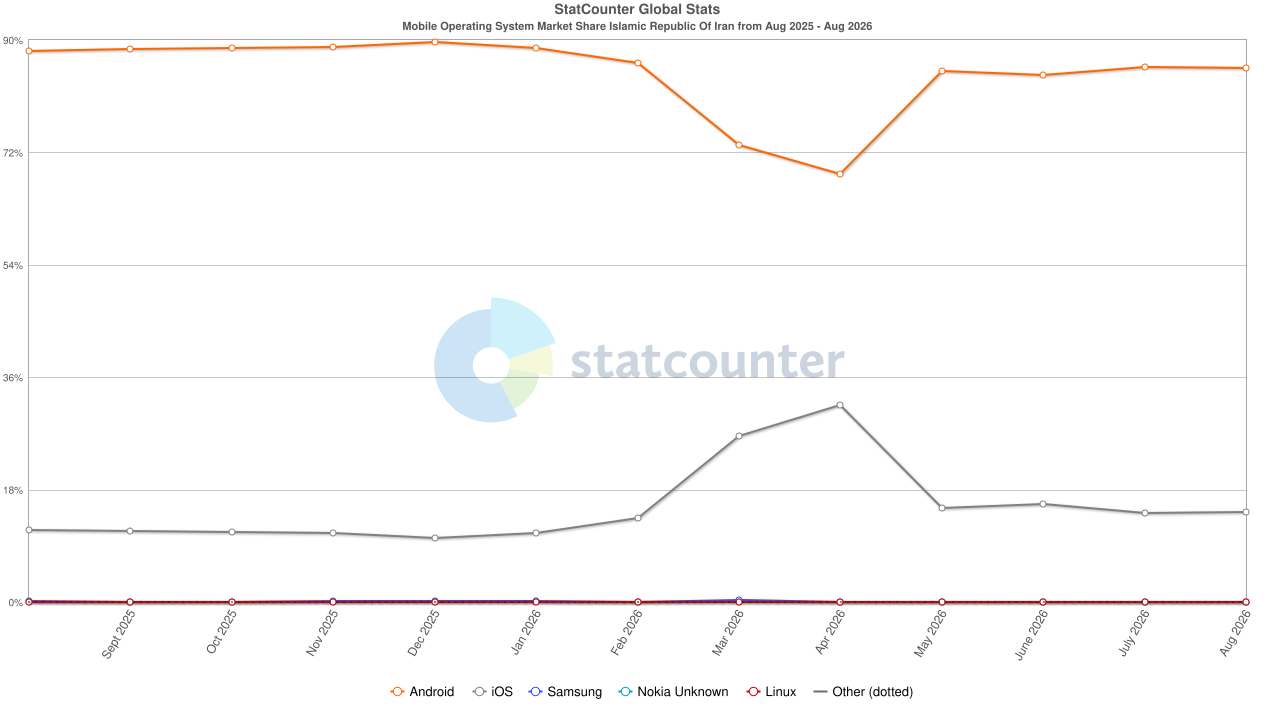
One of the strangest indicators of the shutdown’s class dimension appeared in data from Statcounter, an international web traffic monitor. In February 2026, iPhone’s share of mobile web traffic in Iran was around 13%. By April, it had jumped to nearly 30%. Android traffic fell correspondingly.
The reason wasn’t that millions of Iranians suddenly bought iPhones. Internet Pro reportedly let users access international sites without a VPN, using an international IP address. Android users, who are disproportionately from lower-income groups, relied on cheaper or free VPNs that routed their traffic through foreign IP addresses, such as Germany, Finland, and the Netherlands. Those foreign IPs didn’t count as Iranian traffic. So Android users effectively disappeared from international web statistics, while iPhone users—who were wealthier on average and more likely to afford Internet Pro—remained visible.
One Tehran-based tech worker described it this way. We spoke over a VPN connection that was interrupted three times during our conversation. “Poorer users were affected much more,” he said. “A lot of people basically disappeared from the online space. And they’ll be disadvantaged in many different ways.”
A Tehran daily newspaper picked up on the Statcounter data and ran an analysis titled “The First Blast of Tiered Internet.” It described a country where access to information was distributed according to wealth and political loyalty. One reader commented: “We don’t have iPhones, and we’re not from a wealthy background. A few friends and I started an online business and an online shop, but because of the internet shutdown, everything we had built and spent money on has fallen apart. We received a message about signing up for a 50GB “Pro internet” package, but we will never buy it. We just hope this situation ends soon, so everyone can get back to their lives and find some peace again.”
What Remains
For roughly three months in 2026, Iranians lived with severely limited or no international internet access. Businesses that closed never reopened. Students who lost access to international academic resources fell behind. Freelancers lost clients to competitors in other countries. At least 19% of Telegram-based businesses never reopened. Students who missed application deadlines would not get those years back.
The Iranian Psychiatric Association issued a warning in late May. They said prolonged internet restrictions were causing increased psychological pressure, feelings of injustice, and a breakdown of public trust. They did not use political language. And they did not need to.
Many Iranians say the experience has changed the way they think about internet access and the state’s control over it. Several no longer see connectivity as something reliable or equally available.
For many critics, the shutdown no longer resembled a temporary emergency measure, but part of a broader governance strategy, one that treated connectivity as a reward for loyalty, a commodity for the wealthy, and a tool of pressure against the rest. A member of Iran’s Supreme Council of Cyber Space recently admitted that it purchased and imported equipment for permanent internet filtration from China. He said it matter-of-factly, as if describing a routine infrastructure upgrade.
The situation has continued to evolve since June. International internet access has returned to much of the country, but connectivity remains limited and unstable in many places. In August, Iran’s First Vice President Mohammad Reza Aref said the government had decided to end internet filtering, while acknowledging that the process would take time and be carried out gradually. For many Iranians, the end of the blackout has not necessarily meant a return to the open and reliable internet they had before.
Several people I spoke with said that whatever access exists now does not feel like the internet they had before the shutdown. Even if the connection eventually stabilizes, the blackout’s effects will outlast it. For small business owners, students, and freelancers, the consequences will continue. The economic pressure has been immense, and resentment runs deep among the public. The damage to public trust is also visible in how people communicated during the shutdown: when the internet became unreliable, many turned to neighbors, family members, and other informal networks for news and information. The blackout did not simply cut people off from the internet. It made them less certain that the connection—and the information it carried—would be there when they needed it.

How Iran’s Internet Shutdown Deepened Inequality
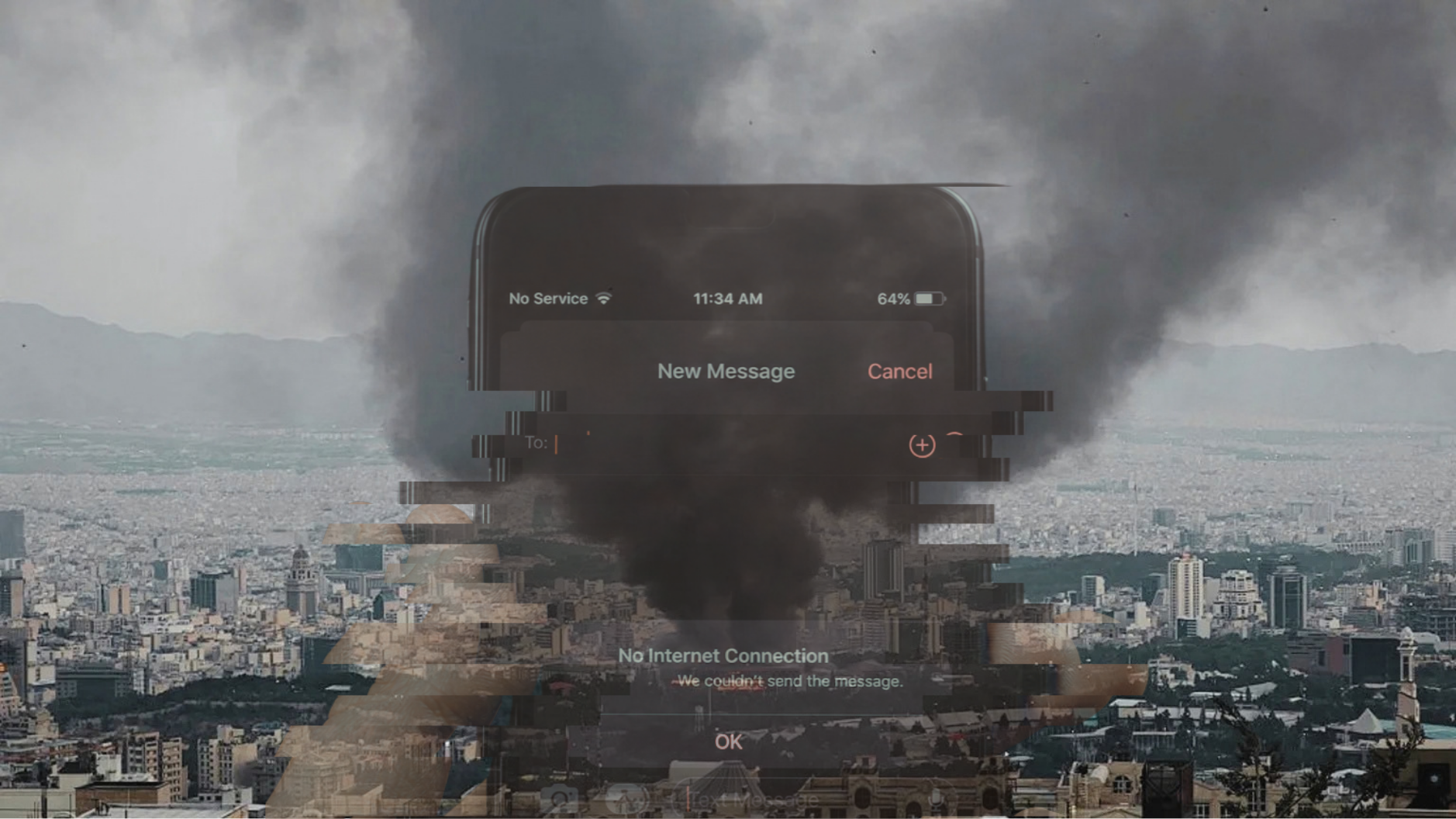
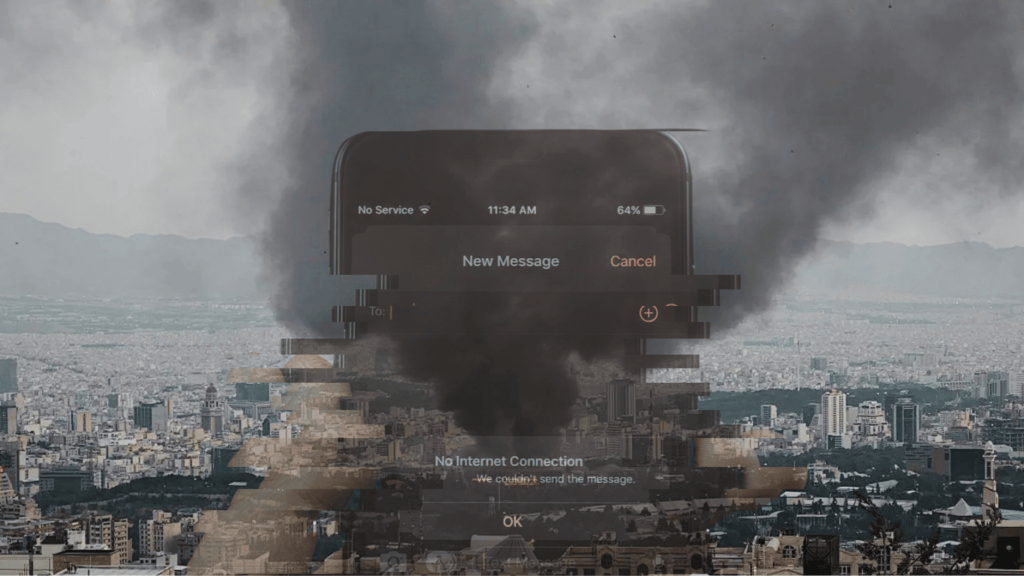
Iran Internet Shutdown. Credit : The Polis Project.
An Iranian mother wrote on X that her son fought back tears when she helped him get online. “You are the best mother in the world,” he told her. She replied: “No. I am the worst mother for bringing you into this world.” The post was viewed millions of times. Another user, a cancer patient, wrote in a comment on Zoomit, an Iranian technology website, that she had lost access to some vital medical information and was having difficulty finding some of her medication.
To the outside world, what was happening in Iran might look like an internet blackout. However, the internet didn’t disappear the same way for everyone. Some people stayed connected; most did not. The shutdown made clear what most Iranians already knew: internet access was a tiered, stratified system.
White SIM cards, unrestricted mobile connections reserved for senior Iranian officials or institutions, reportedly remained fully connected throughout the disruption. For most Iranians, access was cut off or became extremely unstable. A small elite group of leaders and state officials have access to White SIM cards. A smaller group relied on unreliable but expensive VPN, which cost up to five times the normal price. A black market for VPN access also grew, with unofficial and often unverified sellers offering increasingly expensive configurations. Users had no way of knowing who operated these services, where their connections were routed, or what happened to their data. In late April, the government introduced “Internet Pro,” aimed at those it deemed to need connectivity for their jobs, including online businesses, researchers, and others.
The country remained in this condition for nearly three months. NetBlocks estimated the economic loss at over USD 3.2 billion.
A Tiered System
Many Iranians I spoke to said that the tiered system of internet access deepened existing inequalities. But the shutdown’s effects went beyond unequal access and economic loss. Disconnection also served as collective punishment, disrupting millions of people’s daily lives and making communication and coordination much harder: for instance, news reached one part of a city through official channels at noon, while another received fragmented information hours later. It became harder to coordinate protests or even verify basic facts. Most coverage of Iranian internet restrictions focuses on censorship. But what happened in Iran was also about control over who could know what, and when.
The unequal access was intentional, not accidental. A YouTuber who was finally able to resume making videos by using someone else’s Internet Pro told me there were effectively four kinds of internet in Iran during the blackout. “White SIM cards belong to specific people,” he said. “Then there is Internet Pro. Then connection through VPNs. And finally, the domestic intranet.” He said that the quality was in that order.
White SIMs, according to multiple sources I spoke with, went to security personnel, Basij members (a branch of the Islamic Revolutionary Guard Corps (IRGC)), and state-affiliated users. I have not seen an official list. No one I spoke with had seen one. But everyone described the same pattern: the people who never seemed to lose connection were the ones with institutional backing.
This type of privileged access existed long before the recent shutdown. In November last year, an update on X that displayed users’ locations revealed something many Iranians had suspected for some time: government-aligned users had access to unfiltered internet while ordinary users did not. For many people, that was the moment they realized that not everyone was living through the same internet.
Internet Pro, which was officially marketed as “business internet,” cost roughly two million tomans (approximately USD $20 at the time) for 50 gigabytes of international data, valid for one year. But for someone whose livelihood depended on sustained internet use, 50 gigabytes could be consumed in weeks, or even less. Each additional 50 gigabytes cost roughly the same amount. The minimum monthly wage was about eight million tomans (approximately 80 USD), meaning that a single 50-gigabyte package cost roughly a quarter of a month’s minimum wage. For someone like Mehrnoosh, a freelance graphic designer who depended on the internet for work, the cost could quickly become a recurring expense that competed with basic needs such as rent.
Tehran-based Mehrnoosh (name changed for safety reasons) told me she had to choose between buying Internet Pro and paying her rent. “I chose rent,” she said. “But without the internet, I had no work. So I had rent but no income to cover the next month. I borrowed from my sister for eight weeks.”
Mehrnoosh used to make about 25 million tomans a month designing logos and social media graphics for small businesses. Most of her clients found her through Instagram. Most of those clients disappeared once access became unreliable. She tried to find local clients through word of mouth, but without being able to show her portfolio online, she said it felt like asking people to hire her blind. “I spent seven years building my business,” she said. “Seven years of late nights, of learning new software and handling difficult clients. And then it was just gone. My work did not matter to those who cut the connection.”
Offline Communication
When official networks became unavailable, communication shifted. People passed handwritten notes. They met at public places such as bakeries, parks, and the corner store. They stood in lines that used to be for bread and were now also for news. People depended more on face-to-face conversations and informal networks to exchange information.
“I remember the first week of the shutdown,” said Reza, a small business owner in Isfahan who sold handmade crafts through Instagram. He asked me to use only his first name. “I would walk to my neighbor’s house to ask if there was any news. Then my neighbor would walk to someone else. We became a human network. This was necessary if you didn’t want to feel isolated. But many people still went through long periods with no news at all.”
His shop had been open for four years. He had built a following of 40,000 customers on Instagram. He used to sell hand-embroidered textiles and ceramic bowls. Things that took hours to create. “That is gone now,” he said. “Even if the internet comes back, those people have moved on. They found other sellers. I’m not sure I can rebuild. One crisis after another. The sanctions. Then the pandemic. Then the protests. Then the war. Then this blackout.”
Data from the social listening platform LifeWeb show that 19% of Telegram-based businesses never reopened after the most recent prolonged shutdown. The impact on Instagram businesses may have been even greater. Instagram is estimated to host around one million small businesses in Iran, more than 60% of them run by women. For many Iranian women, these businesses were more than a source of income: they offered a way to earn independently from home, without an employer, through a platform they could access with relatively little capital. When the internet was cut off, their economic independence was at risk. Some women were not simply losing customers or sales; they were losing one of the few forms of work that allowed them to earn independently while working from home. Some officials and industry representatives have suggested that as many as 40% of these businesses—roughly 400,000 shops and accounts—have effectively disappeared. These businesses did not just lose weeks or months of sales. Many lost the customer networks they had spent years building.
A woman in Karaj, a city just outside Tehran, told me she used to sell homemade pickles and jams through an Instagram page with over 10,000 followers. She started the business during the pandemic, when her husband lost his job. It was supposed to be temporary, but it became their primary income. “I did not make a single sale in 60 days,” she said. “The jars are still in my kitchen. My husband is looking for work again, but there is no work. Everyone is in the same situation.”
How the Shutdown Affected Activism
I spoke with several people about how the shutdown affected protest organizing. Still, the risks of discussing coordination during an active communications blackout made many reluctant to describe specific incidents or meeting places. They could describe the loss of the basic infrastructure that made collective action possible: the ability to tell others where to go, when to go, and whether it was safe to go at all.
One activist in Tehran put it this way: “People are angry about the conditions, but protesting in the blackout was like going to the street not knowing if anyone else would come.”
That uncertainty was not abstract. Organizing depended on knowing who had received the same information, who was still connected, and whether a meeting point was safe. During the shutdown, activists could arrive at a familiar place and find no one there, with no reliable way to know whether others had stayed home, couldn’t connect, or were waiting somewhere else.
The communication disruptions made organizing much harder. During the 12-day war with the US and Israel, internet access was cut for weeks. The official justification was national security: to protect the country and to prevent the enemy from coordinating. But cybersecurity experts have argued that cutting off public internet access does little to stop sophisticated cyberattacks. The Electronic Commerce Association noted that several major cyberattacks, including attacks on Iranian banks, occurred while the internet was completely shut down.
Different groups criticized the shutdown, but officials publicly denied responsibility. Minister of Communications Sattar Hashemi said the shutdown and stratification were not his ministry’s plan. Yet the shutdown continued for so long. That raises a more fundamental question: who actually decided to impose and maintain them? In Iran, decisions over internet access can involve bodies beyond the Communications Ministry, including the Supreme Council of Cyberspace and the Supreme National Security Council. Yet no official body publicly claimed responsibility for the prolonged shutdown or offered any explanation. A petition demanding restoration gathered nearly 300,000 signatures. It received no official response.
Some professional associations rejected the idea of tiered internet access altogether. In a statement, Iran’s Electronic Commerce Association asked: “How can an obvious right be taken away from one citizen and granted to another—under any justification or classification? Which Iranian citizen does not have dozens of essential needs that depend on the internet? By what logic can these essential needs be ignored, and the basic rights of a homemaker, a retiree, a teenager, a shopkeeper, an office worker, a laborer, and every other Iranian be denied? At the same time, internet access is reserved only for a select few?”
Even some organizations that were eligible for Internet Pro refused to accept the privilege. In an official statement, Iran’s Nursing Organization announced that at a time when the general public had been cut off from international internet access, it would not request or accept special access for its own members. Instead, it said, “it preferred to use the internet alongside the rest of society once the restrictions were lifted.” Its refusal was part of a broader pattern: people and organizations repeatedly rejected the idea that access to the global internet should become a privilege available to some while denied to others.
What Web Traffic Data Showed
One of the strangest indicators of the shutdown’s class dimension appeared in data from Statcounter, an international web traffic monitor. In February 2026, iPhone’s share of mobile web traffic in Iran was around 13%. By April, it had jumped to nearly 30%. Android traffic fell correspondingly.
The reason wasn’t that millions of Iranians suddenly bought iPhones. Internet Pro reportedly let users access international sites without a VPN, using an international IP address. Android users, who are disproportionately from lower-income groups, relied on cheaper or free VPNs that routed their traffic through foreign IP addresses, such as Germany, Finland, and the Netherlands. Those foreign IPs didn’t count as Iranian traffic. So Android users effectively disappeared from international web statistics, while iPhone users—who were wealthier on average and more likely to afford Internet Pro—remained visible.
One Tehran-based tech worker described it this way. We spoke over a VPN connection that was interrupted three times during our conversation. “Poorer users were affected much more,” he said. “A lot of people basically disappeared from the online space. And they’ll be disadvantaged in many different ways.”
A Tehran daily newspaper picked up on the Statcounter data and ran an analysis titled “The First Blast of Tiered Internet.” It described a country where access to information was distributed according to wealth and political loyalty. One reader commented: “We don’t have iPhones, and we’re not from a wealthy background. A few friends and I started an online business and an online shop, but because of the internet shutdown, everything we had built and spent money on has fallen apart. We received a message about signing up for a 50GB “Pro internet” package, but we will never buy it. We just hope this situation ends soon, so everyone can get back to their lives and find some peace again.”
What Remains
For roughly three months in 2026, Iranians lived with severely limited or no international internet access. Businesses that closed never reopened. Students who lost access to international academic resources fell behind. Freelancers lost clients to competitors in other countries. At least 19% of Telegram-based businesses never reopened. Students who missed application deadlines would not get those years back.
The Iranian Psychiatric Association issued a warning in late May. They said prolonged internet restrictions were causing increased psychological pressure, feelings of injustice, and a breakdown of public trust. They did not use political language. And they did not need to.
Many Iranians say the experience has changed the way they think about internet access and the state’s control over it. Several no longer see connectivity as something reliable or equally available.
For many critics, the shutdown no longer resembled a temporary emergency measure, but part of a broader governance strategy, one that treated connectivity as a reward for loyalty, a commodity for the wealthy, and a tool of pressure against the rest. A member of Iran’s Supreme Council of Cyber Space recently admitted that it purchased and imported equipment for permanent internet filtration from China. He said it matter-of-factly, as if describing a routine infrastructure upgrade.
The situation has continued to evolve since June. International internet access has returned to much of the country, but connectivity remains limited and unstable in many places. In August, Iran’s First Vice President Mohammad Reza Aref said the government had decided to end internet filtering, while acknowledging that the process would take time and be carried out gradually. For many Iranians, the end of the blackout has not necessarily meant a return to the open and reliable internet they had before.
Several people I spoke with said that whatever access exists now does not feel like the internet they had before the shutdown. Even if the connection eventually stabilizes, the blackout’s effects will outlast it. For small business owners, students, and freelancers, the consequences will continue. The economic pressure has been immense, and resentment runs deep among the public. The damage to public trust is also visible in how people communicated during the shutdown: when the internet became unreliable, many turned to neighbors, family members, and other informal networks for news and information. The blackout did not simply cut people off from the internet. It made them less certain that the connection—and the information it carried—would be there when they needed it.