




New Delhi received me with the peculiar stillness that precedes movement. I landed on July 23; by evening, I was standing on Janpath Road. Nothing had happened yet—not, at least, anything newspapers would later recognize as an event. And yet the air had acquired the dense, expectant quality through which the future sometimes seems to lean backward into the present.
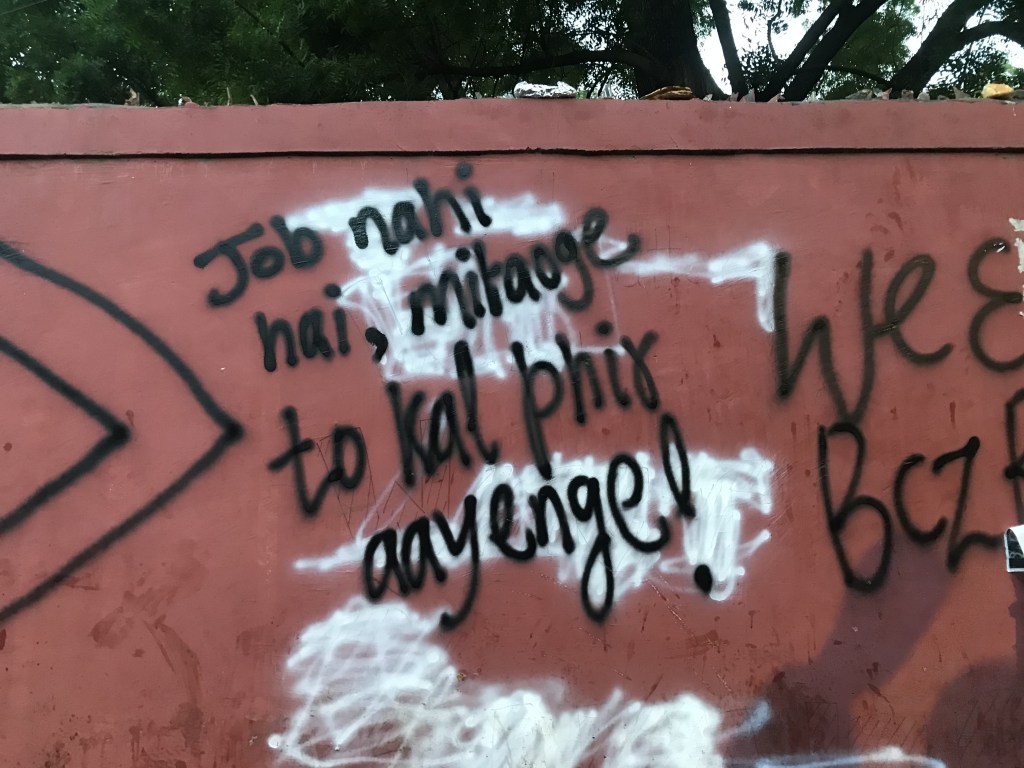
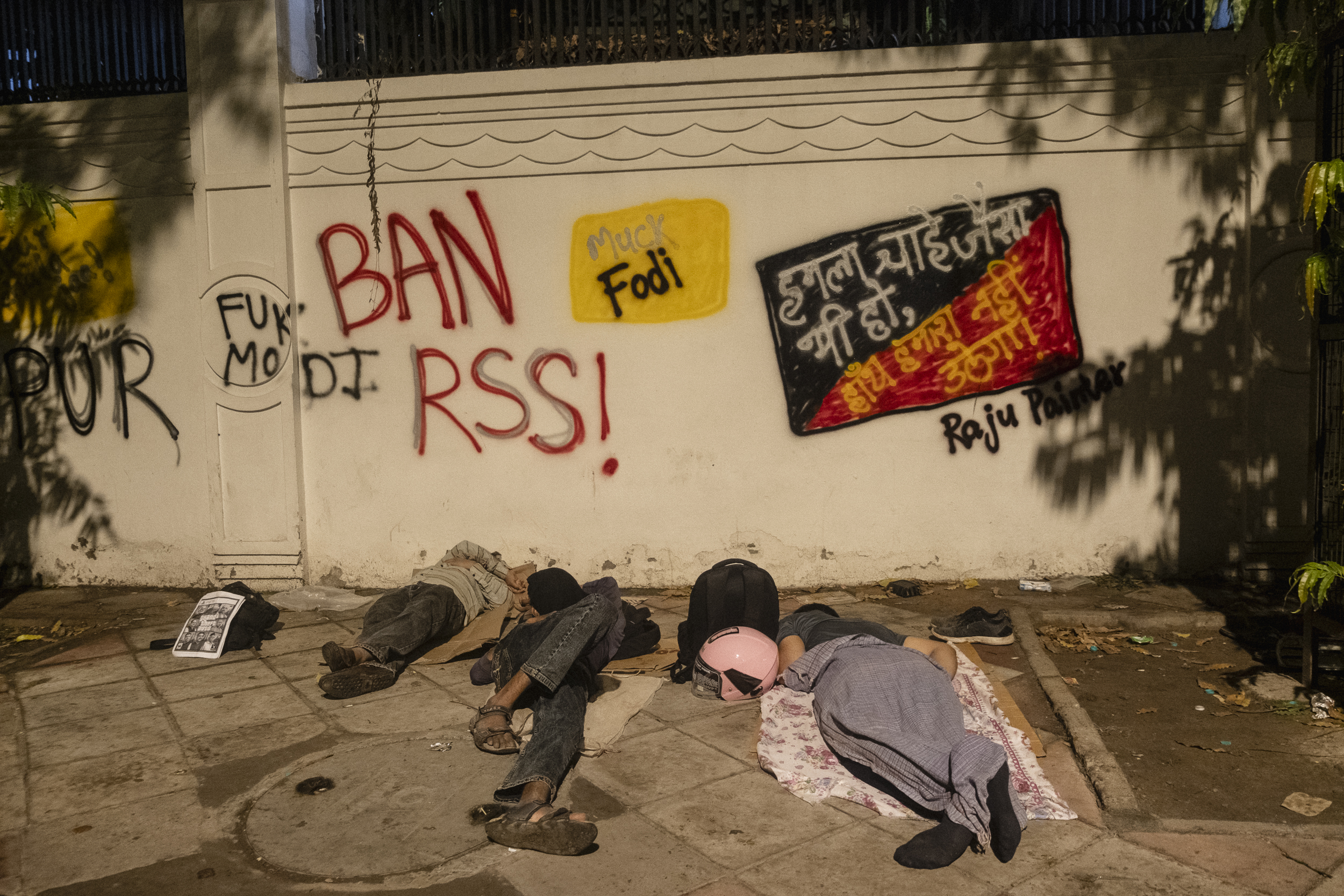
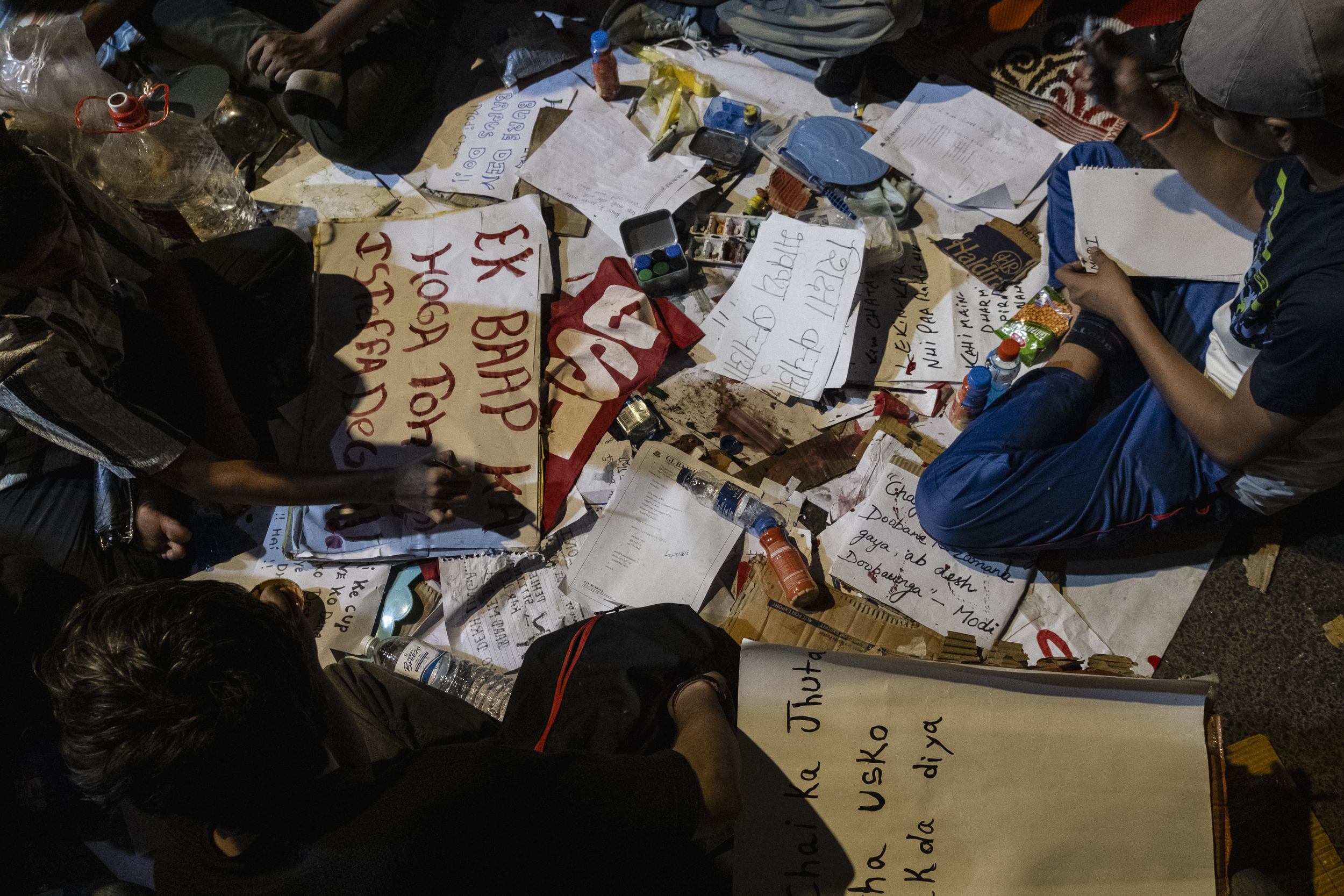
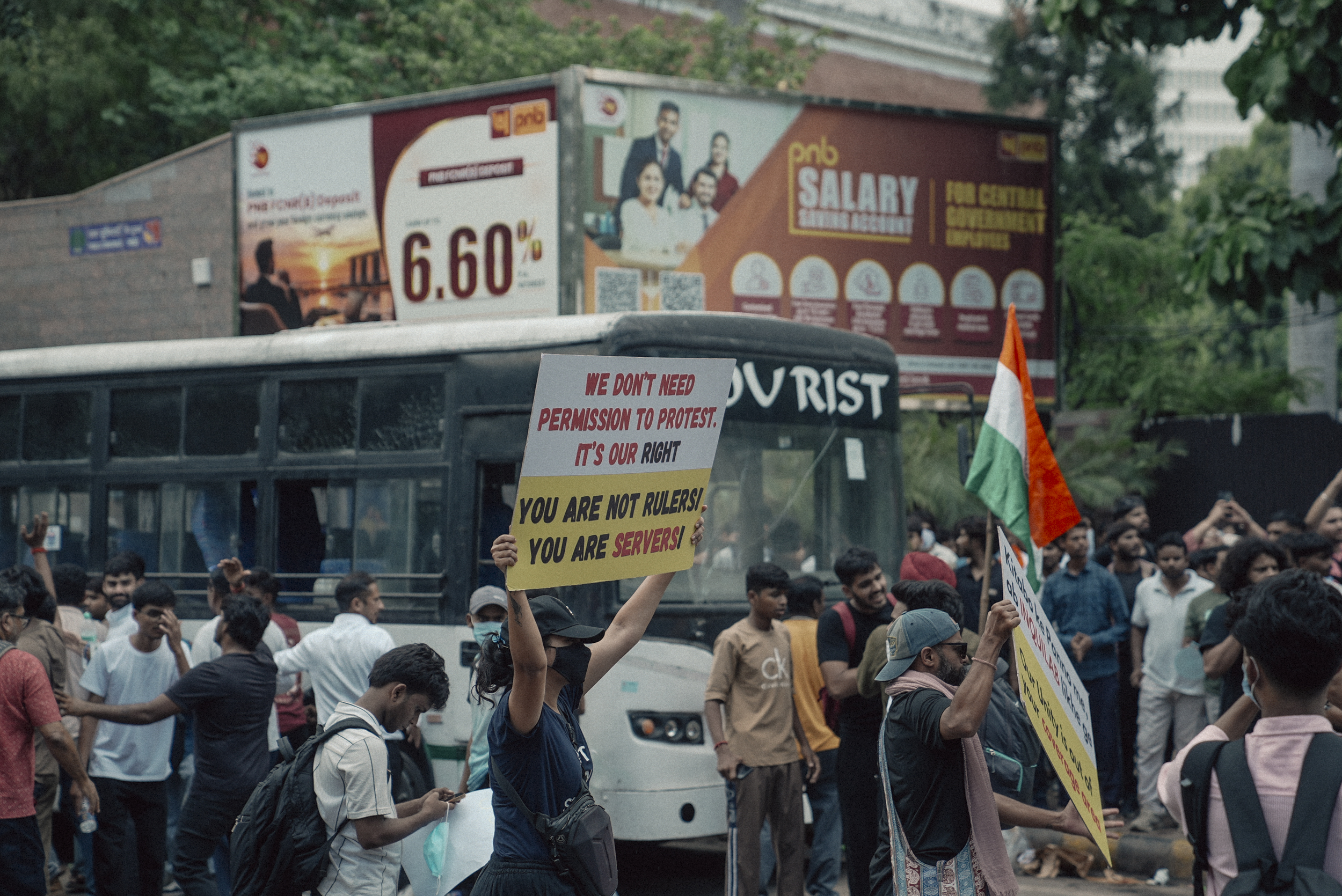
The roads leading up to Janpath were full of people. Students moved in groups, shouting slogans, laughing, jeering, and stopping in the middle of the road to hold up sheets of paper with their thoughts written on them. Others filmed the protest and slogans on their phones. The white walls of The Imperial Hotel and the red walls around the area were covered with graffiti: Ban RSS; Inquilab Zindabad (Long Live the Revolution); Darpok PM (Coward Prime Minister); and Job nahi hai, mitaoge to kal phir aayenge (There are no jobs; erase the graffiti and we will return tomorrow).
The protest had an irreverence that was difficult to miss. Its memes mocked authority; its slogans were deliberately unserious, sometimes abrasive. It was part of what made the protest recognizably Gen Z: authority was not only challenged but made into a joke.
Yet alongside this irreverence was a persistent caveat about what counted as legitimate and illegitimate protest. The Cockroach Janta Party repeatedly described itself as peaceful, distancing itself from what it called “anti-social elements” and rabble-rousers.
The peculiar contradiction was not simply that a protest known for its irreverence towards authority was simultaneously anxious to appear respectable. Instead, it was beginning to produce its own legitimacy by making an ‘other’ to itself. To call a protest “peaceful”, it had to establish what does not belong to it. A protest confronting the state had to make itself legible as a political interlocutor, and the ability to say “those people are not us” had to become a source of authority. This was not necessarily hypocrisy, but a condition of political efficacy. The same logic operated in the media where the peaceful student protester is an intelligible political subject, while the “anti-social element” becomes an interruption to that image. The category of the “anti-social element” thus helped answer a more fundamental question: who counts as the protester? That boundary was continually redrawn through slogans, barricades, negotiations, and the regulation of bodies.
That evening, pāpad sellers and ice-cream vendors moved through the crowd. Sikh volunteers handed out water. Langar was being served. The gathering already resembled a small city, with its vendors, kitchens, photographers and watchmen.
What struck me first was that the anger was not directed only at Education Minister Dharmendra Pradhan. It was directed at Prime Minister Narendra Modi, certainly, but also at the system that had come to bear his name. The students were angry about National Eligibility Cum Entrance Test (NEET) examinations and paper leaks, but the examination was only the surface on which a much older anxiety had gathered.
Through slogans, music, profanity, graffiti, and apparent nonchalance, they spoke about the bargain they had been offered—that education would lead to work, and work to a life—which they could no longer trust.
Another slogan read: Make India Free Again. Elsewhere: Our foreparents fought the British. While the struggle was no longer against a foreign ruler, the disillusionment was against a domestic order experienced as domination and oppression. Against the backdrop of unemployment and deepening social inequalities, the British had become a grammar through which the present could be described.
I would return to this disjunction repeatedly over the next two days—the distance between the histories invoked by a slogan and the politics demanded through it.
Protest Takes Shape

By 7:00 in the evening, as I walked away from Janpath Road along the subway towards Connaught Place, the city had begun to close itself.
Shops were coming down. When I asked some of the owners why, they told me that the New Delhi Traders Association had issued an urgent advisory directing shops and restaurants in Connaught Place to close by 6:30 p.m. The decision, they said, followed the advice of the New Delhi Municipal Council (NDMC) Chairman and Vice Chairman in view of what had been described as a “critical situation”.
The phrase stayed with me. A city does not become critical all at once. It becomes critical through small alterations. Shutters lowered earlier than usual, a police vehicle parked where there had been none, a road that remains technically public but becomes practically inaccessible.
By around 7:30 p.m., I saw the Rapid Action Force (RAF) standing along the footpath of Connaught Circle, with Delhi Police vehicles on the other side. At Kabootar Chowk, the road divides: to the right, Palika Bazaar; to the left, Sansad Marg. The latter was under Section 144 of the Code of Criminal Procedure (CrPC). Technically, it remained a public road. And then there was the strange calm inside this space, barricaded from the public and transport.
As one entered Sansad Marg, the atmosphere seemed festive. Students shouted slogans. Cotton candy was being sold and eaten. Groups sat on the footpaths and bus stops near Palika Kendra, talking among themselves, unhurriedly occupying the space.
I walked towards the chowk near Jantar Mantar. The lane abutting it was Tolstoy Marg, which led to the protest’s center stage; opposite was Jai Singh Road. From the junction, the NDCC II building rose into view, housing the Ministry of Home Affairs. Further along was Bangla Sahib Road opening to the gurudwara by the same name, and opposite it the Delhi Police Headquarters.
By 8:00 p.m., the chowk had been fully barricaded. Jai Singh Marg and the portion of Sansad Marg beyond it were closed. The crackdown had not begun, but its outline had already settled over the street.
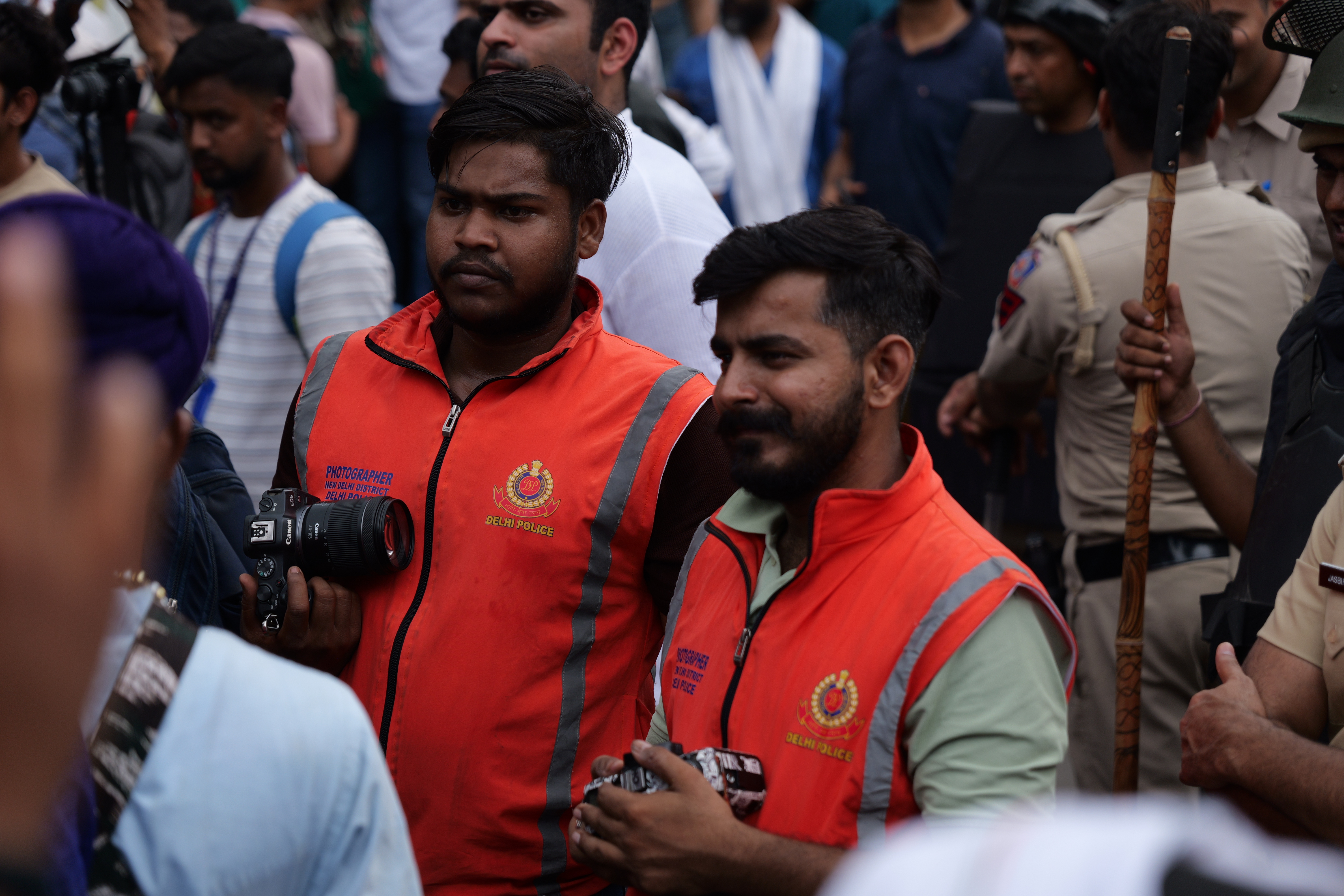
A phalanx of security officers and paramilitary forces stood where they had been instructed. The Central Reserve Police Force (CRPF), Central Industrial Security Force (CISF), the RAF, and the Delhi Police occupied Sansad Marg and Jai Singh Road. The distances between the uniforms seemed carefully measured, as though the city had rehearsed this arrangement many times before.
The RAF carried multi-shot tear-gas launchers and fiber lathis. Drones hovered above the chowk, their red and green lights moving across the dark sky like small, mechanical stars, recording the crowd below. A constable answered his phone. Another lifted his hand almost lazily and called out, Aa ja (Come on). Somewhere a barricade scraped against the road. None of these gestures meant much on their own. But together, they gave away a sensation that violence had already arrived. The people did not name it, but were waiting for it.
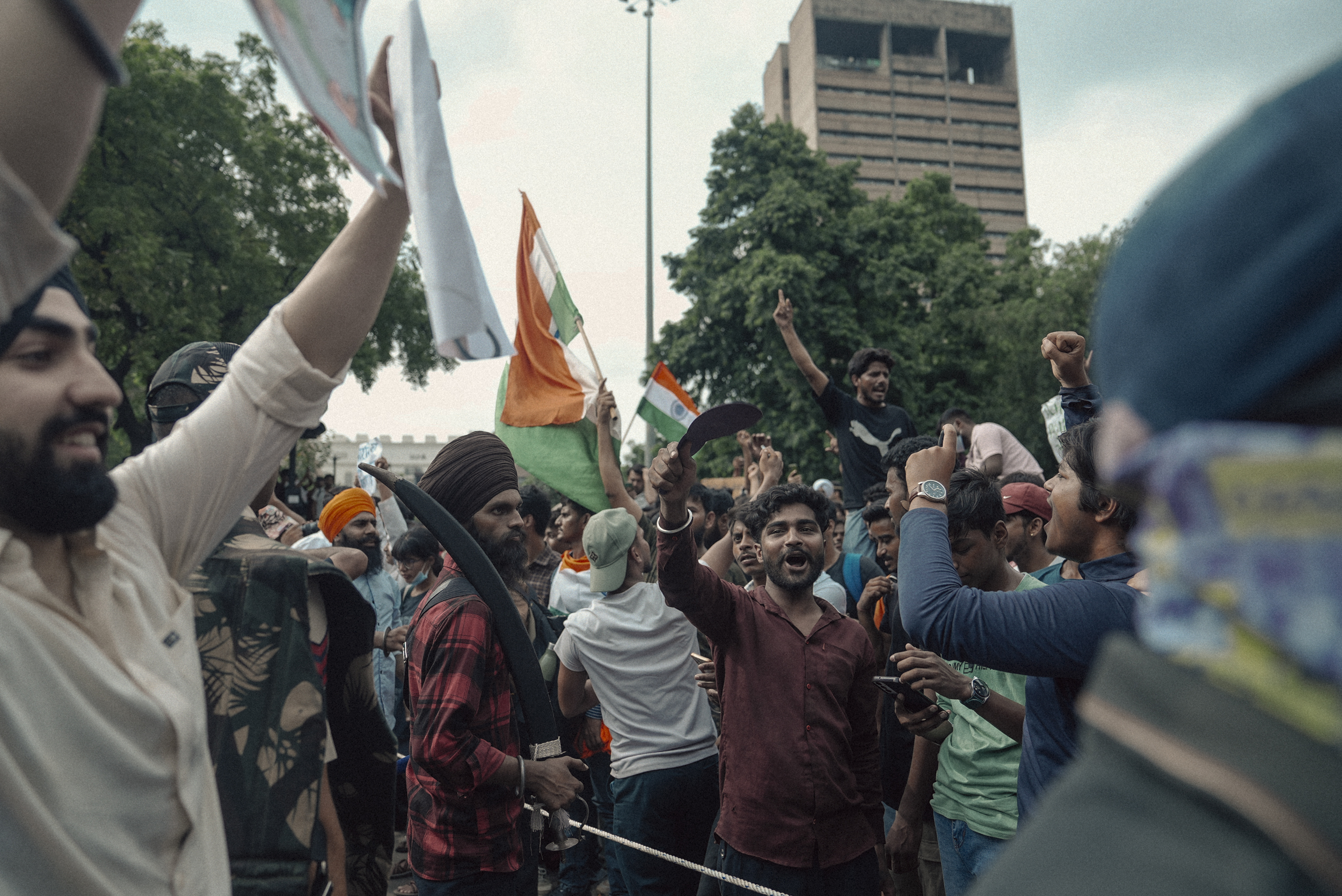
Then, around 9:30 p.m, the shape of the crowd altered. The Nihangs entered. No announcement, no theatrical moment. The space simply reorganized itself around them. Where moments earlier students were facing the police directly, another line of defense now existed between them. It was neither mediation nor protection in any sentimental sense. It was something stranger, such as a change in geometry. Power seemed no longer to travel in a straight line.
The students seemed to understand this slowly and instinctively. The police and other state forces appeared to understand it too. I could not establish why the police did not touch the Sikh volunteers. For the moment, what mattered was the visible effect. Their presence had altered the possibilities of the street.
Students formed human chains to cordon. Elderly Sikh men and women, and middle-aged couples stood watch. Younger volunteers carried water and food. Women arrived with packets of sweets and meals. There were no speeches; they simply did it. By 11:30 p.m., students were playing a volleyball match beside the barricade.
This was perhaps the strangest thing of all. A place prepared for confrontation had, for a few hours, become a place for a game.
When I spoke to the students, they reiterated matters beyond the resignation, which everyone outside the protest seemed to believe they wanted. They spoke about a dark future that awaited them. One grievance folded into another until they became impossible to separate. Education was unemployment. Unemployment was debt. Debt was abandonment. Every sentence seemed to echo the upheavals of the 1930s and the crises that followed, when mass unemployment, insecurity, and the loss of dignity and political belonging found collective unrest.
It occurred to me that perhaps the protest was not what had gathered these lives together. Perhaps they had long been dispersed by the same force, each carrying the same anxiety, until one evening they found themselves standing at the same crossroads, facing one another with an old demand.
The night settled softly. After midnight, food arrived from Bangla Sahib Gurudwara in endless cycles. Before dawn, people moved silently across the road carrying brooms. By the morning of the 24th, they had gathered the dust into careful piles. Plastic bottles disappeared. Thick ropes appeared where there had been none, quietly dividing the road into a new territory. Some of the older protesters continued as before, only to find themselves redirected around spaces that had taken on a different significance. No one announced an order, yet order emerged. The municipal corporation had temporarily stopped being the sole author of the place.
One person arrived and began sweeping; five more broomsticks appeared. Serve another meal. Guard the entrance. Carry water bottles. Arrange medicines in a makeshift tent. Tie another knot. Repeat. Repeat again. Politics moved through maintenance. Even walking acquired instructions. Then I began to wonder whether the true center of the protest had ever been Jantar Mantar at all.
Jantar Mantar had long been made legible to the state. It was a permitted space where dissent could occur without necessarily disturbing the surrounding city’s architecture. Students played cricket in front of the Wall of Shame on Jantar Mantar Road, a makeshift exhibition of photographs and stills from videos of the police crackdown on July 20.
But Sansad Marg felt different precisely because it had been prohibited. It had been pushed outside the permitted geography of dissent, suspended beneath Section 144 like a sentence yet to be completed. The prohibition was not merely municipal. It also began to determine what kind of protest could be recognized as legitimate. The protest itself was beginning to develop its own distinctions between what could and could not be said.
The CJP leadership had announced that only four kinds of slogans were permitted: Bharat Mata ki Jai (Victory to Mother India), Inquilab Zindabad (Long Live the Revolution), Jai Bhim (Long Live Ambedkar), and Dharmendra Pradhan Istifa Do (Dharmendra Pradhan, resign).
Others, slogans that crossed into insult, profanity, and accusation, were forbidden. And yet those were precisely the slogans that could be heard outside the permitted space, which produced a peculiar dissonance. The city seemed to be speaking several political languages at once.
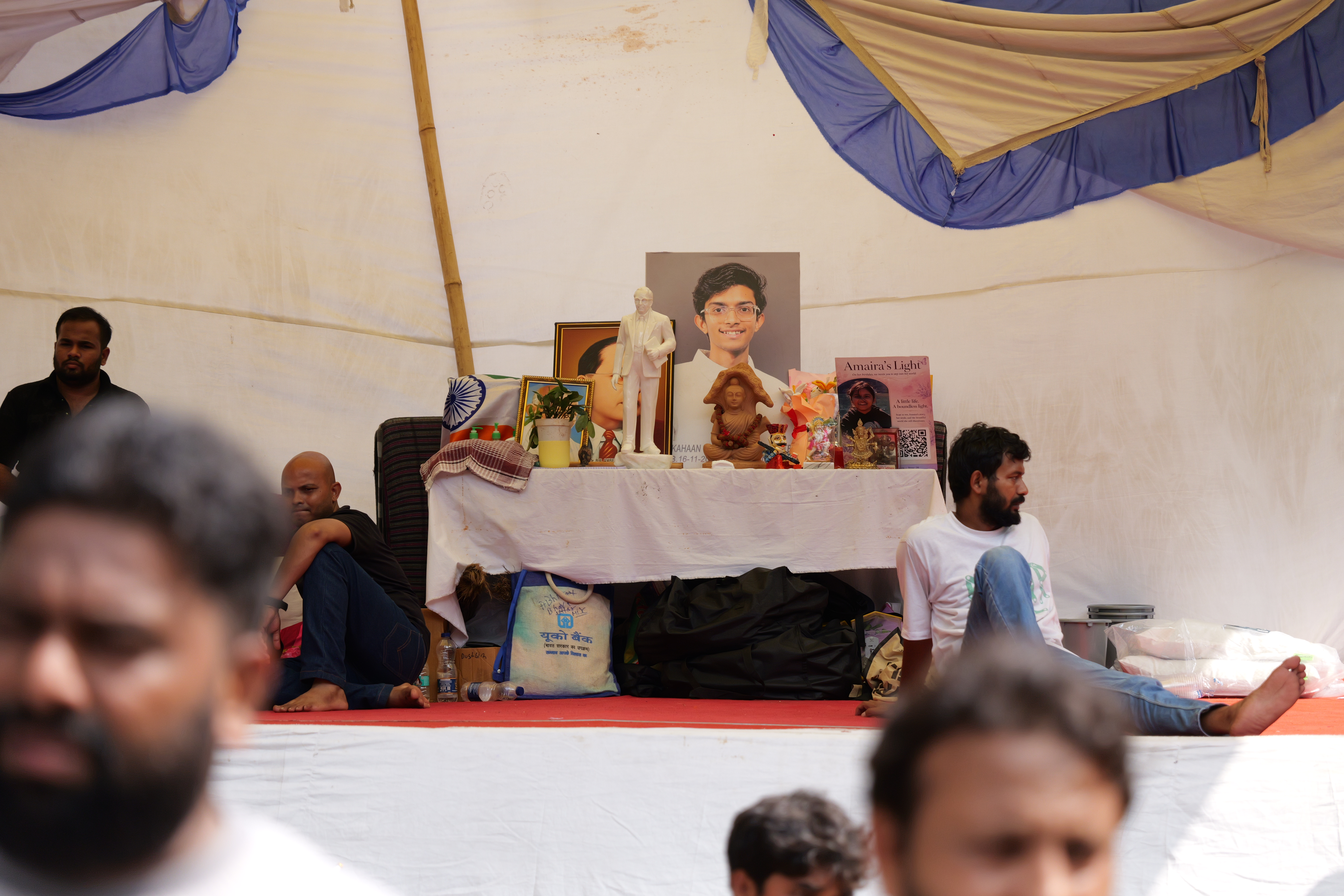
A decade earlier, I had watched Pinjra Tod shout “Bharat ki Mata nahi banenge (We refuse to become Mother India),” a feminist rejection of an ideal that reduces women to symbols of motherhood, sacrifice, and national honor. Now I heard Bharat Mata ki Jai, Vande Mataram (I bow to thee, Mother [India]) and Inquilab Zindabad spoken within the same political moment. Gandhi, Ambedkar, Buddha and the Ramcharitmanas appeared together on the same table. Their histories had not converged; their symbols had simply become available in the same political scene, even as conflicts between those histories remained unresolved.
Even Jai Bhim, a gesture of reverence towards Ambedkar, sat uneasily beside a protest whose demands rarely turned to the structural questions Ambedkar’s politics would have forced into view. What happened to public spending on education, midday meals, Integrated Child Development Scheme (ICDS) and Anganwadis? What did privatization mean for students already borrowing money to study? What did the centralization of examinations through the NTA mean for a system whose failures were being experienced as individual catastrophes? How does the present system institutionally murder Dalit students? What happened to students who had to work while studying? How does caste work in educational institutions? The slogans legitimatized by the CJP had material, but the structural questions of the National Education Policy (NEP), conditions of primary schools, privatization of education and unemployment were largely absent from both CJP’s political articulation and discursively at the protest site.
This felt different from the farm movement (2020-2021) at Tikri Border located on the Delhi-Haryana border in North West Delhi. Despite its own internal contradictions, the relationship between the principal policy demand and the movement’s public discourse remained comparatively legible: repeal the three farm laws. Here, the relationship between grievance, demand and political outcome seemed far less stable.
When I spoke to students, including women, many repeated what the center was saying: resignation. The question that troubled me was not whether the students were angry. They were. It was whether the political demand now being articulated still contained the full range of what had produced that anger. The crisis of education was broader than one minister; it included unemployment, debts, and shrinking public institutions. Yet as the protest gained a clearer political center, this diffuse anger increasingly condensed into a demand that one person resign. That made the grievance easier to name, negotiate and report—but also potentially easier to contain. The question, then, was not simply who was speaking for the students, but what happened to their anger as it was translated into a demand the political system could recognize.
To understand that, I had to look at what had happened before I arrived at the site, and at how the protest had decided beforehand on who could speak for it.
Protest as political architecture
Abhijeet Dipke, founder of the Cockroach Janta Party, landed in New Delhi from the United States on June 6, 2026. At the airport exit, he was photographed carrying a book titled My Autobiography by B.R. Ambedkar. Prabhat Prakashan published the edition, a house that extensively publishes works on the history and leadership of the Rashtriya Swayamsevak Sangh (RSS) and other Sangh literature.
The photograph did not establish what Dipke believed, or why he was carrying that particular book. But it raised a question about the political work an image can do before anyone explains it.
Ambedkar’s Waiting for a Visa is among his best-known autobiographical writings, which made the title of the edition Dipke was carrying, “My Autobiography”, worth examining more closely. What exactly was this edition? Why this title? Why this publisher? And why had this particular object entered the visual field of a protest in which Jai Bhim had become one of the authorized slogans?
What happens when a figure, whose political legacy is inseparable from questions of caste, representation, and public institutions, becomes a symbol within a political spectacle whose other symbols point elsewhere? I could not answer those questions simply by looking at the photograph. But I could not unsee the question once I had noticed it.
The same question arose with Sonam Wangchuk. The protest’s momentum increased sharply after his arrival and the beginning of his hunger strike. In a video published on July 13, 2026, Wangchuk told journalist Saurabh Dwivedi that he met the CJP after an intervention by the Lieutenant Governor of Ladakh.
If Wangchuk’s account is accurate, the immediate question is what that intervention involved: did the Lieutenant Governor or the administration facilitate Wangchuk’s introduction to the CJP, and if so, why? I contacted Gitanjali Angmo to clarify what the intervention involved and whether the administration had facilitated the meeting, but I haven’t received any response yet.
The account does not establish coordination. It does, however, complicate the assumption that the protest’s visible political relationships emerged entirely from below.
After Wangchuk was taken away by Delhi Police personnel in plain clothes on July 18, Dipke began a hunger strike. Gitanjali later asked Dipke to break his 48-hour fast, which he had initially announced as indefinite. Why was the appeal directed at Dipke in particular, when other students had already been fasting alongside Wangchuk? That stood out to me because three All India Student Association (AISA) students, including its President Neha Bora, had already been on a hunger strike for 23 days.
I contacted Manish Kumar, one of the three AISA students on hunger strike, to learn more. He told me: “Once the protest had been initiated by CJP and AISA, Sonam joined and said that if there was no resignation within a week, he would go on hunger strike. From that point, the protest’s political character diluted, and there was an effort to make it ‘non-political’.
“On June 20, neither Dipke nor Gitanjali asked AISA to end the hunger strike. There was no dialogue or coordination.” Throughout the protest, Sonam came only once to ask about their whereabouts, but there was no sustained coordination between the CJP, Wangchuk and AISA, added Kumar.
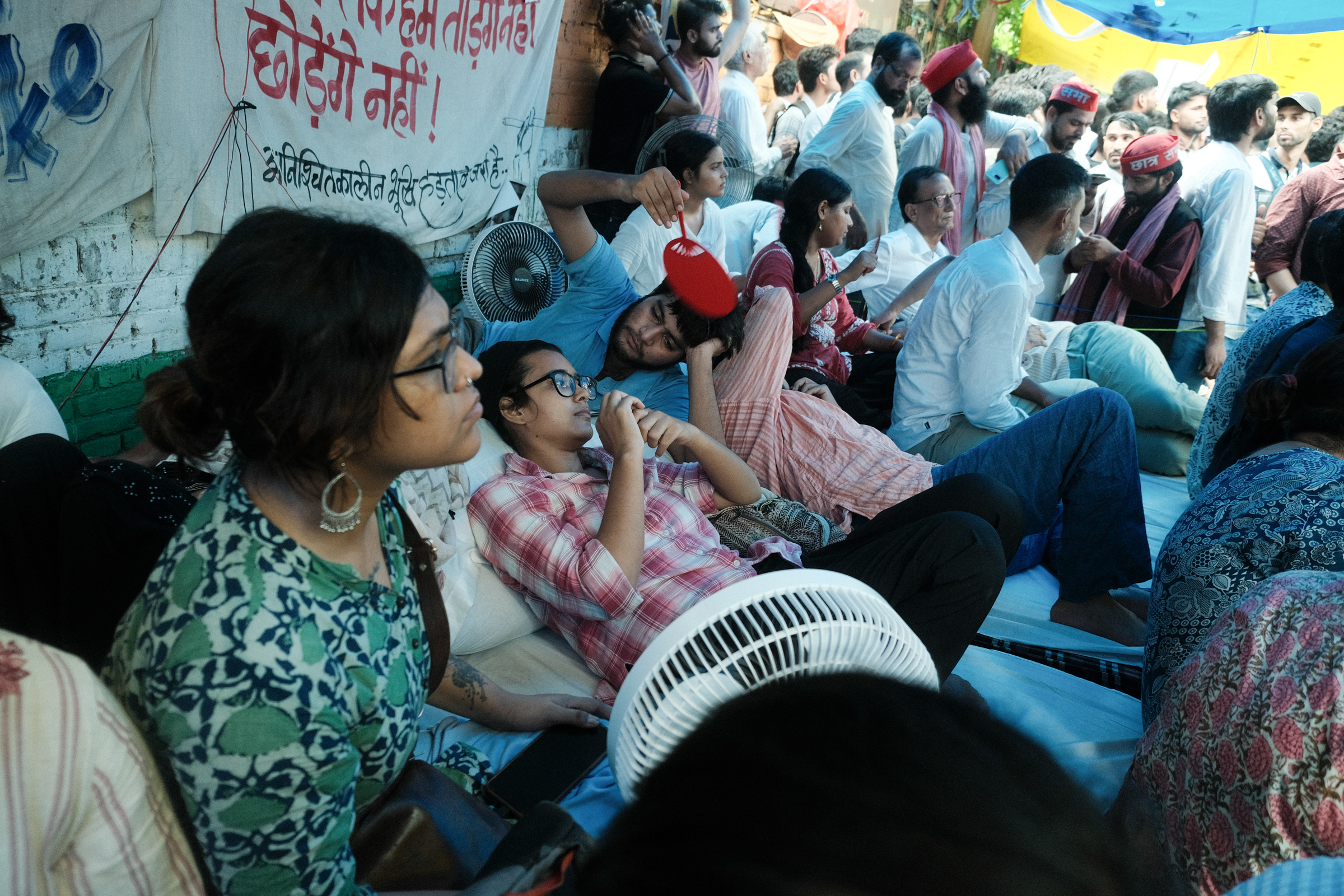
“The arrangements also reflected this disparity. There was a fan for Sonam on stage, while electricity was barely available to us. On the second or third day, CJP tried to pressure us to break the strike, saying our health was weak and that we did not have Sonam’s experience. Why try to break our momentum instead of finding ways to sustain the protest?
“There was no consultation with us before the Parliament march on the 20th either. If the CJP had coordinated with AISA, the Students’ Federation of India (SFI), the All India Students’ Federation (AISF), the Krantikari Yuva Sangathan (KYS) and other student organizations, we could have reduced the casualties during the police crackdown.”
Kumar also said that the Uttar Pradesh Police had recently sent 25 officers to his home and the house of his family members around midnight. He alleged that the police were intimidating auditorium owners in Ghazipur, where a meeting on education was scheduled for August 20 and was eventually canceled. He further alleged that the authorities had collected Aadhaar and bank details of comrades associated with student organizations.
While none of this establishes that the state designed the protest, or that the subsequent events were scripted in advance, the sequence of events made the simpler binary I had arrived at—the state on one side, protesters on the other—harder to sustain.
If a senior state functionary had indeed helped bring a prominent public figure into contact with the organization that would become central to the protest, then some of the connections through which the students’ grievances were later articulated may have existed before much of the public saw them in their most visible form. The question was not simply whether the protest was spontaneous. It was how much of the machinery for giving that spontaneous anger a political voice—who would represent it, which demands would be foregrounded, and which channels would carry those demands to the state—had already been in place before the people on the street understood where the protest was heading.
This distinction mattered to me as the students’ anger did not need to be manufactured. The debts, coaching fees, unemployment, examination failures, and postponements were real. Their despair did not require an organizer to invent it.
A genuine grievance can enter a political arrangement larger than itself. People can act sincerely within a structure whose entire architecture they cannot see. The question was less about whether the anger was real than about what happened to it once it took political form.
That possibility seemed more useful to me than the simpler claim that the protest was “staged”. The center, I began to realize, did not have to be a single institution. It could be a process.
The center never exhausts itself because it is never a fixed place. It keeps remaking itself by producing an outside, and simultaneously, the outsider. This was visible not only in how the police arranged themselves around the protest, but also in how the protest itself began to organize its own center.
Students were being instructed, sometimes explicitly and sometimes simply through the movement of the crowd, about which slogans were acceptable, who could speak to the police, who could negotiate, who could announce what would happen next, and who could be dismissed as unruly.
The distinction between the responsible protester and the disruptive one did not merely describe the movement; instead, it produced a center. Someone had to be reasonable for someone else to become unreasonable. Someone had to be authorized for someone else to become excessive. Order emerged through this constant sorting of bodies and voices. The center was produced at the expense of those pushed towards its edges.
By the afternoon of July 24, Sikh volunteers protected a large part of the protest site. Jatt Sikhs and Jaat men remained at the site through the day and, as I understood it, were prepared for another lathi charge.
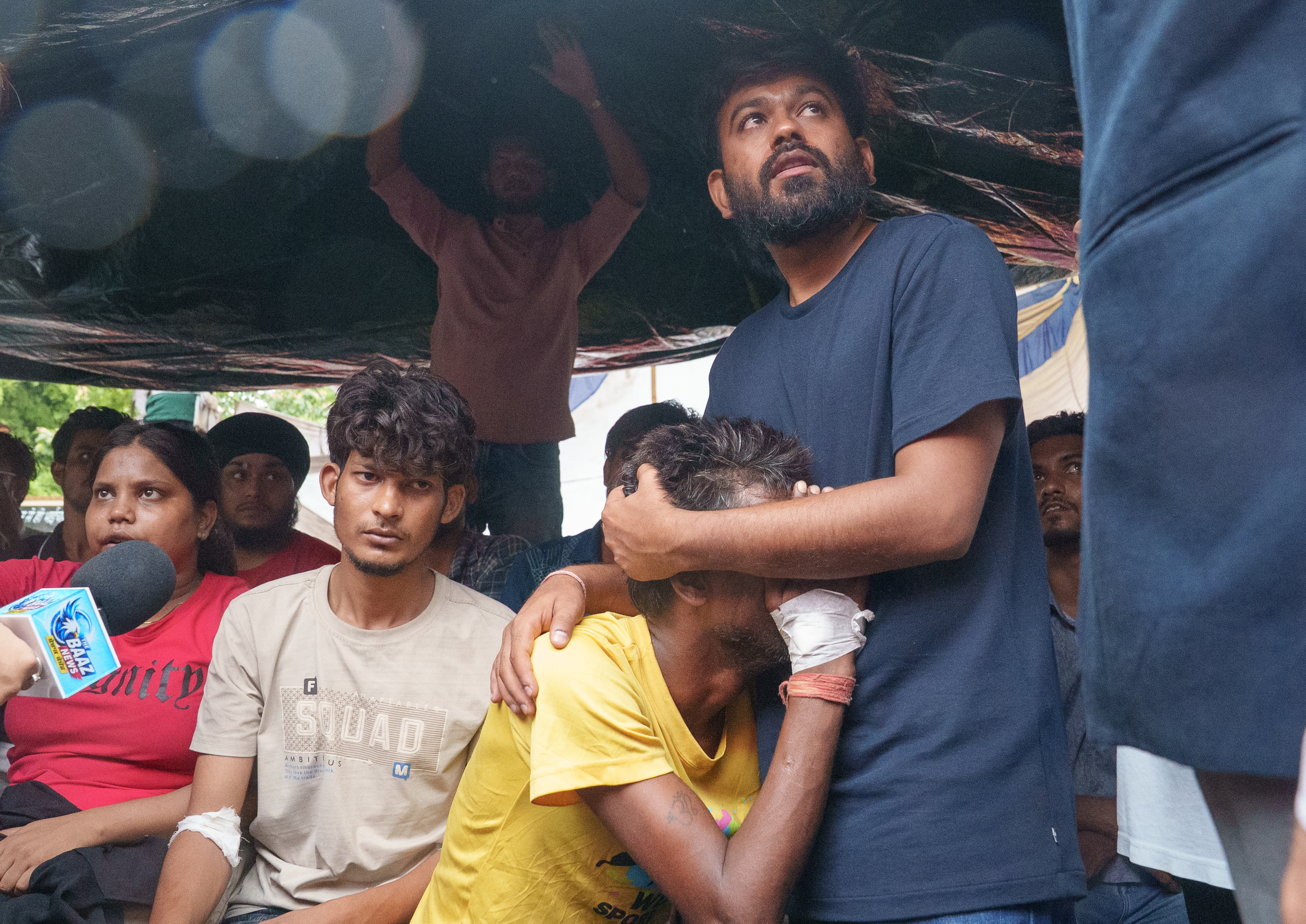
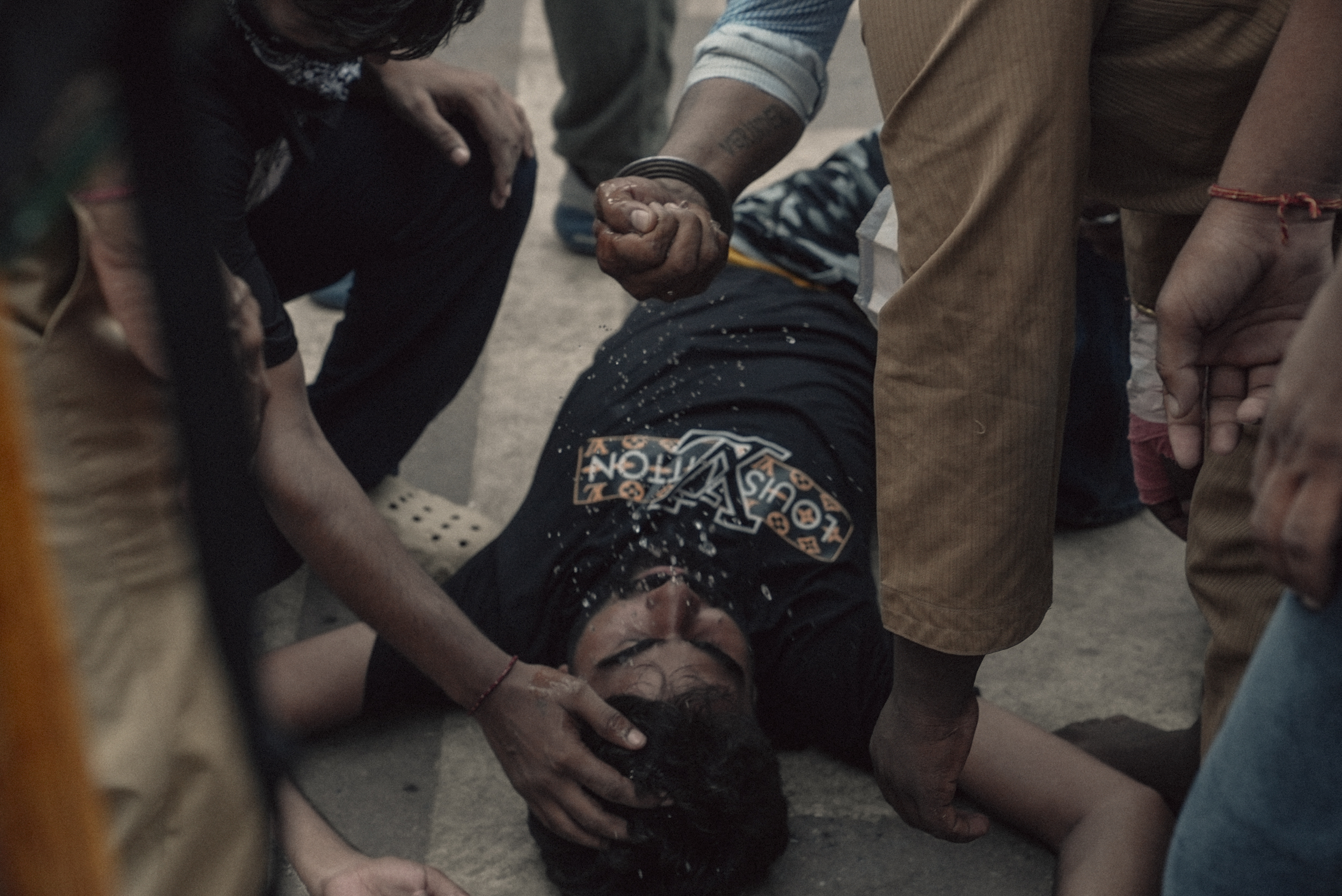
A student from Uttar Pradesh I spoke to, who had been beaten on the 20th and had sustained injuries to his wrist, affecting the carpal tunnel, and to his knees, looked sharply into my eyes and said: “We are not here to break the protest but are here to save it from breaking.” As I saw him sit through the rain, arranging medicines, I kept returning to that sentence because it seemed to describe something larger than the moment.
The protest was no longer only something to be defended against the police. It had begun to require protection from the possibility of its own collapse. This was another way in which the meaning of the barricade had changed. The police barricade separated the protester from the state. The rope divided the protest space internally, regulating who could move where. The Sikh volunteers created a human buffer between the students and the police, a layer of bodies that could absorb or interrupt the force of a confrontation. The protest was beginning to organize and protect itself as a space, even as different people took on different roles within it. The danger was no longer only that the police might disperse the crowd. Confrontation, disorganization, or disagreements over how the protest should proceed could also fracture the movement from within. As evening came, the police began welding extra barricades.
It was the second night I had spent sitting with the students, and by then, the street had taken on the familiarity of a place one has stayed too long. The same faces appeared, the same voices, the same questions: would the police move? Did the leaders know something? Would the night remain quiet?
The sense of anticipation had changed. On the first night, it was repression. Now it was also a decision. Who would decide what happened next? And if a decision came, what could actually be done? Or had the question of who could decide already become more important than what should be done?
Protest as spectacle

The words of the injured student were ricocheting in my head. On the 24th, I understood it as the protestors trying to keep the protest from collapsing into confrontation. But by the morning of July 25, the sentence had begun to sound like something else, a recognition that the protest was already approaching a breaking point, that the pressure accumulating around it would eventually have to resolve itself in some form. Whether that interpretation was justified, I could not know.
At Sansad Marg, there was commotion. Young Nihangs were trying to manage the crowd. The cordoned Sikh area was empty. Around 2:05 p.m., the police threw another tear gas canister. It arrived less as sound than as an interruption. Smoke spread with astonishing speed, obscuring the people, faces, and landmarks. People ran. Conversations dissolved into shouting. Someone pressed a bottle of water into my hand.
I soaked my dupatta and held it against my face while my eyes burned uncontrollably, then crouched beneath a plastic sheet extending from an alcove and tried to relay fragments to my team at Polis over the phone.
There was no longer a whole story to tell. There was smoke. Running feet. Somebody coughing. Someone else shouting. Another canister. Another body moving past me. Everything had become fragmented, and then the fragments had to be assembled afterward. That was when the question of competing accounts became unavoidable.
The police would later say that the students were throwing stones and water bottles and that the tear gas shelling was a response to this. Someone else told me that three trucks had arrived from outside carrying people. I could not verify either account.
As the night progressed, every conversation seemed to produce another version of what had happened. Interpretations outran verification. Old suspicions about who had provoked the violence, whether outsiders had been brought in, and whether the crackdown had been anticipated returned with startling confidence, no longer asking to be confirmed but presenting themselves as though they had always been known.
These were not simply competing explanations; they were competing attempts to establish what had become real. The protest was producing not only competing political demands but competing realities—of who had initiated the violence, what had provoked it, whether what followed was a spontaneous escalation or something more deliberate or if resignation alone could resolve the education crisis.
By around 12:30 p.m., reports of the resignation began circulating among journalists. However, it did not come from the senior police officers standing only meters away or the CJP leadership, but from a social media influencer.
Two hours later, the news was formally announced by Pradeep Dhaka, a YouTuber, and musician who joined the CJP protests in Delhi and was seen engaging with protesters and providing food at the site. His public social media persona carries an explicitly Hindu-nationalist register with Jai Shree Ram (Glory to Lord Rama) in his Instagram bio and a music catalog featuring Hindu devotional and Hindutva-themed tracks. What mattered to me was not that these facts proved an intention. They did not. It was the way his existing political identity intersected with what happened next.
The barricades did not move, but they became different objects. A few minutes earlier they had signified exclusion. Now students climbed over them, laughing, their hands in the air, flags waving above the metal frames that, a couple of hours earlier, had seemed immovable. Nothing material had changed. The barricades remained exactly where they had been, but their meaning had shifted. And with it, the behavior of the people around them.
Somewhere behind me, a Sikh man shouted angrily: “He [Dhaka] is not Punjabi. He is not Sikh. How can he wear a turban and provoke people?” Dhaka was asking the students to clap and sloganeer in support of the Delhi Police who had lathicharged them on the 20th.
I had seen Dhaka earlier with police officers, adjusting his gold chains, and his social media presence was not difficult to find. What struck me later was the transformation captured in a July 25 Instagram reel. He entered the Parliament Street police station bareheaded and emerged wearing a saffron turban.
The image stayed with me because the saffron turban carried several histories at once. It could invoke Sikh dignity and resistance; it could also be read through the visual vocabulary of Hindu nationalism. In Dhaka, those histories occupied the same frame without becoming the same thing. His existing Hindutva—inflected influencer persona acquired, for the camera, the visual grammar of Sikh protest. The image made it difficult to distinguish where religious identity ended, where political symbolism began, and where spectacle took over. The question was no longer simply whether he was Sikh. It was what the image required him to appear to be.
I had encountered something similar earlier in the photograph of Dipke carrying Ambedkar. In both cases, an object with a political history entered the protest and acquired another function through its circulation. The book, the turban, the slogans: each had a history before entering the protest. Once inside the spectacle, each could be made to speak differently.
Perhaps that was what had begun to trouble me. The protest was not only producing political demands but also images of political legitimacy. Identity was no longer merely something one possessed. It was something one could put on, carry, display, and circulate. Representation itself seemed unstable. Brahma Prakash also describes this instability of political symbols as the ritualization of public life, and the elevation of ceremony and symbolic discourse in Spectacle State: How Hindutva Shapes Feeling and Culture.
What I was seeing on Sansad Marg was not necessarily the triumph of one ideology over another. It was the recombination of political symbols whose histories did not always fit together. Jai Bhim could coexist with demands that rarely moved towards the structural questions associated with Ambedkar’s politics. Bharat Mata ki Jai could sit beside Inquilab Zindabad. Vande Mataram could appear alongside anti-government slogans.
The question was who had acquired the power to recombine them, and what political work that recombination performed. The students’ anger remained real. But the symbols through which that anger became visible were no longer entirely theirs to control.
By the evening of the 25th, all metro stations had been opened for students to return home. The stage began to disappear. People began leaving. I remained on the streets from around 8:30 p.m. until after midnight, looking at the posters and slogans and speaking to students and Sikh men who had stayed through the previous nights.
They were remarkably clear that this was not a victory. It was a defeat. Their certainty unsettled me because around us people were jubilant. I decided to go to the gurdwara to understand why the people who had held the protest together were now speaking of defeat. By then, there were rumors everywhere. A few students told me that communalism was being manufactured and the concerns of students were being converted into Hindu-Muslim issues. While there were multiple Instagram reels and X threads running this narrative on social media, on the ground, violence was meted out to students like Mohammad Junaid through harassment, detention of him and his family members, along with alleged raids in his house in Meerut, Uttar Pradesh. The police have denied all the allegations.
Along with this Pinky Chaudhary and Daksh Chaudhary of the Hindu Raksha Dal, a Hindu nationalist organisation, had released videos threatening to come to Jantar Mantar and “turn the arses red” of those they called anti-Sanatanis. Meanwhile, Saurav Das and others associated with the CJP leadership had begun using the category of “anti-social elements” to distinguish between “peaceful” protesters and those portrayed as rabble-rousers. No far-right organizations were named, leaving the category vague and undefined. This contingency allowed the disruptive outsider to exist without specifying who it was. Thus, the category itself was enough to place some protestors outside the boundaries of the legitimate movement. All of this was adding to the atmosphere of violence, which led me to the doors of Bangla Sahib. I wanted to know if the Nihangs were informed of an impending Hindu-Muslim violence lest they don’t retreat. At the gurudwara, I was told that all Nihangs had gone back to Punjab.
I could not tell whether I was witnessing the outline of a danger narrowly avoided or simply allowing the rumors around me to form a picture in my head. I had seen things, people had told me things, and I could only imagine the rest from the fragments available to me.
The police account was one version. The students’ account was another. The rumors formed a third. The uncertainty was not incidental to the story. It had become part of the story. Thus, again and again I returned to the same question: Why had the Nihangs left?
I heard several explanations, but I could not establish which, if any, was correct. Perhaps they had received information that had not reached the rest of us. Perhaps the confrontation had already shifted elsewhere. Perhaps they had simply decided that remaining on the site would put others at greater risk. Perhaps it was precisely the absence of an answer that made the question refuse to disappear. The more I thought about the previous days, the more the sequence resisted the simple story of a protest confronting the state.
If Dipke had arrived carrying an Ambedkar book published by a house whose catalog also includes extensive Sangh literature, at least one question about the protest’s political architecture would have existed before the mobilization reached its most visible form.
On July 20, when the lathi charge took place, much of the visible leadership was absent. Vijeta Dahiya was subsequently removed from his position following his absence that day. Reports also circulated that Dipke had been detained but later released, while Das and Ranka met Health Minister Jagat Prakash Nadda.
The language of the movement seemed to shift almost imperceptibly from rejection to conversation, from resignation to negotiation, without any clear, discernible moment of that shift. A protest does not have to be fabricated to be politically redirected. A crowd does not have to be fake for its political meaning to be reorganized. The students could be genuinely angry and still find that someone else possessed greater power to decide what their anger would become. In the protest discourse, the question of education was largely absent.
Anger over NEET examinations and the National Testing Agency’s (NTA) failures became a public demand for the Education Minister’s resignation. Yet on the day of the resignation, the CJP and the government were speaking the language of compensation. The demand for one crore rupees, raised on July 20, became a promise of “maximum possible compensation” on July 25—a compromise, but with whom? I found no visible evidence of consultation with AISA, the students’ families, or several of the student organizations I had encountered. When I asked Neha Bora, she said: “The language of compensation was part of CJP’s own campaign and demands. This had more to do with CJP’s initial conception than with the ideas AISA put forward. We didn’t oppose it because while families deserved compensation, they also deserved justice. Justice would not come from Dharmendra Pradhan resigning alone; it would come when people like him could no longer exist within a system without being held accountable. Justice would come when people no longer lost their lives to a system that is supposed to secure their future. And that is at the heart of what AISA imagined as the outcome of the movement”.
The protest site had questions of what kind of education system was producing this despair. It was ending, at least publicly, with the question of how much money could be offered after the fact.
The center had moved again. A structural question had become a personnel question. A personnel question had become a compensation question. And the students who had begun by asking what kind of future was being offered to them were now expected to read a resignation as the answer. Few students I spoke to weren’t satisfied with the answer; however, most of the protesting students were happy, at least visibly. But I knew that the political grammar had changed.
This was what felt different from the 2019-2020 anti-CAA movement and the 2020-2021 farm movement. Those mobilizations contained competing classes, castes and political interests, but the central policy disputes produced a relatively legible relationship between demand and the law. Here, the relationship between grievance, demand, and outcome had become unstable.
What remains after the protest
The story did not end with the clearing of the site. On August 7, 2026, Delhi High Court Justice Amit Mahajan questioned the central and local governments on why Jantar Mantar is not shut down as a central protest venue, remarking that demonstrations in the city center unnecessarily hold the capital to ransom. The physical geography of dissent was itself becoming a question. A space once made available for protest was being reconsidered through the language of inconvenience, disruption, and the smooth functioning of the capital.
At almost the same time, Dipke, Das and Ranka began a new campaign called School Thik Karo – Fix the Schools. On one level, the intention was difficult to object to. But the campaign raises a different question: what happens when a mobilization that began with the failures of the examination system turns towards repairing individual schools? Why was this fact-finding happening now, after the student mobilization, when the condition of India’s schools was neither new nor difficult to investigate? Journalists, researchers, RTI activists, students, and the Right to Education movement had documented the condition of government schools in India for years. The information did not begin to exist with this campaign.
The second question was more material. Even if a sarpanch felt sufficiently challenged to fix the school in their village, where would the money come from? Many of the problems being identified locally are not simply failures of individual morality or administrative will. Schools require money, teachers require salaries, children require meals, anganwadis require functioning infrastructure. Public education requires sustained public expenditure.
One of the first “School Thik Karo” audits began at a government school in Santuk Pimpri, Dipke’s native village in Maharashtra’s Hingoli district. CJP’s inspection found no safe drinking water, inadequate benches, unclean toilets, broken windows, and other infrastructure deficiencies. Within days of the visit, the local gram panchayat repaired damaged windows, defunct CCTV cameras were attended to, and water was restored to the washrooms, while education officials instructed the school to expedite the work. The episode demonstrates the practical power of the campaign: a problem that had existed within a public institution became visible, attributable, and administratively actionable once a political actor arrived, documented it, and made it public. But it also reveals the narrowing that accompanies this form of politics. The question of public education—its funding, staffing, privatization, centralization, and capacity to produce a secure future—is reduced to repairing a particular school.
The campaign has a website, of the same name, where citizens or CJP volunteers are requested to send details of schools that need fixing. But the call to action is limited to audits and an option called ‘submit useful evidence’, not what political action is required with the data collected by the CJP or information already publicly available.
When I asked Bora about her thoughts on the campaign, she said: “While it is a good thing and we appreciate that they have gone out in different states to audit the status of government schools in the country, the common people in the country already know very well what the status of government schools is. Nobody is unaware of what’s happening. More importantly, auditing government schools and submitting the results to the government does not achieve the kind of results they are perhaps trying to achieve. It’s not that governments are unaware of the condition of public education; they are very much aware, and are themselves responsible for why it remains the way it is.
“What we would want is for the students in those schools to politicize themselves and take up the concerns of their schools, rather than an outside force visiting them once or twice and highlighting the problems.
“If you are doing a School Thik Karo campaign, you have to address the fact that more than 90,000 schools have been shut down because of the NEP. The conversation also has to address how the disarray of public education encourages the expansion of private schooling, while government spending on education is treated as a burden on state and Union budgets.”
With the subsequent decline in Union budget allocations for education, ICDS, and midday meals, where is the fiscal capacity for the repair being demanded? And if the federal government lacks sufficient fiscal space or revenue-raising capacity, does the responsibility move elsewhere—to private organizations, philanthropic institutions, religious organizations, or corporate actors? What happens to those schools that have been shut down because of civil wars and lives of students snuffed out because of militarization?
What happens when the public sector is asked to solve a problem that its fiscal architecture has weakened its capacity to address? These questions become especially important when organizations tied to different ideological and religious networks are willing to occupy spaces vacated by the state.
Third, in the face of the protests and resignation, the government passed the Public Examination (Prevention of Unfair Means) Amendment Bill, 2026, which makes the penalties stricter. Along with it, Prime Minister Narendra Modi announced the formation of a task force to deal with the NEET paper leak, led by technocrat Nandan Nilekani. Academicians have been critical of this move, as according to them Aadhaar and technocracy will not resolve the crisis.
Fourth, the problem is not that a sarpanch or an organization might repair a school. The problem is the political relationship created when the right to education becomes dependent on whoever can finance its delivery. The system disappears from view when each failure is relocated to a school, a village, a teacher, or a local administrator. The structural grievance becomes an inventory of individual defects.
The CJP announced another protest, on September 5 at India Gate, against unmet demands. On September 1, after the Supreme Court quashed the FIRs against the protesters, CJP called off its planned September 5 march from India Gate to Police Headquarters. Four days later, on September 4, it marched from Patel Chowk to Parliament Street Police Station to demand action over the alleged assault on a protester’s father.
The protest had moved through hunger strikes, a Parliament march, a police crackdown, a ministerial resignation and a compensation demand, before turning towards the repair of individual schools, localizing failures, and returning to the city as another protest.
Long after the barricades disappeared, I began thinking about where the protest had gone. It had not disappeared so much as moved into other kinds of records. The bodies had left the road, but traces remained. A person who had stood at a barricade could become a face in a recording, a location in a phone, a transaction in a payment history, a photograph in an archive.
Sometimes I think the state’s greatest achievement is not dispersing a crowd but dispersing certainty. Force empties a street. Spectacle keeps it occupied. Long after the barricades are removed, the event continues to circulate as footage, metadata, rumor, evidence, accusation, arrest and memory. Each version generates another version; each person becomes at once witness and interpreter. The protest did not simply survive repression; it got reorganized into another political economy, one in which attention itself becomes a terrain of governance.
What remains is not certainty about what happened, but the recognition that neither the apparatus nor the anxiety that brought students into the street disappeared when the crowd did. The protest moved through students, police, volunteers, leaders, influencers, cameras, barricades, food, slogans, rumors and institutions, each altering what the others could do. Its boundaries were repeatedly redrawn: between protester and leader, peaceful protester and rabble-rouser, state and non-state, Sikh symbol and Hindutva symbol, grievance and demand.

Dharmendra Pradhan could resign and be replaced by Pralhad Joshi. A resignation could answer a personnel question. It could not restore the future the students had been promised.

What a Protest Becomes At Jantar Mantar, Sansad Marg and the Politics of Student Anger

Graffiti Images at the 2026 Jantar Mantar Protests.
Photo Credit: Aabha Muralidharan
New Delhi received me with the peculiar stillness that precedes movement. I landed on July 23; by evening, I was standing on Janpath Road. Nothing had happened yet—not, at least, anything newspapers would later recognize as an event. And yet the air had acquired the dense, expectant quality through which the future sometimes seems to lean backward into the present.
The roads leading up to Janpath were full of people. Students moved in groups, shouting slogans, laughing, jeering, and stopping in the middle of the road to hold up sheets of paper with their thoughts written on them. Others filmed the protest and slogans on their phones. The white walls of The Imperial Hotel and the red walls around the area were covered with graffiti: Ban RSS; Inquilab Zindabad (Long Live the Revolution); Darpok PM (Coward Prime Minister); and Job nahi hai, mitaoge to kal phir aayenge (There are no jobs; erase the graffiti and we will return tomorrow).
The protest had an irreverence that was difficult to miss. Its memes mocked authority; its slogans were deliberately unserious, sometimes abrasive. It was part of what made the protest recognizably Gen Z: authority was not only challenged but made into a joke.
Yet alongside this irreverence was a persistent caveat about what counted as legitimate and illegitimate protest. The Cockroach Janta Party repeatedly described itself as peaceful, distancing itself from what it called “anti-social elements” and rabble-rousers.
The peculiar contradiction was not simply that a protest known for its irreverence towards authority was simultaneously anxious to appear respectable. Instead, it was beginning to produce its own legitimacy by making an ‘other’ to itself. To call a protest “peaceful”, it had to establish what does not belong to it. A protest confronting the state had to make itself legible as a political interlocutor, and the ability to say “those people are not us” had to become a source of authority. This was not necessarily hypocrisy, but a condition of political efficacy. The same logic operated in the media where the peaceful student protester is an intelligible political subject, while the “anti-social element” becomes an interruption to that image. The category of the “anti-social element” thus helped answer a more fundamental question: who counts as the protester? That boundary was continually redrawn through slogans, barricades, negotiations, and the regulation of bodies.
That evening, pāpad sellers and ice-cream vendors moved through the crowd. Sikh volunteers handed out water. Langar was being served. The gathering already resembled a small city, with its vendors, kitchens, photographers and watchmen.
What struck me first was that the anger was not directed only at Education Minister Dharmendra Pradhan. It was directed at Prime Minister Narendra Modi, certainly, but also at the system that had come to bear his name. The students were angry about National Eligibility Cum Entrance Test (NEET) examinations and paper leaks, but the examination was only the surface on which a much older anxiety had gathered.
Through slogans, music, profanity, graffiti, and apparent nonchalance, they spoke about the bargain they had been offered—that education would lead to work, and work to a life—which they could no longer trust.
Another slogan read: Make India Free Again. Elsewhere: Our foreparents fought the British. While the struggle was no longer against a foreign ruler, the disillusionment was against a domestic order experienced as domination and oppression. Against the backdrop of unemployment and deepening social inequalities, the British had become a grammar through which the present could be described.
I would return to this disjunction repeatedly over the next two days—the distance between the histories invoked by a slogan and the politics demanded through it.
Protest Takes Shape
By 7:00 in the evening, as I walked away from Janpath Road along the subway towards Connaught Place, the city had begun to close itself.
Shops were coming down. When I asked some of the owners why, they told me that the New Delhi Traders Association had issued an urgent advisory directing shops and restaurants in Connaught Place to close by 6:30 p.m. The decision, they said, followed the advice of the New Delhi Municipal Council (NDMC) Chairman and Vice Chairman in view of what had been described as a “critical situation”.
The phrase stayed with me. A city does not become critical all at once. It becomes critical through small alterations. Shutters lowered earlier than usual, a police vehicle parked where there had been none, a road that remains technically public but becomes practically inaccessible.
By around 7:30 p.m., I saw the Rapid Action Force (RAF) standing along the footpath of Connaught Circle, with Delhi Police vehicles on the other side. At Kabootar Chowk, the road divides: to the right, Palika Bazaar; to the left, Sansad Marg. The latter was under Section 144 of the Code of Criminal Procedure (CrPC). Technically, it remained a public road. And then there was the strange calm inside this space, barricaded from the public and transport.
As one entered Sansad Marg, the atmosphere seemed festive. Students shouted slogans. Cotton candy was being sold and eaten. Groups sat on the footpaths and bus stops near Palika Kendra, talking among themselves, unhurriedly occupying the space.
I walked towards the chowk near Jantar Mantar. The lane abutting it was Tolstoy Marg, which led to the protest’s center stage; opposite was Jai Singh Road. From the junction, the NDCC II building rose into view, housing the Ministry of Home Affairs. Further along was Bangla Sahib Road opening to the gurudwara by the same name, and opposite it the Delhi Police Headquarters.
By 8:00 p.m., the chowk had been fully barricaded. Jai Singh Marg and the portion of Sansad Marg beyond it were closed. The crackdown had not begun, but its outline had already settled over the street.
A phalanx of security officers and paramilitary forces stood where they had been instructed. The Central Reserve Police Force (CRPF), Central Industrial Security Force (CISF), the RAF, and the Delhi Police occupied Sansad Marg and Jai Singh Road. The distances between the uniforms seemed carefully measured, as though the city had rehearsed this arrangement many times before.
The RAF carried multi-shot tear-gas launchers and fiber lathis. Drones hovered above the chowk, their red and green lights moving across the dark sky like small, mechanical stars, recording the crowd below. A constable answered his phone. Another lifted his hand almost lazily and called out, Aa ja (Come on). Somewhere a barricade scraped against the road. None of these gestures meant much on their own. But together, they gave away a sensation that violence had already arrived. The people did not name it, but were waiting for it.
Then, around 9:30 p.m, the shape of the crowd altered. The Nihangs entered. No announcement, no theatrical moment. The space simply reorganized itself around them. Where moments earlier students were facing the police directly, another line of defense now existed between them. It was neither mediation nor protection in any sentimental sense. It was something stranger, such as a change in geometry. Power seemed no longer to travel in a straight line.
The students seemed to understand this slowly and instinctively. The police and other state forces appeared to understand it too. I could not establish why the police did not touch the Sikh volunteers. For the moment, what mattered was the visible effect. Their presence had altered the possibilities of the street.
Students formed human chains to cordon. Elderly Sikh men and women, and middle-aged couples stood watch. Younger volunteers carried water and food. Women arrived with packets of sweets and meals. There were no speeches; they simply did it. By 11:30 p.m., students were playing a volleyball match beside the barricade.
This was perhaps the strangest thing of all. A place prepared for confrontation had, for a few hours, become a place for a game.
When I spoke to the students, they reiterated matters beyond the resignation, which everyone outside the protest seemed to believe they wanted. They spoke about a dark future that awaited them. One grievance folded into another until they became impossible to separate. Education was unemployment. Unemployment was debt. Debt was abandonment. Every sentence seemed to echo the upheavals of the 1930s and the crises that followed, when mass unemployment, insecurity, and the loss of dignity and political belonging found collective unrest.
It occurred to me that perhaps the protest was not what had gathered these lives together. Perhaps they had long been dispersed by the same force, each carrying the same anxiety, until one evening they found themselves standing at the same crossroads, facing one another with an old demand.
The night settled softly. After midnight, food arrived from Bangla Sahib Gurudwara in endless cycles. Before dawn, people moved silently across the road carrying brooms. By the morning of the 24th, they had gathered the dust into careful piles. Plastic bottles disappeared. Thick ropes appeared where there had been none, quietly dividing the road into a new territory. Some of the older protesters continued as before, only to find themselves redirected around spaces that had taken on a different significance. No one announced an order, yet order emerged. The municipal corporation had temporarily stopped being the sole author of the place.
One person arrived and began sweeping; five more broomsticks appeared. Serve another meal. Guard the entrance. Carry water bottles. Arrange medicines in a makeshift tent. Tie another knot. Repeat. Repeat again. Politics moved through maintenance. Even walking acquired instructions. Then I began to wonder whether the true center of the protest had ever been Jantar Mantar at all.
Jantar Mantar had long been made legible to the state. It was a permitted space where dissent could occur without necessarily disturbing the surrounding city’s architecture. Students played cricket in front of the Wall of Shame on Jantar Mantar Road, a makeshift exhibition of photographs and stills from videos of the police crackdown on July 20.
But Sansad Marg felt different precisely because it had been prohibited. It had been pushed outside the permitted geography of dissent, suspended beneath Section 144 like a sentence yet to be completed. The prohibition was not merely municipal. It also began to determine what kind of protest could be recognized as legitimate. The protest itself was beginning to develop its own distinctions between what could and could not be said.
The CJP leadership had announced that only four kinds of slogans were permitted: Bharat Mata ki Jai (Victory to Mother India), Inquilab Zindabad (Long Live the Revolution), Jai Bhim (Long Live Ambedkar), and Dharmendra Pradhan Istifa Do (Dharmendra Pradhan, resign).
Others, slogans that crossed into insult, profanity, and accusation, were forbidden. And yet those were precisely the slogans that could be heard outside the permitted space, which produced a peculiar dissonance. The city seemed to be speaking several political languages at once.
A decade earlier, I had watched Pinjra Tod shout “Bharat ki Mata nahi banenge (We refuse to become Mother India),” a feminist rejection of an ideal that reduces women to symbols of motherhood, sacrifice, and national honor. Now I heard Bharat Mata ki Jai, Vande Mataram (I bow to thee, Mother [India]) and Inquilab Zindabad spoken within the same political moment. Gandhi, Ambedkar, Buddha and the Ramcharitmanas appeared together on the same table. Their histories had not converged; their symbols had simply become available in the same political scene, even as conflicts between those histories remained unresolved.
Even Jai Bhim, a gesture of reverence towards Ambedkar, sat uneasily beside a protest whose demands rarely turned to the structural questions Ambedkar’s politics would have forced into view. What happened to public spending on education, midday meals, Integrated Child Development Scheme (ICDS) and Anganwadis? What did privatization mean for students already borrowing money to study? What did the centralization of examinations through the NTA mean for a system whose failures were being experienced as individual catastrophes? How does the present system institutionally murder Dalit students? What happened to students who had to work while studying? How does caste work in educational institutions? The slogans legitimatized by the CJP had material, but the structural questions of the National Education Policy (NEP), conditions of primary schools, privatization of education and unemployment were largely absent from both CJP’s political articulation and discursively at the protest site.
This felt different from the farm movement (2020-2021) at Tikri Border located on the Delhi-Haryana border in North West Delhi. Despite its own internal contradictions, the relationship between the principal policy demand and the movement’s public discourse remained comparatively legible: repeal the three farm laws. Here, the relationship between grievance, demand and political outcome seemed far less stable.
When I spoke to students, including women, many repeated what the center was saying: resignation. The question that troubled me was not whether the students were angry. They were. It was whether the political demand now being articulated still contained the full range of what had produced that anger. The crisis of education was broader than one minister; it included unemployment, debts, and shrinking public institutions. Yet as the protest gained a clearer political center, this diffuse anger increasingly condensed into a demand that one person resign. That made the grievance easier to name, negotiate and report—but also potentially easier to contain. The question, then, was not simply who was speaking for the students, but what happened to their anger as it was translated into a demand the political system could recognize.
To understand that, I had to look at what had happened before I arrived at the site, and at how the protest had decided beforehand on who could speak for it.
Protest as political architecture
Abhijeet Dipke, founder of the Cockroach Janta Party, landed in New Delhi from the United States on June 6, 2026. At the airport exit, he was photographed carrying a book titled My Autobiography by B.R. Ambedkar. Prabhat Prakashan published the edition, a house that extensively publishes works on the history and leadership of the Rashtriya Swayamsevak Sangh (RSS) and other Sangh literature.
The photograph did not establish what Dipke believed, or why he was carrying that particular book. But it raised a question about the political work an image can do before anyone explains it.
Ambedkar’s Waiting for a Visa is among his best-known autobiographical writings, which made the title of the edition Dipke was carrying, “My Autobiography”, worth examining more closely. What exactly was this edition? Why this title? Why this publisher? And why had this particular object entered the visual field of a protest in which Jai Bhim had become one of the authorized slogans?
What happens when a figure, whose political legacy is inseparable from questions of caste, representation, and public institutions, becomes a symbol within a political spectacle whose other symbols point elsewhere? I could not answer those questions simply by looking at the photograph. But I could not unsee the question once I had noticed it.
The same question arose with Sonam Wangchuk. The protest’s momentum increased sharply after his arrival and the beginning of his hunger strike. In a video published on July 13, 2026, Wangchuk told journalist Saurabh Dwivedi that he met the CJP after an intervention by the Lieutenant Governor of Ladakh.
If Wangchuk’s account is accurate, the immediate question is what that intervention involved: did the Lieutenant Governor or the administration facilitate Wangchuk’s introduction to the CJP, and if so, why? I contacted Gitanjali Angmo to clarify what the intervention involved and whether the administration had facilitated the meeting, but I haven’t received any response yet.
The account does not establish coordination. It does, however, complicate the assumption that the protest’s visible political relationships emerged entirely from below.
After Wangchuk was taken away by Delhi Police personnel in plain clothes on July 18, Dipke began a hunger strike. Gitanjali later asked Dipke to break his 48-hour fast, which he had initially announced as indefinite. Why was the appeal directed at Dipke in particular, when other students had already been fasting alongside Wangchuk? That stood out to me because three All India Student Association (AISA) students, including its President Neha Bora, had already been on a hunger strike for 23 days.
I contacted Manish Kumar, one of the three AISA students on hunger strike, to learn more. He told me: “Once the protest had been initiated by CJP and AISA, Sonam joined and said that if there was no resignation within a week, he would go on hunger strike. From that point, the protest’s political character diluted, and there was an effort to make it ‘non-political’.
“On June 20, neither Dipke nor Gitanjali asked AISA to end the hunger strike. There was no dialogue or coordination.” Throughout the protest, Sonam came only once to ask about their whereabouts, but there was no sustained coordination between the CJP, Wangchuk and AISA, added Kumar.
“The arrangements also reflected this disparity. There was a fan for Sonam on stage, while electricity was barely available to us. On the second or third day, CJP tried to pressure us to break the strike, saying our health was weak and that we did not have Sonam’s experience. Why try to break our momentum instead of finding ways to sustain the protest?
“There was no consultation with us before the Parliament march on the 20th either. If the CJP had coordinated with AISA, the Students’ Federation of India (SFI), the All India Students’ Federation (AISF), the Krantikari Yuva Sangathan (KYS) and other student organizations, we could have reduced the casualties during the police crackdown.”
Kumar also said that the Uttar Pradesh Police had recently sent 25 officers to his home and the house of his family members around midnight. He alleged that the police were intimidating auditorium owners in Ghazipur, where a meeting on education was scheduled for August 20 and was eventually canceled. He further alleged that the authorities had collected Aadhaar and bank details of comrades associated with student organizations.
While none of this establishes that the state designed the protest, or that the subsequent events were scripted in advance, the sequence of events made the simpler binary I had arrived at—the state on one side, protesters on the other—harder to sustain.
If a senior state functionary had indeed helped bring a prominent public figure into contact with the organization that would become central to the protest, then some of the connections through which the students’ grievances were later articulated may have existed before much of the public saw them in their most visible form. The question was not simply whether the protest was spontaneous. It was how much of the machinery for giving that spontaneous anger a political voice—who would represent it, which demands would be foregrounded, and which channels would carry those demands to the state—had already been in place before the people on the street understood where the protest was heading.
This distinction mattered to me as the students’ anger did not need to be manufactured. The debts, coaching fees, unemployment, examination failures, and postponements were real. Their despair did not require an organizer to invent it.
A genuine grievance can enter a political arrangement larger than itself. People can act sincerely within a structure whose entire architecture they cannot see. The question was less about whether the anger was real than about what happened to it once it took political form.
That possibility seemed more useful to me than the simpler claim that the protest was “staged”. The center, I began to realize, did not have to be a single institution. It could be a process.
The center never exhausts itself because it is never a fixed place. It keeps remaking itself by producing an outside, and simultaneously, the outsider. This was visible not only in how the police arranged themselves around the protest, but also in how the protest itself began to organize its own center.
Students were being instructed, sometimes explicitly and sometimes simply through the movement of the crowd, about which slogans were acceptable, who could speak to the police, who could negotiate, who could announce what would happen next, and who could be dismissed as unruly.
The distinction between the responsible protester and the disruptive one did not merely describe the movement; instead, it produced a center. Someone had to be reasonable for someone else to become unreasonable. Someone had to be authorized for someone else to become excessive. Order emerged through this constant sorting of bodies and voices. The center was produced at the expense of those pushed towards its edges.
By the afternoon of July 24, Sikh volunteers protected a large part of the protest site. Jatt Sikhs and Jaat men remained at the site through the day and, as I understood it, were prepared for another lathi charge.
A student from Uttar Pradesh I spoke to, who had been beaten on the 20th and had sustained injuries to his wrist, affecting the carpal tunnel, and to his knees, looked sharply into my eyes and said: “We are not here to break the protest but are here to save it from breaking.” As I saw him sit through the rain, arranging medicines, I kept returning to that sentence because it seemed to describe something larger than the moment.
The protest was no longer only something to be defended against the police. It had begun to require protection from the possibility of its own collapse. This was another way in which the meaning of the barricade had changed. The police barricade separated the protester from the state. The rope divided the protest space internally, regulating who could move where. The Sikh volunteers created a human buffer between the students and the police, a layer of bodies that could absorb or interrupt the force of a confrontation. The protest was beginning to organize and protect itself as a space, even as different people took on different roles within it. The danger was no longer only that the police might disperse the crowd. Confrontation, disorganization, or disagreements over how the protest should proceed could also fracture the movement from within. As evening came, the police began welding extra barricades.
It was the second night I had spent sitting with the students, and by then, the street had taken on the familiarity of a place one has stayed too long. The same faces appeared, the same voices, the same questions: would the police move? Did the leaders know something? Would the night remain quiet?
The sense of anticipation had changed. On the first night, it was repression. Now it was also a decision. Who would decide what happened next? And if a decision came, what could actually be done? Or had the question of who could decide already become more important than what should be done?
Protest as spectacle
The words of the injured student were ricocheting in my head. On the 24th, I understood it as the protestors trying to keep the protest from collapsing into confrontation. But by the morning of July 25, the sentence had begun to sound like something else, a recognition that the protest was already approaching a breaking point, that the pressure accumulating around it would eventually have to resolve itself in some form. Whether that interpretation was justified, I could not know.
At Sansad Marg, there was commotion. Young Nihangs were trying to manage the crowd. The cordoned Sikh area was empty. Around 2:05 p.m., the police threw another tear gas canister. It arrived less as sound than as an interruption. Smoke spread with astonishing speed, obscuring the people, faces, and landmarks. People ran. Conversations dissolved into shouting. Someone pressed a bottle of water into my hand.
I soaked my dupatta and held it against my face while my eyes burned uncontrollably, then crouched beneath a plastic sheet extending from an alcove and tried to relay fragments to my team at Polis over the phone.
There was no longer a whole story to tell. There was smoke. Running feet. Somebody coughing. Someone else shouting. Another canister. Another body moving past me. Everything had become fragmented, and then the fragments had to be assembled afterward. That was when the question of competing accounts became unavoidable.
The police would later say that the students were throwing stones and water bottles and that the tear gas shelling was a response to this. Someone else told me that three trucks had arrived from outside carrying people. I could not verify either account.
As the night progressed, every conversation seemed to produce another version of what had happened. Interpretations outran verification. Old suspicions about who had provoked the violence, whether outsiders had been brought in, and whether the crackdown had been anticipated returned with startling confidence, no longer asking to be confirmed but presenting themselves as though they had always been known.
These were not simply competing explanations; they were competing attempts to establish what had become real. The protest was producing not only competing political demands but competing realities—of who had initiated the violence, what had provoked it, whether what followed was a spontaneous escalation or something more deliberate or if resignation alone could resolve the education crisis.
By around 12:30 p.m., reports of the resignation began circulating among journalists. However, it did not come from the senior police officers standing only meters away or the CJP leadership, but from a social media influencer.
Two hours later, the news was formally announced by Pradeep Dhaka, a YouTuber, and musician who joined the CJP protests in Delhi and was seen engaging with protesters and providing food at the site. His public social media persona carries an explicitly Hindu-nationalist register with Jai Shree Ram (Glory to Lord Rama) in his Instagram bio and a music catalog featuring Hindu devotional and Hindutva-themed tracks. What mattered to me was not that these facts proved an intention. They did not. It was the way his existing political identity intersected with what happened next.
The barricades did not move, but they became different objects. A few minutes earlier they had signified exclusion. Now students climbed over them, laughing, their hands in the air, flags waving above the metal frames that, a couple of hours earlier, had seemed immovable. Nothing material had changed. The barricades remained exactly where they had been, but their meaning had shifted. And with it, the behavior of the people around them.
Somewhere behind me, a Sikh man shouted angrily: “He [Dhaka] is not Punjabi. He is not Sikh. How can he wear a turban and provoke people?” Dhaka was asking the students to clap and sloganeer in support of the Delhi Police who had lathicharged them on the 20th.
I had seen Dhaka earlier with police officers, adjusting his gold chains, and his social media presence was not difficult to find. What struck me later was the transformation captured in a July 25 Instagram reel. He entered the Parliament Street police station bareheaded and emerged wearing a saffron turban.
The image stayed with me because the saffron turban carried several histories at once. It could invoke Sikh dignity and resistance; it could also be read through the visual vocabulary of Hindu nationalism. In Dhaka, those histories occupied the same frame without becoming the same thing. His existing Hindutva—inflected influencer persona acquired, for the camera, the visual grammar of Sikh protest. The image made it difficult to distinguish where religious identity ended, where political symbolism began, and where spectacle took over. The question was no longer simply whether he was Sikh. It was what the image required him to appear to be.
I had encountered something similar earlier in the photograph of Dipke carrying Ambedkar. In both cases, an object with a political history entered the protest and acquired another function through its circulation. The book, the turban, the slogans: each had a history before entering the protest. Once inside the spectacle, each could be made to speak differently.
Perhaps that was what had begun to trouble me. The protest was not only producing political demands but also images of political legitimacy. Identity was no longer merely something one possessed. It was something one could put on, carry, display, and circulate. Representation itself seemed unstable. Brahma Prakash also describes this instability of political symbols as the ritualization of public life, and the elevation of ceremony and symbolic discourse in Spectacle State: How Hindutva Shapes Feeling and Culture.
What I was seeing on Sansad Marg was not necessarily the triumph of one ideology over another. It was the recombination of political symbols whose histories did not always fit together. Jai Bhim could coexist with demands that rarely moved towards the structural questions associated with Ambedkar’s politics. Bharat Mata ki Jai could sit beside Inquilab Zindabad. Vande Mataram could appear alongside anti-government slogans.
The question was who had acquired the power to recombine them, and what political work that recombination performed. The students’ anger remained real. But the symbols through which that anger became visible were no longer entirely theirs to control.
By the evening of the 25th, all metro stations had been opened for students to return home. The stage began to disappear. People began leaving. I remained on the streets from around 8:30 p.m. until after midnight, looking at the posters and slogans and speaking to students and Sikh men who had stayed through the previous nights.
They were remarkably clear that this was not a victory. It was a defeat. Their certainty unsettled me because around us people were jubilant. I decided to go to the gurdwara to understand why the people who had held the protest together were now speaking of defeat. By then, there were rumors everywhere. A few students told me that communalism was being manufactured and the concerns of students were being converted into Hindu-Muslim issues. While there were multiple Instagram reels and X threads running this narrative on social media, on the ground, violence was meted out to students like Mohammad Junaid through harassment, detention of him and his family members, along with alleged raids in his house in Meerut, Uttar Pradesh. The police have denied all the allegations.
Along with this Pinky Chaudhary and Daksh Chaudhary of the Hindu Raksha Dal, a Hindu nationalist organisation, had released videos threatening to come to Jantar Mantar and “turn the arses red” of those they called anti-Sanatanis. Meanwhile, Saurav Das and others associated with the CJP leadership had begun using the category of “anti-social elements” to distinguish between “peaceful” protesters and those portrayed as rabble-rousers. No far-right organizations were named, leaving the category vague and undefined. This contingency allowed the disruptive outsider to exist without specifying who it was. Thus, the category itself was enough to place some protestors outside the boundaries of the legitimate movement. All of this was adding to the atmosphere of violence, which led me to the doors of Bangla Sahib. I wanted to know if the Nihangs were informed of an impending Hindu-Muslim violence lest they don’t retreat. At the gurudwara, I was told that all Nihangs had gone back to Punjab.
I could not tell whether I was witnessing the outline of a danger narrowly avoided or simply allowing the rumors around me to form a picture in my head. I had seen things, people had told me things, and I could only imagine the rest from the fragments available to me.
The police account was one version. The students’ account was another. The rumors formed a third. The uncertainty was not incidental to the story. It had become part of the story. Thus, again and again I returned to the same question: Why had the Nihangs left?
I heard several explanations, but I could not establish which, if any, was correct. Perhaps they had received information that had not reached the rest of us. Perhaps the confrontation had already shifted elsewhere. Perhaps they had simply decided that remaining on the site would put others at greater risk. Perhaps it was precisely the absence of an answer that made the question refuse to disappear. The more I thought about the previous days, the more the sequence resisted the simple story of a protest confronting the state.
If Dipke had arrived carrying an Ambedkar book published by a house whose catalog also includes extensive Sangh literature, at least one question about the protest’s political architecture would have existed before the mobilization reached its most visible form.
On July 20, when the lathi charge took place, much of the visible leadership was absent. Vijeta Dahiya was subsequently removed from his position following his absence that day. Reports also circulated that Dipke had been detained but later released, while Das and Ranka met Health Minister Jagat Prakash Nadda.
The language of the movement seemed to shift almost imperceptibly from rejection to conversation, from resignation to negotiation, without any clear, discernible moment of that shift. A protest does not have to be fabricated to be politically redirected. A crowd does not have to be fake for its political meaning to be reorganized. The students could be genuinely angry and still find that someone else possessed greater power to decide what their anger would become. In the protest discourse, the question of education was largely absent.
Anger over NEET examinations and the National Testing Agency’s (NTA) failures became a public demand for the Education Minister’s resignation. Yet on the day of the resignation, the CJP and the government were speaking the language of compensation. The demand for one crore rupees, raised on July 20, became a promise of “maximum possible compensation” on July 25—a compromise, but with whom? I found no visible evidence of consultation with AISA, the students’ families, or several of the student organizations I had encountered. When I asked Neha Bora, she said: “The language of compensation was part of CJP’s own campaign and demands. This had more to do with CJP’s initial conception than with the ideas AISA put forward. We didn’t oppose it because while families deserved compensation, they also deserved justice. Justice would not come from Dharmendra Pradhan resigning alone; it would come when people like him could no longer exist within a system without being held accountable. Justice would come when people no longer lost their lives to a system that is supposed to secure their future. And that is at the heart of what AISA imagined as the outcome of the movement”.
The protest site had questions of what kind of education system was producing this despair. It was ending, at least publicly, with the question of how much money could be offered after the fact.
The center had moved again. A structural question had become a personnel question. A personnel question had become a compensation question. And the students who had begun by asking what kind of future was being offered to them were now expected to read a resignation as the answer. Few students I spoke to weren’t satisfied with the answer; however, most of the protesting students were happy, at least visibly. But I knew that the political grammar had changed.
This was what felt different from the 2019-2020 anti-CAA movement and the 2020-2021 farm movement. Those mobilizations contained competing classes, castes and political interests, but the central policy disputes produced a relatively legible relationship between demand and the law. Here, the relationship between grievance, demand, and outcome had become unstable.
What remains after the protest
The story did not end with the clearing of the site. On August 7, 2026, Delhi High Court Justice Amit Mahajan questioned the central and local governments on why Jantar Mantar is not shut down as a central protest venue, remarking that demonstrations in the city center unnecessarily hold the capital to ransom. The physical geography of dissent was itself becoming a question. A space once made available for protest was being reconsidered through the language of inconvenience, disruption, and the smooth functioning of the capital.
At almost the same time, Dipke, Das and Ranka began a new campaign called School Thik Karo – Fix the Schools. On one level, the intention was difficult to object to. But the campaign raises a different question: what happens when a mobilization that began with the failures of the examination system turns towards repairing individual schools? Why was this fact-finding happening now, after the student mobilization, when the condition of India’s schools was neither new nor difficult to investigate? Journalists, researchers, RTI activists, students, and the Right to Education movement had documented the condition of government schools in India for years. The information did not begin to exist with this campaign.
The second question was more material. Even if a sarpanch felt sufficiently challenged to fix the school in their village, where would the money come from? Many of the problems being identified locally are not simply failures of individual morality or administrative will. Schools require money, teachers require salaries, children require meals, anganwadis require functioning infrastructure. Public education requires sustained public expenditure.
One of the first “School Thik Karo” audits began at a government school in Santuk Pimpri, Dipke’s native village in Maharashtra’s Hingoli district. CJP’s inspection found no safe drinking water, inadequate benches, unclean toilets, broken windows, and other infrastructure deficiencies. Within days of the visit, the local gram panchayat repaired damaged windows, defunct CCTV cameras were attended to, and water was restored to the washrooms, while education officials instructed the school to expedite the work. The episode demonstrates the practical power of the campaign: a problem that had existed within a public institution became visible, attributable, and administratively actionable once a political actor arrived, documented it, and made it public. But it also reveals the narrowing that accompanies this form of politics. The question of public education—its funding, staffing, privatization, centralization, and capacity to produce a secure future—is reduced to repairing a particular school.
The campaign has a website, of the same name, where citizens or CJP volunteers are requested to send details of schools that need fixing. But the call to action is limited to audits and an option called ‘submit useful evidence’, not what political action is required with the data collected by the CJP or information already publicly available.
When I asked Bora about her thoughts on the campaign, she said: “While it is a good thing and we appreciate that they have gone out in different states to audit the status of government schools in the country, the common people in the country already know very well what the status of government schools is. Nobody is unaware of what’s happening. More importantly, auditing government schools and submitting the results to the government does not achieve the kind of results they are perhaps trying to achieve. It’s not that governments are unaware of the condition of public education; they are very much aware, and are themselves responsible for why it remains the way it is.
“What we would want is for the students in those schools to politicize themselves and take up the concerns of their schools, rather than an outside force visiting them once or twice and highlighting the problems.
“If you are doing a School Thik Karo campaign, you have to address the fact that more than 90,000 schools have been shut down because of the NEP. The conversation also has to address how the disarray of public education encourages the expansion of private schooling, while government spending on education is treated as a burden on state and Union budgets.”
With the subsequent decline in Union budget allocations for education, ICDS, and midday meals, where is the fiscal capacity for the repair being demanded? And if the federal government lacks sufficient fiscal space or revenue-raising capacity, does the responsibility move elsewhere—to private organizations, philanthropic institutions, religious organizations, or corporate actors? What happens to those schools that have been shut down because of civil wars and lives of students snuffed out because of militarization?
What happens when the public sector is asked to solve a problem that its fiscal architecture has weakened its capacity to address? These questions become especially important when organizations tied to different ideological and religious networks are willing to occupy spaces vacated by the state.
Third, in the face of the protests and resignation, the government passed the Public Examination (Prevention of Unfair Means) Amendment Bill, 2026, which makes the penalties stricter. Along with it, Prime Minister Narendra Modi announced the formation of a task force to deal with the NEET paper leak, led by technocrat Nandan Nilekani. Academicians have been critical of this move, as according to them Aadhaar and technocracy will not resolve the crisis.
Fourth, the problem is not that a sarpanch or an organization might repair a school. The problem is the political relationship created when the right to education becomes dependent on whoever can finance its delivery. The system disappears from view when each failure is relocated to a school, a village, a teacher, or a local administrator. The structural grievance becomes an inventory of individual defects.
The CJP announced another protest, on September 5 at India Gate, against unmet demands. On September 1, after the Supreme Court quashed the FIRs against the protesters, CJP called off its planned September 5 march from India Gate to Police Headquarters. Four days later, on September 4, it marched from Patel Chowk to Parliament Street Police Station to demand action over the alleged assault on a protester’s father.
The protest had moved through hunger strikes, a Parliament march, a police crackdown, a ministerial resignation and a compensation demand, before turning towards the repair of individual schools, localizing failures, and returning to the city as another protest.
Long after the barricades disappeared, I began thinking about where the protest had gone. It had not disappeared so much as moved into other kinds of records. The bodies had left the road, but traces remained. A person who had stood at a barricade could become a face in a recording, a location in a phone, a transaction in a payment history, a photograph in an archive.
Sometimes I think the state’s greatest achievement is not dispersing a crowd but dispersing certainty. Force empties a street. Spectacle keeps it occupied. Long after the barricades are removed, the event continues to circulate as footage, metadata, rumor, evidence, accusation, arrest and memory. Each version generates another version; each person becomes at once witness and interpreter. The protest did not simply survive repression; it got reorganized into another political economy, one in which attention itself becomes a terrain of governance.
What remains is not certainty about what happened, but the recognition that neither the apparatus nor the anxiety that brought students into the street disappeared when the crowd did. The protest moved through students, police, volunteers, leaders, influencers, cameras, barricades, food, slogans, rumors and institutions, each altering what the others could do. Its boundaries were repeatedly redrawn: between protester and leader, peaceful protester and rabble-rouser, state and non-state, Sikh symbol and Hindutva symbol, grievance and demand.
Dharmendra Pradhan could resign and be replaced by Pralhad Joshi. A resignation could answer a personnel question. It could not restore the future the students had been promised.