




With additional reporting by Anahita Ahluwalia and Siddharth Shukla
NEW DELHI, July 23 — Students protesting the alleged NEET-UG 2026 paper leak and wider exam irregularities held their ground on Sansad Marg on Thursday evening after the New Delhi Traders Association issued an urgent advisory asking shops, offices and restaurants to shut by 6:30 p.m. The traders’ body said it was acting on telephonic directions from the chairperson and vice-chairperson of the New Delhi Municipal Council, citing the security situation around central Delhi. Arvind Kejriwal also shared the advisory on X.
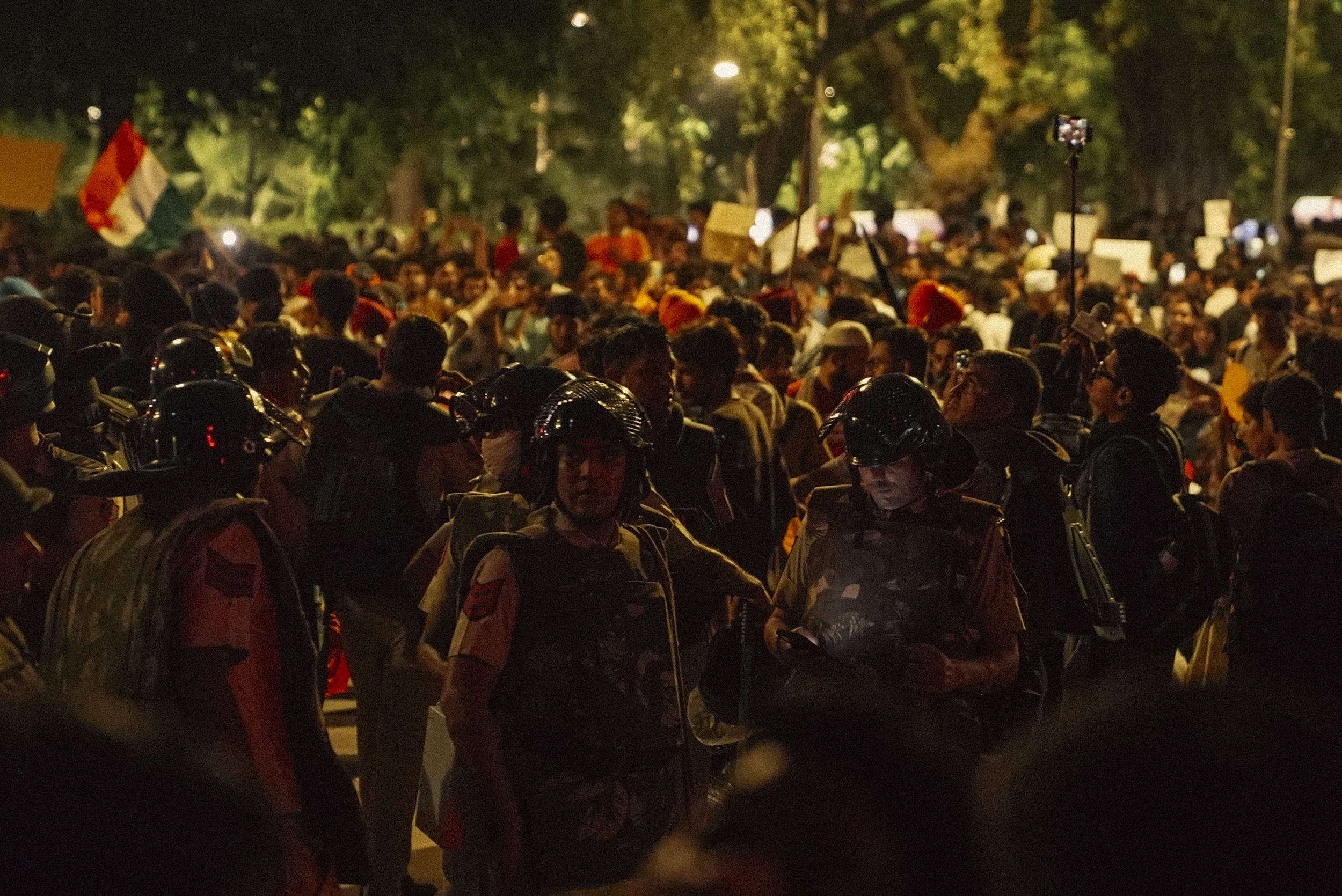
By the time the advisory reached shopkeepers, the area was already tense. From the Sansad Marg junction near Tolstoy Marg to the entrance toward Parliament, Delhi Police and Rapid Action Force had taken position. The market area nearby was chaotic, with shops pulling down shutters while vehicles continued to move in and around the road. Police buses blocked the routes leading toward Parliament, and only the lane toward the main protest stage remained open.
Between 7 and 8 p.m., the police began using loudspeakers to tell students to leave and return at 8 the next morning. The announcement was repeated several times, including twice on the Jai Singh Road side and once from the Sansad Marg side: “Aap yahan se jaiye, aur kal subah wapas aaiye. Hamare ghar mein bhi bachche hain, to aap apne ghar jaiye, apne mata pita ke saath jaiye. (Leave this place, and come back tomorrow morning. We too have children in our homes, and you should also leave for your homes, with your parents).” No written order was provided on the spot.
Mobile network disruption extended beyond the official suspension zone. The Union Home Ministry had ordered a mobile internet suspension within a 1.5-kilometer radius of Jantar Mantar from 4 p.m. to midnight, but a reporter on the ground said connectivity was affected up to 3 to 3.5 kilometers away, including at Copernicus Marg. Calls also failed, and mobile data worked only intermittently, returning reliably only inside a hotel room on Wi-Fi.
The students did not leave. As the police prepared to move forward, Nihangs and other Sikh volunteers stepped into the space between the students and the security line. According to students at the site, the Nihangs had been there since about 1 p.m. the previous day, running langar and seva and helping maintain order around the protest. A doctor, identified by protesters as Swaran, had also brought an ambulance.
Students said the Sikh volunteers had by then taken over much of the care and protection of the protest, stepping in quickly when anyone acted in a way that could be read as provocation. The volunteers physically restrained and hit protesters who threw plastic bottles toward the police, and heard from witnesses that others had been hit after throwing stones. After students formed a human chain around 9 to 9:30 p.m., the volunteers imposed a cordon of their own. Nobody, including the media, was allowed to breach it; a separate area was designated for reporters and photographers to speak to protesters and take images.
Our reporters on the ground estimated seeing about 25-30 Nihangs from 9 p.m. last night to noon today at Sansad Marg. More had gathered later in the night and early morning.
Through the night, the police held the line, while the students stayed. And the Sikh volunteers acting as a buffer occupied the space between them, distributing water and food, negotiating with officers, and trying to keep the protest calm enough that nothing could be construed as violence.
The police did not move against the Nihangs. As the police stopped advancing, a few Sikh men entered into conversation with officers. Through the night, older Sikh men arrived, as did parents of some of the protesters. What had begun as a student-run demonstration now had many others joining in.
By 6:30 a.m. on Friday, July 24, the Nihangs were still holding the center, still acting as a buffer between students and a force that had spent the night deployed for possible escalation. The night passed without the lathi-charge and tear gas that many at the site had been bracing for, and by morning the students had not moved.


Nihangs hold the line at Sansad Marg as police move to clear student protest

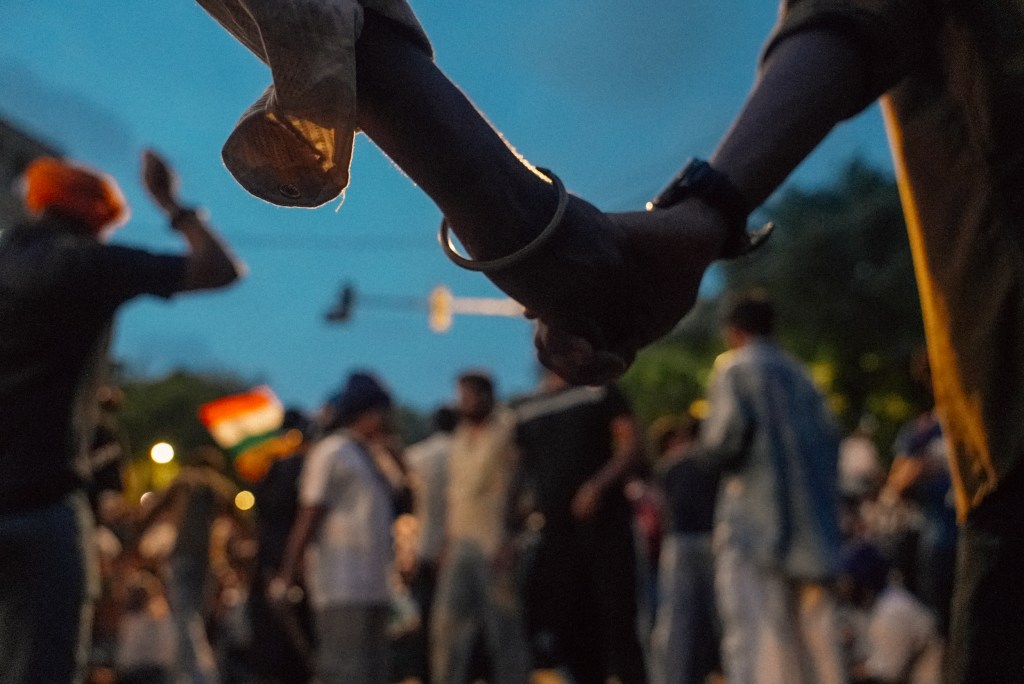
People hold hands to form a human chain. Photo by Akmal Nazer
With additional reporting by Anahita Ahluwalia and Siddharth Shukla
NEW DELHI, July 23 — Students protesting the alleged NEET-UG 2026 paper leak and wider exam irregularities held their ground on Sansad Marg on Thursday evening after the New Delhi Traders Association issued an urgent advisory asking shops, offices and restaurants to shut by 6:30 p.m. The traders’ body said it was acting on telephonic directions from the chairperson and vice-chairperson of the New Delhi Municipal Council, citing the security situation around central Delhi. Arvind Kejriwal also shared the advisory on X.
By the time the advisory reached shopkeepers, the area was already tense. From the Sansad Marg junction near Tolstoy Marg to the entrance toward Parliament, Delhi Police and Rapid Action Force had taken position. The market area nearby was chaotic, with shops pulling down shutters while vehicles continued to move in and around the road. Police buses blocked the routes leading toward Parliament, and only the lane toward the main protest stage remained open.
Between 7 and 8 p.m., the police began using loudspeakers to tell students to leave and return at 8 the next morning. The announcement was repeated several times, including twice on the Jai Singh Road side and once from the Sansad Marg side: “Aap yahan se jaiye, aur kal subah wapas aaiye. Hamare ghar mein bhi bachche hain, to aap apne ghar jaiye, apne mata pita ke saath jaiye. (Leave this place, and come back tomorrow morning. We too have children in our homes, and you should also leave for your homes, with your parents).” No written order was provided on the spot.
Mobile network disruption extended beyond the official suspension zone. The Union Home Ministry had ordered a mobile internet suspension within a 1.5-kilometer radius of Jantar Mantar from 4 p.m. to midnight, but a reporter on the ground said connectivity was affected up to 3 to 3.5 kilometers away, including at Copernicus Marg. Calls also failed, and mobile data worked only intermittently, returning reliably only inside a hotel room on Wi-Fi.
The students did not leave. As the police prepared to move forward, Nihangs and other Sikh volunteers stepped into the space between the students and the security line. According to students at the site, the Nihangs had been there since about 1 p.m. the previous day, running langar and seva and helping maintain order around the protest. A doctor, identified by protesters as Swaran, had also brought an ambulance.
Students said the Sikh volunteers had by then taken over much of the care and protection of the protest, stepping in quickly when anyone acted in a way that could be read as provocation. The volunteers physically restrained and hit protesters who threw plastic bottles toward the police, and heard from witnesses that others had been hit after throwing stones. After students formed a human chain around 9 to 9:30 p.m., the volunteers imposed a cordon of their own. Nobody, including the media, was allowed to breach it; a separate area was designated for reporters and photographers to speak to protesters and take images.
Our reporters on the ground estimated seeing about 25-30 Nihangs from 9 p.m. last night to noon today at Sansad Marg. More had gathered later in the night and early morning.
Through the night, the police held the line, while the students stayed. And the Sikh volunteers acting as a buffer occupied the space between them, distributing water and food, negotiating with officers, and trying to keep the protest calm enough that nothing could be construed as violence.
The police did not move against the Nihangs. As the police stopped advancing, a few Sikh men entered into conversation with officers. Through the night, older Sikh men arrived, as did parents of some of the protesters. What had begun as a student-run demonstration now had many others joining in.
By 6:30 a.m. on Friday, July 24, the Nihangs were still holding the center, still acting as a buffer between students and a force that had spent the night deployed for possible escalation. The night passed without the lathi-charge and tear gas that many at the site had been bracing for, and by morning the students had not moved.