




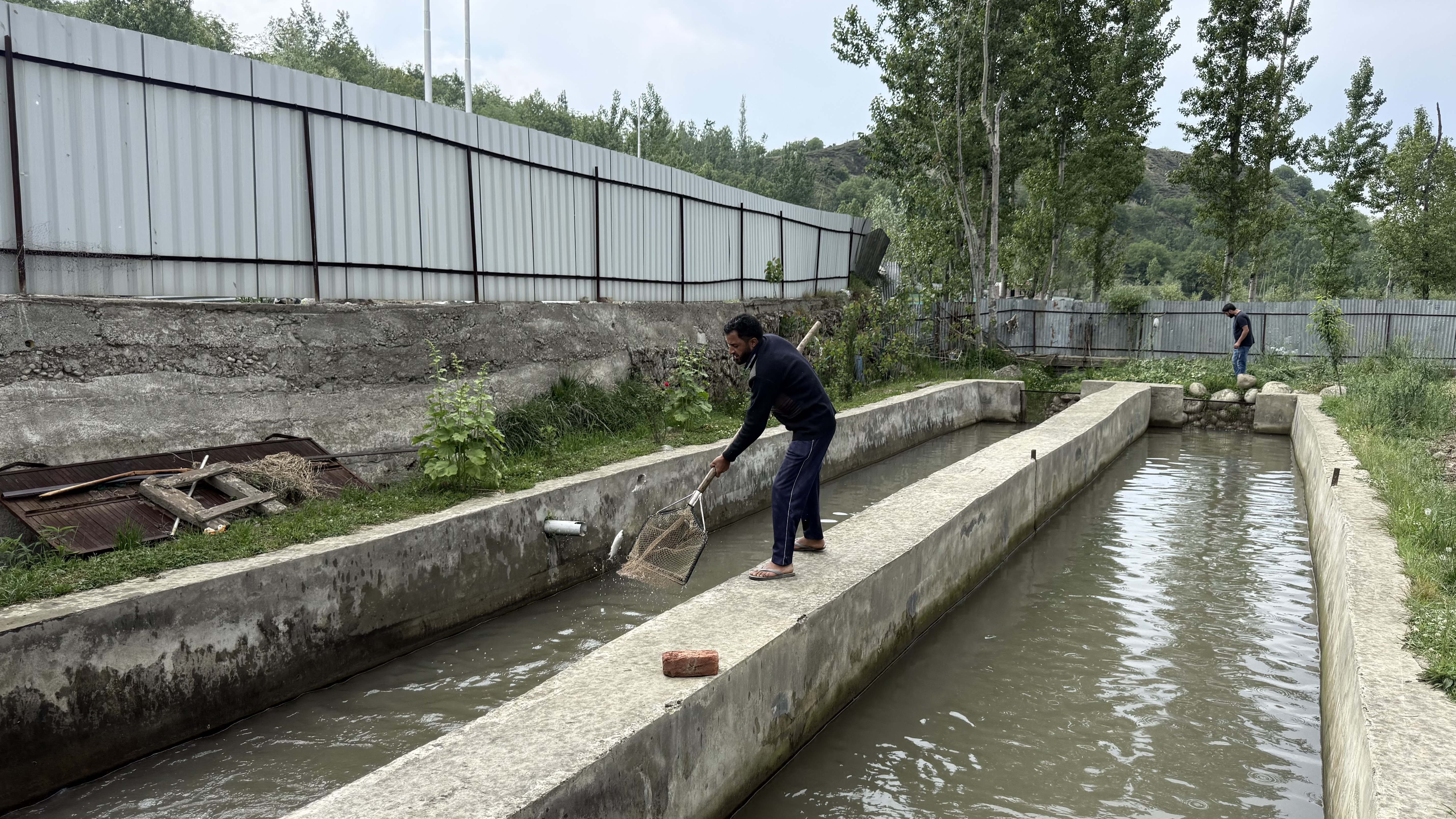
In May 2024, Peerzada Rayees, a fish farmer in Budgam, woke up to find about 2,000 trout dead in his farm in central Kashmir. “I couldn’t believe my eyes; it was years of my hard work, my understanding of the business that died in front of my eyes,” Rayees told The Polis Project.
Rayees’s fish became casualties of illegal riverbed mining, a longstanding problem in Kashmir that intensified after 2019—the year Prime Minister Narendra Modi’s government revoked the region’s special constitutional status, fundamentally altering who could control, access, and transform its land and natural resources.
Since then, residents say, the landscape around them has been stripped bare: riverbeds hollowed out, water diverted, land appropriated, and ecosystems damaged. Over the past six years, Jammu and Kashmir has also faced increasingly extreme weather, while administrative decisions and extractive policies have deepened the region’s environmental insecurity.
Undoing Article 370
On August 5, 2019, the Bharatiya Janata Party (BJP) fulfilled a promise it had repeatedly made to voters—in speeches, manifestos, and campaign rallies. The BJP-led government dismantled Jammu and Kashmir’s special constitutional status, rendered Article 35A inoperative, and replaced the legal framework that had restricted land ownership and public employment to the region’s permanent residents. The changes altered who could buy land, secure contracts, and participate in the economic remaking of the territory.
Kashmiri academic Sheik Showkat explains that Kashmiris have historically been wary of outsiders settling on their land. Harsh weather and poor connectivity had also kept much of the territory beyond the reach of ordinary people, he said.
“Formal legal barriers were created by Dogra Maharajas of the state via state subject laws. The 1927 legislation barred outsiders from purchasing land and being recruited in public service. These laws secured the state’s fragile ecosystem and ensured water security for the large human population around it. Articles 370 & 35A provided protection to these laws,” Showkat told The Polis Project.
The repeal of those provisions, he said, removed those protections and enabled outsiders to settle in J&K. “It endangered the whole ecosystem of the various mountain ranges. Religious tourism and infrastructure created for it post 2014 is another problem,” he said.
Shakir Parray, a lawyer at District Court Budgam, describes the period following August 2019 as an effort to silence Kashmiris. He says the same period brought an administrative assault on the region’s natural resources. “Environmental resources were being looted on administrative orders,” he told The Polis Project. “The legal architecture governing land in Jammu and Kashmir was being dismantled alongside it. On October 26th, 2020, the Indian government repealed 12 land laws and amended 14 others, weakening protections that had restricted who could own, purchase, transfer, and develop land in the region. The changes removed the “permanent resident” requirement from key provisions, opening parts of Jammu and Kashmir’s land market to non-residents.
The amendments removed the requirement that land under the Jammu and Kashmir Development Act be transferred only to ‘permanent residents’. They also repealed laws that restricted transfer of land to non-residents, and introduced provisions allowing the administration to designate ‘strategic areas’ for the armed forces’ operational and training requirements.
The legal re-engineering of Kashmir did more than facilitate development projects. It created an administrative architecture through which occupation could increasingly reshape the landscape itself. Mining leases, strategic roads, military infrastructure, and forest diversions were not isolated policies but interconnected mechanisms that reorganized control over the territory.
As India gained more control over Kashmir’s land, ecological destruction became one of the means through which that control was consolidated—and through which the relationship between Kashmiris and their environment was fundamentally altered.
Resisting River-Robbing

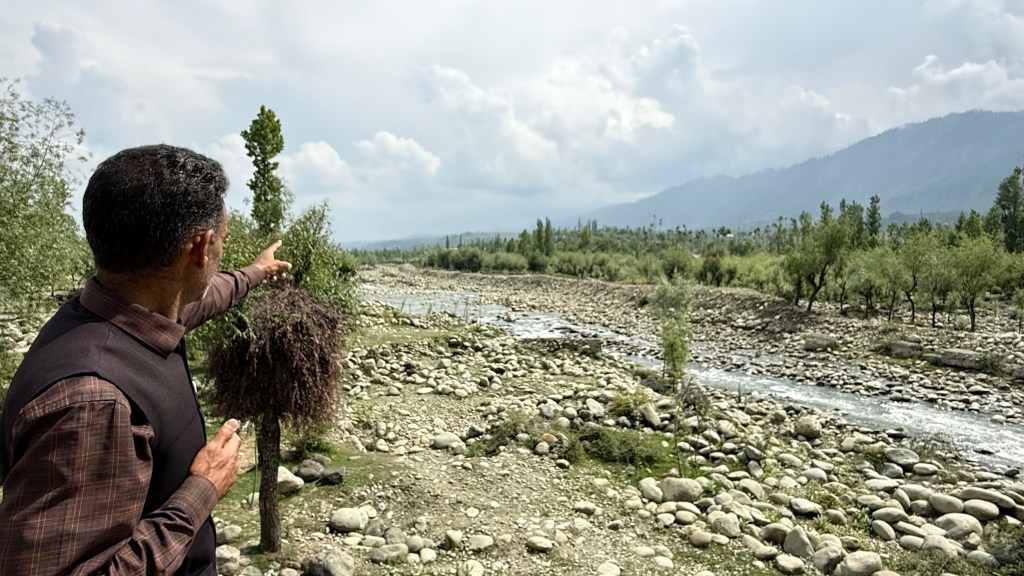
“The river is breathing now. It was our efforts that saved it,” says climate activist Raja Muzaffar Bhat as he looks at the Sukhnag river in central Kashmir’s Budgam district.
In many ways, Sukhnag became a real-time embodiment of Kashmir’s anxieties after the region’s constitutional protections were dismantled. Beginning in 2020, private contractors were permitted to extract sand, gravel, and boulders from the riverbed for five years. The permits, official records show, were issued as short-term permits, without the environmental studies and clearances required to assess the damage.
“We used to drink fresh water from springs that are now drying up. Kashmir is being robbed of its natural environment. Since 2020, we have seen a visible depletion of natural resources,” says Gulzar Ahmed, a resident of Malpora village in Budgam.
In January 2020, while Kashmir was still under the communication blockade imposed by India, government departments issued notices allowing for the extraction of minerals from riverbeds. These mining permits were issued without any replenishment studies or No Objection Certificates (NOCs) from the state and central pollution control boards. “This shows an utter disrespect for laws meant to safeguard the environment. It became like an open loot and plunder system,” climate activist Raja Muzaffar Bhat told The Polis Project. The ecological damage mounted quickly. Excavation lowered the riverbed and water levels, while irrigation channels began to run dry. In Budgam, the Sukhnag’s degradation also threatened trout habitats and downstream water supplies; later assessments documented altered river morphology, damage to aquifer systems, and the drying of springs and irrigation channels.
After repeated complaints to authorities, in 2024, Bhat moved the National Green Tribunal (NGT), maintaining that illegal and unscientific mining in Sukhnag had flouted environmental norms, causing severe ecological damage to the river and its dependent communities. In October 2024, in response to Bhat’s petition, the NGT constituted a joint committee comprising officials from various government departments and ministries. After this committee submitted its report, the tribunal imposed a blanket ban on riverbed mining in Sukhnag in its January 2025 order. The committee confirmed illegal mining in Sukhnag, linking the diversion of water to losses suffered by Rayees, increased turbidity, and declining water levels, and stated that, post 2020, the Geology and Mining Department had issued 163 Short-Term Permits to several companies, including institutions under the Government of India, for projects.
“The mining was halted, but look what happened. They didn’t even spare Kashmir’s waters, fish, and even trees,” Mir Mushtaq, a social activist from Budgam, said, noting that ecological erasure was rising since 2019.
On the ground, Sukhnag’s waters struggle to maintain their volume. More stones and pebbles are visible than the water. The applicability of central environment laws in Kashmir has turned the aqua-blue river into a rugged, grey patch of land. If the abrogation of Article 370 raised anxieties about who would control Kashmir’s land and resources, Sukhnag stands as a textbook example of what can happen when an ecologically fragile zone loses constitutional guarantees. In Sukhnag’s struggles, Kashmir’s anxieties found a physical form: dead fish floating in a river drained for profit, and residents watching their home erode before their eyes.
Firing Amidst the Forests
In Modi’s “Naya Kashmir,” the forests of Tulail revealed another dimension of Kashmir’s environmental transformation. But the militarization of the landscape did not begin in 2019. India’s armed forces have controlled land across Jammu and Kashmir for decades; by 2019, official figures put the area under defense use at more than 56,000 acres, while other government records estimated that approximately 21,500 hectares across the region were occupied by security forces. The figures are difficult to reconcile because they include different categories—acquired, leased, requisitioned, transferred, and allegedly occupied land.
In Kashmir’s Gurez Valley, near the Line of Control, Tulail Valley’s dense forests and high-altitude pastures have long sustained pastoralists and farming communities.
In 2024, Tulail’s residents were shocked to learn that the Indian Army had recommended establishing a firing range on a massive 4,542-hectare area. The proposed range fell within the strategically significant and ecologically pristine Gurez Conservation Reserve. The range was proposed in lieu of the Tosa Maidan meadow in central Kashmir, which was used for artillery exercises until 2014. The unexploded ordnance left behind killed and injured scores. “Our generations have lived and saved forests; forests are our heritage,” a shepherd from Tulail said, fearing that the range would threaten wildlife habitats and forests but also cut them off from grazing grounds, agricultural land, and seasonal migration routes that generations had depended upon. Locals told The Polis Project that the proposal felt less like a firing range and more like a systematic attempt to dispossess Kashmiris from their own land.
But Tulail’s residents resisted. After sustained local opposition and an environmental damage assessment, the proposal stalled. That outcome makes Tulail unusual. Unlike many of the post-2019 land diversions that were ultimately approved, heavy community mobilization interrupted the conversion of a protected landscape into military infrastructure before it could materialize. The project was also halted because of a sub-committee’s report, which stated that local communities such as agro-pastoralists would be severely affected, along with potential harm to animals caused by firing and unexploded shells, as well as the possibility of recurrent soil disturbance at the core impact zone.
The proposal to turn Tulail into a Tosa Maidan-style artillery range revealed that forests, grazing commons, and conservation land could be bureaucratically reclassified as military space long before a single shell was fired.
In 2019-2021 alone, the Jammu and Kashmir administration transferred over 250 hectares of eco-fragile forest land to the armed forces. The administration transferred 135.57 hectares of forest land in Jammu’s Chowadhi to the Border Security Force (BSF) for building a long-range small arms training ground.
Following the April 2025 militant attack in Pahalgam, Indian military agencies expanded their presence across parts of Kashmir, establishing dozens of temporary operating bases inside forested areas to strengthen counter-insurgency operations, turning ecologically sensitive landscapes into security infrastructure.
Taken together, these episodes of forest diversion approvals in J&K for armed forces and defense-related projects illustrate that military expansion has tangible ecological costs. Read together, these diversion orders reveal how occupation is administered through paperwork as much as through armed presence.
Each order transforms forests into military space and diminishes the access of Kashmiri communities to their own surroundings, making ecocide and displacement inseparable outcomes of the same administrative process.
Residents of Tosa Maidan and Tulail fear what the future holds. For them, the Army’s use—and, in Tulail, the proposed acquisition—of their meadows threatens to bring renewed trauma, restricted access to the fields and grazing grounds where they grew up, and the ever-present risk of stepping on unexploded ordnance left behind by exercises intended for an enemy. At Tosa Maidan, decades of military firing reportedly killed at least 67 people and injured more than 50 through misfired or unexploded shells.
“These meadows raised us like a mother. If they become a firing range, what will be left for our children?” a schoolteacher in Tulail asks.
From Encroachment to Erasure
Bundles of envelopes, letters, folded maps and years of newspaper cuttings spill across the desks and shelves of M.M. Shuja’s Srinagar office. Shuja reaches for another stack of Right to Information (RTI) replies—letters from Kashmir’s forest, wildlife and wetland departments that he has spent years collecting.
“We have to have proof, documents, maps and plans of which land is being diverted and to which government department,” says Shuja. He has attempted to trace what official notifications rarely reveal on their own: how, over the last five years, the Valley’s ecological resources were being gradually redistributed to Indian ministries, the armed forces, and private contractors from mainland India.

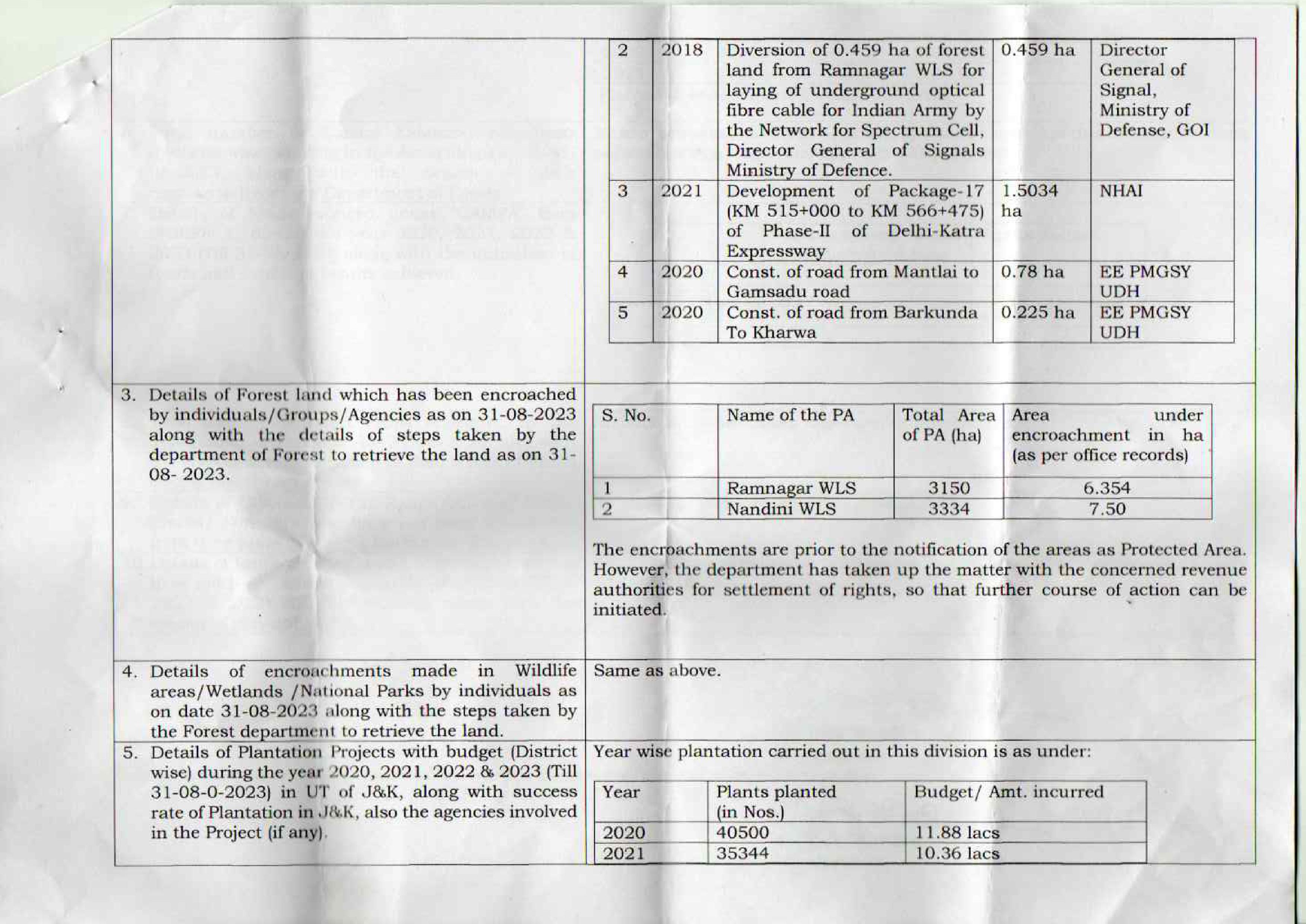
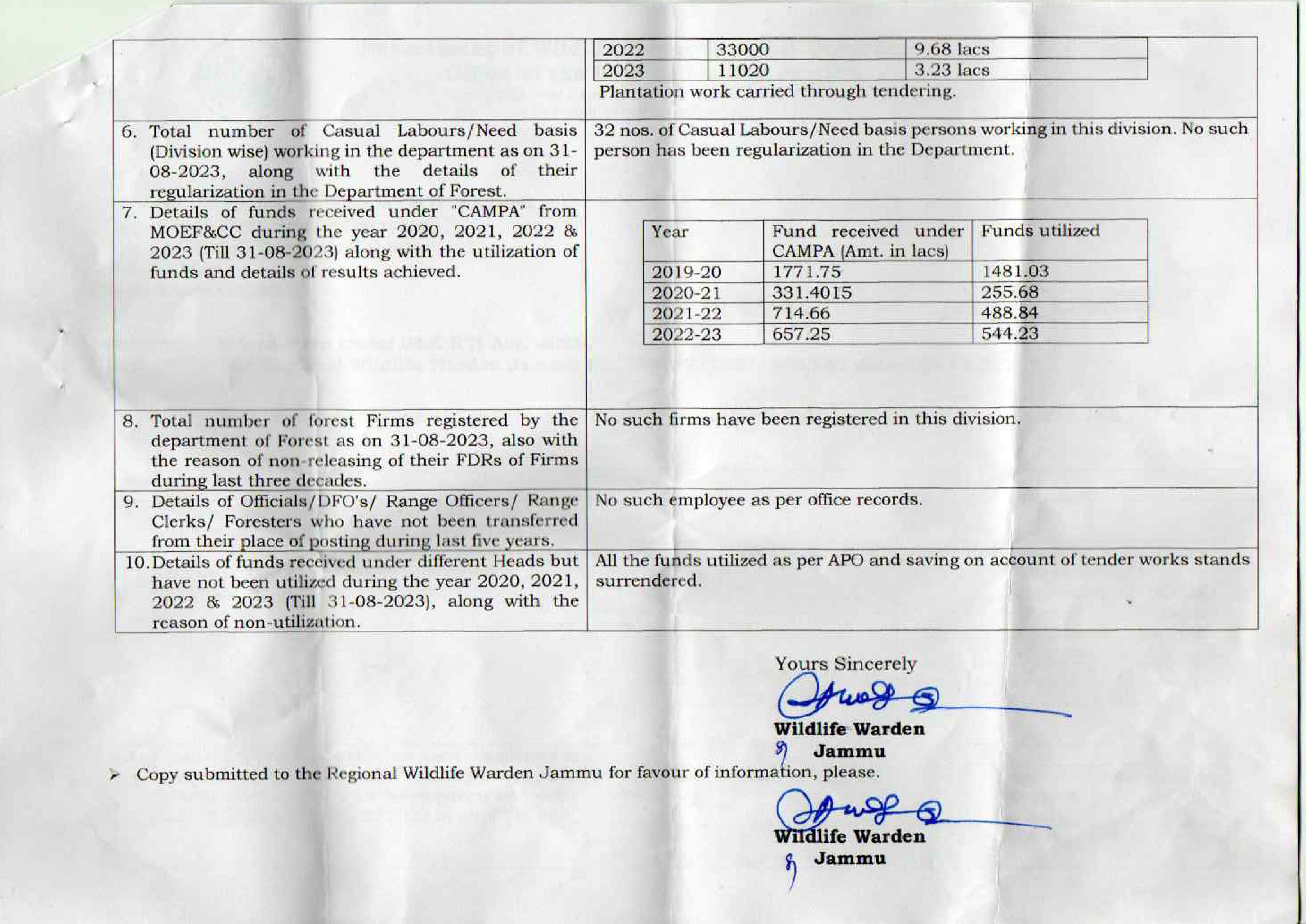
The Polis Project accessed several RTIs filed with Kashmir’s forest and wildlife departments, which Shuja used to compile a chronology of how protected patches of land were systematically opened to infrastructure and security projects. The records show that in 2019, the Standing Committee of the National Board for Wildlife approved the diversion of 1.18 hectares of land inside Gulmarg Wildlife Sanctuary to the Indian Air Force for the installation of an air defense and weaponry project. In 2021, 1.5 hectares of Jammu’s Ramnagar Wildlife Sanctuary were transferred to the National Highways Authority of India (NHAI) for the Delhi–Amritsar–Katra Expressway. Till 2023, nearly 14 hectares of forest land in Jammu’s Ramnagar and Nandini Wildlife Sanctuaries had been encroached. The RTI records that 6.35 hectares in the Ramnagar Wildlife Sanctuary and 7.50 hectares in the Nandini Wildlife Sanctuary were encroached upon by the NHAI and the Border Roads Organization (BRO). More recently, during 2022–23, 3.68 hectares of the Chhachhera Conservation Reserve in Rajouri were diverted to the BRO for widening the Akhnoor–Poonch road, which is strategically significant because it connects Jammu with the border districts of Rajouri and Poonch, both of which lie along the Line of Control (LoC) and host a massive military presence.
On August 13, the Centre informed the Rajya Sabha that Jammu and Kashmir saw 1,086.01 hectares of forest land being diverted for non-forestry purposes during the last three years and the current financial year up to August 6, 2026.
When stitched together, Shuja says, “The replies to my RTIs reveal that even legally protected forests and wildlife habitats have increasingly been opened up and diverted for strategic and developmental projects”.
Both Bhat’s legal battle and Shuja’s archive reveal that ecocide in post-2019 Kashmir has unfolded not only through excavators and mining leases, but through India’s expanding infrastructure of militarization.
Proposed firing ranges, forest diversion orders, new military operating bases, and strategic clearances are not isolated incidents of environmental resources merely being redistributed. Rather, they show how militarization advances by converting ecologically fragile landscapes into security infrastructure, making ecological destruction inseparable from the expansion of military control over land.
For Kashmiris, the loss of Articles 370 and 35A did more than delete constitutional protections. It opened the way for new buyers and new claims over their homeland. On the ground, the rivers became the first bearers of that change, revealing in real time that the custodian of Kashmir had changed—and that this new custodian could now sell off its waters, stones, mountains and forests, one administrative order at a time.


Erasure & Ecocide: Post 2019, India’s Legal Re-Engineering is Hollowing Out Kashmir’s Rivers and Forests

Budgam based activist Mir Mushtaq points to Sukhnag's journey in Kashmir. Credit Tarushi Aswani
In May 2024, Peerzada Rayees, a fish farmer in Budgam, woke up to find about 2,000 trout dead in his farm in central Kashmir. “I couldn’t believe my eyes; it was years of my hard work, my understanding of the business that died in front of my eyes,” Rayees told The Polis Project.
Rayees’s fish became casualties of illegal riverbed mining, a longstanding problem in Kashmir that intensified after 2019—the year Prime Minister Narendra Modi’s government revoked the region’s special constitutional status, fundamentally altering who could control, access, and transform its land and natural resources.
Since then, residents say, the landscape around them has been stripped bare: riverbeds hollowed out, water diverted, land appropriated, and ecosystems damaged. Over the past six years, Jammu and Kashmir has also faced increasingly extreme weather, while administrative decisions and extractive policies have deepened the region’s environmental insecurity.
Undoing Article 370
On August 5, 2019, the Bharatiya Janata Party (BJP) fulfilled a promise it had repeatedly made to voters—in speeches, manifestos, and campaign rallies. The BJP-led government dismantled Jammu and Kashmir’s special constitutional status, rendered Article 35A inoperative, and replaced the legal framework that had restricted land ownership and public employment to the region’s permanent residents. The changes altered who could buy land, secure contracts, and participate in the economic remaking of the territory.
Kashmiri academic Sheik Showkat explains that Kashmiris have historically been wary of outsiders settling on their land. Harsh weather and poor connectivity had also kept much of the territory beyond the reach of ordinary people, he said.
“Formal legal barriers were created by Dogra Maharajas of the state via state subject laws. The 1927 legislation barred outsiders from purchasing land and being recruited in public service. These laws secured the state’s fragile ecosystem and ensured water security for the large human population around it. Articles 370 & 35A provided protection to these laws,” Showkat told The Polis Project.
The repeal of those provisions, he said, removed those protections and enabled outsiders to settle in J&K. “It endangered the whole ecosystem of the various mountain ranges. Religious tourism and infrastructure created for it post 2014 is another problem,” he said.
Shakir Parray, a lawyer at District Court Budgam, describes the period following August 2019 as an effort to silence Kashmiris. He says the same period brought an administrative assault on the region’s natural resources. “Environmental resources were being looted on administrative orders,” he told The Polis Project. “The legal architecture governing land in Jammu and Kashmir was being dismantled alongside it. On October 26th, 2020, the Indian government repealed 12 land laws and amended 14 others, weakening protections that had restricted who could own, purchase, transfer, and develop land in the region. The changes removed the “permanent resident” requirement from key provisions, opening parts of Jammu and Kashmir’s land market to non-residents.
The amendments removed the requirement that land under the Jammu and Kashmir Development Act be transferred only to ‘permanent residents’. They also repealed laws that restricted transfer of land to non-residents, and introduced provisions allowing the administration to designate ‘strategic areas’ for the armed forces’ operational and training requirements.
The legal re-engineering of Kashmir did more than facilitate development projects. It created an administrative architecture through which occupation could increasingly reshape the landscape itself. Mining leases, strategic roads, military infrastructure, and forest diversions were not isolated policies but interconnected mechanisms that reorganized control over the territory.
As India gained more control over Kashmir’s land, ecological destruction became one of the means through which that control was consolidated—and through which the relationship between Kashmiris and their environment was fundamentally altered.
Resisting River-Robbing
“The river is breathing now. It was our efforts that saved it,” says climate activist Raja Muzaffar Bhat as he looks at the Sukhnag river in central Kashmir’s Budgam district.
In many ways, Sukhnag became a real-time embodiment of Kashmir’s anxieties after the region’s constitutional protections were dismantled. Beginning in 2020, private contractors were permitted to extract sand, gravel, and boulders from the riverbed for five years. The permits, official records show, were issued as short-term permits, without the environmental studies and clearances required to assess the damage.
“We used to drink fresh water from springs that are now drying up. Kashmir is being robbed of its natural environment. Since 2020, we have seen a visible depletion of natural resources,” says Gulzar Ahmed, a resident of Malpora village in Budgam.
In January 2020, while Kashmir was still under the communication blockade imposed by India, government departments issued notices allowing for the extraction of minerals from riverbeds. These mining permits were issued without any replenishment studies or No Objection Certificates (NOCs) from the state and central pollution control boards. “This shows an utter disrespect for laws meant to safeguard the environment. It became like an open loot and plunder system,” climate activist Raja Muzaffar Bhat told The Polis Project. The ecological damage mounted quickly. Excavation lowered the riverbed and water levels, while irrigation channels began to run dry. In Budgam, the Sukhnag’s degradation also threatened trout habitats and downstream water supplies; later assessments documented altered river morphology, damage to aquifer systems, and the drying of springs and irrigation channels.
After repeated complaints to authorities, in 2024, Bhat moved the National Green Tribunal (NGT), maintaining that illegal and unscientific mining in Sukhnag had flouted environmental norms, causing severe ecological damage to the river and its dependent communities. In October 2024, in response to Bhat’s petition, the NGT constituted a joint committee comprising officials from various government departments and ministries. After this committee submitted its report, the tribunal imposed a blanket ban on riverbed mining in Sukhnag in its January 2025 order. The committee confirmed illegal mining in Sukhnag, linking the diversion of water to losses suffered by Rayees, increased turbidity, and declining water levels, and stated that, post 2020, the Geology and Mining Department had issued 163 Short-Term Permits to several companies, including institutions under the Government of India, for projects.
“The mining was halted, but look what happened. They didn’t even spare Kashmir’s waters, fish, and even trees,” Mir Mushtaq, a social activist from Budgam, said, noting that ecological erasure was rising since 2019.
On the ground, Sukhnag’s waters struggle to maintain their volume. More stones and pebbles are visible than the water. The applicability of central environment laws in Kashmir has turned the aqua-blue river into a rugged, grey patch of land. If the abrogation of Article 370 raised anxieties about who would control Kashmir’s land and resources, Sukhnag stands as a textbook example of what can happen when an ecologically fragile zone loses constitutional guarantees. In Sukhnag’s struggles, Kashmir’s anxieties found a physical form: dead fish floating in a river drained for profit, and residents watching their home erode before their eyes.
Firing Amidst the Forests
In Modi’s “Naya Kashmir,” the forests of Tulail revealed another dimension of Kashmir’s environmental transformation. But the militarization of the landscape did not begin in 2019. India’s armed forces have controlled land across Jammu and Kashmir for decades; by 2019, official figures put the area under defense use at more than 56,000 acres, while other government records estimated that approximately 21,500 hectares across the region were occupied by security forces. The figures are difficult to reconcile because they include different categories—acquired, leased, requisitioned, transferred, and allegedly occupied land.
In Kashmir’s Gurez Valley, near the Line of Control, Tulail Valley’s dense forests and high-altitude pastures have long sustained pastoralists and farming communities.
In 2024, Tulail’s residents were shocked to learn that the Indian Army had recommended establishing a firing range on a massive 4,542-hectare area. The proposed range fell within the strategically significant and ecologically pristine Gurez Conservation Reserve. The range was proposed in lieu of the Tosa Maidan meadow in central Kashmir, which was used for artillery exercises until 2014. The unexploded ordnance left behind killed and injured scores. “Our generations have lived and saved forests; forests are our heritage,” a shepherd from Tulail said, fearing that the range would threaten wildlife habitats and forests but also cut them off from grazing grounds, agricultural land, and seasonal migration routes that generations had depended upon. Locals told The Polis Project that the proposal felt less like a firing range and more like a systematic attempt to dispossess Kashmiris from their own land.
But Tulail’s residents resisted. After sustained local opposition and an environmental damage assessment, the proposal stalled. That outcome makes Tulail unusual. Unlike many of the post-2019 land diversions that were ultimately approved, heavy community mobilization interrupted the conversion of a protected landscape into military infrastructure before it could materialize. The project was also halted because of a sub-committee’s report, which stated that local communities such as agro-pastoralists would be severely affected, along with potential harm to animals caused by firing and unexploded shells, as well as the possibility of recurrent soil disturbance at the core impact zone.
The proposal to turn Tulail into a Tosa Maidan-style artillery range revealed that forests, grazing commons, and conservation land could be bureaucratically reclassified as military space long before a single shell was fired.
In 2019-2021 alone, the Jammu and Kashmir administration transferred over 250 hectares of eco-fragile forest land to the armed forces. The administration transferred 135.57 hectares of forest land in Jammu’s Chowadhi to the Border Security Force (BSF) for building a long-range small arms training ground.
Following the April 2025 militant attack in Pahalgam, Indian military agencies expanded their presence across parts of Kashmir, establishing dozens of temporary operating bases inside forested areas to strengthen counter-insurgency operations, turning ecologically sensitive landscapes into security infrastructure.
Taken together, these episodes of forest diversion approvals in J&K for armed forces and defense-related projects illustrate that military expansion has tangible ecological costs. Read together, these diversion orders reveal how occupation is administered through paperwork as much as through armed presence.
Each order transforms forests into military space and diminishes the access of Kashmiri communities to their own surroundings, making ecocide and displacement inseparable outcomes of the same administrative process.
Residents of Tosa Maidan and Tulail fear what the future holds. For them, the Army’s use—and, in Tulail, the proposed acquisition—of their meadows threatens to bring renewed trauma, restricted access to the fields and grazing grounds where they grew up, and the ever-present risk of stepping on unexploded ordnance left behind by exercises intended for an enemy. At Tosa Maidan, decades of military firing reportedly killed at least 67 people and injured more than 50 through misfired or unexploded shells.
“These meadows raised us like a mother. If they become a firing range, what will be left for our children?” a schoolteacher in Tulail asks.
From Encroachment to Erasure
Bundles of envelopes, letters, folded maps and years of newspaper cuttings spill across the desks and shelves of M.M. Shuja’s Srinagar office. Shuja reaches for another stack of Right to Information (RTI) replies—letters from Kashmir’s forest, wildlife and wetland departments that he has spent years collecting.
“We have to have proof, documents, maps and plans of which land is being diverted and to which government department,” says Shuja. He has attempted to trace what official notifications rarely reveal on their own: how, over the last five years, the Valley’s ecological resources were being gradually redistributed to Indian ministries, the armed forces, and private contractors from mainland India.
The Polis Project accessed several RTIs filed with Kashmir’s forest and wildlife departments, which Shuja used to compile a chronology of how protected patches of land were systematically opened to infrastructure and security projects. The records show that in 2019, the Standing Committee of the National Board for Wildlife approved the diversion of 1.18 hectares of land inside Gulmarg Wildlife Sanctuary to the Indian Air Force for the installation of an air defense and weaponry project. In 2021, 1.5 hectares of Jammu’s Ramnagar Wildlife Sanctuary were transferred to the National Highways Authority of India (NHAI) for the Delhi–Amritsar–Katra Expressway. Till 2023, nearly 14 hectares of forest land in Jammu’s Ramnagar and Nandini Wildlife Sanctuaries had been encroached. The RTI records that 6.35 hectares in the Ramnagar Wildlife Sanctuary and 7.50 hectares in the Nandini Wildlife Sanctuary were encroached upon by the NHAI and the Border Roads Organization (BRO). More recently, during 2022–23, 3.68 hectares of the Chhachhera Conservation Reserve in Rajouri were diverted to the BRO for widening the Akhnoor–Poonch road, which is strategically significant because it connects Jammu with the border districts of Rajouri and Poonch, both of which lie along the Line of Control (LoC) and host a massive military presence.
On August 13, the Centre informed the Rajya Sabha that Jammu and Kashmir saw 1,086.01 hectares of forest land being diverted for non-forestry purposes during the last three years and the current financial year up to August 6, 2026.
When stitched together, Shuja says, “The replies to my RTIs reveal that even legally protected forests and wildlife habitats have increasingly been opened up and diverted for strategic and developmental projects”.
Both Bhat’s legal battle and Shuja’s archive reveal that ecocide in post-2019 Kashmir has unfolded not only through excavators and mining leases, but through India’s expanding infrastructure of militarization.
Proposed firing ranges, forest diversion orders, new military operating bases, and strategic clearances are not isolated incidents of environmental resources merely being redistributed. Rather, they show how militarization advances by converting ecologically fragile landscapes into security infrastructure, making ecological destruction inseparable from the expansion of military control over land.
For Kashmiris, the loss of Articles 370 and 35A did more than delete constitutional protections. It opened the way for new buyers and new claims over their homeland. On the ground, the rivers became the first bearers of that change, revealing in real time that the custodian of Kashmir had changed—and that this new custodian could now sell off its waters, stones, mountains and forests, one administrative order at a time.