


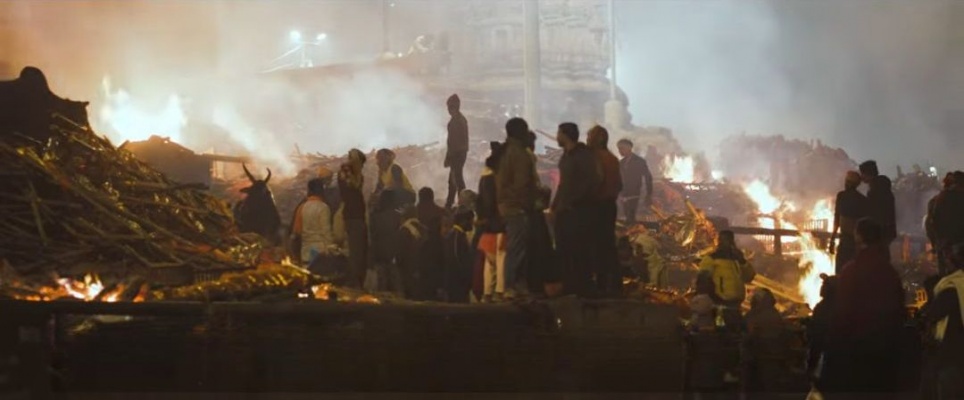
Babita Gautam and Sahil Valmiki’s documentary, Wounds of Pyre: Inside the Minds of Cremation Workers, starts with familiar glimpses of the Indian city of Varanasi: pilgrims seeking inner peace and to be present at the well-known evening aarti. As people quickly and lightly pass their hands over the aarti lamps to receive blessings, the scene sharply cuts to blazing funeral pyres. It then zooms out to show the many cremation workers standing next to them. They occasionally prod the pyres with a wooden stick held with bare hands to aid the burning of a dead body.
In Varanasi, the aarti is for caste Hindus, but the searing funeral pyres are for the Dom community, a Scheduled Caste (Dalit) group who have been performing cremations in the ghats of Varanasi for generations.
“We know that death takes a huge emotional and physical toll on people,” Valmiki explained. “In India, the everyday encounter with death through cremating bodies is brutally assigned to only one community, and it’s solely because of the caste they belong to. Some people know of the work the Dom community does, but how it affects their minds has never been a focus.”
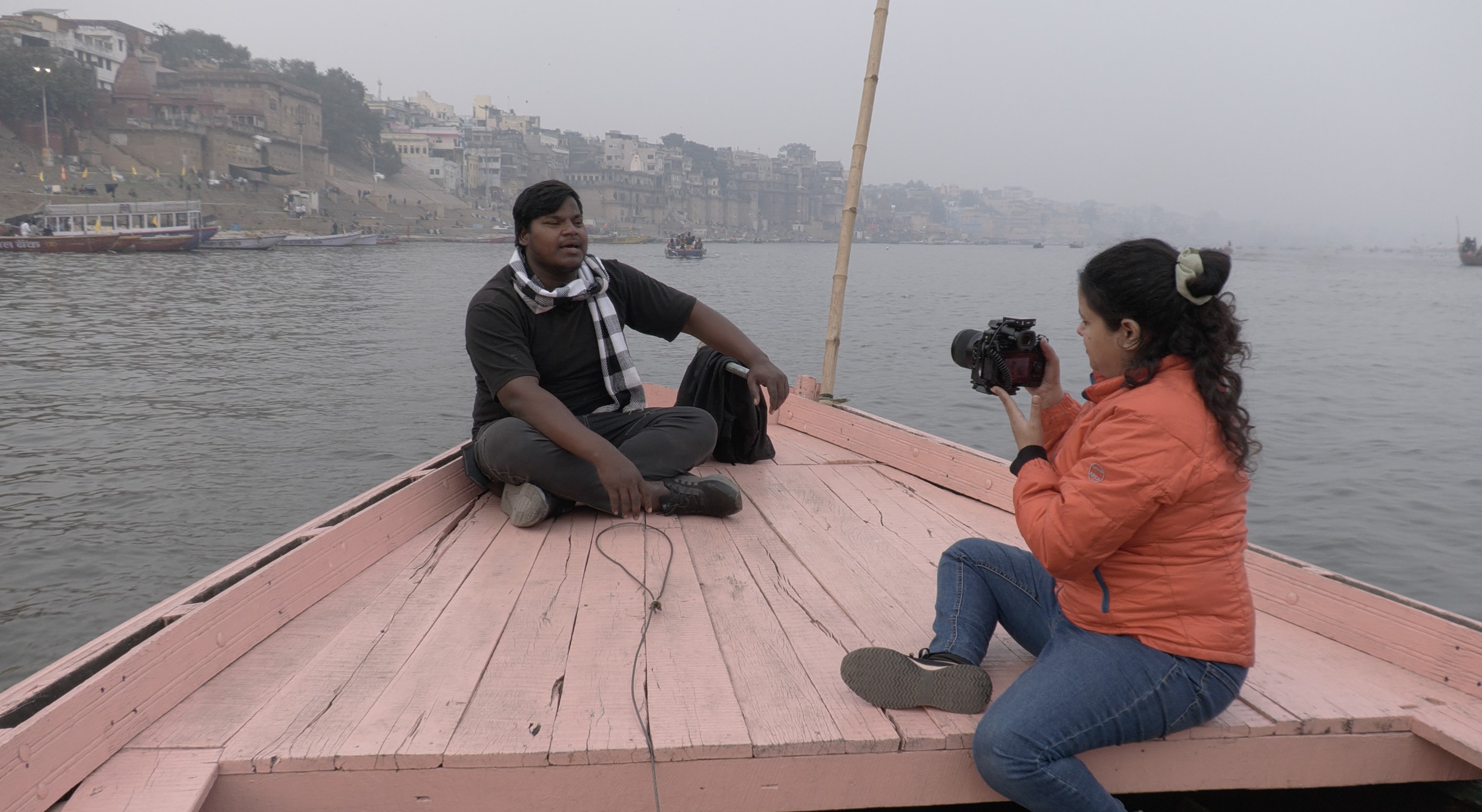
As journalists from the Dalit community and founders of Dalit Desk, a news media organization, Gautam and Valmiki have been documenting the lived realities of Dalits across India since 2019. They began their journeys as community journalists, reporting on caste atrocities, systemic inequalities, and social justice movements.
Wounds of Pyre, their first documentary, which premiered last February, funded by the Mariwala Health Initiative, takes an unflinching look at how the work the Dom community is made to do affects their mental well-being. In 60 minutes, the camera expertly documents how the cremation workers burn about 18 to 20 bodies daily, surrounded by pyres, as if trapping them. During COVID-19, the number rose to 82 in a day. Some bodies burn for 10 to 15 or even 28 hours. But people who come for the cremation often ask them to finish the job in 90 minutes or so, underscoring the complete ignorance of the extreme conditions that they work in.
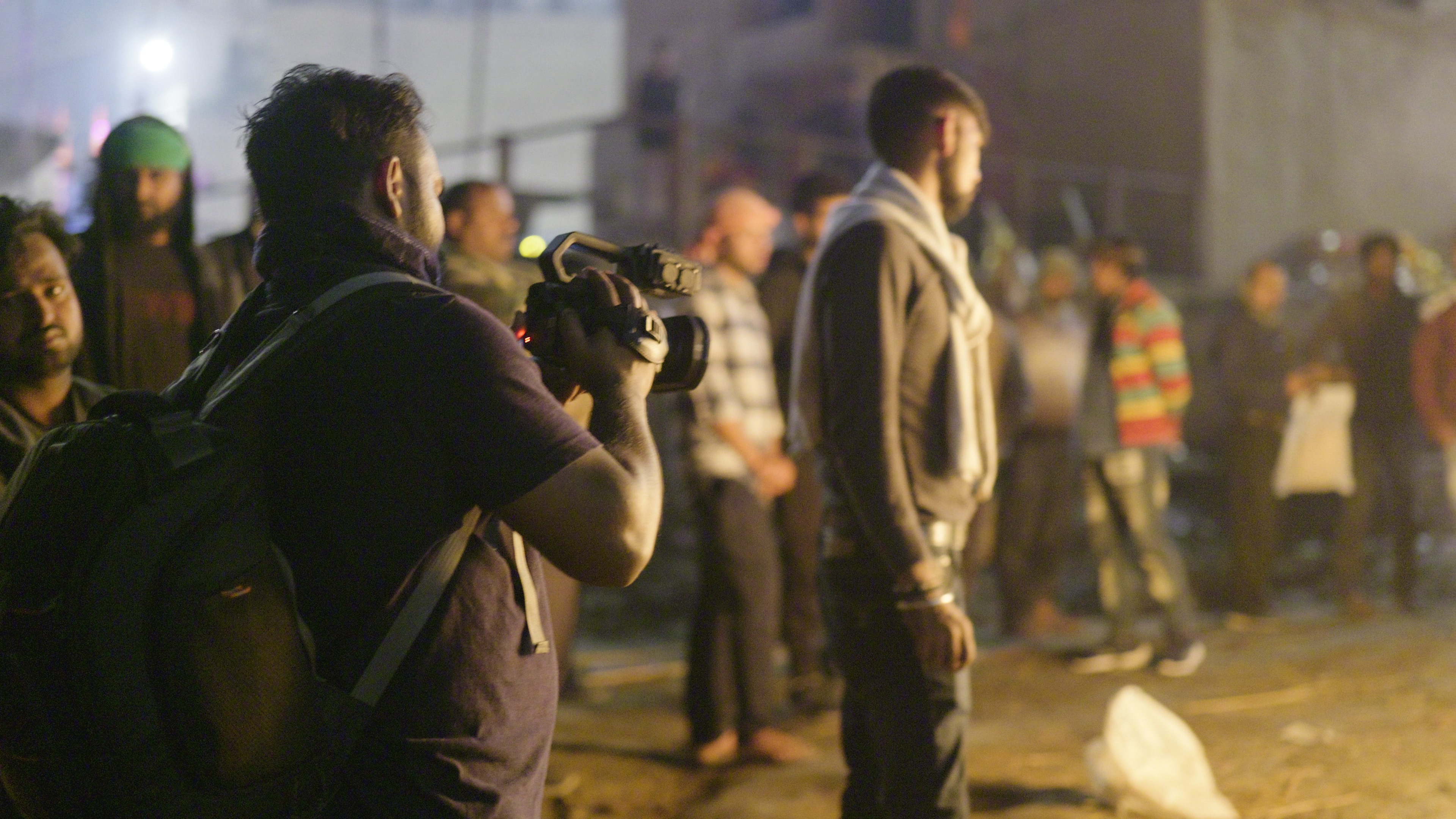
Each frame, and subtle layering of visual elements, such as the constant burning of pyres in the background while the men talk to the camera and the chants of “Ram Naam Satya Hai (Truth is the essence of Rama’s name) echo, are deliberately and strikingly captured by cinematographer Rohit Siddharth, who is also the editor. There is an unmissable sense of honesty in the lens, which is why the film resists sanitizing visuals for viewers.
No Other Choice
In a poignant scene in Wounds of Pyre, one of the cremation workers, Pawan Choudhury, who grew up watching what life spent at the ghat cremating bodies looked like, recalls that at one point in his life, he thought education could be a way out. But his father’s health issues and financial strain left him with no choice but to turn to the pyre. Pawan was 16 when he started cremating bodies. “I have cremated more bodies than my age,” the 22-year-old tells the filmmakers.
When asked if he remembers the first time he cremated a body, Pawan says nothing, just looks into the camera. After a few moments, he tells them it felt “strange.” He adds, “It hit me that someday, I will cremate my family.”
The workers are tied to the job by casteist beliefs that only they can do the job, and by making education and employment opportunities inaccessible to them, so that they don’t have other options but to continue the generational work. A 2024 study, published in the International Journal of Social Impact, found that only 13% of 75 respondents from the Dom community were literate.
The documentary challenges the narrative that links individual choice or merit with caste-based occupations. As the bodies burn around him, Panchkoshi, one of the cremation workers, says, “There are some bodies that make our eyes fill with tears and leave us in a state of disbelief. Yet, we continue the work because who else will take on this task? It’s either us or no one.”
“Be it cremating bodies or manual scavenging, no one is doing these caste-based occupations willingly,” Valmiki explained. “They are left with no other option but to continue the cycle. Caste is so deeply embedded in every aspect of Indian society that people have been made to look at their oppression through the lens of duty.”
Dr Vaishali Sonavane, a Dalit mental health professional featured in the documentary, emphasized that work such as burning pyres is not just caste-based but “forced occupation” and that caste is determined by where “we are born, and that dictates where we work.”
With the use of mythology and cultural narratives that tie them to the work they do, the Dom community, who are often called the “Dom raja” or king of the cremation ghats, are forced to remain the poorest of the poor. They risk their lives to earn just about ₹200 for cremating one body, Valmiki said.
The forced occupation not only affects the men working in the ghat but also the women who are restricted to their homes. While Vishal, one of the cremation workers featured in Wounds of Pyre, burns bodies at the ghat, we see his mother, Darshan Devi, spend her life within the four walls of their house.
For Devi, imagining a life beyond the one she has seen feels impossible. When the filmmakers ask her what she would do if she were to be made prime minister for a day, she refuses to even consider it. “It can’t happen for us,” she insists. After some persuasion, she finally says she would “do it the right way” and “respect is everything” for them.
“For the Dom community, their home is their safe space,” Valmiki explained. “They live in a world where they can be killed for a ringtone or not covering their faces and constantly face abuse at the ghat, they want to keep women and children safe at home.”
A Closer Look at Mental Well-Being
In one scene, a voice cuts through the smoke: “Just cremate the body; don’t haggle over how much I’ll pay.” It starkly reveals the constant erosion of the Dom community’s dignity, not just by the job they are bound to but also the social contempt that comes with it. For the cremation workers, dehumanization clings to them like ash.
As Dr Sonavane points out in the documentary, even the sight of a dead body leaves a lasting impact for days, so one can only imagine the emotional toll the day and night burning of dead bodies has on the Dom community. She insists that it’s a violation of their mental health because it’s a violation of basic human rights.
Caste-based occupations are imposed, not chosen. In a country that continues to deny caste discrimination, the accompanying trauma is often passed on through generations as survival strategies. Over the years, some researchers have highlighted the link between caste discrimination and mental well-being. For instance, a 2024 study showed that Scheduled Caste and Muslim respondents had worse mental health compared to higher caste Hindu respondents. Moreover, studies have also shown that psychoanalysis in India is dominated by “elite upper caste Hindu professionals,” so mental health resources remain inaccessible to people from lowered castes.
Furthermore, there is a lack of research on the impact of caste-based occupation on the Dom community’s well-being. In this light, the documentary is of immense importance as evidence of the severity of the impact on cremation workers and their families. The women of the community are restricted to their house—not covering their face puts their life at risk—and there is a constant reminder that people from their community cannot walk around freely in public places.
What also makes Wounds of Pyre different is the absence of the savarna gaze. During their research, Gautam and Valmiki examined articles, films, and documentaries about the Dom community but quickly noticed a savarna gaze that they found disheartening. For Valmiki, this also underscores the importance of Dalit media houses and journalists who can convey the story through their lens. When filmmakers from the Dalit community tell these stories, it’s also about reclaiming agency and demanding accountability.
The concept of work satisfaction, which is important for well-being, is alien to the Dom community, Dr Sonavane notes in the documentary. With this experience, acts of discrimination such as avoiding their presence, not eating what they cook, and maintaining distance further wear down their self-worth, pushing them towards psychological numbness.
“While constantly cremating the dead, my own body has burned away,” Panchkoshi says in Wounds of Pyre. “If I don’t speak, I’m as dead as the bodies I burn.”
Valmiki shared, off-camera, that some cremation workers mentioned that sometimes their own family members refuse to touch them. For them, the sense of inferiority is the shadow that they can’t seem to escape from in any space they exist in.
“The connection between caste and mental health is that you start believing what society tells you,” he further explained. “When you are constantly told that ‘you are not capable of doing anything else,’ you submerge in self-doubt.”
Caste, Climate, and Health
The documentary also touches on the intersection of caste and climate change—a conversation that often excludes those most affected. In March, as scorching heat swept through Uttar Pradesh, the maximum temperature in Varanasi equaled the 140-year-old record at 47.2 ℃. The cremation workers, who burn bodies throughout the day, experience these extreme temperatures from all sides. As Dr Sonavane says in the documentary, “While a dead body is burning, a live body is also burning.”
“People sit in metro cities like Delhi or Mumbai, in air-conditioned rooms, and talk about heatwaves,” Valmiki said. “But the body of the person, who is working at these ghats, is constantly experiencing the consequences of being excluded from discussions and solutions about climate change.”
Vishal talks about becoming sick because of the heat and the many challenges they face when the sun is “unbearable.” Raj Mariwala, director of Mariwala Health Initiative, highlights in the documentary how climate discourse is dominated by privileged narratives. Adding that even though the Dom community has been experiencing the effects of air pollution for generations, there has been no acknowledgement or study of it.
Wounds of Pyre also delves into the impossible options available to the Dom community to do the work they do. It captures moments of quiet coping—eating gutka, consuming alcohol, or smoking cigarettes. The cremation workers talk about how the pyres dry up their bodies while the smell of the dead bodies clings to the air they breathe.
“They have to choose which death involves less suffering. If they have to bear the work, they have to depend on alcohol or cigarettes or other addictions. Imagine the situation they are dealing with if these are the only options left for them, which come with severe health consequences,” Valmiki said.
Moreover, basic health checkups and access to health camps are unavailable to them, he added. It’s just smoke, ash, and fire.
For instance, in one scene, while assembling the firewood for the pyre, Vishal cuts his hand on a nail. He casually remarks that in all his years at the ghat, he’s never taken the tetanus vaccine.
Hope for a Better Future
The filmmakers insist that this documentary is not just about pain and suffering because: how can a human experience be just that? Thus, they weave in glimpses of the community’s joy: their festivals, and the hope that the cremation workers carry within themselves. Standing in front of the burning pyres, for example, Vishal quite firmly says he doesn’t want his children to do this work. He doesn’t want this to be their life.
Valmiki pointed out that films on the Dom community often lack this human aspect. “No one can live their lives only in grief; there will be moments of joy and hope. It’s important to show the spectrum of emotions they experience, from falling to getting up, surviving, and laughing. Otherwise, it’s a one-dimensional view of their lives where they are treated as subjects,” he explained.
Last April, the filmmakers screened the documentary to members of the Dom community in Varanasi. “Their life has been invisibilized, so seeing themselves on screen and watching their story, which hasn’t been talked about in this way, was something they appreciated,” Valmiki said.
The Dom community also told the filmmakers that while people from India and abroad have come to Varanasi and covered the stories at the ghat, no one showed them the film. Wounds of Pyre was the first time they saw their story, told in their voice. “It’s important that when you are covering someone’s story, that you show it to them,” Valmiki said. It also made them feel hopeful that someone would see their story and there could be betterment in their lives, he added.
Valmiki and Gautam have also developed a leadership program for children from the Dom community interested in filmmaking or journalism. They are currently working on securing funding for it. The idea is to equip them with the skills to tell their own stories.
Over the last year, the documentary has been screened in colleges and universities in Delhi, Palakkad, Switzerland, the United States, and the United Kingdom, among others. It won Honourable Mention at the Athens International Monthly Art Film Festival. They are currently planning to start a screening tour.
When asked what they hope people take away from the documentary, Valmiki said, “See them [the Dom community] as humans. See them as equals, as people beyond cremation workers and the caste-based occupation that is binding them to the ghat.”


Wounds of Pyre: Bringing the Dom Community’s Mental Well-Being Into Focus
Babita Gautam and Sahil Valmiki’s documentary, 'Wounds of Pyre,' focuses on how caste-based occupation impacts the lives and mental health of Varanasi’s Dom community.
Babita Gautam and Sahil Valmiki’s documentary, Wounds of Pyre: Inside the Minds of Cremation Workers, starts with familiar glimpses of the Indian city of Varanasi: pilgrims seeking inner peace and to be present at the well-known evening aarti. As people quickly and lightly pass their hands over the aarti lamps to receive blessings, the scene sharply cuts to blazing funeral pyres. It then zooms out to show the many cremation workers standing next to them. They occasionally prod the pyres with a wooden stick held with bare hands to aid the burning of a dead body.
In Varanasi, the aarti is for caste Hindus, but the searing funeral pyres are for the Dom community, a Scheduled Caste (Dalit) group who have been performing cremations in the ghats of Varanasi for generations.
“We know that death takes a huge emotional and physical toll on people,” Valmiki explained. “In India, the everyday encounter with death through cremating bodies is brutally assigned to only one community, and it’s solely because of the caste they belong to. Some people know of the work the Dom community does, but how it affects their minds has never been a focus.”
As journalists from the Dalit community and founders of Dalit Desk, a news media organization, Gautam and Valmiki have been documenting the lived realities of Dalits across India since 2019. They began their journeys as community journalists, reporting on caste atrocities, systemic inequalities, and social justice movements.
Wounds of Pyre, their first documentary, which premiered last February, funded by the Mariwala Health Initiative, takes an unflinching look at how the work the Dom community is made to do affects their mental well-being. In 60 minutes, the camera expertly documents how the cremation workers burn about 18 to 20 bodies daily, surrounded by pyres, as if trapping them. During COVID-19, the number rose to 82 in a day. Some bodies burn for 10 to 15 or even 28 hours. But people who come for the cremation often ask them to finish the job in 90 minutes or so, underscoring the complete ignorance of the extreme conditions that they work in.
Each frame, and subtle layering of visual elements, such as the constant burning of pyres in the background while the men talk to the camera and the chants of “Ram Naam Satya Hai (Truth is the essence of Rama’s name) echo, are deliberately and strikingly captured by cinematographer Rohit Siddharth, who is also the editor. There is an unmissable sense of honesty in the lens, which is why the film resists sanitizing visuals for viewers.
No Other Choice
In a poignant scene in Wounds of Pyre, one of the cremation workers, Pawan Choudhury, who grew up watching what life spent at the ghat cremating bodies looked like, recalls that at one point in his life, he thought education could be a way out. But his father’s health issues and financial strain left him with no choice but to turn to the pyre. Pawan was 16 when he started cremating bodies. “I have cremated more bodies than my age,” the 22-year-old tells the filmmakers.
When asked if he remembers the first time he cremated a body, Pawan says nothing, just looks into the camera. After a few moments, he tells them it felt “strange.” He adds, “It hit me that someday, I will cremate my family.”
The workers are tied to the job by casteist beliefs that only they can do the job, and by making education and employment opportunities inaccessible to them, so that they don’t have other options but to continue the generational work. A 2024 study, published in the International Journal of Social Impact, found that only 13% of 75 respondents from the Dom community were literate.
The documentary challenges the narrative that links individual choice or merit with caste-based occupations. As the bodies burn around him, Panchkoshi, one of the cremation workers, says, “There are some bodies that make our eyes fill with tears and leave us in a state of disbelief. Yet, we continue the work because who else will take on this task? It’s either us or no one.”
“Be it cremating bodies or manual scavenging, no one is doing these caste-based occupations willingly,” Valmiki explained. “They are left with no other option but to continue the cycle. Caste is so deeply embedded in every aspect of Indian society that people have been made to look at their oppression through the lens of duty.”
Dr Vaishali Sonavane, a Dalit mental health professional featured in the documentary, emphasized that work such as burning pyres is not just caste-based but “forced occupation” and that caste is determined by where “we are born, and that dictates where we work.”
With the use of mythology and cultural narratives that tie them to the work they do, the Dom community, who are often called the “Dom raja” or king of the cremation ghats, are forced to remain the poorest of the poor. They risk their lives to earn just about ₹200 for cremating one body, Valmiki said.
The forced occupation not only affects the men working in the ghat but also the women who are restricted to their homes. While Vishal, one of the cremation workers featured in Wounds of Pyre, burns bodies at the ghat, we see his mother, Darshan Devi, spend her life within the four walls of their house.
For Devi, imagining a life beyond the one she has seen feels impossible. When the filmmakers ask her what she would do if she were to be made prime minister for a day, she refuses to even consider it. “It can’t happen for us,” she insists. After some persuasion, she finally says she would “do it the right way” and “respect is everything” for them.
“For the Dom community, their home is their safe space,” Valmiki explained. “They live in a world where they can be killed for a ringtone or not covering their faces and constantly face abuse at the ghat, they want to keep women and children safe at home.”
A Closer Look at Mental Well-Being
In one scene, a voice cuts through the smoke: “Just cremate the body; don’t haggle over how much I’ll pay.” It starkly reveals the constant erosion of the Dom community’s dignity, not just by the job they are bound to but also the social contempt that comes with it. For the cremation workers, dehumanization clings to them like ash.
As Dr Sonavane points out in the documentary, even the sight of a dead body leaves a lasting impact for days, so one can only imagine the emotional toll the day and night burning of dead bodies has on the Dom community. She insists that it’s a violation of their mental health because it’s a violation of basic human rights.
Caste-based occupations are imposed, not chosen. In a country that continues to deny caste discrimination, the accompanying trauma is often passed on through generations as survival strategies. Over the years, some researchers have highlighted the link between caste discrimination and mental well-being. For instance, a 2024 study showed that Scheduled Caste and Muslim respondents had worse mental health compared to higher caste Hindu respondents. Moreover, studies have also shown that psychoanalysis in India is dominated by “elite upper caste Hindu professionals,” so mental health resources remain inaccessible to people from lowered castes.
Furthermore, there is a lack of research on the impact of caste-based occupation on the Dom community’s well-being. In this light, the documentary is of immense importance as evidence of the severity of the impact on cremation workers and their families. The women of the community are restricted to their house—not covering their face puts their life at risk—and there is a constant reminder that people from their community cannot walk around freely in public places.
What also makes Wounds of Pyre different is the absence of the savarna gaze. During their research, Gautam and Valmiki examined articles, films, and documentaries about the Dom community but quickly noticed a savarna gaze that they found disheartening. For Valmiki, this also underscores the importance of Dalit media houses and journalists who can convey the story through their lens. When filmmakers from the Dalit community tell these stories, it’s also about reclaiming agency and demanding accountability.
The concept of work satisfaction, which is important for well-being, is alien to the Dom community, Dr Sonavane notes in the documentary. With this experience, acts of discrimination such as avoiding their presence, not eating what they cook, and maintaining distance further wear down their self-worth, pushing them towards psychological numbness.
“While constantly cremating the dead, my own body has burned away,” Panchkoshi says in Wounds of Pyre. “If I don’t speak, I’m as dead as the bodies I burn.”
Valmiki shared, off-camera, that some cremation workers mentioned that sometimes their own family members refuse to touch them. For them, the sense of inferiority is the shadow that they can’t seem to escape from in any space they exist in.
“The connection between caste and mental health is that you start believing what society tells you,” he further explained. “When you are constantly told that ‘you are not capable of doing anything else,’ you submerge in self-doubt.”
Caste, Climate, and Health
The documentary also touches on the intersection of caste and climate change—a conversation that often excludes those most affected. In March, as scorching heat swept through Uttar Pradesh, the maximum temperature in Varanasi equaled the 140-year-old record at 47.2 ℃. The cremation workers, who burn bodies throughout the day, experience these extreme temperatures from all sides. As Dr Sonavane says in the documentary, “While a dead body is burning, a live body is also burning.”
“People sit in metro cities like Delhi or Mumbai, in air-conditioned rooms, and talk about heatwaves,” Valmiki said. “But the body of the person, who is working at these ghats, is constantly experiencing the consequences of being excluded from discussions and solutions about climate change.”
Vishal talks about becoming sick because of the heat and the many challenges they face when the sun is “unbearable.” Raj Mariwala, director of Mariwala Health Initiative, highlights in the documentary how climate discourse is dominated by privileged narratives. Adding that even though the Dom community has been experiencing the effects of air pollution for generations, there has been no acknowledgement or study of it.
Wounds of Pyre also delves into the impossible options available to the Dom community to do the work they do. It captures moments of quiet coping—eating gutka, consuming alcohol, or smoking cigarettes. The cremation workers talk about how the pyres dry up their bodies while the smell of the dead bodies clings to the air they breathe.
“They have to choose which death involves less suffering. If they have to bear the work, they have to depend on alcohol or cigarettes or other addictions. Imagine the situation they are dealing with if these are the only options left for them, which come with severe health consequences,” Valmiki said.
Moreover, basic health checkups and access to health camps are unavailable to them, he added. It’s just smoke, ash, and fire.
For instance, in one scene, while assembling the firewood for the pyre, Vishal cuts his hand on a nail. He casually remarks that in all his years at the ghat, he’s never taken the tetanus vaccine.
Hope for a Better Future
The filmmakers insist that this documentary is not just about pain and suffering because: how can a human experience be just that? Thus, they weave in glimpses of the community’s joy: their festivals, and the hope that the cremation workers carry within themselves. Standing in front of the burning pyres, for example, Vishal quite firmly says he doesn’t want his children to do this work. He doesn’t want this to be their life.
Valmiki pointed out that films on the Dom community often lack this human aspect. “No one can live their lives only in grief; there will be moments of joy and hope. It’s important to show the spectrum of emotions they experience, from falling to getting up, surviving, and laughing. Otherwise, it’s a one-dimensional view of their lives where they are treated as subjects,” he explained.
Last April, the filmmakers screened the documentary to members of the Dom community in Varanasi. “Their life has been invisibilized, so seeing themselves on screen and watching their story, which hasn’t been talked about in this way, was something they appreciated,” Valmiki said.
The Dom community also told the filmmakers that while people from India and abroad have come to Varanasi and covered the stories at the ghat, no one showed them the film. Wounds of Pyre was the first time they saw their story, told in their voice. “It’s important that when you are covering someone’s story, that you show it to them,” Valmiki said. It also made them feel hopeful that someone would see their story and there could be betterment in their lives, he added.
Valmiki and Gautam have also developed a leadership program for children from the Dom community interested in filmmaking or journalism. They are currently working on securing funding for it. The idea is to equip them with the skills to tell their own stories.
Over the last year, the documentary has been screened in colleges and universities in Delhi, Palakkad, Switzerland, the United States, and the United Kingdom, among others. It won Honourable Mention at the Athens International Monthly Art Film Festival. They are currently planning to start a screening tour.
When asked what they hope people take away from the documentary, Valmiki said, “See them [the Dom community] as humans. See them as equals, as people beyond cremation workers and the caste-based occupation that is binding them to the ghat.”