



“Made in Tihar.” This is what the label on many of my two-year-old’s clothes says. Tihar is the name of the prison in New Delhi where her grandmother, my mother, a Kashmiri liberation activist, has been incarcerated for the last eight years.
The clothes are knitted, a green sweater, the exact shade of the mint rows my mother used to tend at home, the ones she would scold me for stepping into carelessly, one of the only times she ever raised her voice at me; a yellow sweater with matching yellow trousers; mittens in almost every color; grey winter caps; small wool socks. They come in different sizes. My daughter has outgrown some already. Some fit her now. Some are still too large, waiting for her to grow into them. My mother could not know exactly how fast her granddaughter would grow, so she knitted for the winters to come, not just the winter that was. She could not touch her granddaughter directly. But she could put her hands into wool and send the warmth ahead, not just for this year, but next year and the year after.
Angela Davis once wrote that prisons disappear people. The clothes were my mother’s attempt at refusing that disappearance. Each sweater knitted in a size her granddaughter had not yet grown into was an insistence on a future, a way of saying: I am still here, I am still thinking of you, I know you will grow. I named my daughter after my mother. Asiyah. In Islamic tradition, Asiyah is counted among the greatest women who ever lived, the wife of Pharaoh who defied the most powerful tyrant of her age and was tortured to death for it. It felt right to give my daughter a name that had already survived an empire. So that she becomes a part of her grandmother. So that my mother’s name continues to move through the world freely, carried by a child who runs and laughs and grows in all the ways my mother cannot.
My Father: Prison, Books, and Presence
My father is also serving a life sentence, first arrested in 1993 under the Public Safety Act—a colonial-era preventive detention law that allows imprisonment without charge or trial for up to two years at a stretch—for his involvement in the Kashmiri liberation struggle. He was later falsely implicated in a case, made to sign a blank paper under torture—the marks on his back and legs remain to this date—which was later turned into a confessional statement, based on which he was sentenced to life in prison.
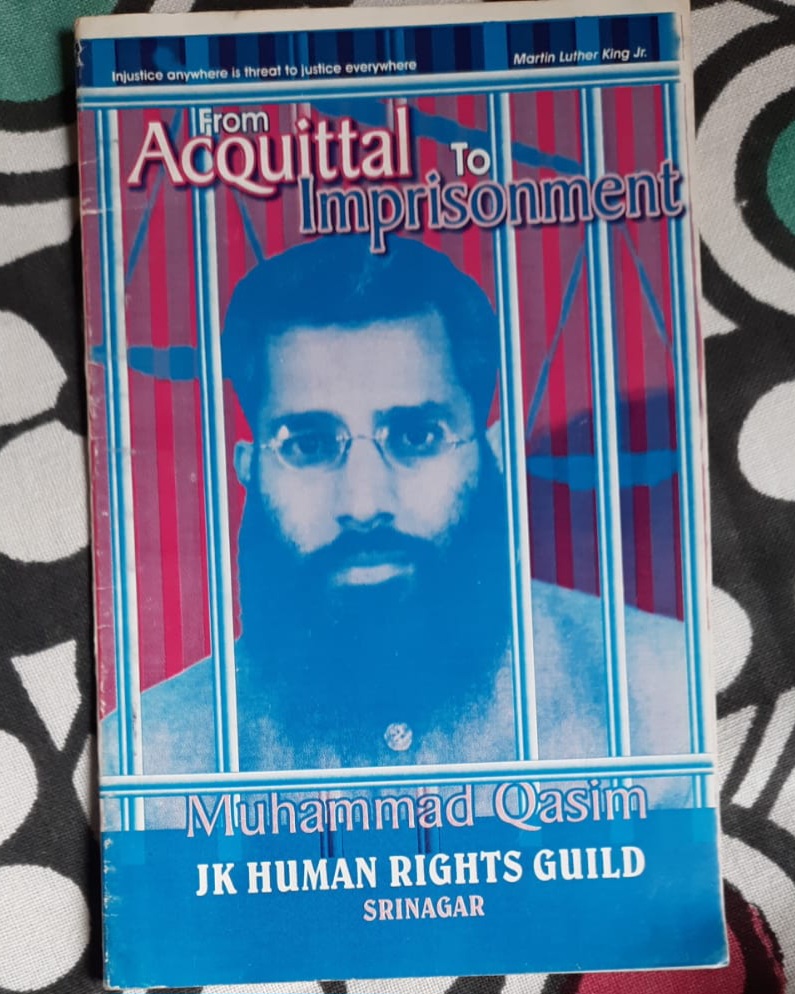
The court that originally sentenced him eventually acquitted him. He was briefly released in 1999, but then rearrested soon after and has remained in prison ever since. The state had the acquittal overturned out of political vendetta. He was 25 when he was first jailed. He is 58 now. His beard and hair were black then. Now all of it is grey. That is how we measure what has been taken, in the colour of a father’s hair, going from black to grey, without us having a day together at our home. Yet he refused to let prison consume him, earning his doctorate from his cell and writing many books.
Books are a wonder; they fold time, they squeeze space. I found my father in them. In his foreword to Soledad Brother (1970), Jonathan Jackson writes that prison “serves not only as a physical barrier, but a communication restraint…with little or no chance to break through.” Books—and dreams—were our small seditious breakthroughs.
When I was eight, I tried to read Freud’s The Psychopathology of Everyday Life (1901). I did not understand a word of it. I was trying to impress my father, who had sent the book from prison. When I told him that I read it, he did not make fun of me; he just smiled. That was how he remained present—he would finish a book in his cell and send it home, as if returning a piece of himself. Sometimes he marked passages in the margins, tiny instructions on how to think, what to question, where to pause.
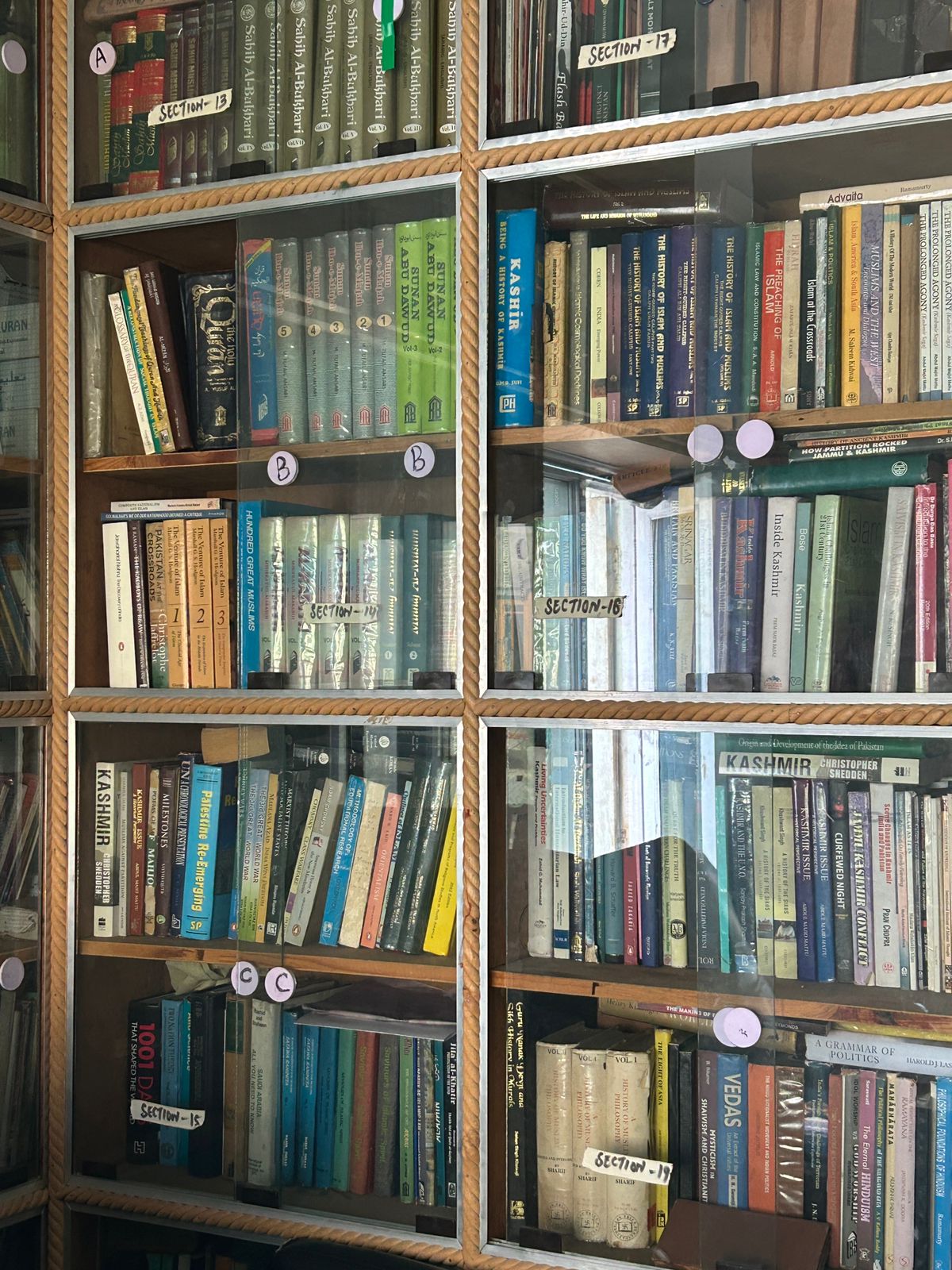
As a child, I could not understand a sentence of Ghazali, Chekhov, or Gorky, but I clung to the books anyway, because I had begun to recognize my father by scent. First, a crate arrived, then another, then we built a shelf, then another, and after many years, it became a library.
Learning to Hide: Childhood Under Secrecy
I must have been four or five when my mother, brother, and I lived in a hideout in Srinagar’s Saderbal area, the first place that exists as a real image in my memory. It was a single room that metamorphosed according to our needs. I have a few fragmented memories of our time there. I can conjure the image of my mother walking hurriedly on different roads one night, looking for a pharmacy and holding me after I had terribly hit my face against the door, while jumping from one pillow to another, imagining that the space in between was lava. She did manage to find one, where my wound had to be stitched.
It was also in this room that I first asked my mother about the reason behind my father’s imprisonment. I cannot recall what prompted the question. The answer, however, has stayed with me. I was told that he was jailed for not doing his homework. As a child, perhaps weary and tormented by school, I accepted the explanation. Yet even then, a lingering unease stayed in the corners of my mind.
So, one day, when I was missing my father a little too much, I knowingly skipped my homework. I thought, erroneously, that they might take me to my father this way. But that did not happen. I did, however, receive a dressing-down in the classroom the next day. I discovered a few years later some other iterations of this reality: a friend of mine, whose father had been forcibly disappeared by the Indian military, was told by her mother that he had gone for Hajj and would not be back for long.
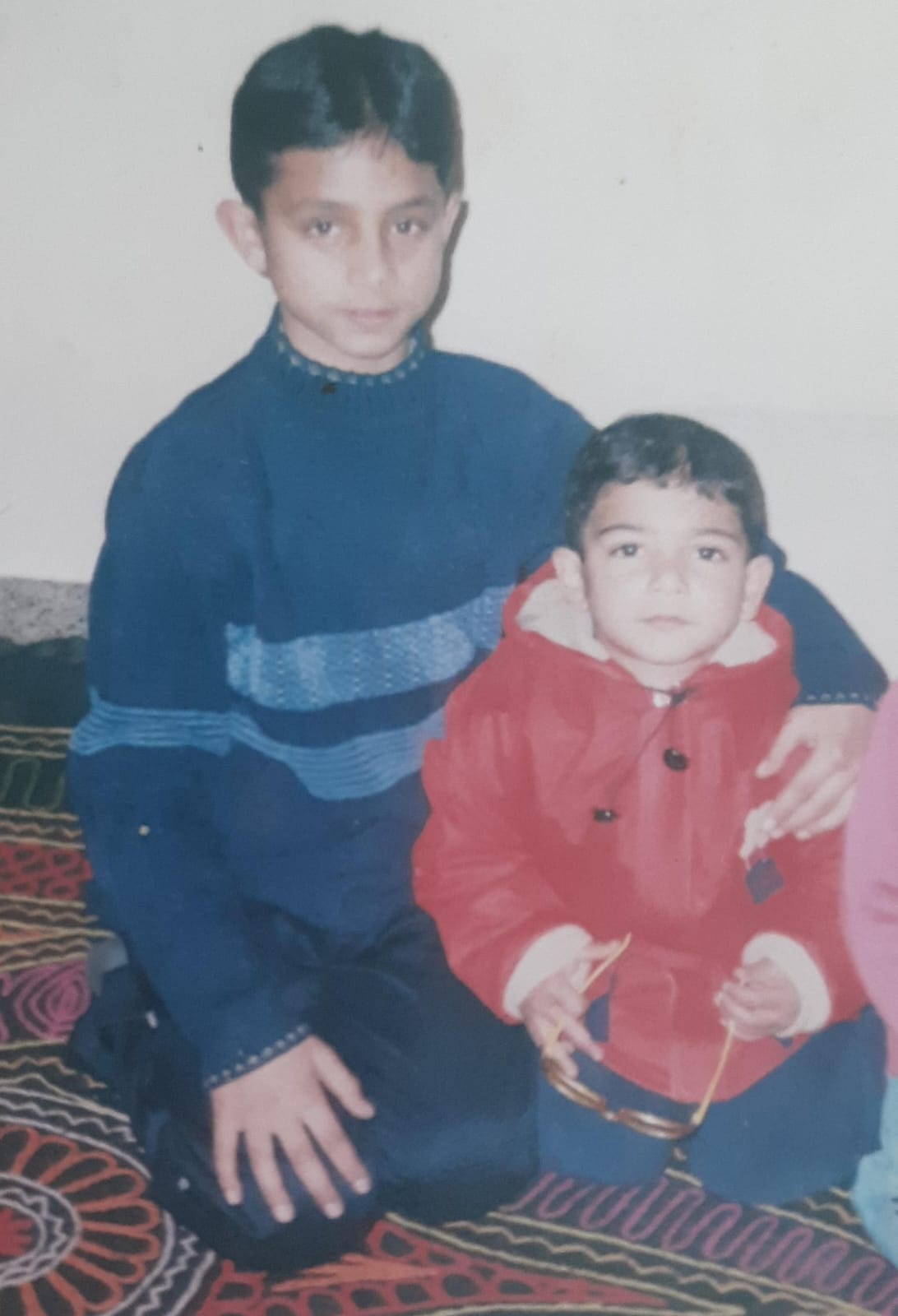
Near our hideout lay a vast playground, where my brother was allowed to play cricket, but under strict conditions set by our mother: he was not to talk too much with the other children, and above all, never to let slip who his parents were, or what they did. We adopted aliases. I was Junaid, and my brother was Ubaid.
The abnormality of this did not occur to me then. I found it rather amusing, even, to answer to a different name. My mother hid her real name even from me. I spent quite some time thinking she was Firdausa. She was right not to tell me. I was too young. I would have said it somewhere, casually, without knowing what I was undoing. To lose her was unimaginable. She was both my parents at once, my rose and my stone.
My father, I had known only as a prisoner; his face, in my memory, is always framed by that fact. I do not know how to see him otherwise. Even now, I am not sure how I would act if he appeared before me outside those walls. Only in dreams have I seen him simply as a man. Free. His absence made my mother’s presence enormous. Which made the thought of losing her the one thought I could not finish. And yet I have had to. Since that time in Saderbal, when I was five, she has spent fourteen years in prison. The unimaginable turned out to be everyday.
Prison Visits: Temporary Tattoos, Frisking, and the Waiting Room
Apple. Cherry. Autumn. These were among the words the prison guards stamped onto my forearms when I used to visit my parents in Central Jail, Srinagar, pressed into my skin as marks of permission, proof of clearance, approval to enter. As a child, I did not register the abnormality of this either. My school friends, who knew nothing of this world, would notice the words on my arms and ask. I told them they were temporary tattoos. It was my bid to be cool, and it worked. They were amazed, some of them even envious, complaining that their own parents would not allow them such things. The ink would linger for days, especially if left unwashed, fading slowly at the edges before disappearing altogether.
There were thumb impressions too, but I was not fond of them. A purple inkpad, my thumb pressed into it, then pressed onto a register of prison visitors, a log of everyone who had come to see someone the state had stolen. I hated the purple stain it left. I would find a coarse wall on the way out and rub my thumb against it, back and forth, until the color was gone.
What I despised, even as a child, was the frisking. The stamps I could mythologize into tattoos. The frisking I could not make into anything else. My first memory of visiting my father exists only in fragments, and none of the fragments contain him, only what came before. I was six. The guards were tall, I was small, and they did not wish to lower themselves before us, so one of them lifted me and set me on a stone block until I was at his eye level. From the corner of my eye, I could see a very old Kashmiri woman who was being upbraided by the female guards because she had attempted, unsuccessfully, to hide some cigarettes in her hair for her jailed son.
Then their frisking of me began. Every pocket. Every layer. The inside of my shoes. I stood there, six years old and burning with a rage I didn’t yet have words for, and I made myself a promise: I will not come back. I did come back. But I made adjustments. I stopped wearing laced shoes, stopped wearing socks. When they ordered me to remove my footwear, I wore sandals I could slip off without touching, nothing that required me to stoop, or labor, or perform effort for their pleasure. I would not give them that.
And then the waiting room. Babies, only months old, waiting to be held by fathers they had never seen free. Old men, grey-bearded, waiting to see their grown sons. James Baldwin wrote that you think your heartbreak is unprecedented until you read. For me, more than any book, it was those waiting rooms. The grief was not mine alone, and the caravan was long, made up of the dead and the living.
Visiting my parents in prison was, in true Dickensian fashion, the best of days and the worst of days. I dressed my best for it. Orange, saffron orange especially, was a color my father disliked, so you would not find a shade of it in my cupboard. I was never entirely sure whether his aversion was aesthetic or political. With him, it was sometimes difficult to tell.
The mornings were best. There was something to look forward to, a direction for the day to move in. The evenings were the worst, the leaving, the walk back out through the gates, the returning to a world in which they remained behind. It was on those walks out that I developed a habit I have never fully shed: mapping escape.
I would study the walls as I passed them: “This one is not insurmountable.”
I would note the barbed wire: “Not impenetrable, not really.”
I would watch the guards: “That one is inattentive, half asleep on his feet.”
I would turn the problem over in my mind like a puzzle: “Could they recognize my father if he shaved and walked out beside me, just another visitor leaving? Could they identify my mother if she removed her veil, this woman who has spent a lifetime seeing without being seen?”
I would keep forging these possibilities, testing them, revising them, until the sound of the main iron gate slamming shut behind me returned me to the world as it actually was. I have always loved The Shawshank Redemption (1994), Cool Hand Luke (1967), and Papillon (1973). The prison break is my idea of pure joy.
Hope and Its Architecture: The House that Waited
In 2007, we moved to my father’s ancestral house. We had reason, that year, for something close to hope. Life imprisonment in Jammu and Kashmir was predominantly interpreted as fourteen years, and my father had served fourteen.
We thought he might come home in 2008. We wanted a place ready for him, a place that looked like a family lived in it, a place with his things arranged the way he would arrange them, a place that would not feel foreign to a man returning after so long. My mother would continue to live in hideouts, moving as she always had, appearing and disappearing according to the pressures of her work and the surveillance that followed her everywhere. But we would have somewhere we may call home.
We set up his room with great care. His cupboards were arranged, his clothes folded and placed as though he might open the door that evening and reach for them. I became the librarian of his books, the crates that had arrived over the years, the shelves we had built one by one, the library that had grown in his absence like a form of correspondence. I marked every section, titled every shelf, and ordered every volume the way I imagined he would want it. Fiction here. Philosophy there. History along the far wall.
I was twelve or thirteen, arranging a library for a man I had never seen read, in a house he had never entered, for a homecoming I had decided to believe in.
There is a particular kind of love that expresses itself through preparation, through the making-ready of a space. I did not have a word for it then. I simply did it, carefully, as though the rightness of the arrangement might somehow hasten his return. But he never came.
In his case, the interpretation of life imprisonment that had given us hope was set aside. For him, it was decided, life imprisonment would mean life until death. His clothes remain folded in the cupboard. Exactly as we placed them. He has not spent a single day in his house. The room we prepared has become a kind of monument to an expectation that was never met.
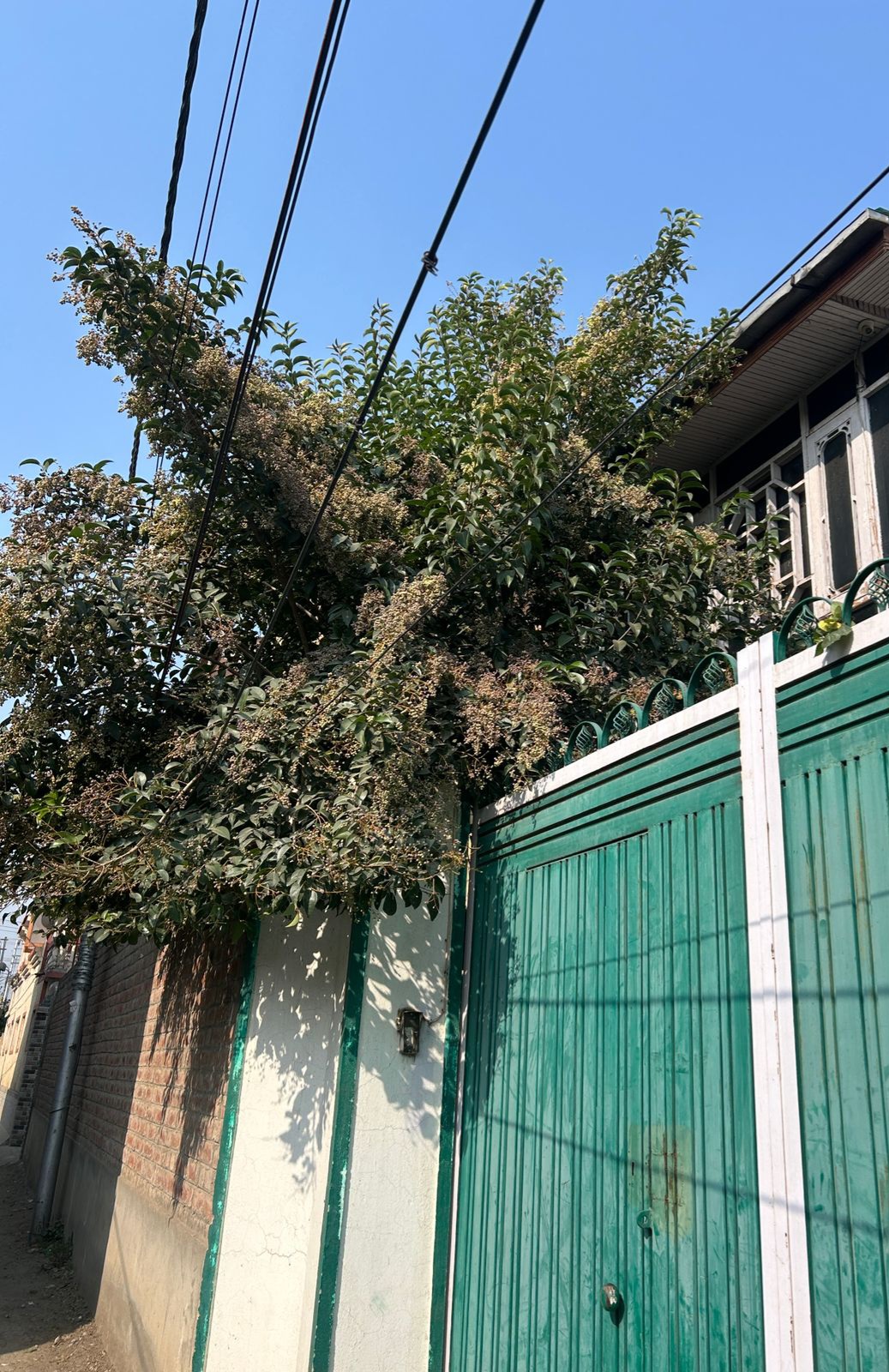
In 2019, the National Investigation Agency of India took the house. Added it to the long inventory of things the state has taken from this family: years, presence, freedom, a father’s hair going from black to grey. Now the house too. They were perhaps worried about leaving some part of our lives untouched. They plastered an ugly notice on our gate – a document meant to declare the takeover, to make it legible. But the rains came. The fingernails of neighborhood children came, scraping at the paper in idle play. Time came, as it always does, patient and corrosive. The notice faded, peeled, disintegrated. It is no longer there. But the expropriation remains.
The 10-Minute Phone Call
I have not been able to visit my parents in prison since 2017. As I write this, my phone sits in my lap. I wait for the clock to say 1:30 pm. I think of Time durée, Henri Bergson’s idea of lived time; it feels nothing like the ticking of a clock.
Moments stretch, contract, and fold over one another. I can talk to my mother once a month for ten minutes, and she calls at 1:30 pm. I know time is Bergsonian because the duration between 1:20 pm and 1:30 pm is so different from the duration between 1:30 pm and 1:40 pm. The ten minutes of waiting are not like the ten minutes of having. The ten minutes of absence are not like the ten minutes of presence, especially when you know that the presence is fleeting.
I have come to detest any idea of regulating, regimenting time. It sucks life out of us; it is parasitical upon joy. In ten minutes, what do I say to my mother, what do I not say? I cannot tell her anything about myself that would leave her in distress, especially because, until the next call, she would remain restless for a month.
There was a time when, as a child, she would tell me hopeful lies to keep me at ease. Now I have to do that. The fretting glancing at the ticking clock is ever-present. You want to say everything, but you can say little.
I want to tell her about the most mundane things: the watermelon I ate this morning, how it looked bright and inviting, and how it turned out bland.
I want to tell her the sky had this beautiful scarlet hue last evening. But I must tell her about her elder sister, my aunt, who is not well, her body fragile after the stroke.
I want to speak of the dog barking in the alley that irritates her namesake granddaughter. But I must speak of my aunt’s doctors, their tense faces. I want to linger on the color of the watermelon, its perfect shape.
Instead, I must linger in the shadows under my family’s eyes, the helplessness that coils in our chests about aunt’s fate. Each word is a negotiation. The mundane tries to break through, insisting on being noticed. The urgent presses back, demanding to be told. I am still deciding what to say when the line goes quiet.
All I want to do is hurl the phone at the policewoman who dictates the duration of the call. All I want is for the occupation to be vaporized.
Time moved the way it always does after those calls, indifferent to what I had not managed to say.

No Remorse: The State, the Sentence, and What is Being Punished
A few days ago, a court in India sentenced my mother, currently 64, to three terms of life imprisonment. It is effectively a death sentence for a woman of her age and health, under different sections of the Unlawful Activities Prevention Act, one of the most draconian pieces of legislation in the world.
This was the first time a Kashmiri woman, jailed for her participation in Kashmir’s self-determination movement, was sentenced to life. Along with her, two of her associates, Nahida Nasreen and Sofi Fehmeeda, were sentenced to thirty years each. The three women have been in jail since 2018.
This was not my mother’s first imprisonment, nor her second, nor her tenth. She has been regularly jailed since the 1990s, detained more than twenty times under the Public Safety Act alone, with Amnesty International highlighting the pattern of her incarceration in 2011. This predates Narendra Modi’s rise to power. It predates the BJP’s current dominance. It predates the revocation of Kashmir’s autonomy in 2019.
India has been doing this to my mother, and numerous other Kashmiri prisoners, across governments, across decades, across every iteration of its democratic self-presentation to the world. The sentencing last week was not an escalation so much as a conclusion, the logical end point of a decades-long project of silencing a woman who refused, across every imprisonment, to be silent.
The court cleared her of waging war, of financing ‘militancy.’ Every charge that carried any suggestion of violence collapsed. What was left were her words. Her associations. Her beliefs. For these, she was sentenced to life.
This reveals something that needs to be said plainly: The line between violent and non-violent resistance, the line the liberal imagination treats as the only morally serious distinction in political struggle, is a line that a colonial state, when it decides to punish resistance, simply does not see. My mother’s sentence is not a reduced sentence. It is not a more lenient outcome than what an armed fighter would face. It is the same.
Because what is being punished was never the method. What is being punished is the refusal, sustained across decades, to concede that Kashmir is India’s to keep.
The sentencing order does not obscure this. It states, with a candor that should be read carefully, that extending leniency to my mother would risk infusing fresh life and vigor into a spirit that aims at the ‘secession of an integral part of India.’ The danger the court identifies is a spirit. It is the persistence of a conviction.
Shareek-e-Hayaat and the Endurance of Ideas
Ngugi wa Thiong’o, imprisoned by a postcolonial state that had inherited its methods intact from the colonial one, wrote that political detention is both punitive and theatrical. What the state wants, more than the removal, is the breaking. A prisoner who emerges repentant, who renounces the cause that brought them there, who apologizes for the audacity of having believed what they believed, that prisoner becomes something more useful than an absence. They become a confession. And a confession serves the state twice over: it retrospectively justifies every act of repression that came before, and it pre-authorizes everything still to come.
The prisoner who cannot be broken is, at minimum, displayed, held up as a wreck, a warning, evidence of what resistance costs. The sentencing order makes this purpose legible. The court listed, among the weightiest factors in its decision, the fact that my mother expressed no remorse. She had said, in court, that she was not regretful. That she would continue to organize against the sexual exploitation of Kashmiri women, as she had before her arrest, and would do so again if released. My mother did not break. And so the state, having nothing else to offer, gave her everything it had left. Three life sentences in one lifetime.
When the sentences were read, Nahida Nasreen stood up and addressed the judge. “You fail to understand here,” she said, “that we are mere embodiments of an idea. The idea existed before us, and our imprisonment, or our deaths here in prison, shall not kill the idea.”
It was a statement of historical fact. Tihar, the prison where these three women have spent the last eight years and where they might spend the rest of their lives, is the same prison where India hanged Maqbool Bhat in 1984, one of the foremost leaders of Kashmir’s liberation movement. India thought it had buried the idea then, too. Forty years later, it is still sentencing Kashmiris for the same idea, still convinced that the next sentence will be the one that finishes it.
My mother, being the woman she is, told me that she has now truly become my father’s shareek-e-hayaat. In Urdu, the word for spouse is shareek-e-hayaat, which means the one with whom life is shared. They may not have been able to share a life, but they share a life sentence now, she said. She was smiling when she said it. I could hear it.


‘Made in Tihar’: On Inheritance and Incarceration
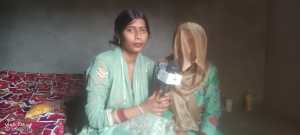
I watch the camera as my mother is interviewed in a hideout.
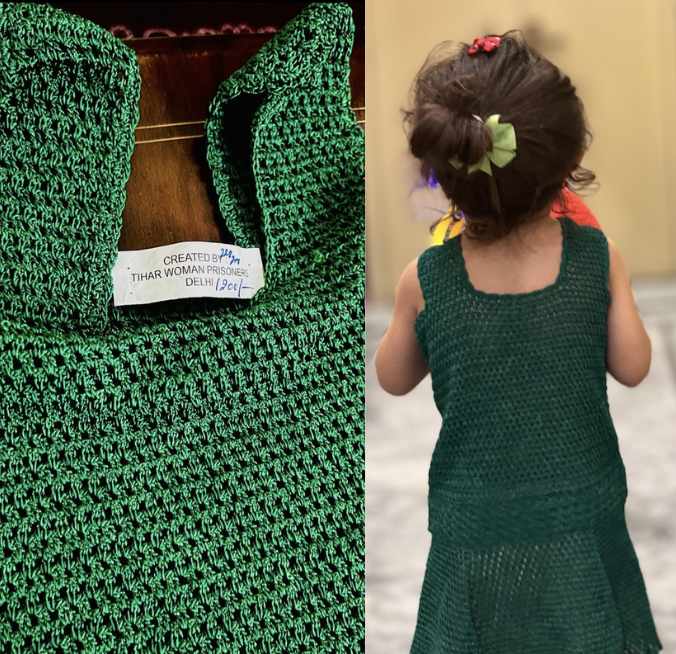
“Made in Tihar.” This is what the label on many of my two-year-old’s clothes says. Tihar is the name of the prison in New Delhi where her grandmother, my mother, a Kashmiri liberation activist, has been incarcerated for the last eight years.
The clothes are knitted, a green sweater, the exact shade of the mint rows my mother used to tend at home, the ones she would scold me for stepping into carelessly, one of the only times she ever raised her voice at me; a yellow sweater with matching yellow trousers; mittens in almost every color; grey winter caps; small wool socks. They come in different sizes. My daughter has outgrown some already. Some fit her now. Some are still too large, waiting for her to grow into them. My mother could not know exactly how fast her granddaughter would grow, so she knitted for the winters to come, not just the winter that was. She could not touch her granddaughter directly. But she could put her hands into wool and send the warmth ahead, not just for this year, but next year and the year after.
Angela Davis once wrote that prisons disappear people. The clothes were my mother’s attempt at refusing that disappearance. Each sweater knitted in a size her granddaughter had not yet grown into was an insistence on a future, a way of saying: I am still here, I am still thinking of you, I know you will grow. I named my daughter after my mother. Asiyah. In Islamic tradition, Asiyah is counted among the greatest women who ever lived, the wife of Pharaoh who defied the most powerful tyrant of her age and was tortured to death for it. It felt right to give my daughter a name that had already survived an empire. So that she becomes a part of her grandmother. So that my mother’s name continues to move through the world freely, carried by a child who runs and laughs and grows in all the ways my mother cannot.
My Father: Prison, Books, and Presence
My father is also serving a life sentence, first arrested in 1993 under the Public Safety Act—a colonial-era preventive detention law that allows imprisonment without charge or trial for up to two years at a stretch—for his involvement in the Kashmiri liberation struggle. He was later falsely implicated in a case, made to sign a blank paper under torture—the marks on his back and legs remain to this date—which was later turned into a confessional statement, based on which he was sentenced to life in prison.
The court that originally sentenced him eventually acquitted him. He was briefly released in 1999, but then rearrested soon after and has remained in prison ever since. The state had the acquittal overturned out of political vendetta. He was 25 when he was first jailed. He is 58 now. His beard and hair were black then. Now all of it is grey. That is how we measure what has been taken, in the colour of a father’s hair, going from black to grey, without us having a day together at our home. Yet he refused to let prison consume him, earning his doctorate from his cell and writing many books.
Books are a wonder; they fold time, they squeeze space. I found my father in them. In his foreword to Soledad Brother (1970), Jonathan Jackson writes that prison “serves not only as a physical barrier, but a communication restraint…with little or no chance to break through.” Books—and dreams—were our small seditious breakthroughs.
When I was eight, I tried to read Freud’s The Psychopathology of Everyday Life (1901). I did not understand a word of it. I was trying to impress my father, who had sent the book from prison. When I told him that I read it, he did not make fun of me; he just smiled. That was how he remained present—he would finish a book in his cell and send it home, as if returning a piece of himself. Sometimes he marked passages in the margins, tiny instructions on how to think, what to question, where to pause.
As a child, I could not understand a sentence of Ghazali, Chekhov, or Gorky, but I clung to the books anyway, because I had begun to recognize my father by scent. First, a crate arrived, then another, then we built a shelf, then another, and after many years, it became a library.
Learning to Hide: Childhood Under Secrecy
I must have been four or five when my mother, brother, and I lived in a hideout in Srinagar’s Saderbal area, the first place that exists as a real image in my memory. It was a single room that metamorphosed according to our needs. I have a few fragmented memories of our time there. I can conjure the image of my mother walking hurriedly on different roads one night, looking for a pharmacy and holding me after I had terribly hit my face against the door, while jumping from one pillow to another, imagining that the space in between was lava. She did manage to find one, where my wound had to be stitched.
It was also in this room that I first asked my mother about the reason behind my father’s imprisonment. I cannot recall what prompted the question. The answer, however, has stayed with me. I was told that he was jailed for not doing his homework. As a child, perhaps weary and tormented by school, I accepted the explanation. Yet even then, a lingering unease stayed in the corners of my mind.
So, one day, when I was missing my father a little too much, I knowingly skipped my homework. I thought, erroneously, that they might take me to my father this way. But that did not happen. I did, however, receive a dressing-down in the classroom the next day. I discovered a few years later some other iterations of this reality: a friend of mine, whose father had been forcibly disappeared by the Indian military, was told by her mother that he had gone for Hajj and would not be back for long.
Near our hideout lay a vast playground, where my brother was allowed to play cricket, but under strict conditions set by our mother: he was not to talk too much with the other children, and above all, never to let slip who his parents were, or what they did. We adopted aliases. I was Junaid, and my brother was Ubaid.
The abnormality of this did not occur to me then. I found it rather amusing, even, to answer to a different name. My mother hid her real name even from me. I spent quite some time thinking she was Firdausa. She was right not to tell me. I was too young. I would have said it somewhere, casually, without knowing what I was undoing. To lose her was unimaginable. She was both my parents at once, my rose and my stone.
My father, I had known only as a prisoner; his face, in my memory, is always framed by that fact. I do not know how to see him otherwise. Even now, I am not sure how I would act if he appeared before me outside those walls. Only in dreams have I seen him simply as a man. Free. His absence made my mother’s presence enormous. Which made the thought of losing her the one thought I could not finish. And yet I have had to. Since that time in Saderbal, when I was five, she has spent fourteen years in prison. The unimaginable turned out to be everyday.
Prison Visits: Temporary Tattoos, Frisking, and the Waiting Room
Apple. Cherry. Autumn. These were among the words the prison guards stamped onto my forearms when I used to visit my parents in Central Jail, Srinagar, pressed into my skin as marks of permission, proof of clearance, approval to enter. As a child, I did not register the abnormality of this either. My school friends, who knew nothing of this world, would notice the words on my arms and ask. I told them they were temporary tattoos. It was my bid to be cool, and it worked. They were amazed, some of them even envious, complaining that their own parents would not allow them such things. The ink would linger for days, especially if left unwashed, fading slowly at the edges before disappearing altogether.
There were thumb impressions too, but I was not fond of them. A purple inkpad, my thumb pressed into it, then pressed onto a register of prison visitors, a log of everyone who had come to see someone the state had stolen. I hated the purple stain it left. I would find a coarse wall on the way out and rub my thumb against it, back and forth, until the color was gone.
What I despised, even as a child, was the frisking. The stamps I could mythologize into tattoos. The frisking I could not make into anything else. My first memory of visiting my father exists only in fragments, and none of the fragments contain him, only what came before. I was six. The guards were tall, I was small, and they did not wish to lower themselves before us, so one of them lifted me and set me on a stone block until I was at his eye level. From the corner of my eye, I could see a very old Kashmiri woman who was being upbraided by the female guards because she had attempted, unsuccessfully, to hide some cigarettes in her hair for her jailed son.
Then their frisking of me began. Every pocket. Every layer. The inside of my shoes. I stood there, six years old and burning with a rage I didn’t yet have words for, and I made myself a promise: I will not come back. I did come back. But I made adjustments. I stopped wearing laced shoes, stopped wearing socks. When they ordered me to remove my footwear, I wore sandals I could slip off without touching, nothing that required me to stoop, or labor, or perform effort for their pleasure. I would not give them that.
And then the waiting room. Babies, only months old, waiting to be held by fathers they had never seen free. Old men, grey-bearded, waiting to see their grown sons. James Baldwin wrote that you think your heartbreak is unprecedented until you read. For me, more than any book, it was those waiting rooms. The grief was not mine alone, and the caravan was long, made up of the dead and the living.
Visiting my parents in prison was, in true Dickensian fashion, the best of days and the worst of days. I dressed my best for it. Orange, saffron orange especially, was a color my father disliked, so you would not find a shade of it in my cupboard. I was never entirely sure whether his aversion was aesthetic or political. With him, it was sometimes difficult to tell.
The mornings were best. There was something to look forward to, a direction for the day to move in. The evenings were the worst, the leaving, the walk back out through the gates, the returning to a world in which they remained behind. It was on those walks out that I developed a habit I have never fully shed: mapping escape.
I would study the walls as I passed them: “This one is not insurmountable.”
I would note the barbed wire: “Not impenetrable, not really.”
I would watch the guards: “That one is inattentive, half asleep on his feet.”
I would turn the problem over in my mind like a puzzle: “Could they recognize my father if he shaved and walked out beside me, just another visitor leaving? Could they identify my mother if she removed her veil, this woman who has spent a lifetime seeing without being seen?”
I would keep forging these possibilities, testing them, revising them, until the sound of the main iron gate slamming shut behind me returned me to the world as it actually was. I have always loved The Shawshank Redemption (1994), Cool Hand Luke (1967), and Papillon (1973). The prison break is my idea of pure joy.
Hope and Its Architecture: The House that Waited
In 2007, we moved to my father’s ancestral house. We had reason, that year, for something close to hope. Life imprisonment in Jammu and Kashmir was predominantly interpreted as fourteen years, and my father had served fourteen.
We thought he might come home in 2008. We wanted a place ready for him, a place that looked like a family lived in it, a place with his things arranged the way he would arrange them, a place that would not feel foreign to a man returning after so long. My mother would continue to live in hideouts, moving as she always had, appearing and disappearing according to the pressures of her work and the surveillance that followed her everywhere. But we would have somewhere we may call home.
We set up his room with great care. His cupboards were arranged, his clothes folded and placed as though he might open the door that evening and reach for them. I became the librarian of his books, the crates that had arrived over the years, the shelves we had built one by one, the library that had grown in his absence like a form of correspondence. I marked every section, titled every shelf, and ordered every volume the way I imagined he would want it. Fiction here. Philosophy there. History along the far wall.
I was twelve or thirteen, arranging a library for a man I had never seen read, in a house he had never entered, for a homecoming I had decided to believe in.
There is a particular kind of love that expresses itself through preparation, through the making-ready of a space. I did not have a word for it then. I simply did it, carefully, as though the rightness of the arrangement might somehow hasten his return. But he never came.
In his case, the interpretation of life imprisonment that had given us hope was set aside. For him, it was decided, life imprisonment would mean life until death. His clothes remain folded in the cupboard. Exactly as we placed them. He has not spent a single day in his house. The room we prepared has become a kind of monument to an expectation that was never met.
In 2019, the National Investigation Agency of India took the house. Added it to the long inventory of things the state has taken from this family: years, presence, freedom, a father’s hair going from black to grey. Now the house too. They were perhaps worried about leaving some part of our lives untouched. They plastered an ugly notice on our gate – a document meant to declare the takeover, to make it legible. But the rains came. The fingernails of neighborhood children came, scraping at the paper in idle play. Time came, as it always does, patient and corrosive. The notice faded, peeled, disintegrated. It is no longer there. But the expropriation remains.
The 10-Minute Phone Call
I have not been able to visit my parents in prison since 2017. As I write this, my phone sits in my lap. I wait for the clock to say 1:30 pm. I think of Time durée, Henri Bergson’s idea of lived time; it feels nothing like the ticking of a clock.
Moments stretch, contract, and fold over one another. I can talk to my mother once a month for ten minutes, and she calls at 1:30 pm. I know time is Bergsonian because the duration between 1:20 pm and 1:30 pm is so different from the duration between 1:30 pm and 1:40 pm. The ten minutes of waiting are not like the ten minutes of having. The ten minutes of absence are not like the ten minutes of presence, especially when you know that the presence is fleeting.
I have come to detest any idea of regulating, regimenting time. It sucks life out of us; it is parasitical upon joy. In ten minutes, what do I say to my mother, what do I not say? I cannot tell her anything about myself that would leave her in distress, especially because, until the next call, she would remain restless for a month.
There was a time when, as a child, she would tell me hopeful lies to keep me at ease. Now I have to do that. The fretting glancing at the ticking clock is ever-present. You want to say everything, but you can say little.
I want to tell her about the most mundane things: the watermelon I ate this morning, how it looked bright and inviting, and how it turned out bland.
I want to tell her the sky had this beautiful scarlet hue last evening. But I must tell her about her elder sister, my aunt, who is not well, her body fragile after the stroke.
I want to speak of the dog barking in the alley that irritates her namesake granddaughter. But I must speak of my aunt’s doctors, their tense faces. I want to linger on the color of the watermelon, its perfect shape.
Instead, I must linger in the shadows under my family’s eyes, the helplessness that coils in our chests about aunt’s fate. Each word is a negotiation. The mundane tries to break through, insisting on being noticed. The urgent presses back, demanding to be told. I am still deciding what to say when the line goes quiet.
All I want to do is hurl the phone at the policewoman who dictates the duration of the call. All I want is for the occupation to be vaporized.
Time moved the way it always does after those calls, indifferent to what I had not managed to say.
No Remorse: The State, the Sentence, and What is Being Punished
A few days ago, a court in India sentenced my mother, currently 64, to three terms of life imprisonment. It is effectively a death sentence for a woman of her age and health, under different sections of the Unlawful Activities Prevention Act, one of the most draconian pieces of legislation in the world.
This was the first time a Kashmiri woman, jailed for her participation in Kashmir’s self-determination movement, was sentenced to life. Along with her, two of her associates, Nahida Nasreen and Sofi Fehmeeda, were sentenced to thirty years each. The three women have been in jail since 2018.
This was not my mother’s first imprisonment, nor her second, nor her tenth. She has been regularly jailed since the 1990s, detained more than twenty times under the Public Safety Act alone, with Amnesty International highlighting the pattern of her incarceration in 2011. This predates Narendra Modi’s rise to power. It predates the BJP’s current dominance. It predates the revocation of Kashmir’s autonomy in 2019.
India has been doing this to my mother, and numerous other Kashmiri prisoners, across governments, across decades, across every iteration of its democratic self-presentation to the world. The sentencing last week was not an escalation so much as a conclusion, the logical end point of a decades-long project of silencing a woman who refused, across every imprisonment, to be silent.
The court cleared her of waging war, of financing ‘militancy.’ Every charge that carried any suggestion of violence collapsed. What was left were her words. Her associations. Her beliefs. For these, she was sentenced to life.
This reveals something that needs to be said plainly: The line between violent and non-violent resistance, the line the liberal imagination treats as the only morally serious distinction in political struggle, is a line that a colonial state, when it decides to punish resistance, simply does not see. My mother’s sentence is not a reduced sentence. It is not a more lenient outcome than what an armed fighter would face. It is the same.
Because what is being punished was never the method. What is being punished is the refusal, sustained across decades, to concede that Kashmir is India’s to keep.
The sentencing order does not obscure this. It states, with a candor that should be read carefully, that extending leniency to my mother would risk infusing fresh life and vigor into a spirit that aims at the ‘secession of an integral part of India.’ The danger the court identifies is a spirit. It is the persistence of a conviction.
Shareek-e-Hayaat and the Endurance of Ideas
Ngugi wa Thiong’o, imprisoned by a postcolonial state that had inherited its methods intact from the colonial one, wrote that political detention is both punitive and theatrical. What the state wants, more than the removal, is the breaking. A prisoner who emerges repentant, who renounces the cause that brought them there, who apologizes for the audacity of having believed what they believed, that prisoner becomes something more useful than an absence. They become a confession. And a confession serves the state twice over: it retrospectively justifies every act of repression that came before, and it pre-authorizes everything still to come.
The prisoner who cannot be broken is, at minimum, displayed, held up as a wreck, a warning, evidence of what resistance costs. The sentencing order makes this purpose legible. The court listed, among the weightiest factors in its decision, the fact that my mother expressed no remorse. She had said, in court, that she was not regretful. That she would continue to organize against the sexual exploitation of Kashmiri women, as she had before her arrest, and would do so again if released. My mother did not break. And so the state, having nothing else to offer, gave her everything it had left. Three life sentences in one lifetime.
When the sentences were read, Nahida Nasreen stood up and addressed the judge. “You fail to understand here,” she said, “that we are mere embodiments of an idea. The idea existed before us, and our imprisonment, or our deaths here in prison, shall not kill the idea.”
It was a statement of historical fact. Tihar, the prison where these three women have spent the last eight years and where they might spend the rest of their lives, is the same prison where India hanged Maqbool Bhat in 1984, one of the foremost leaders of Kashmir’s liberation movement. India thought it had buried the idea then, too. Forty years later, it is still sentencing Kashmiris for the same idea, still convinced that the next sentence will be the one that finishes it.
My mother, being the woman she is, told me that she has now truly become my father’s shareek-e-hayaat. In Urdu, the word for spouse is shareek-e-hayaat, which means the one with whom life is shared. They may not have been able to share a life, but they share a life sentence now, she said. She was smiling when she said it. I could hear it.