



It began with images of death. When Argentine director Lucrecia Martel was trawling through YouTube in 2009, conducting research for what would eventually become her period drama Zama (2017), she came across footage of the murder of Javier Chocobar, the indigenous Chuschagasta community chief who had been shot just six months earlier. “For someone who works in cinema like myself, to see someone with a camera and a weapon was quite shocking,” said the filmmaker over Zoom.
It was only when she stumbled across that video again—so much later that she’d initially forgotten she’d seen it before—that she began digging deeper. She got in touch with a local journalist, who then connected her with the community, and she traveled to the province of Tucumán to meet them.
Years of research, collated archival material, and interviews with the Chuschagastas eventually made their way into Martel’s first nonfiction film last year, Nuestra Tierra (Our Land), which uses courtroom footage of the 2018 murder trial to unspool a larger narrative of not just a community’s fresh grief and loss, but also their systematic erasure over centuries.
A Murder Trial Framed Against Stolen Land
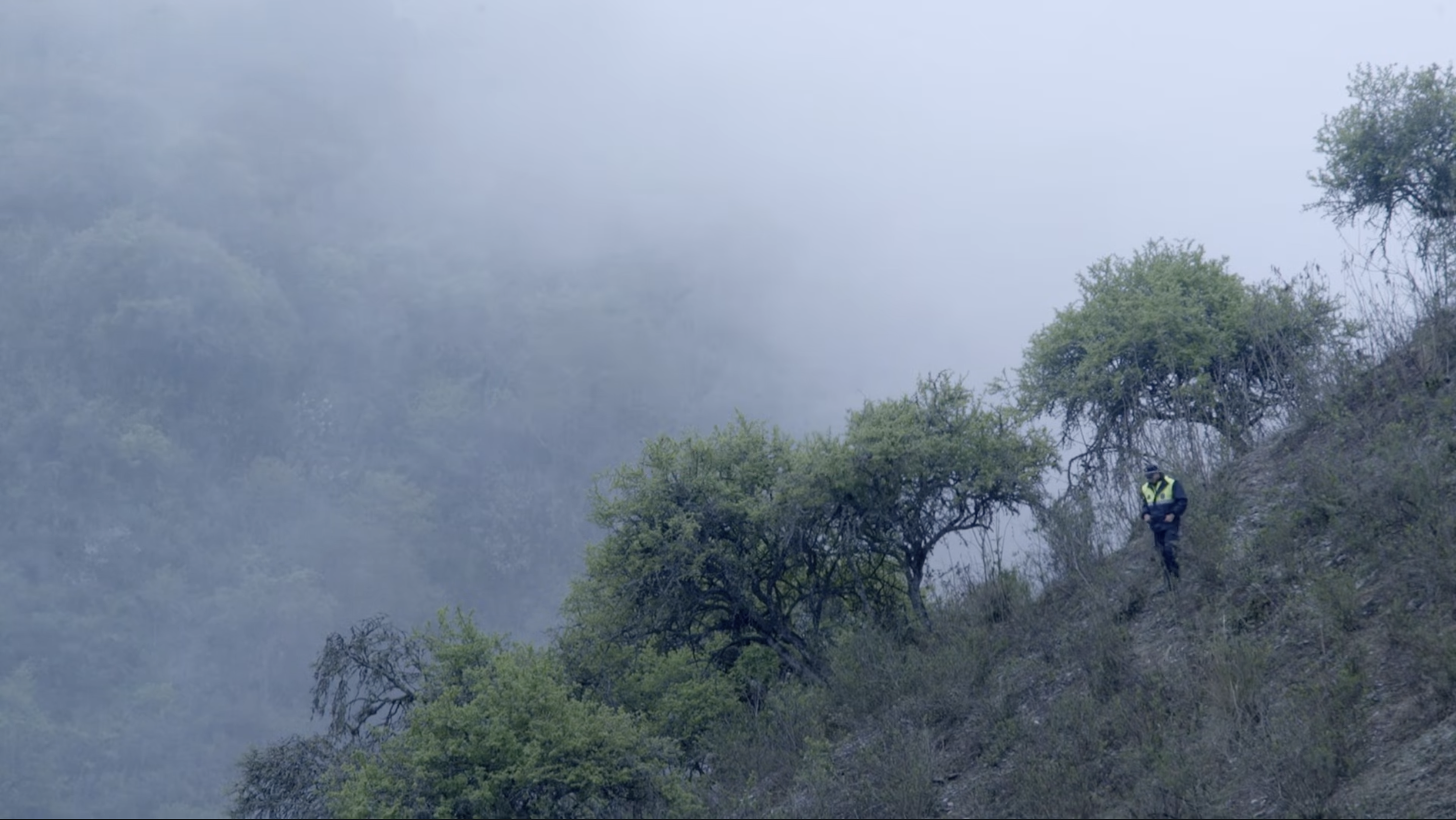
Though the film’s genesis might’ve been Martel’s discovery of an act of violence, she begins her documentary with its tonal opposite: scenes of startling, serene beauty. There’s satellite footage of our planet from outer space, with the camera then gliding over the topography of Argentina, followed by drone shots of Tucumán’s lush green fields and mountains.
Yet, even among such boundless landscapes, vicious manmade divisions endure. The threat of persecution persists, illustrated by the montage’s eventual culmination inside the oppressive confines of a courtroom, where white mine owner Dario Amin and retired police officers Luis Humberto Gomez and Eduardo José Valdivieso are charged with aggravated attempted homicide in real concurrence and illegal possession of firearms.
Nine years earlier, these men had trespassed onto Chuschagasta property with the intent of embarking on a mining venture that would’ve displaced the community from their land. In the ensuing confrontation between the groups, 68-year-old Chocobar was killed, and two others from the 300-member community sustained gunshot wounds.
In court, the defence team repeatedly insists that everyone assembled there is equal, a refrain exposed as a cruel untruth over the course of the documentary. “Had Gomez intended to kill, he would’ve done so,” says a lawyer at one point, bringing up the former officer’s skillset, acquired during his time with an internationally trained task force. The statement, meant to assert that he had no intention to harm, instead only reaffirms just how much power he and his cohorts wield over the community.
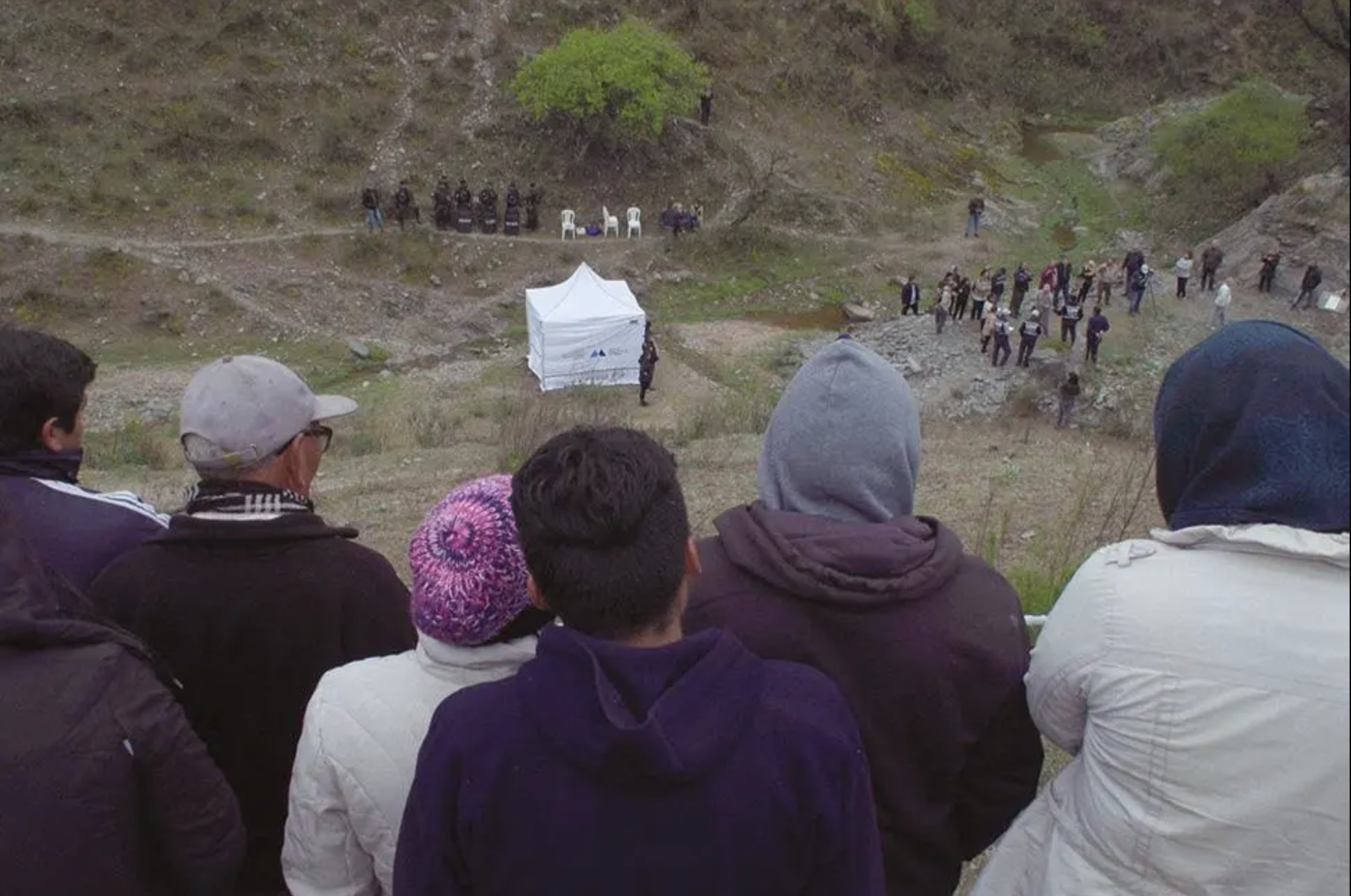
Martel re-emphasizes this power differential using footage of a staged re-enactment of the murder, conducted as part of the trial and held at the scene of the crime. The ground-level camera evokes the gaze of the accused, who—as participants—re-create a slow-mo, action-packed version of the shootings for the assembled jury. One of them even cracks a joke, sparking laughter from the crowd. It’s a mockery of the murder. The scene then cuts to a shot of the same performed dramatization, now seen from the point of view of the Chuschagastas watching from atop a hill, their silence underscoring the hollowness of this farce.
In another scene, the accused and a witness are permitted to confront each other directly in court, seated across from each other before the judge. The accused, Valdivieso, verbally attacks Chocobar’s nephew over and over, raising his voice and leaning forward aggressively as the young man shrinks back in his seat.
The most damning proof of Argentinian societal disparity and the white men’s assurance of their status, however, comes from their own recording of the crime. As they arrive at the quarry, they spot community members taking photos to document the intrusion. “Why take photos?” asks a voice on the recording. “No one at the court listens to them anymore.” Had the community members not recovered this footage, Martel points out, the accused would’ve suppressed it.
How the State Manufactures Disappearance
A sharp critique of Argentina’s legal and bureaucratic systems is a feature of the director’s work. In her 2008 fiction film The Headless Woman, for example, a white woman’s familial connections to the police and a local hospital enable the disappearance of documents linked to her potential killing of an indigenous boy.
In Our Land, interviews with the Chuschagastas reveal how complaints of land encroachment—raised at levels ranging from the local Congress to the Land Registry Office—are shelved, buried under old files, or lost. Their testimony conjures images of people first driven from their land, then corralled even further into government offices, hallways, and front desks, as they repeatedly follow up on these complaints, without redress.
In one scene, the accused Amin explains, “I’m not a murderer. I was home,” accounting for his presence in the quarry on the day of the murder. He adds that he owns the deed and title to the lands, bought at a judicial auction—an egregious example of state-enabled land theft, premised on the fiction of terra nullius, or “nobody’s land,” that has justified the colonial invasion of indigenous lands for centuries.
That Amin and his co-accused intended to exploit the stone quarry on the Chuschagastas’ land for mining purposes mirrors a slew of similar reports from around the world, including in India, as the country’s indigenous tribal groups—or Adivasis—are pressured into eviction to further state-backed corporate interests. Last year, the Gauhati High Court questioned the Assam government’s decision to allot nearly 3,000 bighas of tribal land to a private cement company. In Chhattisgarh, tribal groups have been alleging state coercion and illegal land takeovers for more than a decade, with farmers’ organizations and environmentalists joining them for a public protest against the expansion of mining projects sure to result in their forced displacement earlier this year.
Martel and her co-writer, Maria Alche, had spent years studying thousands of documents that made up the Chuschagastas’ land-claim cases, looking for judicial material and working with historian Milena Acosta to source additional, often hard-to-understand papers. “The community had been insisting on the same petition for decades—that the government does a study of their land so that it could be awarded to them,” she said. “[What stood out to us] was all the different government bodies that they went through, the irresponsibility of the government itself when it received these petitions and the way that it responded, never giving a clear ‘yes’ or ‘no’ answer, just pushing it off to the next body.”
Argentina’s Fiction of Indigenous Extinction
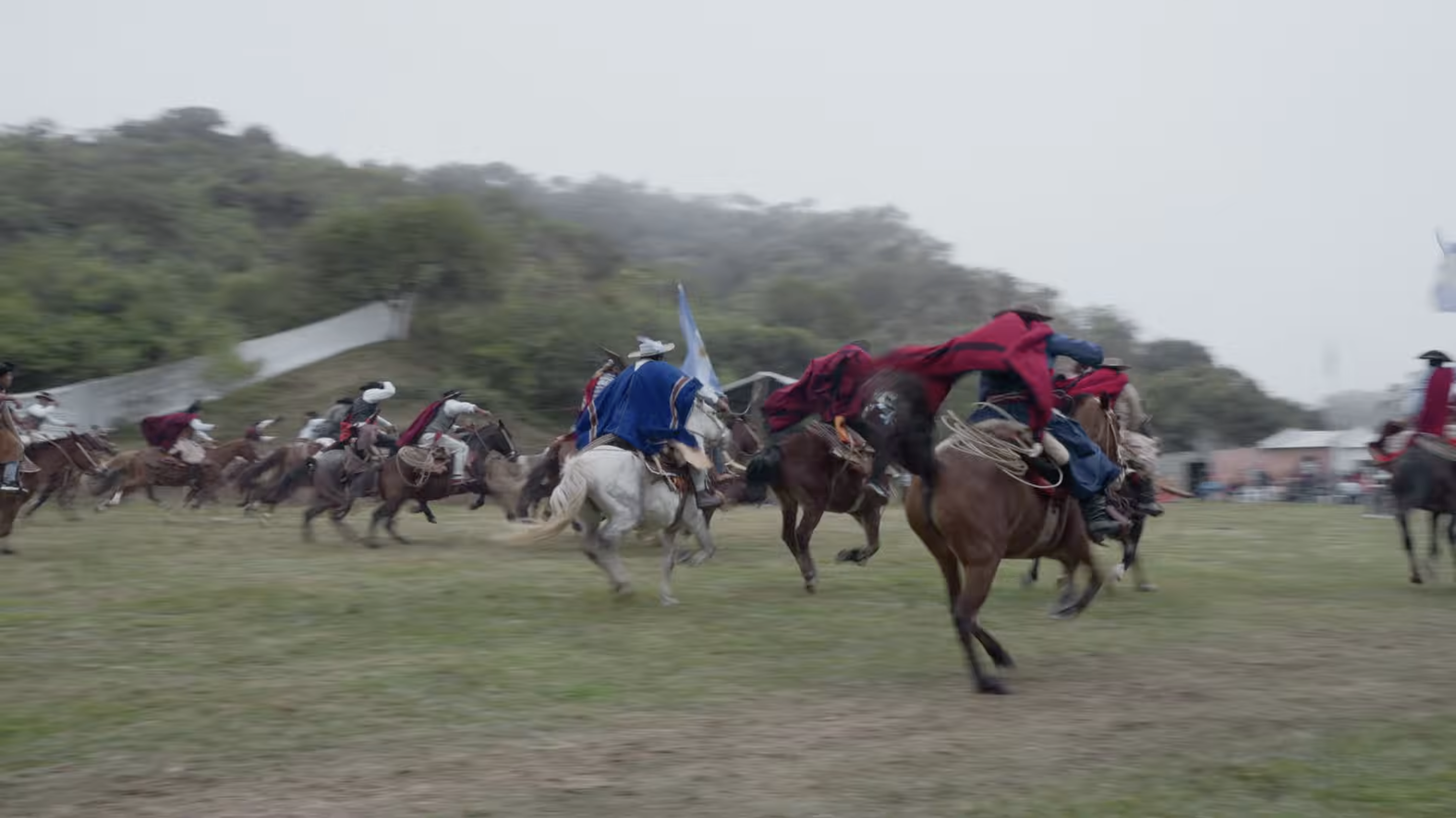
Our Land also lays out the construction of a tale as old as time: an insidious historical narrative that depicts indigenous people as either illegals on their own land, or as a population that died out in 1807. Warped religious iconography pictures the Chuschagasta community as invaders, with angels descending from the heavens to fight them off with beams of light. This reflects a prevalent narrative in Argentina.
Martel succinctly captures this through a snippet of an online video featuring a man earnestly explaining to young students that God wants the indigenous to be destroyed. There’s a bitter parallel to be drawn to Martel’s 2001 drama La Ciénaga (The Swamp), in which several characters believe they’ve spotted the Virgin Mary at a local water tank, and Our Land, in which they refute the existence of the flesh-and-blood human beings native to their country. It’s a form of dehumanization the Chuschagastas have long been subjected to.
To the defence team, the mere presence of these indigenous communities isn’t sufficient proof of their existence; they are repeatedly directed to provide documented historical evidence of it. There are repeated allegations that the Chuschagastas cannot possibly belong to one community, since they don’t share common features or a common language. (They lost their original common language—the Cacán—in the 17th century.)
Martel explained that while the Argentinian constitution recognizes the rights of indigenous communities, schoolchildren who were never educated about their existence grow up to become adults who remain ignorant of them. “So every time there’s an indigenous community that comes to light and claims their land, it’s almost as if people are seeing a ghost,” she said. “At the core of the problems Argentina has today is its inability to understand the composition of its people.”
Argentina has about 35 officially recognized Indigenous communities, including the Mapuche, Guaraní, and Diaguita (to which the Chuschagastas belong). According to the 2022 census, indigenous people account for about 2.9% of the national population. In 2006, the country’s National Congress approved Law 26.160, which declared a state of “emergency with respect to the possession and property of the ancestral lands of the Indigenous communities of the country.” It prohibited the eviction or removal of Indigenous peoples from their ancestral lands for four years, and mandated that their lands be surveyed and registered statewide.
The law, however, was revoked soon after. “Our nation has been dependent on Spain since 1810, and it wasn’t until 200 years later that it was decided, for the first time, to consider a significant portion of our population,” said the filmmaker. “That process was interrupted by Javier Milei’s presidency.”
The Milei presidency has rolled back hard-won protections for Argentina’s indigenous communities, while simultaneously advancing an aggressive push for development—including soliciting foreign investment—in the resource-rich ancestral lands of the country’s indigenous population. In November 2024, Argentina was the only country to vote against a United Nations draft resolution on indigenous rights, arguing that recognizing ancestral practices would interfere with the exercise of individual rights.
Stories and Photographs that Defy Erasure
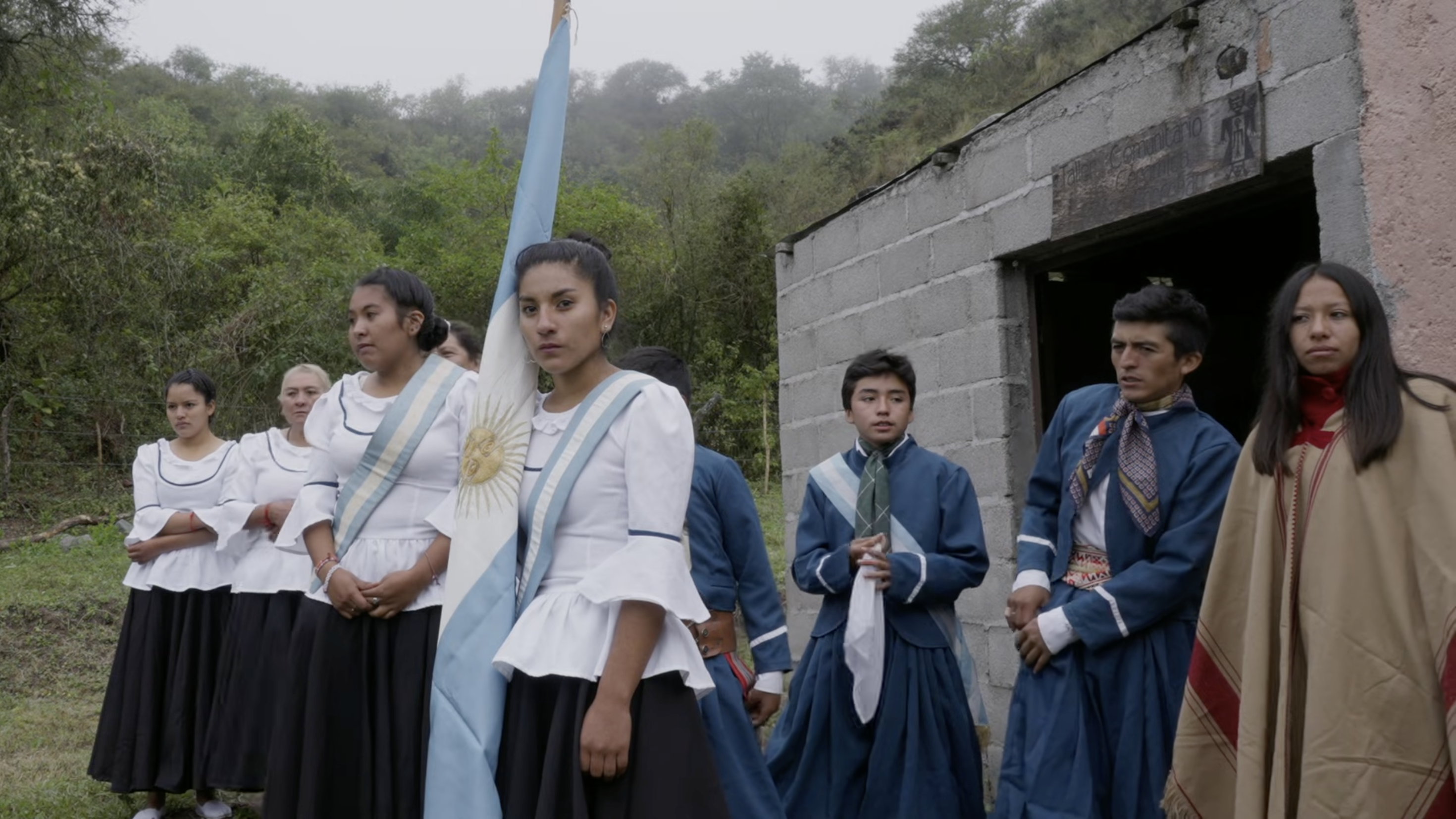
Our Land intersperses footage of the trial with the Chuschagastas’ personal photo collections tracing back their lineage. These images of the past—of courtship, family gatherings, and celebrations—aren’t static, but animated through the transportive sounds of local music and atmosphere, such as drums, the bleating of lambs, or a piñata being whacked at a party, sourced from the community itself, rendering the images vibrant and alive.
“For the Argentinian public that is against these indigenous communities, it’s quite shocking to see this archival material. It goes against their narrative of extinction,” said Martel. The inclusion of the community’s personal and collective records in the documentary serves as a counter to their organized erasure. Over the years, the Chuschagastas have given up parts of themselves by ceding their land to Spanish colonizers. These photos preserve themselves and their past.
As members recount detailed family histories and childhood stories, the personal becomes a window into the political, such as the period when the military dictatorship of Juan Carlos Onganía ordered the closure of 11 out of 27 sugar mills in Tucumán, setting off mass community migration.
What each story has in common is Chuschagasta community members being assigned to work or graze cattle on their own land. Even seemingly friendly outsiders have ulterior motives, revealed once they begin asking the group questions about land ownership. They’re often threatened with eviction, or hit with lawsuits, their livestock and harvest snatched.
For Martel, who had filmed 300 hours of courtroom footage, paring it down was initially a challenge. “I felt like what I had lived through was going to be very difficult to transmit, until I realized I didn’t need to follow the chronology of the trial, but rather pick out the moments that would expose how Argentina builds its historical truth,” she said.
Reclaiming the Lens
Our Land marks Martel’s first time working with drones, traditionally a tool of surveillance and control, but here subverted through shots of the landscape’s natural beauty, free from colonial usurpers. “Like with all technology, its use can be changed when the user’s intentions are sincere and different from what these tools were designed for,” she pointed out. “The drone is simply a flying camera that we tried to understand, and that spirit of understanding is what drives the film.”
Upon realizing how interested the Chuschagasta youth were in film and filmmaking, Martel offered them the opportunity to collaborate on the film as well. Our Land cinematographer Ernesto de Carvalho held a series of workshops to train them, and the footage they recorded has been incorporated into the documentary. The director, however, is clear that it can’t be called an “indigenous film.” “For that to have been the case, they would’ve had to be involved in the entire process and leading it,” she clarified.
The final few minutes of the documentary reveal that, by a unanimous vote, Amin was sentenced to 22 years in prison, Gomez to 18, and Valdivieso to 10. The convicts, however, appealed the verdict and were released just two years later, in 2020. A year later, Amin died of COVID. In 2025, the sentence was upheld, with Gomez and Valdivieso being incarcerated once more.
Martel isn’t anticipating any governmental pushback to her documentary. “What power does very intelligently is sweep any contradictory discourse under the rug rather than trying to counter it,” she said.
In Our Land, too, defiance persists. Chocobar’s nephew treks across the landscape before settling on a plot where he can construct a house for his family, clawing back space—and his right to exist.
(With translations by Cordelia Montes)


Our Land Is a Damning Indictment of Indigenous Erasure
Nuestra Tierra (Our Land) uses courtroom footage of a 2018 murder trial to unspool a larger narrative of not just a community’s fresh grief and loss, but also their systematic erasure over centuries.
It began with images of death. When Argentine director Lucrecia Martel was trawling through YouTube in 2009, conducting research for what would eventually become her period drama Zama (2017), she came across footage of the murder of Javier Chocobar, the indigenous Chuschagasta community chief who had been shot just six months earlier. “For someone who works in cinema like myself, to see someone with a camera and a weapon was quite shocking,” said the filmmaker over Zoom.
It was only when she stumbled across that video again—so much later that she’d initially forgotten she’d seen it before—that she began digging deeper. She got in touch with a local journalist, who then connected her with the community, and she traveled to the province of Tucumán to meet them.
Years of research, collated archival material, and interviews with the Chuschagastas eventually made their way into Martel’s first nonfiction film last year, Nuestra Tierra (Our Land), which uses courtroom footage of the 2018 murder trial to unspool a larger narrative of not just a community’s fresh grief and loss, but also their systematic erasure over centuries.
A Murder Trial Framed Against Stolen Land
Though the film’s genesis might’ve been Martel’s discovery of an act of violence, she begins her documentary with its tonal opposite: scenes of startling, serene beauty. There’s satellite footage of our planet from outer space, with the camera then gliding over the topography of Argentina, followed by drone shots of Tucumán’s lush green fields and mountains.
Yet, even among such boundless landscapes, vicious manmade divisions endure. The threat of persecution persists, illustrated by the montage’s eventual culmination inside the oppressive confines of a courtroom, where white mine owner Dario Amin and retired police officers Luis Humberto Gomez and Eduardo José Valdivieso are charged with aggravated attempted homicide in real concurrence and illegal possession of firearms.
Nine years earlier, these men had trespassed onto Chuschagasta property with the intent of embarking on a mining venture that would’ve displaced the community from their land. In the ensuing confrontation between the groups, 68-year-old Chocobar was killed, and two others from the 300-member community sustained gunshot wounds.
In court, the defence team repeatedly insists that everyone assembled there is equal, a refrain exposed as a cruel untruth over the course of the documentary. “Had Gomez intended to kill, he would’ve done so,” says a lawyer at one point, bringing up the former officer’s skillset, acquired during his time with an internationally trained task force. The statement, meant to assert that he had no intention to harm, instead only reaffirms just how much power he and his cohorts wield over the community.
Martel re-emphasizes this power differential using footage of a staged re-enactment of the murder, conducted as part of the trial and held at the scene of the crime. The ground-level camera evokes the gaze of the accused, who—as participants—re-create a slow-mo, action-packed version of the shootings for the assembled jury. One of them even cracks a joke, sparking laughter from the crowd. It’s a mockery of the murder. The scene then cuts to a shot of the same performed dramatization, now seen from the point of view of the Chuschagastas watching from atop a hill, their silence underscoring the hollowness of this farce.
In another scene, the accused and a witness are permitted to confront each other directly in court, seated across from each other before the judge. The accused, Valdivieso, verbally attacks Chocobar’s nephew over and over, raising his voice and leaning forward aggressively as the young man shrinks back in his seat.
The most damning proof of Argentinian societal disparity and the white men’s assurance of their status, however, comes from their own recording of the crime. As they arrive at the quarry, they spot community members taking photos to document the intrusion. “Why take photos?” asks a voice on the recording. “No one at the court listens to them anymore.” Had the community members not recovered this footage, Martel points out, the accused would’ve suppressed it.
How the State Manufactures Disappearance
A sharp critique of Argentina’s legal and bureaucratic systems is a feature of the director’s work. In her 2008 fiction film The Headless Woman, for example, a white woman’s familial connections to the police and a local hospital enable the disappearance of documents linked to her potential killing of an indigenous boy.
In Our Land, interviews with the Chuschagastas reveal how complaints of land encroachment—raised at levels ranging from the local Congress to the Land Registry Office—are shelved, buried under old files, or lost. Their testimony conjures images of people first driven from their land, then corralled even further into government offices, hallways, and front desks, as they repeatedly follow up on these complaints, without redress.
In one scene, the accused Amin explains, “I’m not a murderer. I was home,” accounting for his presence in the quarry on the day of the murder. He adds that he owns the deed and title to the lands, bought at a judicial auction—an egregious example of state-enabled land theft, premised on the fiction of terra nullius, or “nobody’s land,” that has justified the colonial invasion of indigenous lands for centuries.
That Amin and his co-accused intended to exploit the stone quarry on the Chuschagastas’ land for mining purposes mirrors a slew of similar reports from around the world, including in India, as the country’s indigenous tribal groups—or Adivasis—are pressured into eviction to further state-backed corporate interests. Last year, the Gauhati High Court questioned the Assam government’s decision to allot nearly 3,000 bighas of tribal land to a private cement company. In Chhattisgarh, tribal groups have been alleging state coercion and illegal land takeovers for more than a decade, with farmers’ organizations and environmentalists joining them for a public protest against the expansion of mining projects sure to result in their forced displacement earlier this year.
Martel and her co-writer, Maria Alche, had spent years studying thousands of documents that made up the Chuschagastas’ land-claim cases, looking for judicial material and working with historian Milena Acosta to source additional, often hard-to-understand papers. “The community had been insisting on the same petition for decades—that the government does a study of their land so that it could be awarded to them,” she said. “[What stood out to us] was all the different government bodies that they went through, the irresponsibility of the government itself when it received these petitions and the way that it responded, never giving a clear ‘yes’ or ‘no’ answer, just pushing it off to the next body.”
Argentina’s Fiction of Indigenous Extinction
Our Land also lays out the construction of a tale as old as time: an insidious historical narrative that depicts indigenous people as either illegals on their own land, or as a population that died out in 1807. Warped religious iconography pictures the Chuschagasta community as invaders, with angels descending from the heavens to fight them off with beams of light. This reflects a prevalent narrative in Argentina.
Martel succinctly captures this through a snippet of an online video featuring a man earnestly explaining to young students that God wants the indigenous to be destroyed. There’s a bitter parallel to be drawn to Martel’s 2001 drama La Ciénaga (The Swamp), in which several characters believe they’ve spotted the Virgin Mary at a local water tank, and Our Land, in which they refute the existence of the flesh-and-blood human beings native to their country. It’s a form of dehumanization the Chuschagastas have long been subjected to.
To the defence team, the mere presence of these indigenous communities isn’t sufficient proof of their existence; they are repeatedly directed to provide documented historical evidence of it. There are repeated allegations that the Chuschagastas cannot possibly belong to one community, since they don’t share common features or a common language. (They lost their original common language—the Cacán—in the 17th century.)
Martel explained that while the Argentinian constitution recognizes the rights of indigenous communities, schoolchildren who were never educated about their existence grow up to become adults who remain ignorant of them. “So every time there’s an indigenous community that comes to light and claims their land, it’s almost as if people are seeing a ghost,” she said. “At the core of the problems Argentina has today is its inability to understand the composition of its people.”
Argentina has about 35 officially recognized Indigenous communities, including the Mapuche, Guaraní, and Diaguita (to which the Chuschagastas belong). According to the 2022 census, indigenous people account for about 2.9% of the national population. In 2006, the country’s National Congress approved Law 26.160, which declared a state of “emergency with respect to the possession and property of the ancestral lands of the Indigenous communities of the country.” It prohibited the eviction or removal of Indigenous peoples from their ancestral lands for four years, and mandated that their lands be surveyed and registered statewide.
The law, however, was revoked soon after. “Our nation has been dependent on Spain since 1810, and it wasn’t until 200 years later that it was decided, for the first time, to consider a significant portion of our population,” said the filmmaker. “That process was interrupted by Javier Milei’s presidency.”
The Milei presidency has rolled back hard-won protections for Argentina’s indigenous communities, while simultaneously advancing an aggressive push for development—including soliciting foreign investment—in the resource-rich ancestral lands of the country’s indigenous population. In November 2024, Argentina was the only country to vote against a United Nations draft resolution on indigenous rights, arguing that recognizing ancestral practices would interfere with the exercise of individual rights.
Stories and Photographs that Defy Erasure
Our Land intersperses footage of the trial with the Chuschagastas’ personal photo collections tracing back their lineage. These images of the past—of courtship, family gatherings, and celebrations—aren’t static, but animated through the transportive sounds of local music and atmosphere, such as drums, the bleating of lambs, or a piñata being whacked at a party, sourced from the community itself, rendering the images vibrant and alive.
“For the Argentinian public that is against these indigenous communities, it’s quite shocking to see this archival material. It goes against their narrative of extinction,” said Martel. The inclusion of the community’s personal and collective records in the documentary serves as a counter to their organized erasure. Over the years, the Chuschagastas have given up parts of themselves by ceding their land to Spanish colonizers. These photos preserve themselves and their past.
As members recount detailed family histories and childhood stories, the personal becomes a window into the political, such as the period when the military dictatorship of Juan Carlos Onganía ordered the closure of 11 out of 27 sugar mills in Tucumán, setting off mass community migration.
What each story has in common is Chuschagasta community members being assigned to work or graze cattle on their own land. Even seemingly friendly outsiders have ulterior motives, revealed once they begin asking the group questions about land ownership. They’re often threatened with eviction, or hit with lawsuits, their livestock and harvest snatched.
For Martel, who had filmed 300 hours of courtroom footage, paring it down was initially a challenge. “I felt like what I had lived through was going to be very difficult to transmit, until I realized I didn’t need to follow the chronology of the trial, but rather pick out the moments that would expose how Argentina builds its historical truth,” she said.
Reclaiming the Lens
Our Land marks Martel’s first time working with drones, traditionally a tool of surveillance and control, but here subverted through shots of the landscape’s natural beauty, free from colonial usurpers. “Like with all technology, its use can be changed when the user’s intentions are sincere and different from what these tools were designed for,” she pointed out. “The drone is simply a flying camera that we tried to understand, and that spirit of understanding is what drives the film.”
Upon realizing how interested the Chuschagasta youth were in film and filmmaking, Martel offered them the opportunity to collaborate on the film as well. Our Land cinematographer Ernesto de Carvalho held a series of workshops to train them, and the footage they recorded has been incorporated into the documentary. The director, however, is clear that it can’t be called an “indigenous film.” “For that to have been the case, they would’ve had to be involved in the entire process and leading it,” she clarified.
The final few minutes of the documentary reveal that, by a unanimous vote, Amin was sentenced to 22 years in prison, Gomez to 18, and Valdivieso to 10. The convicts, however, appealed the verdict and were released just two years later, in 2020. A year later, Amin died of COVID. In 2025, the sentence was upheld, with Gomez and Valdivieso being incarcerated once more.
Martel isn’t anticipating any governmental pushback to her documentary. “What power does very intelligently is sweep any contradictory discourse under the rug rather than trying to counter it,” she said.
In Our Land, too, defiance persists. Chocobar’s nephew treks across the landscape before settling on a plot where he can construct a house for his family, clawing back space—and his right to exist.
(With translations by Cordelia Montes)