



Israel killed nearly 300 Palestinians in an attack on the Nuseirat refugee camp in Gaza in June 2024. The US-based PBS News covered the incident with the headline: “Israel rescues 4 hostages from Hamas captivity, while 210 Palestinians are reported killed during fighting in Gaza”.
The New York Times led with: “What We Know About Israel’s Deadly Strike on U.N. School Complex in Gaza.”
Both news outlets referred to the bombing as part of the “Israel-Hamas conflict” and “war”, respectively.
Calling what transpired in Gaza a “war” or “conflict” between two sides frames a highly asymmetrical relationship as if it were a conventional war between comparable sides. However, Israel is a state equipped with one of the world’s most advanced militaries. On the other hand, Hamas is an armed non-state actor embedded within a stateless civilian population facing Israeli blockade and apartheid, as concluded by human rights organizations. The terms – either ‘war’ or ‘conflict’ – can flatten this crucial difference between the two.
Now, let’s look at a global wire service like the Associated Press (AP). The AP article described the attack on the Nuseirat camp as “the most successful operation of the eight-month war” for Israel. The same language was circulated through the network of 3,900 media organizations that subscribe to the AP.
“The operation is actually a massacre of more than 250 Palestinians in the most horrific ways you could imagine,” said Aseel Albajeh, advocacy officer at The Palestine Institute for Public Diplomacy, a West Bank-based NGO that works on strengthening Palestinian narratives globally. “This is just an example of what language can do to the perception of the people. They [The audience] see Israel as the victim, they don’t see the full perspective of what is happening to Palestinians,” Albajeh told The Polis Project.
It is important to note that this incident took place around six months after the International Court of Justice had already ordered Israel to prevent genocidal actions in Gaza. However, that information remains absent in these reports.
In recent years, legacy and mainstream Western publications have been repeatedly called out for bias in their reporting and media standards with regards to Gaza. Much of it has to do with the language they use. Leading media style guides, such as the Associated Press (AP) Stylebook—often referred to as the ‘Bible of Journalism’—play a key role in shaping this language. Style guides provide rules for grammar (punctuation, spelling, capitalization, and word choice), as well as guidance on describing people, events, and sensitive topics.
The “Middle East Conflicts” guide in AP’s online catalog provides instructions on how to write about countries, armed groups, and communities, including Palestine, Israel, Iran, Hamas, and Hezbollah. It says journalists should refer to the genocide as the “Israel-Hamas war”, not refer to Palestine as a state, and must “understand the deep wells of anger, hurt and grievance built up over generations among Israelis and Palestinians.”
Other related directives of the guide are strikingly vague, with the “famine, hunger crisis” section merely providing a definition of how to determine famine and vaguely noting that there are “unique challenges to gathering such data in Gaza.”
Such linguistic directives have established a common understanding of the genocide as merely a conflict that started on October 7, in which Israel and Gaza are on an even playing field. The Stylebook has already taken a position. Its directives do not pay heed to the fact that Holocaust and genocide scholars, along with major human rights organizations, have described Israel’s assault on Gaza as an ongoing genocide. It does not ensure a historical understanding of the occupation of Palestine that dates back nearly a century, with 700,000 Palestinians displaced by Israel in the 1948 Nakba (“catastrophe”).
To whom, then, is linguistic “accuracy” afforded? And who benefits from these “standards”? “They’re kind of jumping through rhetorical gymnastics to avoid saying what’s happening,” said Sharif Abdel Kouddous, the Middle East and North Africa editor at Drop Site News. When it comes to attributions for using words like “genocide”, “There are different standards in what is being pulled in and attributed, and this deeply affects how people understand what’s happening, why these biases exist,” he said.
Politics of Language: Neutrality, Standardization, Positionality
By standardizing reporting language, style guides often influence how stories are framed, even though AP claims that these are in place for “accuracy” and “neutrality”. AP states that the Stylebook is “factual and nonpartisan” and “doesn’t align with any particular agenda.” And it instructs, “Words should be chosen carefully to reflect respect for different perspectives.” While this sounds noble at face value, in reality, it also serves to create false equivalences, like the one between Hamas and Israel.
While some major newsrooms and wire services, such as the New York Times and Reuters, have their own internal style guides, the AP Stylebook is circulated, taught to journalists worldwide, and considered the gold standard. It is used by major publications across news, magazines, public relations, and more. Its physical version is updated every other year, while its online version is updated continuously to incorporate major world events.
AP retains a tremendous amount of authority and discretion in choosing what linguistic updates it accepts. As the COVID-19 pandemic progressed, for example, and debates over epidemic vs. pandemic and how to frame anti-vaccination conspiracies swirled, the Stylebook was updated in accordance with decisions made by the World Health Organization, a global authority on the situation. On the other hand, after President Donald Trump demanded that journalists refer to the Gulf of Mexico as the “Gulf of America”, AP strongly refused that politically loaded directive.
After the Russian invasion of Ukraine, the topical style guide for the ensuing war only contained corrections to the spelling of ‘Kyiv’, currencies, and the usage of ‘war’ itself in referring to the issue.
“It [the Russia-Ukraine war] is taking place between two countries — one that has invaded to achieve its goals, and one that believes it is defending its homeland and sees itself as fighting for its very existence,” a note published by the AP says. The note is a public explanation on why “war” is the preferred framework for AP in this case. It narrates asymmetry, identifies aggression, and explains why euphemisms such as Russia’s “special military operation” are inadequate to describe reality. Even while adopting the broader label “war,” AP’s note preserves the legitimacy of sharper terms like “attack” and “invasion.”
However, AP does not maintain such standards on the question of Palestine. Despite multi-faceted evidence of there being a genocide and a history of over seven decades of Israeli apartheid, the AP Stylebook has not yet been updated; it still prescribes using “Israel-Hamas war”, a phrase that compresses a widely unequal confrontation into the language of parity. The contrast is revealing because of the explanatory labor AP performs for one conflict and withholds from another. The style guide adds, “Do not use terms such as Israel-Palestinian war or Israel-Lebanon war, as major Palestinian and Lebanese factions did not take part.”
Kouddous affirms that these framings are simply incorrect and that Drop Site does not use ‘Israel-Hamas war’ in its coverage. “It’s just purely a matter of accuracy, right? So if you say the Israel-Hamas war, that makes it sound like there are two equal sides, and Israel is only waging a war on Hamas, but that’s not the case,” he said. “They’re attacking all aspects of civilian infrastructure, aspects of Palestinian society in a systematic and sustained way.”
While the AP Stylebook is widely referenced in newsrooms, “use of AP style” may not always mean a strict, formal adoption of all guidelines. Many outlets report following AP style with local exceptions or adapting AP rules into their own editorial manuals, blending standard guidelines—such as spelling, abbreviations, numbers, and dates—with newsroom-specific practices. For example, the Electronic Intifada does defer to AP Stylebook guidelines but does not adhere to the prescribed style for stories from the Middle East and North Africa (MENA) region.
“A lot of times people can consider it semantics, but we know that the language we use can either accurately depict a reality or shroud the truth,” Olivia Riggio, administrative and fundraising director at Fairness and Accuracy in Reporting (FAIR), said. FAIR is a US-based media watch group that publishes analysis and criticism of corporate media.
“The conversation [about the impact of language] needs to start with – the language we use does matter,” Riggio said.
“If your premise is neutrality in situations where there’s systemic racism and occupation, then you’re not delivering the facts to your audience. And that is against the ethics of media standards that they should abide by,” Albajeh said,
Western media style guides explicitly falter, on the question of Palestinian statehood. Palestine is internationally recognized as a country, including by France and the United Kingdom. But the AP Stylebook instructs usage of Palestine as a state “only in the context of Palestine’s activities in international bodies to which it has been admitted. Do not use Palestine or the state of Palestine in other situations, since it is not a fully independent, unified state.” However, there are no similar instructions to not refer independently to Somaliland, Taiwan, or Kurdistan—none of which are formally recognized as independent countries.
The AP advises using “Palestinian territories” only for Gaza and the West Bank when referring to them together. For east Jerusalem, it says: “Most countries consider east Jerusalem to be occupied territory and locate their embassies in Tel Aviv.”
AP is not alone in having such a stance. The Guardian’s stylebook instructs only using Palestine “for historical references to the area before 1948.” UK’s public broadcaster, BBC, has a similar position, saying, “in day-to-day coverage of the Middle East you should not affix the name ‘Palestine’ to Gaza or the West Bank – rather, it is still an aspiration or an historical entity.” It adds that in specific, limited contexts, it can still be used, like the Olympics or UK’s 2025 recognition of the state of Palestine.
Euphemisms for Genocide
Sahar (name changed) works as a reporter at an international office of a major US newsroom that adheres to the AP Stylebook. At her newsroom, language restrictions are part of the editorial standards and also influence the publication’s culture.
Sahar explained that after multiple rounds of edits, all stories undergo a “standards review”, which is a legal review that checks for anything that could lead to a lawsuit or for terminologies that are “legally binding”. In case of reports on Palestine, this process looks for terms like “genocide” or “famine,” which are then changed as per their stylebook or attributed to a source. “They are so strict in what sort of terminology they use. If it’s coming from an UN agency, they use it. They go ‘the UN called genocide,’ and they are open about it, but they do not use that word just by itself,” Sahar added, underlining a trend seen across many newsrooms in the West.
This standard review process therefore often amounts to changes in the language of Palestine-related articles, said Sahar. This process eventually leads to fewer and fewer attempts to use language that goes against the AP stylebook and the legal review team. That’s because reporters want to publish their stories in a timely manner and not be “trapped at the standards review forever”.
“In general, after some point, you lose your compass. Am I censoring myself, or am I just preventing more edits on the things that I’m writing?” she said. “At some point, the border becomes blurry.”
Reporters like Sahar have been trying to sound the alarm about these language practices in major Western newsrooms.
In April 2024, nonprofit media publication The Intercept reported a leaked memo from the New York Times that instructed reporters to restrict the use of “Palestine”, “genocide”, and “ethnic cleansing” in their stories, and to “avoid” the phrase “occupied territory” when describing Palestinian land. The memo, which was internally distributed by the New York Times a month into the genocide, lays similar justifications as AP: “accuracy, consistency and nuance.” But the report adds: “… several Times staffers told The Intercept that some of its contents show evidence of the paper’s deference to Israeli narratives.”
“The New York Times being as influential a paper as it is globally, [NYT’s] narrative could have had the power to change the conversation and allow pressure to be put on world leaders to stop what is occurring,” FAIR’s Riggio said. “Oftentimes, the reason for this wishy-washy language is that it’s inconvenient to tell the truth when your loyalty is not to the truth, but to corporate stakeholders and the billionaires that own them, and the politicians that they’re trying to appeal to.”
Another investigation into the Reuters’ style mandate further revealed the depth of this bias. The report, released last August by Declassified UK, followed internal backlash within the global wire newsroom after Reuters released an updated Middle East style guide for its newsroom last May. It led several members of the editorial staff to speak out against a perceived pro-Israel bias in the publication’s reporting. Archit Mehta, who reported on the story for Declassified UK, said he received a call from a Reuters reporter (anonymized in the story due to fear of reprisal), alerting him of the new style guide. “They called me, and they were really upset,” Mehta, a US-based journalist, said.
The update let Reuters journalists to use the word “genocide” only with attribution. “War”, “conflict,” and “campaign” are the words generally used to skirt around “genocide”. The style guide also continued to limit usage of the term Palestine for “references to historic Palestine from antiquity… to 1948”.
Name the killer and the crime @Reuters. pic.twitter.com/Mn7fOsz1vY
— Assal Rad (@AssalRad) April 18, 2026
The debate in the Reuters newsroom resulted in an internal study analyzing about 500 reports published between October 7 and November 14, 2023. It was spurred both by reporting bias – such as allocating more resources to cover “stories affecting Israelis as opposed to Palestinians” – and by the style guide’s bias. The study was quoted as saying: “One clear-cut example of how our wording implies bias is in our choice to prohibit use of ‘Palestine’… While Palestine may not be recognized as a state in some Western countries, we do not need to pretend that it is not a real place.”
Several inconsistencies continue to mark editorial policies and style guides. Even after a 2025 UN Commission found Israel has committed genocide in Gaza (as defined under the Geneva Convention), the BBC did not use it standalone, or as necessary information in its subsequent reportage. Previously, the International Criminal Court had issued an arrest warrant for Israeli PM Benjamin Netanyahu for alleged war crimes. Yet, the BBC runs with “Israel-Gaza War” or sometimes just the “Gaza War”. A February 2026 article still called it “a military campaign in Gaza”.
On the other hand, the broadcaster often defers to similar international bodies in other areas. For example, the BBC’s style guide cites the UN’s use of the word “barrier” to refer to the Israeli-built West Bank wall, and promotes that word for being neutral. “The United Nations also uses the term ‘barrier’. It’s better to keep to this word unless you have sought the advice of the Middle East bureau,” it says.
Here, editorial discretion is given to the “Middle East bureau”. This signals to a practice common in most major newsrooms. Editorial directives often trump stylebooks and have the power to define things where they are left vague. An investigation by journalist Owen Jones for Drop Site revealed that certain sources claim Raffi Berg, BBC News online’s Middle East editor, who oversaw the digital publication of news on Israel and Palestine, was biased towards Israel. Published in 2024 after interviewing over a dozen BBC staff, the article corroborated findings by a report published earlier that year by the Centre for Media Monitoring (a nonprofit founded by the Muslim Council of Britain). These findings include BBC’s use of emotive language for Israeli suffering or deaths compared to Palestinian victims, and a pattern that BBC’s coverage often uncritically accepts Israeli positions while casting suspicion on Palestinian sources. Former BBC newsreader Karishma Patel backed similar claims in a 2025 piece for The Independent.
Biases and inaccuracies trickle down to local newsrooms too, which often repost articles from wire services like the Reuters and the AP. They also follow the AP Stylebook when reporting on events related to Palestine in their respective regions and prefer employing journalists proficient in the AP style.
For instance, in the US, the Tampa Bay Times, a local newspaper owned by the Poynter Institute, requires knowledge of AP style and grammar in its job postings. A March 2024 report from the publication also reflects its use of the style guide in framing the genocide as “Israel-Hamas war”. The Texas Tribune’s reporting similarly follows the AP style and lists proficiency in it as a requirement for employment.
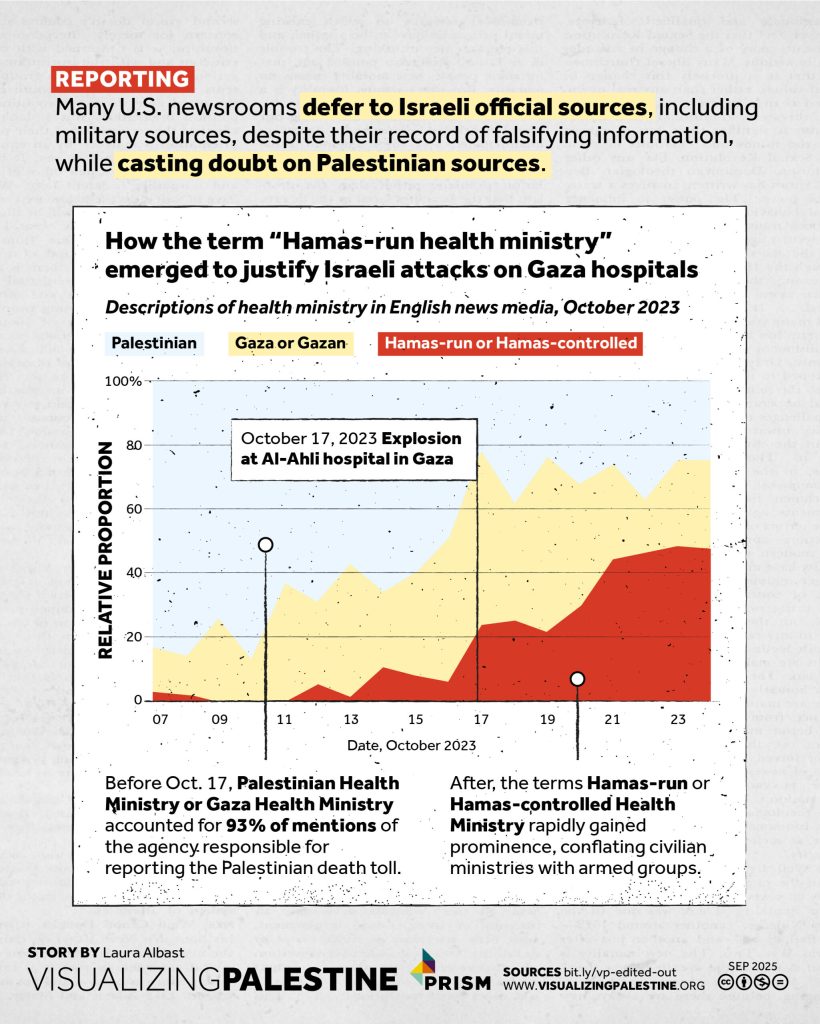
The USA Today Network, owned by Gannett, has over 250 newsrooms under its umbrella, and issues internal guidelines for USA Today newsrooms such as the Detroit Free Press, Milwaukee Journal Sentinel, The Arizona Republic, and The Journal News, among others. Many of these guidelines on Palestine are similar to those of AP: using “Israel-Hamas war” to refer to the genocide, and restricting the use of ‘Palestine’ to articulations by international bodies that recognize it as a state. It also refers to the Ministry of Health in the Gaza Strip as the ‘Hamas-controlled Gaza Health Ministry’, thus raising questions over the death tolls published by the Ministry.
Albajeh said that the use of “Hamas-run Ministry of Health” when it comes to attributing data on atrocities and fatalities casts a doubt in the readers’ minds. Sahar has encountered this practice firsthand in her newsroom, particularly early on in the genocide. “Even if I would always write [Gaza Ministry of Health] in my reporting, it would automatically change to Hamas-run Ministry of Health [in the published version],” she said. She clarified that this didn’t mean the figures published by the Ministry would be censored, but that “it [the data] would lose its legitimacy as soon as we would mention it’s coming from the ‘Hamas-run’ Gaza Ministry of Health.”
The use of the “Hamas-run” qualifier introduces skepticism about the death toll in Gaza, despite international bodies like the UN, World Health Organization, and other international institutions having held the data as largely accurate. When the death toll surpassed the 50,000-mark, the BBC ran with the headline “More than 50,000 killed in Gaza since Israel offensive began, Hamas-run ministry says”. Notably, The Guardian’s style guide includes some nuance in this regard: “Palestinian ministry of health manages healthcare in both the West Bank and Gaza. Therefore, many of its functions and staff are not linked to Gaza or its Hamas government. Be careful not to imply that they are.”
Communicating Palestine, in Palestinians’ Words
The decades-long institutionalized biases have influenced how Palestine is communicated to the world. As Riggio put it, it has served to “soften the truth” and “doesn’t accurately depict the reality” of Palestine.
In 2020, this prompted Albajeh’s team to collaborate with other Palestinian advocacy groups, NGOs, journalists, and communication specialists to compile a guide titled Communicating Palestine.
“There has always been a gap in the need for a guide that tackles all the problems, but also solutions and tips on how to communicate Palestine properly to an international audience,” Albajeh said. The guide also lays out how to frame Israel’s genocide and settler attacks, best practices for engaging with Palestinians in media and communications, presenting ethical visuals from Palestine, and how to counter ubiquitous inaccuracies and misrepresentations.
Communicating Palestine, designed as an interactive tool for media professionals, includes an alphabetical guide on language usage. Albajeh points out that the guide describes the use of ‘Israel-Hamas War’ as ‘both sides-ism’, and explains that it assigns equal responsibility between the two parties and “creates flawed understandings of Israeli policies and Palestinian actions”.
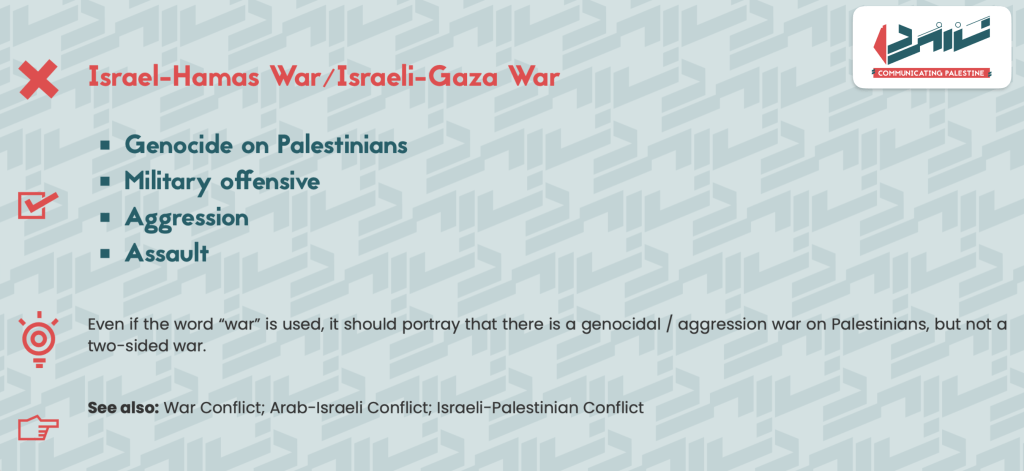
Explaining the significance of these linguistic choices, Albajeh said that Palestinians are more likely to be framed as terrorists rather than as engaging in resistance. Meanwhile, Israeli actions are characterized within frameworks of security or self-defense rather than occupation or aggression; similarly, demonstrations in the West Bank are reported as clashes instead of protests against occupation.
The process of creating Communicating Palestine included field research to understand how Palestinians felt about their portrayal in the West. Albajeh said that the research team talked to nearly all representative segments of Palestinian society and asked the following questions: “What do you think are the main problems when it comes to communicating Palestine? How do different audiences engage with Palestinians? And how do you recommend this would be deconstructed and addressed?”
“Media was one of the key sectors that was identified—international media, mainstream media—as a problematic actor in mainstreaming harmful narratives on the Palestinian cause,” Albajeh said.
Independent Journalists and Newsrooms Navigate Style Guide Restrictions
Neha Madhira, a freelance investigative journalist covering the regions of Middle East, North Africa, and South Asia, said editorial language choices directly affect her relationship with sources and the people she interviews in the Gaza Strip and the West Bank. “I feel that it’s almost disrespectful to take everything that they have said to me, and then go to these outlets and have to distort all of the language they have used while talking to me,” Madhira said.
According to Madhira, how a publication frames its coverage of the genocide also determines where she chooses to publish her work. Her experiences have led to this decision. She shared an incident where she undertook an extensive assignment to document attacks on healthcare facilities, the targeting of specific communities, and the nature of evacuation orders by Israel. During the process of producing the story, her main source, a local journalist, was killed by Israeli bombing. She wrote the draft without expecting major changes. About a month before publication, editors told her that they were internally debating the story’s framing—including pressure to shift language from Palestine to Hamas—and proposals to cut large sections or pause the piece entirely. The story was eventually published, but “that entire editing process was honestly really humiliating,” Madhira said.
Now, she writes for a select few independent newsrooms that do not follow AP-style guidelines on Palestine. So that, “I don’t have to jump through these hoops and fight every single word with [them].”
More and more independent newsrooms, similar to the few mentioned in this report, are not adhering to standardized guidelines like AP’s, especially regarding Palestine.
“Mainstream media has always been, for many Palestinians, especially in the advocacy and activism scene, not the go-to place, but actually a place that we want to hold accountable,” Albajeh said. Most Palestinians rely instead on “alternative and emerging outlets” for their news, she noted.
“The people who have been leading the storytelling about Gaza and putting it into perspective, they’re from independent media outlets. They’re independent journalists and a lot of them are Palestinian journalists,” Riggio added.

Don’t Say Palestine: Politics of Western Media Style Guides and Entrenched Bias
Image by The Polis Project
Israel killed nearly 300 Palestinians in an attack on the Nuseirat refugee camp in Gaza in June 2024. The US-based PBS News covered the incident with the headline: “Israel rescues 4 hostages from Hamas captivity, while 210 Palestinians are reported killed during fighting in Gaza”.
The New York Times led with: “What We Know About Israel’s Deadly Strike on U.N. School Complex in Gaza.”
Both news outlets referred to the bombing as part of the “Israel-Hamas conflict” and “war”, respectively.
Calling what transpired in Gaza a “war” or “conflict” between two sides frames a highly asymmetrical relationship as if it were a conventional war between comparable sides. However, Israel is a state equipped with one of the world’s most advanced militaries. On the other hand, Hamas is an armed non-state actor embedded within a stateless civilian population facing Israeli blockade and apartheid, as concluded by human rights organizations. The terms – either ‘war’ or ‘conflict’ – can flatten this crucial difference between the two.
Now, let’s look at a global wire service like the Associated Press (AP). The AP article described the attack on the Nuseirat camp as “the most successful operation of the eight-month war” for Israel. The same language was circulated through the network of 3,900 media organizations that subscribe to the AP.
“The operation is actually a massacre of more than 250 Palestinians in the most horrific ways you could imagine,” said Aseel Albajeh, advocacy officer at The Palestine Institute for Public Diplomacy, a West Bank-based NGO that works on strengthening Palestinian narratives globally. “This is just an example of what language can do to the perception of the people. They [The audience] see Israel as the victim, they don’t see the full perspective of what is happening to Palestinians,” Albajeh told The Polis Project.
It is important to note that this incident took place around six months after the International Court of Justice had already ordered Israel to prevent genocidal actions in Gaza. However, that information remains absent in these reports.
In recent years, legacy and mainstream Western publications have been repeatedly called out for bias in their reporting and media standards with regards to Gaza. Much of it has to do with the language they use. Leading media style guides, such as the Associated Press (AP) Stylebook—often referred to as the ‘Bible of Journalism’—play a key role in shaping this language. Style guides provide rules for grammar (punctuation, spelling, capitalization, and word choice), as well as guidance on describing people, events, and sensitive topics.
The “Middle East Conflicts” guide in AP’s online catalog provides instructions on how to write about countries, armed groups, and communities, including Palestine, Israel, Iran, Hamas, and Hezbollah. It says journalists should refer to the genocide as the “Israel-Hamas war”, not refer to Palestine as a state, and must “understand the deep wells of anger, hurt and grievance built up over generations among Israelis and Palestinians.”
Other related directives of the guide are strikingly vague, with the “famine, hunger crisis” section merely providing a definition of how to determine famine and vaguely noting that there are “unique challenges to gathering such data in Gaza.”
Such linguistic directives have established a common understanding of the genocide as merely a conflict that started on October 7, in which Israel and Gaza are on an even playing field. The Stylebook has already taken a position. Its directives do not pay heed to the fact that Holocaust and genocide scholars, along with major human rights organizations, have described Israel’s assault on Gaza as an ongoing genocide. It does not ensure a historical understanding of the occupation of Palestine that dates back nearly a century, with 700,000 Palestinians displaced by Israel in the 1948 Nakba (“catastrophe”).
To whom, then, is linguistic “accuracy” afforded? And who benefits from these “standards”? “They’re kind of jumping through rhetorical gymnastics to avoid saying what’s happening,” said Sharif Abdel Kouddous, the Middle East and North Africa editor at Drop Site News. When it comes to attributions for using words like “genocide”, “There are different standards in what is being pulled in and attributed, and this deeply affects how people understand what’s happening, why these biases exist,” he said.
Politics of Language: Neutrality, Standardization, Positionality
By standardizing reporting language, style guides often influence how stories are framed, even though AP claims that these are in place for “accuracy” and “neutrality”. AP states that the Stylebook is “factual and nonpartisan” and “doesn’t align with any particular agenda.” And it instructs, “Words should be chosen carefully to reflect respect for different perspectives.” While this sounds noble at face value, in reality, it also serves to create false equivalences, like the one between Hamas and Israel.
While some major newsrooms and wire services, such as the New York Times and Reuters, have their own internal style guides, the AP Stylebook is circulated, taught to journalists worldwide, and considered the gold standard. It is used by major publications across news, magazines, public relations, and more. Its physical version is updated every other year, while its online version is updated continuously to incorporate major world events.
AP retains a tremendous amount of authority and discretion in choosing what linguistic updates it accepts. As the COVID-19 pandemic progressed, for example, and debates over epidemic vs. pandemic and how to frame anti-vaccination conspiracies swirled, the Stylebook was updated in accordance with decisions made by the World Health Organization, a global authority on the situation. On the other hand, after President Donald Trump demanded that journalists refer to the Gulf of Mexico as the “Gulf of America”, AP strongly refused that politically loaded directive.
After the Russian invasion of Ukraine, the topical style guide for the ensuing war only contained corrections to the spelling of ‘Kyiv’, currencies, and the usage of ‘war’ itself in referring to the issue.
“It [the Russia-Ukraine war] is taking place between two countries — one that has invaded to achieve its goals, and one that believes it is defending its homeland and sees itself as fighting for its very existence,” a note published by the AP says. The note is a public explanation on why “war” is the preferred framework for AP in this case. It narrates asymmetry, identifies aggression, and explains why euphemisms such as Russia’s “special military operation” are inadequate to describe reality. Even while adopting the broader label “war,” AP’s note preserves the legitimacy of sharper terms like “attack” and “invasion.”
However, AP does not maintain such standards on the question of Palestine. Despite multi-faceted evidence of there being a genocide and a history of over seven decades of Israeli apartheid, the AP Stylebook has not yet been updated; it still prescribes using “Israel-Hamas war”, a phrase that compresses a widely unequal confrontation into the language of parity. The contrast is revealing because of the explanatory labor AP performs for one conflict and withholds from another. The style guide adds, “Do not use terms such as Israel-Palestinian war or Israel-Lebanon war, as major Palestinian and Lebanese factions did not take part.”
Kouddous affirms that these framings are simply incorrect and that Drop Site does not use ‘Israel-Hamas war’ in its coverage. “It’s just purely a matter of accuracy, right? So if you say the Israel-Hamas war, that makes it sound like there are two equal sides, and Israel is only waging a war on Hamas, but that’s not the case,” he said. “They’re attacking all aspects of civilian infrastructure, aspects of Palestinian society in a systematic and sustained way.”
While the AP Stylebook is widely referenced in newsrooms, “use of AP style” may not always mean a strict, formal adoption of all guidelines. Many outlets report following AP style with local exceptions or adapting AP rules into their own editorial manuals, blending standard guidelines—such as spelling, abbreviations, numbers, and dates—with newsroom-specific practices. For example, the Electronic Intifada does defer to AP Stylebook guidelines but does not adhere to the prescribed style for stories from the Middle East and North Africa (MENA) region.
“A lot of times people can consider it semantics, but we know that the language we use can either accurately depict a reality or shroud the truth,” Olivia Riggio, administrative and fundraising director at Fairness and Accuracy in Reporting (FAIR), said. FAIR is a US-based media watch group that publishes analysis and criticism of corporate media.
“The conversation [about the impact of language] needs to start with – the language we use does matter,” Riggio said.
“If your premise is neutrality in situations where there’s systemic racism and occupation, then you’re not delivering the facts to your audience. And that is against the ethics of media standards that they should abide by,” Albajeh said,
Western media style guides explicitly falter, on the question of Palestinian statehood. Palestine is internationally recognized as a country, including by France and the United Kingdom. But the AP Stylebook instructs usage of Palestine as a state “only in the context of Palestine’s activities in international bodies to which it has been admitted. Do not use Palestine or the state of Palestine in other situations, since it is not a fully independent, unified state.” However, there are no similar instructions to not refer independently to Somaliland, Taiwan, or Kurdistan—none of which are formally recognized as independent countries.
The AP advises using “Palestinian territories” only for Gaza and the West Bank when referring to them together. For east Jerusalem, it says: “Most countries consider east Jerusalem to be occupied territory and locate their embassies in Tel Aviv.”
AP is not alone in having such a stance. The Guardian’s stylebook instructs only using Palestine “for historical references to the area before 1948.” UK’s public broadcaster, BBC, has a similar position, saying, “in day-to-day coverage of the Middle East you should not affix the name ‘Palestine’ to Gaza or the West Bank – rather, it is still an aspiration or an historical entity.” It adds that in specific, limited contexts, it can still be used, like the Olympics or UK’s 2025 recognition of the state of Palestine.
Euphemisms for Genocide
Sahar (name changed) works as a reporter at an international office of a major US newsroom that adheres to the AP Stylebook. At her newsroom, language restrictions are part of the editorial standards and also influence the publication’s culture.
Sahar explained that after multiple rounds of edits, all stories undergo a “standards review”, which is a legal review that checks for anything that could lead to a lawsuit or for terminologies that are “legally binding”. In case of reports on Palestine, this process looks for terms like “genocide” or “famine,” which are then changed as per their stylebook or attributed to a source. “They are so strict in what sort of terminology they use. If it’s coming from an UN agency, they use it. They go ‘the UN called genocide,’ and they are open about it, but they do not use that word just by itself,” Sahar added, underlining a trend seen across many newsrooms in the West.
This standard review process therefore often amounts to changes in the language of Palestine-related articles, said Sahar. This process eventually leads to fewer and fewer attempts to use language that goes against the AP stylebook and the legal review team. That’s because reporters want to publish their stories in a timely manner and not be “trapped at the standards review forever”.
“In general, after some point, you lose your compass. Am I censoring myself, or am I just preventing more edits on the things that I’m writing?” she said. “At some point, the border becomes blurry.”
Reporters like Sahar have been trying to sound the alarm about these language practices in major Western newsrooms.
In April 2024, nonprofit media publication The Intercept reported a leaked memo from the New York Times that instructed reporters to restrict the use of “Palestine”, “genocide”, and “ethnic cleansing” in their stories, and to “avoid” the phrase “occupied territory” when describing Palestinian land. The memo, which was internally distributed by the New York Times a month into the genocide, lays similar justifications as AP: “accuracy, consistency and nuance.” But the report adds: “… several Times staffers told The Intercept that some of its contents show evidence of the paper’s deference to Israeli narratives.”
“The New York Times being as influential a paper as it is globally, [NYT’s] narrative could have had the power to change the conversation and allow pressure to be put on world leaders to stop what is occurring,” FAIR’s Riggio said. “Oftentimes, the reason for this wishy-washy language is that it’s inconvenient to tell the truth when your loyalty is not to the truth, but to corporate stakeholders and the billionaires that own them, and the politicians that they’re trying to appeal to.”
Another investigation into the Reuters’ style mandate further revealed the depth of this bias. The report, released last August by Declassified UK, followed internal backlash within the global wire newsroom after Reuters released an updated Middle East style guide for its newsroom last May. It led several members of the editorial staff to speak out against a perceived pro-Israel bias in the publication’s reporting. Archit Mehta, who reported on the story for Declassified UK, said he received a call from a Reuters reporter (anonymized in the story due to fear of reprisal), alerting him of the new style guide. “They called me, and they were really upset,” Mehta, a US-based journalist, said.
The update let Reuters journalists to use the word “genocide” only with attribution. “War”, “conflict,” and “campaign” are the words generally used to skirt around “genocide”. The style guide also continued to limit usage of the term Palestine for “references to historic Palestine from antiquity… to 1948”.
Name the killer and the crime @Reuters. pic.twitter.com/Mn7fOsz1vY
— Assal Rad (@AssalRad) April 18, 2026
The debate in the Reuters newsroom resulted in an internal study analyzing about 500 reports published between October 7 and November 14, 2023. It was spurred both by reporting bias – such as allocating more resources to cover “stories affecting Israelis as opposed to Palestinians” – and by the style guide’s bias. The study was quoted as saying: “One clear-cut example of how our wording implies bias is in our choice to prohibit use of ‘Palestine’… While Palestine may not be recognized as a state in some Western countries, we do not need to pretend that it is not a real place.”
Several inconsistencies continue to mark editorial policies and style guides. Even after a 2025 UN Commission found Israel has committed genocide in Gaza (as defined under the Geneva Convention), the BBC did not use it standalone, or as necessary information in its subsequent reportage. Previously, the International Criminal Court had issued an arrest warrant for Israeli PM Benjamin Netanyahu for alleged war crimes. Yet, the BBC runs with “Israel-Gaza War” or sometimes just the “Gaza War”. A February 2026 article still called it “a military campaign in Gaza”.
On the other hand, the broadcaster often defers to similar international bodies in other areas. For example, the BBC’s style guide cites the UN’s use of the word “barrier” to refer to the Israeli-built West Bank wall, and promotes that word for being neutral. “The United Nations also uses the term ‘barrier’. It’s better to keep to this word unless you have sought the advice of the Middle East bureau,” it says.
Here, editorial discretion is given to the “Middle East bureau”. This signals to a practice common in most major newsrooms. Editorial directives often trump stylebooks and have the power to define things where they are left vague. An investigation by journalist Owen Jones for Drop Site revealed that certain sources claim Raffi Berg, BBC News online’s Middle East editor, who oversaw the digital publication of news on Israel and Palestine, was biased towards Israel. Published in 2024 after interviewing over a dozen BBC staff, the article corroborated findings by a report published earlier that year by the Centre for Media Monitoring (a nonprofit founded by the Muslim Council of Britain). These findings include BBC’s use of emotive language for Israeli suffering or deaths compared to Palestinian victims, and a pattern that BBC’s coverage often uncritically accepts Israeli positions while casting suspicion on Palestinian sources. Former BBC newsreader Karishma Patel backed similar claims in a 2025 piece for The Independent.
Biases and inaccuracies trickle down to local newsrooms too, which often repost articles from wire services like the Reuters and the AP. They also follow the AP Stylebook when reporting on events related to Palestine in their respective regions and prefer employing journalists proficient in the AP style.
For instance, in the US, the Tampa Bay Times, a local newspaper owned by the Poynter Institute, requires knowledge of AP style and grammar in its job postings. A March 2024 report from the publication also reflects its use of the style guide in framing the genocide as “Israel-Hamas war”. The Texas Tribune’s reporting similarly follows the AP style and lists proficiency in it as a requirement for employment.
The USA Today Network, owned by Gannett, has over 250 newsrooms under its umbrella, and issues internal guidelines for USA Today newsrooms such as the Detroit Free Press, Milwaukee Journal Sentinel, The Arizona Republic, and The Journal News, among others. Many of these guidelines on Palestine are similar to those of AP: using “Israel-Hamas war” to refer to the genocide, and restricting the use of ‘Palestine’ to articulations by international bodies that recognize it as a state. It also refers to the Ministry of Health in the Gaza Strip as the ‘Hamas-controlled Gaza Health Ministry’, thus raising questions over the death tolls published by the Ministry.
Albajeh said that the use of “Hamas-run Ministry of Health” when it comes to attributing data on atrocities and fatalities casts a doubt in the readers’ minds. Sahar has encountered this practice firsthand in her newsroom, particularly early on in the genocide. “Even if I would always write [Gaza Ministry of Health] in my reporting, it would automatically change to Hamas-run Ministry of Health [in the published version],” she said. She clarified that this didn’t mean the figures published by the Ministry would be censored, but that “it [the data] would lose its legitimacy as soon as we would mention it’s coming from the ‘Hamas-run’ Gaza Ministry of Health.”
The use of the “Hamas-run” qualifier introduces skepticism about the death toll in Gaza, despite international bodies like the UN, World Health Organization, and other international institutions having held the data as largely accurate. When the death toll surpassed the 50,000-mark, the BBC ran with the headline “More than 50,000 killed in Gaza since Israel offensive began, Hamas-run ministry says”. Notably, The Guardian’s style guide includes some nuance in this regard: “Palestinian ministry of health manages healthcare in both the West Bank and Gaza. Therefore, many of its functions and staff are not linked to Gaza or its Hamas government. Be careful not to imply that they are.”
Communicating Palestine, in Palestinians’ Words
The decades-long institutionalized biases have influenced how Palestine is communicated to the world. As Riggio put it, it has served to “soften the truth” and “doesn’t accurately depict the reality” of Palestine.
In 2020, this prompted Albajeh’s team to collaborate with other Palestinian advocacy groups, NGOs, journalists, and communication specialists to compile a guide titled Communicating Palestine.
“There has always been a gap in the need for a guide that tackles all the problems, but also solutions and tips on how to communicate Palestine properly to an international audience,” Albajeh said. The guide also lays out how to frame Israel’s genocide and settler attacks, best practices for engaging with Palestinians in media and communications, presenting ethical visuals from Palestine, and how to counter ubiquitous inaccuracies and misrepresentations.
Communicating Palestine, designed as an interactive tool for media professionals, includes an alphabetical guide on language usage. Albajeh points out that the guide describes the use of ‘Israel-Hamas War’ as ‘both sides-ism’, and explains that it assigns equal responsibility between the two parties and “creates flawed understandings of Israeli policies and Palestinian actions”.
Explaining the significance of these linguistic choices, Albajeh said that Palestinians are more likely to be framed as terrorists rather than as engaging in resistance. Meanwhile, Israeli actions are characterized within frameworks of security or self-defense rather than occupation or aggression; similarly, demonstrations in the West Bank are reported as clashes instead of protests against occupation.
The process of creating Communicating Palestine included field research to understand how Palestinians felt about their portrayal in the West. Albajeh said that the research team talked to nearly all representative segments of Palestinian society and asked the following questions: “What do you think are the main problems when it comes to communicating Palestine? How do different audiences engage with Palestinians? And how do you recommend this would be deconstructed and addressed?”
“Media was one of the key sectors that was identified—international media, mainstream media—as a problematic actor in mainstreaming harmful narratives on the Palestinian cause,” Albajeh said.
Independent Journalists and Newsrooms Navigate Style Guide Restrictions
Neha Madhira, a freelance investigative journalist covering the regions of Middle East, North Africa, and South Asia, said editorial language choices directly affect her relationship with sources and the people she interviews in the Gaza Strip and the West Bank. “I feel that it’s almost disrespectful to take everything that they have said to me, and then go to these outlets and have to distort all of the language they have used while talking to me,” Madhira said.
According to Madhira, how a publication frames its coverage of the genocide also determines where she chooses to publish her work. Her experiences have led to this decision. She shared an incident where she undertook an extensive assignment to document attacks on healthcare facilities, the targeting of specific communities, and the nature of evacuation orders by Israel. During the process of producing the story, her main source, a local journalist, was killed by Israeli bombing. She wrote the draft without expecting major changes. About a month before publication, editors told her that they were internally debating the story’s framing—including pressure to shift language from Palestine to Hamas—and proposals to cut large sections or pause the piece entirely. The story was eventually published, but “that entire editing process was honestly really humiliating,” Madhira said.
Now, she writes for a select few independent newsrooms that do not follow AP-style guidelines on Palestine. So that, “I don’t have to jump through these hoops and fight every single word with [them].”
More and more independent newsrooms, similar to the few mentioned in this report, are not adhering to standardized guidelines like AP’s, especially regarding Palestine.
“Mainstream media has always been, for many Palestinians, especially in the advocacy and activism scene, not the go-to place, but actually a place that we want to hold accountable,” Albajeh said. Most Palestinians rely instead on “alternative and emerging outlets” for their news, she noted.
“The people who have been leading the storytelling about Gaza and putting it into perspective, they’re from independent media outlets. They’re independent journalists and a lot of them are Palestinian journalists,” Riggio added.