



Police officer Abdul Salam was finally home after five days spent searching the riverbanks of the Chenab in Jammu with the local district administration teams. His only son, 18-year-old Tanveer, was still missing. At 56, Salam is a healthy, good-looking man; he parts his hair to one side and keeps his face shaved. He carries an air of humility and familiarity. He sat quietly, his lips dry, his face carrying the particular stillness of someone who has exhausted both tears and words. He remembered the last phone call. It came at 6 am on April 12, the morning everything changed.
“Where are you, Papa? Are you at home or on duty?” his son Tanveer had asked. Salam told him he was home. “I will come home today,” were his son’s last words to him. He paused, trying to moisten his lips. “Since that day, we haven’t seen him.” Another pause. “His eight-year-old sister keeps asking about Kaka — that’s what we all called him. His mother, me, everyone,” the father narrated. Tanveer was the only son among four sisters.
The youth was killed after an alleged attack by cow vigilantes, which has raised concerns over vigilante violence, the effectiveness of policing, and the vulnerability of the cattle-rearing Gujjar community in the Chenab region. While cow-vigilante-related violence, mainly targeting Muslims, is often reported from the northern Indian plains, in Jammu and Kashmir, it is rare.

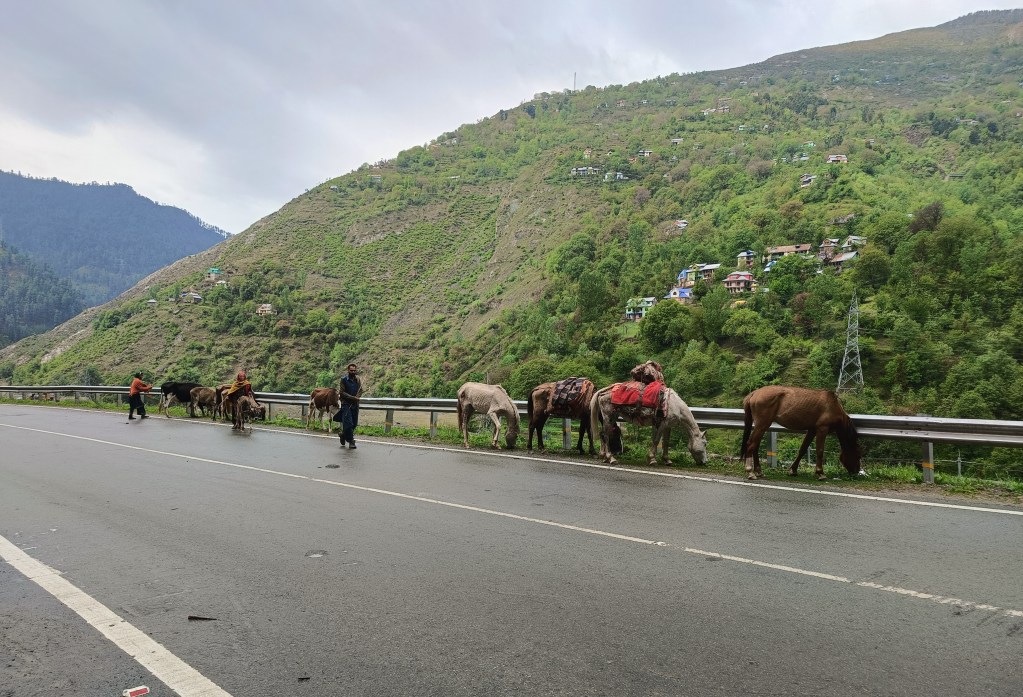
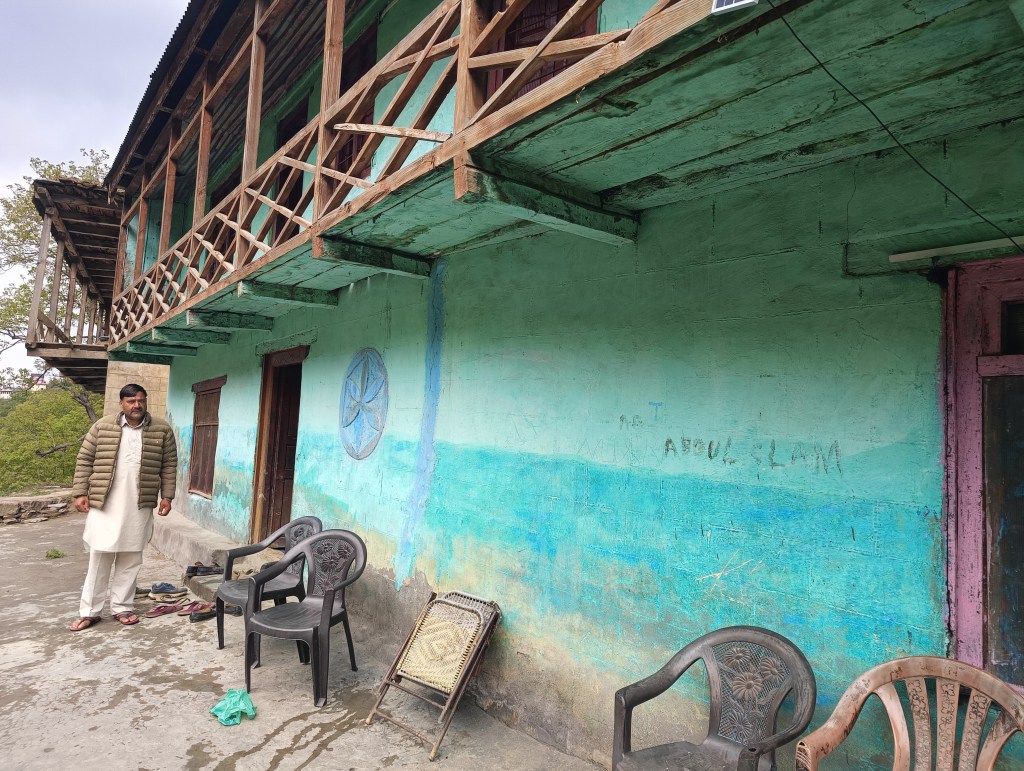
The highway from Ramban has four lanes. Then the road to Ukhral tehsil veers off, and everything changes. It narrows into a single lane along the edges of small mountains, barely wide enough for one vehicle at a time. To reach Tanveer’s house, one has to leave the road entirely, then descend steep slopes, cross a river, and climb back up a steep path.
At Tanveer’s house, a middle-aged woman entered the room in slightly shaking steps, alongside her elder daughter. Draped in a traditional Gujjar shawl and shalwar firaq, Naseema, 55, sat beside her husband and struggled to contain what seemed to be uncontrollable sobs. “My son was a humble soul,” she said. “Whenever there was a quarrel in the village, he would tell us to stay indoors, and he himself would leave… He was unaware of politics; he never thought about it. The whole village admired him.”
She paused, then her voice shifted. “We do not have much fertile land; a small patch for corn, nothing more. My son was the breadwinner. How can we live without him? It is impossible to imagine.”
She constantly wonders why her son died. “If he had committed any crime, he should have been taken to jail. Why was he killed?” After a pause, she added, “Injustice has been done to us.” Her last wish, she added, is to receive her son’s body. “We want to perform his last rites. Though his absence can never be filled, at least our souls will find some peace.”

What happened on April 12?
On the afternoon of April 12, Tanveer was returning to Ramban after nearly a month. He was driving a Tata Mobile vehicle, transporting a cow and a calf, according to the family. Beside him was the vehicle’s owner, a man from Qazigund in Kashmir, whose name could not be verified, and the cattle belonged to him. According to Salam, Tanveer was carrying all the necessary papers, issued by the deputy commissioner of Jammu, including a veterinary certificate confirming the animals were fit to travel, and a transport permit issued under India’s animal welfare rules. In the past decade, as laws on cattle trade and slaughter tightened, cattle transporters, particularly Muslim ones, have started to keep their documents close.
Since 2014, vigilante groups in mainland India have positioned themselves as enforcers of cow protection laws, stopping vehicles, demanding proof, and, when they judge the answer unsatisfactory, administering punishment themselves. A 2019 Human Rights Watch report found that 36 of 44 people killed in such attacks between May 2015 and December 2018 were Muslims.
Tanveer had the papers, and it made no difference.
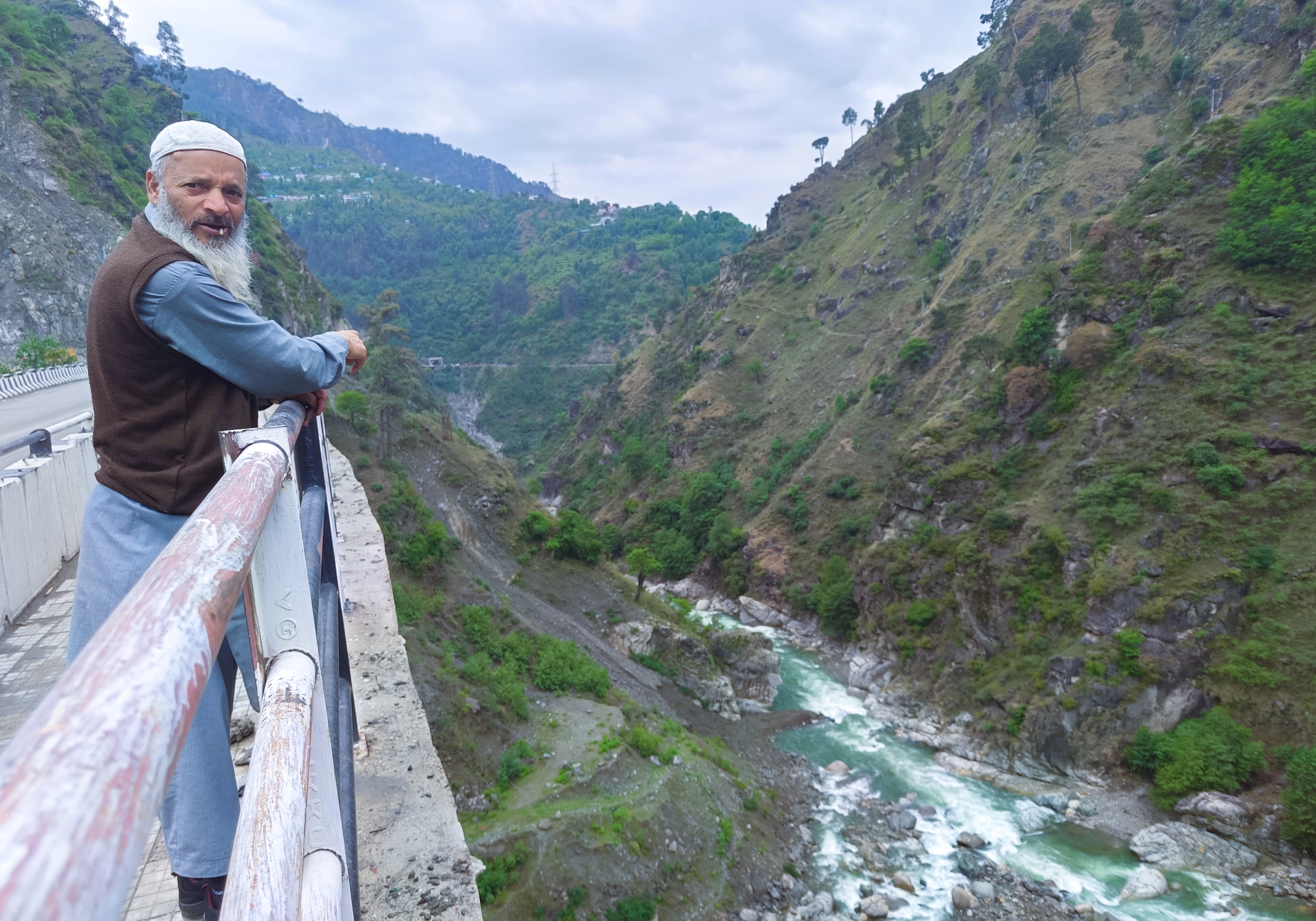
According to the family, the attackers had beaten Tanveer, chased him, and pelted stones at him. Tanveer’s father said the vehicle owner was also beaten but managed to escape. In a desperate attempt to save himself, Tanveer jumped into the Bishlari stream (a tributary of the Chenab River), hoping to reach another village. As he tried to cross, an eyewitness claimed that the current took him. A large crowd had gathered at the spot, and in the aftermath, locals blocked the national highway for several hours in protest.
“Such groups,” referring to the men who targeted Tanveer, “routinely extort money from drivers transporting cattle,” Salam said. “They are goons. Whenever drivers refuse to pay, they chase them and beat them.”
Tanveer had left school after Class 10. “He was fond of driving; he loved it,” his father said. “So he decided to become a driver. For the past year, he had been working for a transport company in Jammu, moving goods to different places.”
Salam has spent twenty years as a Special Police Officer in the Jammu and Kashmir Police. He knows what loss looks like from the outside. But he had never known it like this. “Today,” Salam said quietly, “I can feel the pain of those who have lost their kith and kin in similar incidents.”
The news traveled fast through Ukhral. Neighbors came to sit with the family and offer what little comfort proximity provides.
Razia Begum, 52, was among those who visited. She has one son. “We have never witnessed such a situation in the past,” she said. “After this incident, I am anxious about my son every time he leaves. The incident has deeply frightened us.” She noted that the area’s population is roughly 60 percent Muslim, 40 percent Hindu, and that these communities have, until now, lived without antagonism.
Ratan Lal, 65, a Hindu resident of Ukhral, also came to offer his condolences. He was careful with his words. In every community, he said, some bring shame on everyone else, individuals pursuing personal gain or, worse, brainwashed by Hindu right-wing groups into believing this is what their faith requires. “They are spoiling the image of Hindus,” he said. “We are humans first. Religion comes later.”
Lal has lived in this valley since before Partition. “Jammu and Kashmir was among the regions where communal harmony was maintained even in 1947, which was a testing period for the whole country. We have lived here peacefully since then.” He paused. “Such incidents harm that. Stringent action must be taken.”
Mohammad Abdullah, in his seventies, has watched the young men of this village leave for work year after year. Most families here depend on cattle rearing; there is little else. “They are living in fear of being killed just for earning bread and butter,” Abdullah said. He did not need to say what happens to families if that fear wins, if the young men stop going to work.
The cattle trade, his neighbor Mohammad Abbas noted, is not a Muslim business. Hindus are equally involved. “A few goons have been exploiting the situation for the past ten years,” Abbas claimed, “beating drivers, extorting money.” What is new is not the extortion but the violence that led to a death.
The broader pattern
Locals allege that those involved in the incident are members of the Bajrang Dal. No resident was willing to be quoted by name; each cited fear of repercussions. But Tanveer’s father said the police have arrested four men. Reports identify the men as Surjeet Singh, Sandeep Singh, Digvijay Singh, and Keval Singh, all Hindu residents of Ramban town and the adjoining Seri area.
Mohammad Ayaz, 62, a resident of Makerkot in Ramban, where the attack occurred, said the incident did not arise from nowhere. “They [the perpetrators] think they have backing,” he said. “Similar incidents in other parts of the country encourage a few people here.”
He was right that Ramban does not exist in isolation, and neither does Jammu. In 2015, a mob led by a police officer in Udhampur threw gasoline bombs at a truck driven by an 18-year-old Muslim trucker suspected of transporting beef. In 2017, eleven people were arrested in Reasi after a Muslim family was attacked over cattle transport suspicions; an elderly man and a young girl were among the injured. In 2019, an elderly Muslim man was shot dead by vigilantes in Bhaderwah. The MP for Srinagar, Ruhullah Mehdi, described Tanveer’s case as the fourth such incident in Ramban alone.
The pattern extends far beyond J&K. Cow vigilante violence across India has surged since 2014, leaving dozens dead and hundreds injured. The attacks have disproportionately targeted Muslims and Dalits, often in states ruled by the Hindu nationalist Bharatiya Janata Party, with significant concerns about police inaction and impunity.
Apart from these incidents over the past decade, Jammu and Kashmir has largely been spared this pattern until now.
Salman Nizami, a political activist from the region, called the attack a “lynching”. He placed it inside a pattern of violence that Kashmiris who leave home know well.
Since the Pahalgam attack on tourists in April 2025, roughly 200 cases of assaults, harassment, and forced displacement of Kashmiri shawl sellers, students, and migrant workers have been reported across India. In Uttarakhand, an 18-year-old Kashmiri shawl seller, Tabish Ganie, a Class 10 dropout, like Tanveer, was hit with an iron rod by a shopkeeper who told him that Kashmiri Muslims had no place in his village. Ganie needed 12 stitches and suffered fractures in his leg. In Himachal Pradesh, a retired army soldier livestreamed himself harassing Kashmiri hawkers. In Uttarakhand’s capital, Kashmiri students fled to the airport after a right-wing Hindu group threatened them with “dire consequences” if they did not leave.
Since 2019, when the Modi government revoked J&K’s partial autonomy and placed it under direct federal control, limited employment opportunities at home have pushed young Kashmiris out of the valley to survive. They go to the same northern states where they are now being told to leave, as widely reported.
Nizami said, “We have raised these matters with authorities, and action has been taken.” But action after the fact, he argued, is not enough. “Such crimes should be made non-bailable. There should be strict laws — at least ten years’ imprisonment. We cannot keep allowing the accused to secure bail after a short period and walk free.”
The Ramban attack, he said, is part of the same logic. “Violence in the name of such issues cannot be justified. Our Union Territory has always rejected communalism.”
The attack drew responses from across the political spectrum, though notably, accountability lagged behind condemnation.
Altaf Thakur, the Jammu and Kashmir BJP spokesperson, told The Polis Project the incident was unequivocal. “We condemn it. There is no space for those who take the law into their own hands. No one is above the law.” The statement came from the regional arm of a party whose national governance has presided over a decade-long surge in cow vigilante violence, a context Thakur did not address.
A senior district official told The Polis Project that recovery efforts for the dead body were ongoing. “We have deployed waterproof cameras underwater, and multiple agencies are working around the clock,” he said. Asked whether any arrests were made, he said a First Information Report had been lodged, and the matter was under investigation, and referred further questions to the police. The Assistant Superintendent of Police did not respond to requests for a comment.
A strongly worded official response came from Chief Minister Omar Abdullah, who condemned the attack. “They are engaging in gundagardi hooliganism and trying to create jungle raj (lawlessness) here,” he said. He questioned the legal basis for the attack entirely: no law prohibits the transportation of livestock. “We, as public representatives, will not allow this in J&K.”
The body is found
For twenty days, Tanveer’s village waited in a particular kind of silence, the silence of people who do not yet know how to mourn because they do not yet have a body to grieve over. Tanveer’s family had performed his last rites in absentia. At home, his mother sat where she always sat, as if time itself had stopped moving for her. His eight-year-old sister and his elder sister, his closest companion, kept looking down the road.
On 2 May 2026, twenty days after Tanveer tried crossing the turbulent waterbody, his decomposed body was recovered from Nallah Bishlari near Kraalna Digdol in Ramban district.
What the family had feared was now confirmed. Neighbors gathered again, filling the house that had already been filled with grief, leading the family to begin again from the beginning: the condolences, the faces, the same unbearable words.
Naseema had said, in the days before, that her last wish was to receive her son’s body. “We want to perform his last rites,” she had told us. “Though his absence can never be filled, at least our souls will find some peace.”
There is no peace in what they received. Only a different kind of knowing.
Her question, asked in anger weeks earlier, still stands without an answer: “If he had committed any crime, he should have been taken to jail. Why was he killed?”


In Jammu, Cow Vigilante Attack Drives Youth into River; Leaves a Family and a Region Reckoning with Spreading Fear
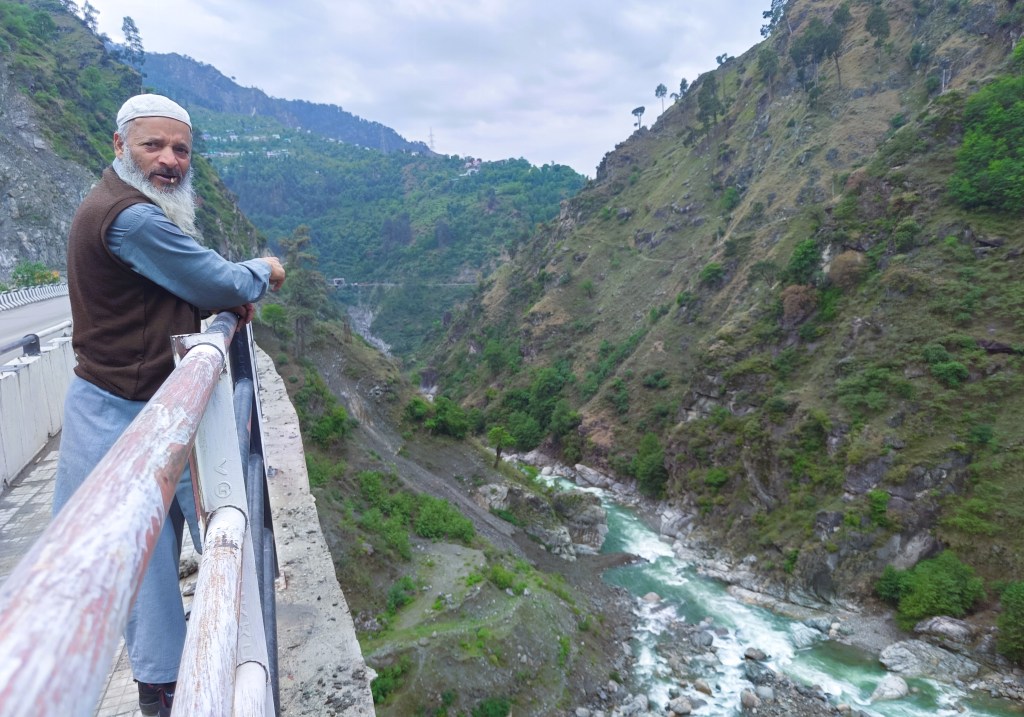
A local points towards the river where Tanveer jumped after being beaten and chased by cow vigilantes. Photo by Basharat Amin for The Polis Project
Police officer Abdul Salam was finally home after five days spent searching the riverbanks of the Chenab in Jammu with the local district administration teams. His only son, 18-year-old Tanveer, was still missing. At 56, Salam is a healthy, good-looking man; he parts his hair to one side and keeps his face shaved. He carries an air of humility and familiarity. He sat quietly, his lips dry, his face carrying the particular stillness of someone who has exhausted both tears and words. He remembered the last phone call. It came at 6 am on April 12, the morning everything changed.
“Where are you, Papa? Are you at home or on duty?” his son Tanveer had asked. Salam told him he was home. “I will come home today,” were his son’s last words to him. He paused, trying to moisten his lips. “Since that day, we haven’t seen him.” Another pause. “His eight-year-old sister keeps asking about Kaka — that’s what we all called him. His mother, me, everyone,” the father narrated. Tanveer was the only son among four sisters.
The youth was killed after an alleged attack by cow vigilantes, which has raised concerns over vigilante violence, the effectiveness of policing, and the vulnerability of the cattle-rearing Gujjar community in the Chenab region. While cow-vigilante-related violence, mainly targeting Muslims, is often reported from the northern Indian plains, in Jammu and Kashmir, it is rare.
The highway from Ramban has four lanes. Then the road to Ukhral tehsil veers off, and everything changes. It narrows into a single lane along the edges of small mountains, barely wide enough for one vehicle at a time. To reach Tanveer’s house, one has to leave the road entirely, then descend steep slopes, cross a river, and climb back up a steep path.
At Tanveer’s house, a middle-aged woman entered the room in slightly shaking steps, alongside her elder daughter. Draped in a traditional Gujjar shawl and shalwar firaq, Naseema, 55, sat beside her husband and struggled to contain what seemed to be uncontrollable sobs. “My son was a humble soul,” she said. “Whenever there was a quarrel in the village, he would tell us to stay indoors, and he himself would leave… He was unaware of politics; he never thought about it. The whole village admired him.”
She paused, then her voice shifted. “We do not have much fertile land; a small patch for corn, nothing more. My son was the breadwinner. How can we live without him? It is impossible to imagine.”
She constantly wonders why her son died. “If he had committed any crime, he should have been taken to jail. Why was he killed?” After a pause, she added, “Injustice has been done to us.” Her last wish, she added, is to receive her son’s body. “We want to perform his last rites. Though his absence can never be filled, at least our souls will find some peace.”
What happened on April 12?
On the afternoon of April 12, Tanveer was returning to Ramban after nearly a month. He was driving a Tata Mobile vehicle, transporting a cow and a calf, according to the family. Beside him was the vehicle’s owner, a man from Qazigund in Kashmir, whose name could not be verified, and the cattle belonged to him. According to Salam, Tanveer was carrying all the necessary papers, issued by the deputy commissioner of Jammu, including a veterinary certificate confirming the animals were fit to travel, and a transport permit issued under India’s animal welfare rules. In the past decade, as laws on cattle trade and slaughter tightened, cattle transporters, particularly Muslim ones, have started to keep their documents close.
Since 2014, vigilante groups in mainland India have positioned themselves as enforcers of cow protection laws, stopping vehicles, demanding proof, and, when they judge the answer unsatisfactory, administering punishment themselves. A 2019 Human Rights Watch report found that 36 of 44 people killed in such attacks between May 2015 and December 2018 were Muslims.
Tanveer had the papers, and it made no difference.
According to the family, the attackers had beaten Tanveer, chased him, and pelted stones at him. Tanveer’s father said the vehicle owner was also beaten but managed to escape. In a desperate attempt to save himself, Tanveer jumped into the Bishlari stream (a tributary of the Chenab River), hoping to reach another village. As he tried to cross, an eyewitness claimed that the current took him. A large crowd had gathered at the spot, and in the aftermath, locals blocked the national highway for several hours in protest.
“Such groups,” referring to the men who targeted Tanveer, “routinely extort money from drivers transporting cattle,” Salam said. “They are goons. Whenever drivers refuse to pay, they chase them and beat them.”
Tanveer had left school after Class 10. “He was fond of driving; he loved it,” his father said. “So he decided to become a driver. For the past year, he had been working for a transport company in Jammu, moving goods to different places.”
Salam has spent twenty years as a Special Police Officer in the Jammu and Kashmir Police. He knows what loss looks like from the outside. But he had never known it like this. “Today,” Salam said quietly, “I can feel the pain of those who have lost their kith and kin in similar incidents.”
The news traveled fast through Ukhral. Neighbors came to sit with the family and offer what little comfort proximity provides.
Razia Begum, 52, was among those who visited. She has one son. “We have never witnessed such a situation in the past,” she said. “After this incident, I am anxious about my son every time he leaves. The incident has deeply frightened us.” She noted that the area’s population is roughly 60 percent Muslim, 40 percent Hindu, and that these communities have, until now, lived without antagonism.
Ratan Lal, 65, a Hindu resident of Ukhral, also came to offer his condolences. He was careful with his words. In every community, he said, some bring shame on everyone else, individuals pursuing personal gain or, worse, brainwashed by Hindu right-wing groups into believing this is what their faith requires. “They are spoiling the image of Hindus,” he said. “We are humans first. Religion comes later.”
Lal has lived in this valley since before Partition. “Jammu and Kashmir was among the regions where communal harmony was maintained even in 1947, which was a testing period for the whole country. We have lived here peacefully since then.” He paused. “Such incidents harm that. Stringent action must be taken.”
Mohammad Abdullah, in his seventies, has watched the young men of this village leave for work year after year. Most families here depend on cattle rearing; there is little else. “They are living in fear of being killed just for earning bread and butter,” Abdullah said. He did not need to say what happens to families if that fear wins, if the young men stop going to work.
The cattle trade, his neighbor Mohammad Abbas noted, is not a Muslim business. Hindus are equally involved. “A few goons have been exploiting the situation for the past ten years,” Abbas claimed, “beating drivers, extorting money.” What is new is not the extortion but the violence that led to a death.
The broader pattern
Locals allege that those involved in the incident are members of the Bajrang Dal. No resident was willing to be quoted by name; each cited fear of repercussions. But Tanveer’s father said the police have arrested four men. Reports identify the men as Surjeet Singh, Sandeep Singh, Digvijay Singh, and Keval Singh, all Hindu residents of Ramban town and the adjoining Seri area.
Mohammad Ayaz, 62, a resident of Makerkot in Ramban, where the attack occurred, said the incident did not arise from nowhere. “They [the perpetrators] think they have backing,” he said. “Similar incidents in other parts of the country encourage a few people here.”
He was right that Ramban does not exist in isolation, and neither does Jammu. In 2015, a mob led by a police officer in Udhampur threw gasoline bombs at a truck driven by an 18-year-old Muslim trucker suspected of transporting beef. In 2017, eleven people were arrested in Reasi after a Muslim family was attacked over cattle transport suspicions; an elderly man and a young girl were among the injured. In 2019, an elderly Muslim man was shot dead by vigilantes in Bhaderwah. The MP for Srinagar, Ruhullah Mehdi, described Tanveer’s case as the fourth such incident in Ramban alone.
The pattern extends far beyond J&K. Cow vigilante violence across India has surged since 2014, leaving dozens dead and hundreds injured. The attacks have disproportionately targeted Muslims and Dalits, often in states ruled by the Hindu nationalist Bharatiya Janata Party, with significant concerns about police inaction and impunity.
Apart from these incidents over the past decade, Jammu and Kashmir has largely been spared this pattern until now.
Salman Nizami, a political activist from the region, called the attack a “lynching”. He placed it inside a pattern of violence that Kashmiris who leave home know well.
Since the Pahalgam attack on tourists in April 2025, roughly 200 cases of assaults, harassment, and forced displacement of Kashmiri shawl sellers, students, and migrant workers have been reported across India. In Uttarakhand, an 18-year-old Kashmiri shawl seller, Tabish Ganie, a Class 10 dropout, like Tanveer, was hit with an iron rod by a shopkeeper who told him that Kashmiri Muslims had no place in his village. Ganie needed 12 stitches and suffered fractures in his leg. In Himachal Pradesh, a retired army soldier livestreamed himself harassing Kashmiri hawkers. In Uttarakhand’s capital, Kashmiri students fled to the airport after a right-wing Hindu group threatened them with “dire consequences” if they did not leave.
Since 2019, when the Modi government revoked J&K’s partial autonomy and placed it under direct federal control, limited employment opportunities at home have pushed young Kashmiris out of the valley to survive. They go to the same northern states where they are now being told to leave, as widely reported.
Nizami said, “We have raised these matters with authorities, and action has been taken.” But action after the fact, he argued, is not enough. “Such crimes should be made non-bailable. There should be strict laws — at least ten years’ imprisonment. We cannot keep allowing the accused to secure bail after a short period and walk free.”
The Ramban attack, he said, is part of the same logic. “Violence in the name of such issues cannot be justified. Our Union Territory has always rejected communalism.”
The attack drew responses from across the political spectrum, though notably, accountability lagged behind condemnation.
Altaf Thakur, the Jammu and Kashmir BJP spokesperson, told The Polis Project the incident was unequivocal. “We condemn it. There is no space for those who take the law into their own hands. No one is above the law.” The statement came from the regional arm of a party whose national governance has presided over a decade-long surge in cow vigilante violence, a context Thakur did not address.
A senior district official told The Polis Project that recovery efforts for the dead body were ongoing. “We have deployed waterproof cameras underwater, and multiple agencies are working around the clock,” he said. Asked whether any arrests were made, he said a First Information Report had been lodged, and the matter was under investigation, and referred further questions to the police. The Assistant Superintendent of Police did not respond to requests for a comment.
A strongly worded official response came from Chief Minister Omar Abdullah, who condemned the attack. “They are engaging in gundagardi hooliganism and trying to create jungle raj (lawlessness) here,” he said. He questioned the legal basis for the attack entirely: no law prohibits the transportation of livestock. “We, as public representatives, will not allow this in J&K.”
The body is found
For twenty days, Tanveer’s village waited in a particular kind of silence, the silence of people who do not yet know how to mourn because they do not yet have a body to grieve over. Tanveer’s family had performed his last rites in absentia. At home, his mother sat where she always sat, as if time itself had stopped moving for her. His eight-year-old sister and his elder sister, his closest companion, kept looking down the road.
On 2 May 2026, twenty days after Tanveer tried crossing the turbulent waterbody, his decomposed body was recovered from Nallah Bishlari near Kraalna Digdol in Ramban district.
What the family had feared was now confirmed. Neighbors gathered again, filling the house that had already been filled with grief, leading the family to begin again from the beginning: the condolences, the faces, the same unbearable words.
Naseema had said, in the days before, that her last wish was to receive her son’s body. “We want to perform his last rites,” she had told us. “Though his absence can never be filled, at least our souls will find some peace.”
There is no peace in what they received. Only a different kind of knowing.
Her question, asked in anger weeks earlier, still stands without an answer: “If he had committed any crime, he should have been taken to jail. Why was he killed?”