


Mohammed el-Kurd’s ‘Perfect Victims’ Asks Why Palestinians Must Perform Their Humanity to Be Seen
Note: The US attacked Iran on 28 February, 2026, at Israel’s behest, murdering the country’s Supreme Leader, Ayatollah Khameini. In the weeks that have ensued, the US and Israel have engaged in indiscriminate bombing and war crimes. However, this time, we find ourselves shrouded by a thick haze of censorship perpetrated by the genocidal media in the US and Israel. While the moment might feel terrifying and unprecedented, it is anything but. Each week, our editorial team will unpack and analyze seminal texts that help us make sense of this moment.
Nearly 1000 days into Israel’s ongoing genocide in Gaza—and decades into the longer history of occupation—one pattern has become increasingly difficult to ignore: Palestinian suffering is not automatically recognized as that of other groups. It must be performed, qualified, and caveated to be made legible to Western liberal audiences.
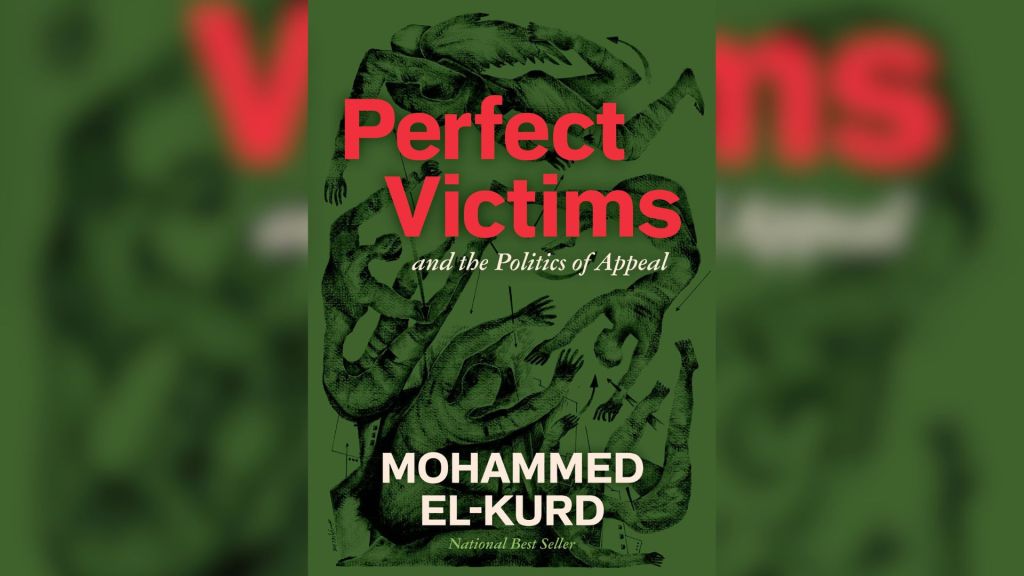
In Perfect Victims and the Politics of Appeal (2025), Palestinian writer Mohammed el-Kurd offers a sharp and unsettling critique of this dynamic. Drawing on the criminological concept of the “ideal victim,” first articulated by Nils Christie in 1986, el-Kurd argues that Palestinians are subjected to a far more demanding standard: they must appear as “perfect victims.”
According to Christie, societies implicitly rank victims based on how well they fit a recognizable moral script. The “ideal victim” is weak, blameless, engaged in a respectable activity, and harmed by a clearly identifiable perpetrator. Victimhood, in this sense, is not simply a matter of harm but of narrative fit.
El-Kurd extends this insight into the terrain of colonial power, and further, into the glaring reality of having witnessed the livestreamed genocide of Palestinians in the Gaza Strip, and the settler violence and apartheid in the West Bank, where the situation has only worsened since October 2023.
He uses the motif of snipers, referring both literally to Israeli snipers—who shoot Palestinians, including young children, in the head and back—and metaphorically to the broader mainstream media and civil society who obfuscate the reality of genocide and occupation. The latter’s actions further reinforce the dehumanization of Palestinians, which enables violence against them.
Between “Terrorist” and “Victim”
Under Israeli occupation, Palestinian existence is itself irreconcilable, el-Kurd suggests. In his words, “I could not merely exist without a bespoke explanation that justifies my being … a narrative.”
The dehumanization seeps into the self-perception of Palestinians. For el-Kurd, the consequence is that Palestinians face a false dichotomy: victims, who are sometimes given the mic, and terrorists, who cannot be grieved.
However, for Palestinians to be seen as victims, it’s not enough to have suffered. They must also conform to a narrow and exacting script: as wounded and weak, as bereaved (widows, orphans, infants), as docile and defanged, as individual, personal tragedies (never collective struggles), and as humanitarian crises in isolation from global affairs, rather than a nucleus of racialized global capitalism.
The “Politics of Appeal”
This rigid and unforgiving binary leaves little room for complexity, contradiction, or ordinary humanity. The adherence to these impossible standards—the only way to avoid being seen as a terrorist and meet the narrow scope of victimhood—is what el-Kurd refers to as the “politics of appeal.”
While at best, this can be seen as shrewd attempts to play the system, at worst, it fits into a reformist framework that pledges allegiance to the status quo of colonialism and reifies the civilized-uncivilized binary that Edward Said famously dubbed “orientalism”.
El-Kurd also draws on the work of anti-colonial thinker Frantz Fanon, who argued that under colonial conditions, recognition is never freely given but must be earned through performance. Palestinians are expected to perform the “perfect victim”: suffer quietly, present themselves in ways that are palatable to Western audiences, and avoid any expression, particularly of rage or resistance, that might disrupt that image.
This approach also reflects the sentiment established by Palestinian author and political thinker Ghassan Kanafani. His novellas, like Men in the Sun (1962) and Returning to Haifa (1969), reject the silent, suffering refugee as morally pure yet politically inert, dismantle the idea that victimhood alone generates justice, and that dignity comes from endurance rather than action.
In his explicit polemic, El-Kurd articulates Kanafani’s central critiques—that victimhood without resistance becomes politically useless, the demand for purity produces paralysis, and recognition by others (international sympathy) is unreliable and conditional.
“Spectacular Death” and Moral Legibility
El-Kurd also points to an implicit hierarchy of suffering, in which Palestinians must die a “spectacular death” to be mourned. But even then, some deaths are more legible than others because they fit the expectations of what a victim should look like.
A young child killed in an airstrike or gunfire becomes an unambiguous symbol of innocence, like six-year-old Hind Rajab, about whom there is now an Oscar-nominated docu-fiction film. By contrast, a teenager accused of throwing a Molotov cocktail is far less likely to be recognized as a victim, like 15-year-old Adam Ayad.
But this distinction, el-Kurd suggests, is deeply misleading. It shifts attention away from the conditions that shape these lives—occupation, dispossession, and violence—and toward a narrow question of individual innocence.
In doing so, it isolates events from their political context, turning systemic injustice into a series of disconnected tragedies. This approach, he argues, “diverts critical scrutiny away from the colonizers and onto the colonized, obscuring the injustice of colonization.”
Conditional Humanity
This insidious framework affects who is humanized after death and suffering in the eyes of the West and the rest of the world. “We are not human automatically by virtue of being human,” el-Kurd writes. “We are to be humanized by virtue of our proximity to innocence, whiteness…”
This dynamic becomes visible in the differential reception of certain figures. The killing of Shireen Abu Akleh, for example, was widely covered in part because she was a journalist and a U.S. citizen. According to el-Kurd, her “alleged Americanness” compensated for her Palestinian-ness and “made her more human,” and her murder perhaps more condemnable.
Similarly, the mourning of Refaat Alareer emphasized his identity as a poet and academic, roles that align with recognizable cultural forms. For el-Kurd, “to eulogize a Palestinian man is to self-flagelate,” with class blindness serving as a key feature of humanization—that is, a tendency to frame worthiness through socially acceptable, often elite identity markers while overlooking the broader class position and material realities of Palestinians under occupation.
He recognizes the potential strategic benefits of playing into these categories—to drum up more support or increase the chances of some accountability. However, el-Kurd urges Palestinians and their allies to reassess these tactics, as they’re based on the humiliating subtext of innocence, involve cowering to a xenophobic worldview, and transform the Palestinian cause from a liberation struggle to a humanitarian issue.
Resistance, Recognition, and the Double Standard
One of el-Kurd’s more unsettling observations is that an act doesn’t determine whether it is called resistance or terrorism, but who is carrying it out and against whom.
For instance, Ukrainian guerrilla fighters resisting Russian invasion are widely celebrated as defenders of sovereignty and freedom. Their actions are contextualized within the language of occupation, self-defense, and international law. By contrast, Palestinian resistance is routinely stripped of political context and reframed through the language of terrorism and religious extremism.
For el-Kurd, this double standard reflects broader geopolitical alignment. For the West, Russia is positioned as a geopolitical adversary while Israel functions as a strategic ally and, in many analyses, a colonial outpost.
This asymmetry is reinforced through media language. Western outlets such as The New York Times routinely describe Russia’s actions in Ukraine using explicit, active language: “invasion,” “occupation,” “war crimes,” “illegal annexation,” clearly identify both the actor and the violation.
Coverage of Israeli actions, by contrast, often relies on passive constructions and euphemisms. Civilian deaths “occur.” Buildings “are hit.” Violence “erupts.” This subtly redistributes responsibility, obscuring and diffusing accountability.
Zionist Propaganda and the “Antisemitism” Charge
Another dimension of what el-Kurd describes as the “politics of appeal” is the constant imperative to navigate accusations of antisemitism. For Palestinians, this produces a deeply paradoxical and exhausting dynamic: living under the control of a state that defines itself as Jewish, while being required to carefully separate critique of that state from any perceived critique of Jewish identity.
It results in a form of discursive labor that metaphorically mirrors the physical reality of occupation. In the chapter title “tropes and drones”, the author thus draws a parallel between navigating literal violence on the ground and rhetorical landmines in global discourse.
Palestinians are expected not only to articulate their oppression, but to do so while simultaneously affirming their opposition to antisemitism, and moderating their tone to avoid reinforcing stereotypes. This asymmetrical burden demands that Palestinians center the sensitivities of their oppressors even as they describe their own dispossession.
The accusation, in this sense, functions as a discursive tool that shifts attention away from structures of power and toward the legitimacy of the critique itself.
“There’s no escaping being accused of antisemitism,” el-Kurd writes, rejecting the “false equivalence” between the semantic violence of alleged Palestinian antisemitism and real, systemic violence of Israel’s ongoing occupation and genocide in Palestine. “It is a losing battle and, more importantly, a glaring red herring. And it is time we reevaluate this tactic.”
The Marginalization of Palestinian Voice
A further consequence of this framework is the systematic marginalization of Palestinian voices within discussions about Palestine itself.
El-Kurd points to a recurring pattern in which Palestinian journalists, writers, and scholars are treated as inherently biased, their accounts discounted precisely because they emerge from lived experience. At the same time, findings from Israeli institutions or Western media outlets are often granted greater legitimacy, even when they simply confirm realities that Palestinians have documented and articulated for decades.
This dynamic reflects a deeper epistemic hierarchy that only positions Palestinians as subjects of suffering, but not producers of knowledge.
El-Kurd’s critique extends into academia and activism, where non-Palestinian voices often occupy disproportionate space in scholarship and public discourse on Palestine. Phrases such as “We are all Palestinians” circulate widely in protests and advocacy spaces, but the gap between rhetoric and reality is especially stark given the asymmetry of stakes.
For many outside Palestine, support remains conditional and low-risk—with hesitation to challenge institutional power, jeopardize professional standing, and make sustained material commitments—whereas those in Palestine navigate displacement, destruction, and death.
While el-Kurd does not argue that only Palestinians should write about Palestine, he calls for a more critical engagement with positionality, stakes, and accountability.
Ultimately, el-Kurd’s most important insight is that the demand for perfect victimhood is unfair and narrows the terms on which suffering can be acknowledged. In doing so, it constrains the possibilities for justice. As long as humanity must be performed to be acknowledged, el-Kurd contends, no amount of suffering will ever be enough.
Join us

Mohammed el-Kurd’s ‘Perfect Victims’ Asks Why Palestinians Must Perform Their Humanity to Be Seen
By The Polis Project
April 29, 2026

“We are not human automatically by virtue of being human," writes Mohammed el-Kurd. "We are to be humanized by virtue of our proximity to innocence, whiteness.”
Note: The US attacked Iran on 28 February, 2026, at Israel’s behest, murdering the country’s Supreme Leader, Ayatollah Khameini. In the weeks that have ensued, the US and Israel have engaged in indiscriminate bombing and war crimes. However, this time, we find ourselves shrouded by a thick haze of censorship perpetrated by the genocidal media in the US and Israel. While the moment might feel terrifying and unprecedented, it is anything but. Each week, our editorial team will unpack and analyze seminal texts that help us make sense of this moment.
Nearly 1000 days into Israel’s ongoing genocide in Gaza—and decades into the longer history of occupation—one pattern has become increasingly difficult to ignore: Palestinian suffering is not automatically recognized as that of other groups. It must be performed, qualified, and caveated to be made legible to Western liberal audiences.
In Perfect Victims and the Politics of Appeal (2025), Palestinian writer Mohammed el-Kurd offers a sharp and unsettling critique of this dynamic. Drawing on the criminological concept of the “ideal victim,” first articulated by Nils Christie in 1986, el-Kurd argues that Palestinians are subjected to a far more demanding standard: they must appear as “perfect victims.”
According to Christie, societies implicitly rank victims based on how well they fit a recognizable moral script. The “ideal victim” is weak, blameless, engaged in a respectable activity, and harmed by a clearly identifiable perpetrator. Victimhood, in this sense, is not simply a matter of harm but of narrative fit.
El-Kurd extends this insight into the terrain of colonial power, and further, into the glaring reality of having witnessed the livestreamed genocide of Palestinians in the Gaza Strip, and the settler violence and apartheid in the West Bank, where the situation has only worsened since October 2023.
He uses the motif of snipers, referring both literally to Israeli snipers—who shoot Palestinians, including young children, in the head and back—and metaphorically to the broader mainstream media and civil society who obfuscate the reality of genocide and occupation. The latter’s actions further reinforce the dehumanization of Palestinians, which enables violence against them.
Between “Terrorist” and “Victim”
Under Israeli occupation, Palestinian existence is itself irreconcilable, el-Kurd suggests. In his words, “I could not merely exist without a bespoke explanation that justifies my being … a narrative.”
The dehumanization seeps into the self-perception of Palestinians. For el-Kurd, the consequence is that Palestinians face a false dichotomy: victims, who are sometimes given the mic, and terrorists, who cannot be grieved.
However, for Palestinians to be seen as victims, it’s not enough to have suffered. They must also conform to a narrow and exacting script: as wounded and weak, as bereaved (widows, orphans, infants), as docile and defanged, as individual, personal tragedies (never collective struggles), and as humanitarian crises in isolation from global affairs, rather than a nucleus of racialized global capitalism.
The “Politics of Appeal”
This rigid and unforgiving binary leaves little room for complexity, contradiction, or ordinary humanity. The adherence to these impossible standards—the only way to avoid being seen as a terrorist and meet the narrow scope of victimhood—is what el-Kurd refers to as the “politics of appeal.”
While at best, this can be seen as shrewd attempts to play the system, at worst, it fits into a reformist framework that pledges allegiance to the status quo of colonialism and reifies the civilized-uncivilized binary that Edward Said famously dubbed “orientalism”.
El-Kurd also draws on the work of anti-colonial thinker Frantz Fanon, who argued that under colonial conditions, recognition is never freely given but must be earned through performance. Palestinians are expected to perform the “perfect victim”: suffer quietly, present themselves in ways that are palatable to Western audiences, and avoid any expression, particularly of rage or resistance, that might disrupt that image.
This approach also reflects the sentiment established by Palestinian author and political thinker Ghassan Kanafani. His novellas, like Men in the Sun (1962) and Returning to Haifa (1969), reject the silent, suffering refugee as morally pure yet politically inert, dismantle the idea that victimhood alone generates justice, and that dignity comes from endurance rather than action.
In his explicit polemic, El-Kurd articulates Kanafani’s central critiques—that victimhood without resistance becomes politically useless, the demand for purity produces paralysis, and recognition by others (international sympathy) is unreliable and conditional.
“Spectacular Death” and Moral Legibility
El-Kurd also points to an implicit hierarchy of suffering, in which Palestinians must die a “spectacular death” to be mourned. But even then, some deaths are more legible than others because they fit the expectations of what a victim should look like.
A young child killed in an airstrike or gunfire becomes an unambiguous symbol of innocence, like six-year-old Hind Rajab, about whom there is now an Oscar-nominated docu-fiction film. By contrast, a teenager accused of throwing a Molotov cocktail is far less likely to be recognized as a victim, like 15-year-old Adam Ayad.
But this distinction, el-Kurd suggests, is deeply misleading. It shifts attention away from the conditions that shape these lives—occupation, dispossession, and violence—and toward a narrow question of individual innocence.
In doing so, it isolates events from their political context, turning systemic injustice into a series of disconnected tragedies. This approach, he argues, “diverts critical scrutiny away from the colonizers and onto the colonized, obscuring the injustice of colonization.”
Conditional Humanity
This insidious framework affects who is humanized after death and suffering in the eyes of the West and the rest of the world. “We are not human automatically by virtue of being human,” el-Kurd writes. “We are to be humanized by virtue of our proximity to innocence, whiteness…”
This dynamic becomes visible in the differential reception of certain figures. The killing of Shireen Abu Akleh, for example, was widely covered in part because she was a journalist and a U.S. citizen. According to el-Kurd, her “alleged Americanness” compensated for her Palestinian-ness and “made her more human,” and her murder perhaps more condemnable.
Similarly, the mourning of Refaat Alareer emphasized his identity as a poet and academic, roles that align with recognizable cultural forms. For el-Kurd, “to eulogize a Palestinian man is to self-flagelate,” with class blindness serving as a key feature of humanization—that is, a tendency to frame worthiness through socially acceptable, often elite identity markers while overlooking the broader class position and material realities of Palestinians under occupation.
He recognizes the potential strategic benefits of playing into these categories—to drum up more support or increase the chances of some accountability. However, el-Kurd urges Palestinians and their allies to reassess these tactics, as they’re based on the humiliating subtext of innocence, involve cowering to a xenophobic worldview, and transform the Palestinian cause from a liberation struggle to a humanitarian issue.
Resistance, Recognition, and the Double Standard
One of el-Kurd’s more unsettling observations is that an act doesn’t determine whether it is called resistance or terrorism, but who is carrying it out and against whom.
For instance, Ukrainian guerrilla fighters resisting Russian invasion are widely celebrated as defenders of sovereignty and freedom. Their actions are contextualized within the language of occupation, self-defense, and international law. By contrast, Palestinian resistance is routinely stripped of political context and reframed through the language of terrorism and religious extremism.
For el-Kurd, this double standard reflects broader geopolitical alignment. For the West, Russia is positioned as a geopolitical adversary while Israel functions as a strategic ally and, in many analyses, a colonial outpost.
This asymmetry is reinforced through media language. Western outlets such as The New York Times routinely describe Russia’s actions in Ukraine using explicit, active language: “invasion,” “occupation,” “war crimes,” “illegal annexation,” clearly identify both the actor and the violation.
Coverage of Israeli actions, by contrast, often relies on passive constructions and euphemisms. Civilian deaths “occur.” Buildings “are hit.” Violence “erupts.” This subtly redistributes responsibility, obscuring and diffusing accountability.
Zionist Propaganda and the “Antisemitism” Charge
Another dimension of what el-Kurd describes as the “politics of appeal” is the constant imperative to navigate accusations of antisemitism. For Palestinians, this produces a deeply paradoxical and exhausting dynamic: living under the control of a state that defines itself as Jewish, while being required to carefully separate critique of that state from any perceived critique of Jewish identity.
It results in a form of discursive labor that metaphorically mirrors the physical reality of occupation. In the chapter title “tropes and drones”, the author thus draws a parallel between navigating literal violence on the ground and rhetorical landmines in global discourse.
Palestinians are expected not only to articulate their oppression, but to do so while simultaneously affirming their opposition to antisemitism, and moderating their tone to avoid reinforcing stereotypes. This asymmetrical burden demands that Palestinians center the sensitivities of their oppressors even as they describe their own dispossession.
The accusation, in this sense, functions as a discursive tool that shifts attention away from structures of power and toward the legitimacy of the critique itself.
“There’s no escaping being accused of antisemitism,” el-Kurd writes, rejecting the “false equivalence” between the semantic violence of alleged Palestinian antisemitism and real, systemic violence of Israel’s ongoing occupation and genocide in Palestine. “It is a losing battle and, more importantly, a glaring red herring. And it is time we reevaluate this tactic.”
The Marginalization of Palestinian Voice
A further consequence of this framework is the systematic marginalization of Palestinian voices within discussions about Palestine itself.
El-Kurd points to a recurring pattern in which Palestinian journalists, writers, and scholars are treated as inherently biased, their accounts discounted precisely because they emerge from lived experience. At the same time, findings from Israeli institutions or Western media outlets are often granted greater legitimacy, even when they simply confirm realities that Palestinians have documented and articulated for decades.
This dynamic reflects a deeper epistemic hierarchy that only positions Palestinians as subjects of suffering, but not producers of knowledge.
El-Kurd’s critique extends into academia and activism, where non-Palestinian voices often occupy disproportionate space in scholarship and public discourse on Palestine. Phrases such as “We are all Palestinians” circulate widely in protests and advocacy spaces, but the gap between rhetoric and reality is especially stark given the asymmetry of stakes.
For many outside Palestine, support remains conditional and low-risk—with hesitation to challenge institutional power, jeopardize professional standing, and make sustained material commitments—whereas those in Palestine navigate displacement, destruction, and death.
While el-Kurd does not argue that only Palestinians should write about Palestine, he calls for a more critical engagement with positionality, stakes, and accountability.
Ultimately, el-Kurd’s most important insight is that the demand for perfect victimhood is unfair and narrows the terms on which suffering can be acknowledged. In doing so, it constrains the possibilities for justice. As long as humanity must be performed to be acknowledged, el-Kurd contends, no amount of suffering will ever be enough.
SUPPORT US
We like bringing the stories that don’t get told to you. For that, we need your support. However small, we would appreciate it.
Related Posts

To Bloom Like Jirhul and Cry “Hool!”: A Profile of Poet Jacinta Kerketta
Varsha Prakash, Arjun Rai Gupta