


“Nowhere is safe.” For an immigrant looking for somewhere—anywhere—the line lands with a thud. It is also the thesis of Nowhere, Khalid Abdalla’s solo show produced by Fuel and directed by Omar Elerian, which threads his personal story through several political ruptures: colonial histories, the 2011 Egyptian Revolution, Brexit, Trump, George Floyd, and Israel’s ongoing genocide in Gaza.
Nowhere, written and performed by Abdalla, is an X-ray, examining what happens to a life when, “for intergenerational political reasons,” you are displaced, made diasporic, then punished for trying to belong on your own terms. But “if you go back home and align yourself authentically, you will go to prison or be killed,” he said. “Then where the fuck are you supposed to go?”
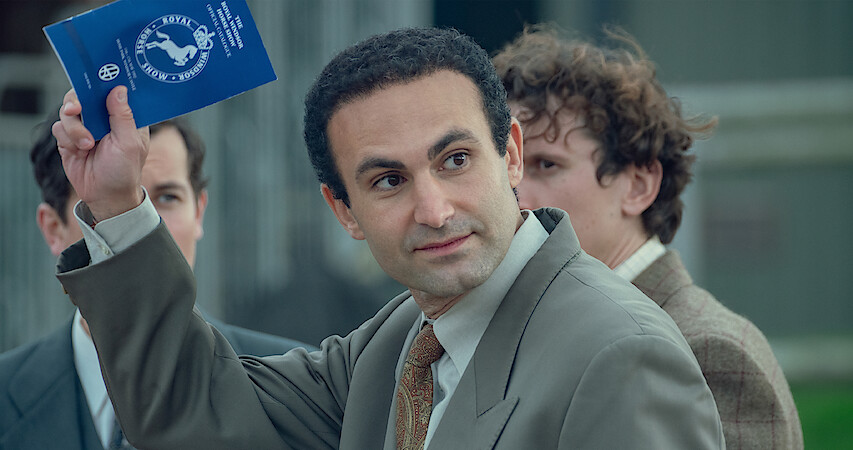
An actor, producer, writer, director, and activist, Abdalla’s history is knotted with theater stages and protest squares—an Egyptian family with an oppositionist lineage, a father and grandfather imprisoned, a life across borders. Many know him from his role in the Netflix hit The Crown as Dodi Fayed, the Egyptian film producer best known for his relationship with Princess Diana (most prominently in season 6, part 1, which premiered on November 16, 2023).
While Abdalla recognized the “huge cultural opportunity” in playing “the first Arab character in the history of film on this side of the world who you get to know and love, not fear,” he felt immense cognitive dissonance walking the red carpets as Israel—with blessings and bombs from the US and UK—was slaughtering thousands in Gaza. The contrast between the humanity the series affords Dodi and how audiences mourn his death in the car crash with Diana, with the ungrievable dead in Gaza, pressed itself into his body. He felt torn between hope and despair.
“I try to hold those boundaries in the play,” he said, “while giving space for the depths of my grief and the heights of my rage.” In a world that insists safety must come through assimilation, shrinking, or silence, Abdalla attempts something radical in Nowhere: he stands tall onstage and refuses to hide. The result is a 90-minute stream of stories, drawings, dance, music, political testimony, comedy, and direct address.
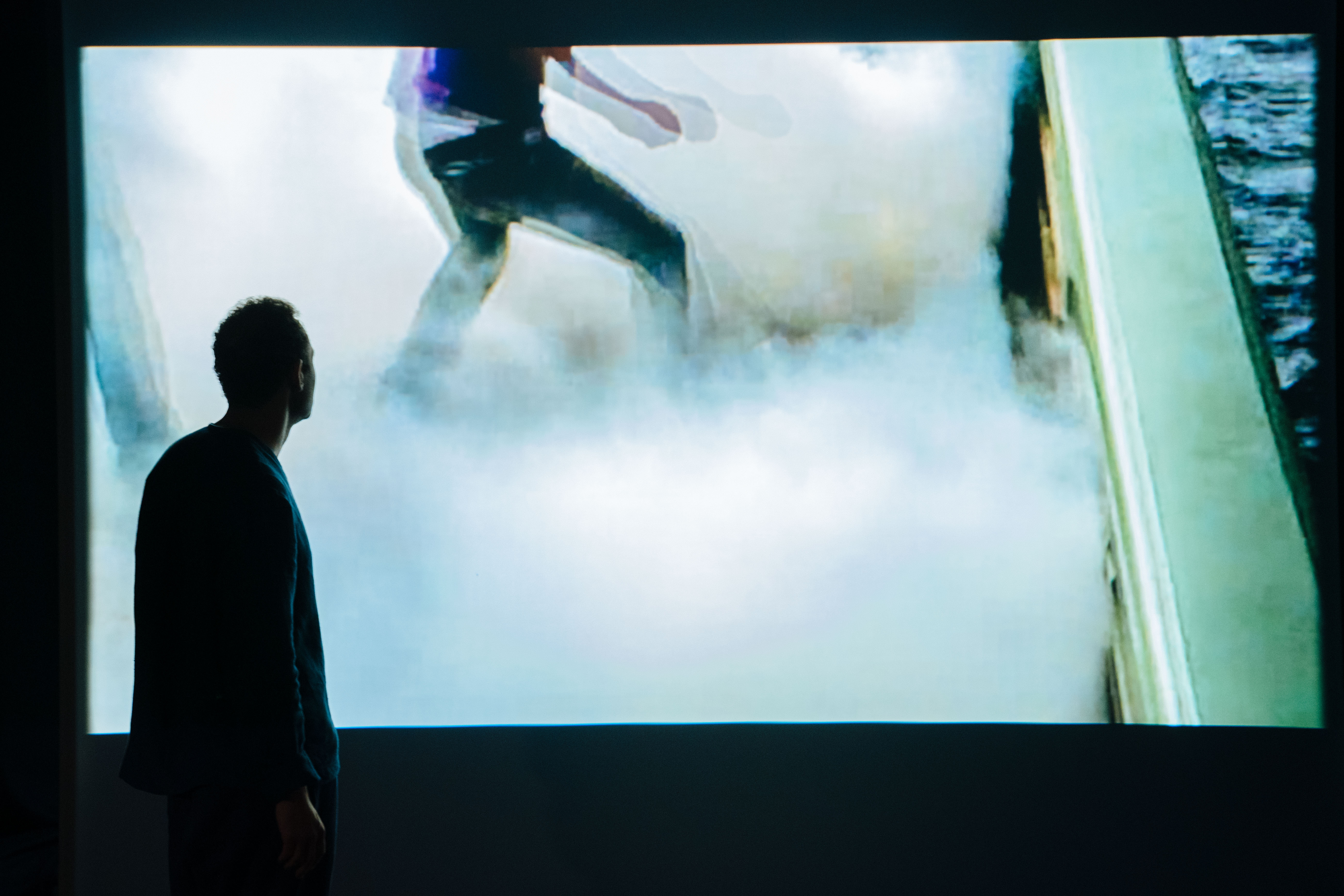
In Nowhere—which premiered at Battersea Arts Centre in October 2024 and has since appeared across the UK, Ireland, Australia, and New Zealand—Abdalla works with a pair of live cameras connected to a projector casting images onto a translucent screen behind him. One camera points down at his desk. Throughout the performance, he builds montages by scattering photographs, sketches, and self-portraits beneath the lens: baby pictures, family snapshots, protest images, archival photos, and drawings.
These personal artifacts are disrupted by photographs of George W. Bush, Ronald Reagan, Osama bin Laden, torture and prisoner abuse at Abu Ghraib, anti-apartheid marches, and the 9/11 attacks—photographs that demand culpability. The audience watches these visual, historical layers accumulate in real time as Abdalla’s hands move across the table, rearranging memory and geopolitics into the same frame.
The silence in the theater grows heavy as images of children’s clothing laid across a shoreline evoke the scale of death in Gaza. The row of clothes, each a tangible absence, stretches beyond the limits of the screen. The show’s aesthetic is deliberately tactile and exposed. The performance’s machinery remains fully visible at all times: the cameras, the projector, the tactile handling of each image, the abrupt shifts between grief and absurdity, testimony and song.
“Nothing in this play wants to hide,” Abdalla wrote into the stage directions.
Nowhere is an act of excavation or, in Abdalla’s words, “political summoning.” Personal memories sit beside colonial violence and contemporary catastrophe; private inheritance collapses into public history. The show moves associatively rather than linearly, accumulating layers of family, empire, protest, illness, displacement, and war compressed into one another, like geological sedimentation.
An “Antibiography” Against Neoliberal Self‑Mythology

“Who am I, and how did I end up here?” Abdalla begins the show by asking. Despite essentially tracing his life story, he insists that Nowhere is an anti-biography. “I am trying to unsettle the traditional neoliberal story of ‘this is who I am, and this is who I became,’” he explained of the traditional arc of a bildungsroman, shaped by triumphing over adversity. “I’m not interested in that story.”
A key line in the show sums this up: “With the stroke of Sadat’s pen, another child of neoliberalism is born.” Without the then-Egyptian President Anwar Sadat’s deal with the World Bank in the 1970s, the “bread riots” that led to Abdalla’s father’s imprisonment may not have even happened. Without that, Abdalla’s parents might not have left Egypt for Ireland and then Scotland. Without that, he would not have been born in Glasgow in 1980, and come of age between different worlds and political eras.
Khalid Abdalla grew up with “a consistent background awareness of war, destruction, political rupture, a lack of safety,” he said, listing them almost flatly. “That creates a lifetime of cognitive dissonance.” He would respond by freezing.
At the same time, his house crackled with “amazingly impassioned, embodied conversations about politics that were constantly inspiring.” It was where he felt his family “most alive.” At school, when a teacher assigned students the task of writing their own obituaries, Abdalla wrote that he “had been assassinated because he was doing important political work.”
And between freezing and feeling galvanized, a question formed: “How am I going to articulate my way through this?”
At 15, Abdalla began acting in school plays. At 18, he directed a production of Frank McGuinness’ Someone Who’ll Watch Over Me, which ran at the 1998 Edinburgh Fringe. After a gap year spent traveling, Abdalla continued acting at university, where he described an “almost colorblind experience of acting,” in which, like many student actors, he played against age and ethnicity—a freeing experience that minimized his differences from his largely white, British classmates.
Shortly after his first year there, 9/11 happened; Abdalla graduated during the 2003 invasion of Iraq. He could no longer remain in denial or “pretend that all the other problems are somewhere else and that you can create that bifurcation.” After graduating, he began working professionally as an actor in the UK and trained for one year at École Philippe Gaulier in Paris.
Abdalla made his Hollywood debut playing a 9/11 hijacker in United 93 (2006). His early career was a “predominantly Hollywood experience” in subsequent films like The Kite Runner (2007) and Green Zone (2010). “I feel I was actually trying to work towards a better discourse,” he said about the directors he gravitated toward. But the work was also a form of accelerated political education.

“As you start entering the creative world as an Arab, you’ve got this set of questions put in front of you,” Abdalla elaborated. ”What do I actually think about this? Can I embody this character’s experience and understand what it feels like?” Each role sharpened his awareness of what it meant, in practice, to represent Arab experiences on screen, and how those representations would be received, repeated, and read beyond the set among predominantly Western audiences.
For years, Abdalla thought the goal of his career was to return to that early “colorblind” freedom, until he realized it was a way of avoiding complex questions about racial and cultural differences. Now, he prefers “colorfulness, ”a small shift that signals a much larger refusal—of neutrality, of easy integration, of being “treated like everyone else,” on conditions that erase the histories that Nowhere insists on staging.
“My story is just a version of everybody else’s story,” he said. “Of course, there are elements specific to me… but unless you can see the forces, you’re captive to the way that they have been normalized.” Abdalla’s anti-biography is less about the arc of a self than the conditions that make a self legible in the first place.
“How do I find agency?” he asks at one point in Nowhere. Agency, in this sense, is not something he can claim alone, but something that only becomes thinkable once those conditions are made visible, and the story of the self is understood as something already shared.
Making Theater in a World on Fire

In 2008, Khalid Abdalla went to Cairo to make In the Last Days of the City (2016), a low-budget independent docu-drama that traces his own struggles as a filmmaker on the eve of the Egyptian Revolution of 2011, in which he actively participated in protests at Tahrir Square against then-President Hosni Mubarak. The film was shot over two and a half years and completed over a decade.
While navigating the film’s long development amid state censorship, Abdalla co-founded the Mosireen Collective, a “volunteer media activist collective that came together to document and transmit images of the Egyptian Revolution of 2011.” Between 2011 and 2014, they produced and published over 250 videos online that challenged dominant state narratives and built an archive of resistance. Within three months, Mosireen became the most-watched non-profit YouTube channel in Egypt of all time, and in the whole world in January 2012.
In Egypt, Abdalla also featured in The Square (2013), a documentary about the Egyptian Revolution, and acted in The Narrow Frame of Midnight (2014), which follows a writer’s search for his disappeared brother across Morocco and Spain. His experience working in Egypt between 2008 and 2016 reshaped his understanding not just of individual stories but also the systems of the storytelling industry. “There’s a reason why certain films are more likely to be made than others,” Abdalla said. “I experienced that infrastructurally.”
In 2013, a producer named Kate McGrath asked him if he had a play in him. Abdalla said, “Maybe, but not now.” He postponed writing it for several years, still reeling from Egypt’s revolution and counter‑revolution: the sudden opening of public life followed by its collapse back into curfew, containment, and silence, “as if this never happened.”
Abdalla returned to London in 2016—“the day after Brexit.” As far-right politics rose further in the UK and the US, he felt an eerie sense of deja vu from Egypt: a politics organized around fear, a backlash against destabilizing hierarchies, the construction of internal enemies, and emotional polarization. It felt too overwhelming to process.
Then in 2020 came the COVID-19 pandemic, then the murder of George Floyd, “at which point,” Abdalla said, “my body erupts in a sense of ‘if not now, when?’”
In six days, Abdalla wrote 12,000 words, the first full draft of Nowhere.

After three years of redrafting, Abdalla and his collaborators gathered in a London rehearsal space for a development workshop in September 2023. Palestine was already a significant part of the text: a reflection on apartheid, from the Panopticon to the quick roads of the settlers, versus the long roads of the colonial subject; the complete fracturing of space in Hebron; but also the silence that Abdalla grew up with as a child, and the dictum—“Don’t talk about Palestine”—to avoid getting into trouble as an Arab immigrant in the UK.
Two weeks later: October 7, 2023. The genocide in Gaza began. The stakes of speaking about Palestine on British and European stages completely changed, and Abdalla had to confront the even heavier silence and complicity more explicitly, in front of strangers. Another rewrite.
Abdalla noted an uncanny parallel between his trajectory and that of Omar El Akkad, author of One Day Everyone Will Have Always Been Against This (2025), which intersperses El Akkad’s life story with a reckoning about Gaza, Western liberalism, and the moral evasions of the post-9/11 era. Abdalla doesn’t know El Akkad personally, but after reading the book, he describes feeling as if his own life had been laid out on the page.
The word that stayed with him most was “severance,” particularly the need to sever himself from the current Western neoliberal order. “It’s not like I didn’t know that there was rot before, but the genocide has made aspects unsalvageable,” he said. “Unreformable.”
A Return to Play and Vulnerability

In 2016, during the counter-revolution in Egypt, Brexit, and Trump’s meteoric rise to power, Khalid Abdalla became a father.
Fatherhood, for him, has been less about stabilizing into a settled adult self than about reopening “the space and the encouragement to be able to play again,” he said, and to witness “forms of learning and unlearning and getting up” that he then carries into his creative work.
Abdalla’s children—Nawar (“one who brings light”) and Aya (“a sign of the miraculous”)—took him back to “drawing, musical instruments,” forms of experimentation he’d amputated from himself long before.
During the COVID-19 lockdowns, he realized how aggressively the modern home is set up to police small children. It is “a ‘no’ space: Don’t do this. Don’t do that,” he said. “I didn’t want to be this constant ‘no’ person.” The task, then, was to reorient his space and relationship toward greater openness while remaining safe and generative.
That question of safety is contained within the architecture of Nowhere. Vulnerability is a core part of the show’s methodology. It creates the secure warmth that allows him to address the complexities of colonialism, complicity, and belonging without holding back.

While Abdalla acknowledges the importance of confrontational politics, he remains acutely aware of its limits. During moments of inflammation, he noted, confrontation can produce “adversarial cycles of defensive aggressiveness.” In Nowhere, he tried to build an atmosphere of trust. “Even if we disagree,” he said of his imagined audience, “I feel like somehow we will be able to get to a place where we will be able to hold each other safely.”
Comedy is central to this aim. “Somehow I’m able to laugh more when I acknowledge the pain, and I’m able to feel more of how it hurts when I laugh,” Abdalla said of rehearsal and real life. “It does something inside my body that returns a different kind of safety and balance.” The audience feels this sensation exactly as he described it: an immediate unclenching, followed by a deeper openness.
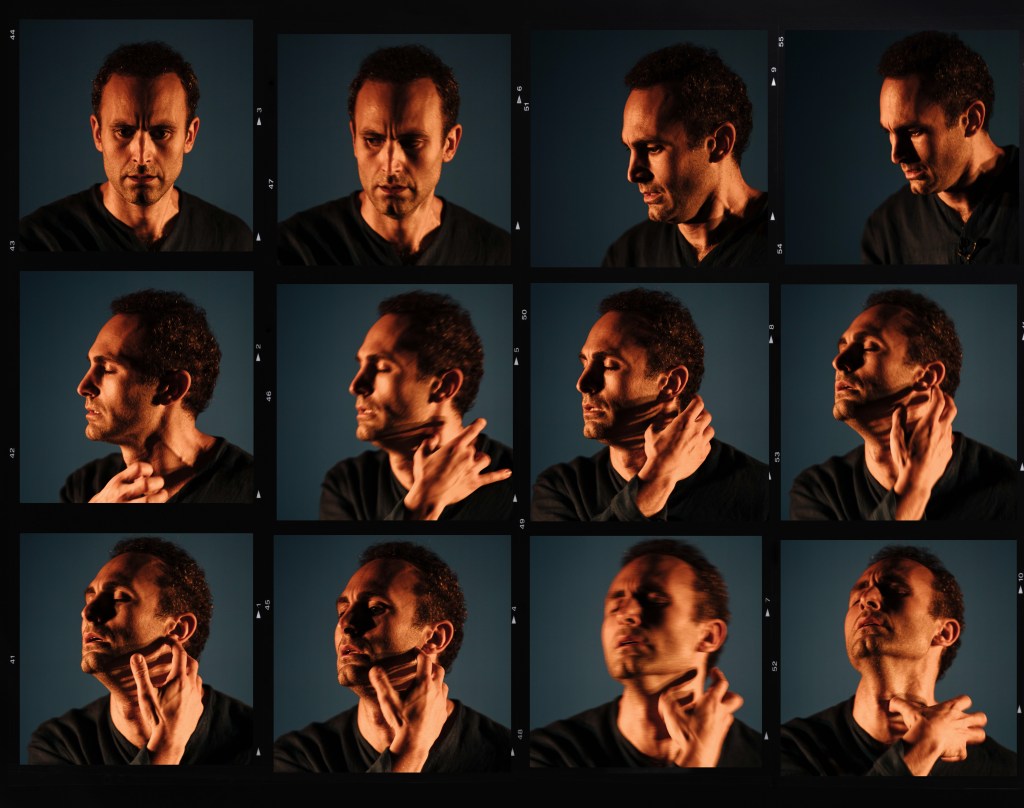
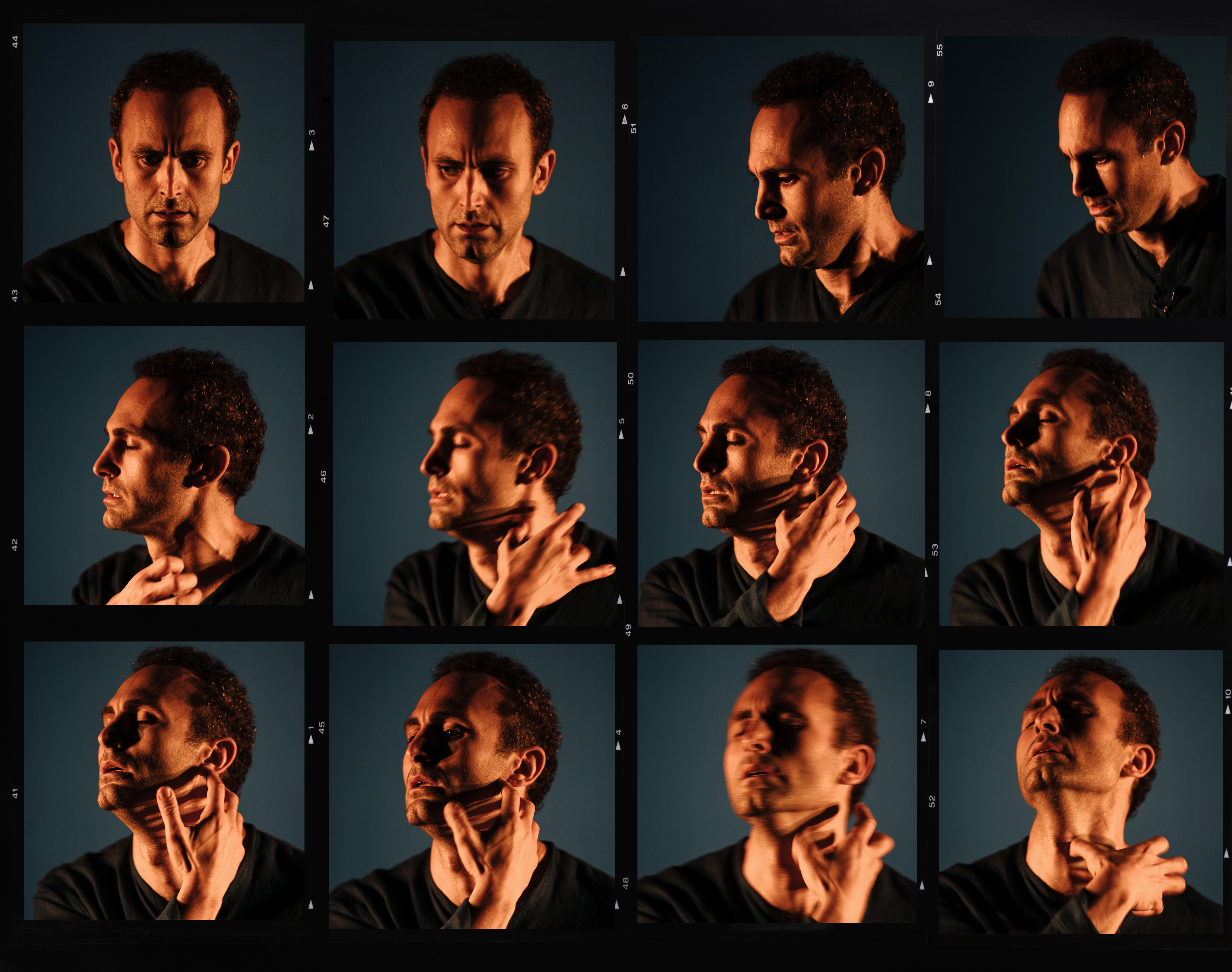
Nowhere draws on experimental theater from the likes of Simon McBurney, Complicité, and Philippe Gaulier. “The body knows,” choreographer Hannes Langolf told Abdalla while they developed the movement for the show. “If you told me 10 years ago that I would dance in front of an audience, I would have thought you were from a parallel universe,” Abdalla said, alluding to the level of vulnerability he displays in the show.
“I’m not on stage to dance and show you how technically proficient I am,” he added. “I’m on stage trying to find a language to express what it means in the shoulders to have a history of fucking borders in your body, which we all have.”
Theater allows this expression in a way film cannot. On a screen, Abdalla noted, we are “fragmented” and “atomized.” A protest gathers bodies temporarily. Although more ephemeral than film, theater creates a different kind of collective: people enter as strangers and leave having shared something that “sits inside them, hopefully forever or for as long as it is valuable to them.”
What Comes Next?
The year 2026 marks the fifteenth anniversary of the Egyptian revolution—a “formative rupture” that imbued Abdalla with a “huge creative impetus.” He’s 45 now, and as fifteen more years pass, he will be 60, and the distance from Tahrir will double.
Abdalla knows that from here on, his creative life will be related to Palestine, which has initiated a reorientation away from Western hegemony towards an international order built on equal rights.
“I want to be in service of that,” he said. “I want to be part of the generation that makes the work—whether it’s in film, theater, or poetry—that participates in the cultural and political shift that I think we so desperately need.”
Abdalla feels a compulsion towards his artistic practices that allow his work to be “world-building along with other people.” The phrase lands differently in light of everything that animates him: the infrastructures under stories, the weight of imperial histories, the unspoken generational contracts now being torn up.
To talk to Abdalla is to be reminded that world-building is not a metaphor. It is the work of rehearsals and picket lines, of languages revived after attempted erasure, of children insisting on play in rooms designed to control them.
In the meantime, what is one thing Abdalla most hopes people leave Nowhere feeling? “That a better world is possible to live for—now and here,” he said. “That it is not something to be deferred.”
The wager of Nowhere—and of Khalid Abdalla’s work more broadly—is that if nowhere is safe, then safety has to be made, in fragile, temporary commons: a theater, a square, a classroom, a WhatsApp chat, an interview. Spaces where we can, for a moment, not hide. Where grief and rage and laughter and hope can coexist. Where we might begin to “get the fuck out of this nightmare”—not in the abstract, but here, now, even with the people sitting next to us in the dark.

The Anti-Biography of Khalid Abdalla
British-Egyptian actor Khalid Abdalla’s history is knotted with theater stages and protest squares. His new solo show, 'Nowhere,' tells his story as an "anti-biography."
“Nowhere is safe.” For an immigrant looking for somewhere—anywhere—the line lands with a thud. It is also the thesis of Nowhere, Khalid Abdalla’s solo show produced by Fuel and directed by Omar Elerian, which threads his personal story through several political ruptures: colonial histories, the 2011 Egyptian Revolution, Brexit, Trump, George Floyd, and Israel’s ongoing genocide in Gaza.
Nowhere, written and performed by Abdalla, is an X-ray, examining what happens to a life when, “for intergenerational political reasons,” you are displaced, made diasporic, then punished for trying to belong on your own terms. But “if you go back home and align yourself authentically, you will go to prison or be killed,” he said. “Then where the fuck are you supposed to go?”
An actor, producer, writer, director, and activist, Abdalla’s history is knotted with theater stages and protest squares—an Egyptian family with an oppositionist lineage, a father and grandfather imprisoned, a life across borders. Many know him from his role in the Netflix hit The Crown as Dodi Fayed, the Egyptian film producer best known for his relationship with Princess Diana (most prominently in season 6, part 1, which premiered on November 16, 2023).
While Abdalla recognized the “huge cultural opportunity” in playing “the first Arab character in the history of film on this side of the world who you get to know and love, not fear,” he felt immense cognitive dissonance walking the red carpets as Israel—with blessings and bombs from the US and UK—was slaughtering thousands in Gaza. The contrast between the humanity the series affords Dodi and how audiences mourn his death in the car crash with Diana, with the ungrievable dead in Gaza, pressed itself into his body. He felt torn between hope and despair.
“I try to hold those boundaries in the play,” he said, “while giving space for the depths of my grief and the heights of my rage.” In a world that insists safety must come through assimilation, shrinking, or silence, Abdalla attempts something radical in Nowhere: he stands tall onstage and refuses to hide. The result is a 90-minute stream of stories, drawings, dance, music, political testimony, comedy, and direct address.
In Nowhere—which premiered at Battersea Arts Centre in October 2024 and has since appeared across the UK, Ireland, Australia, and New Zealand—Abdalla works with a pair of live cameras connected to a projector casting images onto a translucent screen behind him. One camera points down at his desk. Throughout the performance, he builds montages by scattering photographs, sketches, and self-portraits beneath the lens: baby pictures, family snapshots, protest images, archival photos, and drawings.
These personal artifacts are disrupted by photographs of George W. Bush, Ronald Reagan, Osama bin Laden, torture and prisoner abuse at Abu Ghraib, anti-apartheid marches, and the 9/11 attacks—photographs that demand culpability. The audience watches these visual, historical layers accumulate in real time as Abdalla’s hands move across the table, rearranging memory and geopolitics into the same frame.
The silence in the theater grows heavy as images of children’s clothing laid across a shoreline evoke the scale of death in Gaza. The row of clothes, each a tangible absence, stretches beyond the limits of the screen. The show’s aesthetic is deliberately tactile and exposed. The performance’s machinery remains fully visible at all times: the cameras, the projector, the tactile handling of each image, the abrupt shifts between grief and absurdity, testimony and song.
“Nothing in this play wants to hide,” Abdalla wrote into the stage directions.
Nowhere is an act of excavation or, in Abdalla’s words, “political summoning.” Personal memories sit beside colonial violence and contemporary catastrophe; private inheritance collapses into public history. The show moves associatively rather than linearly, accumulating layers of family, empire, protest, illness, displacement, and war compressed into one another, like geological sedimentation.
An “Antibiography” Against Neoliberal Self‑Mythology
“Who am I, and how did I end up here?” Abdalla begins the show by asking. Despite essentially tracing his life story, he insists that Nowhere is an anti-biography. “I am trying to unsettle the traditional neoliberal story of ‘this is who I am, and this is who I became,’” he explained of the traditional arc of a bildungsroman, shaped by triumphing over adversity. “I’m not interested in that story.”
A key line in the show sums this up: “With the stroke of Sadat’s pen, another child of neoliberalism is born.” Without the then-Egyptian President Anwar Sadat’s deal with the World Bank in the 1970s, the “bread riots” that led to Abdalla’s father’s imprisonment may not have even happened. Without that, Abdalla’s parents might not have left Egypt for Ireland and then Scotland. Without that, he would not have been born in Glasgow in 1980, and come of age between different worlds and political eras.
Khalid Abdalla grew up with “a consistent background awareness of war, destruction, political rupture, a lack of safety,” he said, listing them almost flatly. “That creates a lifetime of cognitive dissonance.” He would respond by freezing.
At the same time, his house crackled with “amazingly impassioned, embodied conversations about politics that were constantly inspiring.” It was where he felt his family “most alive.” At school, when a teacher assigned students the task of writing their own obituaries, Abdalla wrote that he “had been assassinated because he was doing important political work.”
And between freezing and feeling galvanized, a question formed: “How am I going to articulate my way through this?”
At 15, Abdalla began acting in school plays. At 18, he directed a production of Frank McGuinness’ Someone Who’ll Watch Over Me, which ran at the 1998 Edinburgh Fringe. After a gap year spent traveling, Abdalla continued acting at university, where he described an “almost colorblind experience of acting,” in which, like many student actors, he played against age and ethnicity—a freeing experience that minimized his differences from his largely white, British classmates.
Shortly after his first year there, 9/11 happened; Abdalla graduated during the 2003 invasion of Iraq. He could no longer remain in denial or “pretend that all the other problems are somewhere else and that you can create that bifurcation.” After graduating, he began working professionally as an actor in the UK and trained for one year at École Philippe Gaulier in Paris.
Abdalla made his Hollywood debut playing a 9/11 hijacker in United 93 (2006). His early career was a “predominantly Hollywood experience” in subsequent films like The Kite Runner (2007) and Green Zone (2010). “I feel I was actually trying to work towards a better discourse,” he said about the directors he gravitated toward. But the work was also a form of accelerated political education.
“As you start entering the creative world as an Arab, you’ve got this set of questions put in front of you,” Abdalla elaborated. ”What do I actually think about this? Can I embody this character’s experience and understand what it feels like?” Each role sharpened his awareness of what it meant, in practice, to represent Arab experiences on screen, and how those representations would be received, repeated, and read beyond the set among predominantly Western audiences.
For years, Abdalla thought the goal of his career was to return to that early “colorblind” freedom, until he realized it was a way of avoiding complex questions about racial and cultural differences. Now, he prefers “colorfulness, ”a small shift that signals a much larger refusal—of neutrality, of easy integration, of being “treated like everyone else,” on conditions that erase the histories that Nowhere insists on staging.
“My story is just a version of everybody else’s story,” he said. “Of course, there are elements specific to me… but unless you can see the forces, you’re captive to the way that they have been normalized.” Abdalla’s anti-biography is less about the arc of a self than the conditions that make a self legible in the first place.
“How do I find agency?” he asks at one point in Nowhere. Agency, in this sense, is not something he can claim alone, but something that only becomes thinkable once those conditions are made visible, and the story of the self is understood as something already shared.
Making Theater in a World on Fire
In 2008, Khalid Abdalla went to Cairo to make In the Last Days of the City (2016), a low-budget independent docu-drama that traces his own struggles as a filmmaker on the eve of the Egyptian Revolution of 2011, in which he actively participated in protests at Tahrir Square against then-President Hosni Mubarak. The film was shot over two and a half years and completed over a decade.
While navigating the film’s long development amid state censorship, Abdalla co-founded the Mosireen Collective, a “volunteer media activist collective that came together to document and transmit images of the Egyptian Revolution of 2011.” Between 2011 and 2014, they produced and published over 250 videos online that challenged dominant state narratives and built an archive of resistance. Within three months, Mosireen became the most-watched non-profit YouTube channel in Egypt of all time, and in the whole world in January 2012.
In Egypt, Abdalla also featured in The Square (2013), a documentary about the Egyptian Revolution, and acted in The Narrow Frame of Midnight (2014), which follows a writer’s search for his disappeared brother across Morocco and Spain. His experience working in Egypt between 2008 and 2016 reshaped his understanding not just of individual stories but also the systems of the storytelling industry. “There’s a reason why certain films are more likely to be made than others,” Abdalla said. “I experienced that infrastructurally.”
In 2013, a producer named Kate McGrath asked him if he had a play in him. Abdalla said, “Maybe, but not now.” He postponed writing it for several years, still reeling from Egypt’s revolution and counter‑revolution: the sudden opening of public life followed by its collapse back into curfew, containment, and silence, “as if this never happened.”
Abdalla returned to London in 2016—“the day after Brexit.” As far-right politics rose further in the UK and the US, he felt an eerie sense of deja vu from Egypt: a politics organized around fear, a backlash against destabilizing hierarchies, the construction of internal enemies, and emotional polarization. It felt too overwhelming to process.
Then in 2020 came the COVID-19 pandemic, then the murder of George Floyd, “at which point,” Abdalla said, “my body erupts in a sense of ‘if not now, when?’”
In six days, Abdalla wrote 12,000 words, the first full draft of Nowhere.
After three years of redrafting, Abdalla and his collaborators gathered in a London rehearsal space for a development workshop in September 2023. Palestine was already a significant part of the text: a reflection on apartheid, from the Panopticon to the quick roads of the settlers, versus the long roads of the colonial subject; the complete fracturing of space in Hebron; but also the silence that Abdalla grew up with as a child, and the dictum—“Don’t talk about Palestine”—to avoid getting into trouble as an Arab immigrant in the UK.
Two weeks later: October 7, 2023. The genocide in Gaza began. The stakes of speaking about Palestine on British and European stages completely changed, and Abdalla had to confront the even heavier silence and complicity more explicitly, in front of strangers. Another rewrite.
Abdalla noted an uncanny parallel between his trajectory and that of Omar El Akkad, author of One Day Everyone Will Have Always Been Against This (2025), which intersperses El Akkad’s life story with a reckoning about Gaza, Western liberalism, and the moral evasions of the post-9/11 era. Abdalla doesn’t know El Akkad personally, but after reading the book, he describes feeling as if his own life had been laid out on the page.
The word that stayed with him most was “severance,” particularly the need to sever himself from the current Western neoliberal order. “It’s not like I didn’t know that there was rot before, but the genocide has made aspects unsalvageable,” he said. “Unreformable.”
A Return to Play and Vulnerability
In 2016, during the counter-revolution in Egypt, Brexit, and Trump’s meteoric rise to power, Khalid Abdalla became a father.
Fatherhood, for him, has been less about stabilizing into a settled adult self than about reopening “the space and the encouragement to be able to play again,” he said, and to witness “forms of learning and unlearning and getting up” that he then carries into his creative work.
Abdalla’s children—Nawar (“one who brings light”) and Aya (“a sign of the miraculous”)—took him back to “drawing, musical instruments,” forms of experimentation he’d amputated from himself long before.
During the COVID-19 lockdowns, he realized how aggressively the modern home is set up to police small children. It is “a ‘no’ space: Don’t do this. Don’t do that,” he said. “I didn’t want to be this constant ‘no’ person.” The task, then, was to reorient his space and relationship toward greater openness while remaining safe and generative.
That question of safety is contained within the architecture of Nowhere. Vulnerability is a core part of the show’s methodology. It creates the secure warmth that allows him to address the complexities of colonialism, complicity, and belonging without holding back.
While Abdalla acknowledges the importance of confrontational politics, he remains acutely aware of its limits. During moments of inflammation, he noted, confrontation can produce “adversarial cycles of defensive aggressiveness.” In Nowhere, he tried to build an atmosphere of trust. “Even if we disagree,” he said of his imagined audience, “I feel like somehow we will be able to get to a place where we will be able to hold each other safely.”
Comedy is central to this aim. “Somehow I’m able to laugh more when I acknowledge the pain, and I’m able to feel more of how it hurts when I laugh,” Abdalla said of rehearsal and real life. “It does something inside my body that returns a different kind of safety and balance.” The audience feels this sensation exactly as he described it: an immediate unclenching, followed by a deeper openness.
Nowhere draws on experimental theater from the likes of Simon McBurney, Complicité, and Philippe Gaulier. “The body knows,” choreographer Hannes Langolf told Abdalla while they developed the movement for the show. “If you told me 10 years ago that I would dance in front of an audience, I would have thought you were from a parallel universe,” Abdalla said, alluding to the level of vulnerability he displays in the show.
“I’m not on stage to dance and show you how technically proficient I am,” he added. “I’m on stage trying to find a language to express what it means in the shoulders to have a history of fucking borders in your body, which we all have.”
Theater allows this expression in a way film cannot. On a screen, Abdalla noted, we are “fragmented” and “atomized.” A protest gathers bodies temporarily. Although more ephemeral than film, theater creates a different kind of collective: people enter as strangers and leave having shared something that “sits inside them, hopefully forever or for as long as it is valuable to them.”
What Comes Next?
The year 2026 marks the fifteenth anniversary of the Egyptian revolution—a “formative rupture” that imbued Abdalla with a “huge creative impetus.” He’s 45 now, and as fifteen more years pass, he will be 60, and the distance from Tahrir will double.
Abdalla knows that from here on, his creative life will be related to Palestine, which has initiated a reorientation away from Western hegemony towards an international order built on equal rights.
“I want to be in service of that,” he said. “I want to be part of the generation that makes the work—whether it’s in film, theater, or poetry—that participates in the cultural and political shift that I think we so desperately need.”
Abdalla feels a compulsion towards his artistic practices that allow his work to be “world-building along with other people.” The phrase lands differently in light of everything that animates him: the infrastructures under stories, the weight of imperial histories, the unspoken generational contracts now being torn up.
To talk to Abdalla is to be reminded that world-building is not a metaphor. It is the work of rehearsals and picket lines, of languages revived after attempted erasure, of children insisting on play in rooms designed to control them.
In the meantime, what is one thing Abdalla most hopes people leave Nowhere feeling? “That a better world is possible to live for—now and here,” he said. “That it is not something to be deferred.”
The wager of Nowhere—and of Khalid Abdalla’s work more broadly—is that if nowhere is safe, then safety has to be made, in fragile, temporary commons: a theater, a square, a classroom, a WhatsApp chat, an interview. Spaces where we can, for a moment, not hide. Where grief and rage and laughter and hope can coexist. Where we might begin to “get the fuck out of this nightmare”—not in the abstract, but here, now, even with the people sitting next to us in the dark.