



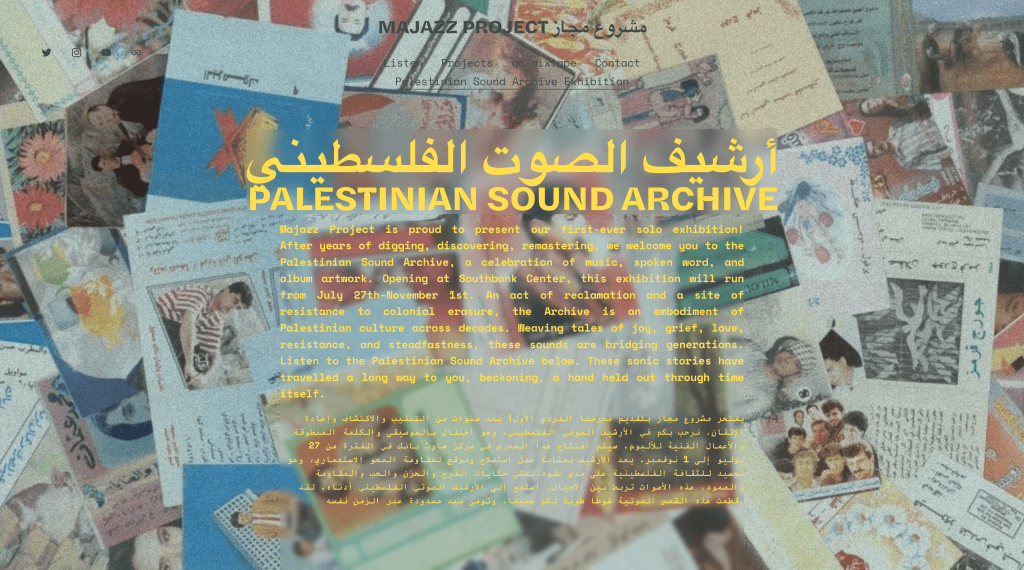
It was February 15th, 2025, when I encountered Palestinian actor Mo’min Swaitat at a packed panel discussion at Columbia University. The day was electrifying, a unique haven where Palestinian culture was experienced, danced, and sang rather than just portrayed. I was pulled to the panel “Archives of Storytelling: The Materiality of Popular Music,” where Swaitat and filmmaker Sama’an Ashrawi sat as the afternoon light faded into evening.
Mo’min spoke with a refreshing honesty. He captured the urgency of the Majazz Project, a community effort to keep Palestinian music, poetry, and album art alive and vibrant as resistance to Zionist erasure. By sampling, remixing, and re-releasing everything from revolutionary anthems to wedding songs, it bridges the historical dispossession and occupation in Palestine with the ongoing genocide.
Modern beats mix with historic recordings, giving old tracks new political meaning. Every song, every line of poetry, every piece of art in the archive is an act of defiance.
The Majazz Project’s global outreach turns Palestinian cultural archives into powerful tools for international solidarity. Exhibiting at spaces like London’s Southbank Centre or events in Amsterdam brings Palestinian music, stories, and art into international conversations, breaking through the walls that colonial regimes try to build around them.
The archival collection is huge and varied, including folk, jazz, funk, soul, electronic music, poetry, and more, showcasing the richness and diversity of Palestinian musical culture. “My dream was to create a platform run by Palestinians that amplifies and celebrates Palestinian music,” Swaitat said in an interview with The Quietus. “That was clear.”
Epistemicide and Erasure: Archival is Survival
The urgency of the Majazz project’s mission arises from Israel’s ongoing genocide in Palestine. As of March 2026, UNESCO has verified damage to 164 sites in Gaza since 7 October 2023, which include 14 religious sites, 128 buildings of historical/artistic interest, three depositories of movable cultural property, nine monuments, two museums, and eight archaeological sites. The Palestinian Ministry of Culture reports that 118 cultural workers were killed in the Gaza Strip during 2024 alone, where nearly 70% of all structures in Gaza have been damaged or destroyed since.
This destruction extends far beyond physical infrastructure to what scholars term epistemicide: the systematic killing, silencing, and erasure of Indigenous and colonized knowledge systems, in which dominant powers devalue and suppress alternative ways of knowing, compelling colonized societies to reconstruct their understanding of the world, often through the lens of the colonizer’s knowledge system. Israel’s epistemicide of Palestinians operates through multiple mechanisms like the assassination of intellectual artists, the destruction of universities and libraries, and the near-exclusive centering of Israeli narratives in international discourse.
The systematic erasure of Gaza’s cultural voices has taken an enormous toll on the world. An initial report by the Palestinian Ministry of Culture reports the loss of 45 artists, writers, and cultural activists between October 2023 and February 2024, and subsequent updates estimate that 118 cultural workers were killed in 2024. Among them are visual artist Heba Zagout, who was killed with her two young children in an Israeli airstrike, artist and painter Muhammed Sami Qariqa, poet and novelist Hiba Abu Nada, author of Oxygen Is Not for the Dead, Palestinian actor and playwright Inas al-Saqa, killed alongside three of her children.
PEN International’s research records at least 23 writers and poets killed during this same period and an additional 28 artists, marking what may be the deadliest period for writers in recent history.
The targeting of cultural sites, cultural voices, and institutions represents not only collateral damage but a deliberate act of cultural genocide designed to separate Palestinians from history, to render their intellectual lineage invisible, and ensure that future generations inherit silence.
Contemporary cultural erasure has expanded to encompass digital colonialism. Palestinian voices face systematic suppression across the major social media platforms, with documented violations against Palestinian digital content mounting steadily. This is sonic colonialism–a term used in sound and decolonial studies to describe how colonial power operates through sound, listening, and control over what can be heard at all.
In this context, it includes the removal of pro-Palestinian music from streaming platforms, for instance, in May 2023, Mohammed Assaf’s iconic “Ana Dammi Falastini”(“My Blood Is Palestinian”), taken down from Spotify, Apple Music, and Deezer, following a Pro-Zionist petition alleging that the song “incites against Israel”.
Manuscripts at Gaza’s Great Omari Mosque may be lost forever, while ancient archaeological sites have been destroyed. As the UN Commission states, “Israeli attacks on educational, religious and cultural sites in the Occupied Palestinian Territory amount to war crimes and the crime against humanity of extermination.”
Art as Political Intervention: Challenging Dominant Narratives
The Majazz Project operates on a radical premise. Palestinian people must be able to choose how their own memories live and breathe. Rather than giving this power to the state—institutional archives built on colonial logics, archives that have historically excluded, erased Palestinian voices—The Majazz Project places the narrative of history firmly back in the hands of Palestinians, enabling them to choose how to be voiced, and by whom, and what history is created.
This resistance becomes especially clear in the way the project handles music and art that was censored or banned by Israeli state and military authorities, often through confiscation, criminalization, or the locking away of recordings in army secret archives. For instance, The Land Day Compilation, released by the Majazz Project on March 30, 2024, is perhaps the most politically charged in the archive. Commemorating the March 30, 1976, massacre when six Palestinian civilians were killed, and over 100 were injured while protesting land expropriation across the Galilee, this compilation transforms historical trauma into sonic resistance.
The collection features tracks with titles that read as battle cries, like “From Your Wound You Create a Song” (من جرحك تصنع أغنية), “Revolt Revolt” (ثوري ثوري), and “Hero” (يا شهيداً). It features several artists, some of whom were assassinated because of their role in bringing this music to light. It also features poetry by Toufic Zayyad, whose words were famously used throughout the first Yom Al Ard protests.
By reviving and sharing music that was confiscated, criminalized, banned, and buried in military archives, Majazz turns acts of colonial suppression into a living political expression—what many Palestinians see as culture fueling consciousness and resistance. Swaitat was explicit about this, describing Majazz as “a platform run by Palestinians” that treats archiving as a political work. “The majority of the Majazz Project is celebrating and resisting”, he said, insisting that revolutionary songs can still be played “on the dance floor” without losing political weight.
The Majazz Project also counters the Zionist idea that Palestinian culture ended in 1948. The archive is packed with recordings from all sorts of eras, like wedding music from across the Galilee in the 1970s, anthems from the Intifada, and fresh Bedouin tracks being made right now.
A Living Archive: More than Preservation
Swaitat has said that while many labels working with archival music are interested in sampling or remixing, “I wanted the Palestinian sounds exactly how it was created,” emphasizing that Majazz’s decolonial practice includes allowing Palestinian artists to be heard on their own terms.
Swaitat described the archive as “a hand held out through time itself,” creating tangible connections between generations of Palestinians scattered across the globe. His own journey exemplifies this process. Born during the First Intifada in Jenin in 1989, Swaitat was raised under Israeli occupation. He later trained in theater resistance at the Freedom Theatre under Juliano Mer-Khamis and was moved to London in 2011 after director and activist Mer-Khamis’ assassination, where he spent the next decade working as an actor, theatre-maker, and DJ in experimental and diasporic art spaces.
Then, during the COVID-19 lockdown in 2020, Swaitat found himself back in Jenin, where he came across a shuttered cassette record shop called Tariq Cassettes, which reconnected him to both his childhood memories and the broader Palestinian cultural ecosystem. The collection of around 7000 tapes from that shop he recovered became the core of the Palestinian Sound Archive X The Majazz Project.
Swaitat comes from a long line of Palestinian Bedouin musicians and storytellers, positioning his archival work within a cultural tradition that has always relied on oral transmission and family-based knowledge preservation.
Archival scholars have long documented how indigenous families resist surrendering personal cultural materials to traditional institutions precisely because of their intimate connection to family heritage and collective memory. The Majazz Project directly addresses this problem through a decolonial archival model. As Swaitat emphasized, “the reissues are borne out of a very close collaboration and discussion with the artists and their families…these albums are available to listeners around the world yet ultimately remain in our hands.”
Projects such as the Palestinian Bedouin Tape and later compilations of Bedouin wedding music were developed in conversation with Swaitat’s own relatives, like his uncle Atef Swaitat. Swaitat also collaborated with Abu Recordings on “The Remaining Voice: Tribute for Juliano Mer Khamis,” a four-track hip‑hop EP that samples Mer‑Khamis’ political speeches to mark the 11th anniversary of his assassination. Ensuring that the rights, liner-note stories, and financial benefits were negotiated within the communities whose sounds are being circulated.
Swaitat’s personal and familial history illuminates the Majazz Project’s goal of preserving not only music but also the social worlds that produce it—wedding halls, cassette shops, and family gatherings—and the oral histories, regional styles, and shared catalogues that Palestinians use to pass memory between generations.
Intergenerational Transmission
One week after the First Intifada erupted in December 1987, Riad Awwad gathered his sisters Hanan, Alia, and Nariman in their living room in Jerusalem’s Old City to record an album titled The Intifada 1987 that would capture the moment, both its rage and its love. Using equipment he’d constructed himself, Awwad and his family created an 11-track album featuring a composition co-written with Palestine’s national poet, Mahmoud Darwish. They pressed 3,000 cassettes and began circulating them across the West Bank.
The Israeli military confiscated virtually every copy they could find, and Riad was arrested, interrogated, and detained for months for the crime of inciting resistance through song. The album disappeared into military archives, lost to Palestinian memory for 35 years.
Swaitat discovered a single unmarked cassette with “Intifada” scrawled on it in the shuttered Tariq Cassettes. He tracked down Hanan Awwad, Riad’s sister, who hadn’t heard the tape in three decades. When Swaitat sent her a digitized version, she broke down not just at hearing her brother’s voice again, but also at learning that his work was being remembered and resurrected.
This is where the generational bridge forms. Swaitat has no direct memory of the First Uprising, but when he remastered and released The Intifada 1987, he created a channel for Palestinians who lived through that year, who threw stones, who heard this music in underground gatherings, to speak directly to youth who know the First Intifada only through stories.
And vice versa: young Palestinians could finally hear what their elders had lived and fought for, not through abstraction or nostalgia, but through the actual sound, the lo-fi roughness of Awwad’s homemade equipment, the urgency in the vocals, the poetic descriptions of Palestinian landscape woven through songs about liberation and resistance.
The lyrics are, as one source describes them, “a love letter to Palestine,” describing mountains, sunrises, birds, freedom of movement, and voice. For older Palestinians, hearing this again meant reclaiming a piece of their own history that the occupation tried to bury, and for younger Palestinians, it meant inheriting not just as a memory, but as a specific model of how culture becomes resistance and how a living room recording becomes an act of national defiance.
This is what Majazz understands. Each time a song is released, remastered, and shared, those stories circulate again. They gain new listeners. They inspire new resistance. Swaitat put it plainly: “I think music is one of the ways to keep our culture alive, so younger generations can understand what has happened.”
But it’s more than understanding. It’s a connection. It’s an inheritance. It’s the sound of your uncle’s voice, your mother’s poetry, your generation’s rage, traveling through time itself—reaching across 35 years of erasure to find you, to make you feel less alone.
Join us
David Sathuluri is an anti-caste, climate justice, and social justice advocate who is currently a researcher at Columbia University, New York City. His research and writing sit at the intersection of caste-climate justice, AI governance, culture, critical philosophy, and politics.
Related Posts

Archiving Resistance: The Majazz Project and the Soundscape of Palestinian Memory
By David Sathuluri
May 14, 2026

The Majazz Project is a community effort to keep Palestinian music, poetry, and album art alive and vibrant as resistance to Zionist erasure.
It was February 15th, 2025, when I encountered Palestinian actor Mo’min Swaitat at a packed panel discussion at Columbia University. The day was electrifying, a unique haven where Palestinian culture was experienced, danced, and sang rather than just portrayed. I was pulled to the panel “Archives of Storytelling: The Materiality of Popular Music,” where Swaitat and filmmaker Sama’an Ashrawi sat as the afternoon light faded into evening.
Mo’min spoke with a refreshing honesty. He captured the urgency of the Majazz Project, a community effort to keep Palestinian music, poetry, and album art alive and vibrant as resistance to Zionist erasure. By sampling, remixing, and re-releasing everything from revolutionary anthems to wedding songs, it bridges the historical dispossession and occupation in Palestine with the ongoing genocide.
Modern beats mix with historic recordings, giving old tracks new political meaning. Every song, every line of poetry, every piece of art in the archive is an act of defiance.
The Majazz Project’s global outreach turns Palestinian cultural archives into powerful tools for international solidarity. Exhibiting at spaces like London’s Southbank Centre or events in Amsterdam brings Palestinian music, stories, and art into international conversations, breaking through the walls that colonial regimes try to build around them.
The archival collection is huge and varied, including folk, jazz, funk, soul, electronic music, poetry, and more, showcasing the richness and diversity of Palestinian musical culture. “My dream was to create a platform run by Palestinians that amplifies and celebrates Palestinian music,” Swaitat said in an interview with The Quietus. “That was clear.”
Epistemicide and Erasure: Archival is Survival
The urgency of the Majazz project’s mission arises from Israel’s ongoing genocide in Palestine. As of March 2026, UNESCO has verified damage to 164 sites in Gaza since 7 October 2023, which include 14 religious sites, 128 buildings of historical/artistic interest, three depositories of movable cultural property, nine monuments, two museums, and eight archaeological sites. The Palestinian Ministry of Culture reports that 118 cultural workers were killed in the Gaza Strip during 2024 alone, where nearly 70% of all structures in Gaza have been damaged or destroyed since.
This destruction extends far beyond physical infrastructure to what scholars term epistemicide: the systematic killing, silencing, and erasure of Indigenous and colonized knowledge systems, in which dominant powers devalue and suppress alternative ways of knowing, compelling colonized societies to reconstruct their understanding of the world, often through the lens of the colonizer’s knowledge system. Israel’s epistemicide of Palestinians operates through multiple mechanisms like the assassination of intellectual artists, the destruction of universities and libraries, and the near-exclusive centering of Israeli narratives in international discourse.
The systematic erasure of Gaza’s cultural voices has taken an enormous toll on the world. An initial report by the Palestinian Ministry of Culture reports the loss of 45 artists, writers, and cultural activists between October 2023 and February 2024, and subsequent updates estimate that 118 cultural workers were killed in 2024. Among them are visual artist Heba Zagout, who was killed with her two young children in an Israeli airstrike, artist and painter Muhammed Sami Qariqa, poet and novelist Hiba Abu Nada, author of Oxygen Is Not for the Dead, Palestinian actor and playwright Inas al-Saqa, killed alongside three of her children.
PEN International’s research records at least 23 writers and poets killed during this same period and an additional 28 artists, marking what may be the deadliest period for writers in recent history.
The targeting of cultural sites, cultural voices, and institutions represents not only collateral damage but a deliberate act of cultural genocide designed to separate Palestinians from history, to render their intellectual lineage invisible, and ensure that future generations inherit silence.
Contemporary cultural erasure has expanded to encompass digital colonialism. Palestinian voices face systematic suppression across the major social media platforms, with documented violations against Palestinian digital content mounting steadily. This is sonic colonialism–a term used in sound and decolonial studies to describe how colonial power operates through sound, listening, and control over what can be heard at all.
In this context, it includes the removal of pro-Palestinian music from streaming platforms, for instance, in May 2023, Mohammed Assaf’s iconic “Ana Dammi Falastini”(“My Blood Is Palestinian”), taken down from Spotify, Apple Music, and Deezer, following a Pro-Zionist petition alleging that the song “incites against Israel”.
Manuscripts at Gaza’s Great Omari Mosque may be lost forever, while ancient archaeological sites have been destroyed. As the UN Commission states, “Israeli attacks on educational, religious and cultural sites in the Occupied Palestinian Territory amount to war crimes and the crime against humanity of extermination.”
Art as Political Intervention: Challenging Dominant Narratives
The Majazz Project operates on a radical premise. Palestinian people must be able to choose how their own memories live and breathe. Rather than giving this power to the state—institutional archives built on colonial logics, archives that have historically excluded, erased Palestinian voices—The Majazz Project places the narrative of history firmly back in the hands of Palestinians, enabling them to choose how to be voiced, and by whom, and what history is created.
This resistance becomes especially clear in the way the project handles music and art that was censored or banned by Israeli state and military authorities, often through confiscation, criminalization, or the locking away of recordings in army secret archives. For instance, The Land Day Compilation, released by the Majazz Project on March 30, 2024, is perhaps the most politically charged in the archive. Commemorating the March 30, 1976, massacre when six Palestinian civilians were killed, and over 100 were injured while protesting land expropriation across the Galilee, this compilation transforms historical trauma into sonic resistance.
The collection features tracks with titles that read as battle cries, like “From Your Wound You Create a Song” (من جرحك تصنع أغنية), “Revolt Revolt” (ثوري ثوري), and “Hero” (يا شهيداً). It features several artists, some of whom were assassinated because of their role in bringing this music to light. It also features poetry by Toufic Zayyad, whose words were famously used throughout the first Yom Al Ard protests.
By reviving and sharing music that was confiscated, criminalized, banned, and buried in military archives, Majazz turns acts of colonial suppression into a living political expression—what many Palestinians see as culture fueling consciousness and resistance. Swaitat was explicit about this, describing Majazz as “a platform run by Palestinians” that treats archiving as a political work. “The majority of the Majazz Project is celebrating and resisting”, he said, insisting that revolutionary songs can still be played “on the dance floor” without losing political weight.
The Majazz Project also counters the Zionist idea that Palestinian culture ended in 1948. The archive is packed with recordings from all sorts of eras, like wedding music from across the Galilee in the 1970s, anthems from the Intifada, and fresh Bedouin tracks being made right now.
A Living Archive: More than Preservation
Swaitat has said that while many labels working with archival music are interested in sampling or remixing, “I wanted the Palestinian sounds exactly how it was created,” emphasizing that Majazz’s decolonial practice includes allowing Palestinian artists to be heard on their own terms.
Swaitat described the archive as “a hand held out through time itself,” creating tangible connections between generations of Palestinians scattered across the globe. His own journey exemplifies this process. Born during the First Intifada in Jenin in 1989, Swaitat was raised under Israeli occupation. He later trained in theater resistance at the Freedom Theatre under Juliano Mer-Khamis and was moved to London in 2011 after director and activist Mer-Khamis’ assassination, where he spent the next decade working as an actor, theatre-maker, and DJ in experimental and diasporic art spaces.
Then, during the COVID-19 lockdown in 2020, Swaitat found himself back in Jenin, where he came across a shuttered cassette record shop called Tariq Cassettes, which reconnected him to both his childhood memories and the broader Palestinian cultural ecosystem. The collection of around 7000 tapes from that shop he recovered became the core of the Palestinian Sound Archive X The Majazz Project.
Swaitat comes from a long line of Palestinian Bedouin musicians and storytellers, positioning his archival work within a cultural tradition that has always relied on oral transmission and family-based knowledge preservation.
Archival scholars have long documented how indigenous families resist surrendering personal cultural materials to traditional institutions precisely because of their intimate connection to family heritage and collective memory. The Majazz Project directly addresses this problem through a decolonial archival model. As Swaitat emphasized, “the reissues are borne out of a very close collaboration and discussion with the artists and their families…these albums are available to listeners around the world yet ultimately remain in our hands.”
Projects such as the Palestinian Bedouin Tape and later compilations of Bedouin wedding music were developed in conversation with Swaitat’s own relatives, like his uncle Atef Swaitat. Swaitat also collaborated with Abu Recordings on “The Remaining Voice: Tribute for Juliano Mer Khamis,” a four-track hip‑hop EP that samples Mer‑Khamis’ political speeches to mark the 11th anniversary of his assassination. Ensuring that the rights, liner-note stories, and financial benefits were negotiated within the communities whose sounds are being circulated.
Swaitat’s personal and familial history illuminates the Majazz Project’s goal of preserving not only music but also the social worlds that produce it—wedding halls, cassette shops, and family gatherings—and the oral histories, regional styles, and shared catalogues that Palestinians use to pass memory between generations.
Intergenerational Transmission
One week after the First Intifada erupted in December 1987, Riad Awwad gathered his sisters Hanan, Alia, and Nariman in their living room in Jerusalem’s Old City to record an album titled The Intifada 1987 that would capture the moment, both its rage and its love. Using equipment he’d constructed himself, Awwad and his family created an 11-track album featuring a composition co-written with Palestine’s national poet, Mahmoud Darwish. They pressed 3,000 cassettes and began circulating them across the West Bank.
The Israeli military confiscated virtually every copy they could find, and Riad was arrested, interrogated, and detained for months for the crime of inciting resistance through song. The album disappeared into military archives, lost to Palestinian memory for 35 years.
Swaitat discovered a single unmarked cassette with “Intifada” scrawled on it in the shuttered Tariq Cassettes. He tracked down Hanan Awwad, Riad’s sister, who hadn’t heard the tape in three decades. When Swaitat sent her a digitized version, she broke down not just at hearing her brother’s voice again, but also at learning that his work was being remembered and resurrected.
This is where the generational bridge forms. Swaitat has no direct memory of the First Uprising, but when he remastered and released The Intifada 1987, he created a channel for Palestinians who lived through that year, who threw stones, who heard this music in underground gatherings, to speak directly to youth who know the First Intifada only through stories.
And vice versa: young Palestinians could finally hear what their elders had lived and fought for, not through abstraction or nostalgia, but through the actual sound, the lo-fi roughness of Awwad’s homemade equipment, the urgency in the vocals, the poetic descriptions of Palestinian landscape woven through songs about liberation and resistance.
The lyrics are, as one source describes them, “a love letter to Palestine,” describing mountains, sunrises, birds, freedom of movement, and voice. For older Palestinians, hearing this again meant reclaiming a piece of their own history that the occupation tried to bury, and for younger Palestinians, it meant inheriting not just as a memory, but as a specific model of how culture becomes resistance and how a living room recording becomes an act of national defiance.
This is what Majazz understands. Each time a song is released, remastered, and shared, those stories circulate again. They gain new listeners. They inspire new resistance. Swaitat put it plainly: “I think music is one of the ways to keep our culture alive, so younger generations can understand what has happened.”
But it’s more than understanding. It’s a connection. It’s an inheritance. It’s the sound of your uncle’s voice, your mother’s poetry, your generation’s rage, traveling through time itself—reaching across 35 years of erasure to find you, to make you feel less alone.
SUPPORT US
We like bringing the stories that don’t get told to you. For that, we need your support. However small, we would appreciate it.
David Sathuluri is an anti-caste, climate justice, and social justice advocate who is currently a researcher at Columbia University, New York City. His research and writing sit at the intersection of caste-climate justice, AI governance, culture, critical philosophy, and politics.
Related Posts