





The discourse and media coverage on the Epstein files—spanning millions of documents from court cases, DOJ releases, and institutional reviews, especially on social media—reads like digital zombies hungry for spectacle because spectacle asks nothing of us in return.
I have mostly held my tongue, partly because of the sheer scale of what was done to young people, to children, to women and boys, and partly because of how this story is being told—and my incapacity to process just what it means for the survivors of the many monsters who lurk in the Epstein files.
The Epstein files, as discussed in the media, are salacious gossip. We fixate on details, sexploits, celebrity names, and spectacle, and we avoid the question that matters: what structures and institutions made this possible, protected it, normalized it, and benefited from it? That discussion remains thin, evasive, and endlessly deferred.
What we get instead is a morality play about individual depravity. Yes, name the men. Yes, name what they did. Name the violence, the cruelty, the entitlement. But the story ends there, exactly where it becomes safest for power to retreat, return, and endlessly reproduce itself. We talk about individual men failing but never about annihilating the networks and systems that allowed them to thrive.
Academia’s Role
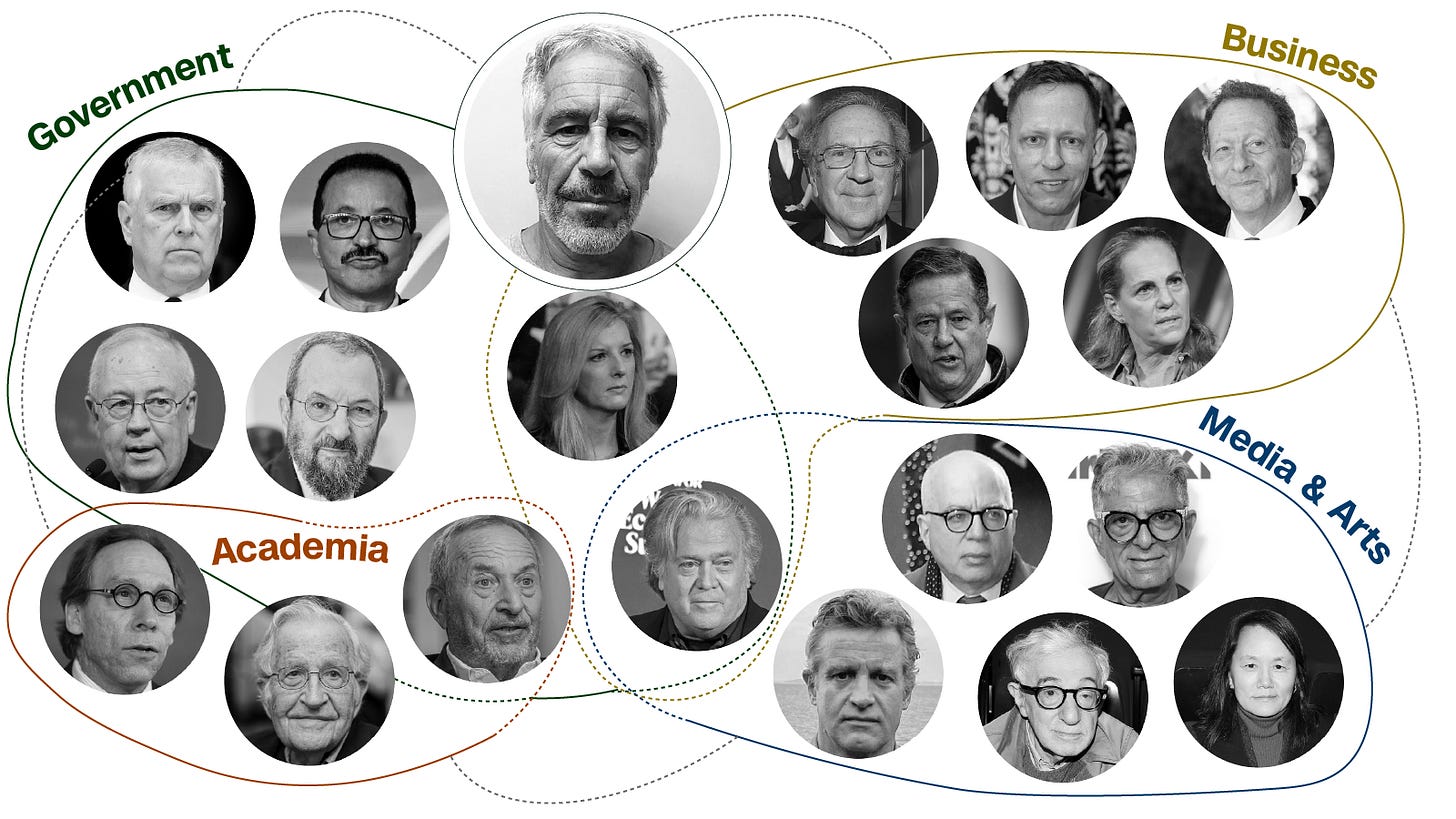
One of the clearest examples of that machinery is academia, and it should trouble us far more than it does. The number of academics named in the Epstein files is grotesque—including Harvard’s Alan Dershowitz (accused by Virginia Giuffre of multiple sexual encounters with her as a minor), Lawrence Summers (extensive emails and donations), Martin Nowak, and Elisa New; MIT’s Marvin Minsky (alleged island sex with Giuffre) and Seth Lloyd; Yale’s Nicholas Christakis and David Gelernter (emails describing female students’ appearances); Duke’s Dan Ariely; linguists Noam Chomsky and Robert Trivers (Rutgers emeritus); physicists Lawrence Krauss and Lisa Randall; plus others like Stephen Hawking (mentioned in defamatory email claim) and Harvard Hillel figures.
Harvard Hillel sought donations from Jeffrey Epstein in 2010 and 2011—after his 2008 conviction and during his house arrest—through emails from then-leaders like President Bernie Steinberg, who thanked Epstein for past support (including 1990s fundraising for Rosovsky Hall) and requested an additional $25 million.
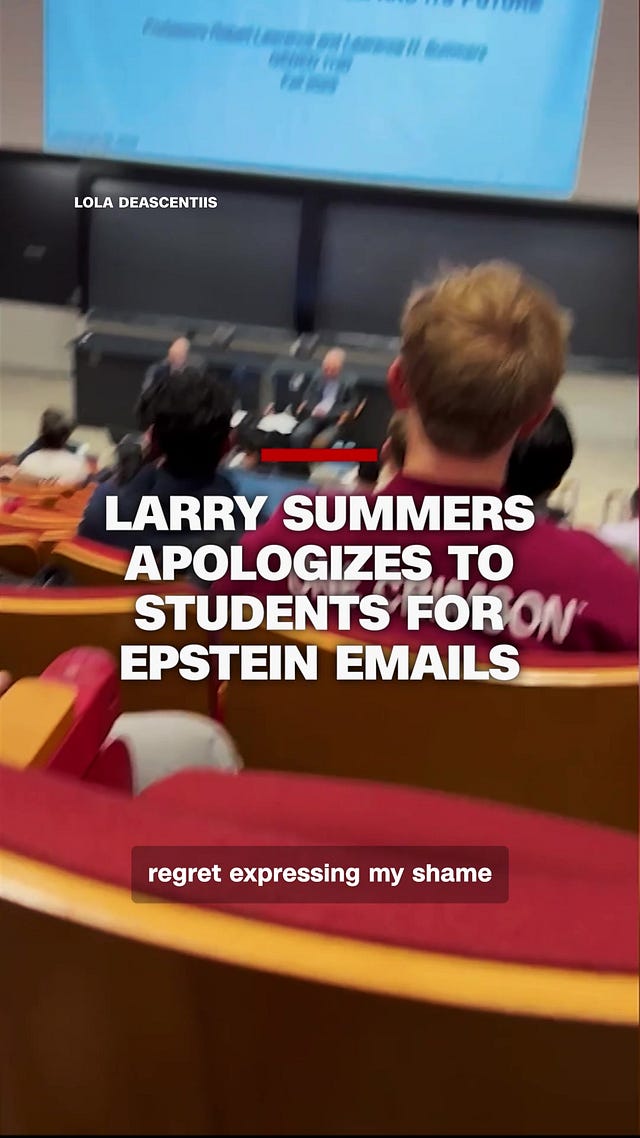
When news broke last year, Larry Summers addressed his ties to Jeffrey Epstein in a Harvard Kennedy School class on November 19, 2025, expressing “deep shame” over post-conviction emails and initially planning to continue teaching. But he soon stepped back from instruction. While he is not scheduled to teach this semester, the student who recorded him was under university investigation for recording his apology.
No protests or mass walkouts happened—videos captured one student shouting “No we won’t!” amid laughter when a co-instructor noted Summers’ insights. The Harvard Feminist Collective’s petition demanding the revocation of his tenure gained some traction, but there was no broader campus unrest. Alan Dershowitz remains openly associated with the Kennedy School as Professor Emeritus, speaking there in September 2025 without formal consequences, highlighting the absence of student or parental protests despite scrutiny from the ongoing release of the Epstein files.
These are men and women who teach, who hold power over students. We pretend not to see what it often is: that we allow ourselves to crave proximity to these institutions, and we normalize it. It tells us everything about how deeply “protection” of predators is built into “respectable” structures.
Power Survives Through Rebranding
Is any of this truly shocking, though? Should we not already know what kind of people so many of these names really are? Are we surprised that Deepak Chopra is a snake-oil salesman? Critics have labeled him a pseudoscientist peddling a “noxious brew” of science and spirituality to credulous audiences. Are we surprised that the Anil Ambanis or the Bin Sulaimans of the world operate as political pimps with more money? We knew. Soon-Yi Previn speaks of a fifteen-year-old girl “entrapping” Harvey Weinstein and says she should have known better—this sounds awfully familiar, too.
I have watched this rebrand play out again and again. In the United States, the architects and salesmen of the Iraq War—figures like David Frum, Paul Wolfowitz, and the broader class of Beltway hawks—returned as sober defenders of democracy, their crimes characterized as “errors in judgment.” The same revolving door produced the legal and security experts who defended torture, rendition, and mass surveillance after 9/11, then reinvented themselves as guardians of civil liberties.
In Europe, leaders normalized Viktor Orbán in the name of pragmatism, stability, and markets, until authoritarianism became too naked to defend. In the Gulf, elites and commentators lined up to cheer Mohammed bin Salman as a modernizer even after Jamal Khashoggi’s murder, with Thomas Friedman continuing to champion MBS long after the blood was on the floor.
Indian diaspora across professions and communities turned up at Modi fundraisers, presidential dinners, posed for photographs, offered legitimacy, and now circulate as principled anti-Modi, anti-fascist liberals, evading responsibility for what they enabled. In the activist, literary, and film world, networks continue to protect abusers for years; festivals and institutions keep welcoming them; and once news breaks, shock is quickly performed, careers are briefly paused, and then quietly restored. This is how power survives—it moves, it rebrands, and finds new language.
Supremacy and Silence
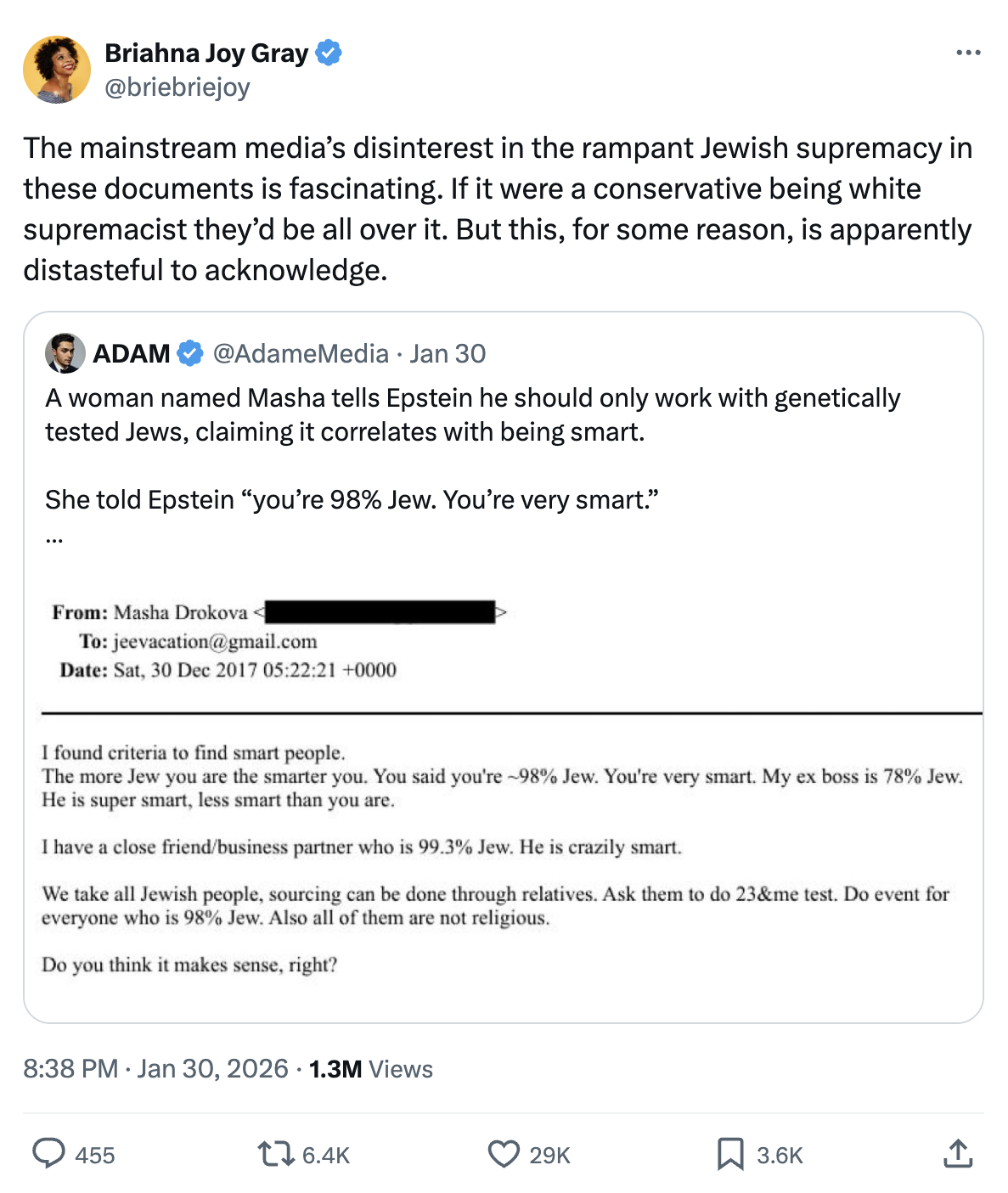
The sheer amount of disgusting back-and-forth in the Epstein files about Jewish supremacy—about testing DNA to quantify “Jewishness,” about claims of inherent Jewish superiority—is racialized science, old supremacist garbage dressed up as pride in Jewish identity. It demands interrogation, and it receives almost none. Powerful people, including figures who moved through the “good” Obama-era foreign policy ecosystem, speak the language of entrenchment and exceptionalism with an ease that should alarm anyone who claims to oppose supremacist politics.
You see how this logic of superiority circulates across institutions, philanthropy, media, academia, and policy circles, and you watch it get normalized by silence. Now we have people tweeting that discussing the Epstein files is anti-Semitic, as if naming power and coercion were hatred, as if critique itself were violence. This is the weaponizing of anti-Semitism accusations to protect elites while real anti-Semitism remains untouched. The result is a public sphere where Jewish supremacy and Zionist power politics can sit in plain view while any sustained analysis is strangled at birth by the accusation. This is how impunity protects itself.

The same silence surrounds Epstein’s relationship to Israel, the question of intelligence ties, Mossad, and who benefited from decades of cultivation, coercion, and collection. The mainstream media’s refusal to investigate this in depth is not coincidental.
You also have to understand this: Powerful people, regardless of religion, caste, class, or nationality, behave as rich people. Wealth is the real country; impunity is the shared passport. Class loyalty overrides all other claims to solidarity, and solidarity for everyone else never enters the room.
Because there will be no real judgment and no mechanisms to hold these people accountable, the salacious details are doing exactly what they are meant to do. They flood the public sphere, occupy attention, and then evaporate.
We have been given our very own Colosseum. We are fed documents, leaks, names, transcripts, details so lurid they command attention and exhaust it at once. We argue over specifics, we write hot takes, and we fight over interpretation. While we are busy watching, the institutions that produced the harm, protected the perpetrators, laundered their legitimacy, and ensured their impunity remain untouched. The spectacle absorbs dissent and transforms structural violence into consumable drama.
When the crowd moves on—as it always does—the arena stands exactly where it was: ready for the next offering

What the Epstein Files Media Discourse Misses About How Power Operates

Media discourse on the Epstein files prioritizes salacious, sidelining survivors and the structure that enables this abuse.
The discourse and media coverage on the Epstein files—spanning millions of documents from court cases, DOJ releases, and institutional reviews, especially on social media—reads like digital zombies hungry for spectacle because spectacle asks nothing of us in return.
I have mostly held my tongue, partly because of the sheer scale of what was done to young people, to children, to women and boys, and partly because of how this story is being told—and my incapacity to process just what it means for the survivors of the many monsters who lurk in the Epstein files.
The Epstein files, as discussed in the media, are salacious gossip. We fixate on details, sexploits, celebrity names, and spectacle, and we avoid the question that matters: what structures and institutions made this possible, protected it, normalized it, and benefited from it? That discussion remains thin, evasive, and endlessly deferred.
What we get instead is a morality play about individual depravity. Yes, name the men. Yes, name what they did. Name the violence, the cruelty, the entitlement. But the story ends there, exactly where it becomes safest for power to retreat, return, and endlessly reproduce itself. We talk about individual men failing but never about annihilating the networks and systems that allowed them to thrive.
Academia’s Role
One of the clearest examples of that machinery is academia, and it should trouble us far more than it does. The number of academics named in the Epstein files is grotesque—including Harvard’s Alan Dershowitz (accused by Virginia Giuffre of multiple sexual encounters with her as a minor), Lawrence Summers (extensive emails and donations), Martin Nowak, and Elisa New; MIT’s Marvin Minsky (alleged island sex with Giuffre) and Seth Lloyd; Yale’s Nicholas Christakis and David Gelernter (emails describing female students’ appearances); Duke’s Dan Ariely; linguists Noam Chomsky and Robert Trivers (Rutgers emeritus); physicists Lawrence Krauss and Lisa Randall; plus others like Stephen Hawking (mentioned in defamatory email claim) and Harvard Hillel figures.
Harvard Hillel sought donations from Jeffrey Epstein in 2010 and 2011—after his 2008 conviction and during his house arrest—through emails from then-leaders like President Bernie Steinberg, who thanked Epstein for past support (including 1990s fundraising for Rosovsky Hall) and requested an additional $25 million.
When news broke last year, Larry Summers addressed his ties to Jeffrey Epstein in a Harvard Kennedy School class on November 19, 2025, expressing “deep shame” over post-conviction emails and initially planning to continue teaching. But he soon stepped back from instruction. While he is not scheduled to teach this semester, the student who recorded him was under university investigation for recording his apology.
No protests or mass walkouts happened—videos captured one student shouting “No we won’t!” amid laughter when a co-instructor noted Summers’ insights. The Harvard Feminist Collective’s petition demanding the revocation of his tenure gained some traction, but there was no broader campus unrest. Alan Dershowitz remains openly associated with the Kennedy School as Professor Emeritus, speaking there in September 2025 without formal consequences, highlighting the absence of student or parental protests despite scrutiny from the ongoing release of the Epstein files.
These are men and women who teach, who hold power over students. We pretend not to see what it often is: that we allow ourselves to crave proximity to these institutions, and we normalize it. It tells us everything about how deeply “protection” of predators is built into “respectable” structures.
Power Survives Through Rebranding
Is any of this truly shocking, though? Should we not already know what kind of people so many of these names really are? Are we surprised that Deepak Chopra is a snake-oil salesman? Critics have labeled him a pseudoscientist peddling a “noxious brew” of science and spirituality to credulous audiences. Are we surprised that the Anil Ambanis or the Bin Sulaimans of the world operate as political pimps with more money? We knew. Soon-Yi Previn speaks of a fifteen-year-old girl “entrapping” Harvey Weinstein and says she should have known better—this sounds awfully familiar, too.
I have watched this rebrand play out again and again. In the United States, the architects and salesmen of the Iraq War—figures like David Frum, Paul Wolfowitz, and the broader class of Beltway hawks—returned as sober defenders of democracy, their crimes characterized as “errors in judgment.” The same revolving door produced the legal and security experts who defended torture, rendition, and mass surveillance after 9/11, then reinvented themselves as guardians of civil liberties.
In Europe, leaders normalized Viktor Orbán in the name of pragmatism, stability, and markets, until authoritarianism became too naked to defend. In the Gulf, elites and commentators lined up to cheer Mohammed bin Salman as a modernizer even after Jamal Khashoggi’s murder, with Thomas Friedman continuing to champion MBS long after the blood was on the floor.
Indian diaspora across professions and communities turned up at Modi fundraisers, presidential dinners, posed for photographs, offered legitimacy, and now circulate as principled anti-Modi, anti-fascist liberals, evading responsibility for what they enabled. In the activist, literary, and film world, networks continue to protect abusers for years; festivals and institutions keep welcoming them; and once news breaks, shock is quickly performed, careers are briefly paused, and then quietly restored. This is how power survives—it moves, it rebrands, and finds new language.
Supremacy and Silence
The sheer amount of disgusting back-and-forth in the Epstein files about Jewish supremacy—about testing DNA to quantify “Jewishness,” about claims of inherent Jewish superiority—is racialized science, old supremacist garbage dressed up as pride in Jewish identity. It demands interrogation, and it receives almost none. Powerful people, including figures who moved through the “good” Obama-era foreign policy ecosystem, speak the language of entrenchment and exceptionalism with an ease that should alarm anyone who claims to oppose supremacist politics.
You see how this logic of superiority circulates across institutions, philanthropy, media, academia, and policy circles, and you watch it get normalized by silence. Now we have people tweeting that discussing the Epstein files is anti-Semitic, as if naming power and coercion were hatred, as if critique itself were violence. This is the weaponizing of anti-Semitism accusations to protect elites while real anti-Semitism remains untouched. The result is a public sphere where Jewish supremacy and Zionist power politics can sit in plain view while any sustained analysis is strangled at birth by the accusation. This is how impunity protects itself.
The same silence surrounds Epstein’s relationship to Israel, the question of intelligence ties, Mossad, and who benefited from decades of cultivation, coercion, and collection. The mainstream media’s refusal to investigate this in depth is not coincidental.
You also have to understand this: Powerful people, regardless of religion, caste, class, or nationality, behave as rich people. Wealth is the real country; impunity is the shared passport. Class loyalty overrides all other claims to solidarity, and solidarity for everyone else never enters the room.
Because there will be no real judgment and no mechanisms to hold these people accountable, the salacious details are doing exactly what they are meant to do. They flood the public sphere, occupy attention, and then evaporate.
We have been given our very own Colosseum. We are fed documents, leaks, names, transcripts, details so lurid they command attention and exhaust it at once. We argue over specifics, we write hot takes, and we fight over interpretation. While we are busy watching, the institutions that produced the harm, protected the perpetrators, laundered their legitimacy, and ensured their impunity remain untouched. The spectacle absorbs dissent and transforms structural violence into consumable drama.
When the crowd moves on—as it always does—the arena stands exactly where it was: ready for the next offering