





Editor’s Note: Beginning on 5 June 2026, and intensifying through the late-July unrest in Rawalakot and Mirpur, protests in Pakistan-administered Azad Jammu and Kashmir were met with a severe crackdown by the Pakistani state. Led largely by the Jammu Kashmir Joint Awami Action Committee (JAAC), the demonstrations over political representation—particularly the reservation of 12 legislative seats for refugees living outside the territory—followed years of broader grievances over prices, governance and autonomy. After the authorities proscribed the JAAC, shut down internet and mobile services, and arrested activists, clashes escalated across the territory. At least 40 people were reported killed in the unrest ahead of the AJK elections, including 34 protesters. During two days of late-July clashes in Rawalakot and Mirpur, JAAC organizers stated that 26 people were killed—20 in Rawalakot and six in Mirpur. This piece tells the stories of two people killed during the protests in Azad Jammu and Kashmir. The author’s name has been withheld, and this piece is published under a pseudonym for safety reasons.
There is no word for a parent who loses a child. A child who loses their parents becomes an orphan; a husband or wife left behind becomes a widower or a widow. But for the mother or father who buries a child, there is no word at all, only the boundary-stone past which the language will not go. Last month, the village of Mang, a scatter of homes in the hills of Sudhanoti, one of the small mountain districts of Pakistan-administered Kashmir, was made to grieve in both directions at once. It buried Sardar Usama Jameel, a young man it had claimed as a son, and “Commander” Farooq Khan, in his 80s, a man it had long looked up to as a father. So Mang became both the parent with no name for its grief and the child left orphaned.
They were killed in the same violence. On the evening of 27 July, the Joint Awami Action Committee set out on a long march toward Muzaffarabad, the regional capital in the far north of the territory. The committee had formed in September 2023, out of Pakistan-administered Kashmir’s long grievances: the price of electricity and flour, and the privileges of a ruling class that governs the region from far away. At the hard edge of its demands were 12 seats in the regional assembly. They are held not as the inhabitants of Azad Kashmir but as refugees, Muslims who left Indian-occupied Jammu and Kashmir around the Partition of 1947 and the 1965 war, and settled across mainland Pakistan. Their descendants still elect a bloc of the assembly from outside the territory. This, the movement says, lets Islamabad’s parties install the region’s government without winning a single local vote. In June this year the state outlawed the committee under anti-terrorism law. The march went ahead regardless. It set out from the edge of Rawalakot, the main hill-town of Poonch district, an hour’s climbing road above Sudhanoti. The people walked, and they were fired upon by Pakistani paramilitary forces and the local police.
By the time the shooting stopped that evening, some 20 marchers were dead, though even the counting had to be done by their families. Mobile signals were cut, the electricity and the internet went dark, and the town’s one main hospital was sealed off by government forces. The wounded had to be carried by hand and by private car down the mountain roads to whichever hospital would still receive them–in Hajira, another small town of the Poonch hills, and in Pallandri, the modest district seat of Sudhanoti itself. In those towns, crowds lined the hospital gates to give blood. Among the dead it left on that road were two who belonged to Mang.
Mang is not an ordinary village, and it did not become a place of mourning for the first time this week. A village in Sudhanoti District, in present-day Azad Kashmir, it is a stronghold of the Sudhans, the hill tribe of these mountains, and has been a seat of resistance for the better part of two centuries. In 1837, when the Dogra chief Gulab Singh moved to bring the Poonch hills to heel for the Sikh empire, it was from the fortress of Mang that the Sudhans, under Shams Khan, held out until a long assault broke them. The reprisal for the revolt was brutal: the rebel leaders Malli Khan and Sabz Ali Khan were flayed alive at Mang, a bounty of a single rupee was set on every rebel head, and many died in the hills. Within a decade, Gulab Singh would buy Kashmir outright from the British East India Company for cash, setting in motion the political order that shaped the present uprising.
Locals say the tree where the sardars were flayed is still standing. A little over a century later, in 1947, when Poonch rose against the last of that same Dogra line, Mang once again served as a base for the fighting, part of the uprising out of which Azad Kashmir itself was born. Mang birthed Farooq and Usama; Mang has now buried them.
The Son
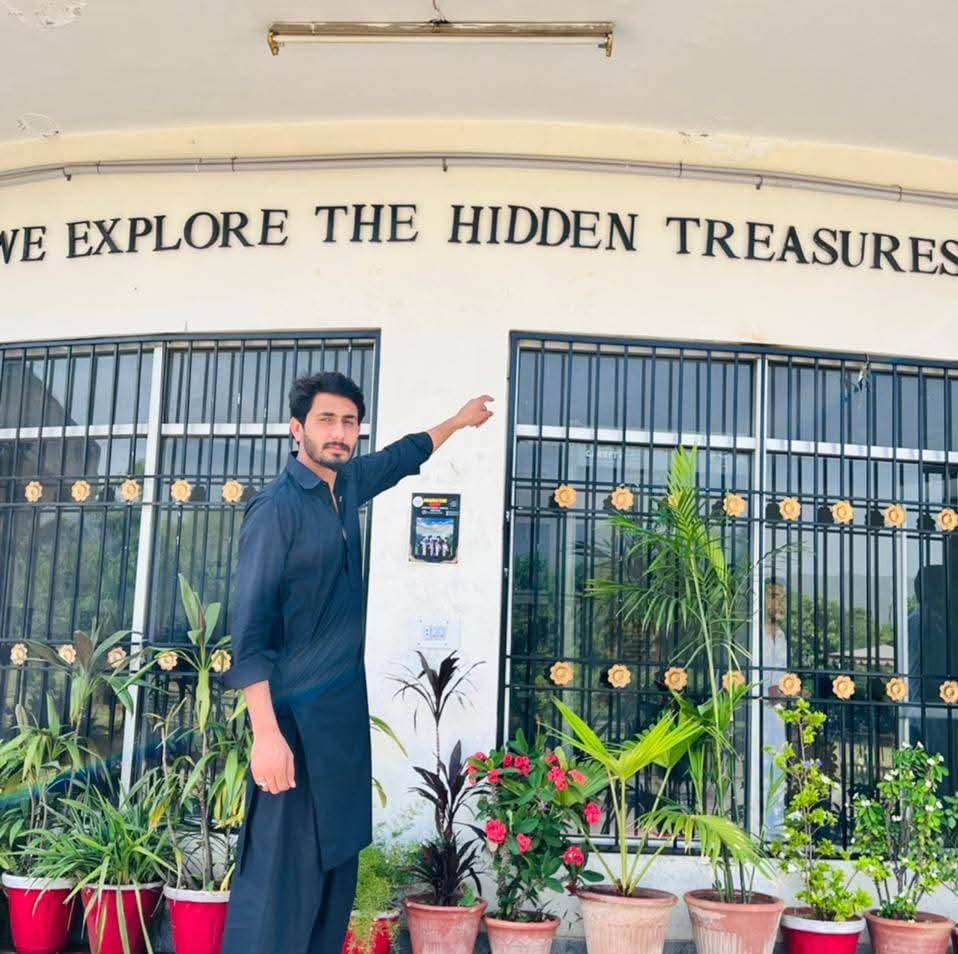
I first saw Usama three or four years ago, in a cafeteria at Quaid-i-Azam University in Islamabad. He sat on the bench across mine, in a white shalwar kameez, reading. The clatter of the cafeteria, the students passing between us, my own eyes trying and failing to catch the title on the cover: none of it reached him. He looked up only when the waiter set down his tea, and the whole of the attention he had given the book seemed to pass, unbroken, to the man’s face. He smiled and asked if he was well and if he needed anything. The waiter tapped his shoulder, smiled back, and moved on. We came to know each other after that. I would often find him humming poetry under his breath, alone on a road or walking across the campus. He loved Faiz, Jaun Elia, and Bismil Azimabadi with the same enthusiasm he brought to history or politics, and it followed him everywhere. In the middle of a demonstration, the same voice that had carried a poem quietly to itself would lift it into the air for hundreds to answer.
Usama Jameel was from Mang. His father died of a heart attack years ago; one elder brother was in the Pakistan army and came home missing part of a leg; his brother-in-law spent 14 years in an Indian prison for his part in the armed struggle for Kashmir’s liberation before returning to this side of the Line of Control. Usama was one of eleven children, five sisters and six brothers, with two younger brothers after him. “You can imagine,” a relative said, “what kind of a family we are.” One son maimed in the uniform of the Pakistani state, one son-in-law jailed for years by India, and now a son shot dead on a road in Rawalakot by Pakistan’s state Rangers. The state’s favorite charge against dissidents like Usama is that they are agents of India, and the local protests are often characterized as a plot hatched across the border.
Usama had come up the hard way. He was among the first cohort to graduate in geology from the underfunded University of Poonch. From there, he made a leap to Quaid-i-Azam for an MPhil, then a doctorate. He was in the second semester of his PhD studying the earth, its strata, and its faults.
Sitting with a few Kashmiri students at the university one day, Usama asked them what they wanted their lives to be about. They turned the question back on him. A nine-to-five was never what a life was for, he said; a salaried life was a kind of gulaami, servitude, and a man who clocked in and out could do little for his homeland. What he did instead was read, and make others read. “Keep reading,” he liked to say. “Don’t worry about memorizing.” In a study circle this year, he put it this way: “The people who use us as a herd of sheep keep us busy with slogans of the living and the dead. The one and only book that can free us from them is the book that gives the common people culture, that gives people awareness and consciousness, so that we can liberate ourselves from the slavery of the capitalist class.”
At Quaid-i-Azam University, with its reputation as a place for dissenting ideas and voices, he met and built close relationships with Baloch, Pashtun, Sindhi, and Gilgit-Baltistani students, recognizing their shared histories of struggle and marginalization. But he also encountered a difficult contradiction. When Kashmiri students tried to establish the Azad Jammu and Kashmir Students’ Council, other, larger ethnic councils opposed the initiative, arguing that Kashmiris were too small a community to warrant separate representation and that, if their demand were accepted, every smaller group would seek its own council. The experience taught him that even spaces committed to resistance could reproduce hierarchies.
On 28 April this year, he had opened a community group for the Kashmiri students scattered across the science departments. His first message announced a study circle for the coming Tuesday. He wanted them to read and write. “You write too,” he urged one hesitant female member of the group, and when she said she knew too little, he replied, “As you write, the words begin to flow and link themselves, and your knowledge grows alongside them.”
He also made sure that students in the study circle never missed an exam. When a campus strike interrupted a scheduled study circle, it was Usama who postponed the circle: sit your papers, he said, we will gather after.
He argued without flinching, and was usually the first to call and make peace, because he did not think a disagreement had to become a division. They might differ, he said, in person, in politics, in opinion, but they were not separate: “our bodies are entangled, our fates are entangled.”
You meet the whole of him in his writing. He wrote on self-determination, on the plebiscite the United Nations had promised and the decades that swallowed it, and he would not let the argument rest on law. Kashmir, he wrote, was less a dispute over a map than a test of the world’s conscience. The work in front of them was to make their own people here self-sufficient enough to hold up their people across the Line.
On May 1, he refused the world’s name for the day. “The world calls it Labor Day,” he wrote. “I call it the Day of Conscience. In 1886 the workers of Chicago asked for three words, eight hours’ work, and the owners answered with gunfire. The workers were martyred. And from their shrouds rose the cry: you can kill us, but you cannot kill our thought.” The wind that had blown through Kashmir for three quarters of a century, he called it the wind of imperialism, the thing that cut a people in two to strip them of their rights. The ones who faced the wind, he said, were the conscious young; and the conscious, in every age, are the danger to empire.
Usama was the deputy chief organizer of the Jammu Kashmir National Students Federation, the socialist, pro-independence students’ front that has demanded a free Kashmir since 1966. The federation viewed the students’ regular grievances as inextricably linked to the demand for self-determination. The university campuses run like garrisons – dilapidated schools, a syllabus that, it says, is drowned in state propaganda, an economy that offers the young nothing. None of this can be separated from the question of who holds the land. The struggle to win free education, the Federation declared, is, in truth, the struggle to win the right to live among one’s own people with dignity. Usama wanted a Kashmir that governed itself, an independent and sovereign state whose land and rivers belonged to its people and not its elite. He saw the Baloch, Pashtuns, and the oppressed of the world as his own and stood in solidarity with them, on and off campus.
For close to two years, he had carried on with the same work, from home to Poonch, into the schools and colleges of the villages around Mang, gathering the young into a room or onto a terrace and getting them to read. In May 2025, more than a year before the march, he brought four student groups together in Mang, the Jammu Kashmir National Students Federation, the Kashmir Students Liberation Front, the Muslim Students Federation, and the Jammu Kashmir Peoples Students Organization, bodies from different, often opposing, political affiliations, and got them to found a joint Students Action Committee with a 12-point charter. The demands were plain and local. Restore the student union. Fix the staff shortage at the local colleges. Build a library and provide university students with internet access. One point asked for something else: that the study of Kashmir be written into the curriculum. And in February 2026, in the last winter of his life, he was gathering Mang college students to mark the anniversary of Maqbool Bhat’s hanging in an Indian prison, teaching them the man’s life before they mourned his death. He taught, but he was also the one who put up posters announcing events, meetings, or study circles. Sometimes one would see paint on his hands from the slogans he had been covering different walls with. The campus organizer and the village teacher were the same man, and he was mourned as both. When word of his killing reached Quaid-i-Azam University, it was not only Kashmiris who protested. Baloch, Pashtun, Sindhi, and Gilgit-Baltistani students came out too.

In Usama’s account, the military was the force behind the repeated interruption of the people’s right to govern themselves, in Pakistan and in Pakistan-administered Kashmir alike. From the time of Jinnah to Imran Khan, he said in a study circle in February 2026, the military had never allowed democracy to flourish, whether by direct coups or by quieter forms of tutelage, so that the people’s mandate was never allowed to become fully sovereign. That conviction shaped the ethics of the movement he belonged to. The National Students Federation, he said, did not accept a tyrant or an oppressor as its brother, and did not accept as a political worker the man who sold his homeland.
His sharpest criticism was reserved for those who dressed unjust power in the language of religion. There are religious figures who paint socialists and nationalists as though they have no faith, and Usama remained the furthest one from that, his friends of eight years said to me.
He kept his prayers, fasted, and studied Karbala more deeply than anyone the friend knew. “For him it was the measure of every oppression, wherever it happened,” he said. Faith often furnished the grammar of his politics; his arguments moved easily between Karbala, Moses, Saladin, and the anti-colonial struggles of Kashmir, scripture and history sitting together. But precisely because he took faith seriously, he treated its use to coerce one as a kind of desecration. He had little patience for the Aalim, the religious scholar, who lent sacred cover to military authority. “I could not honor a turban,” he said, “whose cloth had been worn smooth polishing military boots.”
Not long before he died, a Kashmiri friend, who later recounted their exchange to me, told Usama her politics were not nationalist at all, but rooted in an Islamic internationalism that transcended nations and borders. He did not dismiss it. Even that vision, he replied, assumed a Kashmiri Muslim community capable of deciding its own future, and that powerless people cannot meaningfully choose between alternatives. Power first, he told her; otherwise nothing you believe in gets built.
It was an argument with old roots in Kashmiri political thought. Maqbool Bhat once sketched it beneath a chinar tree in Trehgam, Kupwara. As long as a sapling stayed under the canopy of a larger tree, he had said, it would never grow into itself. India was that tree. Only after stepping out of its shadow could Kashmiris decide what they wished to become, “whether they planted a rose or a thorn, whether they ended up an Islamic nation or a secular one.”
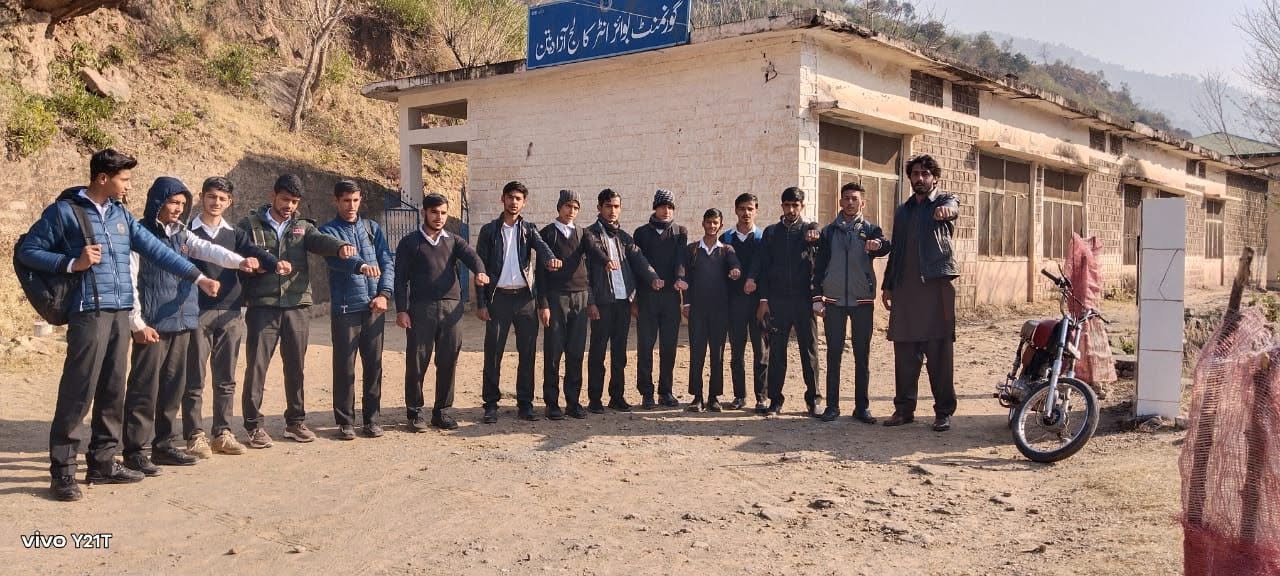
Usama returned to the idea again and again, and when he spoke he preferred to invoke revolutionaries whose graves lay in the valleys around him. One such evening was in Azad Pattan. In May this year, he set the movement before the village’s young men within a lineage that goes back two centuries. Did Sabz Ali Khan and Malli Khan accept the rule of any ruling class? he asked them. Did they vote tyrants into power? If not, he asked the inheritors of martyrs and warriors to reject the electoral politics of the political elite as well and join the people’s movement led by the Awami Action Committee.
His argument was not simply against voting. “Within a colonial structure, becoming part of the electoral process is an extremely sensitive matter,” he wrote to his friends. “In revolutionary and resistance politics, whether or not to participate in parliamentary or local elections has always remained a subject of debate among revolutionaries and freedom fighters, and both schools of thought have their own point of view.”
But Usama had made his choice. “In my view, before achieving national independence and in the presence of a colonial system, one should not participate in the electoral process,” he wrote. What should occupy the people instead was the struggle against the structure itself. “We should devote all our abilities and energy towards the end of the colonial system and the attainment of the national right to self-determination,” he wrote.
“If the system we seek to overthrow is the very system we should dismantle, then we should not ourselves become part of it, and we should struggle to keep the people away from it.”
Even the quarrels among local representatives in Mang became, for him, a cautionary tale. “The matters that took place among the local government representatives in Mang are proof that when one enters a coal mine, one can also come out with soot on one’s face.”
Walter Benjamin once wrote of a secret agreement between the generations that came before and the one now living, of the claim the past makes on us, “a claim that cannot be settled cheaply.” History, to Usama, was less a record than a summons; the dead were not finished with the living, and the only honest way to stand before them was to answer. For Usama, the past of these villages made a claim on their present. He spoke of martyrdom often, too often, his mother says. “When I am martyred,” he would say to her, never if. And yet in nearly the same breath, he would talk about living. He was leaving for Kashmir the next day, he told a friend from his class, and if he “did not come back a martyr, the next tea was on him.”
He sat on an old and painful fault line, the one that runs between the scholar and the organizer, between the word and the deed. It sharpens wherever a people is being erased. The writer Abdaljawad Omar has described its subtlest form: the enemy of a people’s thought is not only the loudmouthed bigot but the fluent, footnoted intelligence that reasons in complete sentences while the ground is carried away beneath it.
Against it Omar sets the thinker who refuses to remain a merchant of words, who carries his thinking into action, and whose death becomes, in Omar’s words, an intellectual event, an analysis pushed to its conclusion. Usama distrusted the comfort of the first kind. This is not the time for speeches, he told a crowd in his village in the last week of June; this is the time to give our thoughts and words life on the ground, through action. When he set the book down and took his place among the marchers, he closed the distance most people keep open for a lifetime, the safe gap between what we think and what we will risk for it.
His death was, in Omar’s sense, an intellectual event, and in the same breath a silence, the reader who would read no more. To act, in conditions like these, Omar writes, is also to fall silent, a final and most serious utterance: the case you can no longer make in words, made instead with your life.
You could watch him close that distance in the last week of June, in the bazaar of his own village. The shops were shut, the rolling shutters pulled down over the storefronts, and the men had come out into the June sun and gathered in a loose semicircle in the road–old men with white beards and prayer caps, shopkeepers, young boys–the whole village had turned out and was standing. A hired loudspeaker sat on the step. Painted on the wall by the doorway of an open shop, a graffiti likeness of Maqbool Bhat, the man India had hanged, looked down on the crowd. And on a chair, in dark glasses, an old man sat, quietly watching Usama: Commander Farooq. Each time he struck a line that landed, the people around him turned to look at Farooq, and the old commander would nod, or smile, from his chair. They were watching the young man speak, and the old one approve. Organizers credit him, more than anyone, with bringing the students into the Action Committee’s movement, tying the campus fronts and the village circles to the agitation in the streets.
The march to Muzaffarabad was days away. What had begun the year before as a revolt over the price of electricity and flour, and over the 12 assembly seats voted on by refugees outside the territory, had, by June, become the largest movement the region had seen in years, and the state moved to break it. Weeks earlier it had outlawed the Action Committee under anti-terrorism law, named its leaders terrorists, and put a price on their heads. And over the whole of it lay the oldest charge in this territory, that a Kashmiri who resists is a proxy for India, an agent of the enemy. This was what Usama stood up in the square to refuse.
He stood above the crowd in his white kameez, one arm up, and he was not consoling them. It was not the talk of a man hoping to come home. They would either be victorious, he said, or their dead bodies would return; the leadership would be in the front row, they would not hide behind the people, and his own hand would hold the white flag of peace.
They called the marchers terrorists, he said, but if they were terrorists, the collaborators and their facilitators would not be walking freely on their own land. They were called these names because the state feared politically conscious people. He knew the difference between a reactionary movement that turned against its own people and a revolutionary one that struggled in their name; “the marchers had not stumbled into this in anger or haste, but chosen a peaceful struggle after long thought.”
He cast the killers and the killed into the oldest roles his tradition offered. He would not forgive those who stole mothers’ children from them, pieces of their own souls, he said, and history would not forgive them either. “It would remember them as Yazid, as Mir Jafar, as Mir Sadiq, and it would remember the marchers as the caravan of Husayn, the followers of Moses, the admirers of Salahuddin Ayyubi, the comrades of Tipu Sultan.” In a single breath he had crossed the registers most people keep apart, the Islamic, the nationalist, and the anti-colonial worked into one cloth. Then he threw his arm up and called to them, “awaz do,” raise your voice, and the whole square answered him back, “hum ek hain,” we are one. Again he called, and again they answered, the hands going up across the crowd.
He had left Islamabad for the last time at the end of May or the start of June, missing the final papers of his PhD. One of his professors asked, bewildered, how the university was meant to examine a student who simply was not there. A close friend begged him to come back, finish his exams, and then return. But Usama said he could not leave his people. He spent the last weeks of his life in Mang and the villages around it, and it was from there, on 27 July, that he went to the march. Before he left, he gave an instruction. If they returned dead, he said, there was no need to mourn them. “Mark our funerals with the songs of resistance,” he told the crowd gathered at Rawalakot, “so that whoever sees us knows this is the funeral of someone who died a revolutionary’s death.”
A few days later, watching the images of state repression come out of Rawalakot, I saw Usama’s weary face again. There was anger in it at what was being done to his people, and, somehow still, hope in them. He had been leading the protests in his village, raising slogans in the style of Sarjan Barkati, the “Pied Piper” of Kashmir, whose singsong chants of refusal rose against Indian rule until India jailed him.
I had first heard that rhyme in Srinagar in 2016, on the other side of the Line: Yeh pellet-bullet, na bai na. Yeh shelling-killing, na bai na, no to the pellets and bullets, no to the shelling and killing, the crowd answering “no, brother, no” to each thing the state had used to break them. Usama had taken up the same rhyme on this side of the Line, only he named what faced him here: Yeh ranger-shanger, na bai na, no to the Rangers.
It was afternoon when the march gathered at the Motialmara bus stand in Rawalakot, and Usama was leading it. A comrade who marched beside him told me how it went. Usama stood on something that raised him above the crowd, in his white kameez, using the white flag to wipe the sweat from his face in the heat. Commander Farooq was there too, next to him. The homes along the route had been emptied of their families, and snipers stood at the windows, waiting for orders to kill. First came the shelling, then the firing. Most protesters were hit in the legs, some in the back; Usama was shot in the head, and the comrade who stood near him had no doubt it was deliberate.
They buried him the way he had asked to be buried. Thousands came, more than the village could hold, a crowd spilling down a green hillside in Mang with the forested hills of Poonch rising behind. Hands went up across it, and phones, and the slogans he had raised in life came back now over his body. Khoon rang laayega, inqilab aayega – the blood will not go in vain, the revolution will come. Usama tere khoon se, inqilab aayega – Usama, from your blood, the revolution will come. At the front stood the boys, the youngest of those he had gathered on the terraces to read, watching him as he was carried past.
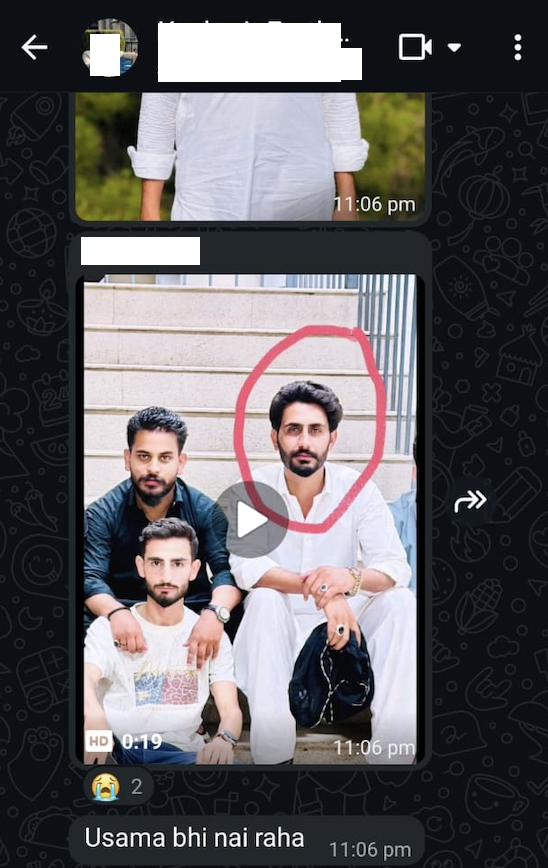

His face looked calm, the head bound in white, the eyes closed, the mouth eased into what a grieving eye reads as a smile and a medical one would call the slackening of muscle. Both readings are true. His people will keep the first. Children fought to get near him, to touch his face; their hands rested on his chest and his shoulder. I had seen this before, across the Line, the way people press in to touch the body of a man killed by the Indian army. The news reached his distant friends when a close friend posted a photograph of Usama on a flight of steps in his white kameez, two friends beside him, one of them ringing his face in red, and beneath it four words: Usama bhai nai raha: Brother Usama is no more.
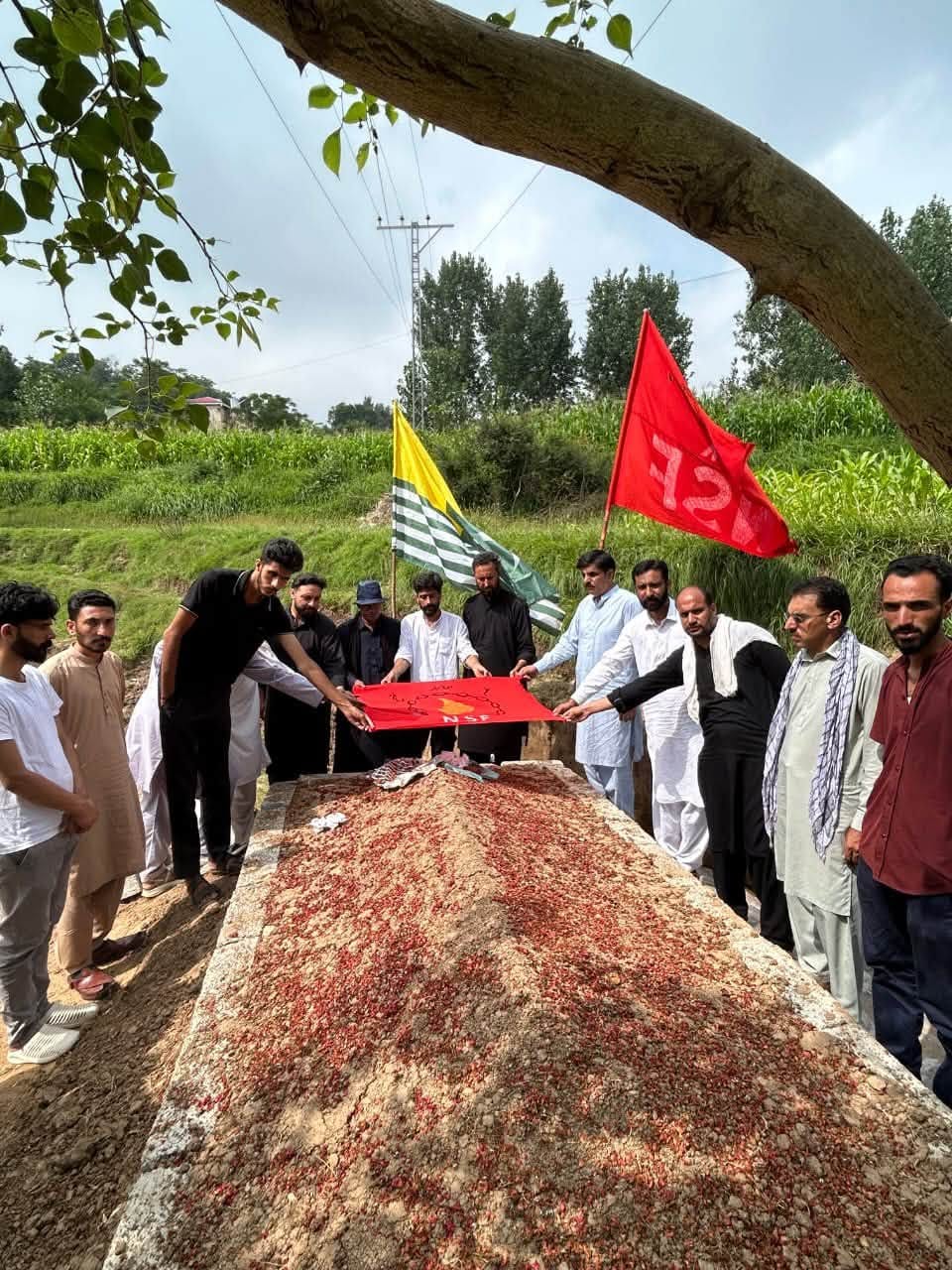
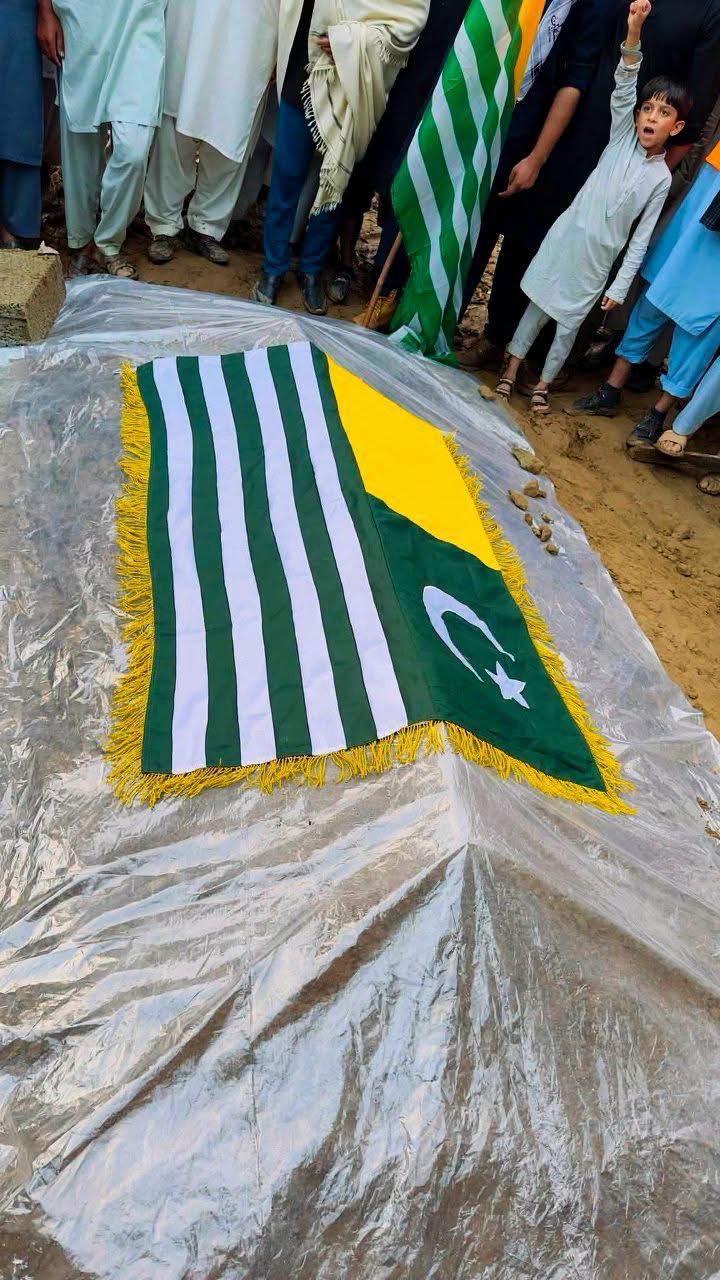
Somewhere in the hills of Mang, a woman has no word for the absence of her son, and none is coming for her. A student of the earth returned to the earth. He was buried under the flag of the JKNSF, the Jammu Kashmir National Students Federation, the cloth laid over his body until they carried him to the grave, and spread over the earth once the grave was closed.
Usama had loved one poem above the others, and it followed him farther than he or Faiz could have known. Faiz wrote ‘Hum Jo Tareek Rahon Mein Mare Gaye’ in a prison cell in 1954, moved by the last letters of Ethel and Julius Rosenberg, the American communists sent to the electric chair the year before. It was a hymn for those who take the dark road and do not turn back. By one of history’s crueler ironies, Usama was not killed in some dark alley, as Faiz imagined, but in the full light of day, surrounded by his own people. But the poem found him anyway:
I longed for your lips, dreamed of their roses:
I was hanged from the dry branch of the scaffold.
I wanted to touch your hands, their silver light:
I was murdered in the half-light of dim lanes.
It’s true that not to reach you was fate,
but who’ll deny that to love you
was entirely in my hands?
So why complain if these matters of desire
brought me inevitably to the execution grounds?
His death is already being put to use. Across the Line, in the Indian press and on Indian timelines, the killing of Usama Jameel fits within the familiar story: look, they say, at what Pakistan does to its Kashmiris, a scholar shot, the boy with the white flag dead on the road, as though his body were a stick to beat the other state with. Ravinder Raina, a senior leader of India’s ruling BJP, was among those who seized on his killing, calling him “a firebrand youth leader,” in the same breath as he called the territory “occupied Kashmir.” The facts are true. Pakistan’s Rangers did kill him. But the moment you let Usama speak, the use collapses, because there is no version of him that India can hold. The rhyme he chanted he had taken from Sarjan Barkati, whom India answered with a prison cell. Carry him across the Line, and he would likely be where Wamiq and Zahid Farooq are, two teenagers shot dead by Indian forces in Srinagar in the 2010 uprising against Indian rule. India may borrow his death for an evening’s argument, but his life would have refuted it.
If Usama’s life was a life interrupted, Commander Farooq’s was its long counterpart. Between them lies the arc of Kashmir’s unfinished struggle, from the young man who had only begun to write his life to the old fighter who had spent decades remembering those who never finished theirs. He was, after all, the Father.
The Father
For Farooq’s people, his presence in the village was coterminous with life in Mang. Children would wave at him when they ran through the streets, and he would try to touch their heads affectionately, but in recent years they had become too fast for him. He would sit with men his age, talking about what they had done right and what could have been done differently. The young would turn to him for advice on everything from a marriage that was not working to an ideological tension seeking some kind of resolution. They were used to having him around, as if it were an unspoken expectation. Like leaving your home and expecting to see a tree that has stood there for decades, or a mountain. But now they will leave their homes, and the mountain is gone. That is what Farooq’s death did to the landscape of Mang.
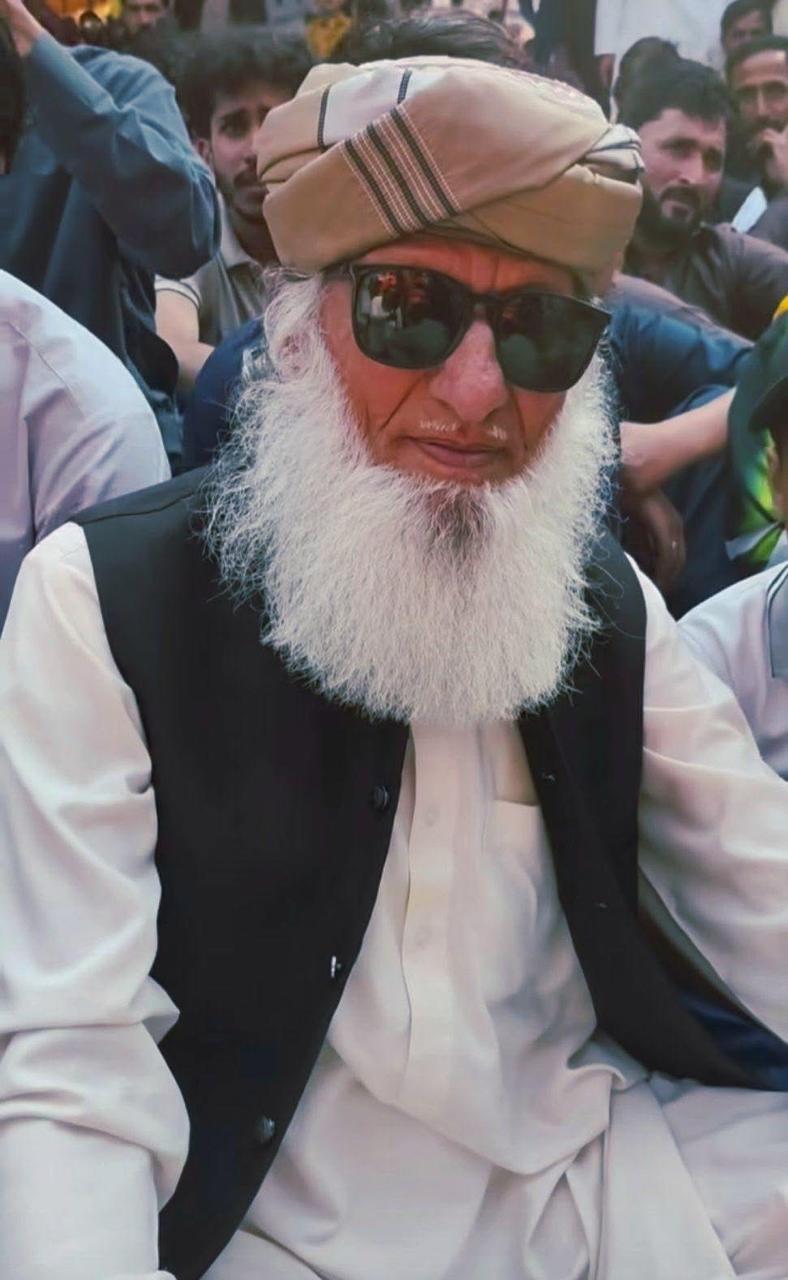
I met Farooq on my first visit to Azad Kashmir in 2021, and several times after. He was an old man by then, but a striking one. The long white beard was kept neat, the black cap set just so, dark glasses on even indoors, and over the white shalwar kameez often sat the camouflage combat jacket he was rarely seen without. He had a deliberate, almost dapper bearing, the carriage of a man who had been a soldier and had never quite stopped standing like one.
When he learned I came from the valley, he greeted me by recalling the places he knew: villages, forests, the passes fighters used to cross, the guides and nomad families who had helped them over, which of them could be trusted and which had sometimes carried word to the other side. One fighter, he told me, had gone days without eating when he stumbled upon a nomad family who took him in and fed him. Later, he woke up naked in an Indian army camp on the other side; there had been something in the food. He told me, too, of a village on this side of the Line called Halmat, where everyone still speaks Kashmiri, with no migrants among them, a people who had simply always been there. He mentioned it, I think, because he imagined I might want to be among people who spoke my own language. He named the fighters he had trained. He had learned that ground the way other men learn a trade, and decades on it was all still in him.

That knowledge was the residue of the first half of his life, dedicated to fighting India. After leaving the Pakistan army, he joined the Jammu Kashmir Liberation Front, the party of Maqbool Bhat and Amanullah Khan, to free the Kashmir that lay under Indian rule. He trained hundreds of its young men in the camps and learned every crossing and guide along the Line.
But that door was closing in his lifetime. Pakistan had once armed and sheltered the fighters who crossed the Line, and the JKLF among them. In time, the state withdrew that patronage. It came to prefer other armed groups over the JKLF, whose demand was not Kashmir’s accession to Pakistan but a Kashmir independent of both states, and the front’s war across the Line thinned out. As it closed, Farooq turned, with no single moment anyone could name, to the people on his own side of the Line. The fight he could still fight was here. It was the electricity and the flour, the taxed mills, the rulers who governed his hills from far away. The man who had spent decades trying to free the valley from India spent his last years trying to free his own hills from the men who ran them from Islamabad.
He came to it by blood. Farooq was the nephew of Khan Muhammad Khan of Mang, the Sudhan captain who had soldiered for the British in the 1st Punjab through the Second World War, in the Middle East and Italy, and came home to fight as a guerrilla in the war of 1947. Khan Muhammad Khan was active in the Mirpur sector, and some accounts credit him with leading the Mirpur campaign, though the claim is disputed. Afterward, he raised one of the first battalions of the Azad Kashmir Regiment. He was, in short, one of the men who wrenched this ground free of the Dogra and put the “Azad” in Azad Kashmir.
But the state those men built did not hold them for long, and it is the second chapter the nephew inherited. Within eight years of founding Azad Kashmir, the Sudhans had turned against it. In 1955 Pakistan dismissed Sardar Ibrahim Khan, the Sudhan barrister who had been Azad Kashmir’s first president, and installed a government the tribe would not accept. Poonch rose in Rawalakot and Pallandri, the same towns, the same tribe, over much the same grievance: that the promises of democracy and self-rule made to a “free” people had not been kept. Pakistan sent the Punjab Constabulary and the 12th Division and held Poonch under martial law for almost two years before the revolt broke out. By his own account, set down in his memoirs, the Khan of Mang rallied support for the uprising, slipped across the Line, was branded by Pakistan a double agent, and on his return was jailed for ten years at Haripur.
Farooq’s death and his uncle’s revolt are not identical: 1955 was an armed tribal uprising put down by martial law, while 2026 was a civilian march met with snipers. But the latter sat folded inside the earlier, the same people, the same towns, the same broken promise of a freedom that was named and then withheld, waiting the 70 years it took to surface again.

Before he was any of this, Farooq had been a soldier of the state he would end his life fighting. He served the Pakistan army, a commando in the Special Services Group for about two decades, according to his comrades. He was among the soldiers sent to help clear the Grand Mosque at Mecca when it was seized in 1979. His authority in Mang, though, rested less on the army than on a claim he made about his own people: the Sudhans do not sell out. He had a story to prove it, and it survives in one of the few recordings left of him speaking. He had guarded Yasser Arafat, he says on it, when the Islamic Summit came to Lahore in 1974; there was a bounty on Arafat’s head in those days, and the detail wanted a bodyguard from among the Sudhans, “because the Sudhans do not sell out.” There are many factions among the Palestinians too, he says, “but they meet on the common purpose of liberation.” He tells it as a man who has told it many times. He had asked Arafat, through a translator, why he had not brought Leila Khaled with him, and Arafat, he says, answered that when he left the country, she stood in his place. Leila Khaled herself Farooq remembered by a line she was said to have given a foreign host who asked whether she was married: that she was wedded to the Palestinian struggle. Whether the old commando had the facts quite right hardly mattered. In the telling, the story had become folklore.
There is a jacket in that history too. During the Kargil war of 1999, on a night when Indian troops pushed across the Line of Control, Farooq and a handful of others held them off for the better part of a day, and the Pakistan army gave him an honorary combat jacket for it. When he spoke of Pakistan in those years, it was never as an outsider. “We have fought two wars for this country,” he said, while addressing a crowd during a protest earlier this year; “we have given every sacrifice.” Pakistan was part of the history he carried, and he expected that history to mean something.
And yet, Farooq was one kind of Kashmiri among many. There are Kashmiris deeply critical of Pakistan, and Kashmiris who feel a genuine belonging to it, and that belonging exists on both sides of the Line in different forms, along with local, layered histories. A Kashmiri can resent the Pakistani state and still feel that Pakistan is part of his own political and emotional world; another can reject both states and insist on an independent Kashmir. One sentiment does not cancel the other. Kashmiris have never been as uniform as the states that claim them would like, and perhaps these competing loyalties are themselves the consequence of a people made to live on a terrain not of their own making. Farooq was one who could hold many of these contradictions within himself, all at once. The man who said “we have fought two wars for this country” could, at a sit-in another week, disown it root and branch: “we have nothing to do with Pakistan”, he said, “it is not even a country, it is run from Islamabad on borrowed money and has no sovereignty.” He felt no need to reconcile them.
The line he kept drawing, between a treacherous elite and the ordinary people he would not blame, had been set down decades earlier by Maqbool Bhat, in the prison letters collected as Shaoor-e-Farda, “The Consciousness of Tomorrow.” To be accused of spying, Bhat wrote, was the ruling class’s own narrative, not the people’s verdict. “This ruling elite is an enemy to the people of its own country,” he wrote, and it brands as spies and foreign agents the very leaders the people love; if it called Kashmiris spies, that should not trouble them at all. He had drawn one distinction sharper than the rest, the one that explains why a place with “Azad,” free, in its name was marching and dying at all. “One part was occupied with an assault by the Indian army,” Bhat wrote, “and the other part, whilst named as free, could not benefit from the fruits of freedom.” Farooq spent his last years living inside that second half.
By the early 2020s he was saying it out in the open, and often. The armies of both states should withdraw, he declared, and the 20 million people of Jammu and Kashmir be given the right to live; the crossings should open so the divided halves could trade again. In September 2022, at a roadside gathering, he turned on Pakistani rulers directly: they had enabled the splitting of their own country in 1971 for petty interests, called Kashmir Pakistan’s jugular vein for seven decades, but then in 2019, when India stripped the other side of its special status, had done nothing, “complicit in the loss through its silence, and now it wanted to make this side a colony too.” On the fourteenth of August that year, Pakistan’s Independence Day, he issued what he called a Declaration of Mang: “there would be no dam at Pattan Sher Khan until the people who lived on that land were given free electricity from it.” We must reap the benefit of what is built on our own ground and resources, he had said.
The grievance underneath was old and exact. Azad Kashmir generated far more electricity than it used and watched the surplus flow out to the national grid, then bought its own power back at rates its people could not meet. The price of flour had been pushed beyond reach, the flour mills taxed until they closed. And the senior officials who ran the place, the administrators and police chiefs, were sent in from mainland Pakistan rather than raised from among its own.
The state had a way of answering. When the people of Pattan Sher Khan came out over the price of electricity and flour, the line to the village went dead. The power had been cut, the families and organizers there say, to punish them for protesting. It was July 2023, deep summer in the hills, and it went on into the night. At a sit-in over it, Farooq spoke of the children of Pattan Sher Khan crying in the dark, and their mothers with nowhere to carry them, and he turned to the men who had thrown the switch and asked whether they had any shame. They charged for a month of electricity, he said, and gave 15 days of it. His faith he wore the way he wore the jacket, out where it could be seen. Don’t clap, he told the crowd; raise the slogan praising God, so that the state that calls us godless nationalists is told to its face that we are the people of prayer, while many of their generals are alcoholics.
The turn was complete at Pallandri that August, and the jacket made it visible. By then the arrests had begun. During the year’s agitation, the Azad Kashmir government had detained many of the protesters, then said it was withdrawing the cases and letting them go, but in Pallandri a judge was still pursuing a fine. Farooq sat through the town’s heat in the combat jacket, an old man in a soldier’s coat in the worst of the season, and told the crowd it was deliberate. “In this heat, I am wearing this military coat,” he said; “it is symbolic, and I will keep it on until a decision is reached, and take it off only when Kashmir is resolved, once and for all.”
Then he laid out his terms–the terms of a man who had no more patience for middlemen. “We will talk only to the Prime Minister”, he said, “to the people who actually decide”; the commissioners and district officers sent to handle him he waved off as “a waste of time he did not have.” If the demands were not met, they would not leave the sit-in. They would go on to Pattan, and “no government car with a green number plate would cross it”; they would seize the cars and the men inside them, and then, he said, the state would understand. “Are our children less than yours,” he asked the men in Islamabad, that theirs sit in big colleges “while ours stay indebted to the IMF?” He had no quarrel with dialogue, only with what the state meant by it: not his people sitting quietly while they were talked at, he said, and “if their just demands were refused, they would throw the dialogue back in the state’s face.” What he wanted, in the end, was the Line opened and the old routes restored so the valley could trade across the divide as it always had, back when the flour came over from Mendhar, in the part of Poonch held by India.
Farooq’s name had come up, years before all this, when I spoke with Yasin Malik, a prominent Kashmiri resistance leader, in Maisuma, the Srinagar neighborhood that has been his ground since he was young. He paused and smiled. He had once told the old man he would learn diplomacy some day, Malik recalled, and Farooq had looked at him and said that the day he did, they could stop calling him Commander. Malik had reason to know. More than three decades earlier, he had trained under Farooq, one of the pioneering young men the Commander put through the camps before he became the face of the armed movement across the Line. They met again in 2012, when Malik visited Pakistan and also came to Pallandri to address a gathering at the Jamia Masjid ground; afterward the two of them sat together at the town’s rest house, the old trainer with his walking stick, the former student leaning in to listen. Malik said it because diplomacy was the one thing Farooq had no use for. He spoke the truth as he saw it, bluntly, sometimes past the point of comfort and sometimes past what could be said aloud in company. His speech ran thick with metaphor, reaching for whatever vivid image would land hardest, and the hardest-landing image was not always one you could repeat in front of children. It was the speech of a man who had never in his life needed to soften anything.
He trained hundreds like Malik. His closeness to the founders and his record in the field carried him onto the JKLF’s Supreme Council, the small body where policy was set, and in the party elections of 2014, Malik named him honorary Vice-Chairman, the office he still held on the day the paramilitary forces shot him. One trainee, now in his late 50s, remembered getting lost during a night exercise and stumbling back into camp expecting a scolding; Farooq only asked whether he had found his way in the end, and when the man nodded, said, good, then the exercise worked, poured him a cup of tea, and moved on. He never wasted energy making you feel foolish, the man recalled; if you had learned something, he considered the matter finished. He ran the camp according to the code Amanullah Khan had written for armed Kashmiri youth, ten points pinned like commandments over the whole enterprise. The fighter was to be a man of character before anything else. He was to hold the honor of the Kashmiri woman as a charge on his own life. He was to spread brotherhood across every region and set himself against sectarian and factional hatred, to prefer the collective to his own name and fame, to share the people’s hardships rather than add to them, to keep clear of lying and backbiting and deceit, and above all to make of himself a model worthy of a freedom-loving people.
He made commanders of other men’s sons, and buried two of his own. Farooq had four sons and a daughter; two of the boys went before him, and his wife before them all, so that the man the village leaned on as a father had himself stood at the head of many graves.
By the last summer of his life, the valley was living under something close to a siege. As the movement swelled, and the state moved to break it, the ordinary arteries of the place were clamped shut: mobile signals cut for days at a stretch, the internet dark, roads blocked at the passes, and with them the everyday passage of food and medicine and fuel that a mountain population lives on. A district that sometimes went short in good times went shorter now. Farooq did more than speak about it. One family told me that in those weeks he went from house to house among the hardest hit families, carrying what he could, flour, money for essentials, whatever was needed and whatever he had, and giving it quietly, doing the smallest and most necessary work.
It was his wish to be martyred, he had told his family, but his years had climbed so high that he had stopped expecting it. The bullets took him on July 27, as he marched alongside Usama. He held on for four days, in a hospital bed, mostly unconscious. His sons and son-in-law surrounded him, along with some core members of the Action Committee he had marched for. He said little in those four days, though a family member told me they often saw his lips moving, apparently reciting the Quran and remembering God. It was hard to see him like that, one member of the Committee told me; they had only ever known him roaring, thundering, and here he was so vulnerable in a bed. On the night of the 31st, he died.
They brought him home to Mang. Men packed the mosque courtyard and spilled down the streets, stood shoulder to shoulder on every rooftop and balcony the small town had, the whole slope white with their shalwar kameez under a low gray sky; the forested hills behind were soft with mist. It was the turnout a valley gives once in a generation, and out of it rose a chant that was less lament than verdict: Commander Farooq, teri siyasat ko salaam ho, salaam ho, salute to your politics, Commander Farooq, salute. They draped him in two flags, the flag of Azad Kashmir and the flag of the Liberation Front he had given his old age to, and then they lowered him into the ancestral graveyard at Mang.
When Farooq trained fighters for the liberation of Kashmir under India, he was doing perilous work, but not, in a sense, inconvenient. Armed struggle against India was looked upon with favor from this side of the Line then, backed and tolerated by the Pakistani state to the extent that suited its interests of the moment. To take up that fight was to run with the grain of power even as you risked your life. The hard turn, the one most men in his position never made, is the one Farooq made afterward. When that chapter closed, he did not fold up his politics and retire into the honor of an old commander. He carried the same conviction home and pointed it at the conditions of his own people inside Azad Kashmir: the taxed mills, the rationed electricity, the distant ruling class. That fight had no patrons. It won him no protection, and in the end it drew the state’s bullets. India will not celebrate this life. Pakistan will not celebrate it either. They have little use for his story. He will be remembered in Mang, and in the hills around it.
Maurice Blanchot once tried to name the difference between an ordinary catastrophe and something worse. A catastrophe has the ultimate for a limit; there is a worst, and it ends there, and the ending contains it. “I call disaster,” he wrote, “that which does not have the ultimate for a limit, but bears the ultimate away in the disaster.” The disaster carries off even the finality that would let you say: this was the end, now it is over. That is the condition of this place. Death here is not a limit that grief can rest against. Usama and Farooq were buried days apart in the same small ground, the Father and the Son. Usama was Mang’s child, and Mang buried him the way a parent buries a child, against the order of things, unrepresentable. Farooq was Mang’s father, and to bury him should have been the natural thing, the old man going first, except that even the ordinary is not ordinary in this part of the world. I think often of how we have been robbed of the ordinary: the simple, unremarkable death in a bed at the end of a long life; the son who outlives the father and grieves him. Usama spent his short life trying to close the gap between the word and the deed; Farooq spent his long one refusing to let the deed harden into a comfortable retirement. They met in the middle, on a road above Rawalakot. And each had already stood where the other’s grief now placed him. Usama had lost his father young; he had buried a father. Farooq had lost his sons; he had buried a child. The boy the village mourned as its son had known, before any of this, what it was to put a father in the ground; the old man it mourned as its father had known what it was to lower a son. So when Mang laid them side by side, it was burying two men who each already carried, in the body, the grief the other’s death would cost, a father and a son who were not father and son, and who had each, in the ordinary course of a life here, already been both.

The Commander and the Scholar: Two Deaths in Mang
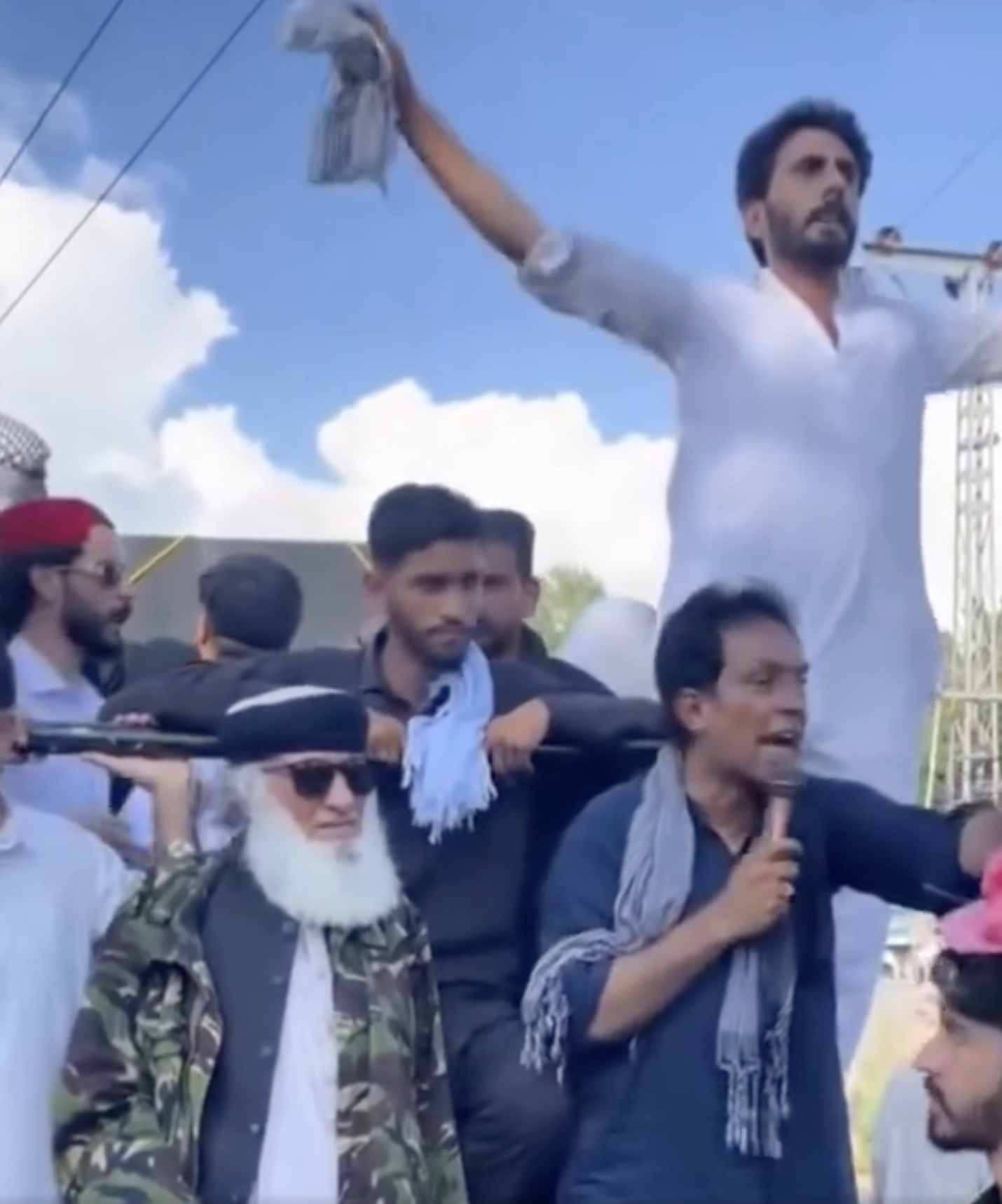
Usama and Farooq seen in one frame on the day of their killing. Photo Credit: Published with permission.
Editor’s Note: Beginning on 5 June 2026, and intensifying through the late-July unrest in Rawalakot and Mirpur, protests in Pakistan-administered Azad Jammu and Kashmir were met with a severe crackdown by the Pakistani state. Led largely by the Jammu Kashmir Joint Awami Action Committee (JAAC), the demonstrations over political representation—particularly the reservation of 12 legislative seats for refugees living outside the territory—followed years of broader grievances over prices, governance and autonomy. After the authorities proscribed the JAAC, shut down internet and mobile services, and arrested activists, clashes escalated across the territory. At least 40 people were reported killed in the unrest ahead of the AJK elections, including 34 protesters. During two days of late-July clashes in Rawalakot and Mirpur, JAAC organizers stated that 26 people were killed—20 in Rawalakot and six in Mirpur. This piece tells the stories of two people killed during the protests in Azad Jammu and Kashmir. The author’s name has been withheld, and this piece is published under a pseudonym for safety reasons.
There is no word for a parent who loses a child. A child who loses their parents becomes an orphan; a husband or wife left behind becomes a widower or a widow. But for the mother or father who buries a child, there is no word at all, only the boundary-stone past which the language will not go. Last month, the village of Mang, a scatter of homes in the hills of Sudhanoti, one of the small mountain districts of Pakistan-administered Kashmir, was made to grieve in both directions at once. It buried Sardar Usama Jameel, a young man it had claimed as a son, and “Commander” Farooq Khan, in his 80s, a man it had long looked up to as a father. So Mang became both the parent with no name for its grief and the child left orphaned.
They were killed in the same violence. On the evening of 27 July, the Joint Awami Action Committee set out on a long march toward Muzaffarabad, the regional capital in the far north of the territory. The committee had formed in September 2023, out of Pakistan-administered Kashmir’s long grievances: the price of electricity and flour, and the privileges of a ruling class that governs the region from far away. At the hard edge of its demands were 12 seats in the regional assembly. They are held not as the inhabitants of Azad Kashmir but as refugees, Muslims who left Indian-occupied Jammu and Kashmir around the Partition of 1947 and the 1965 war, and settled across mainland Pakistan. Their descendants still elect a bloc of the assembly from outside the territory. This, the movement says, lets Islamabad’s parties install the region’s government without winning a single local vote. In June this year the state outlawed the committee under anti-terrorism law. The march went ahead regardless. It set out from the edge of Rawalakot, the main hill-town of Poonch district, an hour’s climbing road above Sudhanoti. The people walked, and they were fired upon by Pakistani paramilitary forces and the local police.
By the time the shooting stopped that evening, some 20 marchers were dead, though even the counting had to be done by their families. Mobile signals were cut, the electricity and the internet went dark, and the town’s one main hospital was sealed off by government forces. The wounded had to be carried by hand and by private car down the mountain roads to whichever hospital would still receive them–in Hajira, another small town of the Poonch hills, and in Pallandri, the modest district seat of Sudhanoti itself. In those towns, crowds lined the hospital gates to give blood. Among the dead it left on that road were two who belonged to Mang.
Mang is not an ordinary village, and it did not become a place of mourning for the first time this week. A village in Sudhanoti District, in present-day Azad Kashmir, it is a stronghold of the Sudhans, the hill tribe of these mountains, and has been a seat of resistance for the better part of two centuries. In 1837, when the Dogra chief Gulab Singh moved to bring the Poonch hills to heel for the Sikh empire, it was from the fortress of Mang that the Sudhans, under Shams Khan, held out until a long assault broke them. The reprisal for the revolt was brutal: the rebel leaders Malli Khan and Sabz Ali Khan were flayed alive at Mang, a bounty of a single rupee was set on every rebel head, and many died in the hills. Within a decade, Gulab Singh would buy Kashmir outright from the British East India Company for cash, setting in motion the political order that shaped the present uprising.
Locals say the tree where the sardars were flayed is still standing. A little over a century later, in 1947, when Poonch rose against the last of that same Dogra line, Mang once again served as a base for the fighting, part of the uprising out of which Azad Kashmir itself was born. Mang birthed Farooq and Usama; Mang has now buried them.
The Son
I first saw Usama three or four years ago, in a cafeteria at Quaid-i-Azam University in Islamabad. He sat on the bench across mine, in a white shalwar kameez, reading. The clatter of the cafeteria, the students passing between us, my own eyes trying and failing to catch the title on the cover: none of it reached him. He looked up only when the waiter set down his tea, and the whole of the attention he had given the book seemed to pass, unbroken, to the man’s face. He smiled and asked if he was well and if he needed anything. The waiter tapped his shoulder, smiled back, and moved on. We came to know each other after that. I would often find him humming poetry under his breath, alone on a road or walking across the campus. He loved Faiz, Jaun Elia, and Bismil Azimabadi with the same enthusiasm he brought to history or politics, and it followed him everywhere. In the middle of a demonstration, the same voice that had carried a poem quietly to itself would lift it into the air for hundreds to answer.
Usama Jameel was from Mang. His father died of a heart attack years ago; one elder brother was in the Pakistan army and came home missing part of a leg; his brother-in-law spent 14 years in an Indian prison for his part in the armed struggle for Kashmir’s liberation before returning to this side of the Line of Control. Usama was one of eleven children, five sisters and six brothers, with two younger brothers after him. “You can imagine,” a relative said, “what kind of a family we are.” One son maimed in the uniform of the Pakistani state, one son-in-law jailed for years by India, and now a son shot dead on a road in Rawalakot by Pakistan’s state Rangers. The state’s favorite charge against dissidents like Usama is that they are agents of India, and the local protests are often characterized as a plot hatched across the border.
Usama had come up the hard way. He was among the first cohort to graduate in geology from the underfunded University of Poonch. From there, he made a leap to Quaid-i-Azam for an MPhil, then a doctorate. He was in the second semester of his PhD studying the earth, its strata, and its faults.
Sitting with a few Kashmiri students at the university one day, Usama asked them what they wanted their lives to be about. They turned the question back on him. A nine-to-five was never what a life was for, he said; a salaried life was a kind of gulaami, servitude, and a man who clocked in and out could do little for his homeland. What he did instead was read, and make others read. “Keep reading,” he liked to say. “Don’t worry about memorizing.” In a study circle this year, he put it this way: “The people who use us as a herd of sheep keep us busy with slogans of the living and the dead. The one and only book that can free us from them is the book that gives the common people culture, that gives people awareness and consciousness, so that we can liberate ourselves from the slavery of the capitalist class.”
At Quaid-i-Azam University, with its reputation as a place for dissenting ideas and voices, he met and built close relationships with Baloch, Pashtun, Sindhi, and Gilgit-Baltistani students, recognizing their shared histories of struggle and marginalization. But he also encountered a difficult contradiction. When Kashmiri students tried to establish the Azad Jammu and Kashmir Students’ Council, other, larger ethnic councils opposed the initiative, arguing that Kashmiris were too small a community to warrant separate representation and that, if their demand were accepted, every smaller group would seek its own council. The experience taught him that even spaces committed to resistance could reproduce hierarchies.
On 28 April this year, he had opened a community group for the Kashmiri students scattered across the science departments. His first message announced a study circle for the coming Tuesday. He wanted them to read and write. “You write too,” he urged one hesitant female member of the group, and when she said she knew too little, he replied, “As you write, the words begin to flow and link themselves, and your knowledge grows alongside them.”
He also made sure that students in the study circle never missed an exam. When a campus strike interrupted a scheduled study circle, it was Usama who postponed the circle: sit your papers, he said, we will gather after.
He argued without flinching, and was usually the first to call and make peace, because he did not think a disagreement had to become a division. They might differ, he said, in person, in politics, in opinion, but they were not separate: “our bodies are entangled, our fates are entangled.”
You meet the whole of him in his writing. He wrote on self-determination, on the plebiscite the United Nations had promised and the decades that swallowed it, and he would not let the argument rest on law. Kashmir, he wrote, was less a dispute over a map than a test of the world’s conscience. The work in front of them was to make their own people here self-sufficient enough to hold up their people across the Line.
On May 1, he refused the world’s name for the day. “The world calls it Labor Day,” he wrote. “I call it the Day of Conscience. In 1886 the workers of Chicago asked for three words, eight hours’ work, and the owners answered with gunfire. The workers were martyred. And from their shrouds rose the cry: you can kill us, but you cannot kill our thought.” The wind that had blown through Kashmir for three quarters of a century, he called it the wind of imperialism, the thing that cut a people in two to strip them of their rights. The ones who faced the wind, he said, were the conscious young; and the conscious, in every age, are the danger to empire.
Usama was the deputy chief organizer of the Jammu Kashmir National Students Federation, the socialist, pro-independence students’ front that has demanded a free Kashmir since 1966. The federation viewed the students’ regular grievances as inextricably linked to the demand for self-determination. The university campuses run like garrisons – dilapidated schools, a syllabus that, it says, is drowned in state propaganda, an economy that offers the young nothing. None of this can be separated from the question of who holds the land. The struggle to win free education, the Federation declared, is, in truth, the struggle to win the right to live among one’s own people with dignity. Usama wanted a Kashmir that governed itself, an independent and sovereign state whose land and rivers belonged to its people and not its elite. He saw the Baloch, Pashtuns, and the oppressed of the world as his own and stood in solidarity with them, on and off campus.
For close to two years, he had carried on with the same work, from home to Poonch, into the schools and colleges of the villages around Mang, gathering the young into a room or onto a terrace and getting them to read. In May 2025, more than a year before the march, he brought four student groups together in Mang, the Jammu Kashmir National Students Federation, the Kashmir Students Liberation Front, the Muslim Students Federation, and the Jammu Kashmir Peoples Students Organization, bodies from different, often opposing, political affiliations, and got them to found a joint Students Action Committee with a 12-point charter. The demands were plain and local. Restore the student union. Fix the staff shortage at the local colleges. Build a library and provide university students with internet access. One point asked for something else: that the study of Kashmir be written into the curriculum. And in February 2026, in the last winter of his life, he was gathering Mang college students to mark the anniversary of Maqbool Bhat’s hanging in an Indian prison, teaching them the man’s life before they mourned his death. He taught, but he was also the one who put up posters announcing events, meetings, or study circles. Sometimes one would see paint on his hands from the slogans he had been covering different walls with. The campus organizer and the village teacher were the same man, and he was mourned as both. When word of his killing reached Quaid-i-Azam University, it was not only Kashmiris who protested. Baloch, Pashtun, Sindhi, and Gilgit-Baltistani students came out too.
In Usama’s account, the military was the force behind the repeated interruption of the people’s right to govern themselves, in Pakistan and in Pakistan-administered Kashmir alike. From the time of Jinnah to Imran Khan, he said in a study circle in February 2026, the military had never allowed democracy to flourish, whether by direct coups or by quieter forms of tutelage, so that the people’s mandate was never allowed to become fully sovereign. That conviction shaped the ethics of the movement he belonged to. The National Students Federation, he said, did not accept a tyrant or an oppressor as its brother, and did not accept as a political worker the man who sold his homeland.
His sharpest criticism was reserved for those who dressed unjust power in the language of religion. There are religious figures who paint socialists and nationalists as though they have no faith, and Usama remained the furthest one from that, his friends of eight years said to me.
He kept his prayers, fasted, and studied Karbala more deeply than anyone the friend knew. “For him it was the measure of every oppression, wherever it happened,” he said. Faith often furnished the grammar of his politics; his arguments moved easily between Karbala, Moses, Saladin, and the anti-colonial struggles of Kashmir, scripture and history sitting together. But precisely because he took faith seriously, he treated its use to coerce one as a kind of desecration. He had little patience for the Aalim, the religious scholar, who lent sacred cover to military authority. “I could not honor a turban,” he said, “whose cloth had been worn smooth polishing military boots.”
Not long before he died, a Kashmiri friend, who later recounted their exchange to me, told Usama her politics were not nationalist at all, but rooted in an Islamic internationalism that transcended nations and borders. He did not dismiss it. Even that vision, he replied, assumed a Kashmiri Muslim community capable of deciding its own future, and that powerless people cannot meaningfully choose between alternatives. Power first, he told her; otherwise nothing you believe in gets built.
It was an argument with old roots in Kashmiri political thought. Maqbool Bhat once sketched it beneath a chinar tree in Trehgam, Kupwara. As long as a sapling stayed under the canopy of a larger tree, he had said, it would never grow into itself. India was that tree. Only after stepping out of its shadow could Kashmiris decide what they wished to become, “whether they planted a rose or a thorn, whether they ended up an Islamic nation or a secular one.”
Usama returned to the idea again and again, and when he spoke he preferred to invoke revolutionaries whose graves lay in the valleys around him. One such evening was in Azad Pattan. In May this year, he set the movement before the village’s young men within a lineage that goes back two centuries. Did Sabz Ali Khan and Malli Khan accept the rule of any ruling class? he asked them. Did they vote tyrants into power? If not, he asked the inheritors of martyrs and warriors to reject the electoral politics of the political elite as well and join the people’s movement led by the Awami Action Committee.
His argument was not simply against voting. “Within a colonial structure, becoming part of the electoral process is an extremely sensitive matter,” he wrote to his friends. “In revolutionary and resistance politics, whether or not to participate in parliamentary or local elections has always remained a subject of debate among revolutionaries and freedom fighters, and both schools of thought have their own point of view.”
But Usama had made his choice. “In my view, before achieving national independence and in the presence of a colonial system, one should not participate in the electoral process,” he wrote. What should occupy the people instead was the struggle against the structure itself. “We should devote all our abilities and energy towards the end of the colonial system and the attainment of the national right to self-determination,” he wrote.
“If the system we seek to overthrow is the very system we should dismantle, then we should not ourselves become part of it, and we should struggle to keep the people away from it.”
Even the quarrels among local representatives in Mang became, for him, a cautionary tale. “The matters that took place among the local government representatives in Mang are proof that when one enters a coal mine, one can also come out with soot on one’s face.”
Walter Benjamin once wrote of a secret agreement between the generations that came before and the one now living, of the claim the past makes on us, “a claim that cannot be settled cheaply.” History, to Usama, was less a record than a summons; the dead were not finished with the living, and the only honest way to stand before them was to answer. For Usama, the past of these villages made a claim on their present. He spoke of martyrdom often, too often, his mother says. “When I am martyred,” he would say to her, never if. And yet in nearly the same breath, he would talk about living. He was leaving for Kashmir the next day, he told a friend from his class, and if he “did not come back a martyr, the next tea was on him.”
He sat on an old and painful fault line, the one that runs between the scholar and the organizer, between the word and the deed. It sharpens wherever a people is being erased. The writer Abdaljawad Omar has described its subtlest form: the enemy of a people’s thought is not only the loudmouthed bigot but the fluent, footnoted intelligence that reasons in complete sentences while the ground is carried away beneath it.
Against it Omar sets the thinker who refuses to remain a merchant of words, who carries his thinking into action, and whose death becomes, in Omar’s words, an intellectual event, an analysis pushed to its conclusion. Usama distrusted the comfort of the first kind. This is not the time for speeches, he told a crowd in his village in the last week of June; this is the time to give our thoughts and words life on the ground, through action. When he set the book down and took his place among the marchers, he closed the distance most people keep open for a lifetime, the safe gap between what we think and what we will risk for it.
His death was, in Omar’s sense, an intellectual event, and in the same breath a silence, the reader who would read no more. To act, in conditions like these, Omar writes, is also to fall silent, a final and most serious utterance: the case you can no longer make in words, made instead with your life.
You could watch him close that distance in the last week of June, in the bazaar of his own village. The shops were shut, the rolling shutters pulled down over the storefronts, and the men had come out into the June sun and gathered in a loose semicircle in the road–old men with white beards and prayer caps, shopkeepers, young boys–the whole village had turned out and was standing. A hired loudspeaker sat on the step. Painted on the wall by the doorway of an open shop, a graffiti likeness of Maqbool Bhat, the man India had hanged, looked down on the crowd. And on a chair, in dark glasses, an old man sat, quietly watching Usama: Commander Farooq. Each time he struck a line that landed, the people around him turned to look at Farooq, and the old commander would nod, or smile, from his chair. They were watching the young man speak, and the old one approve. Organizers credit him, more than anyone, with bringing the students into the Action Committee’s movement, tying the campus fronts and the village circles to the agitation in the streets.
The march to Muzaffarabad was days away. What had begun the year before as a revolt over the price of electricity and flour, and over the 12 assembly seats voted on by refugees outside the territory, had, by June, become the largest movement the region had seen in years, and the state moved to break it. Weeks earlier it had outlawed the Action Committee under anti-terrorism law, named its leaders terrorists, and put a price on their heads. And over the whole of it lay the oldest charge in this territory, that a Kashmiri who resists is a proxy for India, an agent of the enemy. This was what Usama stood up in the square to refuse.
He stood above the crowd in his white kameez, one arm up, and he was not consoling them. It was not the talk of a man hoping to come home. They would either be victorious, he said, or their dead bodies would return; the leadership would be in the front row, they would not hide behind the people, and his own hand would hold the white flag of peace.
They called the marchers terrorists, he said, but if they were terrorists, the collaborators and their facilitators would not be walking freely on their own land. They were called these names because the state feared politically conscious people. He knew the difference between a reactionary movement that turned against its own people and a revolutionary one that struggled in their name; “the marchers had not stumbled into this in anger or haste, but chosen a peaceful struggle after long thought.”
He cast the killers and the killed into the oldest roles his tradition offered. He would not forgive those who stole mothers’ children from them, pieces of their own souls, he said, and history would not forgive them either. “It would remember them as Yazid, as Mir Jafar, as Mir Sadiq, and it would remember the marchers as the caravan of Husayn, the followers of Moses, the admirers of Salahuddin Ayyubi, the comrades of Tipu Sultan.” In a single breath he had crossed the registers most people keep apart, the Islamic, the nationalist, and the anti-colonial worked into one cloth. Then he threw his arm up and called to them, “awaz do,” raise your voice, and the whole square answered him back, “hum ek hain,” we are one. Again he called, and again they answered, the hands going up across the crowd.
He had left Islamabad for the last time at the end of May or the start of June, missing the final papers of his PhD. One of his professors asked, bewildered, how the university was meant to examine a student who simply was not there. A close friend begged him to come back, finish his exams, and then return. But Usama said he could not leave his people. He spent the last weeks of his life in Mang and the villages around it, and it was from there, on 27 July, that he went to the march. Before he left, he gave an instruction. If they returned dead, he said, there was no need to mourn them. “Mark our funerals with the songs of resistance,” he told the crowd gathered at Rawalakot, “so that whoever sees us knows this is the funeral of someone who died a revolutionary’s death.”
A few days later, watching the images of state repression come out of Rawalakot, I saw Usama’s weary face again. There was anger in it at what was being done to his people, and, somehow still, hope in them. He had been leading the protests in his village, raising slogans in the style of Sarjan Barkati, the “Pied Piper” of Kashmir, whose singsong chants of refusal rose against Indian rule until India jailed him.
I had first heard that rhyme in Srinagar in 2016, on the other side of the Line: Yeh pellet-bullet, na bai na. Yeh shelling-killing, na bai na, no to the pellets and bullets, no to the shelling and killing, the crowd answering “no, brother, no” to each thing the state had used to break them. Usama had taken up the same rhyme on this side of the Line, only he named what faced him here: Yeh ranger-shanger, na bai na, no to the Rangers.
It was afternoon when the march gathered at the Motialmara bus stand in Rawalakot, and Usama was leading it. A comrade who marched beside him told me how it went. Usama stood on something that raised him above the crowd, in his white kameez, using the white flag to wipe the sweat from his face in the heat. Commander Farooq was there too, next to him. The homes along the route had been emptied of their families, and snipers stood at the windows, waiting for orders to kill. First came the shelling, then the firing. Most protesters were hit in the legs, some in the back; Usama was shot in the head, and the comrade who stood near him had no doubt it was deliberate.
They buried him the way he had asked to be buried. Thousands came, more than the village could hold, a crowd spilling down a green hillside in Mang with the forested hills of Poonch rising behind. Hands went up across it, and phones, and the slogans he had raised in life came back now over his body. Khoon rang laayega, inqilab aayega – the blood will not go in vain, the revolution will come. Usama tere khoon se, inqilab aayega – Usama, from your blood, the revolution will come. At the front stood the boys, the youngest of those he had gathered on the terraces to read, watching him as he was carried past.
His face looked calm, the head bound in white, the eyes closed, the mouth eased into what a grieving eye reads as a smile and a medical one would call the slackening of muscle. Both readings are true. His people will keep the first. Children fought to get near him, to touch his face; their hands rested on his chest and his shoulder. I had seen this before, across the Line, the way people press in to touch the body of a man killed by the Indian army. The news reached his distant friends when a close friend posted a photograph of Usama on a flight of steps in his white kameez, two friends beside him, one of them ringing his face in red, and beneath it four words: Usama bhai nai raha: Brother Usama is no more.
Somewhere in the hills of Mang, a woman has no word for the absence of her son, and none is coming for her. A student of the earth returned to the earth. He was buried under the flag of the JKNSF, the Jammu Kashmir National Students Federation, the cloth laid over his body until they carried him to the grave, and spread over the earth once the grave was closed.
Usama had loved one poem above the others, and it followed him farther than he or Faiz could have known. Faiz wrote ‘Hum Jo Tareek Rahon Mein Mare Gaye’ in a prison cell in 1954, moved by the last letters of Ethel and Julius Rosenberg, the American communists sent to the electric chair the year before. It was a hymn for those who take the dark road and do not turn back. By one of history’s crueler ironies, Usama was not killed in some dark alley, as Faiz imagined, but in the full light of day, surrounded by his own people. But the poem found him anyway:
I longed for your lips, dreamed of their roses:
I was hanged from the dry branch of the scaffold.
I wanted to touch your hands, their silver light:
I was murdered in the half-light of dim lanes.
It’s true that not to reach you was fate,
but who’ll deny that to love you
was entirely in my hands?
So why complain if these matters of desire
brought me inevitably to the execution grounds?
His death is already being put to use. Across the Line, in the Indian press and on Indian timelines, the killing of Usama Jameel fits within the familiar story: look, they say, at what Pakistan does to its Kashmiris, a scholar shot, the boy with the white flag dead on the road, as though his body were a stick to beat the other state with. Ravinder Raina, a senior leader of India’s ruling BJP, was among those who seized on his killing, calling him “a firebrand youth leader,” in the same breath as he called the territory “occupied Kashmir.” The facts are true. Pakistan’s Rangers did kill him. But the moment you let Usama speak, the use collapses, because there is no version of him that India can hold. The rhyme he chanted he had taken from Sarjan Barkati, whom India answered with a prison cell. Carry him across the Line, and he would likely be where Wamiq and Zahid Farooq are, two teenagers shot dead by Indian forces in Srinagar in the 2010 uprising against Indian rule. India may borrow his death for an evening’s argument, but his life would have refuted it.
If Usama’s life was a life interrupted, Commander Farooq’s was its long counterpart. Between them lies the arc of Kashmir’s unfinished struggle, from the young man who had only begun to write his life to the old fighter who had spent decades remembering those who never finished theirs. He was, after all, the Father.
The Father
For Farooq’s people, his presence in the village was coterminous with life in Mang. Children would wave at him when they ran through the streets, and he would try to touch their heads affectionately, but in recent years they had become too fast for him. He would sit with men his age, talking about what they had done right and what could have been done differently. The young would turn to him for advice on everything from a marriage that was not working to an ideological tension seeking some kind of resolution. They were used to having him around, as if it were an unspoken expectation. Like leaving your home and expecting to see a tree that has stood there for decades, or a mountain. But now they will leave their homes, and the mountain is gone. That is what Farooq’s death did to the landscape of Mang.
I met Farooq on my first visit to Azad Kashmir in 2021, and several times after. He was an old man by then, but a striking one. The long white beard was kept neat, the black cap set just so, dark glasses on even indoors, and over the white shalwar kameez often sat the camouflage combat jacket he was rarely seen without. He had a deliberate, almost dapper bearing, the carriage of a man who had been a soldier and had never quite stopped standing like one.
When he learned I came from the valley, he greeted me by recalling the places he knew: villages, forests, the passes fighters used to cross, the guides and nomad families who had helped them over, which of them could be trusted and which had sometimes carried word to the other side. One fighter, he told me, had gone days without eating when he stumbled upon a nomad family who took him in and fed him. Later, he woke up naked in an Indian army camp on the other side; there had been something in the food. He told me, too, of a village on this side of the Line called Halmat, where everyone still speaks Kashmiri, with no migrants among them, a people who had simply always been there. He mentioned it, I think, because he imagined I might want to be among people who spoke my own language. He named the fighters he had trained. He had learned that ground the way other men learn a trade, and decades on it was all still in him.
That knowledge was the residue of the first half of his life, dedicated to fighting India. After leaving the Pakistan army, he joined the Jammu Kashmir Liberation Front, the party of Maqbool Bhat and Amanullah Khan, to free the Kashmir that lay under Indian rule. He trained hundreds of its young men in the camps and learned every crossing and guide along the Line.
But that door was closing in his lifetime. Pakistan had once armed and sheltered the fighters who crossed the Line, and the JKLF among them. In time, the state withdrew that patronage. It came to prefer other armed groups over the JKLF, whose demand was not Kashmir’s accession to Pakistan but a Kashmir independent of both states, and the front’s war across the Line thinned out. As it closed, Farooq turned, with no single moment anyone could name, to the people on his own side of the Line. The fight he could still fight was here. It was the electricity and the flour, the taxed mills, the rulers who governed his hills from far away. The man who had spent decades trying to free the valley from India spent his last years trying to free his own hills from the men who ran them from Islamabad.
He came to it by blood. Farooq was the nephew of Khan Muhammad Khan of Mang, the Sudhan captain who had soldiered for the British in the 1st Punjab through the Second World War, in the Middle East and Italy, and came home to fight as a guerrilla in the war of 1947. Khan Muhammad Khan was active in the Mirpur sector, and some accounts credit him with leading the Mirpur campaign, though the claim is disputed. Afterward, he raised one of the first battalions of the Azad Kashmir Regiment. He was, in short, one of the men who wrenched this ground free of the Dogra and put the “Azad” in Azad Kashmir.
But the state those men built did not hold them for long, and it is the second chapter the nephew inherited. Within eight years of founding Azad Kashmir, the Sudhans had turned against it. In 1955 Pakistan dismissed Sardar Ibrahim Khan, the Sudhan barrister who had been Azad Kashmir’s first president, and installed a government the tribe would not accept. Poonch rose in Rawalakot and Pallandri, the same towns, the same tribe, over much the same grievance: that the promises of democracy and self-rule made to a “free” people had not been kept. Pakistan sent the Punjab Constabulary and the 12th Division and held Poonch under martial law for almost two years before the revolt broke out. By his own account, set down in his memoirs, the Khan of Mang rallied support for the uprising, slipped across the Line, was branded by Pakistan a double agent, and on his return was jailed for ten years at Haripur.
Farooq’s death and his uncle’s revolt are not identical: 1955 was an armed tribal uprising put down by martial law, while 2026 was a civilian march met with snipers. But the latter sat folded inside the earlier, the same people, the same towns, the same broken promise of a freedom that was named and then withheld, waiting the 70 years it took to surface again.
Before he was any of this, Farooq had been a soldier of the state he would end his life fighting. He served the Pakistan army, a commando in the Special Services Group for about two decades, according to his comrades. He was among the soldiers sent to help clear the Grand Mosque at Mecca when it was seized in 1979. His authority in Mang, though, rested less on the army than on a claim he made about his own people: the Sudhans do not sell out. He had a story to prove it, and it survives in one of the few recordings left of him speaking. He had guarded Yasser Arafat, he says on it, when the Islamic Summit came to Lahore in 1974; there was a bounty on Arafat’s head in those days, and the detail wanted a bodyguard from among the Sudhans, “because the Sudhans do not sell out.” There are many factions among the Palestinians too, he says, “but they meet on the common purpose of liberation.” He tells it as a man who has told it many times. He had asked Arafat, through a translator, why he had not brought Leila Khaled with him, and Arafat, he says, answered that when he left the country, she stood in his place. Leila Khaled herself Farooq remembered by a line she was said to have given a foreign host who asked whether she was married: that she was wedded to the Palestinian struggle. Whether the old commando had the facts quite right hardly mattered. In the telling, the story had become folklore.
There is a jacket in that history too. During the Kargil war of 1999, on a night when Indian troops pushed across the Line of Control, Farooq and a handful of others held them off for the better part of a day, and the Pakistan army gave him an honorary combat jacket for it. When he spoke of Pakistan in those years, it was never as an outsider. “We have fought two wars for this country,” he said, while addressing a crowd during a protest earlier this year; “we have given every sacrifice.” Pakistan was part of the history he carried, and he expected that history to mean something.
And yet, Farooq was one kind of Kashmiri among many. There are Kashmiris deeply critical of Pakistan, and Kashmiris who feel a genuine belonging to it, and that belonging exists on both sides of the Line in different forms, along with local, layered histories. A Kashmiri can resent the Pakistani state and still feel that Pakistan is part of his own political and emotional world; another can reject both states and insist on an independent Kashmir. One sentiment does not cancel the other. Kashmiris have never been as uniform as the states that claim them would like, and perhaps these competing loyalties are themselves the consequence of a people made to live on a terrain not of their own making. Farooq was one who could hold many of these contradictions within himself, all at once. The man who said “we have fought two wars for this country” could, at a sit-in another week, disown it root and branch: “we have nothing to do with Pakistan”, he said, “it is not even a country, it is run from Islamabad on borrowed money and has no sovereignty.” He felt no need to reconcile them.
The line he kept drawing, between a treacherous elite and the ordinary people he would not blame, had been set down decades earlier by Maqbool Bhat, in the prison letters collected as Shaoor-e-Farda, “The Consciousness of Tomorrow.” To be accused of spying, Bhat wrote, was the ruling class’s own narrative, not the people’s verdict. “This ruling elite is an enemy to the people of its own country,” he wrote, and it brands as spies and foreign agents the very leaders the people love; if it called Kashmiris spies, that should not trouble them at all. He had drawn one distinction sharper than the rest, the one that explains why a place with “Azad,” free, in its name was marching and dying at all. “One part was occupied with an assault by the Indian army,” Bhat wrote, “and the other part, whilst named as free, could not benefit from the fruits of freedom.” Farooq spent his last years living inside that second half.
By the early 2020s he was saying it out in the open, and often. The armies of both states should withdraw, he declared, and the 20 million people of Jammu and Kashmir be given the right to live; the crossings should open so the divided halves could trade again. In September 2022, at a roadside gathering, he turned on Pakistani rulers directly: they had enabled the splitting of their own country in 1971 for petty interests, called Kashmir Pakistan’s jugular vein for seven decades, but then in 2019, when India stripped the other side of its special status, had done nothing, “complicit in the loss through its silence, and now it wanted to make this side a colony too.” On the fourteenth of August that year, Pakistan’s Independence Day, he issued what he called a Declaration of Mang: “there would be no dam at Pattan Sher Khan until the people who lived on that land were given free electricity from it.” We must reap the benefit of what is built on our own ground and resources, he had said.
The grievance underneath was old and exact. Azad Kashmir generated far more electricity than it used and watched the surplus flow out to the national grid, then bought its own power back at rates its people could not meet. The price of flour had been pushed beyond reach, the flour mills taxed until they closed. And the senior officials who ran the place, the administrators and police chiefs, were sent in from mainland Pakistan rather than raised from among its own.
The state had a way of answering. When the people of Pattan Sher Khan came out over the price of electricity and flour, the line to the village went dead. The power had been cut, the families and organizers there say, to punish them for protesting. It was July 2023, deep summer in the hills, and it went on into the night. At a sit-in over it, Farooq spoke of the children of Pattan Sher Khan crying in the dark, and their mothers with nowhere to carry them, and he turned to the men who had thrown the switch and asked whether they had any shame. They charged for a month of electricity, he said, and gave 15 days of it. His faith he wore the way he wore the jacket, out where it could be seen. Don’t clap, he told the crowd; raise the slogan praising God, so that the state that calls us godless nationalists is told to its face that we are the people of prayer, while many of their generals are alcoholics.
The turn was complete at Pallandri that August, and the jacket made it visible. By then the arrests had begun. During the year’s agitation, the Azad Kashmir government had detained many of the protesters, then said it was withdrawing the cases and letting them go, but in Pallandri a judge was still pursuing a fine. Farooq sat through the town’s heat in the combat jacket, an old man in a soldier’s coat in the worst of the season, and told the crowd it was deliberate. “In this heat, I am wearing this military coat,” he said; “it is symbolic, and I will keep it on until a decision is reached, and take it off only when Kashmir is resolved, once and for all.”
Then he laid out his terms–the terms of a man who had no more patience for middlemen. “We will talk only to the Prime Minister”, he said, “to the people who actually decide”; the commissioners and district officers sent to handle him he waved off as “a waste of time he did not have.” If the demands were not met, they would not leave the sit-in. They would go on to Pattan, and “no government car with a green number plate would cross it”; they would seize the cars and the men inside them, and then, he said, the state would understand. “Are our children less than yours,” he asked the men in Islamabad, that theirs sit in big colleges “while ours stay indebted to the IMF?” He had no quarrel with dialogue, only with what the state meant by it: not his people sitting quietly while they were talked at, he said, and “if their just demands were refused, they would throw the dialogue back in the state’s face.” What he wanted, in the end, was the Line opened and the old routes restored so the valley could trade across the divide as it always had, back when the flour came over from Mendhar, in the part of Poonch held by India.
Farooq’s name had come up, years before all this, when I spoke with Yasin Malik, a prominent Kashmiri resistance leader, in Maisuma, the Srinagar neighborhood that has been his ground since he was young. He paused and smiled. He had once told the old man he would learn diplomacy some day, Malik recalled, and Farooq had looked at him and said that the day he did, they could stop calling him Commander. Malik had reason to know. More than three decades earlier, he had trained under Farooq, one of the pioneering young men the Commander put through the camps before he became the face of the armed movement across the Line. They met again in 2012, when Malik visited Pakistan and also came to Pallandri to address a gathering at the Jamia Masjid ground; afterward the two of them sat together at the town’s rest house, the old trainer with his walking stick, the former student leaning in to listen. Malik said it because diplomacy was the one thing Farooq had no use for. He spoke the truth as he saw it, bluntly, sometimes past the point of comfort and sometimes past what could be said aloud in company. His speech ran thick with metaphor, reaching for whatever vivid image would land hardest, and the hardest-landing image was not always one you could repeat in front of children. It was the speech of a man who had never in his life needed to soften anything.
He trained hundreds like Malik. His closeness to the founders and his record in the field carried him onto the JKLF’s Supreme Council, the small body where policy was set, and in the party elections of 2014, Malik named him honorary Vice-Chairman, the office he still held on the day the paramilitary forces shot him. One trainee, now in his late 50s, remembered getting lost during a night exercise and stumbling back into camp expecting a scolding; Farooq only asked whether he had found his way in the end, and when the man nodded, said, good, then the exercise worked, poured him a cup of tea, and moved on. He never wasted energy making you feel foolish, the man recalled; if you had learned something, he considered the matter finished. He ran the camp according to the code Amanullah Khan had written for armed Kashmiri youth, ten points pinned like commandments over the whole enterprise. The fighter was to be a man of character before anything else. He was to hold the honor of the Kashmiri woman as a charge on his own life. He was to spread brotherhood across every region and set himself against sectarian and factional hatred, to prefer the collective to his own name and fame, to share the people’s hardships rather than add to them, to keep clear of lying and backbiting and deceit, and above all to make of himself a model worthy of a freedom-loving people.
He made commanders of other men’s sons, and buried two of his own. Farooq had four sons and a daughter; two of the boys went before him, and his wife before them all, so that the man the village leaned on as a father had himself stood at the head of many graves.
By the last summer of his life, the valley was living under something close to a siege. As the movement swelled, and the state moved to break it, the ordinary arteries of the place were clamped shut: mobile signals cut for days at a stretch, the internet dark, roads blocked at the passes, and with them the everyday passage of food and medicine and fuel that a mountain population lives on. A district that sometimes went short in good times went shorter now. Farooq did more than speak about it. One family told me that in those weeks he went from house to house among the hardest hit families, carrying what he could, flour, money for essentials, whatever was needed and whatever he had, and giving it quietly, doing the smallest and most necessary work.
It was his wish to be martyred, he had told his family, but his years had climbed so high that he had stopped expecting it. The bullets took him on July 27, as he marched alongside Usama. He held on for four days, in a hospital bed, mostly unconscious. His sons and son-in-law surrounded him, along with some core members of the Action Committee he had marched for. He said little in those four days, though a family member told me they often saw his lips moving, apparently reciting the Quran and remembering God. It was hard to see him like that, one member of the Committee told me; they had only ever known him roaring, thundering, and here he was so vulnerable in a bed. On the night of the 31st, he died.
They brought him home to Mang. Men packed the mosque courtyard and spilled down the streets, stood shoulder to shoulder on every rooftop and balcony the small town had, the whole slope white with their shalwar kameez under a low gray sky; the forested hills behind were soft with mist. It was the turnout a valley gives once in a generation, and out of it rose a chant that was less lament than verdict: Commander Farooq, teri siyasat ko salaam ho, salaam ho, salute to your politics, Commander Farooq, salute. They draped him in two flags, the flag of Azad Kashmir and the flag of the Liberation Front he had given his old age to, and then they lowered him into the ancestral graveyard at Mang.
When Farooq trained fighters for the liberation of Kashmir under India, he was doing perilous work, but not, in a sense, inconvenient. Armed struggle against India was looked upon with favor from this side of the Line then, backed and tolerated by the Pakistani state to the extent that suited its interests of the moment. To take up that fight was to run with the grain of power even as you risked your life. The hard turn, the one most men in his position never made, is the one Farooq made afterward. When that chapter closed, he did not fold up his politics and retire into the honor of an old commander. He carried the same conviction home and pointed it at the conditions of his own people inside Azad Kashmir: the taxed mills, the rationed electricity, the distant ruling class. That fight had no patrons. It won him no protection, and in the end it drew the state’s bullets. India will not celebrate this life. Pakistan will not celebrate it either. They have little use for his story. He will be remembered in Mang, and in the hills around it.
Maurice Blanchot once tried to name the difference between an ordinary catastrophe and something worse. A catastrophe has the ultimate for a limit; there is a worst, and it ends there, and the ending contains it. “I call disaster,” he wrote, “that which does not have the ultimate for a limit, but bears the ultimate away in the disaster.” The disaster carries off even the finality that would let you say: this was the end, now it is over. That is the condition of this place. Death here is not a limit that grief can rest against. Usama and Farooq were buried days apart in the same small ground, the Father and the Son. Usama was Mang’s child, and Mang buried him the way a parent buries a child, against the order of things, unrepresentable. Farooq was Mang’s father, and to bury him should have been the natural thing, the old man going first, except that even the ordinary is not ordinary in this part of the world. I think often of how we have been robbed of the ordinary: the simple, unremarkable death in a bed at the end of a long life; the son who outlives the father and grieves him. Usama spent his short life trying to close the gap between the word and the deed; Farooq spent his long one refusing to let the deed harden into a comfortable retirement. They met in the middle, on a road above Rawalakot. And each had already stood where the other’s grief now placed him. Usama had lost his father young; he had buried a father. Farooq had lost his sons; he had buried a child. The boy the village mourned as its son had known, before any of this, what it was to put a father in the ground; the old man it mourned as its father had known what it was to lower a son. So when Mang laid them side by side, it was burying two men who each already carried, in the body, the grief the other’s death would cost, a father and a son who were not father and son, and who had each, in the ordinary course of a life here, already been both.