


Shahida Akhter keeps checking her phone. It has been more than 40 days since her brother called, 40 days of refreshing her screen for updates, and finding silence where his voice used to be. In the morning of March 26, the family learned of his arrest, and their mother had collapsed on the floor.
“Amjad has not called me since the 25th of March,” said Shahida, 30. “On the 26th, his friend called to tell us what had happened. Our mother collapsed on the ground after hearing that her son was in a foreign jail.”
Less than a year ago, Shahida’s younger brother, Amjad Ali Bhat, 29, had left their village, Gund Ibrahim Pattan in the Baramulla district of Indian-administered Kashmir. The family had accumulated years of debt to fund his migration to the Kingdom of Saudi Arabia. He worked as a nursing specialist at the Response Plus Medical, a Saudi-based healthcare company in Dammam city–a large metropolitan city and industrial hub in the eastern part of the country. Amjad was due home for his sister’s wedding in June this year.
The wedding has been postponed due to Amjad’s sudden arrest. Shahida is now fighting a legal battle she does not know how to win, in a country whose language she does not speak, for her brother whose location she is yet to find out.
In a world where the internet and social media have penetrated all dimensions of life, Amjad’s crime was a Facebook post.
Price of Political Opinion?
Following the killing of Iran’s Supreme Leader Ayatollah Ali Khamenei in a joint US-Israeli operation in February 2026, Amjad posted a photograph of Khamenei on his Facebook profile with a tribute: “Khamenei is not important — Islam is important”.
“How does a tribute to Ayatollah Khamenei violate Saudi Arabia’s cyber or counter-terrorism laws?” Shahida asked, suspecting her brother was arrested for his social media post.
On March 25, authorities were at his door. Saudi Civil Defense forces cordoned off his room, searched it, and took him away, according to an eye witness who called Amjad’s family shortly after.
Since that morning, his family has not received any communication from Saudi authorities about Amjad and his whereabouts. “We don’t know his charges. There is no word from Saudi officials. We don’t know whether he is dead or alive,” Shahida told The Polis Project.
His family is insistent on his innocence. Amjad has no record of anti-government activity in India or Saudi Arabia, they said. The family suspected he may have been arrested because of the Facebook post on Ali Khamenei. “How does a tribute to Ayatollah Khamenei violate Saudi Arabia’s cyber or counter-terrorism laws?” Shahida asked. “Is faith now a crime?”
In fact, support for Iran is not welcomed in Saudi Arabia, which has a fraught relationship with its Persian neighbor. Religious differences underlie the bigger tension between the two nations for regional dominance. They each follow one of the two main branches of Islam: Iran is largely Shia, while Saudi Arabia sees itself as the leading Sunni power, with the country’s royal families and majority population being Sunni.

Amjad is not the first Kashmiri Shia Muslim to be jailed in Saudi Arabia for supporting Iran. In January 2020, Javeed Ahmed Mir, 36, was working as a supervisor at a Chinese food chain in Dammam city when Saudi authorities arrested him. His offense included sharing a WhatsApp number belonging to a friend in Iran, and posting on Facebook an image of slain Iranian Revolutionary Guard Corps (IRGC) chief Qasem Soleimani. Javeed had posted a few days after the IRGC chief was killed in a US drone strike in Iraq.
“He was given [a sentence of] 25 years imprisonment for sharing a WhatsApp number and a pro-Iran post,” said Javeed’s brother Sajad Ahmed. Javeed Ahmed was held for a year before he was allowed to even phone his family. He is still in the Dammam jail, as is Amjad.
Both families are Shia Muslim. Both men were arrested in Dammam. “They became victims of the Saudi-Iran rivalry,” said Sajad Ahmed. Javeed’s family has been waiting for six years for him.
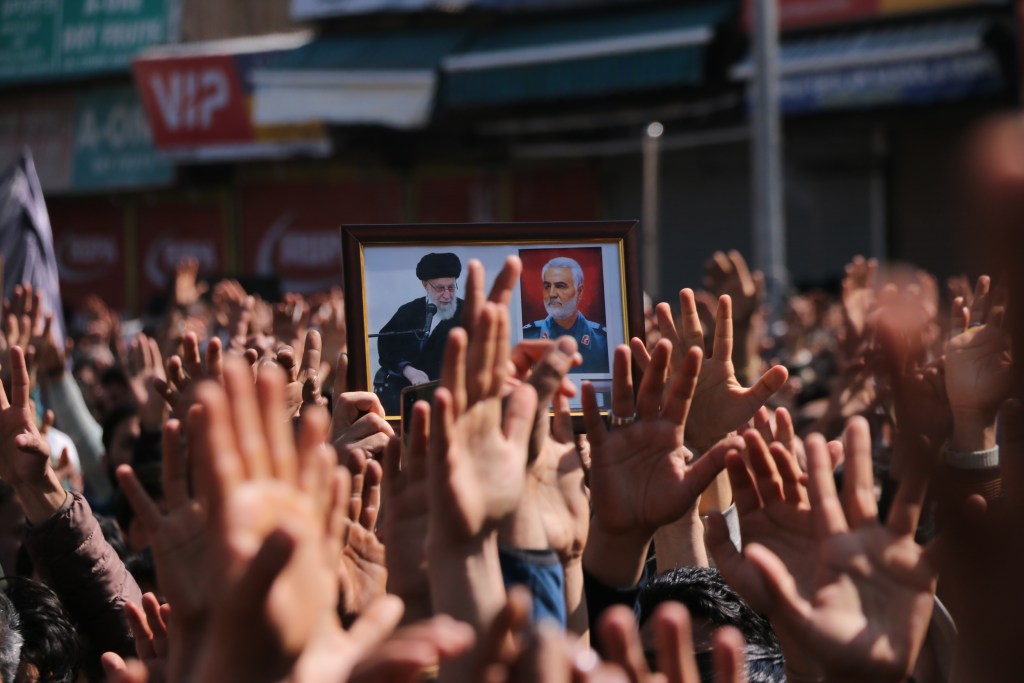
It’s important to note that for many Kashmiris, especially within the region’s Shia communities, Iran holds deep religious and cultural significance. They have historical connections for centuries. After Khamenei’s death, people poured into the streets of Indian-administered Kashmir to mourn and show solidarity with Iran.

Class, Religion, and War
Shia people in Saudi Arabia face discrimination and if they dissent, they often attract “terrorism” charges. The kingdom perceives Shia dissent within its borders as connected to Iranian influence. The repercussions of this are palpable. The kingdom “continued to execute an alarmingly high number of people belonging to the Shia minority, including those who engaged in dissent in Saudi Arabia’s Eastern Province. While the Shia community comprised an estimated 10-12% of the total Saudi population, Shia people accounted for around 42% of “terrorism”-related executions [2014-25],” according to Amnesty International.
Further, migrant workers in the Saudi kingdom continue to be bound by the kafala (sponsorship) system, “which restricts their ability to change jobs or leave the country, putting them at heightened risk of exploitation. Despite some limited reforms, labour abuses were widespread, with workers subjected to wage theft, unsafe working conditions, racial discrimination and substandard living conditions,” Amnesty said. In this context, Shia migrant workers from Kashmir are rendered vulnerable owing to their religious identity and precarious employment.
Javeed Beigh, a prominent Shia activist based in Kashmir, offers another possible explanation for Amjad’s arrest. He said Amjad had been posting regularly against Pakistan and against the treatment of Shia Muslims by the Pakistani state. He referred to the defense ties between Pakistan and Saudi Arabia, which further deepened during the West Asia war this year. As Iran attacked its Gulf Neighbors, Pakistan deployed troops and military assets in Saudi Arabia to aid the kingdom.
According to Javeed, the Saudi-Pakistan relations could have played a role in Amjad’s case. In 2023, Saudi Arabia had arrested Indian writer Zahack Tanveer for posting content that authorities said could damage ties with Pakistan; he was released after a year. “Amjad’s arrest could be for the same reason,” Javeed Beigh said.
Amjad’s family informed Response Plus Medical, the Saudi company that employed Amjad as a nurse specialist, about his arrest. The company has not made any public statement about Amjad’s detention. It also did not respond to The Polis Project’s request for a comment. In Saudi Arabia’s labor system, migrant workers’ legal status is tied to their employer’s sponsorship — an arrangement that gives companies significant leverage over a worker’s standing with the state. Whether that system made Amjad more vulnerable, or whether his employer had any obligation or capacity to intervene, remains unanswered.
The 2026 West Asia war has likely intensified the security lens used against Shia people in Saudi Arabia, with arrests and executions in Shia-populated areas presented by officials as counterterrorism but described by critics as religious and political repression. In the weeks surrounding Amjad’s arrest, as the Iran-US war escalated, Iran retaliated by launching attacks on Gulf states with US military bases. Gulf states then launched a sweeping crackdown on social media users across nationalities.
The UAE detained over 100 people for filming and sharing footage of Iranian missile and drone strikes. Qatar arrested 313. Bahrain detained six people, including children, over social media posts. Saudi Arabia’s Presidency of State Security issued a public warning on March 29th, calling for a strictly regulated media environment. Saudi officials confirmed to The Cradle that a number of citizens and residents had been jailed, though they made no formal public announcement.
Yasoob Abbas, the General Secretary and spokesperson of the All India Shia Personal Law Board said that since Ali Khamenei’s assassination, Saudi Arabia has launched a massive crackdown and several Shia migrant workers detained or stopped at emigration points while travelling for work. “Over the past two months, many Shia migrant workers from Lucknow and Kashmir have disappeared into Saudi prisons without formal communication to their families,” said Abbas. He also claimed that Saudi forces have started profiling Shia names, identifying them through surnames such as, Rezvi Abbas, Hussain, Syed Ali, and Hussain, before questioning or arresting them. “I met the defense minister of India, Rajnath Singh, to intervene as the Indian embassy in Riyadh has not done anything. India should ensure their [Shia youth] safe and early release,” he told the Polis Project.
Abbas said he appealed to India’s Ministry of External Affairs to start diplomatic efforts with Saudi authorities and felicitate the release of Shia youths held in Saudi Jails. “Shia [or] Sunni is not our identity. They are Indian nationals, let India bring them back.”
The Machinery Behind the Arrests
Under Crown Prince Mohammed bin Salman, Saudi Arabia deploys overlapping laws to suppress online speech. It is part of a legal architecture designed to curb dissent. The Anti-Terrorism Law, first passed in 2014 and amended in 2017, is written broadly enough to criminalize online expression, activism, and nonviolent protest. The Anti-Cyber Crime Law and the Press and Publications Law extend the net further, restricting any content deemed to be against national interest.
South Asia-based human rights lawyer Rebecca Mammen has tracked such cases for years. “Expressing yourself online in countries like Saudi Arabia is genuinely dangerous,” she told the Polis Project. “Several bloggers, critics, and women’s rights advocates have faced unfair prosecution, harsh prison terms, and travel bans simply for speaking out.”
In August 2024, British citizen Ahmad Al Doush, 42, was arrested for tweets posted nine years earlier. He had 37 followers in total on the X platform. A court sentenced him to ten years in prison. For social media activities, Saudi teacher Asaad Al-Ghamdi, 47, was handed 20 years by the Specialized Criminal Court — a body originally created to clear terrorism cases, now routinely used against Shia dissidents. Asaad’s brother, retired instructor Mohammed al-Ghamdi, was given death sentence in 2023 for certain YouTube videos and tweets.
However, Saudi Media Minister Salman Al Dosari insists the kingdom’s approach is lawful. Last year, he claimed that online freedom of expression was protected in the Kingdom, while “strict measures and decisions” were taken against those who publish inflammatory and harmful content. The claim accounted for the cases mentioned here as well: A tribute photograph, a WhatsApp number shared with a friend in Iran, and a nine-year-old tweet by someone with 37 followers.
Freedom House’s 2025 report ranks Saudi Arabia among the countries with the lowest internet freedom worldwide. “…users who criticized the government remained subject to persecution, with some receiving decades-long prison sentences for peaceful online expression,” said Freedom House, a global democracy watchdog. At the same time, the kingdom ranks second in the Middle East for 5G availability, having achieved 78% coverage as part of its Vision 2030 program. Fast connectivity and aggressive surveillance have arrived together.
Amjad’s Family Fights Back
Amjad’s family mailed the Indian Embassy in Riyadh on March 31. The embassy told them it was following up on the case and would share developments. Meanwhile, the Jammu and Kashmir Students Association sent a formal letter to India’s Ministry of External Affairs requesting urgent consular access for Amjad, noting that neither his family nor his employer had received any communication from Saudi authorities about his condition or legal status. The family wrote separately to the Minister of External Affairs, S. Jaishankar, and called on Kashmir’s Member of Parliament (MP), Aga Ruhullah Mehdi, to intervene. None of it has produced an answer.
More than 40 days after the arrest, the embassy’s position is unchanged. The Polis Project contacted the Indian Embassy in Riyadh on May 20; no response was received as of publication of this article.
Under the Vienna Convention on Consular Relations, consular access to detained nationals is not optional — it is a legal obligation on both the detaining state and the home state. India’s own parliamentary data shows that 10,152 Indian nationals, most of them migrant workers, are currently held in jails across Gulf countries. Saudi Arabia holds the highest number: 2719. Indian officials describe these prisoners as under trial, but families say they cannot reach their relatives, cannot hire lawyers, and have no information about charges or timelines of legal prosecution.
“We have used all sorts of channels,” said Amjad’s father, Ghulam Bhat, a retired government servant. “None is helping.”
Hiring a lawyer in Saudi Arabia is beyond the family’s means. They do not know where he is held or what he has been charged with. Under the UN’s Standard Minimum Rules for the Treatment of Prisoners, Amjad has the right to contact his family. He has not called. Amnesty International has named what is being done to him: “secret detention” and “enforced disappearance.”
Calls for Protection
“If you write anything against the government, you can be arrested in any country,” Advocate Mammen said. “But when families cannot access a prisoner in a foreign jail, legal representation from the home country’s embassy is not optional — it is a minimum obligation.”
Meenakshi Ganguly, Deputy Director of Human Rights Watch’s Asia Division, was direct about where responsibility sits. “Arab governments should not be arresting people, particularly migrant workers who have very little access to legal protections, for their peaceful exercise of freedom of expression,” she told the Polis Project. “Instead of arbitrarily detaining people, governments and employers should protect migrant workers who are providing services across the Gulf, often under abusive conditions.”
She added that the countries of origin bear their own obligations. “Origin countries should strengthen protections, including by enhancing embassy support to those in custody.”
International human rights law protects the right to seek, receive, and share information across all media, including the internet. Security-related restrictions must be grounded in clear law and be proportionate to a specific threat.
Forty civil society organizations, including Amnesty International, have called on Saudi Arabia to release all those held arbitrarily for online speech. The calls have not been answered.
Waiting amid Uncertainty
Ghulam Bhat sits at home in Gund Ibrahim Pattan. He was looking forward to two celebrations this year — his son’s return and his daughter’s wedding. Both are on hold.
“We have been planning a marriage for him,” Ghulam told the Polis Project. “We have been waiting for his return, wanting to see him as a groom.”
But first, Ghulam Bhat wants to speak to his son. Amjad has the right, under international law, to call home. He has not called. No one in authority has offered an explanation.
“His call can bring me hope,” Ghulam said. “A sign of relief that he is alive and safe.”

Social Media to Prison: Kashmiri Migrant Workers Languish in Saudi Jails, Often after Pro-Iran Posts
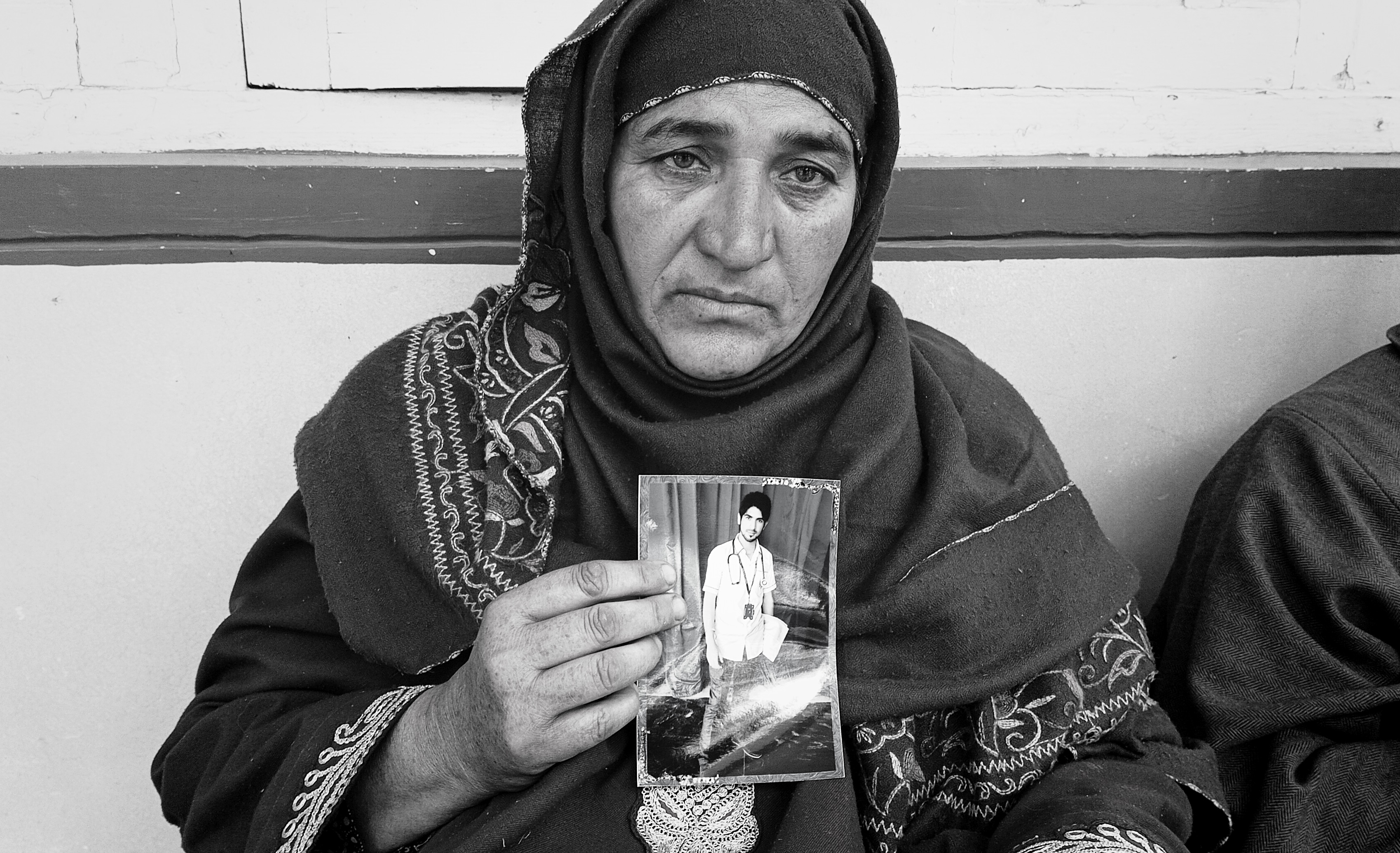
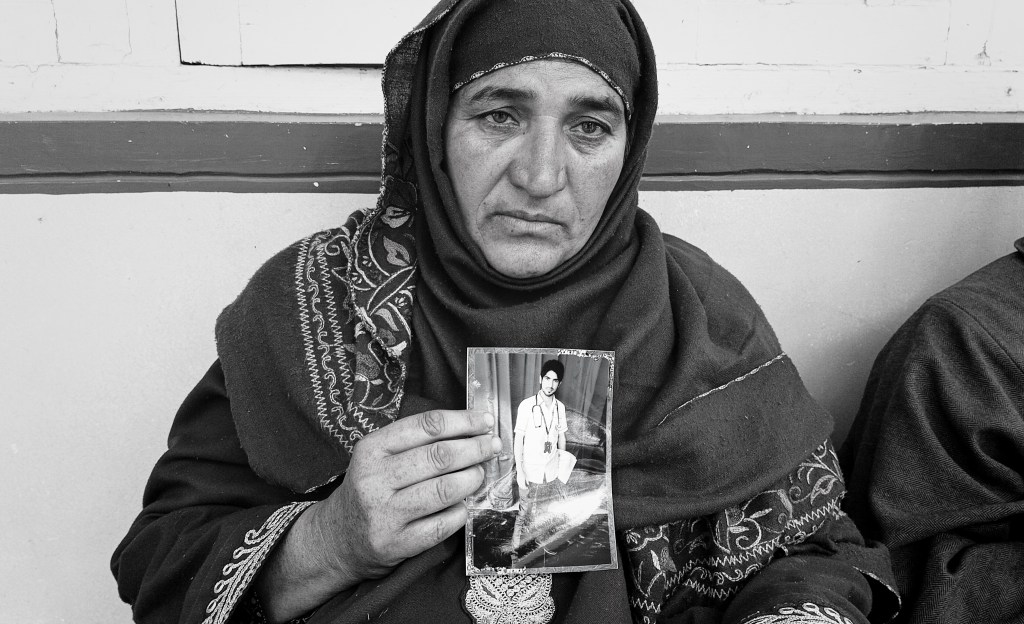
Kashmiri nurse Amjad Ali Bhat remains unreachable to his family after he was arrested by Saudi authorities. His mother holds his photo as the family awaits information on charges against Amjad and his whereabouts. Photo by: Irshad Hussain
Shahida Akhter keeps checking her phone. It has been more than 40 days since her brother called, 40 days of refreshing her screen for updates, and finding silence where his voice used to be. In the morning of March 26, the family learned of his arrest, and their mother had collapsed on the floor.
“Amjad has not called me since the 25th of March,” said Shahida, 30. “On the 26th, his friend called to tell us what had happened. Our mother collapsed on the ground after hearing that her son was in a foreign jail.”
Less than a year ago, Shahida’s younger brother, Amjad Ali Bhat, 29, had left their village, Gund Ibrahim Pattan in the Baramulla district of Indian-administered Kashmir. The family had accumulated years of debt to fund his migration to the Kingdom of Saudi Arabia. He worked as a nursing specialist at the Response Plus Medical, a Saudi-based healthcare company in Dammam city–a large metropolitan city and industrial hub in the eastern part of the country. Amjad was due home for his sister’s wedding in June this year.
The wedding has been postponed due to Amjad’s sudden arrest. Shahida is now fighting a legal battle she does not know how to win, in a country whose language she does not speak, for her brother whose location she is yet to find out.
In a world where the internet and social media have penetrated all dimensions of life, Amjad’s crime was a Facebook post.
Price of Political Opinion?
Following the killing of Iran’s Supreme Leader Ayatollah Ali Khamenei in a joint US-Israeli operation in February 2026, Amjad posted a photograph of Khamenei on his Facebook profile with a tribute: “Khamenei is not important — Islam is important”.
“How does a tribute to Ayatollah Khamenei violate Saudi Arabia’s cyber or counter-terrorism laws?” Shahida asked, suspecting her brother was arrested for his social media post.
On March 25, authorities were at his door. Saudi Civil Defense forces cordoned off his room, searched it, and took him away, according to an eye witness who called Amjad’s family shortly after.
Since that morning, his family has not received any communication from Saudi authorities about Amjad and his whereabouts. “We don’t know his charges. There is no word from Saudi officials. We don’t know whether he is dead or alive,” Shahida told The Polis Project.
His family is insistent on his innocence. Amjad has no record of anti-government activity in India or Saudi Arabia, they said. The family suspected he may have been arrested because of the Facebook post on Ali Khamenei. “How does a tribute to Ayatollah Khamenei violate Saudi Arabia’s cyber or counter-terrorism laws?” Shahida asked. “Is faith now a crime?”
In fact, support for Iran is not welcomed in Saudi Arabia, which has a fraught relationship with its Persian neighbor. Religious differences underlie the bigger tension between the two nations for regional dominance. They each follow one of the two main branches of Islam: Iran is largely Shia, while Saudi Arabia sees itself as the leading Sunni power, with the country’s royal families and majority population being Sunni.
Amjad is not the first Kashmiri Shia Muslim to be jailed in Saudi Arabia for supporting Iran. In January 2020, Javeed Ahmed Mir, 36, was working as a supervisor at a Chinese food chain in Dammam city when Saudi authorities arrested him. His offense included sharing a WhatsApp number belonging to a friend in Iran, and posting on Facebook an image of slain Iranian Revolutionary Guard Corps (IRGC) chief Qasem Soleimani. Javeed had posted a few days after the IRGC chief was killed in a US drone strike in Iraq.
“He was given [a sentence of] 25 years imprisonment for sharing a WhatsApp number and a pro-Iran post,” said Javeed’s brother Sajad Ahmed. Javeed Ahmed was held for a year before he was allowed to even phone his family. He is still in the Dammam jail, as is Amjad.
Both families are Shia Muslim. Both men were arrested in Dammam. “They became victims of the Saudi-Iran rivalry,” said Sajad Ahmed. Javeed’s family has been waiting for six years for him.
It’s important to note that for many Kashmiris, especially within the region’s Shia communities, Iran holds deep religious and cultural significance. They have historical connections for centuries. After Khamenei’s death, people poured into the streets of Indian-administered Kashmir to mourn and show solidarity with Iran.
Class, Religion, and War
Shia people in Saudi Arabia face discrimination and if they dissent, they often attract “terrorism” charges. The kingdom perceives Shia dissent within its borders as connected to Iranian influence. The repercussions of this are palpable. The kingdom “continued to execute an alarmingly high number of people belonging to the Shia minority, including those who engaged in dissent in Saudi Arabia’s Eastern Province. While the Shia community comprised an estimated 10-12% of the total Saudi population, Shia people accounted for around 42% of “terrorism”-related executions [2014-25],” according to Amnesty International.
Further, migrant workers in the Saudi kingdom continue to be bound by the kafala (sponsorship) system, “which restricts their ability to change jobs or leave the country, putting them at heightened risk of exploitation. Despite some limited reforms, labour abuses were widespread, with workers subjected to wage theft, unsafe working conditions, racial discrimination and substandard living conditions,” Amnesty said. In this context, Shia migrant workers from Kashmir are rendered vulnerable owing to their religious identity and precarious employment.
Javeed Beigh, a prominent Shia activist based in Kashmir, offers another possible explanation for Amjad’s arrest. He said Amjad had been posting regularly against Pakistan and against the treatment of Shia Muslims by the Pakistani state. He referred to the defense ties between Pakistan and Saudi Arabia, which further deepened during the West Asia war this year. As Iran attacked its Gulf Neighbors, Pakistan deployed troops and military assets in Saudi Arabia to aid the kingdom.
According to Javeed, the Saudi-Pakistan relations could have played a role in Amjad’s case. In 2023, Saudi Arabia had arrested Indian writer Zahack Tanveer for posting content that authorities said could damage ties with Pakistan; he was released after a year. “Amjad’s arrest could be for the same reason,” Javeed Beigh said.
Amjad’s family informed Response Plus Medical, the Saudi company that employed Amjad as a nurse specialist, about his arrest. The company has not made any public statement about Amjad’s detention. It also did not respond to The Polis Project’s request for a comment. In Saudi Arabia’s labor system, migrant workers’ legal status is tied to their employer’s sponsorship — an arrangement that gives companies significant leverage over a worker’s standing with the state. Whether that system made Amjad more vulnerable, or whether his employer had any obligation or capacity to intervene, remains unanswered.
The 2026 West Asia war has likely intensified the security lens used against Shia people in Saudi Arabia, with arrests and executions in Shia-populated areas presented by officials as counterterrorism but described by critics as religious and political repression. In the weeks surrounding Amjad’s arrest, as the Iran-US war escalated, Iran retaliated by launching attacks on Gulf states with US military bases. Gulf states then launched a sweeping crackdown on social media users across nationalities.
The UAE detained over 100 people for filming and sharing footage of Iranian missile and drone strikes. Qatar arrested 313. Bahrain detained six people, including children, over social media posts. Saudi Arabia’s Presidency of State Security issued a public warning on March 29th, calling for a strictly regulated media environment. Saudi officials confirmed to The Cradle that a number of citizens and residents had been jailed, though they made no formal public announcement.
Yasoob Abbas, the General Secretary and spokesperson of the All India Shia Personal Law Board said that since Ali Khamenei’s assassination, Saudi Arabia has launched a massive crackdown and several Shia migrant workers detained or stopped at emigration points while travelling for work. “Over the past two months, many Shia migrant workers from Lucknow and Kashmir have disappeared into Saudi prisons without formal communication to their families,” said Abbas. He also claimed that Saudi forces have started profiling Shia names, identifying them through surnames such as, Rezvi Abbas, Hussain, Syed Ali, and Hussain, before questioning or arresting them. “I met the defense minister of India, Rajnath Singh, to intervene as the Indian embassy in Riyadh has not done anything. India should ensure their [Shia youth] safe and early release,” he told the Polis Project.
Abbas said he appealed to India’s Ministry of External Affairs to start diplomatic efforts with Saudi authorities and felicitate the release of Shia youths held in Saudi Jails. “Shia [or] Sunni is not our identity. They are Indian nationals, let India bring them back.”
The Machinery Behind the Arrests
Under Crown Prince Mohammed bin Salman, Saudi Arabia deploys overlapping laws to suppress online speech. It is part of a legal architecture designed to curb dissent. The Anti-Terrorism Law, first passed in 2014 and amended in 2017, is written broadly enough to criminalize online expression, activism, and nonviolent protest. The Anti-Cyber Crime Law and the Press and Publications Law extend the net further, restricting any content deemed to be against national interest.
South Asia-based human rights lawyer Rebecca Mammen has tracked such cases for years. “Expressing yourself online in countries like Saudi Arabia is genuinely dangerous,” she told the Polis Project. “Several bloggers, critics, and women’s rights advocates have faced unfair prosecution, harsh prison terms, and travel bans simply for speaking out.”
In August 2024, British citizen Ahmad Al Doush, 42, was arrested for tweets posted nine years earlier. He had 37 followers in total on the X platform. A court sentenced him to ten years in prison. For social media activities, Saudi teacher Asaad Al-Ghamdi, 47, was handed 20 years by the Specialized Criminal Court — a body originally created to clear terrorism cases, now routinely used against Shia dissidents. Asaad’s brother, retired instructor Mohammed al-Ghamdi, was given death sentence in 2023 for certain YouTube videos and tweets.
However, Saudi Media Minister Salman Al Dosari insists the kingdom’s approach is lawful. Last year, he claimed that online freedom of expression was protected in the Kingdom, while “strict measures and decisions” were taken against those who publish inflammatory and harmful content. The claim accounted for the cases mentioned here as well: A tribute photograph, a WhatsApp number shared with a friend in Iran, and a nine-year-old tweet by someone with 37 followers.
Freedom House’s 2025 report ranks Saudi Arabia among the countries with the lowest internet freedom worldwide. “…users who criticized the government remained subject to persecution, with some receiving decades-long prison sentences for peaceful online expression,” said Freedom House, a global democracy watchdog. At the same time, the kingdom ranks second in the Middle East for 5G availability, having achieved 78% coverage as part of its Vision 2030 program. Fast connectivity and aggressive surveillance have arrived together.
Amjad’s Family Fights Back
Amjad’s family mailed the Indian Embassy in Riyadh on March 31. The embassy told them it was following up on the case and would share developments. Meanwhile, the Jammu and Kashmir Students Association sent a formal letter to India’s Ministry of External Affairs requesting urgent consular access for Amjad, noting that neither his family nor his employer had received any communication from Saudi authorities about his condition or legal status. The family wrote separately to the Minister of External Affairs, S. Jaishankar, and called on Kashmir’s Member of Parliament (MP), Aga Ruhullah Mehdi, to intervene. None of it has produced an answer.
More than 40 days after the arrest, the embassy’s position is unchanged. The Polis Project contacted the Indian Embassy in Riyadh on May 20; no response was received as of publication of this article.
Under the Vienna Convention on Consular Relations, consular access to detained nationals is not optional — it is a legal obligation on both the detaining state and the home state. India’s own parliamentary data shows that 10,152 Indian nationals, most of them migrant workers, are currently held in jails across Gulf countries. Saudi Arabia holds the highest number: 2719. Indian officials describe these prisoners as under trial, but families say they cannot reach their relatives, cannot hire lawyers, and have no information about charges or timelines of legal prosecution.
“We have used all sorts of channels,” said Amjad’s father, Ghulam Bhat, a retired government servant. “None is helping.”
Hiring a lawyer in Saudi Arabia is beyond the family’s means. They do not know where he is held or what he has been charged with. Under the UN’s Standard Minimum Rules for the Treatment of Prisoners, Amjad has the right to contact his family. He has not called. Amnesty International has named what is being done to him: “secret detention” and “enforced disappearance.”
Calls for Protection
“If you write anything against the government, you can be arrested in any country,” Advocate Mammen said. “But when families cannot access a prisoner in a foreign jail, legal representation from the home country’s embassy is not optional — it is a minimum obligation.”
Meenakshi Ganguly, Deputy Director of Human Rights Watch’s Asia Division, was direct about where responsibility sits. “Arab governments should not be arresting people, particularly migrant workers who have very little access to legal protections, for their peaceful exercise of freedom of expression,” she told the Polis Project. “Instead of arbitrarily detaining people, governments and employers should protect migrant workers who are providing services across the Gulf, often under abusive conditions.”
She added that the countries of origin bear their own obligations. “Origin countries should strengthen protections, including by enhancing embassy support to those in custody.”
International human rights law protects the right to seek, receive, and share information across all media, including the internet. Security-related restrictions must be grounded in clear law and be proportionate to a specific threat.
Forty civil society organizations, including Amnesty International, have called on Saudi Arabia to release all those held arbitrarily for online speech. The calls have not been answered.
Waiting amid Uncertainty
Ghulam Bhat sits at home in Gund Ibrahim Pattan. He was looking forward to two celebrations this year — his son’s return and his daughter’s wedding. Both are on hold.
“We have been planning a marriage for him,” Ghulam told the Polis Project. “We have been waiting for his return, wanting to see him as a groom.”
But first, Ghulam Bhat wants to speak to his son. Amjad has the right, under international law, to call home. He has not called. No one in authority has offered an explanation.
“His call can bring me hope,” Ghulam said. “A sign of relief that he is alive and safe.”