




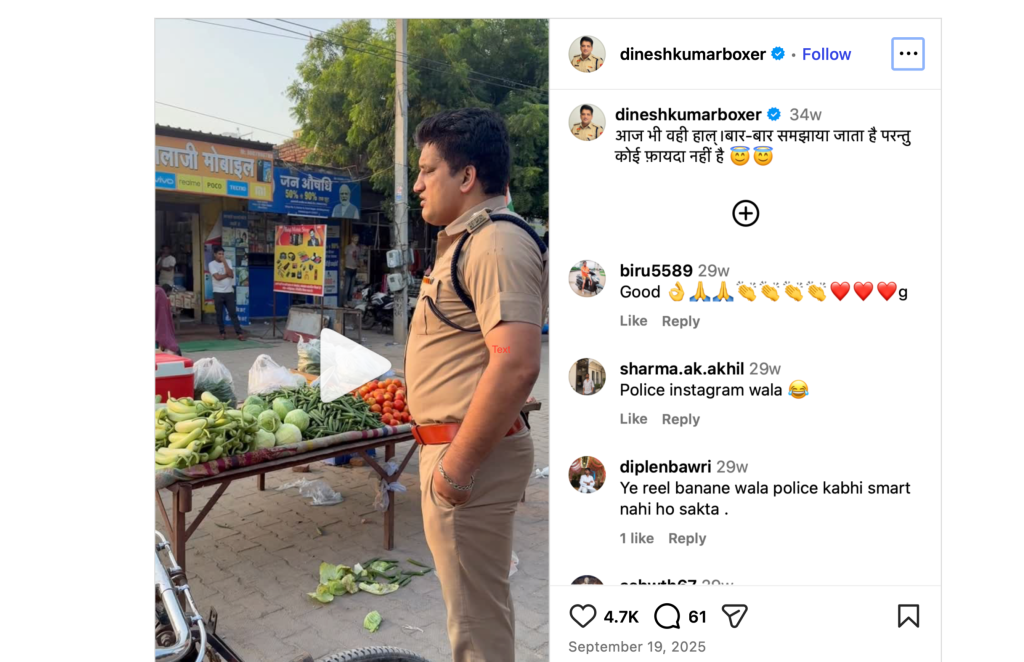
Assistant Commissioner of Police Dinesh Kumar posted a reel on Instagram on October 26, 2025, which is now deleted. In the video, he was seen in uniform, instructing a JCB bulldozer to remove vegetable vendors from the streets in an “anti-encroachment drive” in Haryana’s Bahadurgarh, part of the National Capital Region (NCR) of Delhi. The bulldozer was seen mowing down vegetables, which were hurriedly deserted by the vendors. Soon after he uploaded the reel from his personal Instagram account, it gained wide public attention, with some people openly expressing their support for his actions and others criticizing the insensitive behavior.
Owing to the severe backlash it received online, the video was later deleted from his Instagram handle, and he was taken off duty as the traffic-in-charge.
While the Supreme Court has repeatedly ruled against the arbitrary and punitive measures unleashed by such a model of extra-judicial vigilante justice, these incidents have gone unabated, with repeated instances of its violation. The November 2024 Supreme Court verdict by Justices B.R. Gavai and K.V. Viswanathan on “bulldozer justice” stated that punitive bulldozer demolitions “undermine the rule of law,” and are “wholly unconstitutional” as a form of collective punishment, besides violating fundamental human rights. The March 2025 judgement bolstered the logic of the previous judgment by calling these demolitions as “running a bulldozer over the Constitution.”
The 2024 judgement also laid down legal provisions for state accountability in case of punitive demolitions, asking for videography of demolition proceedings for evidential purposes. To note, videography was decreed to ensure accountability—not for content creation. Guidelines under the Bureau of Police Research and Development (BPR&D) also prohibit social media usage by government employees, stating that “no government emblem, insignia, uniform etc. should not be used in personal posts.” Delhi Police Commissioner Sanjay Arora in 2023 issued a similar memo, reiterating it as “abuse of the uniform.” State governments of West Bengal, Haryana and Uttar Pradesh (UP) have also issued similar guidelines warning that action will be taken against the officers violating them.
Yet, ironically, these videos from the demolition sites are being flaunted by police officers on their personal social media handles, in violation of the Supreme Court rulings and also several BPR&D guidelines. Reels, typically associated with influencers and advertisers, have become a new arena for the police to flaunt extra-judicial actions and curry public favor for “Bulldozer Justice.”
 “Demolitions are not a police-centric exercise. The police are there just to maintain law and order, and provide protection to the municipal corporations as they carry out the demolitions,” said M. Huzaifa, Delhi-based researcher and advocate M. Huzaifa, who works with the Association for Protection of Civil Liberties (APCR). He added that while rules and guidelines against such social media content exist, they are often vague and have not evolved with technology.
Moreover, lack of a robust mechanism for citizens to lodge complaints against such content makes these guidelines toothless. He noted that the only way citizens can register their grievances is by video recording the illegal activity by these officers, but that is also an evolving jurisprudence.
The “Hero Cop” and the Aesthetics of “Peela Panja”
Some officers clearly violate the laws for personal clout, projecting themselves as conscionable workers, who dish out prompt punishment to encroachers who otherwise get the pass from a complacent system. Kumar, a former boxer of Olympics repute as well as an Arjuna awardee, is a perfect example of this “hero cop” aesthetic, drawing from parallel representations in Bollywood cinema. In the comment section, people often hail these officers as “Singham,” an archetype of the hypermasculine, powerful cop figure driven by intense action and patriotic fervor.
Although ACP Kumar was stripped of his duty, a senior official of Haryana Police defended the action as an “individual lapse of judgement.” He added that “despite the right intent the method that was adopted was wrong.”
In one of his reels, Kumar alludes to the bulldozer as “peela panja” (yellow fist), signifying “muscle power” backed by the state, to “squash”, what he deems to be an encroachment.
In an interview with The Indian Express, Kumar justified posting reels on social media for “dissemination of information and creating awareness,” clearly overlooking the arbitrariness with which he deals with it. The bulldozer action precedes any efforts made by him towards creating awareness about anti-encroachment laws, directly contravening the BPR&D guideline: “Information ought not to be released which would portray the police as insensitive or vindictive or which would suggest the pre-judging of an issue.” Further, the guideline adds, “Achievements of the department should be projected as such, and not as the individual efforts or achievements of any one officer” and “no media briefing or communication (official or unofficial) should be done for the personal glorification of any officer.”
Huzaifa said that these reels sensationalize the encroachment issue and normalize the misuse of police power, besides entertaining an online audience.
“Police cannot reveal faces and public parade the accused,” Huzaifa added.
Law mandates that eviction can only be used as a last resort, and has to be backed with rehabilitation. The use of bulldozers in spectacular displays of power blatantly violates this.
Videos like the ones uploaded by ACP Dinesh Kumar bypass the processes set down under the Street Vendors (Protection of Livelihood and Regulation of Street Vending) Act, 2014, said Aravind Unni, an activist and researcher at the Tata Institute of Social Sciences (TISS). Under the law, no vendor can be evicted or relocated until a proper survey has been carried out. It also mandates Town Vending Committees (TVCs) to survey vendors, issue vending certificates, and create vending zones, in order to ensure protection from arbitrary harassment or eviction.
The “Content Creator” style of Urban Cleansing: A New H-Pop?
Despite clearly mandated laws preventing arbitrary evictions, other municipal and district level government officers have also joined this social media bandwagon.
R.S. Batth, District Town Planner (DTP) of Haryana’s Gurugram, another part of Delhi’s NCR, has been responsible for several demolitions and encroachment drives in the area, including one in Prem Nagar in October 2025, which razed down 170 huts.
In one of the reels that Batth uploaded on his personal Instagram handle, he can be seen directing the destruction of 250 jugghis (shanties) in Tigra, Gurugram, with the hateful background music “Bulldozer Baba,” composed by Prabhakar Maurya, and used in more than 25,000 reels on Instagram. The song hails UP Chief Minister Yogi Adityanath for using “bulldozer justice” to provide instant punitive action. It features lyrics like “Rashtravirodhi pe hai bhaari, bulldozer baba bhagwa dhaari. Hinduvirodhi pe hai bhaari, bulldozer baba bhagwa dhaari” (He comes down hard on those who are anti-nationals, Bulldozer Baba [referring to Yogi Adityanath] clad in saffron. He crushes those who oppose Hindus [referring to minorities], Bulldozer Baba dressed in saffron).
Last January, Batth razed down more than a hundred jhuggis in Vikas Nagar in Gurugram. He claims in the video that these jhuggis of the poor give shelter to substance smugglers. But the dwellers of these shanties lamented how they had made their homes with their hard-earned money from ragpicking.
A resident complained, “Bacche ko padhne likhne mil jaaye toh koi galat raaste pe nahi jayega par inhone hamari Anganwadi hi machine se tod di’ (If our kids get to study, no one will resort to wrong paths, but he destroyed our Anganwadi [local school] with his machines).
Another resident added, “Pneumonia ho gaya hai thand ki wajah se, inhone dekha bhi nahi ki thand hai. jo nasha bechte the voh toh bahut pehle chale gaye” (We are suffering from pneumonia because of the cold, but they showed no consideration. People who sold substances have left the place long ago).
“R.S. Batth kabhi bhi aa jaate hai” (R.S. Batth comes whenever he wants), said a local sitting around a tea shop in Gurugram Sector 12, who wishes to remain anonymous.
Another bulldozer action by Batth was a result of an incident in which a roadside kiosk owner and the principal of the Kendriya Vidyalaya School opposite the shop were involved in a physical fight. The very next day, the principal called Batth and got the kiosk removed. This incident reveals the muscle power that Batth and his bulldozer exercise on the locals, who see him as the “man with the machine.”
In another of his reels, he is seen threatening the street vendors that if they don’t comply with his commands “he’ll take such actions that will set an example in Gurugram.”
Nutan Jadhav, an MCGM (Municipal Corporation of Greater Mumbai) officer from Goregaon, Mumbai, posts demolition reels like a content creator with jolly songs in the background to mock the affected people. Her account is filled with many anti-encroachment reels with trending Bollywood songs.
In one of them, the demolition drive is being carried out with a background song whose lyrics say: “Girne se darta hai kyu, marne se darta hai kyu” (why do you fear falling, why do you fear being killed). In the reel, Jadhav is seen walking alongside the bulldozer as it tears down small roadside shops and shanties, while onlookers watch helplessly as their property, and with it their means of livelihood, is reduced to rubble. In another reel, the song goes “duniya me rehna hai toh kaam kar pyaare” (if you have to survive in this world, you ought to work darling), as she continues to pose with the bulldozer and razed down structures.
Similar reels were also posted by Uday Kumar Shirookar, a former Assistant Commissioner of MCGM.

Despite the spectacle of bulldozer violence, little is done for urban development. Bhasha Singh, a Delhi-based journalist and activist, noted the absence of debates around “encroachment” in the vicinity of the Hanuman Mandir in New Delhi’s Nigambodh Ghat, a place notorious for traffic congestion because of vehicles parked on the road. She sees this as a case of selective enforcement of laws based on class, caste, and religious privilege.
“Reels normalize the hatred and violence of lynchings and demolitions, and transform them into entertainment,” Singh said. She added that in this era of “thokne wali sarkar” (an offensive government), videos like these create an atmosphere of hatred in favor of unconstitutional demolitions.
Legitimizing “Bulldozer Tactics”
This form of instant justice is often encouraged by the top political leadership, said Singh. “Reels tell that the Constitution and the courts are not necessary, they create a mobocracy like the encounters that provide instant justice.”
The normalization of “bulldozer justice” under the regime of UP Chief Minister Yogi Adityanath has earned him the moniker “bulldozer baba.” Similarly, Shivraj Singh Chauhan, current Minister of Agriculture, called himself “bulldozer mama” during his tenure as Chief Minister of Madhya Pradesh (2020-2023). Both take pride in their monikers and in their habitual deployment of the bulldozer as a machinery of extra-judicial violence.
Several other Bharatiya Janata Party (BJP) leaders, such as Munesh Deddha, Ravinder Singh Negi, Renu Chaudhary, and others, have championed bulldozer demolitions. Uttarakhand Chief Minister Pushkar Singh Dhami, glorifies “bulldozer tactics” to justify the rhetoric of “land jihad”. Dhami routinely uploads demolition reels, inciting the public to take the law into their own hands.
This mandate, coming from elected politicians and ministers, trickles down to police officers rallying support for “bulldozer justice” on social media. The top leaders and the lower level officers, thus sustain a symbiotic relationship, each legitimizing and amplifying the narrative of the other.
Despite flouting Instagram’s community guidelines, which prohibit any graphic content and language that “incites or facilitates violence and credible threats,” these reels are seldom taken down. In the burgeoning hate-fuelled digital ecosystem of India, many videos include explicit depictions of violence, death, or severe injury based on “race, ethnicity, national origin, sex, gender, gender identity, sexual orientation, religion, disability, or disease.” For instance, Renu Chaudhary has posted reels where she sanctions arbitrary and often violent police actions against the poor vendors by using phrases like “meat ke tarah ulta latka dena” (to hang one upside-down like meat), and “nas daba denge” (to kill them).
Recently, Batth even posted a reel on Instagram saying that “action will be taken against the people” who negatively comment on his content in the platform.
Demolition reels championing “bulldozer justice” also contravene Meta’s listed guidelines, but continue to remain online and to this day, circulate widely across the internet.
How the Algorithm Establishes a “New Legality”
Once the legitimacy for punitive demolition by these officers is accorded by the top brass, the algorithmic amplification by these platforms works towards the normalization of “bulldozer justice.”
Such widely circulated acts of violence seep into the banality of everyday life without triggering an alarm. They become part of an ever-expanding ecosystem in which social media is weaponized to a rhetoric of hatred and intolerance in India.
A study conducted by the Centre for the Study of Organised Hate (CSOH) demonstrates how Instagram enables a networked ecosystem of cow-vigilantes, where reels depicting violence are used to recruit, fundraise, and normalize anti-minority attacks. The report shows how traction is gained over such violent content through Instagram’s features for collaboration and fundraising, thus creating a digital infrastructure where violence is normalized, rewarded, and spread across a connected vigilante network.
The virality of such content is not accidental but baked into platform design. Algorithms treat engagement as a proxy for quality. Since violence and hate speech receive higher and more emotionally charged engagement because they reaffirm majoritarian beliefs and ideological positions, it is in turn rewarded with virality and gets a push in these digital spaces.
For instance, according to estimates by Social Blade, a social media analytics website, R.S. Batth gained almost 14,000 Instagram followers in the second week of March this year, almost double the followers he gained the week before, as he began posting reels about the demolitions in the Pataudi-Jatauli Mandi road in Gurugram. It continued to increase for another subsequent week.
Once legitimized, the reels work to normalize such violent content almost as a means of entertainment, garnering increased viewership and eventually mobilizing through that engagement. Instead of law and due process, the reels allow audience validation to perform the role of a jury, functioning as a “pseudo-plebiscite”, of sorts, that mobilizes support for the bulldozer as an extra-vigilante arm of the state by digitally engaging, participating, and condoning its actions.
The comments on these reels also often take on the role of public FIRs. Besides lauding the officials, the commenters often invite them to conduct similar drives against encroachments in other areas, giving them precise GPS-style locations of particular localities.
Often, these comments demand retributive action from the officer against the poor and the migrants who live in slums. Migrants hailing from West Bengal and Bihar often become easy targets of such xenophobic vigilantism, who are conveniently framed as illegal encroachers on the land, property and jobs that do not “rightfully” belong to them, thus deserving of evictions.
These moments of legitimization, normalization and mobilization consolidates this “new legality” that inverts established juridical procedures. When officers perform punitive demolitions on reels, they do so with the implicit sanction of the top political leadership who openly champions such actions. With wider circulation and algorithmic amplification, these reels become normal, beginning to seem routine and just administrative actions, almost as entertaining as that of films. From there, the audience through their comments and engagement elicits mobilization, directing and inciting future acts.
Amplifying Hate Globally
The rise of digital media has provided a new, pervasive medium for the normalization and amplification of hatred against minorities, in India and the world.
An Amnesty International study revealed how profit-motivated Facebook and Meta algorithms channelized hate against the Rohingyas, culminating in atrocities perpetrated on them by the Myanmar military in 2017. According to Agnès Callamard, Amnesty International’s Secretary General, Meta had profited from the “echo chamber of hatred created by its hate-spiraling algorithms.” Meta was also held accountable for fanning hatred against the Tigrayan community in Ethiopia, during the conflict that raged through the northern part of the country between 2020 and 2022. Meta’s recurring participation in exacerbating hate-fuelled content against minorities raises urgent concerns about platform accountability, since the inflammatory social media content was found to be directly linked to offline violence.
A 2021 report by The Centre for Internet and Society (CIS) traces the impact of caste-hate speech in digital spaces in India, and the pressing need for responsible content moderation on platforms where they are mass-amplified. In 2024, The Guardian revealed how Facebook approved AI-generated political advertisements that demonized the Muslim community and called for their persecution, breaking several of its own policies on hate speech, misinformation, and incitement of violence.
These examples show how an insidious ecosystem of normalization and amplification of violence further proliferates it, both digitally and on ground, disproportionately impacting minorities and the marginalized across the world. The case of demolition reels in India works on the same formula.
The reels become a part of a hate-fuelled ecosystem where punitive action against minorities, Dalits and dissenters is enjoyed by the privileged and boosted by the algorithms. The issue is further compounded by weak platform moderation and accountability gaps in the conduct of these officers. This has metastasized into creating a new legitimacy for “bulldozer justice” in India.
However, beneath the aesthetics of reels and their virality lies not merely an accountability gap, but an insidious culture of impunity that enables these extrajudicial acts of violence. Officers continue to post and carry out demolitions precisely because they anticipate no meaningful consequences. Even landmark rulings by the Supreme Court against punitive demolition rarely translate into enforceable juridical action on the ground while statutory protections for vulnerable groups, like street vendors and slum dwellers, are routinely ignored.
A clear lack of enforceable provisions against violations of BPR&D guidelines encourages this culture of impunity. Most cases of violations are handled internally through transfers, suspensions, or warnings and no well-documented instances of police officers being formally charged for breaching social media norms are available publicly. Platform accountability, in the absence of judicial enforcement, political will, and binding rehabilitation mandates, does little more than deepen this impunity. What emerges is a political order that effectively allows the ones in power to act with impunity, and uses social media to project that as a popular mandate.
The algorithm did not produce bulldozer justice; it simply supplied an audience which gives them the licence to perpetuate it.
(A version of this story was published in The Quint on 13 December 2025)


Influencers of the “Bulldozer Raj”: How Reels Legitimize a Digital Ecosystem of Hatred
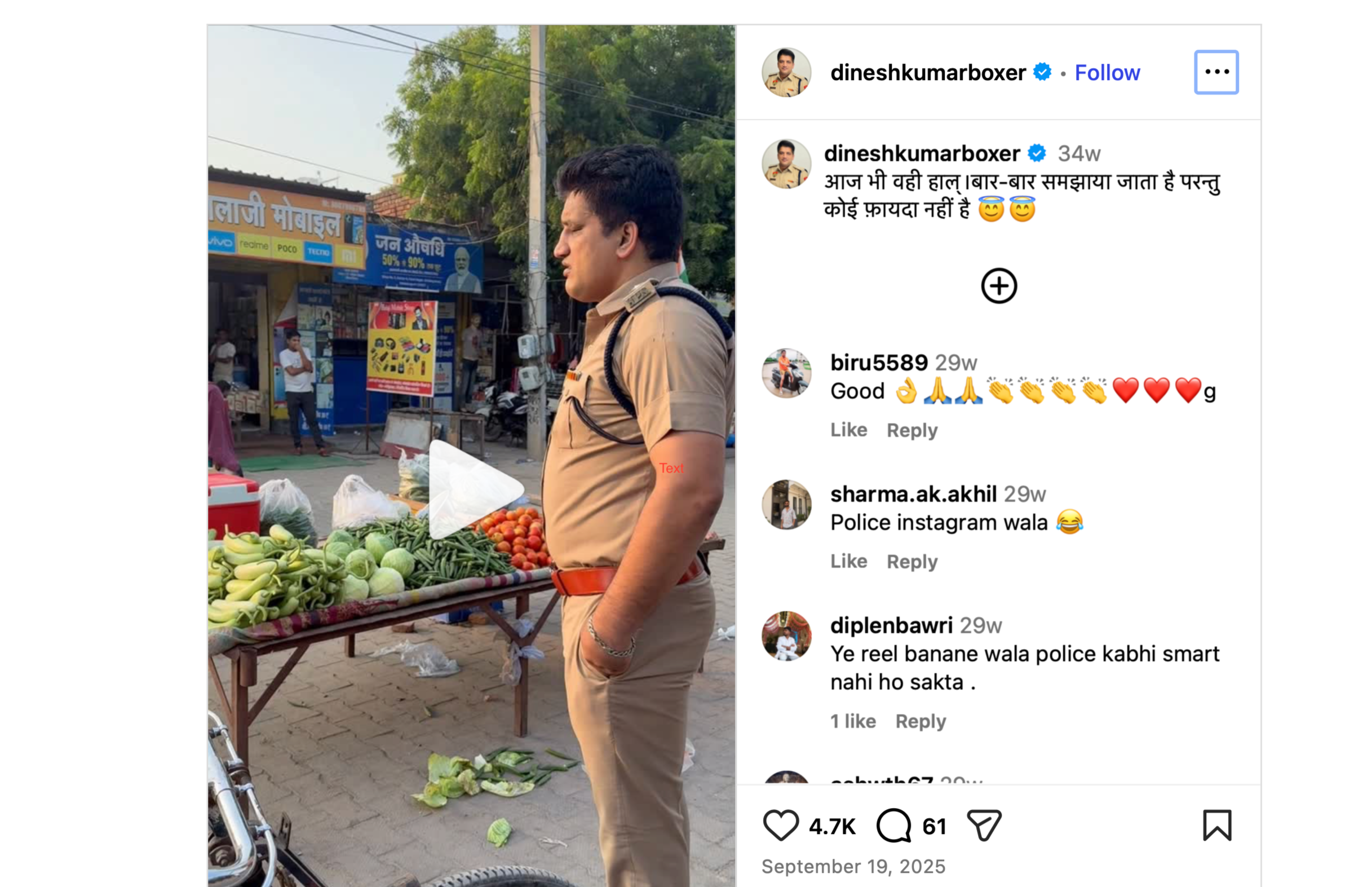
A screenshot from the Instagram profile of Assistant Commissioner of Police Dinesh Kumar
Assistant Commissioner of Police Dinesh Kumar posted a reel on Instagram on October 26, 2025, which is now deleted. In the video, he was seen in uniform, instructing a JCB bulldozer to remove vegetable vendors from the streets in an “anti-encroachment drive” in Haryana’s Bahadurgarh, part of the National Capital Region (NCR) of Delhi. The bulldozer was seen mowing down vegetables, which were hurriedly deserted by the vendors. Soon after he uploaded the reel from his personal Instagram account, it gained wide public attention, with some people openly expressing their support for his actions and others criticizing the insensitive behavior.
Owing to the severe backlash it received online, the video was later deleted from his Instagram handle, and he was taken off duty as the traffic-in-charge.
While the Supreme Court has repeatedly ruled against the arbitrary and punitive measures unleashed by such a model of extra-judicial vigilante justice, these incidents have gone unabated, with repeated instances of its violation. The November 2024 Supreme Court verdict by Justices B.R. Gavai and K.V. Viswanathan on “bulldozer justice” stated that punitive bulldozer demolitions “undermine the rule of law,” and are “wholly unconstitutional” as a form of collective punishment, besides violating fundamental human rights. The March 2025 judgement bolstered the logic of the previous judgment by calling these demolitions as “running a bulldozer over the Constitution.”
The 2024 judgement also laid down legal provisions for state accountability in case of punitive demolitions, asking for videography of demolition proceedings for evidential purposes. To note, videography was decreed to ensure accountability—not for content creation. Guidelines under the Bureau of Police Research and Development (BPR&D) also prohibit social media usage by government employees, stating that “no government emblem, insignia, uniform etc. should not be used in personal posts.” Delhi Police Commissioner Sanjay Arora in 2023 issued a similar memo, reiterating it as “abuse of the uniform.” State governments of West Bengal, Haryana and Uttar Pradesh (UP) have also issued similar guidelines warning that action will be taken against the officers violating them.
Yet, ironically, these videos from the demolition sites are being flaunted by police officers on their personal social media handles, in violation of the Supreme Court rulings and also several BPR&D guidelines. Reels, typically associated with influencers and advertisers, have become a new arena for the police to flaunt extra-judicial actions and curry public favor for “Bulldozer Justice.”
“Demolitions are not a police-centric exercise. The police are there just to maintain law and order, and provide protection to the municipal corporations as they carry out the demolitions,” said M. Huzaifa, Delhi-based researcher and advocate M. Huzaifa, who works with the Association for Protection of Civil Liberties (APCR). He added that while rules and guidelines against such social media content exist, they are often vague and have not evolved with technology.
Moreover, lack of a robust mechanism for citizens to lodge complaints against such content makes these guidelines toothless. He noted that the only way citizens can register their grievances is by video recording the illegal activity by these officers, but that is also an evolving jurisprudence.
The “Hero Cop” and the Aesthetics of “Peela Panja”
Some officers clearly violate the laws for personal clout, projecting themselves as conscionable workers, who dish out prompt punishment to encroachers who otherwise get the pass from a complacent system. Kumar, a former boxer of Olympics repute as well as an Arjuna awardee, is a perfect example of this “hero cop” aesthetic, drawing from parallel representations in Bollywood cinema. In the comment section, people often hail these officers as “Singham,” an archetype of the hypermasculine, powerful cop figure driven by intense action and patriotic fervor.
Although ACP Kumar was stripped of his duty, a senior official of Haryana Police defended the action as an “individual lapse of judgement.” He added that “despite the right intent the method that was adopted was wrong.”
In one of his reels, Kumar alludes to the bulldozer as “peela panja” (yellow fist), signifying “muscle power” backed by the state, to “squash”, what he deems to be an encroachment.
In an interview with The Indian Express, Kumar justified posting reels on social media for “dissemination of information and creating awareness,” clearly overlooking the arbitrariness with which he deals with it. The bulldozer action precedes any efforts made by him towards creating awareness about anti-encroachment laws, directly contravening the BPR&D guideline: “Information ought not to be released which would portray the police as insensitive or vindictive or which would suggest the pre-judging of an issue.” Further, the guideline adds, “Achievements of the department should be projected as such, and not as the individual efforts or achievements of any one officer” and “no media briefing or communication (official or unofficial) should be done for the personal glorification of any officer.”
Huzaifa said that these reels sensationalize the encroachment issue and normalize the misuse of police power, besides entertaining an online audience.
“Police cannot reveal faces and public parade the accused,” Huzaifa added.
Law mandates that eviction can only be used as a last resort, and has to be backed with rehabilitation. The use of bulldozers in spectacular displays of power blatantly violates this.
Videos like the ones uploaded by ACP Dinesh Kumar bypass the processes set down under the Street Vendors (Protection of Livelihood and Regulation of Street Vending) Act, 2014, said Aravind Unni, an activist and researcher at the Tata Institute of Social Sciences (TISS). Under the law, no vendor can be evicted or relocated until a proper survey has been carried out. It also mandates Town Vending Committees (TVCs) to survey vendors, issue vending certificates, and create vending zones, in order to ensure protection from arbitrary harassment or eviction.
The “Content Creator” style of Urban Cleansing: A New H-Pop?
Despite clearly mandated laws preventing arbitrary evictions, other municipal and district level government officers have also joined this social media bandwagon.
R.S. Batth, District Town Planner (DTP) of Haryana’s Gurugram, another part of Delhi’s NCR, has been responsible for several demolitions and encroachment drives in the area, including one in Prem Nagar in October 2025, which razed down 170 huts.
In one of the reels that Batth uploaded on his personal Instagram handle, he can be seen directing the destruction of 250 jugghis (shanties) in Tigra, Gurugram, with the hateful background music “Bulldozer Baba,” composed by Prabhakar Maurya, and used in more than 25,000 reels on Instagram. The song hails UP Chief Minister Yogi Adityanath for using “bulldozer justice” to provide instant punitive action. It features lyrics like “Rashtravirodhi pe hai bhaari, bulldozer baba bhagwa dhaari. Hinduvirodhi pe hai bhaari, bulldozer baba bhagwa dhaari” (He comes down hard on those who are anti-nationals, Bulldozer Baba [referring to Yogi Adityanath] clad in saffron. He crushes those who oppose Hindus [referring to minorities], Bulldozer Baba dressed in saffron).
Last January, Batth razed down more than a hundred jhuggis in Vikas Nagar in Gurugram. He claims in the video that these jhuggis of the poor give shelter to substance smugglers. But the dwellers of these shanties lamented how they had made their homes with their hard-earned money from ragpicking.
A resident complained, “Bacche ko padhne likhne mil jaaye toh koi galat raaste pe nahi jayega par inhone hamari Anganwadi hi machine se tod di’ (If our kids get to study, no one will resort to wrong paths, but he destroyed our Anganwadi [local school] with his machines).
Another resident added, “Pneumonia ho gaya hai thand ki wajah se, inhone dekha bhi nahi ki thand hai. jo nasha bechte the voh toh bahut pehle chale gaye” (We are suffering from pneumonia because of the cold, but they showed no consideration. People who sold substances have left the place long ago).
“R.S. Batth kabhi bhi aa jaate hai” (R.S. Batth comes whenever he wants), said a local sitting around a tea shop in Gurugram Sector 12, who wishes to remain anonymous.
Another bulldozer action by Batth was a result of an incident in which a roadside kiosk owner and the principal of the Kendriya Vidyalaya School opposite the shop were involved in a physical fight. The very next day, the principal called Batth and got the kiosk removed. This incident reveals the muscle power that Batth and his bulldozer exercise on the locals, who see him as the “man with the machine.”
In another of his reels, he is seen threatening the street vendors that if they don’t comply with his commands “he’ll take such actions that will set an example in Gurugram.”
Nutan Jadhav, an MCGM (Municipal Corporation of Greater Mumbai) officer from Goregaon, Mumbai, posts demolition reels like a content creator with jolly songs in the background to mock the affected people. Her account is filled with many anti-encroachment reels with trending Bollywood songs.
In one of them, the demolition drive is being carried out with a background song whose lyrics say: “Girne se darta hai kyu, marne se darta hai kyu” (why do you fear falling, why do you fear being killed). In the reel, Jadhav is seen walking alongside the bulldozer as it tears down small roadside shops and shanties, while onlookers watch helplessly as their property, and with it their means of livelihood, is reduced to rubble. In another reel, the song goes “duniya me rehna hai toh kaam kar pyaare” (if you have to survive in this world, you ought to work darling), as she continues to pose with the bulldozer and razed down structures.
Similar reels were also posted by Uday Kumar Shirookar, a former Assistant Commissioner of MCGM.
Despite the spectacle of bulldozer violence, little is done for urban development. Bhasha Singh, a Delhi-based journalist and activist, noted the absence of debates around “encroachment” in the vicinity of the Hanuman Mandir in New Delhi’s Nigambodh Ghat, a place notorious for traffic congestion because of vehicles parked on the road. She sees this as a case of selective enforcement of laws based on class, caste, and religious privilege.
“Reels normalize the hatred and violence of lynchings and demolitions, and transform them into entertainment,” Singh said. She added that in this era of “thokne wali sarkar” (an offensive government), videos like these create an atmosphere of hatred in favor of unconstitutional demolitions.
Legitimizing “Bulldozer Tactics”
This form of instant justice is often encouraged by the top political leadership, said Singh. “Reels tell that the Constitution and the courts are not necessary, they create a mobocracy like the encounters that provide instant justice.”
The normalization of “bulldozer justice” under the regime of UP Chief Minister Yogi Adityanath has earned him the moniker “bulldozer baba.” Similarly, Shivraj Singh Chauhan, current Minister of Agriculture, called himself “bulldozer mama” during his tenure as Chief Minister of Madhya Pradesh (2020-2023). Both take pride in their monikers and in their habitual deployment of the bulldozer as a machinery of extra-judicial violence.
Several other Bharatiya Janata Party (BJP) leaders, such as Munesh Deddha, Ravinder Singh Negi, Renu Chaudhary, and others, have championed bulldozer demolitions. Uttarakhand Chief Minister Pushkar Singh Dhami, glorifies “bulldozer tactics” to justify the rhetoric of “land jihad”. Dhami routinely uploads demolition reels, inciting the public to take the law into their own hands.
This mandate, coming from elected politicians and ministers, trickles down to police officers rallying support for “bulldozer justice” on social media. The top leaders and the lower level officers, thus sustain a symbiotic relationship, each legitimizing and amplifying the narrative of the other.
Despite flouting Instagram’s community guidelines, which prohibit any graphic content and language that “incites or facilitates violence and credible threats,” these reels are seldom taken down. In the burgeoning hate-fuelled digital ecosystem of India, many videos include explicit depictions of violence, death, or severe injury based on “race, ethnicity, national origin, sex, gender, gender identity, sexual orientation, religion, disability, or disease.” For instance, Renu Chaudhary has posted reels where she sanctions arbitrary and often violent police actions against the poor vendors by using phrases like “meat ke tarah ulta latka dena” (to hang one upside-down like meat), and “nas daba denge” (to kill them).
Recently, Batth even posted a reel on Instagram saying that “action will be taken against the people” who negatively comment on his content in the platform.
Demolition reels championing “bulldozer justice” also contravene Meta’s listed guidelines, but continue to remain online and to this day, circulate widely across the internet.
How the Algorithm Establishes a “New Legality”
Once the legitimacy for punitive demolition by these officers is accorded by the top brass, the algorithmic amplification by these platforms works towards the normalization of “bulldozer justice.”
Such widely circulated acts of violence seep into the banality of everyday life without triggering an alarm. They become part of an ever-expanding ecosystem in which social media is weaponized to a rhetoric of hatred and intolerance in India.
A study conducted by the Centre for the Study of Organised Hate (CSOH) demonstrates how Instagram enables a networked ecosystem of cow-vigilantes, where reels depicting violence are used to recruit, fundraise, and normalize anti-minority attacks. The report shows how traction is gained over such violent content through Instagram’s features for collaboration and fundraising, thus creating a digital infrastructure where violence is normalized, rewarded, and spread across a connected vigilante network.
The virality of such content is not accidental but baked into platform design. Algorithms treat engagement as a proxy for quality. Since violence and hate speech receive higher and more emotionally charged engagement because they reaffirm majoritarian beliefs and ideological positions, it is in turn rewarded with virality and gets a push in these digital spaces.
For instance, according to estimates by Social Blade, a social media analytics website, R.S. Batth gained almost 14,000 Instagram followers in the second week of March this year, almost double the followers he gained the week before, as he began posting reels about the demolitions in the Pataudi-Jatauli Mandi road in Gurugram. It continued to increase for another subsequent week.
Once legitimized, the reels work to normalize such violent content almost as a means of entertainment, garnering increased viewership and eventually mobilizing through that engagement. Instead of law and due process, the reels allow audience validation to perform the role of a jury, functioning as a “pseudo-plebiscite”, of sorts, that mobilizes support for the bulldozer as an extra-vigilante arm of the state by digitally engaging, participating, and condoning its actions.
The comments on these reels also often take on the role of public FIRs. Besides lauding the officials, the commenters often invite them to conduct similar drives against encroachments in other areas, giving them precise GPS-style locations of particular localities.
Often, these comments demand retributive action from the officer against the poor and the migrants who live in slums. Migrants hailing from West Bengal and Bihar often become easy targets of such xenophobic vigilantism, who are conveniently framed as illegal encroachers on the land, property and jobs that do not “rightfully” belong to them, thus deserving of evictions.
These moments of legitimization, normalization and mobilization consolidates this “new legality” that inverts established juridical procedures. When officers perform punitive demolitions on reels, they do so with the implicit sanction of the top political leadership who openly champions such actions. With wider circulation and algorithmic amplification, these reels become normal, beginning to seem routine and just administrative actions, almost as entertaining as that of films. From there, the audience through their comments and engagement elicits mobilization, directing and inciting future acts.
Amplifying Hate Globally
The rise of digital media has provided a new, pervasive medium for the normalization and amplification of hatred against minorities, in India and the world.
An Amnesty International study revealed how profit-motivated Facebook and Meta algorithms channelized hate against the Rohingyas, culminating in atrocities perpetrated on them by the Myanmar military in 2017. According to Agnès Callamard, Amnesty International’s Secretary General, Meta had profited from the “echo chamber of hatred created by its hate-spiraling algorithms.” Meta was also held accountable for fanning hatred against the Tigrayan community in Ethiopia, during the conflict that raged through the northern part of the country between 2020 and 2022. Meta’s recurring participation in exacerbating hate-fuelled content against minorities raises urgent concerns about platform accountability, since the inflammatory social media content was found to be directly linked to offline violence.
A 2021 report by The Centre for Internet and Society (CIS) traces the impact of caste-hate speech in digital spaces in India, and the pressing need for responsible content moderation on platforms where they are mass-amplified. In 2024, The Guardian revealed how Facebook approved AI-generated political advertisements that demonized the Muslim community and called for their persecution, breaking several of its own policies on hate speech, misinformation, and incitement of violence.
These examples show how an insidious ecosystem of normalization and amplification of violence further proliferates it, both digitally and on ground, disproportionately impacting minorities and the marginalized across the world. The case of demolition reels in India works on the same formula.
The reels become a part of a hate-fuelled ecosystem where punitive action against minorities, Dalits and dissenters is enjoyed by the privileged and boosted by the algorithms. The issue is further compounded by weak platform moderation and accountability gaps in the conduct of these officers. This has metastasized into creating a new legitimacy for “bulldozer justice” in India.
However, beneath the aesthetics of reels and their virality lies not merely an accountability gap, but an insidious culture of impunity that enables these extrajudicial acts of violence. Officers continue to post and carry out demolitions precisely because they anticipate no meaningful consequences. Even landmark rulings by the Supreme Court against punitive demolition rarely translate into enforceable juridical action on the ground while statutory protections for vulnerable groups, like street vendors and slum dwellers, are routinely ignored.
A clear lack of enforceable provisions against violations of BPR&D guidelines encourages this culture of impunity. Most cases of violations are handled internally through transfers, suspensions, or warnings and no well-documented instances of police officers being formally charged for breaching social media norms are available publicly. Platform accountability, in the absence of judicial enforcement, political will, and binding rehabilitation mandates, does little more than deepen this impunity. What emerges is a political order that effectively allows the ones in power to act with impunity, and uses social media to project that as a popular mandate.
The algorithm did not produce bulldozer justice; it simply supplied an audience which gives them the licence to perpetuate it.
(A version of this story was published in The Quint on 13 December 2025)