




Editor’s Note
This report examines the use of Jammu and Kashmir’s Public Safety Act (PSA) through the detention dossiers prepared against Amir Ali Kand and Arbaz Ali. The documents offer a close view of a preventive-detention system in which incarceration can rest not on a proven criminal act, but on police assertions of suspicion, association, and anticipated future conduct.
In the dossiers, familiar administrative phrases— such as “trouble monger,” “credible sources,” and warnings that an individual may disturb public order—do more than describe alleged risk. They transform participation in protest, relationships within a neighborhood, and political visibility into grounds for detention without trial. The state’s case is framed prospectively: not what a person has been convicted of doing, but what authorities say they might do.
The article is published anonymously because reporting on preventive detention in Kashmir carries serious risks for journalists, sources, detainees, and their families. Since 2019, Kashmir’s press has been curtailed through arrests, preventive detention, anti-terror cases, raids, surveillance, and the closure of independent outlets. More than 200 journalists had faced police cases by 2022, while reporters including Aasif Sultan, Fahad Shah, Sajad Gul, and Irfan Mehraj have faced prolonged detention or re-arrest. Counterinsurgency tactics—raids, surveillance, terror investigations, and detention laws—have been turned on journalists, making routine reporting a source of suspicion and deepening a climate of silence. People who challenge official accounts, document security-force practices, or publicly discuss detention may face surveillance, intimidation, legal exposure, reprisals, or renewed scrutiny. Anonymity is therefore not a stylistic choice; it is a necessary protection that makes this reporting possible.
We have withheld identifying details where disclosure could increase risk, while preserving the documentary record and the substance of the reporting. The aim is to make visible the bureaucratic language through which exceptional state power is normalized and to ask what due process means when suspicion is treated as sufficient evidence for the loss of liberty.
On the morning of 15 May, Amir Ali Kand left his home in the lanes around Srinagar’s Dal Lake and went to the gym. To his family, the 21-year-old was a young man who had done nothing more than grieve. To the Jammu and Kashmir Police, he was a “habitual trouble monger” — the phrase that anchors the preventive detention dossier that would soon send him, without trial, to a jail about 330 kilometers from home.
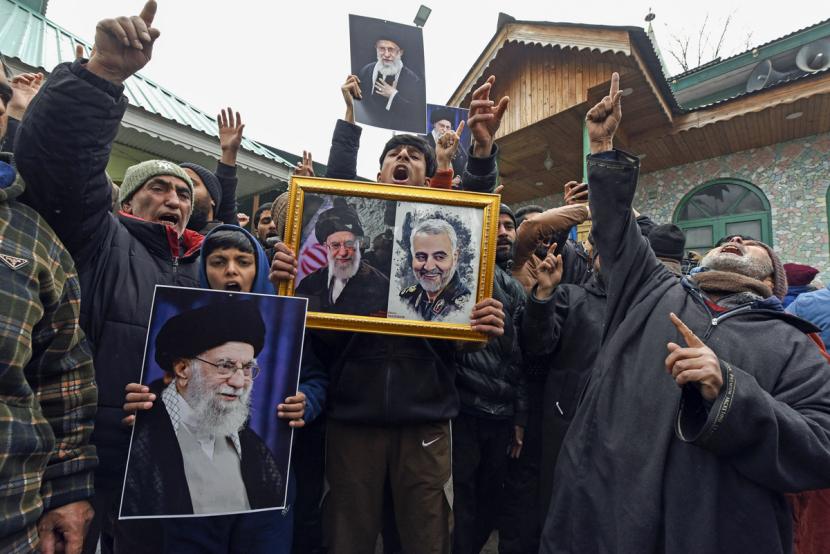
Those two descriptions of the same young man sit at the center of a widening pattern in Kashmir. In the weeks after the killing of Iran’s Supreme Leader, Ayatollah Ali Khamenei, Shia youths who joined processions to mourn him have been booked under the Public Safety Act (PSA), a law that permits incarceration without trial. The Polis Project has traced at least six such cases. In each, the machinery of detention runs not on proven crimes but on a documentary logic of suspicion — one that treats political grief, street protest, and neighborhood association as evidence of threat.
Human rights experts say police dossiers like these transform suspicion into punishment, treating anticipated future conduct as enough to deprive a person of liberty without any proven criminal charge. Read closely, the dossiers against Amir and two other young men reviewed by The Polis Project show exactly how that conversion is done.
Amir had joined an anti-US and anti-Israel procession that culminated at Srinagar’s Lal Chowk on March 3, one of many across the Valley after reports that Khamenei had been killed in joint US-Israel airstrikes in Tehran on 28 February 28. Kashmir, a Muslim-majority region in the Himalayas, is often called Iran-e-Sagheer — Little Iran — for its deep religious and cultural ties to Iran, and thousands poured into the streets and observed shutdowns to condemn the killing. For many, the demonstrations were about solidarity and mourning as much as Iran. “He protested against the assassination of Ayatollah Khamenei, just like thousands of others in Kashmir,” his brother, Ashiq Hussain, said.
The man and the dossier: Amir
His family’s account of the arrest is spare. Amir went to the gym; he did not come home. His mother waited anxiously for news of his release before learning that he had been booked under the decades-old Public Safety Act at Srinagar’s Rainawari police station. “His father was shell-shocked after signing the PSA document,” a family member told The Polis Project. Amir was transferred to Kot Bhalwal Jail in Jammu. According to the family, police said the detention was necessary to maintain law and order after a stone-pelting incident on the 2nd of March in Srinagar’s Saida Kadal area — but they say they still do not understand why he was booked under the PSA at all.
The dossier tells a different story, in a different register. Submitted to the District Magistrate, Srinagar, it describes Amir as a “habitual trouble monger” who allegedly influenced local youth, participated in protests, and posed a threat to public order. It leans heavily on “credible sources” and “ground reports” rather than on any single proven act.
Where it cites specifics, it points to two FIRs registered at the Rainawari police station. FIR No. 30/2025 invokes provisions of the Bharatiya Nyaya Sanhita (BNS) for rioting — including rioting while armed with a lethal weapon — along with mischief causing property damage, acts endangering others’ safety, and voluntarily causing hurt. FIR No. 09/2026 adds unlawful assembly, wrongful restraint, and voluntarily causing hurt, together with two provisions notable in a case that began with Shia mourning: defiling a place of worship and deliberately outraging religious feelings. These are ordinary criminal charges, prosecutable in the ordinary courts — yet the state reached instead for a law that requires no trial.
Beyond the FIRs, the detention rests on five Daily Diary Reports (DDRs) — routine police log entries — all recorded within a single 37-day window, from February 2 to March 11 this year, in the weeks immediately preceding Amir’s detention. These are records the police generate themselves; clustered so tightly ahead of the order, they raise the question the dossier never answers: whether the file documents a threat or was assembled to build one.
The rest reaches for context. The dossier situates Amir within the security logic of post-Article 370 Kashmir, arguing that the Valley remains vulnerable despite the appearance of calm, and invokes the possibility of renewed unrest to justify immediate detention. Even ordinary criminal law, it reasons, would take too long — during which Amir “could continue activities prejudicial to public order.” The case against him, in other words, is largely a case about what he might do next.
Arbaz Ali


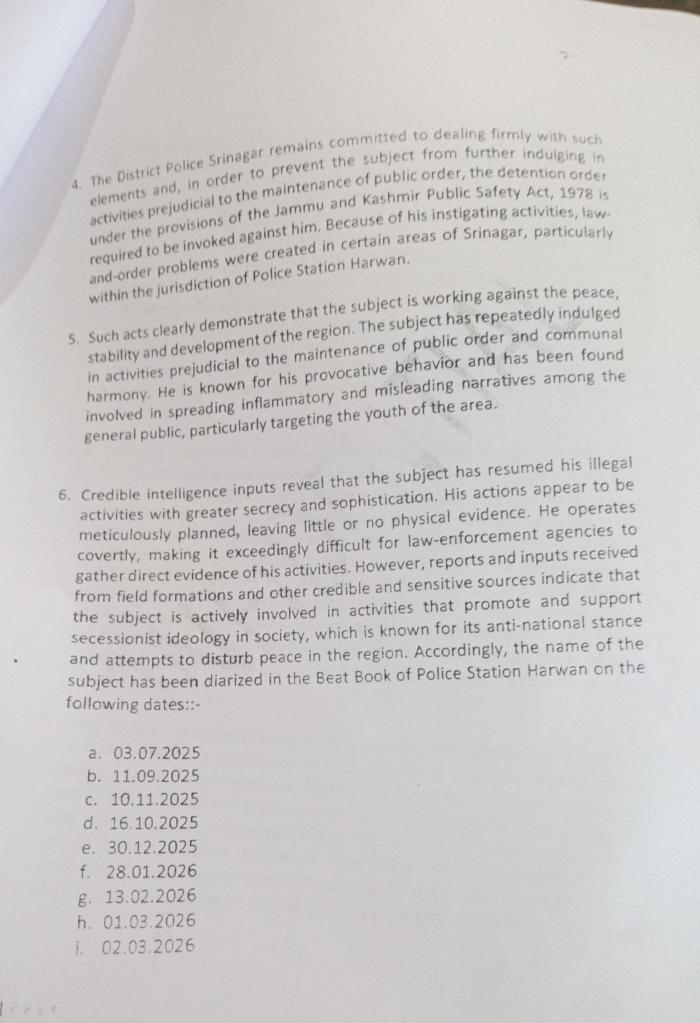
Arbaz Ali, a 23-year-old motorcycle mechanic from Srinagar’s Arabal locality, was among the demonstrators at an anti-US and anti-Israel rally in the Shalimar area. His family said the protest was about Khamenei’s killing and expressed solidarity with Iran and Palestine. On May 12, the police arrived at his workshop and asked him to accompany them to the station, where he was made to sign a document before being taken into custody. “The next day, we received a call from Central Jail, Bhaderwah. Arbaz told us that he had been shifted there, far away from home in Srinagar,” a family member said.
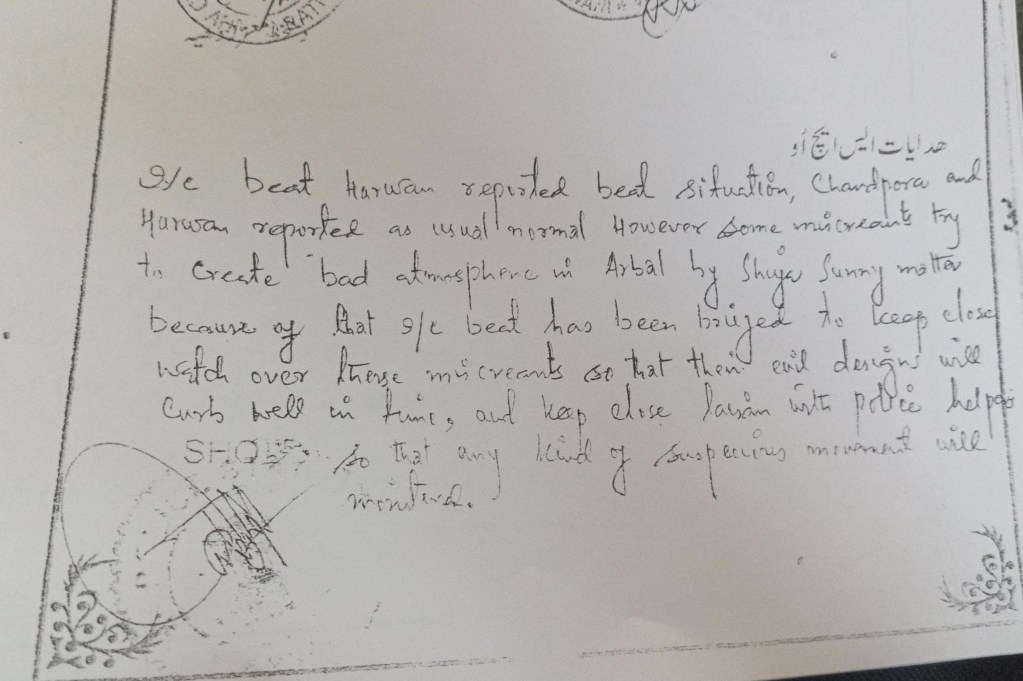
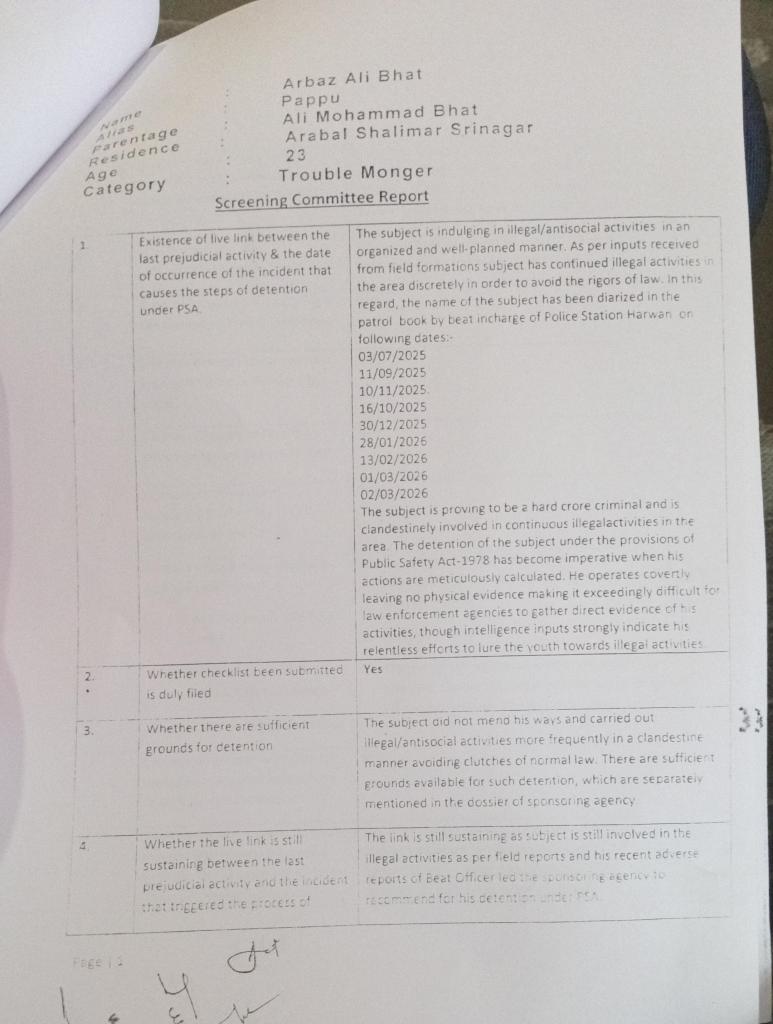
His four-page dossier, accessed by The Polis Project, describes him as a “trouble monger” who allegedly came into contact with “inimical elements” at an early age and organized a group to incite local youth into “anti-national activities.” It says he mobilized his neighborhood into “illegal processions,” raised “provocative slogans,” and — despite repeated police intervention — resumed his activities “in secret,” making it hard for investigators to collect direct evidence. Police said intelligence inputs and field reports suggested he spread inflammatory narratives, incited stone-pelting, and promoted secessionist ideology. From 2025 to March 2026, the dossier notes that his name appeared repeatedly in the Beat Book of Police Station Harwan, and that local residents had urged the police to take severe action against him. Residents of his locality told The Polis Project a different story. Several said the friction was personal: Arbaz had had a minor altercation with the area’s Station House Officer (SHO) and, at one point, grabbed the officer by his collar. Their account casts the dossier’s invocation of public demand in a different light — a personal confrontation with an officer, recast in the language of public order. On that basis, the Senior Superintendent of Police, Srinagar, recommended his preventive detention, calling him an immediate threat to public order and linking him to alleged drug peddling. As with Amir, the vocabulary carries the weight the evidence does not. Three months later, a judge would take that dossier apart.
Yawar Abass Ganei
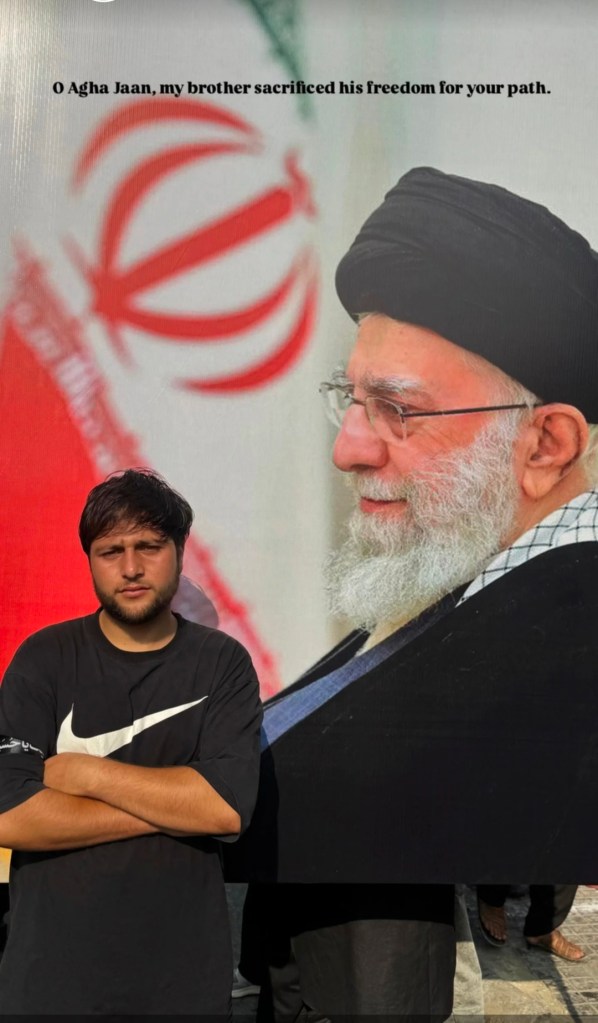
For Yawar Abass Ganei, 20, the dossier’s forward-looking logic is written almost in plain sight. He had been trying to rebuild his life after 38 days in detention under the Unlawful Activities (Prevention) Act (UAPA), following a protest after Khamenei’s killing, when the police came back. On June 8 this year, at around 7 p.m., he received a call from an unknown number; the caller identified himself as an officer from Nowgam police station and told him to report to the same. Yawar went the next day and did not return home. His family later learned he had been booked under the PSA and shifted to Kot Bhalwal Jail, Jammu, some 300 kilometers away.
Yawar is pursuing a B.Tech in artificial intelligence at SSM College of Engineering in Baramulla. “Who will be responsible for his academic career?” a family member asked, requesting anonymity. “The police say he is involved in anti-national activity — how can he be, when he studied at Army Goodwill Public School, Pahalgam, up to class 10?”
His dossier, too, places him in the “trouble monger” category. It accuses him of joining a procession from Khanda towards Nowgam on March 2, where participants allegedly raised slogans in support of Hezbollah, which the dossier calls a banned terrorist organization, and chanted against America and Israel, including “America ka jo yaar hai, gaddar hai” (whoever is a friend of America is a traitor). The procession, the police version says, moved towards Lal Chowk and turned violent, with participants forming “riotous mobs” and pelting stones at security forces “with intent to kill,” forcing the use of tear gas and a mild lathi charge. Yawar, the dossier alleges, was at the forefront; he was apprehended, booked in FIR No. 31/2026 at Nowgam, and released on bail.
Then comes the passage that captures the document’s overall logic. His release, the dossier says, did not end his “criminal activities”; instead, he formed a “gang of miscreants” to resume “illegal activities with greater secrecy and sophistication.” Its central claim about him is a forecast: “Yawar may form a gang of miscreants and will start indulging in illegal activities.” No new act is alleged. The prediction is the ground.
“Who will listen to us? He had just started dreaming about his studies and his future,” his family said. “We thought the worst was over, but they took him away again — this time under the Public Safety Act. What crime has he committed that his entire life should be taken away from him?”
Anatomy of a Dossier
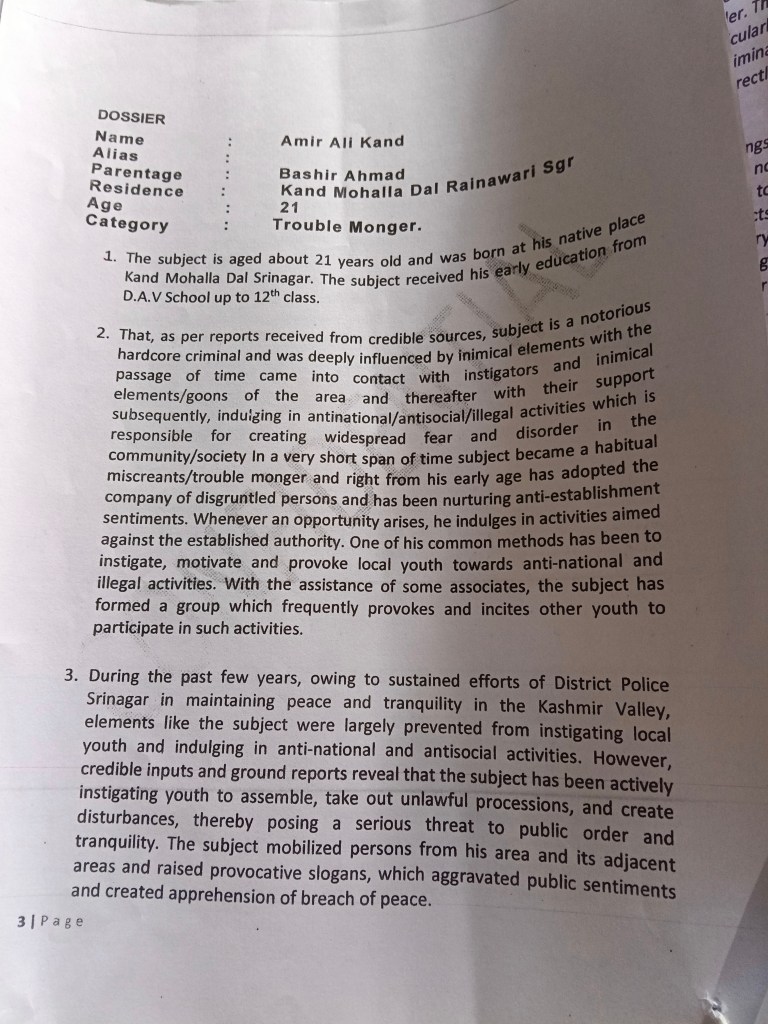
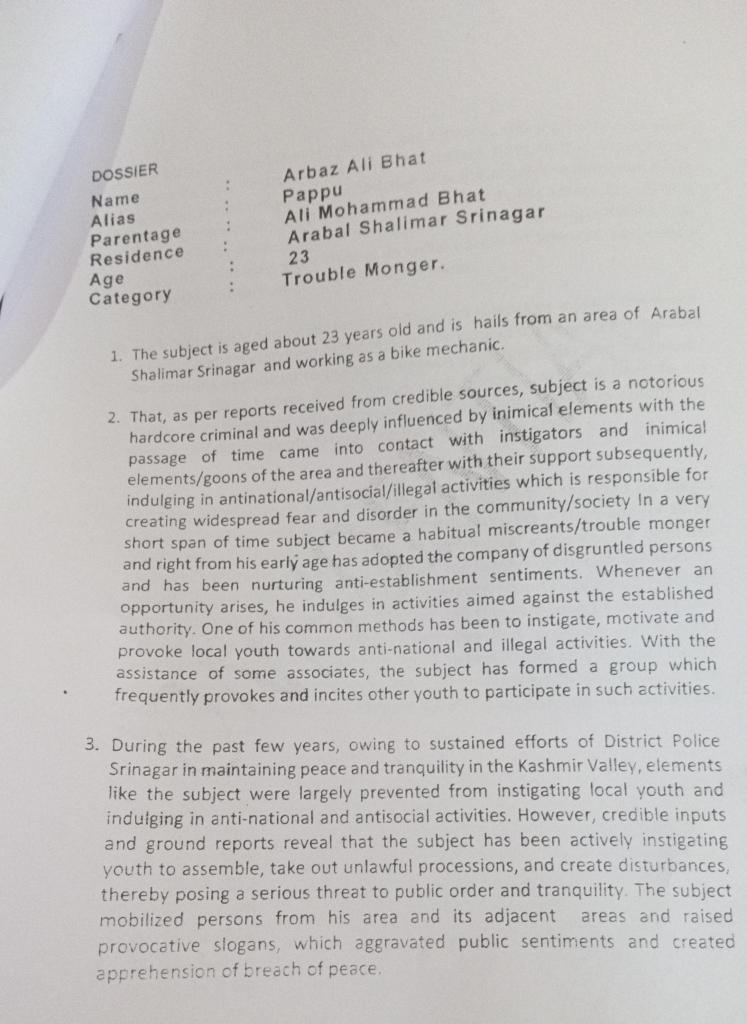
Preventive detention dossiers are internal police records used to justify a person’s detention under the PSA. Compiled by the police and relied on by the district administration, they typically describe an individual’s alleged activities and the perceived threat to public order or state security, often without any prior conviction. In these three cases the structure is consistent: a police officer assembles the narrative, the Senior Superintendent of Police recommends detention, and the District Magistrate approves it — a chain that moves from field observation to incarceration largely on the strength of the police’s own account.
What holds that account together is a recurring vocabulary. “Trouble monger,” “inimical elements,” “illegal processions,” “anti-national activities,” “credible sources,” “ground reports,” “public order” — the same terms surface across dossiers, doing the work that dates and incidents do not. A protest becomes an “illegal procession”; mourning becomes evidence of “anti-national” intent; a neighborhood acquaintance becomes contact with “inimical elements.” The FIRs and diary entries cited are real police records, but they do not, by themselves, prove the broader claims of guilt built on top of them. In each dossier, a narrow paper trail is converted into a forward-looking threat narrative that rests more on surveillance-based profiling and speculative allegations than on documented conduct.
That profiling is systemic. Across Kashmir, police and security agencies gather expansive personal and institutional data through questionnaires, household surveys, informant networks, and digital monitoring. The result is a form of pre-emptive criminalization: people are cast as suspects based on their affiliations, beliefs, movements, or associations, producing surveillance-driven targeting rather than incident-specific evidence.
This is the machinery that scholars of Kashmir have spent years documenting. Anthropologist Haley Duschinski and legal scholar Shrimoyee Nandini Ghosh describe a “permanent emergency” in which preventive detention functions not as an exceptional measure but as an everyday instrument of control. In their reading of what they term the “paperwork warfare” of indefinite incarceration, the subject of their study, “The Grid of Indefinite Incarceration: Everyday Legality and Paperwork Warfare in Indian-controlled Kashmir” — police dossiers, detention orders, and complaints become a bureaucratic apparatus that fuses colonial policing, routine paperwork, and the logic of war, one that confines people through delay and deferral rather than trial. The dossiers against Amir, Arbaz, and Yawar are that apparatus in miniature: anticipatory threat narratives that justify imprisonment before any conviction.
What the Lawyers and Judges Say
A retired sessions judge in Srinagar, who spoke on condition of anonymity, said the PSA is meant to be an exception but has become routine in Kashmir. The dossiers, he said, tend to repeat the same wording. “It is a vague term,” he said of “trouble monger;” the detaining authorities “don’t mention what activities the detenues have committed.” Booking mourners on such language, he argued, violates constitutional guarantees. He said magistrates too often defer entirely to the police file rather than verifying it independently. “The detaining authorities have been rubber-stamped through police dossiers,” he said.
He added that the PSA is intended for genuine threats to the state’s security.
“They were not a threat to the security of the state,” he said of the detained mourners. On the reliance on old cases, he was categorical: the police “cannot make the basis of old FIRs to frame a dossier. There must be a current proximate link or substantial proof against the activities a person is committing.” He went further, describing how loosely the law can be turned against individuals; a person, he said, could be booked under the PSA simply for being out of favor with a particular political group.
Lawyers who litigate these cases describe a system that rarely corrects itself. A senior criminal lawyer, who agreed to speak anonymously and has worked on such cases, told The Polis Project that many detainees want to seek compensation but fear the state will retaliate with a fresh detention order, a fear that often silences families. And even vindication comes slowly: habeas corpus petitions that once took a few months now routinely take eight or nine, sometimes longer, so that by the time a court rules, the detainee may already have served most of the period behind bars.
What the Law Is — and What It Was Meant for
The Jammu and Kashmir Public Safety Act was enacted in 1978 under the Sheikh Abdullah–led government, originally to curb timber smuggling. Amnesty International has called it “lawless.” Over the decades, it has been used against separatist leaders, mainstream politicians, journalists, human rights defenders, and ordinary citizens. After the abrogation of Jammu and Kashmir’s special status in August 2019, the BJP-led central government used the PSA to detain mainstream leaders, including Omar Abdullah and Mehbooba Mufti.
The scale is not disputed even by those who now govern under it. Last year, on March 6, Omar Abdullah told the legislative assembly that 400 youths were languishing under the PSA. “Lodging youths in jail for years under PSA means you have no evidence to prosecute them,” he said. Before returning to power, he had promised to repeal the law; however, more than 21 months after the National Conference formed the government, it remains in force. The Union territory government cannot repeal it without the Union government’s approval.
Protest, and the State’s Account of It
The bookings followed a national alert. Amid rising tensions in West Asia after the US-Israel strikes on Iran, India’s Union Ministry of Home Affairs issued directions to states warning of possible unrest. A communication sent on February 28 asked state authorities to identify “pro-Iran radical preachers” delivering “inflammatory sermons.” In Kashmir, demonstrators were subsequently booked under the UAPA and the PSA; the police filed seven UAPA FIRs across several areas and said they had arrested people with alleged past criminal records.
The police insist the net was narrow. A police official told The Print that action was being taken only against a subset of protesters. “Crackdown is not on those people but on those who raised slogans like Bomb Iran, Bomb USA, and Bomb New Delhi,” the official said, adding that no action was being taken against those who burned effigies of Donald Trump and Benjamin Netanyahu or mourned Khamenei. “Only those who took advantage of this chance to spread anti-Indian sentiment and encourage separatist activities will face consequences.” But with thousands taking part in the rallies, the dossiers reviewed by The Polis Project point to a broader logic — one in which protest participation and neighborhood association themselves become grounds for detention.
Courts Flag Repeated Flaws
The courts have said as much, repeatedly. The PSA has not been reserved for alleged protesters; it has also been applied to elected representatives. In September 2025, Mehraj Malik, a sitting member of the Legislative Assembly, became the first MLA detained under the law. Eight months later, the High Court quashed his detention, calling it “a shortcut to bypass ordinary criminal law.”
That was not an isolated ruling. Over the years the Jammu and Kashmir High Court has repeatedly identified grave errors in detention orders, sometimes in unusually strong language, yet the officials responsible are rarely held accountable, and those wrongfully held almost never receive compensation. In March 2024, while quashing the detention of Imtiyaz Ahmed Ganie, a 34-year-old driver from South Kashmir, Justice Moksha Khajuria Kazmi found the authorities had detained the wrong man. There was, she noted, “absolutely no justification available on record” to answer the mistaken-identity argument his counsel had raised. “The prognosis, therefore, is that the submission advanced by learned counsel for the petitioner in this regard is correct,” she held, adding that the grounds of detention revealed a glaring lack of application of mind. Ganie spent 520 days in prison before he was released.
The pattern of relying on stale material recurs. Abdul Rashid Naik was detained partly on police daily diary reports — which the High Court has repeatedly said cannot by themselves justify preventive detention — and on a 2010 FIR in which he had already been acquitted. The court held that stale allegations, absent a live and proximate link to the detention, cannot justify incarceration, and that prior cases may be cited only where they show a direct nexus with the immediate need to detain. In December 2023, the court quashed the detention of Bashir Ahmad Koka of Anantnag after the police cited an old FIR in which he, too, had been acquitted, holding that vague and unsubstantiated allegations could not support detention, particularly where the detaining authority had failed even to account for the acquittal.
The most recent ruling struck closest to this story. On August 21, the High Court quashed the detention of Arbaz Ali — one of the six mourners named here. Hearing his petition, Justice Rahul Bharti found that, for all its labels, the dossier did not even present Arbaz as a person with criminal antecedents; it contained only Beat Book reports generated by Harwan Police Station on a scatter of dates between July 2025 and March 2026. The District Magistrate, Srinagar, had then taken almost two months to sign the detention order, hardly the urgency the police had claimed, and, the judge reasoned, evidence that Arbaz’s weeks at liberty had never truly been treated as a danger to public order. The order, Bharti held, had “no iota of factual basis except the self-serving Beat Reports” of the police, whose contents the grounds of detention did not even disclose. He ordered Arbaz released forthwith.
Taken together, the rulings return to a single theme — the one running through the dossiers of Amir, Arbaz, and Yawar. A law meant for extraordinary circumstances is, in practice, being used on the basis of stale, ambiguous or speculative material, depriving people of liberty on the strength of what they might do rather than what they have done.
Calls for Release

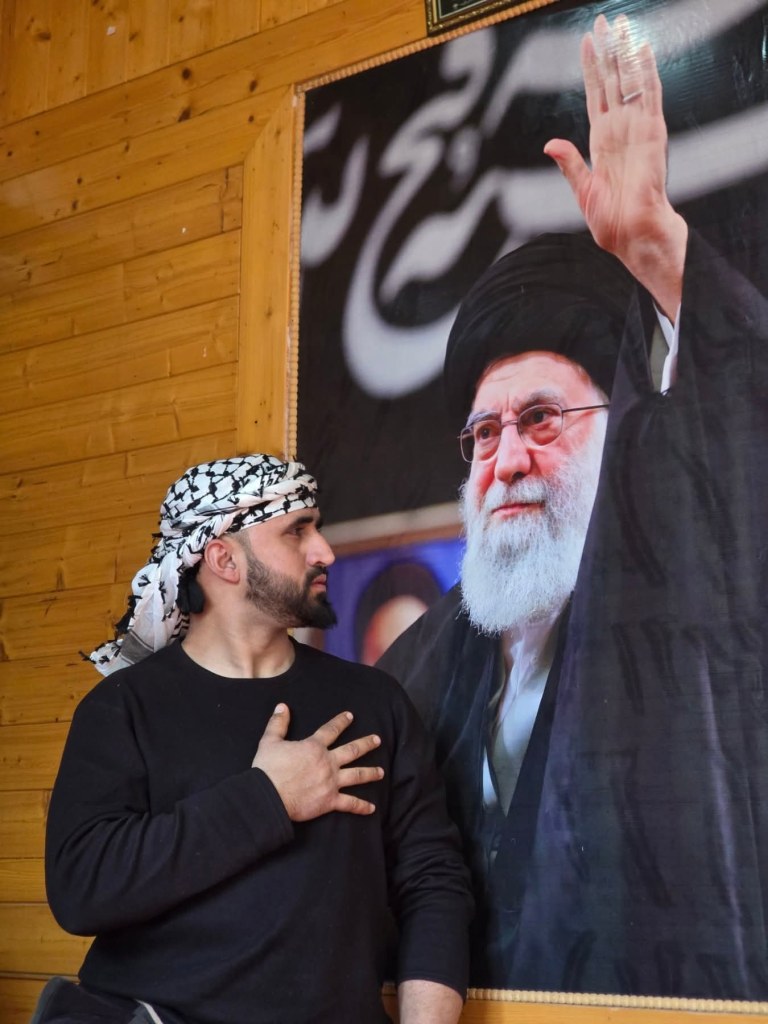
Political parties in Jammu and Kashmir have repeatedly demanded the release of political prisoners and PSA detainees held in jails outside the region — an issue that has stayed politically sensitive since the mass detentions that followed the abrogation of Article 370. On March 15 this year, members of the ruling National Conference submitted a memorandum to Lieutenant Governor Manoj Sinha seeking the release of those detained during the protests and the withdrawal of the cases against them. The Shia cleric Masroor Abbas Ansari condemned the arrests, alleging that mourners were being detained and moved to jails outside Kashmir. “I urge the administration to take a compassionate and constructive approach, review the cases of the detained youths, and facilitate their return to Kashmir,” he said.
Aga Syed Ruhullah Mehdi, a National Conference leader and prominent Shia figure, was equally blunt. The young men who protested what he called the barbaric acts of the United States and Israel, he told The Polis Project, had mourned Khamenei’s death without committing any violence, yet were booked under the UAPA and the PSA. “Booking them under PSA is a violation of democratic values. Under what crimes have the police booked them under PSA?” he asked. The problem, he added, ran well beyond these cases: hundreds of PSA detainees were languishing in jails outside Kashmir without trial.
Syed Muntazir Mehdi, a Shia leader and Peoples Democratic Party representative from Budgam, said about 100 to 200 Shia youths, including some women, had been arrested for paying tribute to what he called their martyred leader. “They are innocent mourners just expressing solidarity and grief over Khamenei’s killing. They are not stone pelters,” he said. BJP spokesperson Altaf Thakur rejected that account: “They are stone pelters and will not be spared.”
For Mehbooba Mufti, the former chief minister and Peoples Democratic Party president, the detentions were part of a wider silencing. Dissent was being curbed in Kashmir, she told The Polis Project, and the ground had shifted rapidly since the abrogation of Article 370. These young men, she said, had been booked under the PSA simply for mourning Khamenei — and she noted pointedly that the Union territory’s elected chief minister had not even condemned the assassination. The damage, she argued, outlasts the detention itself: “When youths are getting booked under UAPA and PSA, it darkens their future. They may not be able to get jobs and passports.” During her own tenure, she said, she had revoked the PSA orders of 1,200 youths in Kashmir.
The distance is itself part of the punishment. According to available figures, 1,122 PSA detainees were transferred to jails outside the region between 2018 and August 1, 2023, and 408 remained incarcerated outside Jammu and Kashmir. Families say holding detainees hundreds of kilometers from home imposes severe financial strain and makes visits nearly impossible.
In all, The Polis Project has documented six Shia mourners booked under the PSA in the weeks after Khamenei’s killing: Arif Hussain Dar, Raja Bashir, Yawar Abass Ganei, Arbaz Ali, Amir Ali Kand and Sheik Auqib. Some of their families spoke to us; others stayed silent, afraid of reprisal.
Since then, one of the six has walked free: the High Court quashed Arbaz Ali’s detention on 21 August 21. The other five Amir Ali Kand, Yawar Abass Ganei, Arif Hussain Dar, Raja Bashir, and Sheik Auqib remain in jail, their petitions still to be heard.
As Amir endures the scorching summer heat inside Kot Bhalwal Jail, his family continues to wait. “Amir has been in a jail outside Kashmir for almost 70 days. Please release him; I cannot even meet him in person,” his elderly mother pleaded. “We are fighting a legal battle and holding on to hope. It would be a miracle once Amir is back home.”


Tehran’s Shadow: Why Kashmir’s Shia Youth Are Being Booked Under the Public Safety Act
IMAGE: People gather to express solidarity with Iran’s supreme leader, Ayatollah Syed Ali Khamenei, amidst Iran's rising tensions, in Srinagar, Jammu and Kashmir, January 16, 2026. Photograph: ANI Photo
Editor’s Note
This report examines the use of Jammu and Kashmir’s Public Safety Act (PSA) through the detention dossiers prepared against Amir Ali Kand and Arbaz Ali. The documents offer a close view of a preventive-detention system in which incarceration can rest not on a proven criminal act, but on police assertions of suspicion, association, and anticipated future conduct.
In the dossiers, familiar administrative phrases— such as “trouble monger,” “credible sources,” and warnings that an individual may disturb public order—do more than describe alleged risk. They transform participation in protest, relationships within a neighborhood, and political visibility into grounds for detention without trial. The state’s case is framed prospectively: not what a person has been convicted of doing, but what authorities say they might do.
The article is published anonymously because reporting on preventive detention in Kashmir carries serious risks for journalists, sources, detainees, and their families. Since 2019, Kashmir’s press has been curtailed through arrests, preventive detention, anti-terror cases, raids, surveillance, and the closure of independent outlets. More than 200 journalists had faced police cases by 2022, while reporters including Aasif Sultan, Fahad Shah, Sajad Gul, and Irfan Mehraj have faced prolonged detention or re-arrest. Counterinsurgency tactics—raids, surveillance, terror investigations, and detention laws—have been turned on journalists, making routine reporting a source of suspicion and deepening a climate of silence. People who challenge official accounts, document security-force practices, or publicly discuss detention may face surveillance, intimidation, legal exposure, reprisals, or renewed scrutiny. Anonymity is therefore not a stylistic choice; it is a necessary protection that makes this reporting possible.
We have withheld identifying details where disclosure could increase risk, while preserving the documentary record and the substance of the reporting. The aim is to make visible the bureaucratic language through which exceptional state power is normalized and to ask what due process means when suspicion is treated as sufficient evidence for the loss of liberty.
On the morning of 15 May, Amir Ali Kand left his home in the lanes around Srinagar’s Dal Lake and went to the gym. To his family, the 21-year-old was a young man who had done nothing more than grieve. To the Jammu and Kashmir Police, he was a “habitual trouble monger” — the phrase that anchors the preventive detention dossier that would soon send him, without trial, to a jail about 330 kilometers from home.
Those two descriptions of the same young man sit at the center of a widening pattern in Kashmir. In the weeks after the killing of Iran’s Supreme Leader, Ayatollah Ali Khamenei, Shia youths who joined processions to mourn him have been booked under the Public Safety Act (PSA), a law that permits incarceration without trial. The Polis Project has traced at least six such cases. In each, the machinery of detention runs not on proven crimes but on a documentary logic of suspicion — one that treats political grief, street protest, and neighborhood association as evidence of threat.
Human rights experts say police dossiers like these transform suspicion into punishment, treating anticipated future conduct as enough to deprive a person of liberty without any proven criminal charge. Read closely, the dossiers against Amir and two other young men reviewed by The Polis Project show exactly how that conversion is done.
Amir had joined an anti-US and anti-Israel procession that culminated at Srinagar’s Lal Chowk on March 3, one of many across the Valley after reports that Khamenei had been killed in joint US-Israel airstrikes in Tehran on 28 February 28. Kashmir, a Muslim-majority region in the Himalayas, is often called Iran-e-Sagheer — Little Iran — for its deep religious and cultural ties to Iran, and thousands poured into the streets and observed shutdowns to condemn the killing. For many, the demonstrations were about solidarity and mourning as much as Iran. “He protested against the assassination of Ayatollah Khamenei, just like thousands of others in Kashmir,” his brother, Ashiq Hussain, said.
The man and the dossier: Amir
His family’s account of the arrest is spare. Amir went to the gym; he did not come home. His mother waited anxiously for news of his release before learning that he had been booked under the decades-old Public Safety Act at Srinagar’s Rainawari police station. “His father was shell-shocked after signing the PSA document,” a family member told The Polis Project. Amir was transferred to Kot Bhalwal Jail in Jammu. According to the family, police said the detention was necessary to maintain law and order after a stone-pelting incident on the 2nd of March in Srinagar’s Saida Kadal area — but they say they still do not understand why he was booked under the PSA at all.
The dossier tells a different story, in a different register. Submitted to the District Magistrate, Srinagar, it describes Amir as a “habitual trouble monger” who allegedly influenced local youth, participated in protests, and posed a threat to public order. It leans heavily on “credible sources” and “ground reports” rather than on any single proven act.
Where it cites specifics, it points to two FIRs registered at the Rainawari police station. FIR No. 30/2025 invokes provisions of the Bharatiya Nyaya Sanhita (BNS) for rioting — including rioting while armed with a lethal weapon — along with mischief causing property damage, acts endangering others’ safety, and voluntarily causing hurt. FIR No. 09/2026 adds unlawful assembly, wrongful restraint, and voluntarily causing hurt, together with two provisions notable in a case that began with Shia mourning: defiling a place of worship and deliberately outraging religious feelings. These are ordinary criminal charges, prosecutable in the ordinary courts — yet the state reached instead for a law that requires no trial.
Beyond the FIRs, the detention rests on five Daily Diary Reports (DDRs) — routine police log entries — all recorded within a single 37-day window, from February 2 to March 11 this year, in the weeks immediately preceding Amir’s detention. These are records the police generate themselves; clustered so tightly ahead of the order, they raise the question the dossier never answers: whether the file documents a threat or was assembled to build one.
The rest reaches for context. The dossier situates Amir within the security logic of post-Article 370 Kashmir, arguing that the Valley remains vulnerable despite the appearance of calm, and invokes the possibility of renewed unrest to justify immediate detention. Even ordinary criminal law, it reasons, would take too long — during which Amir “could continue activities prejudicial to public order.” The case against him, in other words, is largely a case about what he might do next.
Arbaz Ali
Arbaz Ali, a 23-year-old motorcycle mechanic from Srinagar’s Arabal locality, was among the demonstrators at an anti-US and anti-Israel rally in the Shalimar area. His family said the protest was about Khamenei’s killing and expressed solidarity with Iran and Palestine. On May 12, the police arrived at his workshop and asked him to accompany them to the station, where he was made to sign a document before being taken into custody. “The next day, we received a call from Central Jail, Bhaderwah. Arbaz told us that he had been shifted there, far away from home in Srinagar,” a family member said.
His four-page dossier, accessed by The Polis Project, describes him as a “trouble monger” who allegedly came into contact with “inimical elements” at an early age and organized a group to incite local youth into “anti-national activities.” It says he mobilized his neighborhood into “illegal processions,” raised “provocative slogans,” and — despite repeated police intervention — resumed his activities “in secret,” making it hard for investigators to collect direct evidence. Police said intelligence inputs and field reports suggested he spread inflammatory narratives, incited stone-pelting, and promoted secessionist ideology. From 2025 to March 2026, the dossier notes that his name appeared repeatedly in the Beat Book of Police Station Harwan, and that local residents had urged the police to take severe action against him. Residents of his locality told The Polis Project a different story. Several said the friction was personal: Arbaz had had a minor altercation with the area’s Station House Officer (SHO) and, at one point, grabbed the officer by his collar. Their account casts the dossier’s invocation of public demand in a different light — a personal confrontation with an officer, recast in the language of public order. On that basis, the Senior Superintendent of Police, Srinagar, recommended his preventive detention, calling him an immediate threat to public order and linking him to alleged drug peddling. As with Amir, the vocabulary carries the weight the evidence does not. Three months later, a judge would take that dossier apart.
Yawar Abass Ganei
For Yawar Abass Ganei, 20, the dossier’s forward-looking logic is written almost in plain sight. He had been trying to rebuild his life after 38 days in detention under the Unlawful Activities (Prevention) Act (UAPA), following a protest after Khamenei’s killing, when the police came back. On June 8 this year, at around 7 p.m., he received a call from an unknown number; the caller identified himself as an officer from Nowgam police station and told him to report to the same. Yawar went the next day and did not return home. His family later learned he had been booked under the PSA and shifted to Kot Bhalwal Jail, Jammu, some 300 kilometers away.
Yawar is pursuing a B.Tech in artificial intelligence at SSM College of Engineering in Baramulla. “Who will be responsible for his academic career?” a family member asked, requesting anonymity. “The police say he is involved in anti-national activity — how can he be, when he studied at Army Goodwill Public School, Pahalgam, up to class 10?”
His dossier, too, places him in the “trouble monger” category. It accuses him of joining a procession from Khanda towards Nowgam on March 2, where participants allegedly raised slogans in support of Hezbollah, which the dossier calls a banned terrorist organization, and chanted against America and Israel, including “America ka jo yaar hai, gaddar hai” (whoever is a friend of America is a traitor). The procession, the police version says, moved towards Lal Chowk and turned violent, with participants forming “riotous mobs” and pelting stones at security forces “with intent to kill,” forcing the use of tear gas and a mild lathi charge. Yawar, the dossier alleges, was at the forefront; he was apprehended, booked in FIR No. 31/2026 at Nowgam, and released on bail.
Then comes the passage that captures the document’s overall logic. His release, the dossier says, did not end his “criminal activities”; instead, he formed a “gang of miscreants” to resume “illegal activities with greater secrecy and sophistication.” Its central claim about him is a forecast: “Yawar may form a gang of miscreants and will start indulging in illegal activities.” No new act is alleged. The prediction is the ground.
“Who will listen to us? He had just started dreaming about his studies and his future,” his family said. “We thought the worst was over, but they took him away again — this time under the Public Safety Act. What crime has he committed that his entire life should be taken away from him?”
Anatomy of a Dossier
Preventive detention dossiers are internal police records used to justify a person’s detention under the PSA. Compiled by the police and relied on by the district administration, they typically describe an individual’s alleged activities and the perceived threat to public order or state security, often without any prior conviction. In these three cases the structure is consistent: a police officer assembles the narrative, the Senior Superintendent of Police recommends detention, and the District Magistrate approves it — a chain that moves from field observation to incarceration largely on the strength of the police’s own account.
What holds that account together is a recurring vocabulary. “Trouble monger,” “inimical elements,” “illegal processions,” “anti-national activities,” “credible sources,” “ground reports,” “public order” — the same terms surface across dossiers, doing the work that dates and incidents do not. A protest becomes an “illegal procession”; mourning becomes evidence of “anti-national” intent; a neighborhood acquaintance becomes contact with “inimical elements.” The FIRs and diary entries cited are real police records, but they do not, by themselves, prove the broader claims of guilt built on top of them. In each dossier, a narrow paper trail is converted into a forward-looking threat narrative that rests more on surveillance-based profiling and speculative allegations than on documented conduct.
That profiling is systemic. Across Kashmir, police and security agencies gather expansive personal and institutional data through questionnaires, household surveys, informant networks, and digital monitoring. The result is a form of pre-emptive criminalization: people are cast as suspects based on their affiliations, beliefs, movements, or associations, producing surveillance-driven targeting rather than incident-specific evidence.
This is the machinery that scholars of Kashmir have spent years documenting. Anthropologist Haley Duschinski and legal scholar Shrimoyee Nandini Ghosh describe a “permanent emergency” in which preventive detention functions not as an exceptional measure but as an everyday instrument of control. In their reading of what they term the “paperwork warfare” of indefinite incarceration, the subject of their study, “The Grid of Indefinite Incarceration: Everyday Legality and Paperwork Warfare in Indian-controlled Kashmir” — police dossiers, detention orders, and complaints become a bureaucratic apparatus that fuses colonial policing, routine paperwork, and the logic of war, one that confines people through delay and deferral rather than trial. The dossiers against Amir, Arbaz, and Yawar are that apparatus in miniature: anticipatory threat narratives that justify imprisonment before any conviction.
What the Lawyers and Judges Say
A retired sessions judge in Srinagar, who spoke on condition of anonymity, said the PSA is meant to be an exception but has become routine in Kashmir. The dossiers, he said, tend to repeat the same wording. “It is a vague term,” he said of “trouble monger;” the detaining authorities “don’t mention what activities the detenues have committed.” Booking mourners on such language, he argued, violates constitutional guarantees. He said magistrates too often defer entirely to the police file rather than verifying it independently. “The detaining authorities have been rubber-stamped through police dossiers,” he said.
He added that the PSA is intended for genuine threats to the state’s security.
“They were not a threat to the security of the state,” he said of the detained mourners. On the reliance on old cases, he was categorical: the police “cannot make the basis of old FIRs to frame a dossier. There must be a current proximate link or substantial proof against the activities a person is committing.” He went further, describing how loosely the law can be turned against individuals; a person, he said, could be booked under the PSA simply for being out of favor with a particular political group.
Lawyers who litigate these cases describe a system that rarely corrects itself. A senior criminal lawyer, who agreed to speak anonymously and has worked on such cases, told The Polis Project that many detainees want to seek compensation but fear the state will retaliate with a fresh detention order, a fear that often silences families. And even vindication comes slowly: habeas corpus petitions that once took a few months now routinely take eight or nine, sometimes longer, so that by the time a court rules, the detainee may already have served most of the period behind bars.
What the Law Is — and What It Was Meant for
The Jammu and Kashmir Public Safety Act was enacted in 1978 under the Sheikh Abdullah–led government, originally to curb timber smuggling. Amnesty International has called it “lawless.” Over the decades, it has been used against separatist leaders, mainstream politicians, journalists, human rights defenders, and ordinary citizens. After the abrogation of Jammu and Kashmir’s special status in August 2019, the BJP-led central government used the PSA to detain mainstream leaders, including Omar Abdullah and Mehbooba Mufti.
The scale is not disputed even by those who now govern under it. Last year, on March 6, Omar Abdullah told the legislative assembly that 400 youths were languishing under the PSA. “Lodging youths in jail for years under PSA means you have no evidence to prosecute them,” he said. Before returning to power, he had promised to repeal the law; however, more than 21 months after the National Conference formed the government, it remains in force. The Union territory government cannot repeal it without the Union government’s approval.
Protest, and the State’s Account of It
The bookings followed a national alert. Amid rising tensions in West Asia after the US-Israel strikes on Iran, India’s Union Ministry of Home Affairs issued directions to states warning of possible unrest. A communication sent on February 28 asked state authorities to identify “pro-Iran radical preachers” delivering “inflammatory sermons.” In Kashmir, demonstrators were subsequently booked under the UAPA and the PSA; the police filed seven UAPA FIRs across several areas and said they had arrested people with alleged past criminal records.
The police insist the net was narrow. A police official told The Print that action was being taken only against a subset of protesters. “Crackdown is not on those people but on those who raised slogans like Bomb Iran, Bomb USA, and Bomb New Delhi,” the official said, adding that no action was being taken against those who burned effigies of Donald Trump and Benjamin Netanyahu or mourned Khamenei. “Only those who took advantage of this chance to spread anti-Indian sentiment and encourage separatist activities will face consequences.” But with thousands taking part in the rallies, the dossiers reviewed by The Polis Project point to a broader logic — one in which protest participation and neighborhood association themselves become grounds for detention.
Courts Flag Repeated Flaws
The courts have said as much, repeatedly. The PSA has not been reserved for alleged protesters; it has also been applied to elected representatives. In September 2025, Mehraj Malik, a sitting member of the Legislative Assembly, became the first MLA detained under the law. Eight months later, the High Court quashed his detention, calling it “a shortcut to bypass ordinary criminal law.”
That was not an isolated ruling. Over the years the Jammu and Kashmir High Court has repeatedly identified grave errors in detention orders, sometimes in unusually strong language, yet the officials responsible are rarely held accountable, and those wrongfully held almost never receive compensation. In March 2024, while quashing the detention of Imtiyaz Ahmed Ganie, a 34-year-old driver from South Kashmir, Justice Moksha Khajuria Kazmi found the authorities had detained the wrong man. There was, she noted, “absolutely no justification available on record” to answer the mistaken-identity argument his counsel had raised. “The prognosis, therefore, is that the submission advanced by learned counsel for the petitioner in this regard is correct,” she held, adding that the grounds of detention revealed a glaring lack of application of mind. Ganie spent 520 days in prison before he was released.
The pattern of relying on stale material recurs. Abdul Rashid Naik was detained partly on police daily diary reports — which the High Court has repeatedly said cannot by themselves justify preventive detention — and on a 2010 FIR in which he had already been acquitted. The court held that stale allegations, absent a live and proximate link to the detention, cannot justify incarceration, and that prior cases may be cited only where they show a direct nexus with the immediate need to detain. In December 2023, the court quashed the detention of Bashir Ahmad Koka of Anantnag after the police cited an old FIR in which he, too, had been acquitted, holding that vague and unsubstantiated allegations could not support detention, particularly where the detaining authority had failed even to account for the acquittal.
The most recent ruling struck closest to this story. On August 21, the High Court quashed the detention of Arbaz Ali — one of the six mourners named here. Hearing his petition, Justice Rahul Bharti found that, for all its labels, the dossier did not even present Arbaz as a person with criminal antecedents; it contained only Beat Book reports generated by Harwan Police Station on a scatter of dates between July 2025 and March 2026. The District Magistrate, Srinagar, had then taken almost two months to sign the detention order, hardly the urgency the police had claimed, and, the judge reasoned, evidence that Arbaz’s weeks at liberty had never truly been treated as a danger to public order. The order, Bharti held, had “no iota of factual basis except the self-serving Beat Reports” of the police, whose contents the grounds of detention did not even disclose. He ordered Arbaz released forthwith.
Taken together, the rulings return to a single theme — the one running through the dossiers of Amir, Arbaz, and Yawar. A law meant for extraordinary circumstances is, in practice, being used on the basis of stale, ambiguous or speculative material, depriving people of liberty on the strength of what they might do rather than what they have done.
Calls for Release
Political parties in Jammu and Kashmir have repeatedly demanded the release of political prisoners and PSA detainees held in jails outside the region — an issue that has stayed politically sensitive since the mass detentions that followed the abrogation of Article 370. On March 15 this year, members of the ruling National Conference submitted a memorandum to Lieutenant Governor Manoj Sinha seeking the release of those detained during the protests and the withdrawal of the cases against them. The Shia cleric Masroor Abbas Ansari condemned the arrests, alleging that mourners were being detained and moved to jails outside Kashmir. “I urge the administration to take a compassionate and constructive approach, review the cases of the detained youths, and facilitate their return to Kashmir,” he said.
Aga Syed Ruhullah Mehdi, a National Conference leader and prominent Shia figure, was equally blunt. The young men who protested what he called the barbaric acts of the United States and Israel, he told The Polis Project, had mourned Khamenei’s death without committing any violence, yet were booked under the UAPA and the PSA. “Booking them under PSA is a violation of democratic values. Under what crimes have the police booked them under PSA?” he asked. The problem, he added, ran well beyond these cases: hundreds of PSA detainees were languishing in jails outside Kashmir without trial.
Syed Muntazir Mehdi, a Shia leader and Peoples Democratic Party representative from Budgam, said about 100 to 200 Shia youths, including some women, had been arrested for paying tribute to what he called their martyred leader. “They are innocent mourners just expressing solidarity and grief over Khamenei’s killing. They are not stone pelters,” he said. BJP spokesperson Altaf Thakur rejected that account: “They are stone pelters and will not be spared.”
For Mehbooba Mufti, the former chief minister and Peoples Democratic Party president, the detentions were part of a wider silencing. Dissent was being curbed in Kashmir, she told The Polis Project, and the ground had shifted rapidly since the abrogation of Article 370. These young men, she said, had been booked under the PSA simply for mourning Khamenei — and she noted pointedly that the Union territory’s elected chief minister had not even condemned the assassination. The damage, she argued, outlasts the detention itself: “When youths are getting booked under UAPA and PSA, it darkens their future. They may not be able to get jobs and passports.” During her own tenure, she said, she had revoked the PSA orders of 1,200 youths in Kashmir.
The distance is itself part of the punishment. According to available figures, 1,122 PSA detainees were transferred to jails outside the region between 2018 and August 1, 2023, and 408 remained incarcerated outside Jammu and Kashmir. Families say holding detainees hundreds of kilometers from home imposes severe financial strain and makes visits nearly impossible.
In all, The Polis Project has documented six Shia mourners booked under the PSA in the weeks after Khamenei’s killing: Arif Hussain Dar, Raja Bashir, Yawar Abass Ganei, Arbaz Ali, Amir Ali Kand and Sheik Auqib. Some of their families spoke to us; others stayed silent, afraid of reprisal.
Since then, one of the six has walked free: the High Court quashed Arbaz Ali’s detention on 21 August 21. The other five Amir Ali Kand, Yawar Abass Ganei, Arif Hussain Dar, Raja Bashir, and Sheik Auqib remain in jail, their petitions still to be heard.
As Amir endures the scorching summer heat inside Kot Bhalwal Jail, his family continues to wait. “Amir has been in a jail outside Kashmir for almost 70 days. Please release him; I cannot even meet him in person,” his elderly mother pleaded. “We are fighting a legal battle and holding on to hope. It would be a miracle once Amir is back home.”