


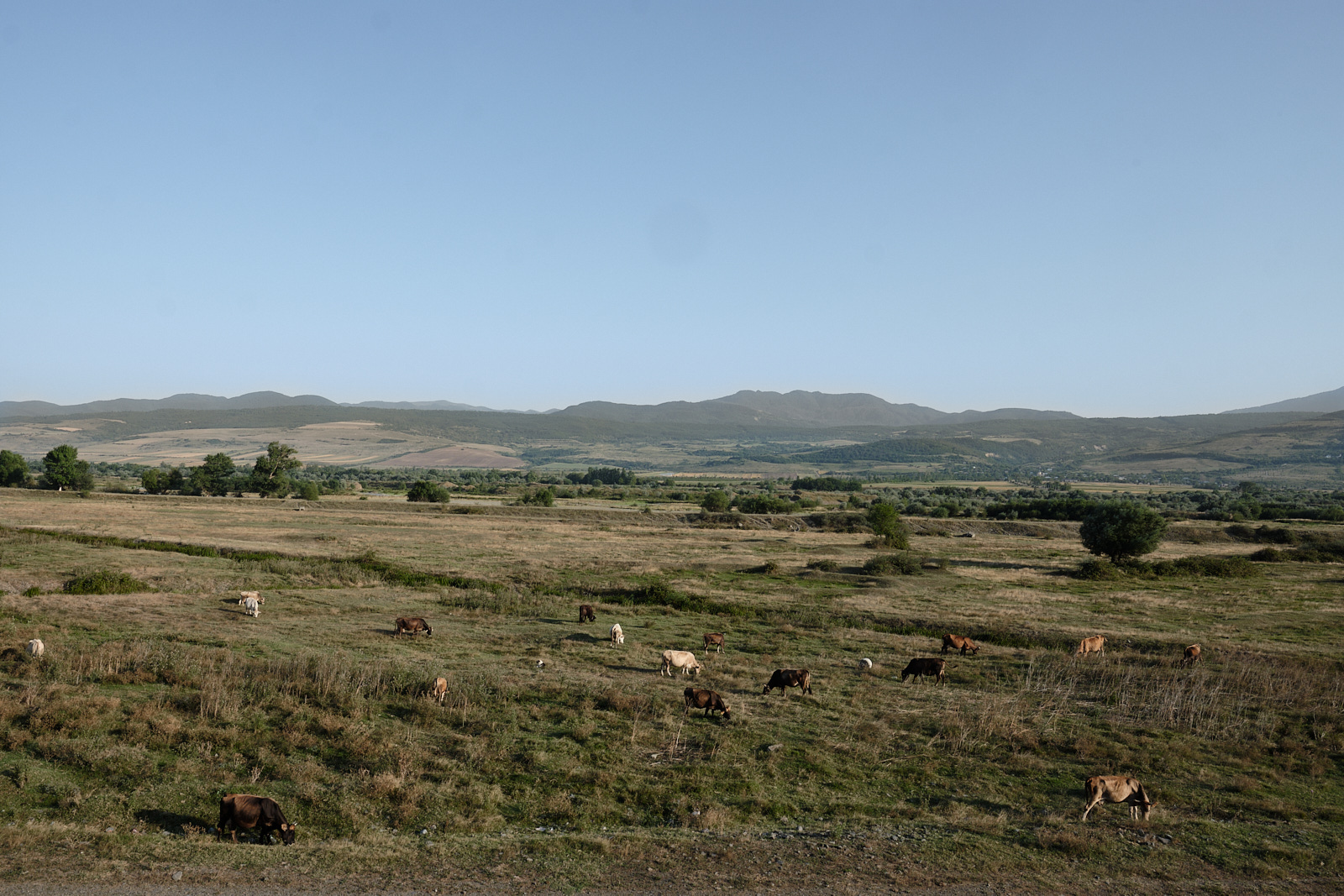
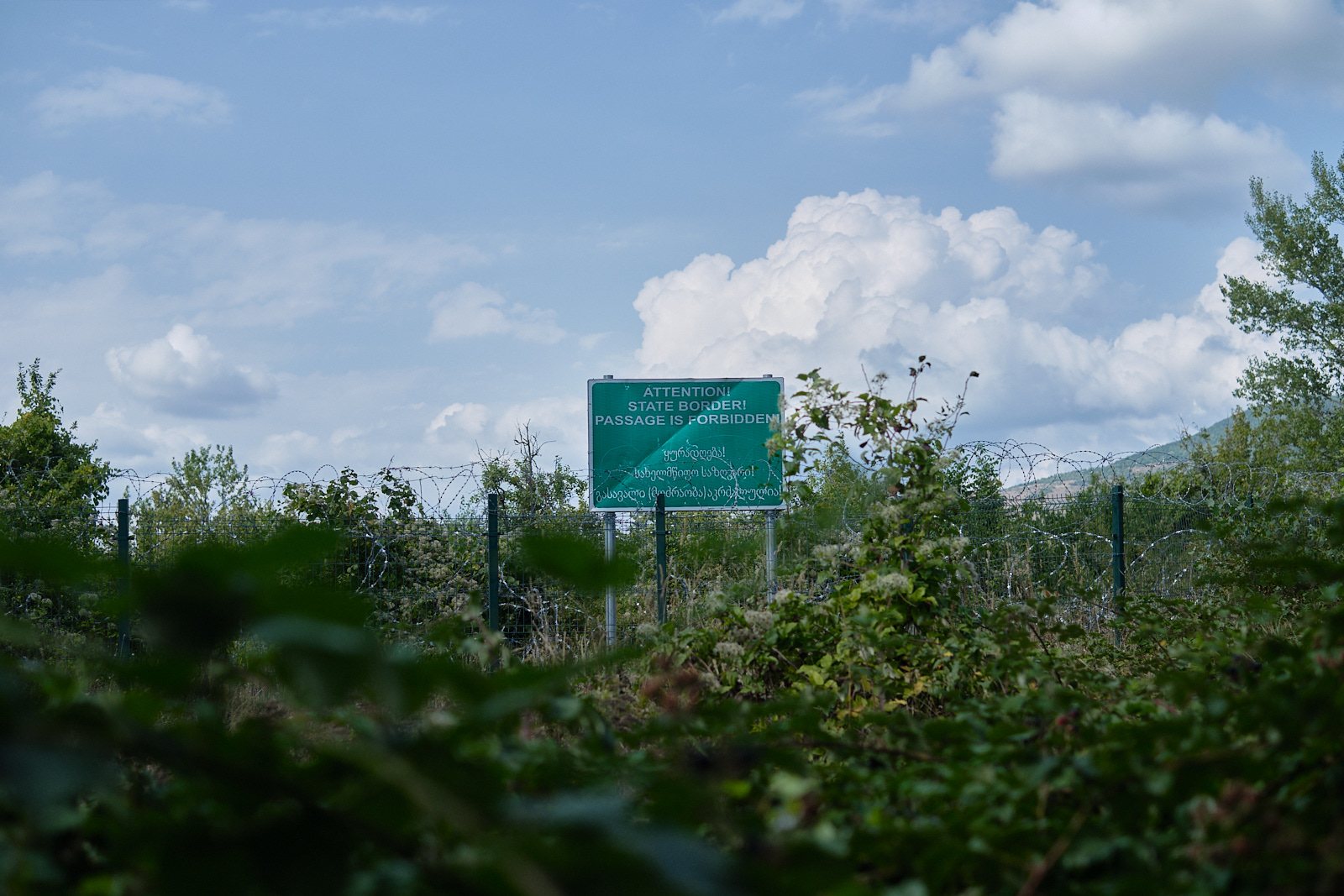
Silence filled the car once the road turned, as we drove along the highway toward Gori, Georgia, past a stretch of fields set against the hills. There, the Administrative Boundary Line (ABL) runs, separating Georgia from the region many Georgians remember as Samachablo, now known as South Ossetia. On one side, Tbilisi controls the territory; on the other, separatist authorities in Tskhinvali and Russian influence. In between lie villages where families live alongside an increasingly militarized de facto frontier, one that continues to advance slowly and inexorably since the 2008 war. Among these villages is Ergneti, where we were heading, beyond a security line set by the Georgian police, whose authorization and escort were mandatory.
After passing the Georgian patrol, the car set off slowly again along roads that grew narrower and less paved, lined with houses as grey as the leaden sky above us. People peeked out of their windows, their faces surprised at the sight of our unfamiliar faces. They followed us with their eyes until there was nothing left in front of us but a wall of watchtowers, military posts, and a long stretch of barbed wire. To the left of the wall, two flags fluttered on the fence of a gate leading to a neat and well-kept house: one Georgian, one European. That was Lia Chlachidze’s house, our destination. She stood at the entrance, welcoming us in.
“I apologize for the procedure. There are many police officers around here. Over time, you get used to it,” Chlachidze said.

Lia’s Basement
Once you pass through the gate, you realize you have entered a unique place: a small, quiet, immaculately kept space that feels far removed from the barbed-wire fence just a few meters away. After the Russo-Georgian war of 2008, Chlachidze turned part of her house into a small museum dedicated to the memory of the conflict. To reach it, you have to go beneath the house, into the basement, where thick stone walls preserve the memory of those who experienced war on the front line. “At the end of the conflict, I found my home in ruins, so I decided to collect what remained of it and keep it,” she said, walking among the objects she has collected over the years.
Inside the museum, there are panels, photographs, fragments of explosive ordnance and letters from the children, women and men who became victims of the bombings when Ergneti became a theater of war. “This is Ergneti during the rain of bombs in 2008,” Chlachidze said, showing me a photograph. “Those were days when it felt as if we were in hell.” She pointed at the photograph taken right after the conflict reached the village: houses reduced to rubble, empty streets, and families who could not flee.
“The war literally entered our homes, and these objects are among the few witnesses left to tell that story.” As Lia spoke, a dim light fell over the objects carefully arranged in every corner of the room. All of them were bound together within a long coil of barbed wire, the same barbed wire that runs along the ABL.
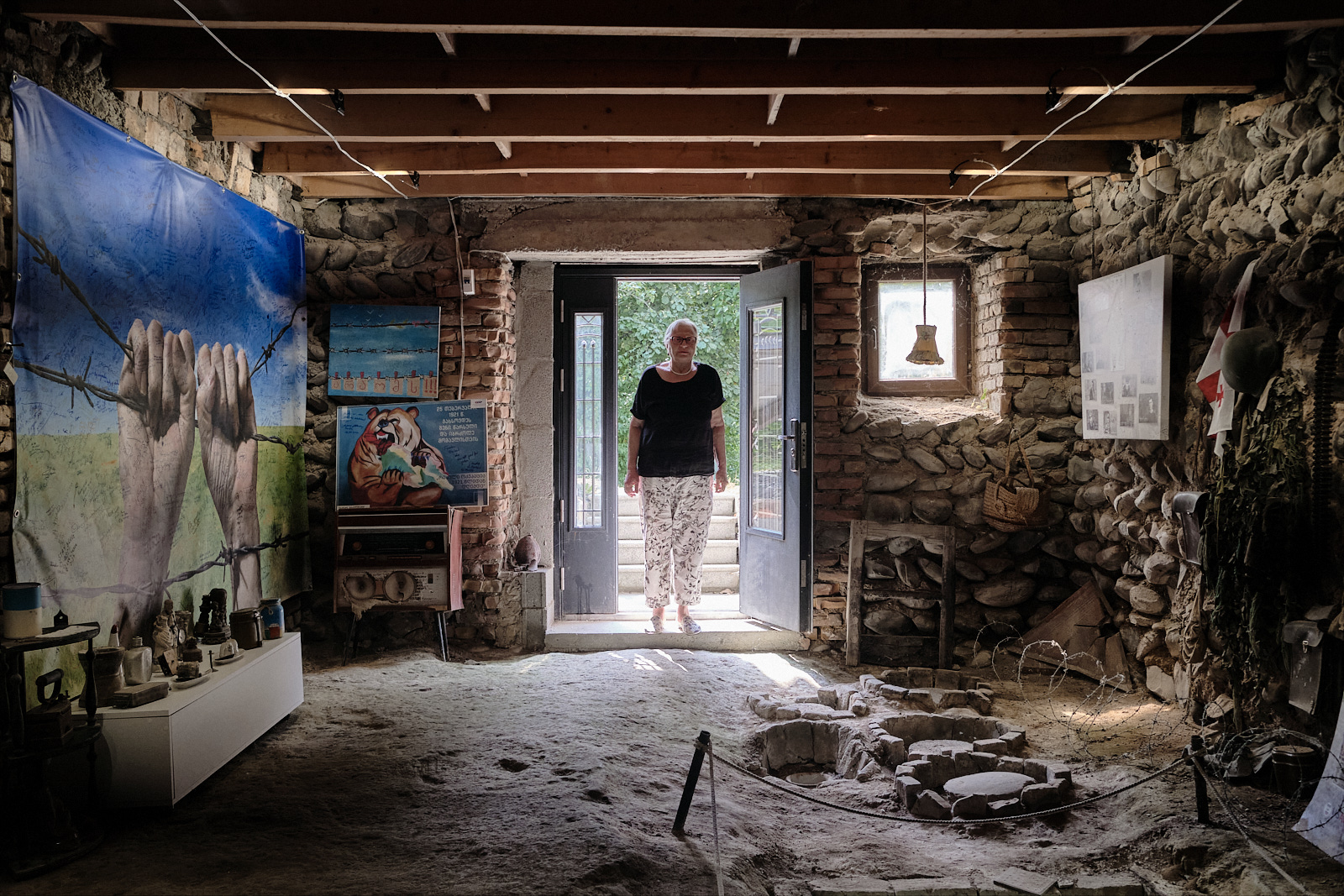

In one corner, the glassy eyes of the dolls stare into space; their hair tousled and frizzy, and their torn, time-worn clothes still stained with the dust from the explosions that have never been removed. “Those toys belonged to my children when they were little,” Chlachidze said. “I found them right here, outside the house, when I returned from Tbilisi ten days after the ceasefire.”
A little higher up on the walls hung camouflage military uniforms worn during the conflict to crawl unseen through the bushes, unusual uniforms for people who, only days earlier, had been ordinary civilians. “These young men had been farmers, workers and traders. Then, almost overnight, they found themselves carrying weapons to protect their homes,” Chlachidze said, pointing to the framed photographs of young men with pale faces and faded names above their black-and-white portraits.
“In those days, people took up arms, some by choice, others by unfortunate necessity, to protect their homes,” Lia said as she took a seat on an old chair, her gaze drifting toward one of the room’s few small windows, through which a faint light filtered in.
“You know, when the first rifle is picked up, the day of defeat has already arrived, because there is no going back from war: it is a spiral of pain and hatred that we human beings have not yet learned to uproot.”


It is from the bottom of this spiral that the museum was born. The idea was rooted in a pain that needed to be shared and felt, within the cold foundations of Chlachidze’s house of memory. “It is important to me that people relive every aspect of those days; they must understand the amount of violence and the pain that was caused.”
Today, the museum is one of the few places in Georgia that bears witness to the brutality inflicted on Ergneti. Its homes were shelled and set alight, its fields were strewn with landmines and unexploded shells, and its survivors were left to carry a trauma that has hardened into an endless cycle of revenge. For Chlachidze, it is also an attempt to prevent that memory from being rewritten, erased, or taken over by interpretations of those who did not live through the conflict firsthand.
“I believed this museum had to be born in Ergneti, because throughout history, this place has been a point of connection between peoples, not only between Ossetians and Georgians, but across the whole Caucasus,” she said.
The decision to place it in Ergneti was also influenced by its proximity to Tskhinvali, so that ethnic Ossetians might know the museum exists and one day be able to visit it.
“The museum was not created only to remember the suffering inflicted on this village, but above all, as a place of reconciliation for Georgians and Ossetians. A place where people can meet and reflect on the pain caused by both sides.”
This liminal position gives the museum its strength, and at the same time its deepest fragility. Literally situated on the de facto border, it is the offspring of a conflict which appears frozen in time rather than resolved, with growing tensions along the barbed wire fueling hate as well as the possibility of renewed violence. “I know this is an almost impossible mission, but I am moved by the strength of my childhood memories, of a time when our peoples lived peacefully and without hatred,” she said. “Maybe this is what still gives me strength: the fact that I have never stopped feeling like a child from that time.”

The Girl from Tskhinvali
Chlachidze was born in 1952 in the Tskhinvali region, present-day South Ossetia, a region many Georgians still remember as Samachablo. Today, although it lies only a few kilometers from Georgia-controlled territory, it is a place she can visit only through her childhood memories, which were beautiful and radiant, imbued with the hope of a united future.
“I belonged to that generation, pioneering in a way, that was trying to build a cohesive community where ethnic Ossetians and Georgians could live as one people,” she said.
She went to school in Tskhinvali before graduating from the North Ossetian Pedagogical Institute and becoming a history teacher in Rustavi, a village near Tskhinvali. “We all lived together, Georgians and Ossetians, like neighbors,” she says. “Looking back on those days, I still do not understand how a wave of hostility emerged between us. What happened is that, slowly and silently, a language of hatred fuelled by propaganda made its way into our community.”
In the late 1980s, as the Soviet Union began to fall apart and Georgia’s national movement, led by Zviad Gamsakhurdia, gained strength, relations between Georgians and Ossetians began to change. Since 1922, South Ossetia had held limited autonomy within Soviet Georgia, when the Bolsheviks created the oblast following earlier ethnic conflict between Georgians and Ossetians. In November 1989, Tskhinvali asked for the region to be upgraded to an autonomous republic, a move Tbilisi saw as a threat to Georgia’s territorial integrity.
“I still remember that day, November 23, 1989,” Lia says. “Thousands of Georgians arrived in Tskhinvali, in buses and in a multitude of cars.”
The mobilization was led by Georgian nationalists, and its intention still remains contested: the organizers described it as a peaceful march, while many Ossetians perceived the mass arrival of Georgians as an act of aggression. “At that moment, the police blocked the way to Tskhinvali,” Chlachidze said. “It was the Georgian police, because South Ossetia was still under Georgian jurisdiction at the time.”

The political crisis soon turned into armed conflict. A year later, in December 1990, the Georgian parliament, then dominated by Gamsakhurdia’s nationalist movement, abolished the South Ossetian Autonomous Oblast. In the months that followed, Tskhinvali and the villages around the city were drawn into a spiral of violence. “Unfortunately, our politicians acted without enough prudence,” she said. “They thought this conflict with the Ossetians would be easy to resolve, but it was not.”
Two years after the first mobilization, on November 23, 1991, her husband, Zakaria Chlachidze, was killed during the clashes. Lia was 38 then, and had three young children. “At that moment I felt completely lost, and it was only because of my love for my children that I decided not to give up.” She decided to leave Tskhinvali: a place she no longer recognized as home and that felt increasingly distant day after day.
“Since then, I have been at war for 30 years. There has not been a single quiet night,” she said.
Ergneti before the Barbed Wire
Chlachidze moved to Ergneti, a small village in Georgian territory near Tskhinvali, the de facto capital of South Ossetia today. A road that once connected Gori to Tskhinvali crosses the village. After the war of 1991–92 and the subsequent ceasefire, it was in Ergneti that the two peoples found the opportunity to get closer again.
“It all began when an elderly woman from Ergneti had an idea to go near Tskhinvali and set up a small stand to sell her apples. They sold very quickly. Surprised, she went back again, this time with a proper table of goods, together with another elderly friend, and once again everything sold very fast. Soon word spread through Ergneti, and people saw it as an important economic opportunity. Other Georgians from villages around Ergneti followed them, and then people came from all over Georgia to buy and sell goods here. A sack of flour cost eight lari at the time. Who would not have come for a price like that?”
Within a few years, that stretch of road became one of the main spaces of informal exchange in the Caucasus. “Traders came from Georgia, Ossetia, Russia, Armenia and Azerbaijan,” Chlachidze said. “People stayed for days in Ergneti because of the long journeys they undertook to benefit from the market and its highly profitable economy,” she added.
“During that period I witnessed scenes I had not seen for a long time: people from different countries of the Caucasus slept in the same room, cooked and shared boiled eggs for breakfast,” she said, her eyes wistful with memories. “I myself made rooms in my house available to rent to traders; it was a way to be hospitable, and not only that, it was profitable too.”
“Since the market opened, between 2,000 and 3,000 people had settled in Ergneti, all of them earning a living directly or indirectly from the market,” said Nino Lomarja, an EU-certified peacebuilder based in Gori who works on the ground to document and gather information on best practices for dialogue and reconciliation between Georgian and Ossetian communities. “In a way, this created a real form of international grassroots diplomacy, where people began to find a common language: a trade as free as it was informal.”
In a short time, Ergneti became a strategic trading point and the center of a vast informal economy across the Caucasus. However, the lack of a clear legal framework led to many illegal activities around the Ergneti market.
“There were so many different currencies and so much money circulating. It is incredible to see how something so big could emerge from such a small trading system,” Chlachidze said. “And yet, despite all this, something special was happening: Georgians and Ossetians were meeting again, not because someone had ordered them to, but because they needed one another.”
In 2004, Georgian authorities closed the market. For the government, it was a system fueled by smuggling activities that had damaged state revenues and hence was brought to an end. On the other hand, residents and peacebuilding advocates said it represented a spontaneous space of relationship that was cut off and soon disappeared. “Closing the market didn’t just bring trade to an end; it also severed the everyday relationships that people from both sides had rebuilt there,” Lomarja explained. “From that moment onwards, incidents, kidnappings, violence, and new fears gradually caused Ergneti to stop being an open threshold facing a border that didn’t appear on any maps, but which would soon lead to new tensions.”
Preserving the Memory of the War
Ergneti became a front line once again in August 2008, when the old wound of the 1990s began to bleed again with tensions, shooting, and mutual accusations intensifying along the separation line. On the night of August 7 and the day after, the Georgian offensive on Tskhinvali turned the decades-old crisis into open war. Russia’s response was not long in coming: their troops crossed the Roki Tunnel, South Ossetia’s principal road connection with Russia, then advanced into Georgia-controlled territory.
The most intense fighting lasted only a few days, but the bombings and the violence that followed erased everything. “Childhood memories, personal belongings: everything had disappeared or had been destroyed, among pieces of shells and bombs lodged in the earth and in the walls,” Chlachidze said.
For years, Chlachidze collected the remains and objects she recovered from the ruins in the basement of her house. “When I began collecting what was left after the bombings, many residents of Ergneti offered to help me,” she said. Soon, she realized that every object was one piece of a shared story, one that not only must not be forgotten, but also had to be made known to those who were suffering the effects of war without ever having experienced it themselves.
“I believe it is essential to preserve these objects and their story, not so much for me as for future generations,” she said. She pointed her finger towards the window through which the barbed-wire fence could be seen running just a few meters from the house. “Today they live beside barbed wire whose existence seems normal to them. We tell them that we were born in villages that no longer exist, or of which only ruins remain. They play in the gardens of their homes under police escort, as if this were normal, but it is not,” she said, as her voice, until then calm and measured, began to tremble. “They must know why they live in this condition, and the reasons behind such a difficult life.”
Along a Hardening Border
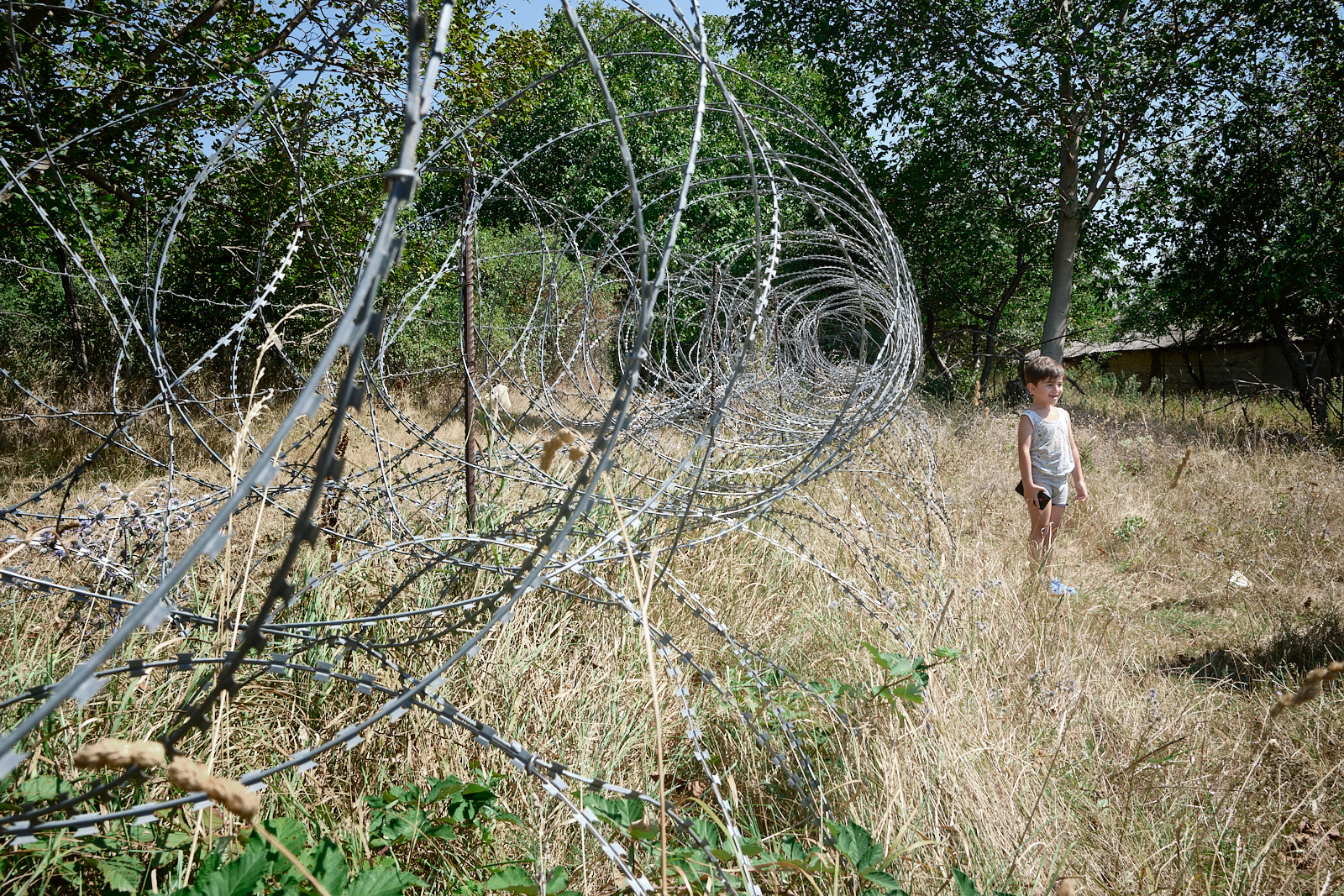
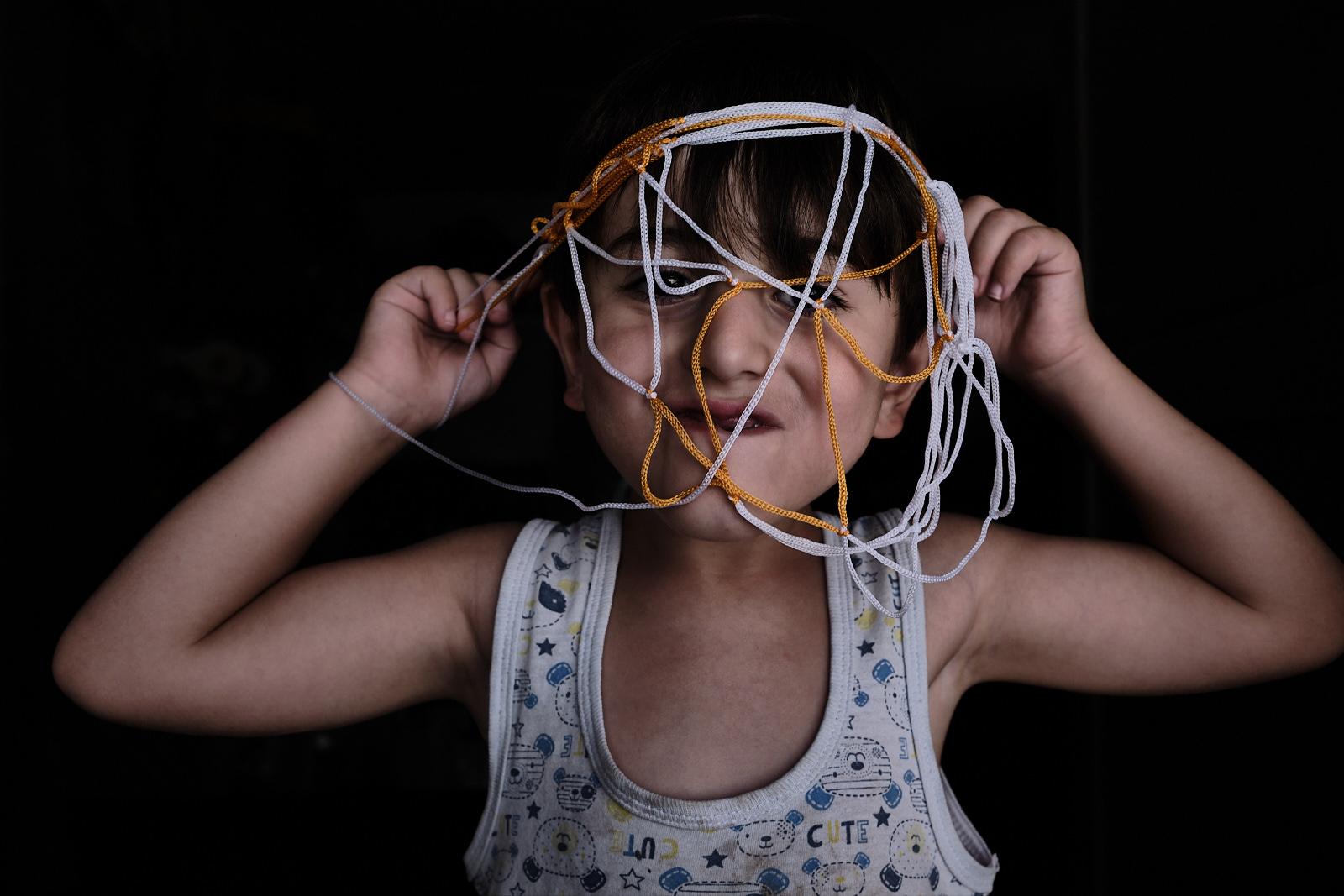
Although younger generations are increasingly leaving villages along the ABL, many families with nowhere else to go continue to raise their children alongside barbed wire that silently draws ever closer to their homes, depriving them of essential services, including access to school, transport, and even phone connections. These are the effects of so-called “borderization”, as defined by the European Union Monitoring Mission (EUMM): the progressive transformation of a border area into an armed frontier, where barbed wire and firing positions advance silently, and with them the abuses that the dwindling number of residents still living in these villages have to endure. The reason is as simple as it is cruel: the separatist authorities want them to leave, because as long as even one Georgian remains along this strip of land, the barbed wire may surround their garden, but it cannot enter it, cannot advance a single centimeter further.
“Our families and their children often live isolated from the outside world,” Nino Tibilova said. Ossetian by birth and a resident of Ergneti by choice, Tibilova decided to move from Tskhinvali after meeting her future husband. Today she lives with her family in the house next to Chlachidze’s, where she runs a small learning center for children.
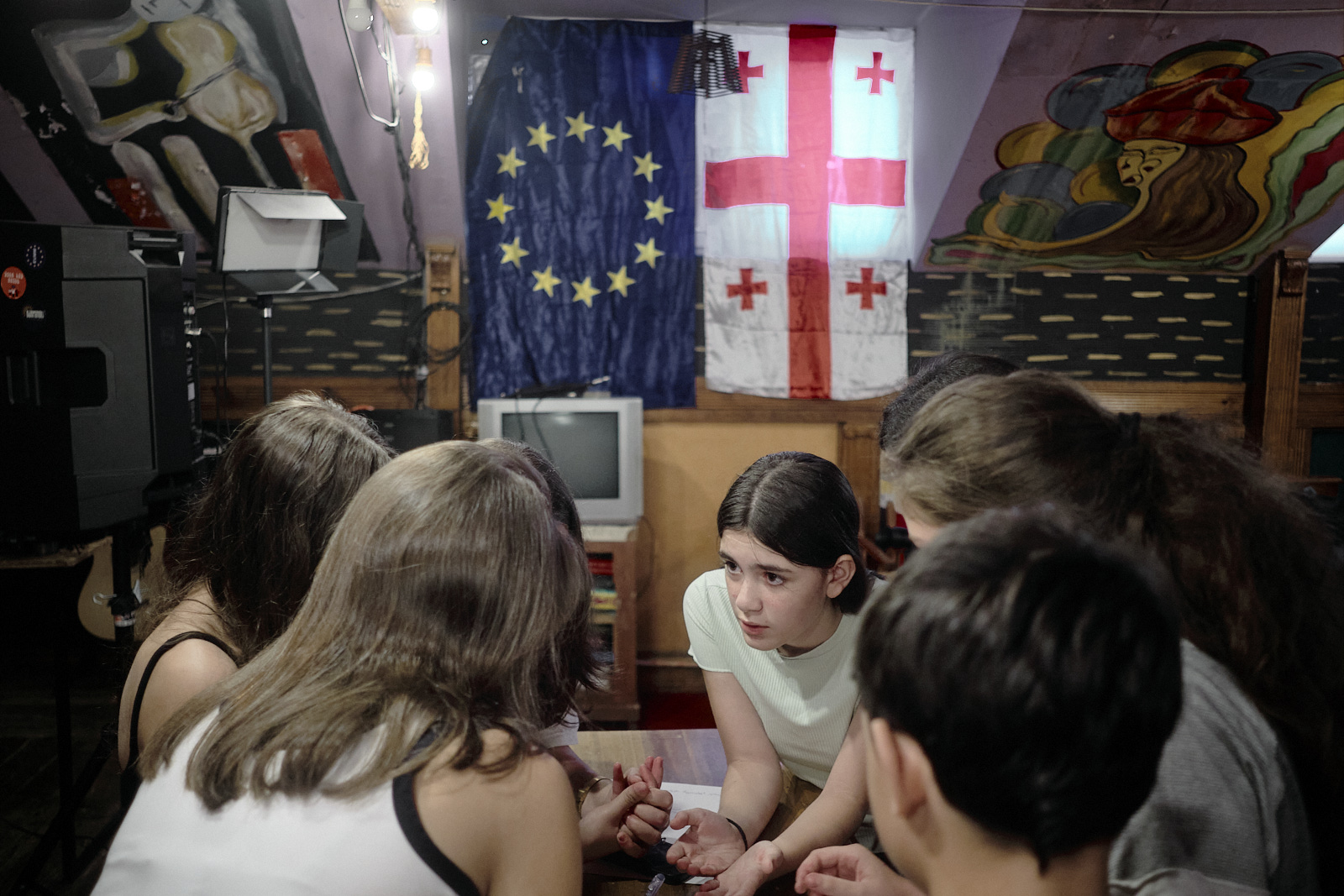
“Here we organize lessons and, of course, school trips to Lia’s museum both for children of Ergneti and from Tskhinvali too,” Tibilova said. “Before, it was easier to invite young Ossetians to the museum, to organize meetings between Ossetian and Georgian children. But today, with tensions intensifying along the ABL, together with propaganda and the new restrictions imposed by the current government, it is practically impossible to organize new meetings. Borderization suffocates every ambition and every possibility of change.”
Although it might appear barely visible, or a scattered and disjointed presence along the de facto border, borderization follows a precise strategy aimed at enclosing homes along the ABL with barbed wire, gradually isolating the families and depriving them of access to basic necessities. “The separatist authorities and Russian soldiers still present along the border proceed systematically, slowly and undisturbed. They want the villagers to leave, and for this reason they frighten us, and sometimes abduct us, accusing us of having crossed the de facto border,” Tibilova said. “But they are the ones advancing the barbed wire. “They do it deliberately, because as long as one of us remains, we can testify that they are slowly taking more and more land.”
“Too little is said about how the occupied areas have changed in recent years, especially since the invasion of Ukraine,” Chlachidze said. “One example is the forest near the village of Chorchana, occupied by Russian forces in 2019. Since then, roads have been carved through it and military positions have been set up.”
According to the most recent EUMM reports on the conflict in Georgia, since Russia’s invasion of Ukraine, the militarization process along the ABL has hardly slowed. On the contrary, new fences, observation posts, and military infrastructure have been recorded, while restrictions, arrests, and everyday mistreatment have increased for residents of the villages along the line.
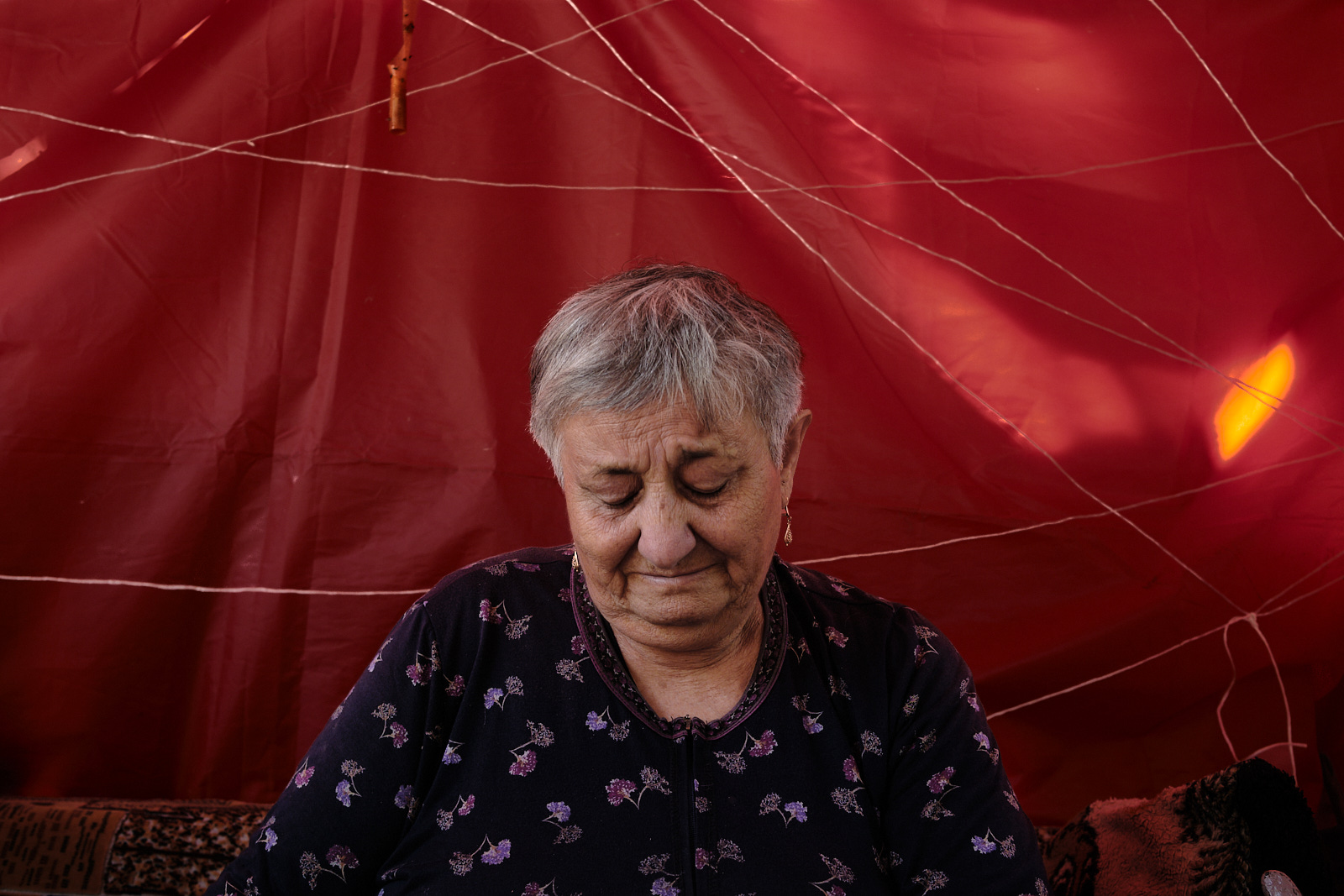
In the Geneva International Discussions, the safe and voluntary return of people displaced in Georgia to the occupied regions of Abkhazia and South Ossetia remains blocked by the walkout of Russian, Abkhaz, and South Ossetian representatives. Meanwhile, residents who remain in the occupied regions face severe restrictions on crossing into Tbilisi-administered territory, including limited opening periods, selective permits and arbitrary closures. Finally, on the ground, the line keeps creeping forward. Between September 2025 and February 2026, the European mission recorded more than 1,800 meters of new fencing in the Tskhinvali region, or South Ossetia, along with new detentions and a further strengthening of control mechanisms.


Georgia’s Authoritarian Turn
The tensions and growing pressures faced by residents of Ergneti and many other villages along the ABL are increasingly being recognized against the backdrop of a deeper political and diplomatic transformation unfolding in Georgia since the disputed elections of October 2024.
“The effects of this diplomatic friction have reached us here in Ergneti,” Chlachidze said. “Although the work of the EUMM has not stopped, and the Ergneti Incident Prevention and Response Mechanism (IPRM) continues to meet, channels for reconciliation have been pushed into the background, while routes between territories controlled by the de facto Ossetian authorities and Tbilisi-administered territory have become more heavily monitored and harder to cross.”
Shortly after the election and the formation of the new government backed by the Georgian Dream party, Prime Minister Irakli Kobakhidze announced that the opening of accession talks with the European Union would be postponed until 2028, dealing a sharp setback to Georgia’s European path. That December, the election of Mikheil Kavelashvili to the presidency, backed by Georgian Dream, further intensified the confrontation with the domestic opposition and accelerated the country’s drift away from Brussels, with repercussions for the already fragile channels of dialogue with the occupied regions of South Ossetia and Abkhazia.
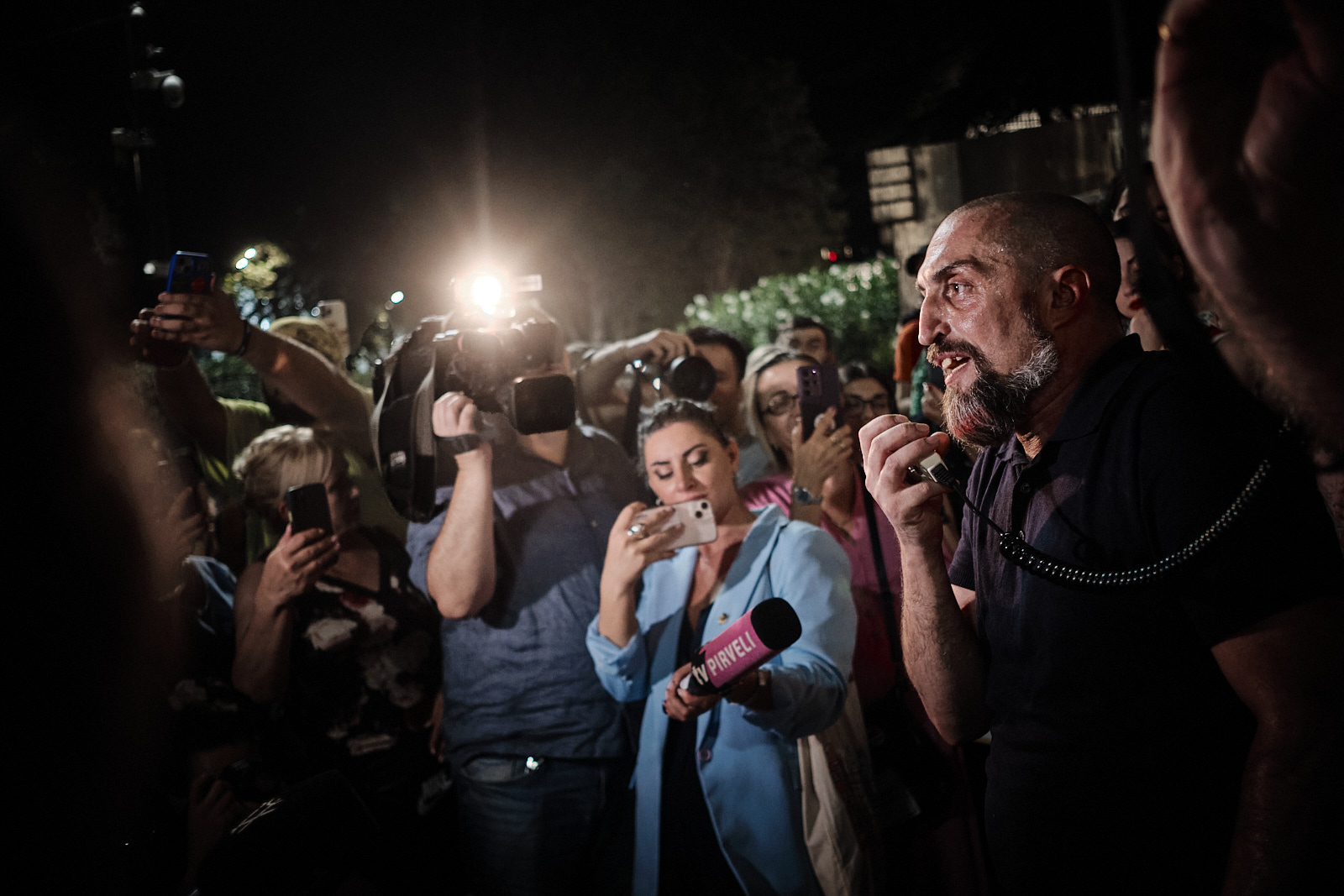
A clear expression of this new course came in 2025, with the introduction of a new law on foreign agents and further restrictions on foreign funding for local organizations and groups. When the Foreign Agents Registration Act was adopted in April 2025, Maria Telalian, Director of the ODINHR, the Human Rights and Democracy Office of the OSCE (Organization for Security and Co-operation in Europe), warned that it “profoundly impacts the work of civil society and all those working to defend human rights.” In this new condition, the space for independent monitoring and programs supported by international partners along the de facto borders has gradually narrowed.
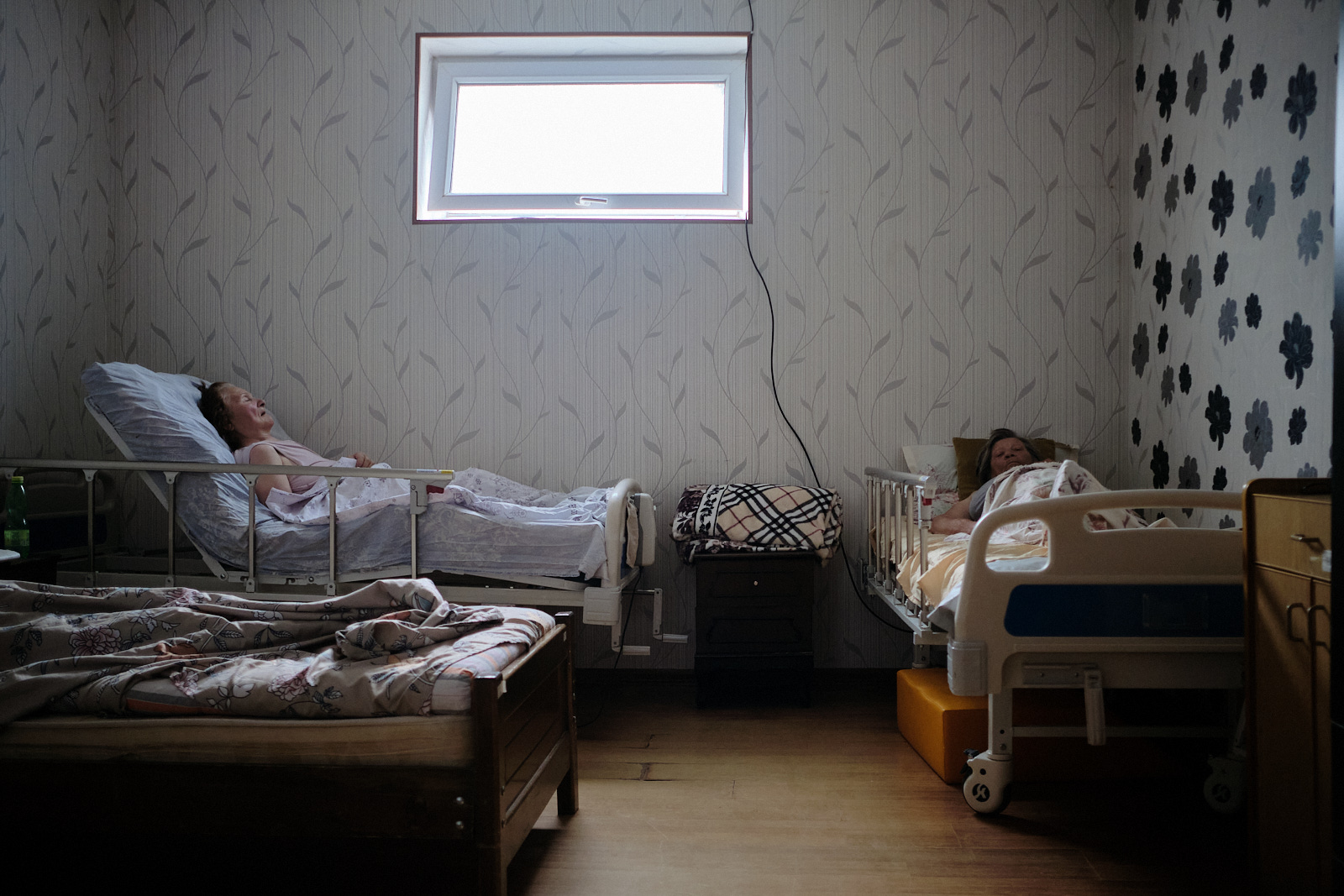
“For years, many Ossetians crossed the border to receive treatment in Georgian hospitals or to participate in programs supported by European partners. However, many of these initiatives have now been suspended, have become less visible or are more difficult to access,” said Luda Salia, who worked as a nurse in Tskhinvali in her youth, now the founder of Home Without Borders, a nursing home located in Khurvaleti that provides care to Georgians and Ossetians along ABL. “These were small steps, certainly not enough, but together they represented a beginning, or at least a glimmer of hope. They brought Ossetians and Georgians together so that they could see for themselves that we are not the monsters that propaganda continues to portray,” Salia added.
While reconciliation programs are increasingly being obstructed, the administration and annexation of the occupied regions does not seem to be a priority on the government’s agenda either. In this context, the abolition of the provisional South Ossetian administration, announced by Parliament Speaker Shalva Papuashvili and approved by the Georgian Dream majority with effect from January 1, 2026, has taken on, for many Georgians, a strong symbolic meaning, becoming a clear indication of the government’s intentions.
“Created by Tbilisi in 2007 as part of its policy of peaceful resolution, the provisional administration was intended to provide a Georgian-backed alternative to the de facto authorities in Tskhinvali, which are highly dependent on and influenced by Moscow,” said Chlachidze.
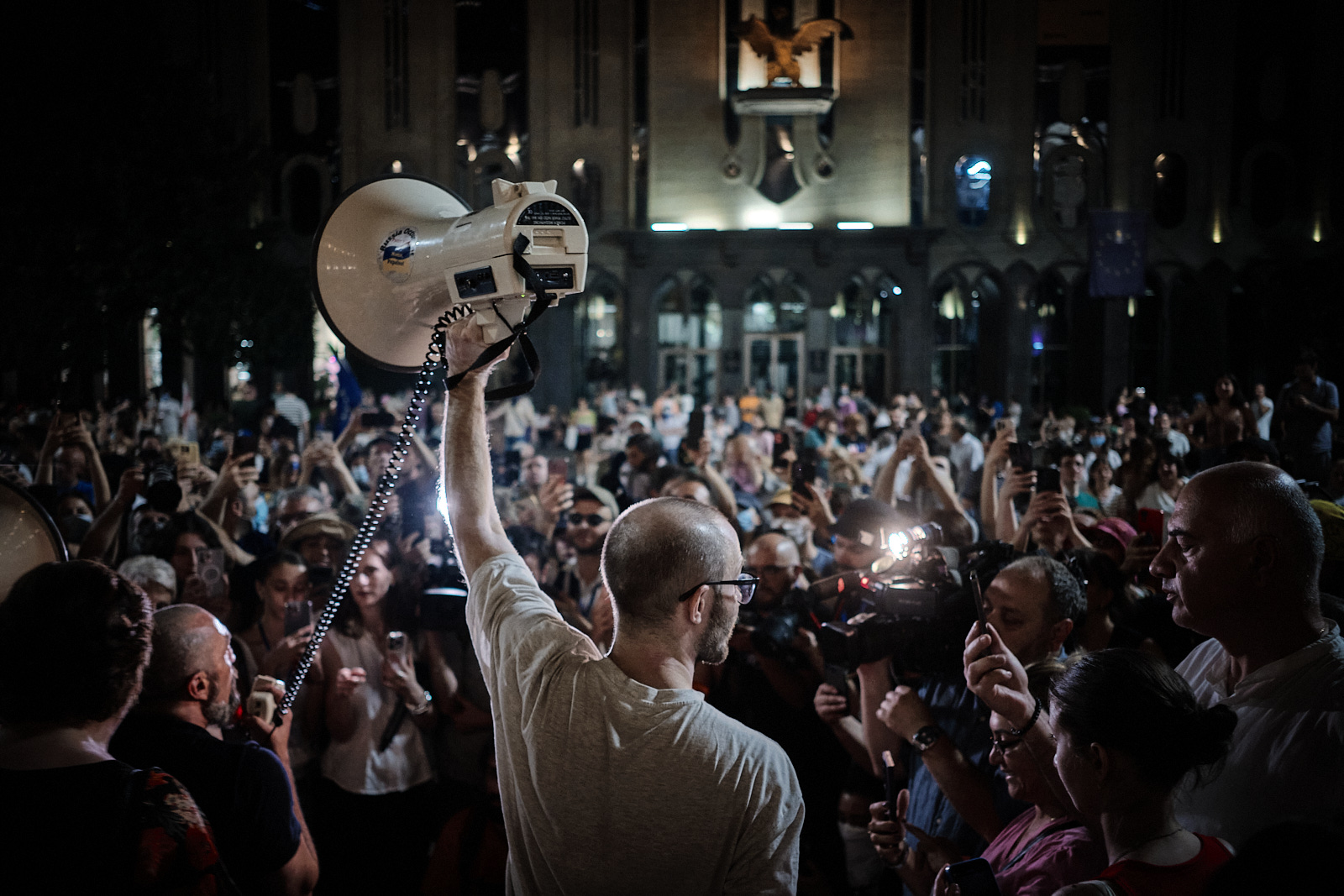
In May 2024, the Georgian Parliament approved the law on the “transparency of foreign influence”, often compared to Russia’s “foreign agents” legislation. The law required media outlets and non-governmental organizations receiving foreign funding to register as entities pursuing a foreign power’s interests. Georgian Dream defended the measure as a safeguard for transparency and sovereignty.
Then-President Salome Zourabichvili, one of the most prominent pro-European voices in Georgia’s institutions, quickly opposed the measure. After vetoing the law in May, she described it as “Russian in its essence and spirit” and warned that it represented “an obstacle to our European path,” but the Parliament later overrode her veto. The Venice Commission, the Council of Europe’s advisory body on constitutional law, urged Georgia to repeal the law and warned its “fundamental flaws” would have “significant negative consequences” for freedom of association and expression, privacy and participation in public affairs.
Meanwhile, Russian influence in Tskhinvali continues to grow, as does the region’s dependence on Moscow. On May 9 this year, at the Kremlin, Vladimir Putin and South Ossetia’s leader Alan Gagloev signed a new agreement on allied cooperation, which Georgian analysts and organizations interpreted as another step toward the region’s absorption into Russia’s political, economic and institutional space. A few weeks later, Gagloev resigned as de facto leader to become an adviser to Putin in the Russian presidential administration, saying he would work to implement the treaty and link it to South Ossetia’s long-declared goal of incorporation into Russia. The landscape seems to point to a divided future, marked by hostility and concern for those who still live in the villages along the ABL.
“It is frustrating,” Lia said. “I have lived a life in war, and I know I will not have time to see reconciliation. That is why the museum matters. Today, cultivating memory is more important than ever, so that what happened will never happen again.”


What the Barbed Wire Cannot Erase: A History Teacher’s Museum Between Georgia and Ossetia

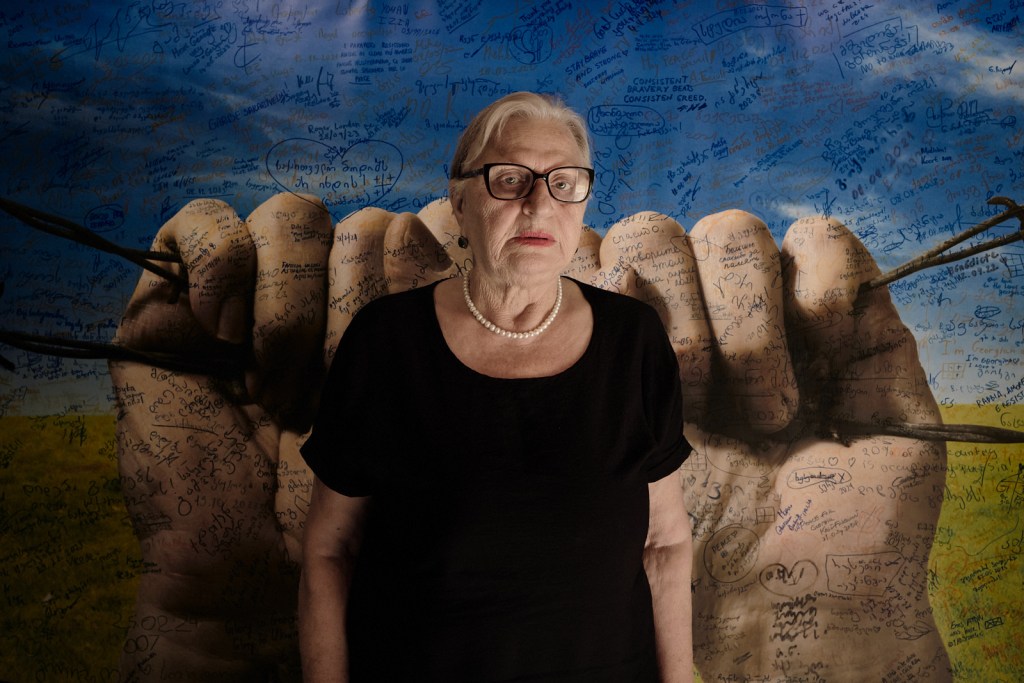
Lia Chlachidze, founder of the Ergneti Museum of Memory, in front of an installation covered with visitors’ signatures and messages, near the Administrative Boundary Line, Georgia. Photo: Fabio Lovati.
Silence filled the car once the road turned, as we drove along the highway toward Gori, Georgia, past a stretch of fields set against the hills. There, the Administrative Boundary Line (ABL) runs, separating Georgia from the region many Georgians remember as Samachablo, now known as South Ossetia. On one side, Tbilisi controls the territory; on the other, separatist authorities in Tskhinvali and Russian influence. In between lie villages where families live alongside an increasingly militarized de facto frontier, one that continues to advance slowly and inexorably since the 2008 war. Among these villages is Ergneti, where we were heading, beyond a security line set by the Georgian police, whose authorization and escort were mandatory.
After passing the Georgian patrol, the car set off slowly again along roads that grew narrower and less paved, lined with houses as grey as the leaden sky above us. People peeked out of their windows, their faces surprised at the sight of our unfamiliar faces. They followed us with their eyes until there was nothing left in front of us but a wall of watchtowers, military posts, and a long stretch of barbed wire. To the left of the wall, two flags fluttered on the fence of a gate leading to a neat and well-kept house: one Georgian, one European. That was Lia Chlachidze’s house, our destination. She stood at the entrance, welcoming us in.
“I apologize for the procedure. There are many police officers around here. Over time, you get used to it,” Chlachidze said.
Lia’s Basement
Once you pass through the gate, you realize you have entered a unique place: a small, quiet, immaculately kept space that feels far removed from the barbed-wire fence just a few meters away. After the Russo-Georgian war of 2008, Chlachidze turned part of her house into a small museum dedicated to the memory of the conflict. To reach it, you have to go beneath the house, into the basement, where thick stone walls preserve the memory of those who experienced war on the front line. “At the end of the conflict, I found my home in ruins, so I decided to collect what remained of it and keep it,” she said, walking among the objects she has collected over the years.
Inside the museum, there are panels, photographs, fragments of explosive ordnance and letters from the children, women and men who became victims of the bombings when Ergneti became a theater of war. “This is Ergneti during the rain of bombs in 2008,” Chlachidze said, showing me a photograph. “Those were days when it felt as if we were in hell.” She pointed at the photograph taken right after the conflict reached the village: houses reduced to rubble, empty streets, and families who could not flee.
“The war literally entered our homes, and these objects are among the few witnesses left to tell that story.” As Lia spoke, a dim light fell over the objects carefully arranged in every corner of the room. All of them were bound together within a long coil of barbed wire, the same barbed wire that runs along the ABL.
In one corner, the glassy eyes of the dolls stare into space; their hair tousled and frizzy, and their torn, time-worn clothes still stained with the dust from the explosions that have never been removed. “Those toys belonged to my children when they were little,” Chlachidze said. “I found them right here, outside the house, when I returned from Tbilisi ten days after the ceasefire.”
A little higher up on the walls hung camouflage military uniforms worn during the conflict to crawl unseen through the bushes, unusual uniforms for people who, only days earlier, had been ordinary civilians. “These young men had been farmers, workers and traders. Then, almost overnight, they found themselves carrying weapons to protect their homes,” Chlachidze said, pointing to the framed photographs of young men with pale faces and faded names above their black-and-white portraits.
“In those days, people took up arms, some by choice, others by unfortunate necessity, to protect their homes,” Lia said as she took a seat on an old chair, her gaze drifting toward one of the room’s few small windows, through which a faint light filtered in.
“You know, when the first rifle is picked up, the day of defeat has already arrived, because there is no going back from war: it is a spiral of pain and hatred that we human beings have not yet learned to uproot.”
It is from the bottom of this spiral that the museum was born. The idea was rooted in a pain that needed to be shared and felt, within the cold foundations of Chlachidze’s house of memory. “It is important to me that people relive every aspect of those days; they must understand the amount of violence and the pain that was caused.”
Today, the museum is one of the few places in Georgia that bears witness to the brutality inflicted on Ergneti. Its homes were shelled and set alight, its fields were strewn with landmines and unexploded shells, and its survivors were left to carry a trauma that has hardened into an endless cycle of revenge. For Chlachidze, it is also an attempt to prevent that memory from being rewritten, erased, or taken over by interpretations of those who did not live through the conflict firsthand.
“I believed this museum had to be born in Ergneti, because throughout history, this place has been a point of connection between peoples, not only between Ossetians and Georgians, but across the whole Caucasus,” she said.
The decision to place it in Ergneti was also influenced by its proximity to Tskhinvali, so that ethnic Ossetians might know the museum exists and one day be able to visit it.
“The museum was not created only to remember the suffering inflicted on this village, but above all, as a place of reconciliation for Georgians and Ossetians. A place where people can meet and reflect on the pain caused by both sides.”
This liminal position gives the museum its strength, and at the same time its deepest fragility. Literally situated on the de facto border, it is the offspring of a conflict which appears frozen in time rather than resolved, with growing tensions along the barbed wire fueling hate as well as the possibility of renewed violence. “I know this is an almost impossible mission, but I am moved by the strength of my childhood memories, of a time when our peoples lived peacefully and without hatred,” she said. “Maybe this is what still gives me strength: the fact that I have never stopped feeling like a child from that time.”
The Girl from Tskhinvali
Chlachidze was born in 1952 in the Tskhinvali region, present-day South Ossetia, a region many Georgians still remember as Samachablo. Today, although it lies only a few kilometers from Georgia-controlled territory, it is a place she can visit only through her childhood memories, which were beautiful and radiant, imbued with the hope of a united future.
“I belonged to that generation, pioneering in a way, that was trying to build a cohesive community where ethnic Ossetians and Georgians could live as one people,” she said.
She went to school in Tskhinvali before graduating from the North Ossetian Pedagogical Institute and becoming a history teacher in Rustavi, a village near Tskhinvali. “We all lived together, Georgians and Ossetians, like neighbors,” she says. “Looking back on those days, I still do not understand how a wave of hostility emerged between us. What happened is that, slowly and silently, a language of hatred fuelled by propaganda made its way into our community.”
In the late 1980s, as the Soviet Union began to fall apart and Georgia’s national movement, led by Zviad Gamsakhurdia, gained strength, relations between Georgians and Ossetians began to change. Since 1922, South Ossetia had held limited autonomy within Soviet Georgia, when the Bolsheviks created the oblast following earlier ethnic conflict between Georgians and Ossetians. In November 1989, Tskhinvali asked for the region to be upgraded to an autonomous republic, a move Tbilisi saw as a threat to Georgia’s territorial integrity.
“I still remember that day, November 23, 1989,” Lia says. “Thousands of Georgians arrived in Tskhinvali, in buses and in a multitude of cars.”
The mobilization was led by Georgian nationalists, and its intention still remains contested: the organizers described it as a peaceful march, while many Ossetians perceived the mass arrival of Georgians as an act of aggression. “At that moment, the police blocked the way to Tskhinvali,” Chlachidze said. “It was the Georgian police, because South Ossetia was still under Georgian jurisdiction at the time.”
The political crisis soon turned into armed conflict. A year later, in December 1990, the Georgian parliament, then dominated by Gamsakhurdia’s nationalist movement, abolished the South Ossetian Autonomous Oblast. In the months that followed, Tskhinvali and the villages around the city were drawn into a spiral of violence. “Unfortunately, our politicians acted without enough prudence,” she said. “They thought this conflict with the Ossetians would be easy to resolve, but it was not.”
Two years after the first mobilization, on November 23, 1991, her husband, Zakaria Chlachidze, was killed during the clashes. Lia was 38 then, and had three young children. “At that moment I felt completely lost, and it was only because of my love for my children that I decided not to give up.” She decided to leave Tskhinvali: a place she no longer recognized as home and that felt increasingly distant day after day.
“Since then, I have been at war for 30 years. There has not been a single quiet night,” she said.
Ergneti before the Barbed Wire
Chlachidze moved to Ergneti, a small village in Georgian territory near Tskhinvali, the de facto capital of South Ossetia today. A road that once connected Gori to Tskhinvali crosses the village. After the war of 1991–92 and the subsequent ceasefire, it was in Ergneti that the two peoples found the opportunity to get closer again.
“It all began when an elderly woman from Ergneti had an idea to go near Tskhinvali and set up a small stand to sell her apples. They sold very quickly. Surprised, she went back again, this time with a proper table of goods, together with another elderly friend, and once again everything sold very fast. Soon word spread through Ergneti, and people saw it as an important economic opportunity. Other Georgians from villages around Ergneti followed them, and then people came from all over Georgia to buy and sell goods here. A sack of flour cost eight lari at the time. Who would not have come for a price like that?”
Within a few years, that stretch of road became one of the main spaces of informal exchange in the Caucasus. “Traders came from Georgia, Ossetia, Russia, Armenia and Azerbaijan,” Chlachidze said. “People stayed for days in Ergneti because of the long journeys they undertook to benefit from the market and its highly profitable economy,” she added.
“During that period I witnessed scenes I had not seen for a long time: people from different countries of the Caucasus slept in the same room, cooked and shared boiled eggs for breakfast,” she said, her eyes wistful with memories. “I myself made rooms in my house available to rent to traders; it was a way to be hospitable, and not only that, it was profitable too.”
“Since the market opened, between 2,000 and 3,000 people had settled in Ergneti, all of them earning a living directly or indirectly from the market,” said Nino Lomarja, an EU-certified peacebuilder based in Gori who works on the ground to document and gather information on best practices for dialogue and reconciliation between Georgian and Ossetian communities. “In a way, this created a real form of international grassroots diplomacy, where people began to find a common language: a trade as free as it was informal.”
In a short time, Ergneti became a strategic trading point and the center of a vast informal economy across the Caucasus. However, the lack of a clear legal framework led to many illegal activities around the Ergneti market.
“There were so many different currencies and so much money circulating. It is incredible to see how something so big could emerge from such a small trading system,” Chlachidze said. “And yet, despite all this, something special was happening: Georgians and Ossetians were meeting again, not because someone had ordered them to, but because they needed one another.”
In 2004, Georgian authorities closed the market. For the government, it was a system fueled by smuggling activities that had damaged state revenues and hence was brought to an end. On the other hand, residents and peacebuilding advocates said it represented a spontaneous space of relationship that was cut off and soon disappeared. “Closing the market didn’t just bring trade to an end; it also severed the everyday relationships that people from both sides had rebuilt there,” Lomarja explained. “From that moment onwards, incidents, kidnappings, violence, and new fears gradually caused Ergneti to stop being an open threshold facing a border that didn’t appear on any maps, but which would soon lead to new tensions.”
Preserving the Memory of the War
Ergneti became a front line once again in August 2008, when the old wound of the 1990s began to bleed again with tensions, shooting, and mutual accusations intensifying along the separation line. On the night of August 7 and the day after, the Georgian offensive on Tskhinvali turned the decades-old crisis into open war. Russia’s response was not long in coming: their troops crossed the Roki Tunnel, South Ossetia’s principal road connection with Russia, then advanced into Georgia-controlled territory.
The most intense fighting lasted only a few days, but the bombings and the violence that followed erased everything. “Childhood memories, personal belongings: everything had disappeared or had been destroyed, among pieces of shells and bombs lodged in the earth and in the walls,” Chlachidze said.
For years, Chlachidze collected the remains and objects she recovered from the ruins in the basement of her house. “When I began collecting what was left after the bombings, many residents of Ergneti offered to help me,” she said. Soon, she realized that every object was one piece of a shared story, one that not only must not be forgotten, but also had to be made known to those who were suffering the effects of war without ever having experienced it themselves.
“I believe it is essential to preserve these objects and their story, not so much for me as for future generations,” she said. She pointed her finger towards the window through which the barbed-wire fence could be seen running just a few meters from the house. “Today they live beside barbed wire whose existence seems normal to them. We tell them that we were born in villages that no longer exist, or of which only ruins remain. They play in the gardens of their homes under police escort, as if this were normal, but it is not,” she said, as her voice, until then calm and measured, began to tremble. “They must know why they live in this condition, and the reasons behind such a difficult life.”
Along a Hardening Border
Although younger generations are increasingly leaving villages along the ABL, many families with nowhere else to go continue to raise their children alongside barbed wire that silently draws ever closer to their homes, depriving them of essential services, including access to school, transport, and even phone connections. These are the effects of so-called “borderization”, as defined by the European Union Monitoring Mission (EUMM): the progressive transformation of a border area into an armed frontier, where barbed wire and firing positions advance silently, and with them the abuses that the dwindling number of residents still living in these villages have to endure. The reason is as simple as it is cruel: the separatist authorities want them to leave, because as long as even one Georgian remains along this strip of land, the barbed wire may surround their garden, but it cannot enter it, cannot advance a single centimeter further.
“Our families and their children often live isolated from the outside world,” Nino Tibilova said. Ossetian by birth and a resident of Ergneti by choice, Tibilova decided to move from Tskhinvali after meeting her future husband. Today she lives with her family in the house next to Chlachidze’s, where she runs a small learning center for children.
“Here we organize lessons and, of course, school trips to Lia’s museum both for children of Ergneti and from Tskhinvali too,” Tibilova said. “Before, it was easier to invite young Ossetians to the museum, to organize meetings between Ossetian and Georgian children. But today, with tensions intensifying along the ABL, together with propaganda and the new restrictions imposed by the current government, it is practically impossible to organize new meetings. Borderization suffocates every ambition and every possibility of change.”
Although it might appear barely visible, or a scattered and disjointed presence along the de facto border, borderization follows a precise strategy aimed at enclosing homes along the ABL with barbed wire, gradually isolating the families and depriving them of access to basic necessities. “The separatist authorities and Russian soldiers still present along the border proceed systematically, slowly and undisturbed. They want the villagers to leave, and for this reason they frighten us, and sometimes abduct us, accusing us of having crossed the de facto border,” Tibilova said. “But they are the ones advancing the barbed wire. “They do it deliberately, because as long as one of us remains, we can testify that they are slowly taking more and more land.”
“Too little is said about how the occupied areas have changed in recent years, especially since the invasion of Ukraine,” Chlachidze said. “One example is the forest near the village of Chorchana, occupied by Russian forces in 2019. Since then, roads have been carved through it and military positions have been set up.”
According to the most recent EUMM reports on the conflict in Georgia, since Russia’s invasion of Ukraine, the militarization process along the ABL has hardly slowed. On the contrary, new fences, observation posts, and military infrastructure have been recorded, while restrictions, arrests, and everyday mistreatment have increased for residents of the villages along the line.
In the Geneva International Discussions, the safe and voluntary return of people displaced in Georgia to the occupied regions of Abkhazia and South Ossetia remains blocked by the walkout of Russian, Abkhaz, and South Ossetian representatives. Meanwhile, residents who remain in the occupied regions face severe restrictions on crossing into Tbilisi-administered territory, including limited opening periods, selective permits and arbitrary closures. Finally, on the ground, the line keeps creeping forward. Between September 2025 and February 2026, the European mission recorded more than 1,800 meters of new fencing in the Tskhinvali region, or South Ossetia, along with new detentions and a further strengthening of control mechanisms.
Georgia’s Authoritarian Turn
The tensions and growing pressures faced by residents of Ergneti and many other villages along the ABL are increasingly being recognized against the backdrop of a deeper political and diplomatic transformation unfolding in Georgia since the disputed elections of October 2024.
“The effects of this diplomatic friction have reached us here in Ergneti,” Chlachidze said. “Although the work of the EUMM has not stopped, and the Ergneti Incident Prevention and Response Mechanism (IPRM) continues to meet, channels for reconciliation have been pushed into the background, while routes between territories controlled by the de facto Ossetian authorities and Tbilisi-administered territory have become more heavily monitored and harder to cross.”
Shortly after the election and the formation of the new government backed by the Georgian Dream party, Prime Minister Irakli Kobakhidze announced that the opening of accession talks with the European Union would be postponed until 2028, dealing a sharp setback to Georgia’s European path. That December, the election of Mikheil Kavelashvili to the presidency, backed by Georgian Dream, further intensified the confrontation with the domestic opposition and accelerated the country’s drift away from Brussels, with repercussions for the already fragile channels of dialogue with the occupied regions of South Ossetia and Abkhazia.
A clear expression of this new course came in 2025, with the introduction of a new law on foreign agents and further restrictions on foreign funding for local organizations and groups. When the Foreign Agents Registration Act was adopted in April 2025, Maria Telalian, Director of the ODINHR, the Human Rights and Democracy Office of the OSCE (Organization for Security and Co-operation in Europe), warned that it “profoundly impacts the work of civil society and all those working to defend human rights.” In this new condition, the space for independent monitoring and programs supported by international partners along the de facto borders has gradually narrowed.
“For years, many Ossetians crossed the border to receive treatment in Georgian hospitals or to participate in programs supported by European partners. However, many of these initiatives have now been suspended, have become less visible or are more difficult to access,” said Luda Salia, who worked as a nurse in Tskhinvali in her youth, now the founder of Home Without Borders, a nursing home located in Khurvaleti that provides care to Georgians and Ossetians along ABL. “These were small steps, certainly not enough, but together they represented a beginning, or at least a glimmer of hope. They brought Ossetians and Georgians together so that they could see for themselves that we are not the monsters that propaganda continues to portray,” Salia added.
While reconciliation programs are increasingly being obstructed, the administration and annexation of the occupied regions does not seem to be a priority on the government’s agenda either. In this context, the abolition of the provisional South Ossetian administration, announced by Parliament Speaker Shalva Papuashvili and approved by the Georgian Dream majority with effect from January 1, 2026, has taken on, for many Georgians, a strong symbolic meaning, becoming a clear indication of the government’s intentions.
“Created by Tbilisi in 2007 as part of its policy of peaceful resolution, the provisional administration was intended to provide a Georgian-backed alternative to the de facto authorities in Tskhinvali, which are highly dependent on and influenced by Moscow,” said Chlachidze.
In May 2024, the Georgian Parliament approved the law on the “transparency of foreign influence”, often compared to Russia’s “foreign agents” legislation. The law required media outlets and non-governmental organizations receiving foreign funding to register as entities pursuing a foreign power’s interests. Georgian Dream defended the measure as a safeguard for transparency and sovereignty.
Then-President Salome Zourabichvili, one of the most prominent pro-European voices in Georgia’s institutions, quickly opposed the measure. After vetoing the law in May, she described it as “Russian in its essence and spirit” and warned that it represented “an obstacle to our European path,” but the Parliament later overrode her veto. The Venice Commission, the Council of Europe’s advisory body on constitutional law, urged Georgia to repeal the law and warned its “fundamental flaws” would have “significant negative consequences” for freedom of association and expression, privacy and participation in public affairs.
Meanwhile, Russian influence in Tskhinvali continues to grow, as does the region’s dependence on Moscow. On May 9 this year, at the Kremlin, Vladimir Putin and South Ossetia’s leader Alan Gagloev signed a new agreement on allied cooperation, which Georgian analysts and organizations interpreted as another step toward the region’s absorption into Russia’s political, economic and institutional space. A few weeks later, Gagloev resigned as de facto leader to become an adviser to Putin in the Russian presidential administration, saying he would work to implement the treaty and link it to South Ossetia’s long-declared goal of incorporation into Russia. The landscape seems to point to a divided future, marked by hostility and concern for those who still live in the villages along the ABL.
“It is frustrating,” Lia said. “I have lived a life in war, and I know I will not have time to see reconciliation. That is why the museum matters. Today, cultivating memory is more important than ever, so that what happened will never happen again.”