



A young woman, Shikha, driven by her ambitions and pursuit of wealth and status, rejects Rahul, who is in love with her, believing he is a small-time employee at her workplace. The trouble is, he is actually a millionaire businessman hiding his identity to test her loyalty. Shikha, obviously, has failed the test spectacularly and is now being called “gold digger kahin ki” (gold digger from somewhere), which also happens to be the name of the allegedly most-watched Indian microdrama series in the country this January, clocking a whopping 210 million views according to its host platform, StoryTV. As of September 4, the series has clocked in 318.5 million views on its app.
For the uninitiated, microdramas are ultra-short, serialized shows made vertically for phone consumption in the 9:16 aspect ratio, with each episode lasting no more than three minutes. Built around cliffhangers, melodrama, romance, revenge, or fantasy plots, these short-form genre plays are designed to reel in audiences who need a dopamine hit of instant gratification.
The pacing is quick, the horizontally restrictive frames favor close-up shots, and the dialogue is high-pitched, both in decibels and in theatrics, to heighten the drama. In one of the first episodes of Gold Digger Kahin Ki, Shikha’s mother asks her whether she invited the shabby-looking Rahul to a swanky cocktail party. “No, mom,” Shikha responds. “Main kyun iss fatichar ko yahan bulaaungi?” (“Why should I invite this ragamuffin here?”).
This answer invites the choicest taunt from her mother, who says to Rahul, while exaggeratedly flailing her arms around, “Oh! Toh tum yahan khud hi chale aye? Maan na maan, main tera mehmaan? (“You just showed up here on your own? Like ‘Whether you accept it or not, I am your guest?’”).

The novelty isn’t in the stories’ themes; they’re spiritual sequels to Indian soaps, packaged in a format meant to be more addictive. Microdramas are designed specifically for a viewership with dwindling attention spans due to chronic doomscrolling on social media, where most Indian microdrama audiences first encounter them, according to a 2026 report by META and Ormax Media. As a result, the writing process is molded by compression, speed, and constraint, with engagement often taking precedence over depth.
The Ormax report also notes that over 90% of the sample watches it solo—in other words, consumption, evaluation, and behavior formation largely happen at an individual level, without social influence.
Owing to their vertical frame, microdrama scripts also favor frontal exchanges, minimal movement, and fewer characters per frame, thereby flattening spatial storytelling and making dialogue sharper and more immediate. Combined with platform logic—in which content is consumed in quick, often solitary bursts—microdramas are more reactive and data-driven than television, where feedback is slower, and viewing is more collective.
Each series is divided into 50 to 100 episodes. As a result, unlike TV’s relatively buffered production cycles, microdramas have to operate at speed, often releasing multiple shows in a week and demanding rapid turnaround, which pushes writers to produce volume rather than refine individual scripts. Storytelling shifts from narrative progression to retention design, with episodes functioning as short escalation beats built around hook, tension, and payoff teases.
When it comes to embracing microdramas, India has followed China’s lead, with the format exploding in 2022 before evolving into a massive industry in 2023-24, eventually even outpacing Chinese box office revenue in 2024. Notably, the Indian microdrama industry was born not in Mumbai or the film industries down South—but in Bengaluru’s tech hubs.
The Indian microdrama market has already crossed $300 million in its first year—2025—according to a report by gaming and media venture fund Lumikai, which also estimates that the sector could reach $4.5 billion by 2030.
The average budget for an Indian microdrama ranges from ₹15 to 30 lakh, and the team usually comprises a creative director or producer, a writer, a cinematographer, a crew, and actors. “It’s like television on steroids,” said Ariah Agarwal, a television and OTT actor who has featured in several microdramas. Agarwal’s observation reveals an overlap not only in talent between the TV and microdrama industries, but also in themes. The dramas frequently recycle the hyper-patriarchal and misogynistic tropes long embedded in soap operas, but repackage them for private, mobile-first consumption.
The Decline of TV
In the last three years, nearly 50 TV channels surrendered their licenses amid falling viewership and advertising revenue. Broadcasters, including major players such as JioStar, Zee Entertainment, Sony Pictures Networks India, ABP Network and NDTV, have either shut channels down or scaled back their expansion plans. JioStar surrendered licenses for channels such as MTV Beats, VH1, Comedy Central and Colors Odia, while Sony gave up 26 channel permissions as part of a restructuring exercise. Enter10 Media, which operates the highly watched Hindi General Entertainment Channel (GEC), Dangal, abandoned plans to launch Dangal HD and Dangal Oriya after a strategic review. Meanwhile, ABP shut ABP News HD, and NDTV dropped plans for a Gujarati news channel.
The slowdown comes as audiences migrate to streaming platforms and DD Free Dish, eroding the traditional pay-TV market.
So, between 2018 and 2025, the Indian cable television industry lost an estimated 577,000 jobs. “That leaves us with only 4-5 major GECs with eight slots for shows throughout the day. It’s finite, and everyone is fighting to fit in there,” said Urvashi Bagtharia, executive producer at Zee TV. “So the ones who couldn’t make it in television—since it’s much harder to find your way into the film world once you’ve done television, because they don’t take you very seriously—microdramas have stepped in and given them employment.”
This means a semblance of a steadier stream of work, given the significantly shorter turnaround times of microdramas, compared to television projects that go on for months, if not years.
Bagtharia has her hands full with her ongoing Hindi TV show Ganga Mai Ki Betiyan (Mother Ganga’s Daughters), which launched in September 2025 and has already crossed the 300-episode mark—a rare success following the microdrama boom. It’s about Ganga Mai, a woman abandoned by her husband for not bearing a son, who goes on to raise her three daughters in Varanasi, battling social stigma, family conflicts, and injustice as she helps them build independent lives. Ganga Mai Ki Betiyan has been among the most-watched shows on Indian television since its launch, according to TRP ratings. Millions tune in every day—including on weekends—to watch her saga at 9 PM, one of the most coveted slots for GECs.
Bagtharia, who has clocked nearly a decade in the industry, is in no mood to leave it. For her, the job is creatively satisfying. She knows that her round-the-clock workday, with mostly working weekends, entertains the person living in the last mile of India. And that’s enough motivation for her to carry on.
She explained the math behind the budgets for a 30-minute TV show, including ad breaks. “We are usually assigned an average budget per episode, which is shot over 2-3 days,” shared Bagtharia, explaining that the 6-7 PM slot shows have a budget of roughly ₹7-8 lakh per episode, while an 8-9 PM slot will be allotted about ₹12 lakh. “Everything—from paying the actors, spot people, make-up and hair artists, directors, caterers, electricity, water, set—has to fit into that budget.”
For scale, she cites the example of popular television actor Sharad Kelkar, who is currently the lead in Zee TV’s 8.30 PM show Tumm Se Tum Tak (From You To You), which has been on air since July 2025. He charges ₹5 lakh per episode, while a top-tier director for a primetime show charges around ₹70,000 per episode—and all of these fees are factored into the per-episode budget.
Yet, a crew has an average size of 20-25 people per episode, which includes members of the production team, like line producers who look after the logistics and set requirements, and supervising producers who handle budgets; members from the channel; a team of 4-5 writers, like the broad story writer who works on the larger narrative, an episodic writer, a screenplay writer and a dialogue writer; and the directors’ team, which includes assistant directors as well.
Considering that every microdrama series is shot on what would be considered a shoestring budget, even for the lowest of low-budget films in India, especially in the Hindi or Southern film industries, each series is shot in an average of four to five days–- a week, if one is being generous. This also means a heavily downsized crew of not more than 10-12 people, which allows production companies to wrap up shooting an entire microdrama series on a budget that would allow only two to four episodes to be filmed for a TV show.
Television production is grueling work, Bagtharia said, that often entails playing to the gallery of patriarchy, but with every new show, the audience expects novelty only in terms of the faces they see. “Where will the actors go, then, after a project ends? It’s good that microdramas have happened, because they can get work there. Moreover, we aren’t competing for the same audience’s attention,” she said.
The TV-watching audience like her mother and aunt, according to Bagtharia, has no idea what microdramas are. “So even if the talent working across these industries are the same, they’re not catering to the same set of people,” she said.
Microdramas have evidently crept into and exploited the cracks left by a rapidly shifting entertainment landscape. Much like television, once the post-pandemic streaming content boom cooled, the aggressive commissioning race slowed. It has been widely reported that this let-up has made it increasingly difficult for production houses to convert speculatively greenlit projects, due to slower approvals and a growing backlog of content. Streaming rights for films in India have fallen by around 30%, while satellite rights have corrected by 50-60%.
A Predatory Ecosystem
Sulagna Chatterjee has been a screenwriter for over a decade, with projects like Amazon Mini TV’s Adulting (2018–2022), Voot Select’s Code M (2020–Present), and Zee5’s The Verdict: State Vs Nanavati (2019) to her credit. But streaming commissions and television work have lost some steam in the recent past, thereby shrinking the space for new talent to enter the industry.
In December of 2025, Chatterjee’s former colleague and manager, Nidhi Dev (pseudonym), reached out to her, saying she could get a good deal with KukuTV, one of the leading microdrama platforms in India, launched in February 2025, with 10 million paid subscribers (they have a 1-day trial period for ₹1, and then ₹699 for 3 months), offering content in Hindi, Telugu, Tamil, Malayalam, Kannada, and Bengali. However, their flagship YouTube channel is Hindi-dominant, as is their rollout and marketing strategy. The focus on Hindi-language content seems to be the case for most of its competitors as well, such as Story TV, Rocket Reels, Bullet, QuickTV, and Fatafat by Amazon MX Player. Chatterjee wrote for the platform in Hindi.
“Since I had worked with Nidhi before and she was liaising with KukuTV, she said she would be able to get me ₹2.5 lakh for writing between 40 and 50 episodes of one series,” Chatterjee said. This equates to around 75 minutes of screenplay.
To put things into perspective, a 90-minute-long screenplay could qualify for a full-length feature film that takes months, sometimes even years, to develop. The recommended minimum fee for a full script is ₹12 lakh for films with budgets below ₹5 crore, and ₹24 lakh for films with budgets between ₹5 crore and ₹15 crore, according to the “Minimum Basic Contract” framework set in 2019 by the Screenwriters’ Association.
But owing to the nascent stage the microdrama industry is currently in, guardrails to protect talent interests and ensure fair pay have yet to be established.
Chatterjee wasn’t particularly keen on signing up for a microdrama writing gig, given the pace and nature of writing they demand. But the sector’s dire straits and her ever-inflating bills compelled her to reconsider. “What’s the worst that’ll happen?” she told herself. “I’ll not be proud of the work that I have done, and thank god they’ve not credited me for those shows.”
Chatterjee signed the KukuTV deal—even if it meant pandering to hyperbolic emotions, outlandish themes of secret identities, hidden lives, and outrageous misogyny, all mashed up into a roughly 90-minute story written in two to six days.
In the microdrama world, creative control still lies heavily with management and marketing teams, with data and search volumes determining what gets greenlit and what doesn’t. Within that, writers are left with very little room to innovate. As someone who has always strived to bring queer and other marginalized narratives into the mainstream, Chatterjee struggled. “I was doing this completely out of broke-ness. I was crying a river every night,” she recalled. Her former manager, however, encouraged her to power through, considering it was “easy money, even if it means killing your soul a little.”
She ended up writing two series for the platform: the first is about a talented chef who, to honor the final wish of the uncle who raised her, marries a stranger she has never even met. A while later, she joins a cooking reality show and is eliminated by a celebrity chef who then offers her a job. She soon discovers he is her husband, sparking a complicated relationship shaped by secrets, power struggles, trust, and attraction.
In the second—now listed under WowTV, another microdrama platform owned by KukuFM with its own, separate subscriber base—a mute man becomes the perfect target for his cheating wife and her lover, who believe he cannot expose their affair. When he unexpectedly regains his voice, he stays silent, allowing their lies, schemes, and crimes to unravel on their own.
As of September 4, the former had registered 11.4 million views, while the latter had over 2 million.
“When I was writing one of them, I was asked by the platform to watch two of their past shows that had done well, and they wanted me to recreate similar beats and arcs,” Chatterjee said. When she tried to play around with the characters by adding depth and texture, she was asked to “forget all of that” and to drum up the villainy for the female lead and the “humiliation arc”—another trope popular in Indian microdramas following in the footsteps of their Chinese counterparts. One other platform that pitched a series to Chatterjee asked her to “not think cinema at all.” “It basically meant that I needed to shut my writer’s brain off completely,” she said.
By March 2026, KukuTV stopped communicating with her without stating any explicit reasons. It’s been six months since Chatterjee last worked on a microdrama, and she does not miss it at all. “I still believe I am among the lucky few who got paid as much as I did, because I know people who have written microdramas for as little as ₹15,000,” she said.
Worse still, some haven’t been paid.
Writers Stuck in a Catch-22
In April this year, Jio entered the microdrama race with Tadka, an integrated platform in its JioHotstar app, and launched with 100-plus shows. Reports also suggest that major Bollywood studios like Yash Raj Films and Shah Rukh Khan’s Red Chillies Entertainment are looking to expand into the vertical format as well.
The Kuku Technologies ecosystem—comprising KukuFM, its flagship audio storytelling platform; KukuTV; and Guru, its flagship learning app—has witnessed one of the most rapid expansions within India’s entertainment landscape, coinciding with KukuTV’s launch in 2024. According to early-June reports, it has filed an IPO with the Securities and Exchange Board of India (SEBI). The company is targeting a valuation of up to ₹15,000 crore, and the proposed offering is expected to comprise a mix of fresh shares and an offer-for-sale by existing investors, towards the end of this year.
Kunj Sanghvi, Vice President, Kuku—the Bengaluru-based regional-language parent company of KukuTV, launched in 2018 by three former IIT graduates—sees the microdrama boom as an opportunity to plug the gaps in an unsteady television and OTT ecosystem.
Kuku Technologies reported revenue of more than ₹1,400 crore in FY26, up from about ₹240 crore in FY25. The company plans to use the proceeds from the IPO to invest in technology and AI infrastructure, content creation, and international expansion.
According to Sanghvi, this means brighter days are around the corner for the Indian entertainment industry. He said that while film and television remain largely unorganized, microdramas offer a semblance of structure, given their genesis in the country’s corporate capital.
But what Chatterjee was making as a microdrama writer seems to be way above the industry’s own standards, where the per-series writers’ fees range between ₹15,000 for the completely inexperienced and ₹1.5 lakh for the experienced. In January 2025, Prateek Dadheech, a former TV writer, was offered to write a 60-episode microdrama series for a leading platform, with a turnaround time of two weeks at ₹1 lakh for the whole series. “I was told that this is a good deal because I come from a television writing background, and that the same company was getting writers to write for ₹60,000 or less,” Dadheech said. He declined the offer.
Simran Chaubey (pseudonym), a Mumbai-based senior writer, was contacted in October 2025 by a producer duo she has known for years to write a series for an “upcoming microdrama platform for Indian audiences, even the diaspora, funded by a UAE-based producer.” They had agreed to pay her ₹1 lakh for the series.
They decided to run with a story that Chaubey had been developing over the years and felt lent itself to the microdrama format. Chaubey had a longer turnaround time of over two weeks for this assignment. She was given ₹15,000 upfront as the signing amount, with ₹40,000 due before the start of the shoot by the Indian producers who had recruited her, and with whom she had signed a contract.
The final balance was due after the UAE partners concluded the shoot. For five months, Chaubey and the producers’ messages on unpaid dues went unanswered. Finally, in the sixth month, they received their payments. “My [producer] friends have got f*cked over, too. But they had offered to pay me half of that balance amount out of their own pockets. The show isn’t out, but my idea and my work are now with them,” Chaubey said.
Dadheech is now a Creative Director at Terribly Tiny Tales (TTT), a Mumbai-based digital storytelling and content company that began in 2013 as a micro-fiction page on Facebook and currently produces microdramas. He was among the lucky few who could choose to switch to microdramas after spending six years as a Hindi television writer. But he doesn’t have a straightforward answer for why he made that choice. “Writers, I’d like to believe, are driven by a strong sense of purpose and self—that’s ideally the place they draw from when they create something,” he said. “But when the economy is this broken, and the ecosystem feels so predatory, do they even have the bandwidth to think about those things anymore? When they’re constantly moving from project to project, paycheck to paycheck, just trying to stay afloat?”
Last year, when Arya Vyas (pseudonym), a talent manager and creative producer at one of the leading microdrama platforms in India, entered the microdrama industry, their company asked them to scout for senior writers from Bollywood at ₹60,000 per series. Vyas remembers being reprimanded by a veteran writer, who said that they were sullying their goodwill with industry folks by offering work that pays abysmally, while also requesting them to do something they’re mostly “not proud of”.
When Vyas started, writers were onboarded for ₹2.5 lakhs per series; six months later, that number was slashed to ₹1.5 lakhs. “I don’t know what changed in those few months, but I remember speaking to another person who worked at the platform and had been scouting for far longer than I have—and has now quit—said that they remember feeling guilty for having to offer writers rates like ₹30,000 or ₹50,000 for a series. I know a few who were brought on board for even ₹15,000, and we know all along that they’re getting a bad deal,” Vyas said.
Microdrama writers in India are thus stuck in a Catch-22. Even if working on microdramas isn’t creatively or financially satisfying, most writers struggle to turn down the industry’s exploitative offers, because there’s not much else to fall back on. And that is precisely what the microdrama industry is capitalizing on.
And Then, There’s AI…
Currently, most app-based platforms are in a volume game, releasing between 150 and 200 microdrama series every month. While Story TV, which launched in July 2025, publishes about 150 shows per month, KukuTV publishes close to 200.
This hyper-growth—where human hands race against time—has also meant that AI, especially the generative kind, has seeped into the process —from ideation to writing to execution. Sanghvi believes that the new hustle needs to be taken in one’s stride by warming up to shorter cycles and quicker turnaround times. “It will need a change in perception in the industry, because people are used to that 45-day cycle in TV,” he said. “In terms of the pressures of working in this, I think the answer here is how quickly you can incorporate AI into your workflows.”
The quick turnaround time also means that one has to find creative ways to depict characters—a millionaire’s life, for example—repeatedly across projects without burning through budgets. “If we have to show billionaires, we will have to show them in a Rolls-Royce, which will cost us ₹18 lakhs to rent each time. But because of AI, I can shoot it in a Maruti Suzuki Swift Dzire, and just turn it into a Rolls-Royce using the technology,” Sanghvi said.
For instance, in the series Married to the Halwai for Ten Percent—which, as of September 4, had recorded over 36 million views on KukuTV—a significant part of the action takes place in or around a luxury sedan. The story, once again, mines the billionaire-in-disguise trope, in which a fiercely independent CEO, Gunjan, impulsively enters into a contract marriage with an eccentric, seemingly ordinary Chandni Chowk halwai, Jai Randhawa. The character of Jai is a blatant rip-off of Ranveer Singh’s over-the-top Rocky Randhawa from the 2023 Hindi rom-com Rocky Aur Rani Kii Prem Kahaani.

The marriage is Gunjan’s attempt to save her company from falling into the hands of her conniving stepmother. As enemies close in and a mysterious poison threatens her life, she discovers her husband is a billionaire in disguise—the only man who can heal her, protect her, and help defend her empire. A fancy car is one of the easiest ways to set the “status” and “class” contexts in a story such as this. Using AI in such instances, then, seems like an obvious choice.
In fact, at KukuTV, AI is already deeply embedded in every stage of a microdrama’s life—from the vetting of a pitch against the effectiveness of its hooks, cliffhangers, and arcs, and comparing them to existing data, to suggestions on how to make an idea, a beat in a show, or a dialogue better, using their in-house AI systems. There’s human intervention, of course, but Sanghvi said that one must be open to the entire spectrum of AI and human interaction for content creation in the days to come, from 0% human and 100% AI to 100% human and 0% AI.
Lalit Marathe, a veteran screenwriter with films like Swades (2004) and Tariq (2024), and TV series like Crime Patrol Dial 100, Ajeeb Daastaan Hai Ye, and Adaalat to his credit, seems undaunted by this technology. He joined the vertical-drama bandwagon only in January of this year with Story TV and writes an average of 5 series per month. “I am not the kind that sits and mulls on something for days. I can churn out writing very fast, which is why my friends often call me a writing factory,” he laughed.
Marathe is working on a streaming show, a feature film, and a microdrama every other week simultaneously, and AI is, for him, only a research tool. “If I want to read an article online on a certain subject that can help me write my script better, I simply have to ask AI to find it for me, and it will be there, cutting down the time I would spend on this activity significantly,” he said. Sometimes, Marathe even uses it to “enhance” his writing by asking AI if it thinks a certain beat could be done better.
However, Dadheech, who works with a significant roster of freelance writers, said that the big players in the Indian market—who follow the China model and have their own custom-made AIs—use Large Language Models that can easily translate Chinese stories into Hindi or any other Indian language that they operate in. “They then hire a writer for, say, ₹30,000, asking them to clean up the script and Indianise it a little more, thereby entirely stripping the process of human touch and creativity, to keep up with the pressure of volume,” he said.
Vyas told The Polis Project that their platform is increasingly requiring greater AI knowledge and skill sets when hiring across departments—from creative roles like writing and editing to VFX and growth management. A few months ago, their company experimented with AI dubbing to cut costs, but the results were so disappointing that they had to revert to humans.
Vyas, however, mentioned something interesting. “A lot of creative directors in this company use AI heavily to write their beat sheets—where AI does the complete groundwork—before they hand them over to writers to write the screenplay. But they get very upset if they find out a writer has taken the help of AI to write their script, which has even led to some writers getting blacklisted,” they said, wondering out loud about the reason behind such “double standards”. “Frankly, everyone knows everyone here is using AI,” they said.
So, while discretion varies across the board, the industry as a whole is settling into the idea that AI is here to stay. Amogh Dusad, Director and Head of Content at Amazon MX Player—which launched its microdrama platform, Fatafat, a free, ad-supported streaming service—sees AI as a means to uphold the brand’s dictum of being “customer first”. The platform launched in March this year, with over 330 titles across genres, and plans to adapt successful Amazon Prime Video original shows into the vertical format. “There’s a bunch of work streams incorporating AI, and they are entering different parts of the content creation journey, like in VFX. But it’s being used more for efficiency than quality. Even in microdramas, given the tight deadlines, we’ve used AI to deliver a better quality of product to our customers, keeping in mind the time frames,” Dusad said.
Growth for Growth’s Sake
Between unsteady gigs, low pay, impossible deadlines, repetitive work with little room for creativity, and AI, microdrama writers seem to be getting the short end of the stick. Platforms say these are teething issues that will work themselves out over time as the system finds its groove.
Even if one accepts that microdramas are here to stay, Vyas feels that no effort has been made to consider the context within which they circulate. “I feel like that space where somebody could have innovated and thought about what an Indian microdrama should look like just did not happen. What we have are copies of Chinese ones. We made them in Hindi, with Indian actors, and that’s about it,” Vyas said, adding that they feel like the Indian creators “never really had a voice, which is why there’s been no creativity.” And that’s why writers feel like a part of a machinery where they have to churn out content, “and not as creative partners that somebody would partner with to create something. We have a factory assembly line, and not a writers’ room.”
This kind of friction is inevitable for someone like Sanghvi, who has built a Silver Button-winning YouTube channel and has seen the digital entertainment industry evolve from infancy. The pace—driven by algorithms and data, not writers and creators—is determining the volume of content generated, which, in turn, is determining its quality. Sanghvi likened it to the “Akshay Kumar phase for microdramas,” an actor known for starring in multiple films a year, regardless of how his previous films have fared at the box office or among critics.
“So many of our viewers are watching this content at the end of their long workday, or perhaps while commuting to their workplace, but do not have access to a television. At that moment, I don’t think they are looking for something elevated—they want some sense of familiarity or aspiration they can escape into. Not everything we always watch is going to be an outstanding, imaginative piece of content,” Sanghvi said. Many “agile writers”, he explained, have come to accept these rapidly changing parameters of writing new-age entertainment, and it is also why getting former Indian cricket team captain Mahendra Singh Dhoni to invest in KukuTV in March this year has been seen as a strategic move that aligns with their “small boy from small town making it big” vision for the platform.
But what he can’t deny is the rampant misogyny in the content. It’s what the analytics data said “works”, given that men—both through the metrics of gender and geography—are currently the biggest audience of Indian microdramas. According to the Ormax Media report, women are more likely to remain casual viewers, with 42% classified as “incidental viewers” compared to 36% of men, while men are more likely to become “high-intent viewers” (20% versus 15%). The report claims this reflects women’s “relatively lower control over technology and payments,” meaning access to email IDs for signing up and making UPI payments for subscriptions.
Urban audiences also convert more strongly into engaged viewers and paying users, with metros having the highest share of high-intent viewers (20%) and paid subscribers (22%), compared to 14% and 16%, respectively, in small towns. Still, the report states that participation remains visible across small towns and rural India.
“In subscription formats like ours, since more men convert, the catalog design gets more male-oriented,” Sanghvi said. It is this dependence on subscriptions that Marathe thinks is a major reason for the format’s growth being hindered. If the revenues earned from a male subscriber base directly impact the fee of writers and artistes in microdramas, and if that, in turn, determines the volume and quality of work, it makes sense to diversify the subjects of the stories to bring more women audiences into the fold. “I, for one, would love to write more women-oriented and women-empowering shows, like in American microdramas, where the viewership is heavily female,” Marathe said, and he’s right. According to a December 19, 2025 report by The Guardian, this viewership is also above 45.
National Award-winning filmmaker and writer Satyanshu Singh, a member of the SWA, said that things can’t change unless writers stand up for themselves. “So many microdramas are being made—and this is not me being judgmental—because these writers are agreeing to do such work at low pay and tight deadlines,” he said. While conversations on microdramas have been happening at the SWA, it’s not a body that can force producers to do anything; it can only advise.
But ultimately, as writer and critic Prathyush Parasuraman put it, “These are not shows made with thought, but tact.” Everything in them is a beat that can be traced back to a data point on a graph drawn up by a Bengaluru tech worker.
Over time, then, one may expect the format to embrace newer story genres. “Perhaps a new, premium kind of microdrama will emerge,” Parasuraman thought out loud. “But the lunacy of the form will pervade all such evolutions. If the structure of the building is broken, of what use is a fresh coat of paint?”


Indian Microdramas: How Platforms Are Replacing Writers with Speed
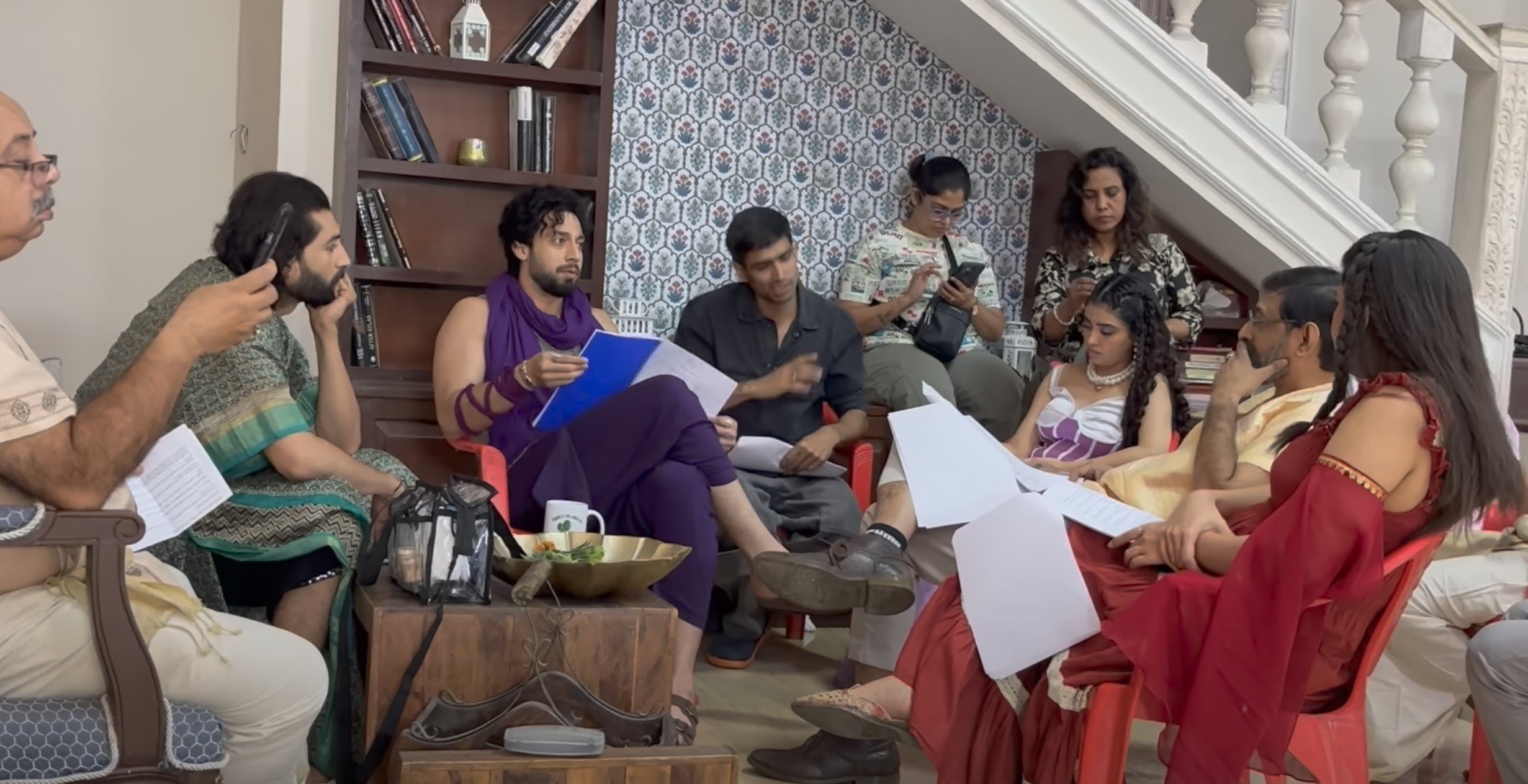
Behind the scenes of the microdrama Defying Destiny. Photo: KukuFM
A young woman, Shikha, driven by her ambitions and pursuit of wealth and status, rejects Rahul, who is in love with her, believing he is a small-time employee at her workplace. The trouble is, he is actually a millionaire businessman hiding his identity to test her loyalty. Shikha, obviously, has failed the test spectacularly and is now being called “gold digger kahin ki” (gold digger from somewhere), which also happens to be the name of the allegedly most-watched Indian microdrama series in the country this January, clocking a whopping 210 million views according to its host platform, StoryTV. As of September 4, the series has clocked in 318.5 million views on its app.
For the uninitiated, microdramas are ultra-short, serialized shows made vertically for phone consumption in the 9:16 aspect ratio, with each episode lasting no more than three minutes. Built around cliffhangers, melodrama, romance, revenge, or fantasy plots, these short-form genre plays are designed to reel in audiences who need a dopamine hit of instant gratification.
The pacing is quick, the horizontally restrictive frames favor close-up shots, and the dialogue is high-pitched, both in decibels and in theatrics, to heighten the drama. In one of the first episodes of Gold Digger Kahin Ki, Shikha’s mother asks her whether she invited the shabby-looking Rahul to a swanky cocktail party. “No, mom,” Shikha responds. “Main kyun iss fatichar ko yahan bulaaungi?” (“Why should I invite this ragamuffin here?”).
This answer invites the choicest taunt from her mother, who says to Rahul, while exaggeratedly flailing her arms around, “Oh! Toh tum yahan khud hi chale aye? Maan na maan, main tera mehmaan? (“You just showed up here on your own? Like ‘Whether you accept it or not, I am your guest?’”).
The novelty isn’t in the stories’ themes; they’re spiritual sequels to Indian soaps, packaged in a format meant to be more addictive. Microdramas are designed specifically for a viewership with dwindling attention spans due to chronic doomscrolling on social media, where most Indian microdrama audiences first encounter them, according to a 2026 report by META and Ormax Media. As a result, the writing process is molded by compression, speed, and constraint, with engagement often taking precedence over depth.
The Ormax report also notes that over 90% of the sample watches it solo—in other words, consumption, evaluation, and behavior formation largely happen at an individual level, without social influence.
Owing to their vertical frame, microdrama scripts also favor frontal exchanges, minimal movement, and fewer characters per frame, thereby flattening spatial storytelling and making dialogue sharper and more immediate. Combined with platform logic—in which content is consumed in quick, often solitary bursts—microdramas are more reactive and data-driven than television, where feedback is slower, and viewing is more collective.
Each series is divided into 50 to 100 episodes. As a result, unlike TV’s relatively buffered production cycles, microdramas have to operate at speed, often releasing multiple shows in a week and demanding rapid turnaround, which pushes writers to produce volume rather than refine individual scripts. Storytelling shifts from narrative progression to retention design, with episodes functioning as short escalation beats built around hook, tension, and payoff teases.
When it comes to embracing microdramas, India has followed China’s lead, with the format exploding in 2022 before evolving into a massive industry in 2023-24, eventually even outpacing Chinese box office revenue in 2024. Notably, the Indian microdrama industry was born not in Mumbai or the film industries down South—but in Bengaluru’s tech hubs.
The Indian microdrama market has already crossed $300 million in its first year—2025—according to a report by gaming and media venture fund Lumikai, which also estimates that the sector could reach $4.5 billion by 2030.
The average budget for an Indian microdrama ranges from ₹15 to 30 lakh, and the team usually comprises a creative director or producer, a writer, a cinematographer, a crew, and actors. “It’s like television on steroids,” said Ariah Agarwal, a television and OTT actor who has featured in several microdramas. Agarwal’s observation reveals an overlap not only in talent between the TV and microdrama industries, but also in themes. The dramas frequently recycle the hyper-patriarchal and misogynistic tropes long embedded in soap operas, but repackage them for private, mobile-first consumption.
The Decline of TV
In the last three years, nearly 50 TV channels surrendered their licenses amid falling viewership and advertising revenue. Broadcasters, including major players such as JioStar, Zee Entertainment, Sony Pictures Networks India, ABP Network and NDTV, have either shut channels down or scaled back their expansion plans. JioStar surrendered licenses for channels such as MTV Beats, VH1, Comedy Central and Colors Odia, while Sony gave up 26 channel permissions as part of a restructuring exercise. Enter10 Media, which operates the highly watched Hindi General Entertainment Channel (GEC), Dangal, abandoned plans to launch Dangal HD and Dangal Oriya after a strategic review. Meanwhile, ABP shut ABP News HD, and NDTV dropped plans for a Gujarati news channel.
The slowdown comes as audiences migrate to streaming platforms and DD Free Dish, eroding the traditional pay-TV market.
So, between 2018 and 2025, the Indian cable television industry lost an estimated 577,000 jobs. “That leaves us with only 4-5 major GECs with eight slots for shows throughout the day. It’s finite, and everyone is fighting to fit in there,” said Urvashi Bagtharia, executive producer at Zee TV. “So the ones who couldn’t make it in television—since it’s much harder to find your way into the film world once you’ve done television, because they don’t take you very seriously—microdramas have stepped in and given them employment.”
This means a semblance of a steadier stream of work, given the significantly shorter turnaround times of microdramas, compared to television projects that go on for months, if not years.
Bagtharia has her hands full with her ongoing Hindi TV show Ganga Mai Ki Betiyan (Mother Ganga’s Daughters), which launched in September 2025 and has already crossed the 300-episode mark—a rare success following the microdrama boom. It’s about Ganga Mai, a woman abandoned by her husband for not bearing a son, who goes on to raise her three daughters in Varanasi, battling social stigma, family conflicts, and injustice as she helps them build independent lives. Ganga Mai Ki Betiyan has been among the most-watched shows on Indian television since its launch, according to TRP ratings. Millions tune in every day—including on weekends—to watch her saga at 9 PM, one of the most coveted slots for GECs.
Bagtharia, who has clocked nearly a decade in the industry, is in no mood to leave it. For her, the job is creatively satisfying. She knows that her round-the-clock workday, with mostly working weekends, entertains the person living in the last mile of India. And that’s enough motivation for her to carry on.
She explained the math behind the budgets for a 30-minute TV show, including ad breaks. “We are usually assigned an average budget per episode, which is shot over 2-3 days,” shared Bagtharia, explaining that the 6-7 PM slot shows have a budget of roughly ₹7-8 lakh per episode, while an 8-9 PM slot will be allotted about ₹12 lakh. “Everything—from paying the actors, spot people, make-up and hair artists, directors, caterers, electricity, water, set—has to fit into that budget.”
For scale, she cites the example of popular television actor Sharad Kelkar, who is currently the lead in Zee TV’s 8.30 PM show Tumm Se Tum Tak (From You To You), which has been on air since July 2025. He charges ₹5 lakh per episode, while a top-tier director for a primetime show charges around ₹70,000 per episode—and all of these fees are factored into the per-episode budget.
Yet, a crew has an average size of 20-25 people per episode, which includes members of the production team, like line producers who look after the logistics and set requirements, and supervising producers who handle budgets; members from the channel; a team of 4-5 writers, like the broad story writer who works on the larger narrative, an episodic writer, a screenplay writer and a dialogue writer; and the directors’ team, which includes assistant directors as well.
Considering that every microdrama series is shot on what would be considered a shoestring budget, even for the lowest of low-budget films in India, especially in the Hindi or Southern film industries, each series is shot in an average of four to five days–- a week, if one is being generous. This also means a heavily downsized crew of not more than 10-12 people, which allows production companies to wrap up shooting an entire microdrama series on a budget that would allow only two to four episodes to be filmed for a TV show.
Television production is grueling work, Bagtharia said, that often entails playing to the gallery of patriarchy, but with every new show, the audience expects novelty only in terms of the faces they see. “Where will the actors go, then, after a project ends? It’s good that microdramas have happened, because they can get work there. Moreover, we aren’t competing for the same audience’s attention,” she said.
The TV-watching audience like her mother and aunt, according to Bagtharia, has no idea what microdramas are. “So even if the talent working across these industries are the same, they’re not catering to the same set of people,” she said.
Microdramas have evidently crept into and exploited the cracks left by a rapidly shifting entertainment landscape. Much like television, once the post-pandemic streaming content boom cooled, the aggressive commissioning race slowed. It has been widely reported that this let-up has made it increasingly difficult for production houses to convert speculatively greenlit projects, due to slower approvals and a growing backlog of content. Streaming rights for films in India have fallen by around 30%, while satellite rights have corrected by 50-60%.
A Predatory Ecosystem
Sulagna Chatterjee has been a screenwriter for over a decade, with projects like Amazon Mini TV’s Adulting (2018–2022), Voot Select’s Code M (2020–Present), and Zee5’s The Verdict: State Vs Nanavati (2019) to her credit. But streaming commissions and television work have lost some steam in the recent past, thereby shrinking the space for new talent to enter the industry.
In December of 2025, Chatterjee’s former colleague and manager, Nidhi Dev (pseudonym), reached out to her, saying she could get a good deal with KukuTV, one of the leading microdrama platforms in India, launched in February 2025, with 10 million paid subscribers (they have a 1-day trial period for ₹1, and then ₹699 for 3 months), offering content in Hindi, Telugu, Tamil, Malayalam, Kannada, and Bengali. However, their flagship YouTube channel is Hindi-dominant, as is their rollout and marketing strategy. The focus on Hindi-language content seems to be the case for most of its competitors as well, such as Story TV, Rocket Reels, Bullet, QuickTV, and Fatafat by Amazon MX Player. Chatterjee wrote for the platform in Hindi.
“Since I had worked with Nidhi before and she was liaising with KukuTV, she said she would be able to get me ₹2.5 lakh for writing between 40 and 50 episodes of one series,” Chatterjee said. This equates to around 75 minutes of screenplay.
To put things into perspective, a 90-minute-long screenplay could qualify for a full-length feature film that takes months, sometimes even years, to develop. The recommended minimum fee for a full script is ₹12 lakh for films with budgets below ₹5 crore, and ₹24 lakh for films with budgets between ₹5 crore and ₹15 crore, according to the “Minimum Basic Contract” framework set in 2019 by the Screenwriters’ Association.
But owing to the nascent stage the microdrama industry is currently in, guardrails to protect talent interests and ensure fair pay have yet to be established.
Chatterjee wasn’t particularly keen on signing up for a microdrama writing gig, given the pace and nature of writing they demand. But the sector’s dire straits and her ever-inflating bills compelled her to reconsider. “What’s the worst that’ll happen?” she told herself. “I’ll not be proud of the work that I have done, and thank god they’ve not credited me for those shows.”
Chatterjee signed the KukuTV deal—even if it meant pandering to hyperbolic emotions, outlandish themes of secret identities, hidden lives, and outrageous misogyny, all mashed up into a roughly 90-minute story written in two to six days.
In the microdrama world, creative control still lies heavily with management and marketing teams, with data and search volumes determining what gets greenlit and what doesn’t. Within that, writers are left with very little room to innovate. As someone who has always strived to bring queer and other marginalized narratives into the mainstream, Chatterjee struggled. “I was doing this completely out of broke-ness. I was crying a river every night,” she recalled. Her former manager, however, encouraged her to power through, considering it was “easy money, even if it means killing your soul a little.”
She ended up writing two series for the platform: the first is about a talented chef who, to honor the final wish of the uncle who raised her, marries a stranger she has never even met. A while later, she joins a cooking reality show and is eliminated by a celebrity chef who then offers her a job. She soon discovers he is her husband, sparking a complicated relationship shaped by secrets, power struggles, trust, and attraction.
In the second—now listed under WowTV, another microdrama platform owned by KukuFM with its own, separate subscriber base—a mute man becomes the perfect target for his cheating wife and her lover, who believe he cannot expose their affair. When he unexpectedly regains his voice, he stays silent, allowing their lies, schemes, and crimes to unravel on their own.
As of September 4, the former had registered 11.4 million views, while the latter had over 2 million.
“When I was writing one of them, I was asked by the platform to watch two of their past shows that had done well, and they wanted me to recreate similar beats and arcs,” Chatterjee said. When she tried to play around with the characters by adding depth and texture, she was asked to “forget all of that” and to drum up the villainy for the female lead and the “humiliation arc”—another trope popular in Indian microdramas following in the footsteps of their Chinese counterparts. One other platform that pitched a series to Chatterjee asked her to “not think cinema at all.” “It basically meant that I needed to shut my writer’s brain off completely,” she said.
By March 2026, KukuTV stopped communicating with her without stating any explicit reasons. It’s been six months since Chatterjee last worked on a microdrama, and she does not miss it at all. “I still believe I am among the lucky few who got paid as much as I did, because I know people who have written microdramas for as little as ₹15,000,” she said.
Worse still, some haven’t been paid.
Writers Stuck in a Catch-22
In April this year, Jio entered the microdrama race with Tadka, an integrated platform in its JioHotstar app, and launched with 100-plus shows. Reports also suggest that major Bollywood studios like Yash Raj Films and Shah Rukh Khan’s Red Chillies Entertainment are looking to expand into the vertical format as well.
The Kuku Technologies ecosystem—comprising KukuFM, its flagship audio storytelling platform; KukuTV; and Guru, its flagship learning app—has witnessed one of the most rapid expansions within India’s entertainment landscape, coinciding with KukuTV’s launch in 2024. According to early-June reports, it has filed an IPO with the Securities and Exchange Board of India (SEBI). The company is targeting a valuation of up to ₹15,000 crore, and the proposed offering is expected to comprise a mix of fresh shares and an offer-for-sale by existing investors, towards the end of this year.
Kunj Sanghvi, Vice President, Kuku—the Bengaluru-based regional-language parent company of KukuTV, launched in 2018 by three former IIT graduates—sees the microdrama boom as an opportunity to plug the gaps in an unsteady television and OTT ecosystem.
Kuku Technologies reported revenue of more than ₹1,400 crore in FY26, up from about ₹240 crore in FY25. The company plans to use the proceeds from the IPO to invest in technology and AI infrastructure, content creation, and international expansion.
According to Sanghvi, this means brighter days are around the corner for the Indian entertainment industry. He said that while film and television remain largely unorganized, microdramas offer a semblance of structure, given their genesis in the country’s corporate capital.
But what Chatterjee was making as a microdrama writer seems to be way above the industry’s own standards, where the per-series writers’ fees range between ₹15,000 for the completely inexperienced and ₹1.5 lakh for the experienced. In January 2025, Prateek Dadheech, a former TV writer, was offered to write a 60-episode microdrama series for a leading platform, with a turnaround time of two weeks at ₹1 lakh for the whole series. “I was told that this is a good deal because I come from a television writing background, and that the same company was getting writers to write for ₹60,000 or less,” Dadheech said. He declined the offer.
Simran Chaubey (pseudonym), a Mumbai-based senior writer, was contacted in October 2025 by a producer duo she has known for years to write a series for an “upcoming microdrama platform for Indian audiences, even the diaspora, funded by a UAE-based producer.” They had agreed to pay her ₹1 lakh for the series.
They decided to run with a story that Chaubey had been developing over the years and felt lent itself to the microdrama format. Chaubey had a longer turnaround time of over two weeks for this assignment. She was given ₹15,000 upfront as the signing amount, with ₹40,000 due before the start of the shoot by the Indian producers who had recruited her, and with whom she had signed a contract.
The final balance was due after the UAE partners concluded the shoot. For five months, Chaubey and the producers’ messages on unpaid dues went unanswered. Finally, in the sixth month, they received their payments. “My [producer] friends have got f*cked over, too. But they had offered to pay me half of that balance amount out of their own pockets. The show isn’t out, but my idea and my work are now with them,” Chaubey said.
Dadheech is now a Creative Director at Terribly Tiny Tales (TTT), a Mumbai-based digital storytelling and content company that began in 2013 as a micro-fiction page on Facebook and currently produces microdramas. He was among the lucky few who could choose to switch to microdramas after spending six years as a Hindi television writer. But he doesn’t have a straightforward answer for why he made that choice. “Writers, I’d like to believe, are driven by a strong sense of purpose and self—that’s ideally the place they draw from when they create something,” he said. “But when the economy is this broken, and the ecosystem feels so predatory, do they even have the bandwidth to think about those things anymore? When they’re constantly moving from project to project, paycheck to paycheck, just trying to stay afloat?”
Last year, when Arya Vyas (pseudonym), a talent manager and creative producer at one of the leading microdrama platforms in India, entered the microdrama industry, their company asked them to scout for senior writers from Bollywood at ₹60,000 per series. Vyas remembers being reprimanded by a veteran writer, who said that they were sullying their goodwill with industry folks by offering work that pays abysmally, while also requesting them to do something they’re mostly “not proud of”.
When Vyas started, writers were onboarded for ₹2.5 lakhs per series; six months later, that number was slashed to ₹1.5 lakhs. “I don’t know what changed in those few months, but I remember speaking to another person who worked at the platform and had been scouting for far longer than I have—and has now quit—said that they remember feeling guilty for having to offer writers rates like ₹30,000 or ₹50,000 for a series. I know a few who were brought on board for even ₹15,000, and we know all along that they’re getting a bad deal,” Vyas said.
Microdrama writers in India are thus stuck in a Catch-22. Even if working on microdramas isn’t creatively or financially satisfying, most writers struggle to turn down the industry’s exploitative offers, because there’s not much else to fall back on. And that is precisely what the microdrama industry is capitalizing on.
And Then, There’s AI…
Currently, most app-based platforms are in a volume game, releasing between 150 and 200 microdrama series every month. While Story TV, which launched in July 2025, publishes about 150 shows per month, KukuTV publishes close to 200.
This hyper-growth—where human hands race against time—has also meant that AI, especially the generative kind, has seeped into the process —from ideation to writing to execution. Sanghvi believes that the new hustle needs to be taken in one’s stride by warming up to shorter cycles and quicker turnaround times. “It will need a change in perception in the industry, because people are used to that 45-day cycle in TV,” he said. “In terms of the pressures of working in this, I think the answer here is how quickly you can incorporate AI into your workflows.”
The quick turnaround time also means that one has to find creative ways to depict characters—a millionaire’s life, for example—repeatedly across projects without burning through budgets. “If we have to show billionaires, we will have to show them in a Rolls-Royce, which will cost us ₹18 lakhs to rent each time. But because of AI, I can shoot it in a Maruti Suzuki Swift Dzire, and just turn it into a Rolls-Royce using the technology,” Sanghvi said.
For instance, in the series Married to the Halwai for Ten Percent—which, as of September 4, had recorded over 36 million views on KukuTV—a significant part of the action takes place in or around a luxury sedan. The story, once again, mines the billionaire-in-disguise trope, in which a fiercely independent CEO, Gunjan, impulsively enters into a contract marriage with an eccentric, seemingly ordinary Chandni Chowk halwai, Jai Randhawa. The character of Jai is a blatant rip-off of Ranveer Singh’s over-the-top Rocky Randhawa from the 2023 Hindi rom-com Rocky Aur Rani Kii Prem Kahaani.
The marriage is Gunjan’s attempt to save her company from falling into the hands of her conniving stepmother. As enemies close in and a mysterious poison threatens her life, she discovers her husband is a billionaire in disguise—the only man who can heal her, protect her, and help defend her empire. A fancy car is one of the easiest ways to set the “status” and “class” contexts in a story such as this. Using AI in such instances, then, seems like an obvious choice.
In fact, at KukuTV, AI is already deeply embedded in every stage of a microdrama’s life—from the vetting of a pitch against the effectiveness of its hooks, cliffhangers, and arcs, and comparing them to existing data, to suggestions on how to make an idea, a beat in a show, or a dialogue better, using their in-house AI systems. There’s human intervention, of course, but Sanghvi said that one must be open to the entire spectrum of AI and human interaction for content creation in the days to come, from 0% human and 100% AI to 100% human and 0% AI.
Lalit Marathe, a veteran screenwriter with films like Swades (2004) and Tariq (2024), and TV series like Crime Patrol Dial 100, Ajeeb Daastaan Hai Ye, and Adaalat to his credit, seems undaunted by this technology. He joined the vertical-drama bandwagon only in January of this year with Story TV and writes an average of 5 series per month. “I am not the kind that sits and mulls on something for days. I can churn out writing very fast, which is why my friends often call me a writing factory,” he laughed.
Marathe is working on a streaming show, a feature film, and a microdrama every other week simultaneously, and AI is, for him, only a research tool. “If I want to read an article online on a certain subject that can help me write my script better, I simply have to ask AI to find it for me, and it will be there, cutting down the time I would spend on this activity significantly,” he said. Sometimes, Marathe even uses it to “enhance” his writing by asking AI if it thinks a certain beat could be done better.
However, Dadheech, who works with a significant roster of freelance writers, said that the big players in the Indian market—who follow the China model and have their own custom-made AIs—use Large Language Models that can easily translate Chinese stories into Hindi or any other Indian language that they operate in. “They then hire a writer for, say, ₹30,000, asking them to clean up the script and Indianise it a little more, thereby entirely stripping the process of human touch and creativity, to keep up with the pressure of volume,” he said.
Vyas told The Polis Project that their platform is increasingly requiring greater AI knowledge and skill sets when hiring across departments—from creative roles like writing and editing to VFX and growth management. A few months ago, their company experimented with AI dubbing to cut costs, but the results were so disappointing that they had to revert to humans.
Vyas, however, mentioned something interesting. “A lot of creative directors in this company use AI heavily to write their beat sheets—where AI does the complete groundwork—before they hand them over to writers to write the screenplay. But they get very upset if they find out a writer has taken the help of AI to write their script, which has even led to some writers getting blacklisted,” they said, wondering out loud about the reason behind such “double standards”. “Frankly, everyone knows everyone here is using AI,” they said.
So, while discretion varies across the board, the industry as a whole is settling into the idea that AI is here to stay. Amogh Dusad, Director and Head of Content at Amazon MX Player—which launched its microdrama platform, Fatafat, a free, ad-supported streaming service—sees AI as a means to uphold the brand’s dictum of being “customer first”. The platform launched in March this year, with over 330 titles across genres, and plans to adapt successful Amazon Prime Video original shows into the vertical format. “There’s a bunch of work streams incorporating AI, and they are entering different parts of the content creation journey, like in VFX. But it’s being used more for efficiency than quality. Even in microdramas, given the tight deadlines, we’ve used AI to deliver a better quality of product to our customers, keeping in mind the time frames,” Dusad said.
Growth for Growth’s Sake
Between unsteady gigs, low pay, impossible deadlines, repetitive work with little room for creativity, and AI, microdrama writers seem to be getting the short end of the stick. Platforms say these are teething issues that will work themselves out over time as the system finds its groove.
Even if one accepts that microdramas are here to stay, Vyas feels that no effort has been made to consider the context within which they circulate. “I feel like that space where somebody could have innovated and thought about what an Indian microdrama should look like just did not happen. What we have are copies of Chinese ones. We made them in Hindi, with Indian actors, and that’s about it,” Vyas said, adding that they feel like the Indian creators “never really had a voice, which is why there’s been no creativity.” And that’s why writers feel like a part of a machinery where they have to churn out content, “and not as creative partners that somebody would partner with to create something. We have a factory assembly line, and not a writers’ room.”
This kind of friction is inevitable for someone like Sanghvi, who has built a Silver Button-winning YouTube channel and has seen the digital entertainment industry evolve from infancy. The pace—driven by algorithms and data, not writers and creators—is determining the volume of content generated, which, in turn, is determining its quality. Sanghvi likened it to the “Akshay Kumar phase for microdramas,” an actor known for starring in multiple films a year, regardless of how his previous films have fared at the box office or among critics.
“So many of our viewers are watching this content at the end of their long workday, or perhaps while commuting to their workplace, but do not have access to a television. At that moment, I don’t think they are looking for something elevated—they want some sense of familiarity or aspiration they can escape into. Not everything we always watch is going to be an outstanding, imaginative piece of content,” Sanghvi said. Many “agile writers”, he explained, have come to accept these rapidly changing parameters of writing new-age entertainment, and it is also why getting former Indian cricket team captain Mahendra Singh Dhoni to invest in KukuTV in March this year has been seen as a strategic move that aligns with their “small boy from small town making it big” vision for the platform.
But what he can’t deny is the rampant misogyny in the content. It’s what the analytics data said “works”, given that men—both through the metrics of gender and geography—are currently the biggest audience of Indian microdramas. According to the Ormax Media report, women are more likely to remain casual viewers, with 42% classified as “incidental viewers” compared to 36% of men, while men are more likely to become “high-intent viewers” (20% versus 15%). The report claims this reflects women’s “relatively lower control over technology and payments,” meaning access to email IDs for signing up and making UPI payments for subscriptions.
Urban audiences also convert more strongly into engaged viewers and paying users, with metros having the highest share of high-intent viewers (20%) and paid subscribers (22%), compared to 14% and 16%, respectively, in small towns. Still, the report states that participation remains visible across small towns and rural India.
“In subscription formats like ours, since more men convert, the catalog design gets more male-oriented,” Sanghvi said. It is this dependence on subscriptions that Marathe thinks is a major reason for the format’s growth being hindered. If the revenues earned from a male subscriber base directly impact the fee of writers and artistes in microdramas, and if that, in turn, determines the volume and quality of work, it makes sense to diversify the subjects of the stories to bring more women audiences into the fold. “I, for one, would love to write more women-oriented and women-empowering shows, like in American microdramas, where the viewership is heavily female,” Marathe said, and he’s right. According to a December 19, 2025 report by The Guardian, this viewership is also above 45.
National Award-winning filmmaker and writer Satyanshu Singh, a member of the SWA, said that things can’t change unless writers stand up for themselves. “So many microdramas are being made—and this is not me being judgmental—because these writers are agreeing to do such work at low pay and tight deadlines,” he said. While conversations on microdramas have been happening at the SWA, it’s not a body that can force producers to do anything; it can only advise.
But ultimately, as writer and critic Prathyush Parasuraman put it, “These are not shows made with thought, but tact.” Everything in them is a beat that can be traced back to a data point on a graph drawn up by a Bengaluru tech worker.
Over time, then, one may expect the format to embrace newer story genres. “Perhaps a new, premium kind of microdrama will emerge,” Parasuraman thought out loud. “But the lunacy of the form will pervade all such evolutions. If the structure of the building is broken, of what use is a fresh coat of paint?”