





Read an excerpt from Prof. Catherine Liu’s important book Traumatized: The New Politics of Public Suffering, which examines what happens when an idea born of genuine suffering is weaponized for social control. Traumatized is the story of how shell shock became PTSD, how Oprah turned pain into profit, and how “authenticity” became the ultimate brand. It traces surveillance capitalism’s greatest coup: convincing us that wounds define us and that accommodating each other’s trauma matters more than challenging the powerful. An unflinching diagnosis of our current crisis, rooted in the collapse of liberal politics, the ascendance of performance fragility, and the rise of emotional display as a surrogate for political action.

On November 10, 1986, Oprah Winfrey made media history when, before a television audience of millions, she “came out of the closet” as a victim and survivor of childhood sexual abuse, a violation that had occurred at the hands of a relative.1 She made the announcement on The Oprah Winfrey Show, which had just been syndicated and was being broadcast across the United States. Using the language of gay liberation at a time when US President Ronald Reagan refused to say the word “AIDS” or mention the gay community in public, Winfrey synthesized the transgressive cultural energy of the 1960s social movements with 1980s effervescence about self-starters, self-improvement, and the entrepreneurial destiny of all human beings under the regime of free markets. Her personal story was a rags-to-riches narrative tailor-made for the end of the twentieth century. Poised, defiant, and composed, Winfrey presented herself as the survivor of one of the most intense forms of sexual and psychological violation: childhood sexual assault. She set the tone for her media brand, mixing spectacular but intimate confessional testimony with progressive-sounding recovery mantras meant to appeal to the predominantly white middle-class female audience that she would cultivate and build on in the decades to come. Her televised confession expanded the communicative capacity embedded in the American public sphere, a space theretofore dominated by the stoicism of the WASPy, stiff-upper-lip ruling class. Very open about a painful past that included drug addiction and teenage promiscuity, Winfrey turned her own life into content for her show. Publicizing her psychological turmoil regarding dating and dieting, Winfrey presented herself to her audience as someone who struggled with relationships with men and with her weight. In 1988, in one of the most watched broadcasts in the medium’s history, she showed off her new slim physique and wheeled sixty-seven pounds of animal fat onto the studio stage to show how much weight she had lost. She touted the benefits of her Optifast, all-liquid diet. Addressing her audience as fellow dieters and sufferers, her message was: “If I can do this, you can too.” She quickly regained the weight she’d lost once she resumed normal eating habits.
Winfrey has never let her celebrity direct her life. She has used her life to direct her celebrity. She choreographed her story and her image with the vigilance of an old-fashioned Hollywood studio head. Tabloid media of the roaring 1920s exploited the fame and misfortunes of movie stars. They supplied a growing readership with lurid details about the lives of silent film stars like Rudolph Valentino and Fatty Arbuckle. Celebrities of the Jazz Age were victims of both the movie studios that owned their labor and a sensationalist media hungry for details about their everyday lives. Broadcast media would take a further step in sensationalism by opening a channel for what looked like a direct and intimate first-person communication between a star and her fans, without any kind of mediation. Instead of letting a tabloid tell her story, Winfrey expanded her own media power by taking control of her own scandals.
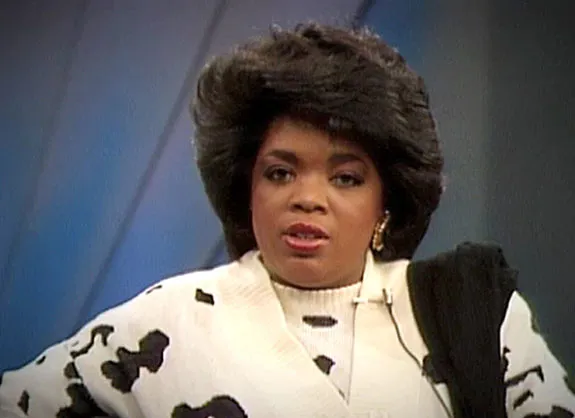
Winfrey’s confession was a stunning televisual moment, when the vulnerable little girl and the composed celebrity merged into one remarkable, exemplary human being. Winfrey’s trauma is at the heart of her distinctive identity: her trauma and recovery were monetized when she herself converted her own story into simple parables that were eagerly consumed by an adoring audience. In talking about her painful past, Winfrey sent an allegedly liberal and liberating public service message about abuse to her audience. She said explicitly that she hoped to dispel the shame and iniquity that surrounded women who as girls had been sexually abused by family members. The catharsis of televisual confession turned private trauma into spectacle, content, and commodity all at once. Most importantly, Winfrey’s public testimony of survivorship allowed her to differentiate herself from her daytime television talk show rivals, including Phil Donahue, Geraldo Rivera, Sally Jessy Raphael, and Jerry Springer. Winfrey was trauma and recovery in action. The Oprah Winfrey Show went on to become the most successful daytime talk show in television history. For sociologist Eva Illouz, “The more Oprah Winfrey became famous and powerful, the more intimate and familiar she became with her audience.” The therapeutic intimacy and empathy produced by her show made her fans feel as if they were part of a project of enlightenment and compassion.
The 1980s under Reagan were a time of renewed optimism and nationalism in a country that had been torn apart by the Vietnam War and the civil rights and labor unrest of the previous two decades. In retrospect, Reagan’s ideology was based on a kind of simple optimism about individual success. According to Reagan, it was only with a massively scaled-back public sector that ordinary people could finally prosper. Conservatives blamed the troubled economy of the 1970s on a government as an administrative state bloated by liberal fantasies of progress. Public provision produced, in the conservative mind, bad workers and malcontents as the counterparts of the dissatisfied and lazy American liberal elites who were responsible for an economy mired in stagnation and inflation. Reagan’s fervent anti-communism and his hatred of the 1960s student movement convinced him that capitalism needed happier rich people who, by paying less taxes, would be motivated to work harder to generate greater prosperity for all. Barbara Ehrenreich described the 1980s as giving rise to “a fear of falling” down the economic ladder into hedonism and dependency imagined as the legacy of hippies and the War on Poverty. Having undermined the world of working-class Americans in the 1970s, deindustrialization and financialization moved to destroying wage gains among the middle and professional classes. Fear of falling gave shape to the anxieties and fears of middle-class wage workers who saw their lives being upended by new political and economic forces largely out of their control. With social and public provisions undermined and attacked by Reagan’s policies, American wage workers adapted to economic insecurity with a combination of competitive determination, forbearance, resignation, and fear. PMC liberals, as we saw in the case of second-wave feminists, could not focus on the mundane, material circumstances of wage work. As top-tier salaried workers, they benefited from lower taxes, real estate speculation, and a volatile stock market. If we accept Ehrenreich’s idea that the 1980s reconfigured “the inner life” of ordinary Americans, we can see how daytime television in general and The Oprah Winfrey Show in particular facilitated this process, remaking the ways Americans thought of their private lives. If today’s media consumers expect an immediate, affective connection with celebrities, it is in no small part because Winfrey offered up new ways of establishing parasocial relations of the kind that digital and social media now promote to their users and consumers. Winfrey was able to use all the broadcast and media tools then available to burnish her brand of industrially produced intimacy and authenticity.
For television historian and critic Anna McCarthy, television produced a new version of the post–World War II American citizen/consumer who prided herself on being savvy, informed, and entertained. Winfrey understood the needs of her viewer as a citizen/consumer. Winfrey nurtured her aspirations. Engaging with addiction, trauma, and recovery, she led them into discussions of scandalous and difficult issues; she evoked the ambitions of the 1950s discussion programs that acted out “contradictory Cold War ideals of democratic freedom.” Televised discussion was seen as “independent from the potentially authoritarian influence of the state” on the one hand, but was “closely monitored via the mediating figure of the discussion leader.” Winfrey built her rhetorical authority on her lived experiences and her ability to embody her audience’s struggles. When she interviewed victims, stars, experts, and specialists she acted as the everywoman, disguising her power as a media mogul with a cultivated air of awe, empathy, and naivete.


Oprah and the Work of Trauma in the Age of Televisual Reproduction: An Excerpt From Catherine Liu’s Traumatized

Read an excerpt from Prof. Catherine Liu’s important book Traumatized: The New Politics of Public Suffering, which examines what happens when an idea born of genuine suffering is weaponized for social control. Traumatized is the story of how shell shock became PTSD, how Oprah turned pain into profit, and how “authenticity” became the ultimate brand. It traces surveillance capitalism’s greatest coup: convincing us that wounds define us and that accommodating each other’s trauma matters more than challenging the powerful. An unflinching diagnosis of our current crisis, rooted in the collapse of liberal politics, the ascendance of performance fragility, and the rise of emotional display as a surrogate for political action.
On November 10, 1986, Oprah Winfrey made media history when, before a television audience of millions, she “came out of the closet” as a victim and survivor of childhood sexual abuse, a violation that had occurred at the hands of a relative.1 She made the announcement on The Oprah Winfrey Show, which had just been syndicated and was being broadcast across the United States. Using the language of gay liberation at a time when US President Ronald Reagan refused to say the word “AIDS” or mention the gay community in public, Winfrey synthesized the transgressive cultural energy of the 1960s social movements with 1980s effervescence about self-starters, self-improvement, and the entrepreneurial destiny of all human beings under the regime of free markets. Her personal story was a rags-to-riches narrative tailor-made for the end of the twentieth century. Poised, defiant, and composed, Winfrey presented herself as the survivor of one of the most intense forms of sexual and psychological violation: childhood sexual assault. She set the tone for her media brand, mixing spectacular but intimate confessional testimony with progressive-sounding recovery mantras meant to appeal to the predominantly white middle-class female audience that she would cultivate and build on in the decades to come. Her televised confession expanded the communicative capacity embedded in the American public sphere, a space theretofore dominated by the stoicism of the WASPy, stiff-upper-lip ruling class. Very open about a painful past that included drug addiction and teenage promiscuity, Winfrey turned her own life into content for her show. Publicizing her psychological turmoil regarding dating and dieting, Winfrey presented herself to her audience as someone who struggled with relationships with men and with her weight. In 1988, in one of the most watched broadcasts in the medium’s history, she showed off her new slim physique and wheeled sixty-seven pounds of animal fat onto the studio stage to show how much weight she had lost. She touted the benefits of her Optifast, all-liquid diet. Addressing her audience as fellow dieters and sufferers, her message was: “If I can do this, you can too.” She quickly regained the weight she’d lost once she resumed normal eating habits.
Winfrey has never let her celebrity direct her life. She has used her life to direct her celebrity. She choreographed her story and her image with the vigilance of an old-fashioned Hollywood studio head. Tabloid media of the roaring 1920s exploited the fame and misfortunes of movie stars. They supplied a growing readership with lurid details about the lives of silent film stars like Rudolph Valentino and Fatty Arbuckle. Celebrities of the Jazz Age were victims of both the movie studios that owned their labor and a sensationalist media hungry for details about their everyday lives. Broadcast media would take a further step in sensationalism by opening a channel for what looked like a direct and intimate first-person communication between a star and her fans, without any kind of mediation. Instead of letting a tabloid tell her story, Winfrey expanded her own media power by taking control of her own scandals.
Winfrey’s confession was a stunning televisual moment, when the vulnerable little girl and the composed celebrity merged into one remarkable, exemplary human being. Winfrey’s trauma is at the heart of her distinctive identity: her trauma and recovery were monetized when she herself converted her own story into simple parables that were eagerly consumed by an adoring audience. In talking about her painful past, Winfrey sent an allegedly liberal and liberating public service message about abuse to her audience. She said explicitly that she hoped to dispel the shame and iniquity that surrounded women who as girls had been sexually abused by family members. The catharsis of televisual confession turned private trauma into spectacle, content, and commodity all at once. Most importantly, Winfrey’s public testimony of survivorship allowed her to differentiate herself from her daytime television talk show rivals, including Phil Donahue, Geraldo Rivera, Sally Jessy Raphael, and Jerry Springer. Winfrey was trauma and recovery in action. The Oprah Winfrey Show went on to become the most successful daytime talk show in television history. For sociologist Eva Illouz, “The more Oprah Winfrey became famous and powerful, the more intimate and familiar she became with her audience.” The therapeutic intimacy and empathy produced by her show made her fans feel as if they were part of a project of enlightenment and compassion.
The 1980s under Reagan were a time of renewed optimism and nationalism in a country that had been torn apart by the Vietnam War and the civil rights and labor unrest of the previous two decades. In retrospect, Reagan’s ideology was based on a kind of simple optimism about individual success. According to Reagan, it was only with a massively scaled-back public sector that ordinary people could finally prosper. Conservatives blamed the troubled economy of the 1970s on a government as an administrative state bloated by liberal fantasies of progress. Public provision produced, in the conservative mind, bad workers and malcontents as the counterparts of the dissatisfied and lazy American liberal elites who were responsible for an economy mired in stagnation and inflation. Reagan’s fervent anti-communism and his hatred of the 1960s student movement convinced him that capitalism needed happier rich people who, by paying less taxes, would be motivated to work harder to generate greater prosperity for all. Barbara Ehrenreich described the 1980s as giving rise to “a fear of falling” down the economic ladder into hedonism and dependency imagined as the legacy of hippies and the War on Poverty. Having undermined the world of working-class Americans in the 1970s, deindustrialization and financialization moved to destroying wage gains among the middle and professional classes. Fear of falling gave shape to the anxieties and fears of middle-class wage workers who saw their lives being upended by new political and economic forces largely out of their control. With social and public provisions undermined and attacked by Reagan’s policies, American wage workers adapted to economic insecurity with a combination of competitive determination, forbearance, resignation, and fear. PMC liberals, as we saw in the case of second-wave feminists, could not focus on the mundane, material circumstances of wage work. As top-tier salaried workers, they benefited from lower taxes, real estate speculation, and a volatile stock market. If we accept Ehrenreich’s idea that the 1980s reconfigured “the inner life” of ordinary Americans, we can see how daytime television in general and The Oprah Winfrey Show in particular facilitated this process, remaking the ways Americans thought of their private lives. If today’s media consumers expect an immediate, affective connection with celebrities, it is in no small part because Winfrey offered up new ways of establishing parasocial relations of the kind that digital and social media now promote to their users and consumers. Winfrey was able to use all the broadcast and media tools then available to burnish her brand of industrially produced intimacy and authenticity.
For television historian and critic Anna McCarthy, television produced a new version of the post–World War II American citizen/consumer who prided herself on being savvy, informed, and entertained. Winfrey understood the needs of her viewer as a citizen/consumer. Winfrey nurtured her aspirations. Engaging with addiction, trauma, and recovery, she led them into discussions of scandalous and difficult issues; she evoked the ambitions of the 1950s discussion programs that acted out “contradictory Cold War ideals of democratic freedom.” Televised discussion was seen as “independent from the potentially authoritarian influence of the state” on the one hand, but was “closely monitored via the mediating figure of the discussion leader.” Winfrey built her rhetorical authority on her lived experiences and her ability to embody her audience’s struggles. When she interviewed victims, stars, experts, and specialists she acted as the everywoman, disguising her power as a media mogul with a cultivated air of awe, empathy, and naivete.