



The genocide in Gaza has changed the rubric of how its people experienced the holy month of Ramadan—the festive season denoting peace and joy. With Israel’s strengthening siege on the Gaza Strip and a fragile ceasefire, destruction is rampant, neighbourhoods are now heaps of rubble, and survivors are mourning their loved ones.
Amid hostilities and severe restrictions, the meaning of Ramadan has changed for the people of Gaza. Eid, the last day of Ramadan, a festival of mirth, is now remembered as a day symbolizing the loss of people, the wreckage of property, and the trauma of displacement.
Arriving once a year, Ramadan is a month of spiritual growth and deep reflection in Islam. It is observed through fasting from dawn till sunset, breaking of the fast with family at community gatherings (iftaar), almsgiving to the less fortunate (zakat), among other practices. These ritualistic practices strengthen communal bonds through shared meals and night prayers.
Abstinence, the practice central to the month of Ramadan, no longer remains a religious choice for Gazans. It is now a compulsion owing to their material conditions. Israel’s blockade of the Strip and destruction of all facilities and agriculture since 2023 have pushed Gaza into the grip of a famine. Now, abstinence has become a permanent state of being. For many, the fast doesn’t end at sunset; it is endless amid the wreckage and vacant markets of a war zone.
“Families in Gaza are facing their third consecutive Ramadan displaced, exposed, and reliant on aid,” said Tamara Alrifai, UNRWA’s Director of External Relations and Communications, asking people to support the UN agency’s campaign to help Palestinians during Ramadan. Aid has been reduced to merely 100 trucks a day.
Rituals for Absence
One can see the eradication of rituals under the Israeli occupation that has slowly and systematically crippled the socio-economic life in Gaza. Lack of food and essential commodities, even medicines, in this ravaged warzone means communal festivities would lose their traditional fervour, certain practices would become untenable, and some would be retained through innovation and adaptation.
Before the war, Hadeel al-Sayyed, 41, managed her home in northwest Gaza like an engineer. Her huge kitchen was a sanctuary, with shiny glassware and the smell of Maqluba (a type of pilaf) and Maftoul (a Palestinian grain dish) rising from there. On the first day of Ramadan, the signature scent of her cooking would waft through the neighborhood.
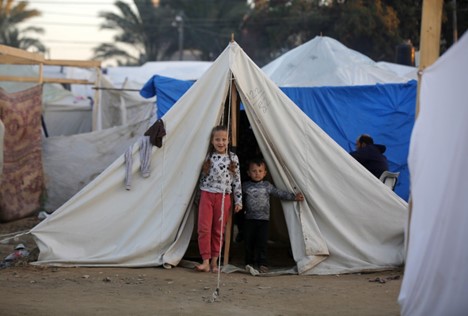
Today, Hadeel can’t cook the meals her children crave. “We no longer eat like humans,” she said, “Food has become a distant dream.” Like most displaced families, she lives in a tent in Al-Mawasi. There are no walls for her to hang decorations, as one would during Ramadan. “I cannot believe we are facing a man-made famine. They are killing us, little by little.”
Hadeel has now adapted to the changing conditions. To cheer her children up, she collected empty cardboard boxes and cut them into shapes of crescents and stars. She then painted them with whatever colors were available, trying to create an illusion of joy.
But the illusion was shattered when her young son, Yamen, looked up at the moon and asked, “Mama, does God hear our prayers under a tent the same way he did in our house? Does the sound of the shelling block our prayers from reaching the sky?” At that moment, Hadeel said she realized that the war had destroyed more than bricks and mortar. She hoped to build a sky devoid of bombs for her child.
A Ramadan of Scarcity
During Ramadan, the markets in Gaza would become more vibrant. Stalls would be full of dates, nuts, sweets, and colorful lanterns. After three years of rampage, the surviving markets have become skeletons of their past selves. People roam about endlessly looking for scant supplies of essentials, whose prices have skyrocketed, while people are unable to make a living.
Now, basic necessities have turned into luxuries. This Ramadan, most Gazans observed it with simple bread and a sense of grief.
Khalil, a 35-year-old man, a previously middle-class shopkeeper, is now struggling to make ends meet. During Ramadan, his shop used to be a place where people came together to share stories and sweets. He remembered how he spent last Ramadan, spending the night having conversations with his brother. Back then, he could still provide for his family.
Now, Khalil is affected by hyperinflation. He pulls a rusted wooden cart through the Al-Jalaa market in northern Gaza, selling the few sweets he can make. “My shop was like paradise during Ramadan,” he recalled. “I used to enjoy seeing people enjoy my kunafa. Now, people can barely find bread.”
For the Gazan head of the family, the war has not only made him poor but also hurt his dignity. In Palestinian culture, a father’s dignity is tied to being able to provide for his family, especially during Ramadan. “Leave me alone,” he said at the end of our conversation, his voice fading away. “It is better that way.”
New Rituals as Ramadan Changes
Praying in congregation at mosques is a core part of observing Ramadan. But where does one find an intact mosque in Gaza? In the first two years of the war alone, Israel bombed and destroyed more than 1,000 mosques and religious sites, according to Gaza’s authorities.
Faith is what keeps 52-year-old Mohammad Odeh going. The mosque in the Al-Saftawi neighborhood, which was his safe place, lies in ruins. Mohammad, a muezzin, climbs the rubble to deliver the Adhan (a call to prayer).
“When I say ‘Allahu Akbar‘ amidst this destruction, I feel like I’m taking back my city,” he said, speaking to this reporter. He spends his nights in his tent with his 12-year-old son, Sari, who lost a leg in an airstrike. Mohammad holds his son steady with shaking hands as the boy tries to stand on one leg to pray.
The father-son duo has created their own ritual in the absence of normal Ramadan, a mosque, or congregation. They call it “psychological ablution”: They sit together and remember the erstwhile mosque’s carpets and the sound of the Imam’s voice.
Such coping tactics in Gaza represent a mechanism of survival. Sumaya, 38, feels both physical pain and psychological longing during her Ramadan. The metal plates in her leg are a constant reminder of the strike that changed her, but she says the real pain is the absence of her brother. He died in an airstrike in the north of Gaza while he was searching for firewood among the rubble.
Now, she makes his brother’s favourite dishes, and waits for him to come home. She has invented this practice as a ritual for Ramadan, waiting endlessly in her brother’s absence. “I feel nothing now,” she said, “There is no joy when his chair at the table is empty. Ramadan has become a scary alarm clock, reminding me of the life I have lost.”
The story of Ramadan has attained new meanings in Gaza. The month is no longer measured by the number of prayers or the variety of dishes; it is measured by their acts of resilience and by showing children that life still holds possibilities the war hasn’t destroyed.
Ramadan and Its Changing Meanings in the Shadows of Gaza’s Ruins
Displaced Palestinians gather to receive food from a charity in Deir el-Balah, Gaza Strip. Image Source: UNRWA
The genocide in Gaza has changed the rubric of how its people experienced the holy month of Ramadan—the festive season denoting peace and joy. With Israel’s strengthening siege on the Gaza Strip and a fragile ceasefire, destruction is rampant, neighbourhoods are now heaps of rubble, and survivors are mourning their loved ones.
Amid hostilities and severe restrictions, the meaning of Ramadan has changed for the people of Gaza. Eid, the last day of Ramadan, a festival of mirth, is now remembered as a day symbolizing the loss of people, the wreckage of property, and the trauma of displacement.
Arriving once a year, Ramadan is a month of spiritual growth and deep reflection in Islam. It is observed through fasting from dawn till sunset, breaking of the fast with family at community gatherings (iftaar), almsgiving to the less fortunate (zakat), among other practices. These ritualistic practices strengthen communal bonds through shared meals and night prayers.
Abstinence, the practice central to the month of Ramadan, no longer remains a religious choice for Gazans. It is now a compulsion owing to their material conditions. Israel’s blockade of the Strip and destruction of all facilities and agriculture since 2023 have pushed Gaza into the grip of a famine. Now, abstinence has become a permanent state of being. For many, the fast doesn’t end at sunset; it is endless amid the wreckage and vacant markets of a war zone.
“Families in Gaza are facing their third consecutive Ramadan displaced, exposed, and reliant on aid,” said Tamara Alrifai, UNRWA’s Director of External Relations and Communications, asking people to support the UN agency’s campaign to help Palestinians during Ramadan. Aid has been reduced to merely 100 trucks a day.
Rituals for Absence
One can see the eradication of rituals under the Israeli occupation that has slowly and systematically crippled the socio-economic life in Gaza. Lack of food and essential commodities, even medicines, in this ravaged warzone means communal festivities would lose their traditional fervour, certain practices would become untenable, and some would be retained through innovation and adaptation.
Before the war, Hadeel al-Sayyed, 41, managed her home in northwest Gaza like an engineer. Her huge kitchen was a sanctuary, with shiny glassware and the smell of Maqluba (a type of pilaf) and Maftoul (a Palestinian grain dish) rising from there. On the first day of Ramadan, the signature scent of her cooking would waft through the neighborhood.
Today, Hadeel can’t cook the meals her children crave. “We no longer eat like humans,” she said, “Food has become a distant dream.” Like most displaced families, she lives in a tent in Al-Mawasi. There are no walls for her to hang decorations, as one would during Ramadan. “I cannot believe we are facing a man-made famine. They are killing us, little by little.”
Hadeel has now adapted to the changing conditions. To cheer her children up, she collected empty cardboard boxes and cut them into shapes of crescents and stars. She then painted them with whatever colors were available, trying to create an illusion of joy.
But the illusion was shattered when her young son, Yamen, looked up at the moon and asked, “Mama, does God hear our prayers under a tent the same way he did in our house? Does the sound of the shelling block our prayers from reaching the sky?” At that moment, Hadeel said she realized that the war had destroyed more than bricks and mortar. She hoped to build a sky devoid of bombs for her child.
A Ramadan of Scarcity
During Ramadan, the markets in Gaza would become more vibrant. Stalls would be full of dates, nuts, sweets, and colorful lanterns. After three years of rampage, the surviving markets have become skeletons of their past selves. People roam about endlessly looking for scant supplies of essentials, whose prices have skyrocketed, while people are unable to make a living.
Now, basic necessities have turned into luxuries. This Ramadan, most Gazans observed it with simple bread and a sense of grief.
Khalil, a 35-year-old man, a previously middle-class shopkeeper, is now struggling to make ends meet. During Ramadan, his shop used to be a place where people came together to share stories and sweets. He remembered how he spent last Ramadan, spending the night having conversations with his brother. Back then, he could still provide for his family.
Now, Khalil is affected by hyperinflation. He pulls a rusted wooden cart through the Al-Jalaa market in northern Gaza, selling the few sweets he can make. “My shop was like paradise during Ramadan,” he recalled. “I used to enjoy seeing people enjoy my kunafa. Now, people can barely find bread.”
For the Gazan head of the family, the war has not only made him poor but also hurt his dignity. In Palestinian culture, a father’s dignity is tied to being able to provide for his family, especially during Ramadan. “Leave me alone,” he said at the end of our conversation, his voice fading away. “It is better that way.”
New Rituals as Ramadan Changes
Praying in congregation at mosques is a core part of observing Ramadan. But where does one find an intact mosque in Gaza? In the first two years of the war alone, Israel bombed and destroyed more than 1,000 mosques and religious sites, according to Gaza’s authorities.
Faith is what keeps 52-year-old Mohammad Odeh going. The mosque in the Al-Saftawi neighborhood, which was his safe place, lies in ruins. Mohammad, a muezzin, climbs the rubble to deliver the Adhan (a call to prayer).
“When I say ‘Allahu Akbar‘ amidst this destruction, I feel like I’m taking back my city,” he said, speaking to this reporter. He spends his nights in his tent with his 12-year-old son, Sari, who lost a leg in an airstrike. Mohammad holds his son steady with shaking hands as the boy tries to stand on one leg to pray.
The father-son duo has created their own ritual in the absence of normal Ramadan, a mosque, or congregation. They call it “psychological ablution”: They sit together and remember the erstwhile mosque’s carpets and the sound of the Imam’s voice.
Such coping tactics in Gaza represent a mechanism of survival. Sumaya, 38, feels both physical pain and psychological longing during her Ramadan. The metal plates in her leg are a constant reminder of the strike that changed her, but she says the real pain is the absence of her brother. He died in an airstrike in the north of Gaza while he was searching for firewood among the rubble.
Now, she makes his brother’s favourite dishes, and waits for him to come home. She has invented this practice as a ritual for Ramadan, waiting endlessly in her brother’s absence. “I feel nothing now,” she said, “There is no joy when his chair at the table is empty. Ramadan has become a scary alarm clock, reminding me of the life I have lost.”
The story of Ramadan has attained new meanings in Gaza. The month is no longer measured by the number of prayers or the variety of dishes; it is measured by their acts of resilience and by showing children that life still holds possibilities the war hasn’t destroyed.