




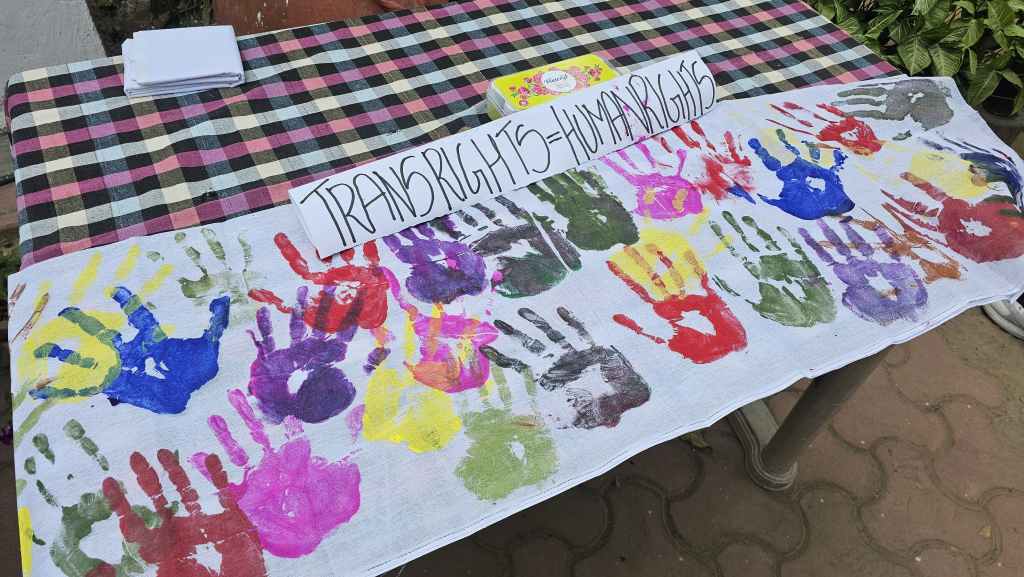
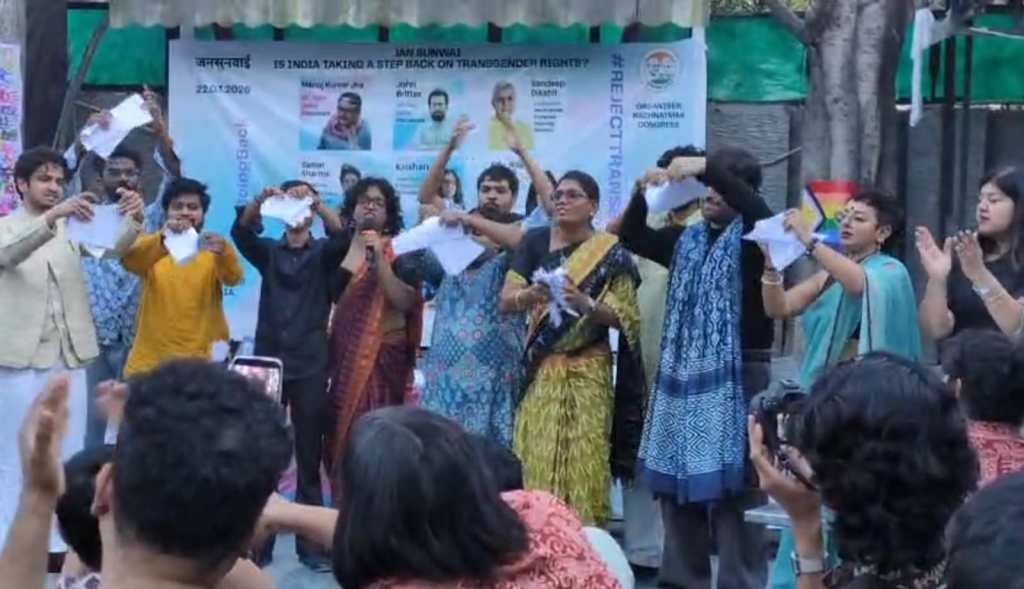
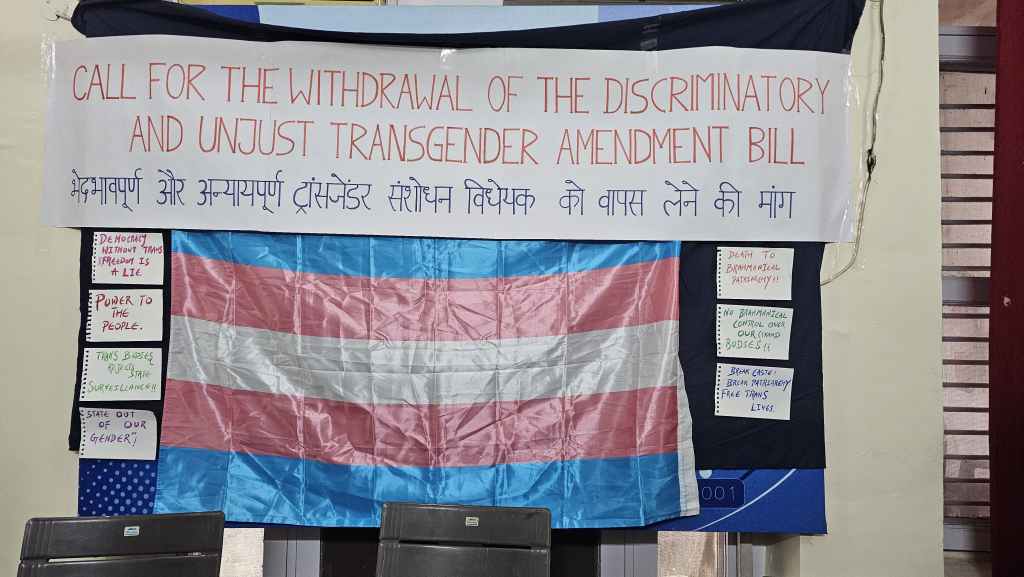
On the afternoon of Sunday, March 22, a plume of grey smoke rose from a metal trash can in the courtyard of the Press Club of India in Delhi, curling upward as a group sang Faiz Ahmed Faiz’s protest anthem “Hum Dekhenge”. A closer look revealed what was burning — charred pages of the Transgender Persons (Protection of Rights) Amendment Bill, 2026. Activists, politicians, and scholars had assembled to denounce the bill and, as many put it, mourn a setback for democracy.
The controversial amendment empowers the state to decide who is transgender in the eyes of the law. Members of India’s transgender community joined opposition lawmakers to voice their objections to a proposed amendment to the Transgender Persons (Protection of Rights) Act, 2019, which deals with the rights and welfare of transgender persons. Politicians from several opposition parties attended the public hearing, including the Rashtriya Janata Dal, the Communist Party of India (Marxist), and the Indian National Congress — the principal opposition party in Parliament. They pledged to formally oppose the bill when it came up for debate in Parliament. Two days later, the bill cleared the Lower House by voice vote amid a mass walkout by opposition members. The Upper House passed it the following day, and President Droupadi Murmu signed it into law on March 30.
For over a decade, India seemed to be moving towards greater protection of transgender rights. But the recent bill narrows the legal definition of transgender people and removes the right to self-identify, requiring medical certification for gender reassignment.
The bill was passed despite protests across the country by transgender communities and their allies, setting up what could become one of the defining rights battles before India’s Supreme Court. The top court is currently hearing a cluster of constitutional challenges to the amendment, which abandons the self-identification principle the Court had itself established in a landmark 2014 ruling. That judgment (NALSA v. Union of India) held that a person’s own sense of their gender, not a state-imposed category, should determine their legal identity. This principle was later incorporated into the 2019 transgender rights law. The 2026 amendment strips that protection out, replacing it with a regressive, narrower framework tied to biological conditions and specific categories such as hijra or intersex status.
A ‘Protection’ Law That Harms
After the bill was introduced on March 13 at the Lower House of the Parliament, protests broke out in multiple cities. About 140 lawyers and activists from organizations like the All-India Feminist Alliance and the National Alliance for Justice, Accountability and Rights appealed to the Indian President to deter the bill’s codification, citing “procedural infirmities” in how it passed. But the President did not heed the appeal.
The speed with which the bill passed in those 12 days sets a concerning precedent. Critics point out that the bill could have been referred to a standing committee after a large section of the transgender community protested it. Further, no pre-legislative public consultation was held as required by policy. The National Council for Transgender Persons, the body established by the parent act to advise on these very matters, was not even consulted. Two members of the council resigned, citing the ‘regressive’ Amendment Bill. Meanwhile, the ruling party rejected motions when the opposition demanded a referral.
Demonstrators argued that the haste, coupled with a lack of engagement from the government, undemocratically rolled back the effort and years it took to build a framework of transgender rights in the country. They said the new provisions, ostensibly meant to prevent abuse and fraud, were likely to end up criminalizing the everyday lived experience of transgender people.
Transgender Identity in Abeyance
Two years ago, Aruvi, a PhD scholar from Goa University, went to the Collectorate (district administration office) to change her name and gender on her Aadhaar ID card after having obtained her transgender ID card. A fellow visitor had then remarked, “Your transgender ID card is like your second birth certificate.” As the new law changes things, those words resonate more deeply with Aruvi. “One birth certificate already has my dead name, and the second birth certificate, which has my name, will be rendered invalid. Is the amendment not, then, our death certificate?” she asked.
Aruvi’s uncertainty over her identity card is far from an isolated worry. “I have had several of my documents changed to reflect my correct name and gender marker. I hold a transgender identity card, but no one knows if any of that is valid anymore,” said Nitaara, a 20-year-old transwoman and student at Delhi University, as she has been grappling with completing her education.
Before the 2026 Amendment, transgender people could change their gender marker online with a certificate from a healthcare provider. The government claims the new system is needed to prevent misuse of welfare benefits and strengthen safeguards.
The issue of what happens to the transgender ID cards issued under the 2019 Act has reached the Supreme Court. Senior Advocate Anand Grover, who is representing a petitioner challenging the Amendment Act, pointed out that the Amendment is unclear about the retrospective provisions that apply to recognized transgender individuals. “It’s a very cleverly drafted thing. It doesn’t automatically cancel the previously issued certificates but just leaves it open-ended. So, we don’t know how they will do it, or if they will do it at all,” Grover told The Polis Project. “Once they open it up, the original transgender certificate may not be of any value, and you [will] have to undergo a medical examination. It’s not a psychological examination; it’s an invasive physical examination which is subject to the magistrate’s approval,” he added.
On August 3, the Court deferred a decision on interim relief sought in petitions challenging the Amendment Act. These petitions also sought protection for the transgender identity cards. One of the lawyers for the petitioners told the Court that the portal through which transgender persons obtained identity cards under the 2019 Act had become “completely defunct,” creating uncertainty over the validity of cards already issued. However, Solicitor General Tushar Mehta, appearing for the central government, opposed an immediate order, remarking, “These [transgender identity cards] are not ration cards that you will not get ration. I fail to understand the urgency.” Advocate Kanmani R. pushed back, saying, “My Lords, I am a transgender lawyer. I cannot even rent a home without the card.” Her point underscored what the petitioners had argued all along: that the identity card is essential for transgender persons to access housing, healthcare, and other basic services.
Grover argued against Mehta’s fears of misappropriation of identity cards as raised in the Court. “According to the data available, there are more than four lakh transgenders, and not more than 40,000 have registered. So, where is the misuse? And what are they getting from it?” he said. Fewer than 34,000 cards have been issued among almost 49,000 applicants, according to the National Portal for Transgender Persons under the Ministry of Social Justice and Empowerment. India’s last official census records, from 15 years ago, quote almost 500,000 transgender individuals under the ‘other’ sex category, while independent estimates point to numbers upward of 2 million.
Attack on Self-Identification, Support Networks
The Supreme Court’s landmark 2014 judgment in National Legal Services Authority (NALSA) v. Union of India drew on principles of personal liberty and international human rights law. Most importantly, it recognized the right of transgender persons to self-identify their gender, without requiring any medical intervention or surgery. The Court held that gender identity was not rooted in biological characteristics, but reflected “an innate perception of one’s gender.” It enshrined the principle of self-identification as part of the fundamental right to personal liberty under Article 21 of the Indian Constitution. Before the latest amendment, the 2019 Act allowed a certificate of identity to be procured based on one’s self-perception, and it also qualified for legal recognition.
“The Amendment goes against the NALSA judgment itself, excluding a large section of trans people,” said Raghavi Shukla, one of the first transwomen lawyers in the Supreme Court. Calling the 2026 Amendment Act “unconstitutional”, she stated, “The right to self-identification and self-determination of gender identity is a part of Article 21 of our Constitution; they are taking that very right away.”
“Not everyone has the means, or even the want, to transition physically,” said 29-year-old Rita, who has chosen to not undergo any form of surgical or hormonal procedures to reaffirm her identity as a transwoman. Speaking to The Polis Project, she said, “I have known I am a woman ever since I was a child; I even have an older transgender identity card issued by the government. Just because my body does not align with the state’s ideas of womanhood does not mean I am any less of a woman. They cannot tell me who I am.”
Many argue that the Amendment undoes a decade’s worth of progress. Besides rescinding the right to self-identification, it seeks to exclude all gender identities that do not fall under the corpus of traditional socio-cultural trans identities, such as Kinnar, Jogita, Hijda, Aravani and eunuch, and intersex variations. The Transgender Persons (Protection of Rights) Act, 2019, riding the coattails of the NALSA judgment, was but an uninspired legislative heir to the judgment. While not perfect, the act’s functional ambiguities include its conflation of intersex biological traits with gender identity and did not explicitly define non-binary spectrums, or the contradiction between self-determination and state certification. These ambiguities have now given way to the controversial omission of non-binary, trans-masculine, and genderqueer identities.
“India has a lot more multi-cultural trans groups with their own specific rituals and kinship networks, such as khwajaseras, thirunambis, nupi, etc.,” said Pratyay, a non-binary trans-feminine PhD scholar from Ambedkar University, Delhi. These are culturally specific identities within South Asian transgender and third-gender communities, and distinct from Western “transgender” frameworks. “The emphasis on these chosen particular groups [Kinnar, Hijra and other communities included in the Act] pushes a very Hindutva-led, Brahminical (caste-based) idea of transness. If you do not fall under their mythology, you do not get mentioned. Queerness cannot be so strictly tied to specific cultural expressions.”
The Amendment Act, like its 2019 Parent Act, clubs trans and intersex identities, conflating gender identity with sex characteristics. This ignores intersex-specific issues like non-consensual surgeries on infants to eliminate intersex traits, medical secrecy, lack of informed consent, and the right to bodily autonomy.
“The amendment violates one’s right to privacy,” argued Shukla, discussing the clause in the Amendment Act wherein medical institutions must report all gender affirming medical care and treatment to the district authorities. “This medical surveillance is a gross breach of privacy and the right to autonomy and agency.”
Vishakha, a post-transition transwoman who belongs to a Hijra gharana and would thereby pass by the amendment’s definition of transness, had joined a protest against the Amendment in Jantar Mantar, a designated protest site in Delhi. Gharanas are a hierarchical clan system in the third-gender community, where disciples are mentored and protected under a guru, mimicking kinship and territorial control. She worries that the Amendment reaffirms the prejudices against transfolk, perpetuating violence and harassment by both the police and the public. “The harassment has begun already,” she alleged, “I have received verbal threats, questioning the validity of my transness. They are looking forward to the bill being taken into action, so they can strip me of both my clothes and my dignity.”
The Amendment adds a new criminal provision in Section 18 with imprisonment for “alluring” or “forcing” someone to become transgender. The vague wording opens the door to its misuse against trans people, supportive parents, families, communities, networks, organizations, and service providers.
“In the state’s eyes, I would not be a genuine transgender person. It is not difficult to see the pattern here – the patriarchal, paternalizing state tells me ‘No, you are forced to become trans, you are a victim trans, nevertheless, you go to jail’,” wrote Aruvi on her social media, where transgender people across backgrounds have bared their lives in an appeal to mobilize people against the Amendment Act.
Sociocultural communities like hijra jamaats, which have historically protected and supported gender-diverse people, are especially at risk from the changed law. The hijras, the traditional South Asian third-gender community, have long sustained themselves on informal family structures that provide shelter, financial support, and solidarity for transgender women, eunuchs, and intersex people. The amendment to Section 18 hands the state the power to declare queer support groups criminal, without forethought or proof.
“Criminalization makes it easier for the government to surveil people and their support networks. This can erode trust between individuals and their families, carers, and communities, causing both formal and informal care networks to break down,” said Nayyab Ali, Global LGBTQI+ Human Rights Fellow from the Carr-Ryan Center for Human Rights at the Harvard Kennedy School. “These rules risk being used to disproportionately target not only transgender persons, but also the friends, family, and allies who support them––the very people most essential to protecting vulnerable community members,” she added.
“Now, what happens to me if my endocrinologist says, ‘No, I do not want to go to prison for your sake. So, I can no longer prescribe you the HRT (Hormone Replacement Therapy) that you need to get through life?’ What if every endo sends me away saying the same thing? What if my house owner says, ‘I do not want to go to prison for your sake, please vacate my premises.’ What if every house-owning person refuses to rent to me? What if every potential employer says, ‘We do not want to get into any trouble employing you,’” asked an indignant Aruvi, who has been worried about the everyday harm the law could bring.
Abigail, a 29-year-old transwoman student at IIT Delhi, said, “The very basis of our existence in institutional spaces, our collectives, are being taken away.” She added, “A lot of us are going to lose our support networks, and queer groups, which allow us to thrive in cisgender hetero-centric spaces. Even those who are supportive are going to retreat further and not support us publicly, for the very support becomes criminalized.”
The Amendment Act establishes fresh criminal offenses that reaffirm anxieties based on the misconception that transgender identities frequently stem from coercion. These offenses can warrant penalties up to life imprisonment, while penalties for violence against transgender persons do not find mention in the law. An Amendment that purports to protect transgender communities by its very name falls short of that design, and instead swerves to merely redefine and exclude.
The Question of Autonomy
The 2026 Amendment’s blanket assertion of state authority over the personal domain of gender raises concerns about autonomy. By removing the statutory recognition of self-perceived gender identity, the legislation shifts power away from the people and towards a bureaucracy, which may also be uninformed about queerness.
“The makers of the Act do not account for the amount of harassment trans people go through already just to get their identities reaffirmed on legal documents. Most of the public officials are ill-informed and ask undue, untoward questions,” said Pratyay. “To put this much control into the hands of these magistrates who barely understand queerness will only lead to further exclusion of transpeople.”
The introduction of medical boards and meticulous control over gender-affirming care concentrates decision-making in the hands of the state. This system ultimately supplants diverse, fluid expressions of gender with state-sanctioned categories drawn selectively from Hindu sociocultural traditions.
“We don’t want your welfare measures; we don’t want your sympathy; we want our rights. That’s why we are fighting against this Brahmanical, patriarchal bill that wants to control us,” said Grace Banu, a dalit trans-activist, at the Press Club protest meet that March day. “The Amendment seeks to further alienate trans people who have found themselves in the margins of society. Trans people have fought to seek acceptance by their families and peers and are yet again left vulnerable to complete categorical erasure.”
Nitaara, the trans undergraduate who also grapples with her other marginalized identity of being a Muslim, said, “There are politicians worrying that there are people faking trans identities in order to get job reservations. I am a transwoman and I do not know which reservations they are talking about. I am yet to receive any such benefit.” Nitaara notes that the Amendment lacks a framework for horizontal reservation (quotas) in educational institutions or job opportunities, as directed by the NALSA judgment. Currently, the reservation exists as a vague and ambiguous promise on paper for India’s transgender community.
As constitutional challenges mount against the Amendment Act in the nation’s highest court, the spirit of resistance remains unbroken among transgender rights activists. “Historically, India had a culture of recognizing the third gender but didn’t have the sophistication of looking at it as gender dysphoria. Now, there is a definition accepted worldwide by WHO (World Health Organization), which situates the basis of transgenderism on the dissonance between one’s biological sex and identification. That was underlined by the NALSA decision by a two-judge bench, now left to be overturned by a three-judge bench if the court wishes to,” said Grover. “I don’t want to believe that we are not optimistic. We go there to fight and win,” the advocate added.
The way forward, as demanded by those fighting on the front lines, lies in reclaiming the foundational promise of the NALSA judgment. The burning pages of the 2026 Amendment Bill outside the Press Club were a symbolic refusal to let a decade of hard-won dignity be torn down by the prying arms of the state, and those who sparked the fire of resistance are not backing down.
Author Bios
Himanshi Aggarwal is a freelance multimedia journalist and documentary filmmaker based in Delhi. She is pursuing her Master’s at AJK MCRC. Her work is rooted in ground reporting and covers stories that center people and their lived experiences.
Instagram: @byemanshi
Harishankar Manoj is a Delhi-based freelance journalist and a Master’s student at AJK MCRC, Jamia Millia Islamia. His work spans across multimedia formats and on-ground coverage, focusing on civic, social, and environmental justice.
Instagram: @hariipotter


Self-Identification Under Threat: India’s Transgender Law Continues to be Challenged
On the afternoon of Sunday, March 22, a plume of grey smoke rose from a metal trash can in the courtyard of the Press Club of India in Delhi, curling upward as a group sang Faiz Ahmed Faiz’s protest anthem “Hum Dekhenge”. A closer look revealed what was burning — charred pages of the Transgender Persons (Protection of Rights) Amendment Bill, 2026. Activists, politicians, and scholars had assembled to denounce the bill and, as many put it, mourn a setback for democracy.
The controversial amendment empowers the state to decide who is transgender in the eyes of the law. Members of India’s transgender community joined opposition lawmakers to voice their objections to a proposed amendment to the Transgender Persons (Protection of Rights) Act, 2019, which deals with the rights and welfare of transgender persons. Politicians from several opposition parties attended the public hearing, including the Rashtriya Janata Dal, the Communist Party of India (Marxist), and the Indian National Congress — the principal opposition party in Parliament. They pledged to formally oppose the bill when it came up for debate in Parliament. Two days later, the bill cleared the Lower House by voice vote amid a mass walkout by opposition members. The Upper House passed it the following day, and President Droupadi Murmu signed it into law on March 30.
For over a decade, India seemed to be moving towards greater protection of transgender rights. But the recent bill narrows the legal definition of transgender people and removes the right to self-identify, requiring medical certification for gender reassignment.
The bill was passed despite protests across the country by transgender communities and their allies, setting up what could become one of the defining rights battles before India’s Supreme Court. The top court is currently hearing a cluster of constitutional challenges to the amendment, which abandons the self-identification principle the Court had itself established in a landmark 2014 ruling. That judgment (NALSA v. Union of India) held that a person’s own sense of their gender, not a state-imposed category, should determine their legal identity. This principle was later incorporated into the 2019 transgender rights law. The 2026 amendment strips that protection out, replacing it with a regressive, narrower framework tied to biological conditions and specific categories such as hijra or intersex status.
A ‘Protection’ Law That Harms
After the bill was introduced on March 13 at the Lower House of the Parliament, protests broke out in multiple cities. About 140 lawyers and activists from organizations like the All-India Feminist Alliance and the National Alliance for Justice, Accountability and Rights appealed to the Indian President to deter the bill’s codification, citing “procedural infirmities” in how it passed. But the President did not heed the appeal.
The speed with which the bill passed in those 12 days sets a concerning precedent. Critics point out that the bill could have been referred to a standing committee after a large section of the transgender community protested it. Further, no pre-legislative public consultation was held as required by policy. The National Council for Transgender Persons, the body established by the parent act to advise on these very matters, was not even consulted. Two members of the council resigned, citing the ‘regressive’ Amendment Bill. Meanwhile, the ruling party rejected motions when the opposition demanded a referral.
Demonstrators argued that the haste, coupled with a lack of engagement from the government, undemocratically rolled back the effort and years it took to build a framework of transgender rights in the country. They said the new provisions, ostensibly meant to prevent abuse and fraud, were likely to end up criminalizing the everyday lived experience of transgender people.
Transgender Identity in Abeyance
Two years ago, Aruvi, a PhD scholar from Goa University, went to the Collectorate (district administration office) to change her name and gender on her Aadhaar ID card after having obtained her transgender ID card. A fellow visitor had then remarked, “Your transgender ID card is like your second birth certificate.” As the new law changes things, those words resonate more deeply with Aruvi. “One birth certificate already has my dead name, and the second birth certificate, which has my name, will be rendered invalid. Is the amendment not, then, our death certificate?” she asked.
Aruvi’s uncertainty over her identity card is far from an isolated worry. “I have had several of my documents changed to reflect my correct name and gender marker. I hold a transgender identity card, but no one knows if any of that is valid anymore,” said Nitaara, a 20-year-old transwoman and student at Delhi University, as she has been grappling with completing her education.
Before the 2026 Amendment, transgender people could change their gender marker online with a certificate from a healthcare provider. The government claims the new system is needed to prevent misuse of welfare benefits and strengthen safeguards.
The issue of what happens to the transgender ID cards issued under the 2019 Act has reached the Supreme Court. Senior Advocate Anand Grover, who is representing a petitioner challenging the Amendment Act, pointed out that the Amendment is unclear about the retrospective provisions that apply to recognized transgender individuals. “It’s a very cleverly drafted thing. It doesn’t automatically cancel the previously issued certificates but just leaves it open-ended. So, we don’t know how they will do it, or if they will do it at all,” Grover told The Polis Project. “Once they open it up, the original transgender certificate may not be of any value, and you [will] have to undergo a medical examination. It’s not a psychological examination; it’s an invasive physical examination which is subject to the magistrate’s approval,” he added.
On August 3, the Court deferred a decision on interim relief sought in petitions challenging the Amendment Act. These petitions also sought protection for the transgender identity cards. One of the lawyers for the petitioners told the Court that the portal through which transgender persons obtained identity cards under the 2019 Act had become “completely defunct,” creating uncertainty over the validity of cards already issued. However, Solicitor General Tushar Mehta, appearing for the central government, opposed an immediate order, remarking, “These [transgender identity cards] are not ration cards that you will not get ration. I fail to understand the urgency.” Advocate Kanmani R. pushed back, saying, “My Lords, I am a transgender lawyer. I cannot even rent a home without the card.” Her point underscored what the petitioners had argued all along: that the identity card is essential for transgender persons to access housing, healthcare, and other basic services.
Grover argued against Mehta’s fears of misappropriation of identity cards as raised in the Court. “According to the data available, there are more than four lakh transgenders, and not more than 40,000 have registered. So, where is the misuse? And what are they getting from it?” he said. Fewer than 34,000 cards have been issued among almost 49,000 applicants, according to the National Portal for Transgender Persons under the Ministry of Social Justice and Empowerment. India’s last official census records, from 15 years ago, quote almost 500,000 transgender individuals under the ‘other’ sex category, while independent estimates point to numbers upward of 2 million.
Attack on Self-Identification, Support Networks
The Supreme Court’s landmark 2014 judgment in National Legal Services Authority (NALSA) v. Union of India drew on principles of personal liberty and international human rights law. Most importantly, it recognized the right of transgender persons to self-identify their gender, without requiring any medical intervention or surgery. The Court held that gender identity was not rooted in biological characteristics, but reflected “an innate perception of one’s gender.” It enshrined the principle of self-identification as part of the fundamental right to personal liberty under Article 21 of the Indian Constitution. Before the latest amendment, the 2019 Act allowed a certificate of identity to be procured based on one’s self-perception, and it also qualified for legal recognition.
“The Amendment goes against the NALSA judgment itself, excluding a large section of trans people,” said Raghavi Shukla, one of the first transwomen lawyers in the Supreme Court. Calling the 2026 Amendment Act “unconstitutional”, she stated, “The right to self-identification and self-determination of gender identity is a part of Article 21 of our Constitution; they are taking that very right away.”
“Not everyone has the means, or even the want, to transition physically,” said 29-year-old Rita, who has chosen to not undergo any form of surgical or hormonal procedures to reaffirm her identity as a transwoman. Speaking to The Polis Project, she said, “I have known I am a woman ever since I was a child; I even have an older transgender identity card issued by the government. Just because my body does not align with the state’s ideas of womanhood does not mean I am any less of a woman. They cannot tell me who I am.”
Many argue that the Amendment undoes a decade’s worth of progress. Besides rescinding the right to self-identification, it seeks to exclude all gender identities that do not fall under the corpus of traditional socio-cultural trans identities, such as Kinnar, Jogita, Hijda, Aravani and eunuch, and intersex variations. The Transgender Persons (Protection of Rights) Act, 2019, riding the coattails of the NALSA judgment, was but an uninspired legislative heir to the judgment. While not perfect, the act’s functional ambiguities include its conflation of intersex biological traits with gender identity and did not explicitly define non-binary spectrums, or the contradiction between self-determination and state certification. These ambiguities have now given way to the controversial omission of non-binary, trans-masculine, and genderqueer identities.
“India has a lot more multi-cultural trans groups with their own specific rituals and kinship networks, such as khwajaseras, thirunambis, nupi, etc.,” said Pratyay, a non-binary trans-feminine PhD scholar from Ambedkar University, Delhi. These are culturally specific identities within South Asian transgender and third-gender communities, and distinct from Western “transgender” frameworks. “The emphasis on these chosen particular groups [Kinnar, Hijra and other communities included in the Act] pushes a very Hindutva-led, Brahminical (caste-based) idea of transness. If you do not fall under their mythology, you do not get mentioned. Queerness cannot be so strictly tied to specific cultural expressions.”
The Amendment Act, like its 2019 Parent Act, clubs trans and intersex identities, conflating gender identity with sex characteristics. This ignores intersex-specific issues like non-consensual surgeries on infants to eliminate intersex traits, medical secrecy, lack of informed consent, and the right to bodily autonomy.
“The amendment violates one’s right to privacy,” argued Shukla, discussing the clause in the Amendment Act wherein medical institutions must report all gender affirming medical care and treatment to the district authorities. “This medical surveillance is a gross breach of privacy and the right to autonomy and agency.”
Vishakha, a post-transition transwoman who belongs to a Hijra gharana and would thereby pass by the amendment’s definition of transness, had joined a protest against the Amendment in Jantar Mantar, a designated protest site in Delhi. Gharanas are a hierarchical clan system in the third-gender community, where disciples are mentored and protected under a guru, mimicking kinship and territorial control. She worries that the Amendment reaffirms the prejudices against transfolk, perpetuating violence and harassment by both the police and the public. “The harassment has begun already,” she alleged, “I have received verbal threats, questioning the validity of my transness. They are looking forward to the bill being taken into action, so they can strip me of both my clothes and my dignity.”
The Amendment adds a new criminal provision in Section 18 with imprisonment for “alluring” or “forcing” someone to become transgender. The vague wording opens the door to its misuse against trans people, supportive parents, families, communities, networks, organizations, and service providers.
“In the state’s eyes, I would not be a genuine transgender person. It is not difficult to see the pattern here – the patriarchal, paternalizing state tells me ‘No, you are forced to become trans, you are a victim trans, nevertheless, you go to jail’,” wrote Aruvi on her social media, where transgender people across backgrounds have bared their lives in an appeal to mobilize people against the Amendment Act.
Sociocultural communities like hijra jamaats, which have historically protected and supported gender-diverse people, are especially at risk from the changed law. The hijras, the traditional South Asian third-gender community, have long sustained themselves on informal family structures that provide shelter, financial support, and solidarity for transgender women, eunuchs, and intersex people. The amendment to Section 18 hands the state the power to declare queer support groups criminal, without forethought or proof.
“Criminalization makes it easier for the government to surveil people and their support networks. This can erode trust between individuals and their families, carers, and communities, causing both formal and informal care networks to break down,” said Nayyab Ali, Global LGBTQI+ Human Rights Fellow from the Carr-Ryan Center for Human Rights at the Harvard Kennedy School. “These rules risk being used to disproportionately target not only transgender persons, but also the friends, family, and allies who support them––the very people most essential to protecting vulnerable community members,” she added.
“Now, what happens to me if my endocrinologist says, ‘No, I do not want to go to prison for your sake. So, I can no longer prescribe you the HRT (Hormone Replacement Therapy) that you need to get through life?’ What if every endo sends me away saying the same thing? What if my house owner says, ‘I do not want to go to prison for your sake, please vacate my premises.’ What if every house-owning person refuses to rent to me? What if every potential employer says, ‘We do not want to get into any trouble employing you,’” asked an indignant Aruvi, who has been worried about the everyday harm the law could bring.
Abigail, a 29-year-old transwoman student at IIT Delhi, said, “The very basis of our existence in institutional spaces, our collectives, are being taken away.” She added, “A lot of us are going to lose our support networks, and queer groups, which allow us to thrive in cisgender hetero-centric spaces. Even those who are supportive are going to retreat further and not support us publicly, for the very support becomes criminalized.”
The Amendment Act establishes fresh criminal offenses that reaffirm anxieties based on the misconception that transgender identities frequently stem from coercion. These offenses can warrant penalties up to life imprisonment, while penalties for violence against transgender persons do not find mention in the law. An Amendment that purports to protect transgender communities by its very name falls short of that design, and instead swerves to merely redefine and exclude.
The Question of Autonomy
The 2026 Amendment’s blanket assertion of state authority over the personal domain of gender raises concerns about autonomy. By removing the statutory recognition of self-perceived gender identity, the legislation shifts power away from the people and towards a bureaucracy, which may also be uninformed about queerness.
“The makers of the Act do not account for the amount of harassment trans people go through already just to get their identities reaffirmed on legal documents. Most of the public officials are ill-informed and ask undue, untoward questions,” said Pratyay. “To put this much control into the hands of these magistrates who barely understand queerness will only lead to further exclusion of transpeople.”
The introduction of medical boards and meticulous control over gender-affirming care concentrates decision-making in the hands of the state. This system ultimately supplants diverse, fluid expressions of gender with state-sanctioned categories drawn selectively from Hindu sociocultural traditions.
“We don’t want your welfare measures; we don’t want your sympathy; we want our rights. That’s why we are fighting against this Brahmanical, patriarchal bill that wants to control us,” said Grace Banu, a dalit trans-activist, at the Press Club protest meet that March day. “The Amendment seeks to further alienate trans people who have found themselves in the margins of society. Trans people have fought to seek acceptance by their families and peers and are yet again left vulnerable to complete categorical erasure.”
Nitaara, the trans undergraduate who also grapples with her other marginalized identity of being a Muslim, said, “There are politicians worrying that there are people faking trans identities in order to get job reservations. I am a transwoman and I do not know which reservations they are talking about. I am yet to receive any such benefit.” Nitaara notes that the Amendment lacks a framework for horizontal reservation (quotas) in educational institutions or job opportunities, as directed by the NALSA judgment. Currently, the reservation exists as a vague and ambiguous promise on paper for India’s transgender community.
As constitutional challenges mount against the Amendment Act in the nation’s highest court, the spirit of resistance remains unbroken among transgender rights activists. “Historically, India had a culture of recognizing the third gender but didn’t have the sophistication of looking at it as gender dysphoria. Now, there is a definition accepted worldwide by WHO (World Health Organization), which situates the basis of transgenderism on the dissonance between one’s biological sex and identification. That was underlined by the NALSA decision by a two-judge bench, now left to be overturned by a three-judge bench if the court wishes to,” said Grover. “I don’t want to believe that we are not optimistic. We go there to fight and win,” the advocate added.
The way forward, as demanded by those fighting on the front lines, lies in reclaiming the foundational promise of the NALSA judgment. The burning pages of the 2026 Amendment Bill outside the Press Club were a symbolic refusal to let a decade of hard-won dignity be torn down by the prying arms of the state, and those who sparked the fire of resistance are not backing down.
Author Bios
Himanshi Aggarwal is a freelance multimedia journalist and documentary filmmaker based in Delhi. She is pursuing her Master’s at AJK MCRC. Her work is rooted in ground reporting and covers stories that center people and their lived experiences.
Instagram: @byemanshi
Harishankar Manoj is a Delhi-based freelance journalist and a Master’s student at AJK MCRC, Jamia Millia Islamia. His work spans across multimedia formats and on-ground coverage, focusing on civic, social, and environmental justice.
Instagram: @hariipotter