



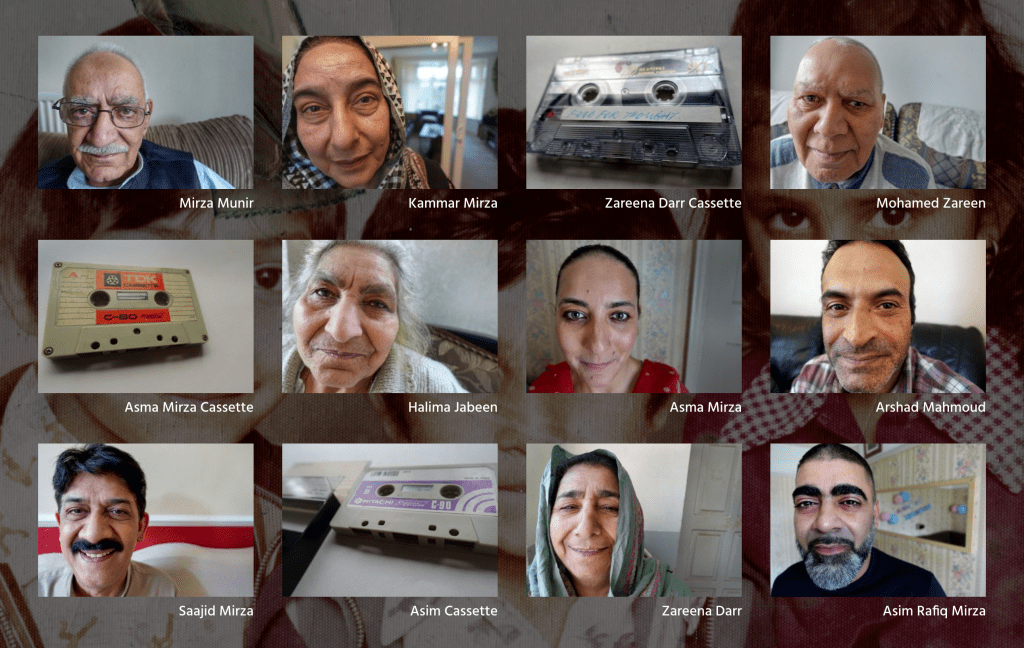
‘Brother, I had a bad dream and it was terrible—I was upset the whole day recalling it. I don’t know why but I dreamt that you were ill, sister Halima and brother Yaseen—I’m talking about the two of you […] but I still wasn’t settled, so I dialed your number and talked to you, but just for a while, because those telephone calls are so expensive […] The things I want to tell you from the heart have to stay in the heart.”
Zareena Darr’s wistful voice reaches out to me, journeying from a decades-old cassette tape to a website as part of the UK-based Tape Letters project. The project highlights the practice of recording and sending messages on cassette tape, as a mode of long-distance communication by Pakistanis who migrated and settled in the UK between 1960 and 1980.
The Tape Letters project explores this unique form of audio messaging across several creative disciplines—such as sound installations, poetry collections, physical exhibitions, radio series, photo series, and videos—pivoting around sound and its role in migration, identity, and displacement.
The project began when Tape Letters’ director, Wajid Yaseen, visited his parental home in Manchester in 2017, where they had migrated to from Pakistan’s Rawalpindi region in the early 1960s. Having lost his father two decades ago, Yaseen talked about the undulating nature of grief, often experiencing the intensity and sharpness of loss as freshly as the day it happened.
Yaseen began combing through his father’s belongings to process his sadness, and chanced upon tapes that he assumed contained recordings of ‘naat’—devotional hymns whose soulful renditions his father was known for in their community. Instead, he discovered tapes whose labels mentioned his aunt’s name in Canada, unearthing buried memories of when he was asked as a child to convey greetings on cassettes to distant family members.
The discovery of those tape letters was an epiphany for Yaseen. He speculated that other families—particularly speaking the Pothwari language—may have also utilized cassette tapes in this way. So he spoke with various people based in and around his hometown to acquire more information.
“A picture slowly emerged of a far more widespread practice,” Yaseen said. “Support from the Heritage Fund and Arts Council England allowed my project team at Modus Arts to research it in-depth, initially on a pilot project with a regional focus in the north of England, followed by a fully-fledged nationwide campaign.”
A Multi-Faceted and Inter-Disciplinary Process
Based in London and a former music producer working with experimental electronic music, Yaseen now works in the sonic arts discipline, running Modus Arts, which thinks about the creative possibilities of sound beyond composition, working with it as philosophical material. “The way people use oil paints in abstract ways, with paintings also asking philosophical questions, for example, I see sound being similarly deployed,” he said.
Yaseen added that the team sourced many ‘tape letter’ cassettes and compiled over a hundred oral histories, culminating in a dedicated archive at the Bishopsgate Institute Library in London. They have also incorporated Scotland into the project, including Scottish-Pakistani experiences
Emphasizing that he and his team are primarily “sound artists, not academics or archivists,” Yaseen shared how the sound-centric approach has enabled the project to sprout many iterations or “outputs,” as they call them, such as physical and digital exhibitions, sound installations, videos, photo series, podcasts, poetry booklets, and talks.
The project’s multi-faceted and interdisciplinary perspective enables people around the world to easily access it on the website, gaining rich insight into the universe of tape letters exchanged between Pothwari-speaking members of the Pakistani community in the UK and Pakistan, conjuring up a historical microcosm of a specific migrant community during a particular time.
The tape letters are, therefore, an anthology of sounds that not only present individual, intimate personal narratives, but also locate them in a wider historical context. Yaseen and his team compiled around 200 interviews and 80 cassettes. They employed NVivo, a Qualitative Data Analysis software, to analyze the data, identifying 50 distinct themes such as linguistic code-switching, cultural heritage, delivery of the cassettes, dreams, metaphors, early experiences of the UK, discrimination, cultural assimilation, gender, and family history.
Yaseen described this aspect of the tapes as sonic archaeology, the sound recordings as a means of uncovering and yielding invaluable historical insights. One is thus privy to the quotidian lives of ordinary people, as opposed to the lavish lifestyles of the privileged.

Technological Evolution, Language, and Translation
Following advances in cassette technology, such as home-recording functionality, cassette tapes became a popular form of audio messaging among members of the British-Pakistani community, given the prohibitive costs of telephone calls and poor telecommunications networks in Pakistan at the time. Messages were recorded on various tape lengths, and the cassettes were sent between families via the postal system, or occasionally delivered by hand via family members or friends. The receivers would listen to the cassettes individually or collectively, similarly recording and returning messages back to the senders.
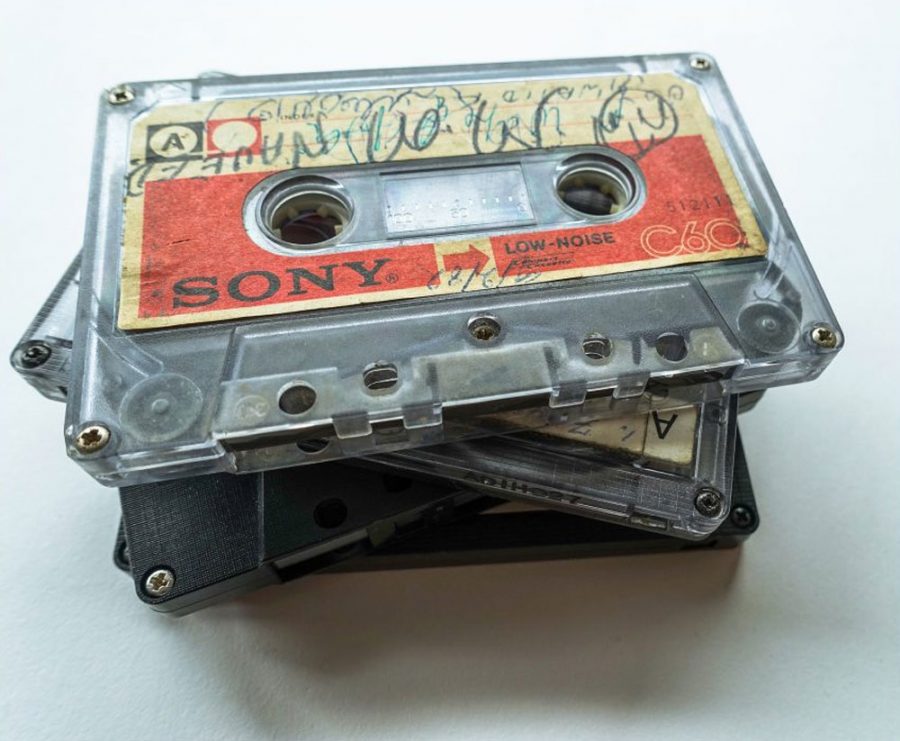
Apart from the narratives providing an auditory window into the people’s quotidian lives, the physical cassettes are significant artifacts reflecting technological growth and innovation. “You can be forensic with not just the content, but the cassette,” Yaseen elaborated, mentioning how different types of tapes from the early ones to the later versions, the sound profiles, the length of the tapes, and even the kind of screws used demonstrate the cassettes’ technological evolution over the years.
Evolving cassette technology would subsequently impact the way the tape letters were recorded and listened to, whether it was the increasing duration one could record for, initially for 60 minutes before eventually graduating to 90- even 120 minutes; or if one chose to record on a cheaper cassette, it could result in the reel being mangled and the conversation being lost. One of the project’s outputs features a sound piece, “The Spaces Between,” a spatial composition incorporating the glitches, recording mistakes, clunks, and clicks typically found on tapes, focusing on the cassette tape system’s analogue physicality.
In one interview, Mirza Muhammad Saeed said they would refer to the cassettes as ‘reels’ in Pothwar, reiterating how the project is so much about language. The speakers using Pothwari in the letters meant it was a complex and laborious undertaking to make the tapes accessible to non-native speakers. Socio-linguists embedded in the region concluded after extensive analysis that Pothwari isn’t just a Punjabi dialect; it is a language in its own right, a transitional language existing between Punjabi and Hindko.
One of the project’s “outputs” involves the intimate, inevitable relationship between language and poetry. Poet Suna Afshan was commissioned by Modus Arts to respond to five cassette tapes, and so she dug into her roots and her Pothwari mother tongue. Her response was encapsulated in the poetry pamphlet, “Tape Letters: A Translation Into Poetry,” in which she sought to translate not just the words heard in the cassette narratives—celebrating Pothwari’s uniqueness and richness—but also the subterranean texts in the pauses and inflections. “Ultimately, the translation attempts to perform what I, at least, consider poetry’s first function: to tell stories,” Afshan said.

The Prototype of Contemporary Voice Notes
To me, the tape letters are prototypes of contemporary voice notes—distinct from audio or video calls, entirely distilling the atmosphere of the moment they were recorded: the language, emotions, pauses, and even extraneous sounds. Yet, unlike the convenient, easy accessibility nowadays in which one simply picks up the phone to record, one wonders about the circumstances in which the tape letter-writers would record the letters, not least having access to the technology in the first place.
Several of the project outputs, such as the Sound Installation project, highlight the story of Asim and Asma, a couple engaged to be married and living in the UK and Pakistan, respectively, who fell in love over three years, sending tapes every two to three weeks to one another. Unable to speak on the phone, they revealed their thoughts, dreams, and desires to one another on tape. In a clip on the website from one of the many tape letters Asma sent to Asim, one can vividly sense the yearnings underlying the challenges of their long-distance relationship, intimacy preserved in the reels.
“Please, give me the right that I can cry as much as I want,” she says. “I don’t have anything except these tears, sweetheart.”
In an interview, Asim talks about the complex nature of recording the cassettes, mentioning that the 90-minute cassette length (45 minutes on either side) meant that ‘‘it wasn’t easy talking…it’s like talking to yourself basically,” adding he would have to take precautions while recording too to maintain privacy and ensure no one would overhear his recordings.
The tape letters also highlight the idea of listening behavior, where Yaseen mentions one interviewee, Kalsum Rasul, who said that she was so overcome by encountering her mother’s crying that she could not hear the cassette more than twice. Even though the cassette is still in her possession and her mother passed away 40 years ago, she has never listened to it since.
Although the nature of the cassette enabled repeated listening, this instance demonstrates every immigrant’s yearning and longing for home. Technology may seemingly bring home and beloved family members closer, and yet, it is an illusion, for they stay as far away as ever.
Given that the tapes encode intimate, personal messages, specifically recorded for an intended receiver, bringing them to a public platform was a long process. “There was also considerable skepticism and distrust of the motive of the tapes,” Yaseen said, elaborating that they had to demonstrate they would be ethical with the material. “It is difficult to build up trust, easy to lose it.”
Apart from the potential participants’ struggles in understanding why these cassette narratives mattered in the first place, they were also unsure if they had even held onto the tapes, believing they had discarded them long ago. Having once convinced the interviewees of their motives, the team then took an oral history approach, interviewing and drawing out memories from the interviewees, which would subsequently lead them to search for and eventually successfully locate tapes.

The Power of Oral History
The tapes’ orality celebrates the power and relevance of oral history, bringing into light narratives often not talked about or heard, such as those of the women. I was particularly drawn to literally hearing the women’s voices emerging from the tapes. Given that women particularly struggled with migrating and adapting to a radically new life in an alien land, the tape letters allowed them to communicate when they could not read or write in other languages. It gave them agency to articulate exactly what they wished to say and liberated them from dictating their letters to someone, which would have likely compelled them to self-censor.
In this interview with Zareena Darr, while she was happy that she could communicate via the cassettes, she nonetheless still expresses her heartache at being unable to read or write, mentioning, “there are a lot of things one can’t tell anyone in writing. Some things are private, like one’s own feelings.”
Maryam Wahid’s Tape Letter photo series, for instance, presents compelling portraits of the faces and personalities behind the voices. One image that particularly stood out was a pair of a woman’s henna-stained palms tenderly cradling a tape, containing a precious cargo of sounds from home, which she held so dear and missed greatly.
Tape Letters’ impact and the community engagement have been significant. Yaseen shared that for the letter-speakers, revisiting their past life chapters and engaging with their contemporary representation has made them feel seen, honoring the significant journeys they took decades ago, making a life-changing decision to make a new home for themselves and their future generations.
Whether it was seemingly mundane such as reconciling to a radically new climate, the snow and fog which would literally make them lost inside the new country they called home, or larger themes of reconciling with loss of identity, enduring a sense of displacement, and their loved ones’ presence reduced to a distant, disembodied voice, the Tape Letters are auditory portraits of lives and choices which are byproducts of the decision to migrate and create homes elsewhere.
As we hear their words from yesterday and today, we too find ourselves contemplating how and what we choose to convey through the way we communicate—and its ripples for the years ahead.

Tape Letters: Wajid Yaseen’s “Sound Archaeology” Project Captures Pakistani Diasporic Memory

The Tape Letters project highlights and explores the practice of recording and sending messages on cassette tape, as a mode of long-distance communication by Pakistanis who migrated and settled in the UK between 1960-1980.
‘Brother, I had a bad dream and it was terrible—I was upset the whole day recalling it. I don’t know why but I dreamt that you were ill, sister Halima and brother Yaseen—I’m talking about the two of you […] but I still wasn’t settled, so I dialed your number and talked to you, but just for a while, because those telephone calls are so expensive […] The things I want to tell you from the heart have to stay in the heart.”
Zareena Darr’s wistful voice reaches out to me, journeying from a decades-old cassette tape to a website as part of the UK-based Tape Letters project. The project highlights the practice of recording and sending messages on cassette tape, as a mode of long-distance communication by Pakistanis who migrated and settled in the UK between 1960 and 1980.
The Tape Letters project explores this unique form of audio messaging across several creative disciplines—such as sound installations, poetry collections, physical exhibitions, radio series, photo series, and videos—pivoting around sound and its role in migration, identity, and displacement.
The project began when Tape Letters’ director, Wajid Yaseen, visited his parental home in Manchester in 2017, where they had migrated to from Pakistan’s Rawalpindi region in the early 1960s. Having lost his father two decades ago, Yaseen talked about the undulating nature of grief, often experiencing the intensity and sharpness of loss as freshly as the day it happened.
Yaseen began combing through his father’s belongings to process his sadness, and chanced upon tapes that he assumed contained recordings of ‘naat’—devotional hymns whose soulful renditions his father was known for in their community. Instead, he discovered tapes whose labels mentioned his aunt’s name in Canada, unearthing buried memories of when he was asked as a child to convey greetings on cassettes to distant family members.
The discovery of those tape letters was an epiphany for Yaseen. He speculated that other families—particularly speaking the Pothwari language—may have also utilized cassette tapes in this way. So he spoke with various people based in and around his hometown to acquire more information.
“A picture slowly emerged of a far more widespread practice,” Yaseen said. “Support from the Heritage Fund and Arts Council England allowed my project team at Modus Arts to research it in-depth, initially on a pilot project with a regional focus in the north of England, followed by a fully-fledged nationwide campaign.”
A Multi-Faceted and Inter-Disciplinary Process
Based in London and a former music producer working with experimental electronic music, Yaseen now works in the sonic arts discipline, running Modus Arts, which thinks about the creative possibilities of sound beyond composition, working with it as philosophical material. “The way people use oil paints in abstract ways, with paintings also asking philosophical questions, for example, I see sound being similarly deployed,” he said.
Yaseen added that the team sourced many ‘tape letter’ cassettes and compiled over a hundred oral histories, culminating in a dedicated archive at the Bishopsgate Institute Library in London. They have also incorporated Scotland into the project, including Scottish-Pakistani experiences
Emphasizing that he and his team are primarily “sound artists, not academics or archivists,” Yaseen shared how the sound-centric approach has enabled the project to sprout many iterations or “outputs,” as they call them, such as physical and digital exhibitions, sound installations, videos, photo series, podcasts, poetry booklets, and talks.
The project’s multi-faceted and interdisciplinary perspective enables people around the world to easily access it on the website, gaining rich insight into the universe of tape letters exchanged between Pothwari-speaking members of the Pakistani community in the UK and Pakistan, conjuring up a historical microcosm of a specific migrant community during a particular time.
The tape letters are, therefore, an anthology of sounds that not only present individual, intimate personal narratives, but also locate them in a wider historical context. Yaseen and his team compiled around 200 interviews and 80 cassettes. They employed NVivo, a Qualitative Data Analysis software, to analyze the data, identifying 50 distinct themes such as linguistic code-switching, cultural heritage, delivery of the cassettes, dreams, metaphors, early experiences of the UK, discrimination, cultural assimilation, gender, and family history.
Yaseen described this aspect of the tapes as sonic archaeology, the sound recordings as a means of uncovering and yielding invaluable historical insights. One is thus privy to the quotidian lives of ordinary people, as opposed to the lavish lifestyles of the privileged.
Technological Evolution, Language, and Translation
Following advances in cassette technology, such as home-recording functionality, cassette tapes became a popular form of audio messaging among members of the British-Pakistani community, given the prohibitive costs of telephone calls and poor telecommunications networks in Pakistan at the time. Messages were recorded on various tape lengths, and the cassettes were sent between families via the postal system, or occasionally delivered by hand via family members or friends. The receivers would listen to the cassettes individually or collectively, similarly recording and returning messages back to the senders.
Apart from the narratives providing an auditory window into the people’s quotidian lives, the physical cassettes are significant artifacts reflecting technological growth and innovation. “You can be forensic with not just the content, but the cassette,” Yaseen elaborated, mentioning how different types of tapes from the early ones to the later versions, the sound profiles, the length of the tapes, and even the kind of screws used demonstrate the cassettes’ technological evolution over the years.
Evolving cassette technology would subsequently impact the way the tape letters were recorded and listened to, whether it was the increasing duration one could record for, initially for 60 minutes before eventually graduating to 90- even 120 minutes; or if one chose to record on a cheaper cassette, it could result in the reel being mangled and the conversation being lost. One of the project’s outputs features a sound piece, “The Spaces Between,” a spatial composition incorporating the glitches, recording mistakes, clunks, and clicks typically found on tapes, focusing on the cassette tape system’s analogue physicality.
In one interview, Mirza Muhammad Saeed said they would refer to the cassettes as ‘reels’ in Pothwar, reiterating how the project is so much about language. The speakers using Pothwari in the letters meant it was a complex and laborious undertaking to make the tapes accessible to non-native speakers. Socio-linguists embedded in the region concluded after extensive analysis that Pothwari isn’t just a Punjabi dialect; it is a language in its own right, a transitional language existing between Punjabi and Hindko.
One of the project’s “outputs” involves the intimate, inevitable relationship between language and poetry. Poet Suna Afshan was commissioned by Modus Arts to respond to five cassette tapes, and so she dug into her roots and her Pothwari mother tongue. Her response was encapsulated in the poetry pamphlet, “Tape Letters: A Translation Into Poetry,” in which she sought to translate not just the words heard in the cassette narratives—celebrating Pothwari’s uniqueness and richness—but also the subterranean texts in the pauses and inflections. “Ultimately, the translation attempts to perform what I, at least, consider poetry’s first function: to tell stories,” Afshan said.
The Prototype of Contemporary Voice Notes
To me, the tape letters are prototypes of contemporary voice notes—distinct from audio or video calls, entirely distilling the atmosphere of the moment they were recorded: the language, emotions, pauses, and even extraneous sounds. Yet, unlike the convenient, easy accessibility nowadays in which one simply picks up the phone to record, one wonders about the circumstances in which the tape letter-writers would record the letters, not least having access to the technology in the first place.
Several of the project outputs, such as the Sound Installation project, highlight the story of Asim and Asma, a couple engaged to be married and living in the UK and Pakistan, respectively, who fell in love over three years, sending tapes every two to three weeks to one another. Unable to speak on the phone, they revealed their thoughts, dreams, and desires to one another on tape. In a clip on the website from one of the many tape letters Asma sent to Asim, one can vividly sense the yearnings underlying the challenges of their long-distance relationship, intimacy preserved in the reels.
“Please, give me the right that I can cry as much as I want,” she says. “I don’t have anything except these tears, sweetheart.”
In an interview, Asim talks about the complex nature of recording the cassettes, mentioning that the 90-minute cassette length (45 minutes on either side) meant that ‘‘it wasn’t easy talking…it’s like talking to yourself basically,” adding he would have to take precautions while recording too to maintain privacy and ensure no one would overhear his recordings.
The tape letters also highlight the idea of listening behavior, where Yaseen mentions one interviewee, Kalsum Rasul, who said that she was so overcome by encountering her mother’s crying that she could not hear the cassette more than twice. Even though the cassette is still in her possession and her mother passed away 40 years ago, she has never listened to it since.
Although the nature of the cassette enabled repeated listening, this instance demonstrates every immigrant’s yearning and longing for home. Technology may seemingly bring home and beloved family members closer, and yet, it is an illusion, for they stay as far away as ever.
Given that the tapes encode intimate, personal messages, specifically recorded for an intended receiver, bringing them to a public platform was a long process. “There was also considerable skepticism and distrust of the motive of the tapes,” Yaseen said, elaborating that they had to demonstrate they would be ethical with the material. “It is difficult to build up trust, easy to lose it.”
Apart from the potential participants’ struggles in understanding why these cassette narratives mattered in the first place, they were also unsure if they had even held onto the tapes, believing they had discarded them long ago. Having once convinced the interviewees of their motives, the team then took an oral history approach, interviewing and drawing out memories from the interviewees, which would subsequently lead them to search for and eventually successfully locate tapes.
The Power of Oral History
The tapes’ orality celebrates the power and relevance of oral history, bringing into light narratives often not talked about or heard, such as those of the women. I was particularly drawn to literally hearing the women’s voices emerging from the tapes. Given that women particularly struggled with migrating and adapting to a radically new life in an alien land, the tape letters allowed them to communicate when they could not read or write in other languages. It gave them agency to articulate exactly what they wished to say and liberated them from dictating their letters to someone, which would have likely compelled them to self-censor.
In this interview with Zareena Darr, while she was happy that she could communicate via the cassettes, she nonetheless still expresses her heartache at being unable to read or write, mentioning, “there are a lot of things one can’t tell anyone in writing. Some things are private, like one’s own feelings.”
Maryam Wahid’s Tape Letter photo series, for instance, presents compelling portraits of the faces and personalities behind the voices. One image that particularly stood out was a pair of a woman’s henna-stained palms tenderly cradling a tape, containing a precious cargo of sounds from home, which she held so dear and missed greatly.
Tape Letters’ impact and the community engagement have been significant. Yaseen shared that for the letter-speakers, revisiting their past life chapters and engaging with their contemporary representation has made them feel seen, honoring the significant journeys they took decades ago, making a life-changing decision to make a new home for themselves and their future generations.
Whether it was seemingly mundane such as reconciling to a radically new climate, the snow and fog which would literally make them lost inside the new country they called home, or larger themes of reconciling with loss of identity, enduring a sense of displacement, and their loved ones’ presence reduced to a distant, disembodied voice, the Tape Letters are auditory portraits of lives and choices which are byproducts of the decision to migrate and create homes elsewhere.
As we hear their words from yesterday and today, we too find ourselves contemplating how and what we choose to convey through the way we communicate—and its ripples for the years ahead.