





Klein begins his essay by declaring that “Charlie Kirk practiced politics the right way.” That this sentence was published at all tells us everything about the decay of the so-called paper of record. Opinions are not free passes to write fiction. They must have some fidelity to fact. Kirk did not practice politics “the right way.” He practiced propaganda, harassment, and incitement.
Ezra Klein: “The foundation of a free society is the ability to participate in politics without fear of violence. To lose that is to risk losing everything.”
This is Klein’s opening premise, and it is far from the truth. The foundation of this country has never been participation without fear. For Black, Brown, Arab, Muslim, and working people, politics is lived through fear. To wear a keffiyeh is to risk being targeted, to march for Gaza is to risk surveillance, and to speak of abolition is to risk police reprisal. Violence shadows every act that demands dignity for these communities. To pretend otherwise is to erase the brutal history of various rights movements in this country— including its very founding.
Ezra Klein: “Charlie Kirk and his family just lost everything. As a country, we came a step closer to losing everything, too.”
Klein builds on this false premise of safety by declaring Kirk’s murder a national rupture, as if his death marks the threshold of political loss for us all. Why Kirk? Why this family? Why now? At the very moment of Kirk’s death, there were other shootings, other losses, and other grief. As of August 2025, there were 302 deaths and 1,354 injuries from 309 mass shootings in the United States. All these families have to live with their loss. Families in Gaza, Sudan, and Congo bury their dead daily as a result of American complicity. As I write this, my social media stream shows the IOF mass-abducting Palestinian men in Tulkarm, while twenty-five journalists have been killed in Yemen in Israeli airstrikes.
When a Palestinian-American journalist, Shireen Abu Akleh, was gunned down by Israel in May 2022, Klein did not write an elegy. Akleh was his tribe, a fellow American journalist killed by snipers. Even when Klein podcasts about Palestine, it is always couched as a question — “Is Israel Committing Genocide in Gaza?” Klein’s canon of grief is selective, and it is bound by whiteness and power. He has shown more decency, kindness, and even grace in writing about a white supremacist like Charlie Kirk than he did when interviewing Ta-Nehisi Coates about his book The Message.
Ezra Klein: “You can dislike much of what Kirk believed, and the following statement is still true: Kirk was practicing politics in exactly the right way.”…“College-age voters shifted sharply right in the 2024 election.”
Klein’s claim that Charlie Kirk was “practicing politics in exactly the right way” is purely rhetorical. Yes, Kirk showed up on campuses and sparred with students, but there is little evidence that he engaged dissenting voices in honest debate. To call this “exactly the right way” is not a fact but a spin. There is no evidence beyond anecdotes to support this claim.
Klein then crowns Kirk “one of the era’s most effective practitioners of persuasion” without proof. Visibility + Virality + Attention does not equal persuasion. He folds this into another leap and makes the point that the left thought it held an “absolute” grip on college students until Kirk came along. Again, with no evidence.
And in the final move, he declares that “college-age voters shifted sharply right in the 2024 election” because of Kirk. Klein relies on correlation and infers causation. The data simply doesn’t support it: while some subgroups, particularly young men and non-college youth, drifted rightward, college-age voters as a whole still leaned Democratic.
To make his point, Klein has to conflate influence with persuasion, correlation with causation, and anecdote with trend. This is mental gymnastics performed to portray Kirk as a martyr of civility, and himself as the sober arbiter of truth. Any half-decent editor— even one that edits the NYT opinions, which still must meet a basic threshold of accuracy— should have slashed this paragraph and demanded a rewrite.
Liberalism and White Supremacy: Bedfellows
Ezra Klein: “I did not know Kirk, and I am not the right person to eulogize him. But I envied what he built.”
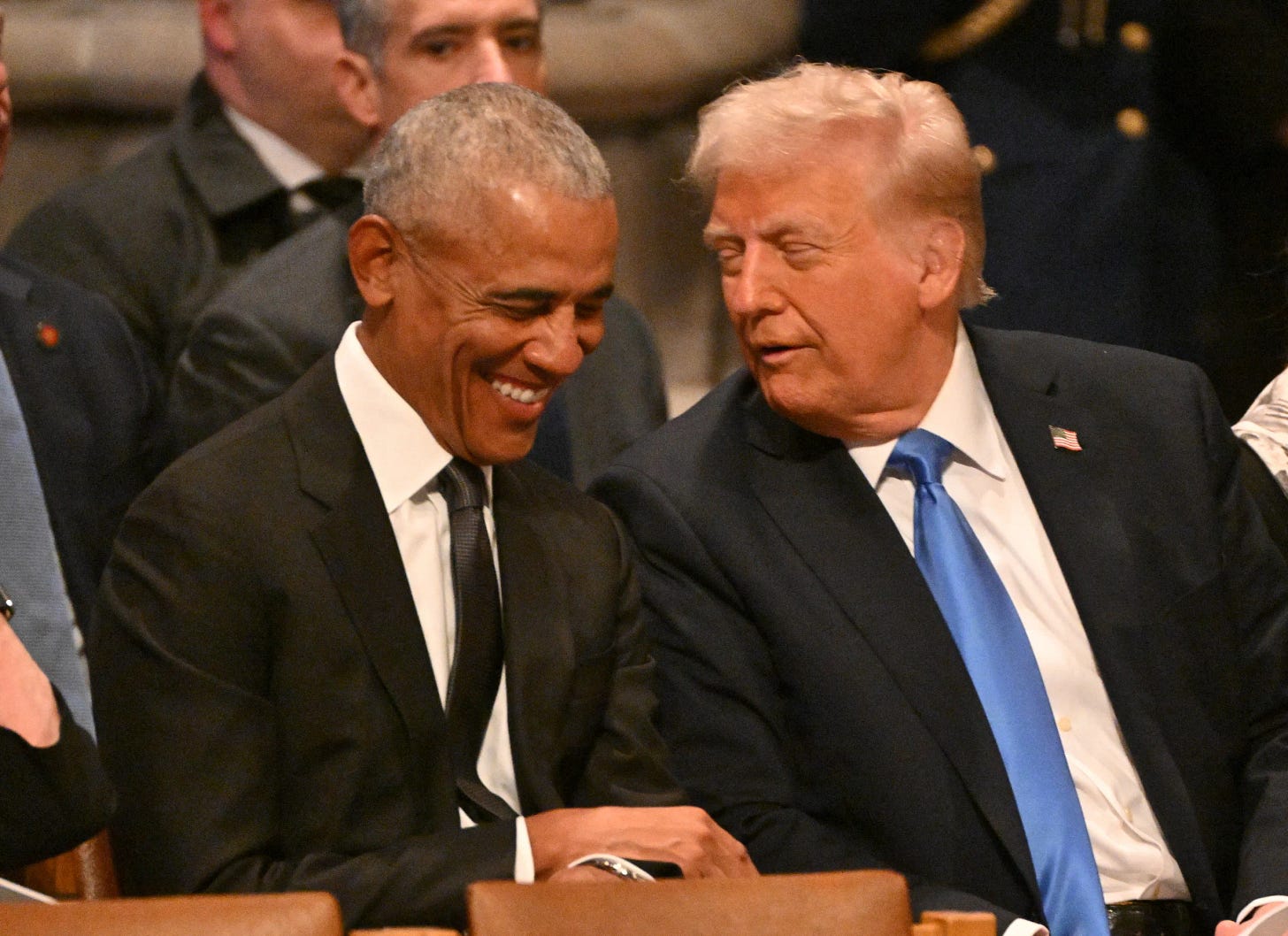
And here the truth slips out. Klein envied Kirk, especially for his reach, his much larger and easily incitable base. He describes Kirk’s violent rhetoric as a “taste for disagreement.” But what Kirk built was a mob consensus, and weaponized anger. Klein perhaps sensed this raw, unbridled power and desired it. He confuses fearlessness with cruelty, persuasion with bullying, and politics with propaganda.
And then argues that “Liberalism could use more of his [Kirk’s] moxie and fearlessness.” Here, Klein lectures his base without quite understanding his own turf; that liberalism does not run on disagreement or moxie. Liberalism is the smug bubble where people like Klein thrive. It is a pool of self-congratulation, where mediocrity floats comfortably.
And Klein is not an anomaly. He is part of the useless political pundit class — Friedman, Kristof, Brooks, Weiss — all of whom generate fog to preserve the facade of American democracy, of an equal society. Alongside them sit an extended subclass of comedians and talk-show hosts, the palatable sages: Stewart, Colbert, Kimmel, Meyers, Fallon, Noah, Minhaj…. The list is long, and the pool is replenished every few years with just enough melanin to keep the fictions going. But the endgame is always the same: to launder garbage into civic virtue.
Liberalism has always been the most reliable ally of white supremacy. It does not challenge state power, but selectively justifies its brutality. American history is littered with examples, from Truman dropping atomic bombs in Japan to Kennedy and Johnson escalating atrocities in Vietnam while speaking the language of civil rights. Clinton gutted welfare, signed the 1994 crime bill that supercharged mass incarceration, and pushed NAFTA, all while expanding the policing and surveillance state.
After 9/11, liberals became the handmaidens of the empire again. They voted for the PATRIOT Act, justified Afghanistan as the “good war,” and stood shoulder to shoulder with Bush in Iraq. Obama expanded the drone program, normalized indefinite detention, and presided over record deportations, all while selling the language of hope and unity.
This is the liberal blueprint: cloak violence in reason, collude with white supremacy while pretending to resist it, and police the left more harshly than the right because the left threatens to expose the structure of systemic racism and inequality itself.
After praising Kirk’s “moxie,” Klein points to Governor Gavin Newsom of California, hosting Kirk on his podcast, noting with delight that Newsom’s son was a huge fan. “What a testament to Kirk’s project,” Klein gushes. I can almost imagine him clutching his pearls, while simultaneously shouting in glee. And this is precisely the problem with his analysis. To treat this as a “testament” is to reveal how hollow Democratic opposition to Trump really is, and the unity of white America across party lines.
Gramsci put it plainly: “The historical unity of the ruling classes is realised in the State. Their history is essentially the history of class unity…” Klein may think he is measuring Kirk’s legacy, but what he is really admiring is the political class’s capacity to reproduce itself, even in death.
Ezra Klein: “On social media, I’ve seen mostly decent reactions to Kirk’s murder. There is grief and shock from both the left and the right.”
After hoping that Liberals have more moxie, Klein performs the most liberal of moves: he flattens the vast and varied response to Kirk’s killing, and sanitizes the differences. He pretends grief for Kirk is universal. But grief is not what many feel for Kirk. White and privileged circles may feel shock, but not out of love for him. Their shock comes from the spectacle, a white man felled mid-sentence on a university stage, even confusion at the how, but not grief at the who.
For many, there is no grief. There is fear of the coming repercussions. Relief, perhaps. But not grief. There is also recognition that Kirk’s politics harmed people, and that his death will not diminish the harm he caused.
No one should be forced into grieving for someone who never saw us as human. But no one should be asked to condemn the death of a man who wished death upon our communities. And yet this is the liberal playbook: a relentless switching between condemnation and a demand to sympathize, to humanize, to work with our annihilators as if civility is the only path left open to us.
Klein’s “shock and grief” reveals how shielded he is from the reality of this country. He knows little of the left and even less of the right. The right wing has long been steeped in fantasies of violence. This is the nation that made lynching postcards, circulated photographs of mutilated Black bodies as souvenirs. Violence does not shock them; it is their tradition.
Many of us have lived months watching livestreams of genocide, the bodies of Palestinians paraded; children pulled from rubble. We are already hollowed out and scarred by a feed of endless corpses. We do not respond to Kirk with the same grief because we cannot. This is the obscenity Klein cannot admit: Americans, no matter who, and where they lie on the political spectrum, have been sanitized for violence — one side through fantasies of white power, the other through the reality of bearing impotent witness to the slaughter of so many people and communities.
Ezra Klein: “One [reaction] is a move on the left to wrap Kirk’s death around his views… Another is on the right, to turn his murder into a justification for an all-out war, a Reichstag fire for our time.”
Immediately, Klein performs another liberal sleight of hand: he equates critique with catastrophe. To him, the left arguing that Kirk’s death cannot be separated from the harm he caused is somehow equal to the right treating his death as a rallying cry for a war. This false equivalence is obscene.


Why shouldn’t Kirk’s death be discussed in the context of what he did? He was a man who openly argued that the Second Amendment was more important than the lives of innocent people. He insisted that young girls raped and impregnated by their rapists should be forced to give birth. He claimed Black people deserved to die at the hands of police. He mainstreamed white supremacist fantasies as campus politics. To criticize Kirk’s death through the lens of his views is not indecent, but an honest accounting. And a mass resistance to the American empire’s version of history.
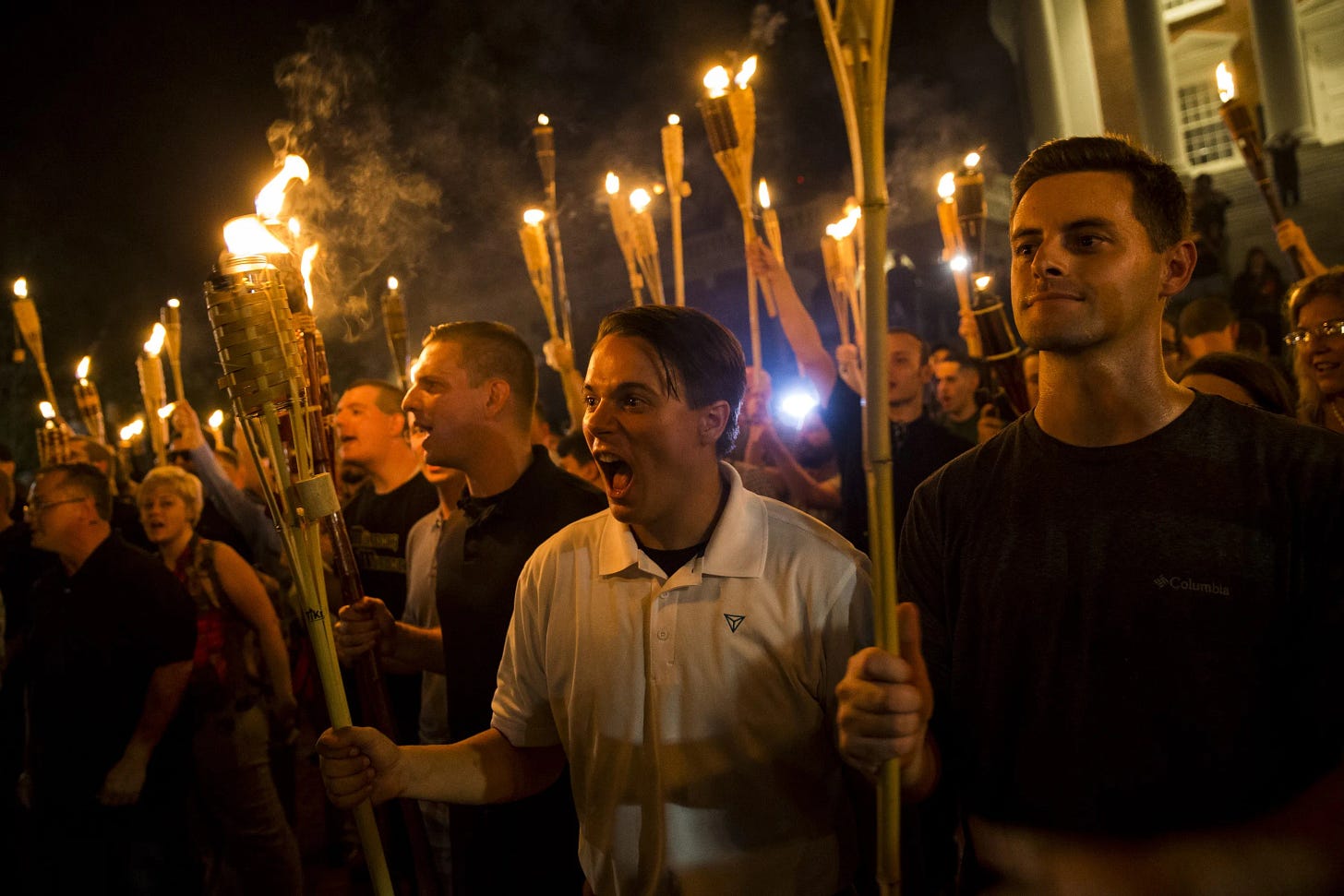
Klein, however, collapses this into the right’s call to arms, a potential “Reichstag fire”. This tells us much less about the left or the right, than it does about Klein himself: that does not understand either. He lives in the bubble of pundit privilege, insulated from violence, where the real fires never reach.
For him, the Reichstag fire” is a future possibility. For many communities, the fire already burned. Black communities live in its ashes. Indigenous nations carry centuries of scorched earth. Palestinians are incinerated in real time on a livestream. The flames of policy consume migrants at the border. The Reichstag fire of our time is not a metaphor. It is here, burning, and being fanned by Kirks and Kleins alike.
Ezra Klein’s Canon of Assassinations
Klein commits another act of flattening. He lists Malcolm X, Martin Luther King Jr., and the Kennedys in the same breath. He throws in George Wallace and Ronald Reagan — as if these deaths and attempts were equivalent, as if their politics and the reasons they were targeted did not matter.
The murder of Malcolm X and Martin Luther King tore through entire communities, ruptured movements, and extinguished visions of liberation. Their loss was collective, not only familial. Yet Klein folds them into a roster of “political figures,” equating them with Reagan, who survived an assassination attempt and went on to intensify the very structures of violence that haunt us still.
Ezra Klein: “American politics has sides. There is no use pretending it doesn’t. But both sides are meant to be on the same side of a larger project — we are all, or most of us, anyway, trying to maintain the viability of the American experiment.”
This is the old Obama catechism: there is no red America or blue America, only the United States of America. It was false then, it is false now. This country has never been a single republic. The “experiment” has always been divided: some thrive, others suffer, and most struggle to survive. While the same Constitution governs us, we are treated so differently that to call us one polity is a myth.
The American experiment survives only because those dispossessed continue, against all odds, to hold fragments of life together. It is not unity that preserves the republic; it is survival despite the republic.
Ezra Klein: “Kirk and I were on different sides of most political arguments. We were on the same side on the continued possibility of American politics. It is supposed to be an argument, not a war; it is supposed to be won with words, not ended with bullets.”
This is Klein’s most honest moment, and here he does what he does best: articulating American politics as an argument between two white men. He affirms what we have always known — Kirk and Klein belong to the same world. They can disagree ferociously and remain on “the same side” of the republic. But the rest of us — Brown, Black, immigrant — are not invited. We are not the public in Klein’s imagined democracy. We are spectators, at best, and targets, at worst.
For Klein, politics is a matter of argument. And arguments for him are also a game. He can spar, write, and retreat into his comforts. For the rest of us, Kirk’s “arguments” translated into assaults in subways, harassment on campuses, and policies that stripped rights from women, migrants, and queer youth. These are not abstract disagreements. They are lived terror.
“It is supposed to be won with words, not ended with bullets,” he writes. But whose words? Whose bullets? Words have never won safety for the oppressed. Words did not free the enslaved. Words did not protect the lynched. Sometimes, when the boot is on your neck, survival requires force. Violence, when used to defend communities from annihilation, does not even enter Klein’s vocabulary. The only violence he can imagine is the violence of elites against elites, white men against white men, sanitized into “political violence.”
Then comes the devastating line: “I wanted Kirk to be safe for his sake, but I also wanted him to be safe for mine and for the sake of our larger shared project.” The “project” is democracy as Klein imagines it, a democracy that protects pundits and politicians while excluding the rest. Klein is not speaking for America’s most protected inheritors, and he is mourning a fellow white man, envying him even in death, and calling it a universal truth.
What Klein is doing through his column, is, unfortunately, not new. It is a part of the Great American Tradition of writing hagiographies of war criminals and genocidaires, from Bush to Kissinger. Klein is a foot soldier of American empire, and the New York Times, it’s scribe; a document of state propaganda, masquerading as fact.
His “we are all safe, or none of us are” is the most hollow of lies. So many of us have never felt safe. We were not safe yesterday, we are not safe today, and we do not know if safety will ever be ours tomorrow.


Ezra Klein’s NYT Elegy for Charlie Kirk Sanitizes Supremacy

Ezra Klein's essay is a hollow, uninspiring piece masquerading as discourse —it's garbage. I say this not as a personal attack, but as an attack on the system that elevates people like him to the status of an oracle. In America, the people we venerate as “sense-makers” are pundits. They publish in “Prestige” publications like The New York Times and proliferate ideas that protect the facade of American life; they are the mediators of elite consensus. If you live in this country long enough, you learn to see and smell this garbage. Klein’s column on Charlie Kirk’s death reeks of it.
Klein begins his essay by declaring that “Charlie Kirk practiced politics the right way.” That this sentence was published at all tells us everything about the decay of the so-called paper of record. Opinions are not free passes to write fiction. They must have some fidelity to fact. Kirk did not practice politics “the right way.” He practiced propaganda, harassment, and incitement.
Ezra Klein: “The foundation of a free society is the ability to participate in politics without fear of violence. To lose that is to risk losing everything.”
This is Klein’s opening premise, and it is far from the truth. The foundation of this country has never been participation without fear. For Black, Brown, Arab, Muslim, and working people, politics is lived through fear. To wear a keffiyeh is to risk being targeted, to march for Gaza is to risk surveillance, and to speak of abolition is to risk police reprisal. Violence shadows every act that demands dignity for these communities. To pretend otherwise is to erase the brutal history of various rights movements in this country— including its very founding.
Ezra Klein: “Charlie Kirk and his family just lost everything. As a country, we came a step closer to losing everything, too.”
Klein builds on this false premise of safety by declaring Kirk’s murder a national rupture, as if his death marks the threshold of political loss for us all. Why Kirk? Why this family? Why now? At the very moment of Kirk’s death, there were other shootings, other losses, and other grief. As of August 2025, there were 302 deaths and 1,354 injuries from 309 mass shootings in the United States. All these families have to live with their loss. Families in Gaza, Sudan, and Congo bury their dead daily as a result of American complicity. As I write this, my social media stream shows the IOF mass-abducting Palestinian men in Tulkarm, while twenty-five journalists have been killed in Yemen in Israeli airstrikes.
When a Palestinian-American journalist, Shireen Abu Akleh, was gunned down by Israel in May 2022, Klein did not write an elegy. Akleh was his tribe, a fellow American journalist killed by snipers. Even when Klein podcasts about Palestine, it is always couched as a question — “Is Israel Committing Genocide in Gaza?” Klein’s canon of grief is selective, and it is bound by whiteness and power. He has shown more decency, kindness, and even grace in writing about a white supremacist like Charlie Kirk than he did when interviewing Ta-Nehisi Coates about his book The Message.
Ezra Klein: “You can dislike much of what Kirk believed, and the following statement is still true: Kirk was practicing politics in exactly the right way.”…“College-age voters shifted sharply right in the 2024 election.”
Klein’s claim that Charlie Kirk was “practicing politics in exactly the right way” is purely rhetorical. Yes, Kirk showed up on campuses and sparred with students, but there is little evidence that he engaged dissenting voices in honest debate. To call this “exactly the right way” is not a fact but a spin. There is no evidence beyond anecdotes to support this claim.
Klein then crowns Kirk “one of the era’s most effective practitioners of persuasion” without proof. Visibility + Virality + Attention does not equal persuasion. He folds this into another leap and makes the point that the left thought it held an “absolute” grip on college students until Kirk came along. Again, with no evidence.
And in the final move, he declares that “college-age voters shifted sharply right in the 2024 election” because of Kirk. Klein relies on correlation and infers causation. The data simply doesn’t support it: while some subgroups, particularly young men and non-college youth, drifted rightward, college-age voters as a whole still leaned Democratic.
To make his point, Klein has to conflate influence with persuasion, correlation with causation, and anecdote with trend. This is mental gymnastics performed to portray Kirk as a martyr of civility, and himself as the sober arbiter of truth. Any half-decent editor— even one that edits the NYT opinions, which still must meet a basic threshold of accuracy— should have slashed this paragraph and demanded a rewrite.
Liberalism and White Supremacy: Bedfellows
Ezra Klein: “I did not know Kirk, and I am not the right person to eulogize him. But I envied what he built.”
And here the truth slips out. Klein envied Kirk, especially for his reach, his much larger and easily incitable base. He describes Kirk’s violent rhetoric as a “taste for disagreement.” But what Kirk built was a mob consensus, and weaponized anger. Klein perhaps sensed this raw, unbridled power and desired it. He confuses fearlessness with cruelty, persuasion with bullying, and politics with propaganda.
And then argues that “Liberalism could use more of his [Kirk’s] moxie and fearlessness.” Here, Klein lectures his base without quite understanding his own turf; that liberalism does not run on disagreement or moxie. Liberalism is the smug bubble where people like Klein thrive. It is a pool of self-congratulation, where mediocrity floats comfortably.
And Klein is not an anomaly. He is part of the useless political pundit class — Friedman, Kristof, Brooks, Weiss — all of whom generate fog to preserve the facade of American democracy, of an equal society. Alongside them sit an extended subclass of comedians and talk-show hosts, the palatable sages: Stewart, Colbert, Kimmel, Meyers, Fallon, Noah, Minhaj…. The list is long, and the pool is replenished every few years with just enough melanin to keep the fictions going. But the endgame is always the same: to launder garbage into civic virtue.
Liberalism has always been the most reliable ally of white supremacy. It does not challenge state power, but selectively justifies its brutality. American history is littered with examples, from Truman dropping atomic bombs in Japan to Kennedy and Johnson escalating atrocities in Vietnam while speaking the language of civil rights. Clinton gutted welfare, signed the 1994 crime bill that supercharged mass incarceration, and pushed NAFTA, all while expanding the policing and surveillance state.
After 9/11, liberals became the handmaidens of the empire again. They voted for the PATRIOT Act, justified Afghanistan as the “good war,” and stood shoulder to shoulder with Bush in Iraq. Obama expanded the drone program, normalized indefinite detention, and presided over record deportations, all while selling the language of hope and unity.
This is the liberal blueprint: cloak violence in reason, collude with white supremacy while pretending to resist it, and police the left more harshly than the right because the left threatens to expose the structure of systemic racism and inequality itself.
After praising Kirk’s “moxie,” Klein points to Governor Gavin Newsom of California, hosting Kirk on his podcast, noting with delight that Newsom’s son was a huge fan. “What a testament to Kirk’s project,” Klein gushes. I can almost imagine him clutching his pearls, while simultaneously shouting in glee. And this is precisely the problem with his analysis. To treat this as a “testament” is to reveal how hollow Democratic opposition to Trump really is, and the unity of white America across party lines.
Gramsci put it plainly: “The historical unity of the ruling classes is realised in the State. Their history is essentially the history of class unity…” Klein may think he is measuring Kirk’s legacy, but what he is really admiring is the political class’s capacity to reproduce itself, even in death.
Ezra Klein: “On social media, I’ve seen mostly decent reactions to Kirk’s murder. There is grief and shock from both the left and the right.”
After hoping that Liberals have more moxie, Klein performs the most liberal of moves: he flattens the vast and varied response to Kirk’s killing, and sanitizes the differences. He pretends grief for Kirk is universal. But grief is not what many feel for Kirk. White and privileged circles may feel shock, but not out of love for him. Their shock comes from the spectacle, a white man felled mid-sentence on a university stage, even confusion at the how, but not grief at the who.
For many, there is no grief. There is fear of the coming repercussions. Relief, perhaps. But not grief. There is also recognition that Kirk’s politics harmed people, and that his death will not diminish the harm he caused.
No one should be forced into grieving for someone who never saw us as human. But no one should be asked to condemn the death of a man who wished death upon our communities. And yet this is the liberal playbook: a relentless switching between condemnation and a demand to sympathize, to humanize, to work with our annihilators as if civility is the only path left open to us.
Klein’s “shock and grief” reveals how shielded he is from the reality of this country. He knows little of the left and even less of the right. The right wing has long been steeped in fantasies of violence. This is the nation that made lynching postcards, circulated photographs of mutilated Black bodies as souvenirs. Violence does not shock them; it is their tradition.
Many of us have lived months watching livestreams of genocide, the bodies of Palestinians paraded; children pulled from rubble. We are already hollowed out and scarred by a feed of endless corpses. We do not respond to Kirk with the same grief because we cannot. This is the obscenity Klein cannot admit: Americans, no matter who, and where they lie on the political spectrum, have been sanitized for violence — one side through fantasies of white power, the other through the reality of bearing impotent witness to the slaughter of so many people and communities.
Ezra Klein: “One [reaction] is a move on the left to wrap Kirk’s death around his views… Another is on the right, to turn his murder into a justification for an all-out war, a Reichstag fire for our time.”
Immediately, Klein performs another liberal sleight of hand: he equates critique with catastrophe. To him, the left arguing that Kirk’s death cannot be separated from the harm he caused is somehow equal to the right treating his death as a rallying cry for a war. This false equivalence is obscene.
Why shouldn’t Kirk’s death be discussed in the context of what he did? He was a man who openly argued that the Second Amendment was more important than the lives of innocent people. He insisted that young girls raped and impregnated by their rapists should be forced to give birth. He claimed Black people deserved to die at the hands of police. He mainstreamed white supremacist fantasies as campus politics. To criticize Kirk’s death through the lens of his views is not indecent, but an honest accounting. And a mass resistance to the American empire’s version of history.
Klein, however, collapses this into the right’s call to arms, a potential “Reichstag fire”. This tells us much less about the left or the right, than it does about Klein himself: that does not understand either. He lives in the bubble of pundit privilege, insulated from violence, where the real fires never reach.
For him, the Reichstag fire” is a future possibility. For many communities, the fire already burned. Black communities live in its ashes. Indigenous nations carry centuries of scorched earth. Palestinians are incinerated in real time on a livestream. The flames of policy consume migrants at the border. The Reichstag fire of our time is not a metaphor. It is here, burning, and being fanned by Kirks and Kleins alike.
Ezra Klein’s Canon of Assassinations
Klein commits another act of flattening. He lists Malcolm X, Martin Luther King Jr., and the Kennedys in the same breath. He throws in George Wallace and Ronald Reagan — as if these deaths and attempts were equivalent, as if their politics and the reasons they were targeted did not matter.
The murder of Malcolm X and Martin Luther King tore through entire communities, ruptured movements, and extinguished visions of liberation. Their loss was collective, not only familial. Yet Klein folds them into a roster of “political figures,” equating them with Reagan, who survived an assassination attempt and went on to intensify the very structures of violence that haunt us still.
Ezra Klein: “American politics has sides. There is no use pretending it doesn’t. But both sides are meant to be on the same side of a larger project — we are all, or most of us, anyway, trying to maintain the viability of the American experiment.”
This is the old Obama catechism: there is no red America or blue America, only the United States of America. It was false then, it is false now. This country has never been a single republic. The “experiment” has always been divided: some thrive, others suffer, and most struggle to survive. While the same Constitution governs us, we are treated so differently that to call us one polity is a myth.
The American experiment survives only because those dispossessed continue, against all odds, to hold fragments of life together. It is not unity that preserves the republic; it is survival despite the republic.
Ezra Klein: “Kirk and I were on different sides of most political arguments. We were on the same side on the continued possibility of American politics. It is supposed to be an argument, not a war; it is supposed to be won with words, not ended with bullets.”
This is Klein’s most honest moment, and here he does what he does best: articulating American politics as an argument between two white men. He affirms what we have always known — Kirk and Klein belong to the same world. They can disagree ferociously and remain on “the same side” of the republic. But the rest of us — Brown, Black, immigrant — are not invited. We are not the public in Klein’s imagined democracy. We are spectators, at best, and targets, at worst.
For Klein, politics is a matter of argument. And arguments for him are also a game. He can spar, write, and retreat into his comforts. For the rest of us, Kirk’s “arguments” translated into assaults in subways, harassment on campuses, and policies that stripped rights from women, migrants, and queer youth. These are not abstract disagreements. They are lived terror.
“It is supposed to be won with words, not ended with bullets,” he writes. But whose words? Whose bullets? Words have never won safety for the oppressed. Words did not free the enslaved. Words did not protect the lynched. Sometimes, when the boot is on your neck, survival requires force. Violence, when used to defend communities from annihilation, does not even enter Klein’s vocabulary. The only violence he can imagine is the violence of elites against elites, white men against white men, sanitized into “political violence.”
Then comes the devastating line: “I wanted Kirk to be safe for his sake, but I also wanted him to be safe for mine and for the sake of our larger shared project.” The “project” is democracy as Klein imagines it, a democracy that protects pundits and politicians while excluding the rest. Klein is not speaking for America’s most protected inheritors, and he is mourning a fellow white man, envying him even in death, and calling it a universal truth.
What Klein is doing through his column, is, unfortunately, not new. It is a part of the Great American Tradition of writing hagiographies of war criminals and genocidaires, from Bush to Kissinger. Klein is a foot soldier of American empire, and the New York Times, it’s scribe; a document of state propaganda, masquerading as fact.
His “we are all safe, or none of us are” is the most hollow of lies. So many of us have never felt safe. We were not safe yesterday, we are not safe today, and we do not know if safety will ever be ours tomorrow.