



This Land We Call Home: A Formidable Counter to the Hindutva Narrative of Forced Conversion

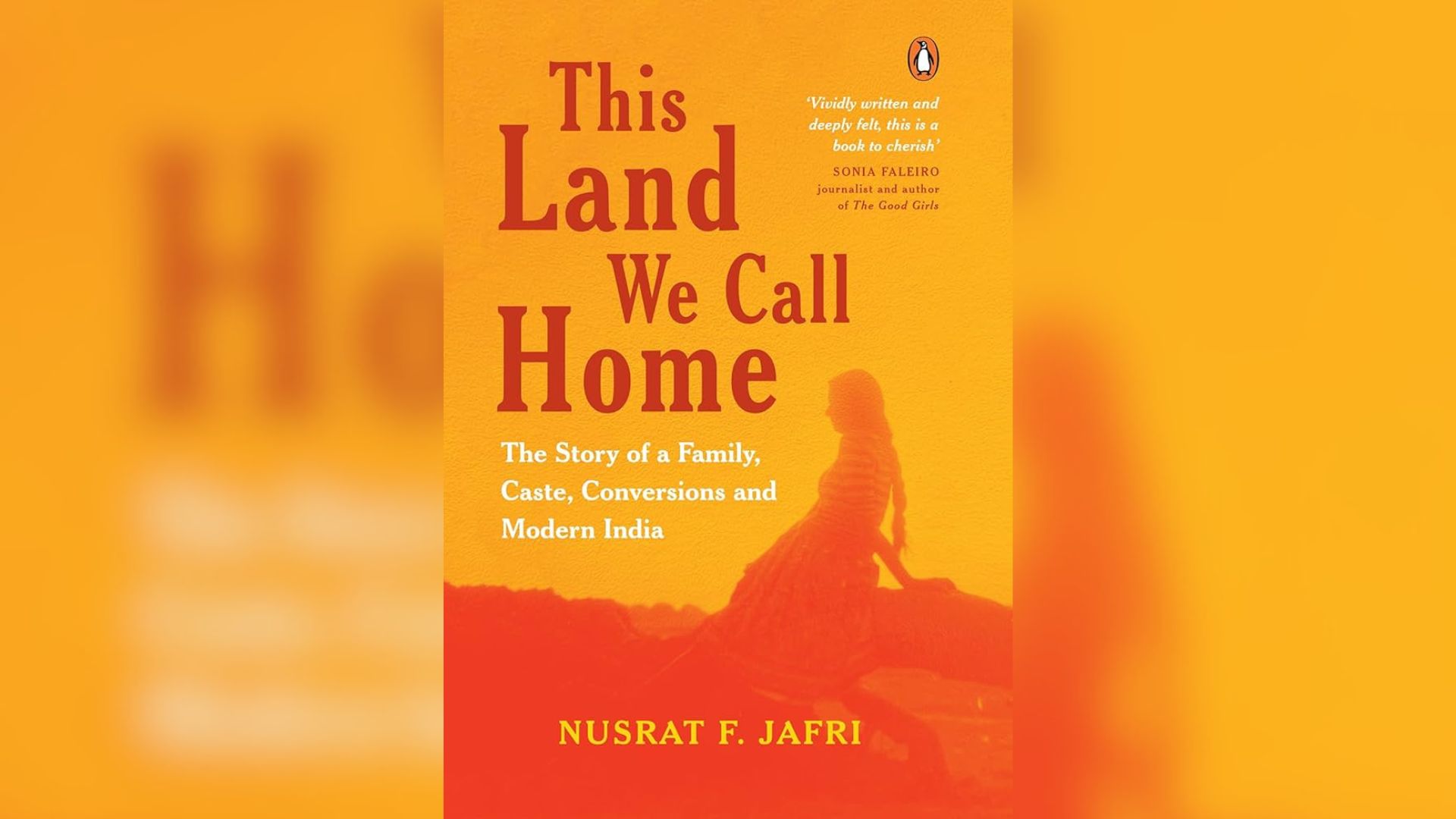
Cinematographer and author Nusrat F. Jafri’s debut book This Land We Call Home: The Story of a Family, Caste, Conversions and Modern India (2024) arrives at a moment when state-specific anti-conversion laws are mushrooming across India, targeting the two communities these laws implicitly single out: Muslims and Christians.
This Land We Call Home traces the conversions of three generations of her maternal ancestors between the late 19th and 20th centuries, from her great-grandparents’ conversion from the nomadic pastoralist Bhantu community to the Methodist faith, to her grandmother’s turn to Catholicism, to her mother’s conversion to Islam upon marriage. It explores how these choices, made under vastly different circumstances, shaped their lives.
Consider two incidents that illuminate the terrain Jafri writes against. In February 2025, an interfaith couple—a Muslim man and a Hindu woman—were attacked by Hindu right-wing groups inside a Bhopal court where they sought to marry under India’s Special Marriage Act, 1954. The assailants accused the man of ‘love jihad’, the conspiracy theory that Muslim men lure Hindu women into marriages to forcibly convert them to Islam. The man was booked under an anti-conversion law; his attackers faced no charges.
In an unrelated 2024 incident, Hindu vigilantes descended on the home of Jaldhar Kashyap, an Adivasi subsistence farmer from Chhattisgarh’s Bastar region, demanding his family reconvert to Hinduism before they could bury his mother, who had converted to Christianity a decade earlier, seeking solace during her illness.
With the right-wing Bharatiya Janata Party (BJP) coming to power in 2014, not only have anti-conversion laws proliferated, but existing ones have also become more expansive and stringent. While older anti-conversion laws focused on preventing religious conversion through force or fraud, the 12 such laws currently in force specifically target interfaith marriages, especially when they involve Hindu women converting to Islam, earning them the moniker ‘anti-love jihad’ laws.
Using vague terms like ‘misrepresentation’, ‘undue influence’, ‘force’, ‘allurement’, and ‘fraud’, these laws treat conversions as criminal acts, shifting the burden of proof onto the accused to demonstrate that the change of faith was voluntary.
It is into this landscape that Jafri builds a radical argument: identity is not fixed but something dynamic, evolving, and always in flux. Jafri’s story begins with a fire that wiped away the homes and belongings of an entire Bhantu village, including those of her maternal great-grandparents Hardayal and Kalyani, in Rajputana (present-day Rajasthan) in the 1880s. A nomadic pastoralist community, the Bhantus were deemed outcastes by the Hindu caste order and classified as a “criminal tribe” under the Criminal Tribes Act of 1871—a British colonial law that branded many nomadic communities as hereditary criminals, and subjected them to surveillance and forced settlement.
Her family history unfolds against the backdrop of major sociopolitical events from British colonial rule to the horrors of Partition to the shock of the 1975-77 Emergency to the resurgence of the Hindu Right following the 1992 Babri Masjid demolition and the rise of Narendra Modi.
By mapping personal acts of faith onto this broader canvas of the country’s history, Jafri offers a formidable counter to the Hindu Right’s narrative of forced conversion, firmly establishing religious conversion as an act of agency on the part of the convert. Conversions, she tells us, left an undeniably rich and positive legacy for her family. These adopted identities came with the prospect of a better life, offered education and social care opportunities that would have been unimaginable otherwise, cushioned them against debilitating poverty, and enabled personal explorations of autonomy and spirituality.
Prisoners in Their Own Land
A significant part of Jafri’s book is dedicated to the relatively underexplored phenomenon of hereditary criminality in India. Hardayal and Kalyani’s Bhantu community was one of nearly 200 such communities classified under the colonial “criminal tribes” laws—a crackdown that intensified after the Revolt of 1857. Members of these communities were subjected to roll calls and pass systems that required them to take police permission before leaving or entering a village. They could be picked up by the police on mere suspicion.
Such laws turned these communities, who are largely Adivasi or Indigenous, into prisoners in their own land, and the label of ‘hereditary criminals’ into a self-fulfilling prophecy. Stripped of their traditional livelihoods, community members resorted to petty crimes as a means of subsistence—a dynamic documented with painful specificity in Vimukta: Freedom Stories (2021), an anthology penned by descendants of the erstwhile ‘criminal’ tribes.
While the term ‘hereditary criminals’ emerged from the British colonizer’s obsession with categorizing, controlling, and subduing nomadic communities, Jafri contends that the caste order had ‘othered’ them long before. They were “forced into an untouchable status within Hindu society” even though they did not associate themselves with Hinduism, Dakxin Bajrange, a filmmaker and activist who hails from the community, tells Jafri.
Jafri traces how their criminalization was ideologically underpinned by Western racial science—from theories of the ‘born criminal’ to research on hereditary criminal traits—which gained traction in colonial India and provided pseudoscientific legitimacy to discriminatory legislation. Thus, she exposes how British colonial logic, Hindu caste hierarchy, and European racial science didn’t merely coexist but actively reinforced each other, deepening the marginalization of communities already pushed to the periphery.
In the aftermath of that fire in the 1880s, allegedly set by men of the oppressor caste from a neighboring village, relief in the form of food, medicines, clothes, and tents came from Methodist missionaries. “What stood out the most for the distressed Bhantus was not the material help, but the respect and empathy they received without discrimination or prejudice,” writes Jafri. In the following days, more than 50 members of the community, including Hardayal, Kalyani, and their three daughters, converted to Methodism, a Christian Protestant denomination.
Piecing together anecdotes from her mother, Meera, who she says delved “into parts of her life she may have been hesitant to explore otherwise” with scholarly work, Jafri traces the opportunities for growth and material betterment that followed the family’s first conversion. While Hardayal studied theology and eventually became a reverend at a local Methodist church, his seven daughters were educated in mission schools, and six of them became trained nurses.
In the 1930-40s, when Indian women were still new to notions of personal independence, Hardayal’s daughters broke gender stereotypes, as their professional journeys took them to Delhi, Dehradun, Lucknow, and even Basra, Iraq, where one of them served as a civilian nurse during World War II. The older sisters financed the education of the younger ones, Jafri notes, and none waited until marriage to wear gold, gifting it to themselves instead.
In the 1950s, Hardayal and Kalyani’s youngest daughter (and Jafri’s grandmother), Prudence, converted to Catholicism. She was driven by the aspiration to secure an English education for her children, since Catholic missionary schools offered an English-medium curriculum that Methodist missions—with their emphasis on vernacular worship and languages—did not.
Prudence’s decision proved fortuitous when the family fell on hard times and could avail of the subsidized fees offered by Catholic schools. Incidentally, the promise of education was also the key motivation for the Methodist conversion of Prudence’s father-in-law, a Brahmin man who hailed from a poor and illiterate family.
For Jafri, these are not merely stories of upward mobility but are evidence of what conversion made possible for communities that the Hindu caste order had consigned to its margins.
The Impossibility of Escaping Caste
By paying meticulous attention to these varied motivations and the diverse contexts within which her ancestors adopted their chosen identities, Jafri dismantles the Hindu Right’s long-held claim that conversions, particularly to Christianity, are induced by material goals alone. For them, education in Christian missionary schools was more than a vehicle for upward mobility—it was a shot at a life free from prejudice and discrimination. “In these English-medium schools, they were able to sit and dine with their classmates, rather than being segregated outside the classroom as they were earlier,” Jafri writes about her grand-aunts.
Significantly, in contemporary India, conversions often come at a high cost rather than the promise of material gain. Dalits who convert to Christianity lose their Scheduled Caste status, and with it, access to reservations and other forms of affirmative action. While there is no such policy for members of Scheduled Tribes, in several states, Adivasi groups backed by the Rashtriya Swayamsevak Sangh (RSS) and the BJP have demanded that community members who convert to Christianity be denied Scheduled Tribes status and reservation benefits.
The risk of converts being excommunicated and losing their cultural identity also looms large as Jafri elaborates on Hardayal and Kalyani’s struggles to accept the loss of their traditional nomadic pastoralist identity and lifestyle.
Jafri is unequivocal that her great-grandparents’ conversion to Methodism represented “a powerful act of resistance against the caste system and a means of reclaiming agency and autonomy.” Yet, she is equally clear-eyed about the impossibility of erasing caste.
When their neighbors were suspicious of them for embracing Methodism, Hardayal and Kalyani sought to emphasize their associations with the dominant caste Rajputs, dating back to when Bhantus were part of the army of Rana Pratap, a 16th-century Rajput king and warrior. This “defensive strategy to downplay their Bhantu background” inadvertently reinforced the stranglehold of caste, Jafri asserts.
Similarly, she explains that Hardayal’s decision to quit the ministry stemmed from his disappointment over Dalit preachers and deacons forming insular groups and blocking his transfers to bigger cities. Hardayal’s frustration arose not only from caste politics within the church, but also from missing out on better transfers despite being higher in the caste order as a Bhantu compared to Dalits—or so he thought.
The persistence of caste was also at play in choosing careers for Hardayal’s daughters. Even as Jafri lauds the way her grandaunts used their missionary school education and became some of the first trained Indian Christian nurses, she highlights the caste-related stigma attached to their profession. “Indian society tended to view nursing as not only menial and morally dubious, but also as polluting work typical of lower castes,” she writes. “This perception is reflected in the derogatory terms that are often used to address nurses, such as neeche-jhakni, which refers to someone who peeps at the bottom of patients to look for stool or urine.”
Conversion, Jafri shows, did not place her ancestors outside the reach of caste—it simply asked them to navigate its hierarchies in new terrain.
Conversion and Its Discontents
In the late 1960s, Prudence’s daughter (and Jafri’s mother) Meera converted to Islam following her marriage to Syed Abid Ali Jafri, a former tutor and love match that found support from Prudence and Hardayal—the only two members of the family who had themselves actively chosen to convert, and perhaps the only ones who truly understood what that choice entailed. The decision to convert was Meera’s alone.
As Jafri writes, “what began as a cultural fascination with Islam turned into a deeply personal exploration of spirituality.” Coming out of a childhood marked by domestic violence and hardship, conversion was, for Meera, an act of agency, a way of stepping into a new life on her own terms. “For her, Islam found her at a difficult crossroad in life. It offered her solace and found her love. As always, the actual conversion was easy, but belonging remained difficult.”
That difficulty of belonging played out on multiple fronts. On Abid’s side, while his family was warm to Meera from the start, acceptance and trust had to be earned over time. The effort was largely hers to make, navigating an unfamiliar culture and learning Urdu, the language of her in-laws. As Jafri writes, “learning their language took up the most time and effort in assimilating into an entirely new culture.” That it was Meera who had to do this work, and not Abid, reflects a pattern Jafri identifies across interfaith marriages: the burden of assimilation falls disproportionately on the woman who converts.
On her own side of the family, the opposition was sharper. Meera’s father disapproved of the match, and her aunts threatened to ostracize both Meera and Prudence if the marriage went ahead. As Jafri explains, her aunts’ distrust of Abid was rooted not in personal objection but in his Muslim faith—”memories of the Partition were still fresh and public perception about Muslims was still harsh.”
While Jafri does not make this observation explicitly, the contrast is implicit in how she narrates Meera’s story: despite the familial tensions, Meera’s conversion did not draw the kind of sociopolitical scrutiny and legal jeopardy that interfaith unions attract in contemporary India, a shift that speaks to how dramatically the political climate around such marriages has changed.
Jafri extends her examination of caste’s persistence into Muslim communities—a subject she calls “the worst-kept secret of the community.” Conversion to Islam, she shows, did not erase caste but transliterated it into a new hierarchy: the Muslim caste order in India maps closely onto the Hindu caste of the community one converted from.
Dominant-caste Hindus who converted assumed Ashraf status, a category that sits “at the top of the pyramid” among the Muslim community; working-caste Hindus who converted became Ajlafs, the tillers, weavers, and cobblers who today identify as Other Backward Communities. The Kundu Committee, drawing on 2011-12 national survey data, found that nearly half the urban Muslim population identified as OBC.
For Jafri, this hierarchy was not merely theoretical. She grew up feeling its weight at family gatherings, where her cousins’ pride in being “pure Syeds” made clear that her mother’s status as a convert placed the family outside the boundaries of that particular notion of Muslim purity. The faith that arrived in India proclaiming the equality of all believers struggled, as Jafri puts it, “to counteract the entrenched biases of caste.”
A Contentious and Exclusionary Home
Though the near-total archival silence on Bhantu history means Jafri cannot comprehensively explore their lives in postcolonial India, her excavation of what does exist is among the book’s most rigorous and valuable work, driven by a “deep personal disappointment” at the dearth of material on communities whose histories have been buried under the labels stamped on them.
India decriminalized or ‘denotified’ these communities in 1952, but recriminalized them that same year under equally stigmatizing ‘habitual offender’ statutes. Even today, police violence against these communities remains disturbingly commonplace. “Till today, the police academies, such as the facility at Karai, Gandhinagar, include in their syllabi mandatory chapters about the incorrigible nature of the born criminal castes and tribes, and the necessity to subdue them by force, often using torture and incarceration as appropriate techniques,” write the editors of Vimukta, Bajrange, and Henry Schwarz.
The latest iteration of such violence was seen in the torture and killing of 24-year-old Deva Pardhi from the denotified Pardhi community after he was taken into custody for questioning over a theft in the village in Madhya Pradesh. Nearly a year later, the police officials involved in the case have faced no consequences despite a magistrate’s inquiry confirming custodial violence as the cause of death.
This Land We Call Home is a timely reminder that for the likes of Deva Pardhi, Jaldhar Kashyap, and the Muslim man attacked inside the Bhopal court, India remains a contentious and exclusionary home, evident in attacks on Adivasi and Dalit Christians, in anti-love jihad laws, and in ‘habitual offender’ statutes that leave communities vulnerable to racial profiling and custodial torture. Jafri’s book holds all of this—the personal, the historical, and the political—within a single narrative.
The Partition’s shadow over Meera’s marriage, the Emergency’s forced sterilizations driving her mother to choose a home birth, the Babri Masjid demolition crystallizing her father’s understanding that he would always be seen as a Muslim first—these are moments where the personal and the political are genuinely inseparable.
Occasionally, the connective tissue between the two histories thins and they run as parallel threads rather than intertwined ones, but these are minor lapses in an otherwise carefully constructed narrative. Jafri’s own identity, shaped by ex-Bhantu, Christian, and Muslim heritage, gives her a deep awareness that, were she asked to prove her Indianness today, she would not know where to start.
This is what makes This Land We Call Home more than a personal history. It is Jafri’s manifesto for a more expansive and inclusive idea of belonging.
Join us
Sohel Sarkar is an India-based independent journalist, writer, and editor working on the areas of gender and health, food and sustainability, and climate change. She's also an occasional book reviewer. Her writing has appeared in New Lines Magazine, Mongabay, Scroll, Sourced Journeys, Feminist Food Journal, Goya Journal, Locavore, Protean Magazine, and Himal Southasian, among others.
Related Posts

This Land We Call Home: A Formidable Counter to the Hindutva Narrative of Forced Conversion
By Sohel Sarkar
April 28, 2026
By mapping personal acts of faith onto this broader canvas of the country’s history, Nusrat Jafri offers a formidable counter to the Hindu Right’s narrative of forced conversion, firmly establishing religious conversion as an act of agency on the part of the convert.
Cinematographer and author Nusrat F. Jafri’s debut book This Land We Call Home: The Story of a Family, Caste, Conversions and Modern India (2024) arrives at a moment when state-specific anti-conversion laws are mushrooming across India, targeting the two communities these laws implicitly single out: Muslims and Christians.
This Land We Call Home traces the conversions of three generations of her maternal ancestors between the late 19th and 20th centuries, from her great-grandparents’ conversion from the nomadic pastoralist Bhantu community to the Methodist faith, to her grandmother’s turn to Catholicism, to her mother’s conversion to Islam upon marriage. It explores how these choices, made under vastly different circumstances, shaped their lives.
Consider two incidents that illuminate the terrain Jafri writes against. In February 2025, an interfaith couple—a Muslim man and a Hindu woman—were attacked by Hindu right-wing groups inside a Bhopal court where they sought to marry under India’s Special Marriage Act, 1954. The assailants accused the man of ‘love jihad’, the conspiracy theory that Muslim men lure Hindu women into marriages to forcibly convert them to Islam. The man was booked under an anti-conversion law; his attackers faced no charges.
In an unrelated 2024 incident, Hindu vigilantes descended on the home of Jaldhar Kashyap, an Adivasi subsistence farmer from Chhattisgarh’s Bastar region, demanding his family reconvert to Hinduism before they could bury his mother, who had converted to Christianity a decade earlier, seeking solace during her illness.
With the right-wing Bharatiya Janata Party (BJP) coming to power in 2014, not only have anti-conversion laws proliferated, but existing ones have also become more expansive and stringent. While older anti-conversion laws focused on preventing religious conversion through force or fraud, the 12 such laws currently in force specifically target interfaith marriages, especially when they involve Hindu women converting to Islam, earning them the moniker ‘anti-love jihad’ laws.
Using vague terms like ‘misrepresentation’, ‘undue influence’, ‘force’, ‘allurement’, and ‘fraud’, these laws treat conversions as criminal acts, shifting the burden of proof onto the accused to demonstrate that the change of faith was voluntary.
It is into this landscape that Jafri builds a radical argument: identity is not fixed but something dynamic, evolving, and always in flux. Jafri’s story begins with a fire that wiped away the homes and belongings of an entire Bhantu village, including those of her maternal great-grandparents Hardayal and Kalyani, in Rajputana (present-day Rajasthan) in the 1880s. A nomadic pastoralist community, the Bhantus were deemed outcastes by the Hindu caste order and classified as a “criminal tribe” under the Criminal Tribes Act of 1871—a British colonial law that branded many nomadic communities as hereditary criminals, and subjected them to surveillance and forced settlement.
Her family history unfolds against the backdrop of major sociopolitical events from British colonial rule to the horrors of Partition to the shock of the 1975-77 Emergency to the resurgence of the Hindu Right following the 1992 Babri Masjid demolition and the rise of Narendra Modi.
By mapping personal acts of faith onto this broader canvas of the country’s history, Jafri offers a formidable counter to the Hindu Right’s narrative of forced conversion, firmly establishing religious conversion as an act of agency on the part of the convert. Conversions, she tells us, left an undeniably rich and positive legacy for her family. These adopted identities came with the prospect of a better life, offered education and social care opportunities that would have been unimaginable otherwise, cushioned them against debilitating poverty, and enabled personal explorations of autonomy and spirituality.
Prisoners in Their Own Land
A significant part of Jafri’s book is dedicated to the relatively underexplored phenomenon of hereditary criminality in India. Hardayal and Kalyani’s Bhantu community was one of nearly 200 such communities classified under the colonial “criminal tribes” laws—a crackdown that intensified after the Revolt of 1857. Members of these communities were subjected to roll calls and pass systems that required them to take police permission before leaving or entering a village. They could be picked up by the police on mere suspicion.
Such laws turned these communities, who are largely Adivasi or Indigenous, into prisoners in their own land, and the label of ‘hereditary criminals’ into a self-fulfilling prophecy. Stripped of their traditional livelihoods, community members resorted to petty crimes as a means of subsistence—a dynamic documented with painful specificity in Vimukta: Freedom Stories (2021), an anthology penned by descendants of the erstwhile ‘criminal’ tribes.
While the term ‘hereditary criminals’ emerged from the British colonizer’s obsession with categorizing, controlling, and subduing nomadic communities, Jafri contends that the caste order had ‘othered’ them long before. They were “forced into an untouchable status within Hindu society” even though they did not associate themselves with Hinduism, Dakxin Bajrange, a filmmaker and activist who hails from the community, tells Jafri.
Jafri traces how their criminalization was ideologically underpinned by Western racial science—from theories of the ‘born criminal’ to research on hereditary criminal traits—which gained traction in colonial India and provided pseudoscientific legitimacy to discriminatory legislation. Thus, she exposes how British colonial logic, Hindu caste hierarchy, and European racial science didn’t merely coexist but actively reinforced each other, deepening the marginalization of communities already pushed to the periphery.
In the aftermath of that fire in the 1880s, allegedly set by men of the oppressor caste from a neighboring village, relief in the form of food, medicines, clothes, and tents came from Methodist missionaries. “What stood out the most for the distressed Bhantus was not the material help, but the respect and empathy they received without discrimination or prejudice,” writes Jafri. In the following days, more than 50 members of the community, including Hardayal, Kalyani, and their three daughters, converted to Methodism, a Christian Protestant denomination.
Piecing together anecdotes from her mother, Meera, who she says delved “into parts of her life she may have been hesitant to explore otherwise” with scholarly work, Jafri traces the opportunities for growth and material betterment that followed the family’s first conversion. While Hardayal studied theology and eventually became a reverend at a local Methodist church, his seven daughters were educated in mission schools, and six of them became trained nurses.
In the 1930-40s, when Indian women were still new to notions of personal independence, Hardayal’s daughters broke gender stereotypes, as their professional journeys took them to Delhi, Dehradun, Lucknow, and even Basra, Iraq, where one of them served as a civilian nurse during World War II. The older sisters financed the education of the younger ones, Jafri notes, and none waited until marriage to wear gold, gifting it to themselves instead.
In the 1950s, Hardayal and Kalyani’s youngest daughter (and Jafri’s grandmother), Prudence, converted to Catholicism. She was driven by the aspiration to secure an English education for her children, since Catholic missionary schools offered an English-medium curriculum that Methodist missions—with their emphasis on vernacular worship and languages—did not.
Prudence’s decision proved fortuitous when the family fell on hard times and could avail of the subsidized fees offered by Catholic schools. Incidentally, the promise of education was also the key motivation for the Methodist conversion of Prudence’s father-in-law, a Brahmin man who hailed from a poor and illiterate family.
For Jafri, these are not merely stories of upward mobility but are evidence of what conversion made possible for communities that the Hindu caste order had consigned to its margins.
The Impossibility of Escaping Caste
By paying meticulous attention to these varied motivations and the diverse contexts within which her ancestors adopted their chosen identities, Jafri dismantles the Hindu Right’s long-held claim that conversions, particularly to Christianity, are induced by material goals alone. For them, education in Christian missionary schools was more than a vehicle for upward mobility—it was a shot at a life free from prejudice and discrimination. “In these English-medium schools, they were able to sit and dine with their classmates, rather than being segregated outside the classroom as they were earlier,” Jafri writes about her grand-aunts.
Significantly, in contemporary India, conversions often come at a high cost rather than the promise of material gain. Dalits who convert to Christianity lose their Scheduled Caste status, and with it, access to reservations and other forms of affirmative action. While there is no such policy for members of Scheduled Tribes, in several states, Adivasi groups backed by the Rashtriya Swayamsevak Sangh (RSS) and the BJP have demanded that community members who convert to Christianity be denied Scheduled Tribes status and reservation benefits.
The risk of converts being excommunicated and losing their cultural identity also looms large as Jafri elaborates on Hardayal and Kalyani’s struggles to accept the loss of their traditional nomadic pastoralist identity and lifestyle.
Jafri is unequivocal that her great-grandparents’ conversion to Methodism represented “a powerful act of resistance against the caste system and a means of reclaiming agency and autonomy.” Yet, she is equally clear-eyed about the impossibility of erasing caste.
When their neighbors were suspicious of them for embracing Methodism, Hardayal and Kalyani sought to emphasize their associations with the dominant caste Rajputs, dating back to when Bhantus were part of the army of Rana Pratap, a 16th-century Rajput king and warrior. This “defensive strategy to downplay their Bhantu background” inadvertently reinforced the stranglehold of caste, Jafri asserts.
Similarly, she explains that Hardayal’s decision to quit the ministry stemmed from his disappointment over Dalit preachers and deacons forming insular groups and blocking his transfers to bigger cities. Hardayal’s frustration arose not only from caste politics within the church, but also from missing out on better transfers despite being higher in the caste order as a Bhantu compared to Dalits—or so he thought.
The persistence of caste was also at play in choosing careers for Hardayal’s daughters. Even as Jafri lauds the way her grandaunts used their missionary school education and became some of the first trained Indian Christian nurses, she highlights the caste-related stigma attached to their profession. “Indian society tended to view nursing as not only menial and morally dubious, but also as polluting work typical of lower castes,” she writes. “This perception is reflected in the derogatory terms that are often used to address nurses, such as neeche-jhakni, which refers to someone who peeps at the bottom of patients to look for stool or urine.”
Conversion, Jafri shows, did not place her ancestors outside the reach of caste—it simply asked them to navigate its hierarchies in new terrain.
Conversion and Its Discontents
In the late 1960s, Prudence’s daughter (and Jafri’s mother) Meera converted to Islam following her marriage to Syed Abid Ali Jafri, a former tutor and love match that found support from Prudence and Hardayal—the only two members of the family who had themselves actively chosen to convert, and perhaps the only ones who truly understood what that choice entailed. The decision to convert was Meera’s alone.
As Jafri writes, “what began as a cultural fascination with Islam turned into a deeply personal exploration of spirituality.” Coming out of a childhood marked by domestic violence and hardship, conversion was, for Meera, an act of agency, a way of stepping into a new life on her own terms. “For her, Islam found her at a difficult crossroad in life. It offered her solace and found her love. As always, the actual conversion was easy, but belonging remained difficult.”
That difficulty of belonging played out on multiple fronts. On Abid’s side, while his family was warm to Meera from the start, acceptance and trust had to be earned over time. The effort was largely hers to make, navigating an unfamiliar culture and learning Urdu, the language of her in-laws. As Jafri writes, “learning their language took up the most time and effort in assimilating into an entirely new culture.” That it was Meera who had to do this work, and not Abid, reflects a pattern Jafri identifies across interfaith marriages: the burden of assimilation falls disproportionately on the woman who converts.
On her own side of the family, the opposition was sharper. Meera’s father disapproved of the match, and her aunts threatened to ostracize both Meera and Prudence if the marriage went ahead. As Jafri explains, her aunts’ distrust of Abid was rooted not in personal objection but in his Muslim faith—”memories of the Partition were still fresh and public perception about Muslims was still harsh.”
While Jafri does not make this observation explicitly, the contrast is implicit in how she narrates Meera’s story: despite the familial tensions, Meera’s conversion did not draw the kind of sociopolitical scrutiny and legal jeopardy that interfaith unions attract in contemporary India, a shift that speaks to how dramatically the political climate around such marriages has changed.
Jafri extends her examination of caste’s persistence into Muslim communities—a subject she calls “the worst-kept secret of the community.” Conversion to Islam, she shows, did not erase caste but transliterated it into a new hierarchy: the Muslim caste order in India maps closely onto the Hindu caste of the community one converted from.
Dominant-caste Hindus who converted assumed Ashraf status, a category that sits “at the top of the pyramid” among the Muslim community; working-caste Hindus who converted became Ajlafs, the tillers, weavers, and cobblers who today identify as Other Backward Communities. The Kundu Committee, drawing on 2011-12 national survey data, found that nearly half the urban Muslim population identified as OBC.
For Jafri, this hierarchy was not merely theoretical. She grew up feeling its weight at family gatherings, where her cousins’ pride in being “pure Syeds” made clear that her mother’s status as a convert placed the family outside the boundaries of that particular notion of Muslim purity. The faith that arrived in India proclaiming the equality of all believers struggled, as Jafri puts it, “to counteract the entrenched biases of caste.”
A Contentious and Exclusionary Home
Though the near-total archival silence on Bhantu history means Jafri cannot comprehensively explore their lives in postcolonial India, her excavation of what does exist is among the book’s most rigorous and valuable work, driven by a “deep personal disappointment” at the dearth of material on communities whose histories have been buried under the labels stamped on them.
India decriminalized or ‘denotified’ these communities in 1952, but recriminalized them that same year under equally stigmatizing ‘habitual offender’ statutes. Even today, police violence against these communities remains disturbingly commonplace. “Till today, the police academies, such as the facility at Karai, Gandhinagar, include in their syllabi mandatory chapters about the incorrigible nature of the born criminal castes and tribes, and the necessity to subdue them by force, often using torture and incarceration as appropriate techniques,” write the editors of Vimukta, Bajrange, and Henry Schwarz.
The latest iteration of such violence was seen in the torture and killing of 24-year-old Deva Pardhi from the denotified Pardhi community after he was taken into custody for questioning over a theft in the village in Madhya Pradesh. Nearly a year later, the police officials involved in the case have faced no consequences despite a magistrate’s inquiry confirming custodial violence as the cause of death.
This Land We Call Home is a timely reminder that for the likes of Deva Pardhi, Jaldhar Kashyap, and the Muslim man attacked inside the Bhopal court, India remains a contentious and exclusionary home, evident in attacks on Adivasi and Dalit Christians, in anti-love jihad laws, and in ‘habitual offender’ statutes that leave communities vulnerable to racial profiling and custodial torture. Jafri’s book holds all of this—the personal, the historical, and the political—within a single narrative.
The Partition’s shadow over Meera’s marriage, the Emergency’s forced sterilizations driving her mother to choose a home birth, the Babri Masjid demolition crystallizing her father’s understanding that he would always be seen as a Muslim first—these are moments where the personal and the political are genuinely inseparable.
Occasionally, the connective tissue between the two histories thins and they run as parallel threads rather than intertwined ones, but these are minor lapses in an otherwise carefully constructed narrative. Jafri’s own identity, shaped by ex-Bhantu, Christian, and Muslim heritage, gives her a deep awareness that, were she asked to prove her Indianness today, she would not know where to start.
This is what makes This Land We Call Home more than a personal history. It is Jafri’s manifesto for a more expansive and inclusive idea of belonging.
SUPPORT US
We like bringing the stories that don’t get told to you. For that, we need your support. However small, we would appreciate it.
Sohel Sarkar is an India-based independent journalist, writer, and editor working on the areas of gender and health, food and sustainability, and climate change. She's also an occasional book reviewer. Her writing has appeared in New Lines Magazine, Mongabay, Scroll, Sourced Journeys, Feminist Food Journal, Goya Journal, Locavore, Protean Magazine, and Himal Southasian, among others.
Related Posts