





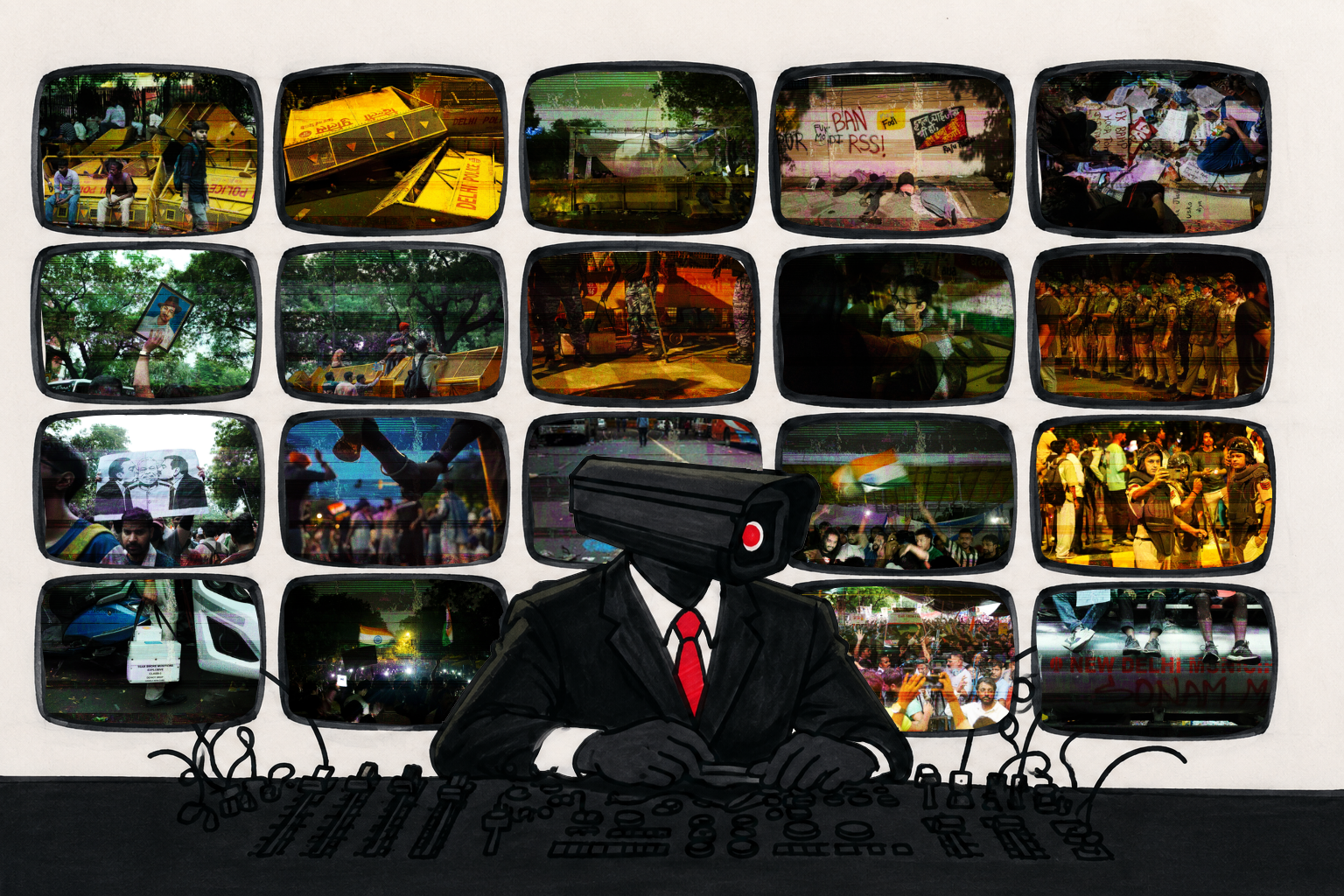
For much of the protest at Jantar Mantar, the police were filming us. They filmed the speeches and the crowds, and photographed people as they entered the protest site. Officers walked around recording protesters on phones and professional video cameras (far better equipment than ours). Cameras were ubiquitous.
As for who secured better footage, there would be no contest—the Delhi Police won decisively. Our cameras were there to document for the public; they operated with the coercive power intent of a surveillance state.

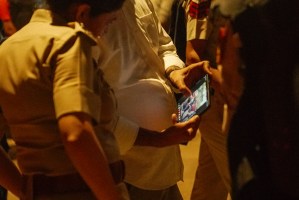
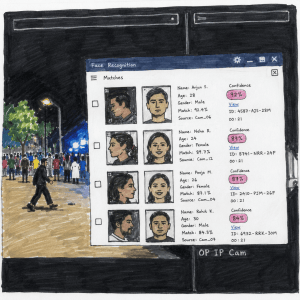
Journalist Vibhu Grover told me that when he was detained in a police van at Jantar Mantar, he watched live facial-recognition technology being used inside it. As people passed outside, the system mapped their faces and movements in real time. His account is consistent with what a Reuters reporter observed on the ground: when the reporter walked past one of Delhi Police’s surveillance vans, a computer monitor inside displayed his face enclosed in a green rectangle alongside a “face accuracy” score.
Jantar Mantar is a way to see what happens when that model enters the everyday policing of political dissent.
Police have photographed demonstrations for decades. Now, the surveillance architecture is sufficient to identify people instantaneously and link them to existing databases. It turns a crowd into individual faces; faces into biometrics and queries; and those queries into names, records, social media profiles, metadata, and phone records.
Once your face, name, and metadata are logged, you become a risk profile. Your presence at a protest becomes a data point that can justify pre-emptive stops, or even detention before any crime has been committed.
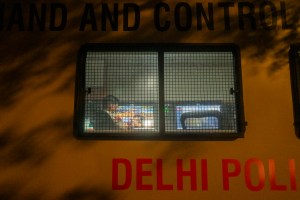
Delhi Police inducted Ikshana, a mobile surveillance vehicle, around the 2023 G20 summit. The vehicle carries eight fixed cameras that provide a 360-degree view and support facial detection and recognition, automatic number-plate recognition, crowd monitoring, traffic management, and on-site video analytics. Alongside it was a separate Mobile Command and Control Vehicle from which officers could watch live CCTV feeds. CP Plus, which developed the prototype with Delhi Police, said Ikshana has AI-powered cameras, mobile cameras, and adjustable varifocal cameras.

Ikshana is produced by CP Plus, the surveillance brand of Aditya Infotech. CP Plus told Reuters that it supplied the hardware, while the deployment and databases were controlled by Delhi Police. Police officers said that the computers flagged people with criminal histories and could also count the number of protesters. Officers were separately seen recording the Instagram handles of people entering Jantar Mantar.
Ikshana was not the only facial-recognition system watching the protest. By July 24, Delhi Police had deployed four FRS units at key entry and exit points around Jantar Mantar. The high-resolution cameras detected faces from a distance and compared them with police databases within seconds. Delhi Police maintained that facial recognition was only being used to locate wanted criminals and people already contained in police databases. It initially claimed to have identified more than 2,500 people with criminal backgrounds, but this is not how dragnet facial recognition actually works.
Targeted FRT starts with a person. Dragnet FRT starts with a crowd. Targeted facial recognition might take the photograph of a particular suspect and ask whether it matches another image. Dragnet facial recognition is closer to placing an invisible ID checkpoint at a doorway: everyone who walks past has their face processed so the system can determine whether someone on a watchlist is among them. To find one wanted person, in other words, the machine must first look at everyone. Thousands of people suspected of nothing become inputs.
Apar Gupta, co-founder of the Internet Freedom Foundation, filed an RTI in 2022 to understand how the accumulated data is used. He says, “[What is done with the data] is all speculation…We did get some information in which the police said that an 80% probabilistic match between image capture with the pre-existing picture in the database results in a positive identification.”
Surveillance began long before Ikshana appeared. A petition filed by Aishe Ghosh in the Delhi High Court alleges that from June 20 onwards, Delhi Police maintained a permanent surveillance tower at Jantar Mantar and continuously photographed and filmed protesters, including while they were resting or receiving medical treatment. Protester-shared videos from the protest also show officers wearing Meta smart glasses that can record what the wearer sees.
A separate Supreme Court petition filed by Rajya Sabha MP A.A. Rahim alleges that participants were recorded through fixed CCTV cameras, drones, body-worn cameras, handheld cameras, officers’ personal phones, and mobile command vehicles. It alleges that AjnaLens AI-enabled smart glasses were used for real-time facial recognition, and that fingerprints were collected through the NCRB’s Abhigyan mobile application and matched against NAFIS. Delhi Police had already used AjnaLens facial-recognition glasses during Republic Day security earlier in 2026.
On August 13, the Supreme Court agreed to examine Rahim’s challenge and issued notice to the Center and Delhi Police. Aditya Infotech, which supplied Ikshana, and Dimension NXG, the company behind AjnaLens, have been asked to respond. On August 18, Delhi Police told the Court that its FRT did not create profiles of every protester, and instead matched faces against NCRB records of people accused in serious cases. Police said the system identified 2,873 people with criminal records between July 20 and 26. The Court has not accepted that account as the final word: Justice Joymalya Bagchi said the issue would have to be examined in terms of proportionality.
Months before Jantar Mantar, Delhi inaugurated the first phase of its Rs 857 crore Safe City surveillance system. Its C4I — Command, Control, Communication and Computer — architecture was designed to integrate thousands of cameras into a centralized policing network. At launch, 2,100 new AI-enabled cameras were operational, with 10,000 new cameras planned and approximately 15,000 older cameras being integrated into the system. The wider network now connects roughly 25,000 cameras, including systems run by the Delhi Metro and Indian Railways. Once those cameras are connected to a common command center, footage from public space can be used to flag faces, number plates, hand gestures, and crowd density.
India still has no dedicated legislation regulating the police use of facial recognition technology. Instead, the state has built different legal powers around different parts of the surveillance process.
The Criminal Procedure (Identification) Act, 2022 expanded the biometric information police can collect from people who are convicted, arrested or detained. It empowered the National Crime Records Bureau to collect those records. It includes fingerprints, photographs and other measurements held in centralized systems.
Rahim’s Supreme Court petition argues that neither the Identification Act nor Delhi Police’s protest rules provide the authority for collections. Gupta reaffirms that, “Even if they cite that law, that law would not be applicable to the Jantar Mantar protest at the very least.”
The law then moves from the body to the phone. Under Section 94 of the Bharatiya Nagarik Suraksha Sanhita, a police station officer can issue a written order requiring the production of documents, electronic communications, or communication devices considered necessary for an investigation. Once a protest generates FIRs, investigators can seize digital evidence surrounding that person.
The Information Technology Act’s Section 69 separately provides powers for interception on specified grounds including public order, while Section 69A creates a mechanism for blocking access to online information. These provisions do not legalize facial recognition. They do, however, enable a surveillance operation to expand across media: from identifying a face to investigating communications to scrutinizing online speech.
In Puttaswamy, the Supreme Court recognized privacy as a fundamental right and established that state intrusion requires a legal basis and must satisfy tests such as necessity and proportionality. Delhi Police says searching criminal databases at a large gathering is a proportionate public-order measure. The petitioners say the constitutional problem begins earlier — before a match can be produced, the system has to collect and process faces en masse.
This legislation has a much longer political lineage. In Fabricating Homeland Security, Rhys Machold describes “homeland security” as a transnational model in which technologies, weapons, expertise, doctrines, and industries move across borders. Israel has positioned itself as an especially influential center for an all-encompassing approach to domestic surveillance.
After the 2008 Mumbai attacks, India–Israel security cooperation expanded significantly. A 2014 agreement on Homeland and Public Security formalized cooperation on areas including cybercrime and counter-terrorism. In 2018, two groups of 75 IPS officers traveled to the Israel National Police Academy to study counter-insurgency and policing technology. They were also introduced to Israeli homeland security companies through SIBAT, the Israeli Defense Ministry’s International Defense Cooperation Directorate.
The relationship continued to deepen. CERT-In and the Israel National Cyber Directorate signed an operational cybersecurity agreement in 2020. In February 2026, the countries announced an India–Israel Joint Center of Excellence for Cyber Defense and signed an agreement between IndiaAI and Israel’s National Artificial Intelligence Directorate. The new center is explicitly designed to connect government, research and industry. Israel’s cyber director said the partnership brings Israel’s cyber ecosystem together with India’s “vast and expanding market.”
Israel deploys facial-recognition systems such as Red Wolf alongside dense CCTV networks in the occupied Palestinian territories, where Palestinians’ faces can be automatically checked against databases as they pass through checkpoints. In occupied East Jerusalem, surveillance intensified after the crackdown on Palestinian protests in May 2021.
Such technology makes entire populations continuously identifiable. This is the heart of the Israelification of policing: counter-terror techniques migrate into ordinary policing, while space itself is reimagined as a security environment.
Kashmir is where this logic was normalized first.
In November 2019, India’s then consul-general in New York, Sandeep Chakravorty, used the term “Israeli model” while discussing Kashmir. He was speaking primarily about Israeli settlement policy, but the comment laid something bare: Israel held an aspirational value for parts of the Indian state.
In 2017, 15-year-old Zahoor Ahmad was removed from his classroom by police months after he had attended a protest. At the police station, officers showed him videos of the demonstration and accused him of being a masked protester. Ahmad said he was detained for 33 days, beaten and pressured to identify other protesters. In a few years, technology would automate what officers had done manually.
By 2021, the J&K Police was moving towards facial-recognition systems intended to “pre-empt and prevent” attacks. At least 300 new cameras were installed in Srinagar that year. By 2025, facial recognition systems along the Pahalgam route could automatically alert security forces when a blacklisted person entered the camera frame.

Israeli surveillance technology appears elsewhere in this history. Pegasus, the military-grade spyware produced by Israel’s NSO Group, was potentially used to target Indian journalists, activists and political figures. The Pegasus Project found that more than 25 people from Kashmir appeared among potential targets between 2017 and 2019. Indian Express journalist Muzamil Jaleel was among the names. Forensic examination of separatist leader Bilal Lone’s phone data found traces consistent with Pegasus targeting. The Indian government has never publicly acknowledged purchasing Pegasus.
The laboratory does not remain at the frontier—its techniques come home. And when they come home, there is money to be made: governments want technologies that promise faster identification and predictive capacity; police departments receive bigger budgets, companies compete to sell surveillance technology, and protests become a product showcase.
CP Plus publicly announced in 2023 that it had designed Ikshana with Delhi Police and said the force planned to commission additional vehicles. In January 2026, Delhi Police issued a separate government tender worth Rs 56.25 lakh simply to hire five 100x tele-lens cameras and accessories for nine days around Republic Day. During the anti-CAA protests, Delhi Police was already using AI Vision software made by Indian company Innefu Labs, whose system also offered gait and body analysis. Six years later, the equipment is more integrated.
This is another aspect of Israelification. Israel’s influence is sustained by an industry that can turn technologies developed through occupation and genocide into exportable expertise. India is simultaneously building its own domestic surveillance industry. The result is a political economy in which securitization produces markets and markets produce more securitization.
After the protest ended, Delhi Police was left with an enormous volume of data. Investigators analyzed CCTV footage, drone recordings, mobile phone videos, media footage, and publicly shared material. Police examined electronic records, movement patterns and digital timelines. A subsequent investigation examined mobile-tower data, call records and other digital trails.
At the same time, social-media posts about the demonstrations began disappearing. Police monitored platforms for “abusive” or “offensive” content about the Prime Minister and hundreds of posts were reportedly flagged. The Internet Freedom Foundation challenged the takedown campaign, arguing that political speech cannot be removed merely because the state finds it offensive and that blocking powers are subject to specific statutory requirements.
We tend to think of facial recognition as neutral because how could a computer know politics? But an algorithm is only as neutral as the database against which it searches. Muslim neighborhoods, Dalit and Adivasi communities, Kashmiris, migrant workers, activists and other marginalized groups have long experienced disproportionate criminalization and scrutiny. Facial recognition automates this history.
Delhi Police’s facial-recognition databases have not historically been limited to convicted criminals. A 2019 investigation found that police were running FRT against databases including more than 150,000 “history-sheeters,” around 2,000 terrorism suspects and a third category labeled “rabble-rousers and miscreants.” That final database was compiled in part using photographs extracted from earlier protest footage. Amnesty’s research into facial recognition in Hyderabad has warned that these systems can compound discrimination against already over-policed communities.
In the aftermath, we have also seen that the state no longer has a monopoly on surveillance. Women and girls who participated became targets of an extraordinary online campaign. Photographs of young female protesters were altered using AI and circulated with phone numbers and home addresses. A 23-year-old woman received rape and murder threats. Several targets were minors. In one case involving a 15-year-old, personal details about her family circulated online.
The most important object produced by this architecture is what we can call the data body: a face from CCTV footage; timestamps of when you entered and left; appearances in different cameras; an Instagram handle; a phone registered to a nearby tower; call metadata; a vehicle number plate; associations with others; public posts; previous FIRs.
The Jantar Mantar protests allowed the government and police to move from a theoretical capacity for integrated surveillance to a highly visible operational deployment. An exceptional technology just became ordinary. Being part of the governed population is reason enough to remain permanently visible.
India has upended the idea of citizenship: The ideal citizen is legible: identified, authenticated, recorded, and retrievable. You can leave Jantar Mantar. Your data body does not leave with you.


Exporting Occupation: How the Israelification of Policing Reached Jantar Mantar
Anahita Ahluwalia for The Polis Project.
For much of the protest at Jantar Mantar, the police were filming us. They filmed the speeches and the crowds, and photographed people as they entered the protest site. Officers walked around recording protesters on phones and professional video cameras (far better equipment than ours). Cameras were ubiquitous.
As for who secured better footage, there would be no contest—the Delhi Police won decisively. Our cameras were there to document for the public; they operated with the coercive power intent of a surveillance state.
Journalist Vibhu Grover told me that when he was detained in a police van at Jantar Mantar, he watched live facial-recognition technology being used inside it. As people passed outside, the system mapped their faces and movements in real time. His account is consistent with what a Reuters reporter observed on the ground: when the reporter walked past one of Delhi Police’s surveillance vans, a computer monitor inside displayed his face enclosed in a green rectangle alongside a “face accuracy” score.
Jantar Mantar is a way to see what happens when that model enters the everyday policing of political dissent.
Police have photographed demonstrations for decades. Now, the surveillance architecture is sufficient to identify people instantaneously and link them to existing databases. It turns a crowd into individual faces; faces into biometrics and queries; and those queries into names, records, social media profiles, metadata, and phone records.
Once your face, name, and metadata are logged, you become a risk profile. Your presence at a protest becomes a data point that can justify pre-emptive stops, or even detention before any crime has been committed.
Delhi Police inducted Ikshana, a mobile surveillance vehicle, around the 2023 G20 summit. The vehicle carries eight fixed cameras that provide a 360-degree view and support facial detection and recognition, automatic number-plate recognition, crowd monitoring, traffic management, and on-site video analytics. Alongside it was a separate Mobile Command and Control Vehicle from which officers could watch live CCTV feeds. CP Plus, which developed the prototype with Delhi Police, said Ikshana has AI-powered cameras, mobile cameras, and adjustable varifocal cameras.
Ikshana is produced by CP Plus, the surveillance brand of Aditya Infotech. CP Plus told Reuters that it supplied the hardware, while the deployment and databases were controlled by Delhi Police. Police officers said that the computers flagged people with criminal histories and could also count the number of protesters. Officers were separately seen recording the Instagram handles of people entering Jantar Mantar.
Ikshana was not the only facial-recognition system watching the protest. By July 24, Delhi Police had deployed four FRS units at key entry and exit points around Jantar Mantar. The high-resolution cameras detected faces from a distance and compared them with police databases within seconds. Delhi Police maintained that facial recognition was only being used to locate wanted criminals and people already contained in police databases. It initially claimed to have identified more than 2,500 people with criminal backgrounds, but this is not how dragnet facial recognition actually works.
Targeted FRT starts with a person. Dragnet FRT starts with a crowd. Targeted facial recognition might take the photograph of a particular suspect and ask whether it matches another image. Dragnet facial recognition is closer to placing an invisible ID checkpoint at a doorway: everyone who walks past has their face processed so the system can determine whether someone on a watchlist is among them. To find one wanted person, in other words, the machine must first look at everyone. Thousands of people suspected of nothing become inputs.
Apar Gupta, co-founder of the Internet Freedom Foundation, filed an RTI in 2022 to understand how the accumulated data is used. He says, “[What is done with the data] is all speculation…We did get some information in which the police said that an 80% probabilistic match between image capture with the pre-existing picture in the database results in a positive identification.”
Surveillance began long before Ikshana appeared. A petition filed by Aishe Ghosh in the Delhi High Court alleges that from June 20 onwards, Delhi Police maintained a permanent surveillance tower at Jantar Mantar and continuously photographed and filmed protesters, including while they were resting or receiving medical treatment. Protester-shared videos from the protest also show officers wearing Meta smart glasses that can record what the wearer sees.
A separate Supreme Court petition filed by Rajya Sabha MP A.A. Rahim alleges that participants were recorded through fixed CCTV cameras, drones, body-worn cameras, handheld cameras, officers’ personal phones, and mobile command vehicles. It alleges that AjnaLens AI-enabled smart glasses were used for real-time facial recognition, and that fingerprints were collected through the NCRB’s Abhigyan mobile application and matched against NAFIS. Delhi Police had already used AjnaLens facial-recognition glasses during Republic Day security earlier in 2026.
On August 13, the Supreme Court agreed to examine Rahim’s challenge and issued notice to the Center and Delhi Police. Aditya Infotech, which supplied Ikshana, and Dimension NXG, the company behind AjnaLens, have been asked to respond. On August 18, Delhi Police told the Court that its FRT did not create profiles of every protester, and instead matched faces against NCRB records of people accused in serious cases. Police said the system identified 2,873 people with criminal records between July 20 and 26. The Court has not accepted that account as the final word: Justice Joymalya Bagchi said the issue would have to be examined in terms of proportionality.
Months before Jantar Mantar, Delhi inaugurated the first phase of its Rs 857 crore Safe City surveillance system. Its C4I — Command, Control, Communication and Computer — architecture was designed to integrate thousands of cameras into a centralized policing network. At launch, 2,100 new AI-enabled cameras were operational, with 10,000 new cameras planned and approximately 15,000 older cameras being integrated into the system. The wider network now connects roughly 25,000 cameras, including systems run by the Delhi Metro and Indian Railways. Once those cameras are connected to a common command center, footage from public space can be used to flag faces, number plates, hand gestures, and crowd density.
India still has no dedicated legislation regulating the police use of facial recognition technology. Instead, the state has built different legal powers around different parts of the surveillance process.
The Criminal Procedure (Identification) Act, 2022 expanded the biometric information police can collect from people who are convicted, arrested or detained. It empowered the National Crime Records Bureau to collect those records. It includes fingerprints, photographs and other measurements held in centralized systems.
Rahim’s Supreme Court petition argues that neither the Identification Act nor Delhi Police’s protest rules provide the authority for collections. Gupta reaffirms that, “Even if they cite that law, that law would not be applicable to the Jantar Mantar protest at the very least.”
The law then moves from the body to the phone. Under Section 94 of the Bharatiya Nagarik Suraksha Sanhita, a police station officer can issue a written order requiring the production of documents, electronic communications, or communication devices considered necessary for an investigation. Once a protest generates FIRs, investigators can seize digital evidence surrounding that person.
The Information Technology Act’s Section 69 separately provides powers for interception on specified grounds including public order, while Section 69A creates a mechanism for blocking access to online information. These provisions do not legalize facial recognition. They do, however, enable a surveillance operation to expand across media: from identifying a face to investigating communications to scrutinizing online speech.
In Puttaswamy, the Supreme Court recognized privacy as a fundamental right and established that state intrusion requires a legal basis and must satisfy tests such as necessity and proportionality. Delhi Police says searching criminal databases at a large gathering is a proportionate public-order measure. The petitioners say the constitutional problem begins earlier — before a match can be produced, the system has to collect and process faces en masse.
This legislation has a much longer political lineage. In Fabricating Homeland Security, Rhys Machold describes “homeland security” as a transnational model in which technologies, weapons, expertise, doctrines, and industries move across borders. Israel has positioned itself as an especially influential center for an all-encompassing approach to domestic surveillance.
After the 2008 Mumbai attacks, India–Israel security cooperation expanded significantly. A 2014 agreement on Homeland and Public Security formalized cooperation on areas including cybercrime and counter-terrorism. In 2018, two groups of 75 IPS officers traveled to the Israel National Police Academy to study counter-insurgency and policing technology. They were also introduced to Israeli homeland security companies through SIBAT, the Israeli Defense Ministry’s International Defense Cooperation Directorate.
The relationship continued to deepen. CERT-In and the Israel National Cyber Directorate signed an operational cybersecurity agreement in 2020. In February 2026, the countries announced an India–Israel Joint Center of Excellence for Cyber Defense and signed an agreement between IndiaAI and Israel’s National Artificial Intelligence Directorate. The new center is explicitly designed to connect government, research and industry. Israel’s cyber director said the partnership brings Israel’s cyber ecosystem together with India’s “vast and expanding market.”
Israel deploys facial-recognition systems such as Red Wolf alongside dense CCTV networks in the occupied Palestinian territories, where Palestinians’ faces can be automatically checked against databases as they pass through checkpoints. In occupied East Jerusalem, surveillance intensified after the crackdown on Palestinian protests in May 2021.
Such technology makes entire populations continuously identifiable. This is the heart of the Israelification of policing: counter-terror techniques migrate into ordinary policing, while space itself is reimagined as a security environment.
Kashmir is where this logic was normalized first.
In November 2019, India’s then consul-general in New York, Sandeep Chakravorty, used the term “Israeli model” while discussing Kashmir. He was speaking primarily about Israeli settlement policy, but the comment laid something bare: Israel held an aspirational value for parts of the Indian state.
In 2017, 15-year-old Zahoor Ahmad was removed from his classroom by police months after he had attended a protest. At the police station, officers showed him videos of the demonstration and accused him of being a masked protester. Ahmad said he was detained for 33 days, beaten and pressured to identify other protesters. In a few years, technology would automate what officers had done manually.
By 2021, the J&K Police was moving towards facial-recognition systems intended to “pre-empt and prevent” attacks. At least 300 new cameras were installed in Srinagar that year. By 2025, facial recognition systems along the Pahalgam route could automatically alert security forces when a blacklisted person entered the camera frame.
Israeli surveillance technology appears elsewhere in this history. Pegasus, the military-grade spyware produced by Israel’s NSO Group, was potentially used to target Indian journalists, activists and political figures. The Pegasus Project found that more than 25 people from Kashmir appeared among potential targets between 2017 and 2019. Indian Express journalist Muzamil Jaleel was among the names. Forensic examination of separatist leader Bilal Lone’s phone data found traces consistent with Pegasus targeting. The Indian government has never publicly acknowledged purchasing Pegasus.
The laboratory does not remain at the frontier—its techniques come home. And when they come home, there is money to be made: governments want technologies that promise faster identification and predictive capacity; police departments receive bigger budgets, companies compete to sell surveillance technology, and protests become a product showcase.
CP Plus publicly announced in 2023 that it had designed Ikshana with Delhi Police and said the force planned to commission additional vehicles. In January 2026, Delhi Police issued a separate government tender worth Rs 56.25 lakh simply to hire five 100x tele-lens cameras and accessories for nine days around Republic Day. During the anti-CAA protests, Delhi Police was already using AI Vision software made by Indian company Innefu Labs, whose system also offered gait and body analysis. Six years later, the equipment is more integrated.
This is another aspect of Israelification. Israel’s influence is sustained by an industry that can turn technologies developed through occupation and genocide into exportable expertise. India is simultaneously building its own domestic surveillance industry. The result is a political economy in which securitization produces markets and markets produce more securitization.
After the protest ended, Delhi Police was left with an enormous volume of data. Investigators analyzed CCTV footage, drone recordings, mobile phone videos, media footage, and publicly shared material. Police examined electronic records, movement patterns and digital timelines. A subsequent investigation examined mobile-tower data, call records and other digital trails.
At the same time, social-media posts about the demonstrations began disappearing. Police monitored platforms for “abusive” or “offensive” content about the Prime Minister and hundreds of posts were reportedly flagged. The Internet Freedom Foundation challenged the takedown campaign, arguing that political speech cannot be removed merely because the state finds it offensive and that blocking powers are subject to specific statutory requirements.
We tend to think of facial recognition as neutral because how could a computer know politics? But an algorithm is only as neutral as the database against which it searches. Muslim neighborhoods, Dalit and Adivasi communities, Kashmiris, migrant workers, activists and other marginalized groups have long experienced disproportionate criminalization and scrutiny. Facial recognition automates this history.
Delhi Police’s facial-recognition databases have not historically been limited to convicted criminals. A 2019 investigation found that police were running FRT against databases including more than 150,000 “history-sheeters,” around 2,000 terrorism suspects and a third category labeled “rabble-rousers and miscreants.” That final database was compiled in part using photographs extracted from earlier protest footage. Amnesty’s research into facial recognition in Hyderabad has warned that these systems can compound discrimination against already over-policed communities.
In the aftermath, we have also seen that the state no longer has a monopoly on surveillance. Women and girls who participated became targets of an extraordinary online campaign. Photographs of young female protesters were altered using AI and circulated with phone numbers and home addresses. A 23-year-old woman received rape and murder threats. Several targets were minors. In one case involving a 15-year-old, personal details about her family circulated online.
The most important object produced by this architecture is what we can call the data body: a face from CCTV footage; timestamps of when you entered and left; appearances in different cameras; an Instagram handle; a phone registered to a nearby tower; call metadata; a vehicle number plate; associations with others; public posts; previous FIRs.
The Jantar Mantar protests allowed the government and police to move from a theoretical capacity for integrated surveillance to a highly visible operational deployment. An exceptional technology just became ordinary. Being part of the governed population is reason enough to remain permanently visible.
India has upended the idea of citizenship: The ideal citizen is legible: identified, authenticated, recorded, and retrievable. You can leave Jantar Mantar. Your data body does not leave with you.