



1 May 2021
Kill us, we will become ghosts,
and write of your killings, with all the evidence.
You write jokes in court,
we will write “justice” on the walls.
We will speak so loudly that even the deaf will hear.
We will write so clearly that even the blind will read.
You write injustice on earth,
we will write revolution in the sky.
Everything will be remembered,
everything recorded.
— Aamir Aziz
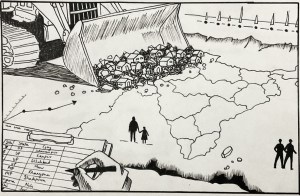
Set up by The Polis Project, Watch the State (WTS) documents, analyzes, and seeks to understand state violence. As a politically organized administrative apparatus, the State exercises authority over a population within a clearly demarcated territory. Our project examines violence inflicted by the State through its actors, as well as through state inaction and the support or consensus of institutional and political forces.
WTS emerged during the first protests against the Citizenship Amendment Act (CAA) in India in December 2019, when student protesters approached The Polis Project for support in tracking escalating police violence against citizens. In response, The Polis Project built a system to document instances of state violence against protestors, including illegal detention, custodial torture, tear gas, surveillance, police brutality, and hate speech.
WTS aims to hold the State and those in power accountable by creating a repository of state violence and sustaining public and institutional memory. It also developed an analytical framework for understanding and confronting state violence. This framework has since expanded beyond India and now applies across multiple geographies and local contexts, including Europe, the Americas, and the SWANA region.
By bringing the expertise of the global majority into American and European contexts, WTS unsettles Eurocentric frameworks and reverses the gaze, turning scrutiny back onto the institutions and interests that wield and justify violence.
To this end, WTS focuses on state-sanctioned violence, authoritarianism, and majoritarianism against citizens, including activists, academics, civil society members, journalists, and lawyers; police brutality; human rights violations; the curbing of civil liberties; executive and judicial actions that create conditions for state violence; abuses against historically oppressed and marginalized communities; arbitrary arrests and illegal detentions; restrictions on press freedom; wrongful convictions; clampdowns on dissent, including violence against protestors; custodial torture; and surveillance and privacy violations.
Agenda
Fueled by majoritarian right-wing ideologies, white supremacy, Hindutva, ethno-nationalism, fascism, and other exclusionary political projects, states across multiple geographies have created political atmospheres in which violence against dissenting citizens and discrimination based on religion, class, caste, race, ethnicity, gender, and political belief have become normalized. Repeated and often brutal attacks against minorities, immigrants, students, protesters, and all those who speak out against repression have made such violence visible across many contexts globally.
The State, however, continues to maintain a monopoly over violence and to perpetrate it with impunity. In contemporary contexts, this power is often extended and reinforced by corporate monopolies, technology platforms, and other non-state actors that shape, enable, amplify, or profit from systems of coercion and exclusion. Those who question governing authorities are branded “anti-national,” “extremist,” “antifa,” or “radical anarchist,” and are similarly delegitimized; compromised judiciaries fail to protect the rights of citizens; and biased media systems often uncritically reproduce the state’s version of truth.
WTS aims to understand what constitutes state violence and how violence and impunity expand by examining the physical, structural, and symbolic dimensions of violence and its social, political, and economic manifestations across local and global contexts, including the present dynamics of securitization. Since its inception, the project has grown organically in theme, agenda, and scope to encompass diverse forms of state violence and the broader ecosystems that sustain them.
By documenting instances of state violence, WTS continues to ask:
-
What constitutes state violence, and what are its patterns and forms?
-
How does state violence intersect with human rights, socio-political, and legal issues?
-
How is the State complicit in normalizing majoritarian politics and perpetuating violence against minorities and marginalized communities?
-
What are the long-term socio-political implications of state violence?
-
How does state inaction function as a form of violence?
-
How does the State propagate violence with impunity?
Methodology
The initial questions that defined our methodology were:
-
How do we digitally map and archive an organic people’s protest and the violence the State perpetrates in response?
-
How do we preserve historical memory in an ethical and collaborative manner?
WTS collates specific examples, news reports, and verified videos with source attribution. We collect instances of violence not covered in mainstream media, drawing on credible, nonpartisan, and independent journalists, newspapers, and digital news outlets. We also gather information through social media platforms such as Twitter and Instagram, as well as through communication with researchers, journalists, grassroots activists, and social workers. We continue to identify national and regional newspapers, digital portals, and community-based journalists as sources of information, and we cross-check all reported instances for verification.
WTS is also a sense-making project: it does not simply document incidents of violence, but examines the conditions under which violence becomes thinkable, administratively organized, and socially normalized. In contexts shaped by securitization, authoritarian governance, racialized and majoritarian ideologies, and the growing entanglement of state, corporate, and technological power, violence is produced not only through force but through law, bureaucracy, media, and infrastructure. WTS therefore traces how violence is distributed across institutions and geographies, how impunity is assembled and sustained, and how the archive itself can become a site for contesting official narratives and preserving political memory.
In India Saab Yaad Rakha Jayega (“Everything will be remembered”), Aamir Aziz’s poem became a powerful refrain during the anti-CAA protests and remains an important reminder of the State’s violent attacks on its citizens. The purpose of WTS is to hold the State accountable by documenting and producing research that questions exploitative hierarchies and systems. Documenting state violence is also an act of memory: it preserves each instance of harm while situating it within larger patterns of violence, repression, and impunity across the world. Through WTS, we aim to remain alert and to transform the ways in which state violence is understood.
Join us


1 May 2021
Kill us, we will become ghosts,
and write of your killings, with all the evidence.
You write jokes in court,
we will write “justice” on the walls.
We will speak so loudly that even the deaf will hear.
We will write so clearly that even the blind will read.
You write injustice on earth,
we will write revolution in the sky.
Everything will be remembered,
everything recorded.
— Aamir Aziz
Set up by The Polis Project, Watch the State (WTS) documents, analyzes, and seeks to understand state violence. As a politically organized administrative apparatus, the State exercises authority over a population within a clearly demarcated territory. Our project examines violence inflicted by the State through its actors, as well as through state inaction and the support or consensus of institutional and political forces.
WTS emerged during the first protests against the Citizenship Amendment Act (CAA) in India in December 2019, when student protesters approached The Polis Project for support in tracking escalating police violence against citizens. In response, The Polis Project built a system to document instances of state violence against protestors, including illegal detention, custodial torture, tear gas, surveillance, police brutality, and hate speech.
WTS aims to hold the State and those in power accountable by creating a repository of state violence and sustaining public and institutional memory. It also developed an analytical framework for understanding and confronting state violence. This framework has since expanded beyond India and now applies across multiple geographies and local contexts, including Europe, the Americas, and the SWANA region.
By bringing the expertise of the global majority into American and European contexts, WTS unsettles Eurocentric frameworks and reverses the gaze, turning scrutiny back onto the institutions and interests that wield and justify violence.
To this end, WTS focuses on state-sanctioned violence, authoritarianism, and majoritarianism against citizens, including activists, academics, civil society members, journalists, and lawyers; police brutality; human rights violations; the curbing of civil liberties; executive and judicial actions that create conditions for state violence; abuses against historically oppressed and marginalized communities; arbitrary arrests and illegal detentions; restrictions on press freedom; wrongful convictions; clampdowns on dissent, including violence against protestors; custodial torture; and surveillance and privacy violations.
Agenda
Fueled by majoritarian right-wing ideologies, white supremacy, Hindutva, ethno-nationalism, fascism, and other exclusionary political projects, states across multiple geographies have created political atmospheres in which violence against dissenting citizens and discrimination based on religion, class, caste, race, ethnicity, gender, and political belief have become normalized. Repeated and often brutal attacks against minorities, immigrants, students, protesters, and all those who speak out against repression have made such violence visible across many contexts globally.
The State, however, continues to maintain a monopoly over violence and to perpetrate it with impunity. In contemporary contexts, this power is often extended and reinforced by corporate monopolies, technology platforms, and other non-state actors that shape, enable, amplify, or profit from systems of coercion and exclusion. Those who question governing authorities are branded “anti-national,” “extremist,” “antifa,” or “radical anarchist,” and are similarly delegitimized; compromised judiciaries fail to protect the rights of citizens; and biased media systems often uncritically reproduce the state’s version of truth.
WTS aims to understand what constitutes state violence and how violence and impunity expand by examining the physical, structural, and symbolic dimensions of violence and its social, political, and economic manifestations across local and global contexts, including the present dynamics of securitization. Since its inception, the project has grown organically in theme, agenda, and scope to encompass diverse forms of state violence and the broader ecosystems that sustain them.
By documenting instances of state violence, WTS continues to ask:
-
What constitutes state violence, and what are its patterns and forms?
-
How does state violence intersect with human rights, socio-political, and legal issues?
-
How is the State complicit in normalizing majoritarian politics and perpetuating violence against minorities and marginalized communities?
-
What are the long-term socio-political implications of state violence?
-
How does state inaction function as a form of violence?
-
How does the State propagate violence with impunity?
Methodology
The initial questions that defined our methodology were:
-
How do we digitally map and archive an organic people’s protest and the violence the State perpetrates in response?
-
How do we preserve historical memory in an ethical and collaborative manner?
WTS collates specific examples, news reports, and verified videos with source attribution. We collect instances of violence not covered in mainstream media, drawing on credible, nonpartisan, and independent journalists, newspapers, and digital news outlets. We also gather information through social media platforms such as Twitter and Instagram, as well as through communication with researchers, journalists, grassroots activists, and social workers. We continue to identify national and regional newspapers, digital portals, and community-based journalists as sources of information, and we cross-check all reported instances for verification.
WTS is also a sense-making project: it does not simply document incidents of violence, but examines the conditions under which violence becomes thinkable, administratively organized, and socially normalized. In contexts shaped by securitization, authoritarian governance, racialized and majoritarian ideologies, and the growing entanglement of state, corporate, and technological power, violence is produced not only through force but through law, bureaucracy, media, and infrastructure. WTS therefore traces how violence is distributed across institutions and geographies, how impunity is assembled and sustained, and how the archive itself can become a site for contesting official narratives and preserving political memory.
In India Saab Yaad Rakha Jayega (“Everything will be remembered”), Aamir Aziz’s poem became a powerful refrain during the anti-CAA protests and remains an important reminder of the State’s violent attacks on its citizens. The purpose of WTS is to hold the State accountable by documenting and producing research that questions exploitative hierarchies and systems. Documenting state violence is also an act of memory: it preserves each instance of harm while situating it within larger patterns of violence, repression, and impunity across the world. Through WTS, we aim to remain alert and to transform the ways in which state violence is understood.
SUPPORT US
We like bringing the stories that don’t get told to you. For that, we need your support. However small, we would appreciate it.