



Editor’s Note: Afreen Fatima spent around two years documenting the punitive demolitions of Muslim homes across North India, writing other people’s stories of loss and displacement. This is the first time she has written her own. In this autoethnographic essay, she turns the lens on herself: an Indian Muslim woman whose own home in Allahabad was reduced to rubble, whose reality became part of her research, and whose grief, until now, had no place in her writing. This is the final installment in Afreen’s three-part series of essays on how she shaped The Demolitions Project while navigating the personal and the political. Read the first essay here and the second here.
Prelude:
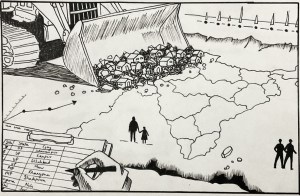
Holding the hands of my little sister, Sumaiya, I came back to the site of my demolished home two months after they had brought it down. The debris had settled into the ground as if it had always been there: chunks of brick, fragments of concrete beams, and rusted rods lying like broken limbs. The wreckage wasn’t cleared, nor was it cordoned off; it simply lay unattended. The streets around it hummed with the usual life of the neighborhood: rickshaws passing by, children playing.
The collapsed ceiling had created stacks of concrete slabs, leaving a low crawlspace I could fit under. It led me to where my room used to be—marked by a sliver of blue paint on a cracked wall and a fleck of purple from my parents’ bedroom. I climbed onto the fallen terrace, where I had once watched the River Yamuna swell each monsoon. I could not recall my home without the rubble superimposed on it — I could list every corner, but my mind refused to rebuild it in its entirety. The bulldozer not only destroyed the walls, it also tore through memory itself. That is the violence of demolition: the loss of property along with the erasure of belonging, and it is no accident.
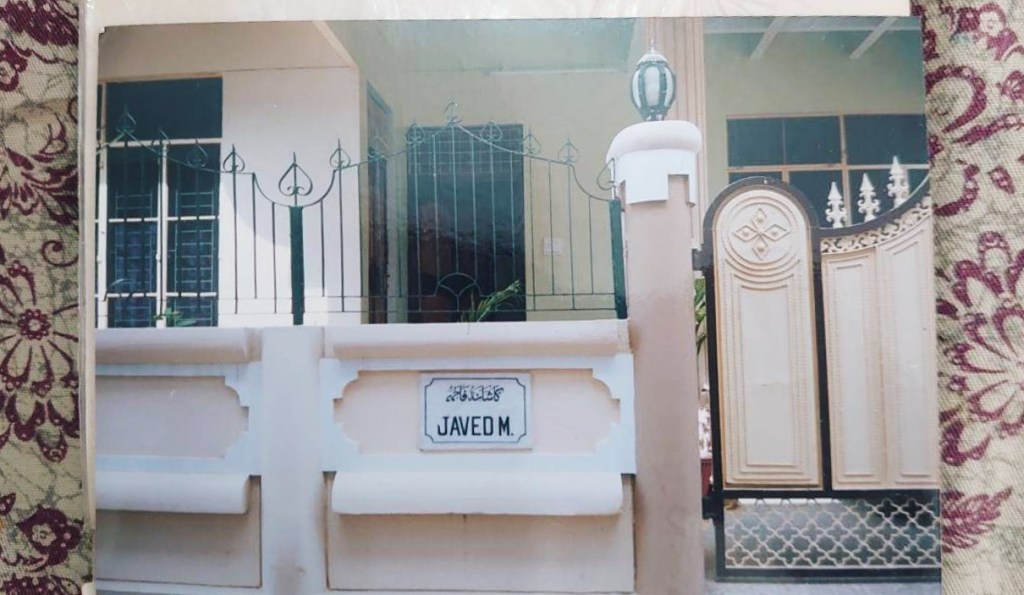
Near where the front gate used to be, I spotted the remnant of our house nameplate half-buried in debris. I picked it up and wiped the dust: it read “Fatima”, from the whole “Kashana-e-Fatima” — the “House of Fatima”, the name my parents gave our home. On June 12, 2022, when the demolition team arrived with a contingent of police, one of the first things they did was break down our gate. The plaque with our house’s name fell with the first blow of the bulldozer and split into pieces. That morning, Kashana-e-Fatima, which had hung at our entrance for over 20 years, ceased to exist on the city map; all that remained was a pile of broken bricks and a family without shelter. Since that day, I have been grappling with a fundamental question: what is a home if it can be torn down in an instant by those in power? And what remains of us when the four walls that held our lives are reduced to dust?
I once believed a home was an inviolable refuge, the one place where you could shut the world out and feel safe. But for Indian Muslims today, even our most personal spaces are not off-limits to the state. For such a community, then, can the houses we inhabit ever truly be ours? If my home is not safe, nowhere is.

Method, or the Refusal of Method
This is not a story written from a distance. There have been days when all I did was stare at the screen, not knowing how to write about this loss that felt completely irreconcilable. It is a testimony from within a crisis. I remember fragments of people’s lives scattered amid rubble — a child’s broken toy or stray pages of books. Each fragment is a witness, and the writing that follows is an invocation of collective memory. It insists that what happened to us must not be forgotten or neatly ironed over by official euphemisms.
So, I built what we at The Polis Project call ‘The Demolitions Project’ – an archive of bulldozed homes across northern India. Over the span of one and a half years (2023-25), I traveled and documented instances of extrajudicial and punitive demolitions across Uttar Pradesh, Madhya Pradesh, Delhi, and Haryana. I collected data about demolitions carried out by the state from 2019 to 2024. I created a database, cross-checked each case against news reports, and verified it with lawyers, journalists, and activists on the ground. But no methodology in the social sciences fully prepared me for the nights I spent weeping after talking to a mother whose house was hit with a bulldozer while she and her grandchildren were still inside. Or the afternoons when I found myself trembling in rage outside a government office that refused to acknowledge what had been done to us.
Traditional anthropology often asks for detachment, but I am implicated in every story I write. Autoethnography thus became my method. It is not the anthropology of distance or of “objective” observation, but a methodology of proximity, of embeddedness, and risk. For those of us writing from the margins, from positions of structural vulnerability, autoethnography is both a research tool and a theory of survival. Our lives, bodies, wounds, and refusals become testimonies. In refusing to separate the personal from the political, one reclaims the right to analyze the systems that target them. Anthropologist Ruth Behar wrote in her 1996 book, ‘The Vulnerable Observer’, that “anthropology that doesn’t break your heart just isn’t worth doing anymore.” Behar argues that vulnerability can be methodologically sound, and sometimes the most truthful analysis comes through tears and trembling voices. From the ruins of a home, through the quiver of a survivor’s voice, I lean on that insistence that our emotions carry insight.
The usual tools of social science can feel woefully inadequate here. How do you “measure” the loss of a home? How do you “operationalize” fear? The answer is you don’t; instead, you refuse the pretense of objectivity and write from within the event. For communities under siege, surviving and remembering is a form of knowledge production.
Location of the Self
I write here as a survivor of the very phenomenon I am investigating.
As a young Muslim woman in India, born and raised in a modest house, home to me was where my family gathered for Eid, where the walls were etched with children’s pencil marks, and where the kitchen smelled of cardamom and fried onions every evening. That home was completely demolished by authorities as a form of punishment, ostensibly because of a legal violation. In the official narrative, we became residents of an “illegal construction” overnight. However, we were made examples of because of who my family and I are and what we represent.
In the eyes of the authorities, I faced scrutiny both as a woman and as a part of the Muslim community that is most frequently targeted by bulldozer demolitions. When the police arrived at my home, male officers and mediapersons rifled through my personal belongings with a kind of casual violation. It was a reminder that in the hierarchy of power, I was doubly “othered”.
As a person with a university education and social network, I also recognize the uncomfortable fact that I was, in some ways, relatively privileged even in my victimhood. Amid a spree of demolition, when I realized our house might be next, I could put out a video message—a desperate plea to the world that my home was under threat. People saw it and responded. My social location afforded me a spotlight that most victims of such demolitions do not receive. I often ask myself, for how many is this possible? Very few, and this realization influences what I choose to see, record, and highlight: stories that didn’t make the news ticker. My experience of having support contrasts with the isolation I have witnessed elsewhere. If a house comes down and the family is somewhat known, people seem to care. When the homes of the most vulnerable are reduced to dust, it often happens in a silence as thick as the dust itself. I carry that knowledge and write with a dual awareness: gratitude for the solidarity I received and determination to extend that solidarity to those who were less visible.
My identity also influenced how people responded to me. Some families found comfort in the fact that I was Muslim like them; they didn’t have to fear being judged as wrongdoers or “rioters”, which is how mainstream media often portrays them. I spoke their language; I prayed with them on occasion; I shared their meals. That insider status allowed for a certain intimacy and trust; it also meant I had to be extra cautious, as I was not an anonymous journalist who could parachute in and out. My ethical commitment was to do this research with integrity and care, never objectifying my community’s pain.
When we started publishing the Demolitions Project newsletters and profiles, I initially did so anonymously to safeguard the families I was writing about. I worried that if an essay carried my name, it might draw unwanted attention or even reprisal towards those featured.
So I foregrounded the collective voice over my own. Only now, in this autoethnographic mode, do I step out from behind the project’s name to say “I”. I took inspiration from my father, who was arrested on made-up charges in June 2022 following protests against BJP spokesperson Nupur Sharma and was released after months in jail. After his release, he said to a journalist, “Chup ho jaate toh aur bada zulm hota (Had we remained silent, the injustice would have been even greater).” It’s his conviction of continuing to speak the truth that emboldens me.
I write from a place of grief and defiance. I write as a Muslim, as a woman, and as a daughter of a family that watched their lives’ work be bulldozed and her father being put behind bars for standing up for his community. I write to honor the trust that demolition-affected families placed in me; they let me into their broken courtyards and their guarded hearts, believing that I might carry a piece of their story to the world. I carry those pieces with the awareness that I am telling our story, mine and theirs bound together. If I sometimes say “I” and “we” interchangeably, it is intentional. To locate myself is to locate us all in the shadow of the bulldozer.
Banishment by Bulldozer: Spatial Exclusion and Social Control
A critical yet often overlooked dimension of extrajudicial demolitions is their function as instruments of de facto banishment. Drawing on Ananya Roy’s theorization of racial banishment as a state-sanctioned mode of spatialized control, I extend her framework to the Indian context. In present-day India, punitive demolitions function as communal banishment: extra-legal, politically orchestrated exclusion targeting Muslims. Roy’s account of how urban governance disciplines racialized bodies helps clarify how demolition disciplines dissenting Muslim populations, often under the guise of legality.
This banishment is part of a political economy built under the Hindu nationalist BJP-RSS regime, which instrumentalizes state violence for ideological consolidation and electoral gain.
In BJP-governed states, demolitions are often framed as anti-encroachment drives or punitive measures against alleged rioters. These legal categories obscure the deeper political function of demolitions: producing precarity, rootlessness, and the erosion of Muslim socio-economic networks. Destroying a home is not merely a financial blow; it severs community ties and enacts a symbolic and material uprooting akin to banishment. This is most visible in Uttar Pradesh, Madhya Pradesh, Gujarat, and Assam, where bulldozers raze Muslim homes before courts establish culpability, often without due process like a notice or a hearing.
The bulldozer has become a weapon of annihilation. Its spectacle is repeated on social media, at political rallies, and in mainstream media, where demolitions are televised, celebrated, and normalized as law-and-order action. The neighborhoods targeted are working-class Muslim settlements built through decades of forced ghettoization: neglected by the government, denied formal housing rights, and heavily policed. Demolitions targeting Muslim-owned property after protests or communal violence embed spatial exclusion within majoritarian politics, aligning with broader projects of demographic engineering that push Muslims out of contested urban spaces. The looming threat of demolition itself deters Muslims from settling or investing in property, making fear and precarity become integral to the state’s repertoire of repression.
Each demolition also generates political capital, affirming the promise of a Hindu Rashtra purified of Muslim “encroachment”. In this imagination, a Muslim protester’s home is stripped of constitutional rights, and demolition is celebrated as justice for a majoritarian public conditioned by decades of Islamophobic propaganda. This architecture survives not through brute force alone but also through legal grey zones and bureaucratic complicity. Demolitions are carried out under a sanitized bureaucratic cover— backdated notices, post-facto justifications, and enforced silences. To frame these acts as mere administrative overreach misses their systemic character. Naming them as banishment matters because it holds the state accountable for targeting marginalized communities under a veil of legality, and because it places these demolitions within broader global patterns of settler colonialism, ethnic cleansing, and apartheid. The bulldozer, ultimately, is pedagogical: it teaches Muslims that their place in “the new India” is insecure, unwanted, and perpetually punishable. The question it forces is not about property, but about who has the right to inhabit space at all.
The Field as a Haunted Archive
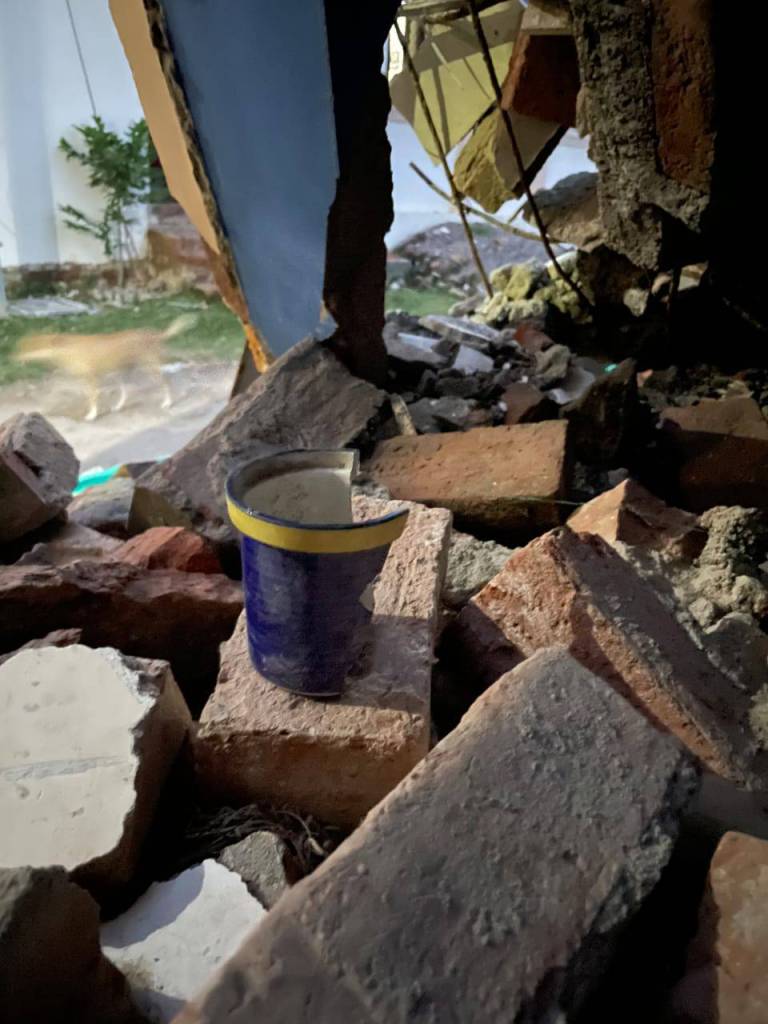
Walking through the aftermath of a demolition felt like stepping into a haunted archive. The sites of destroyed homes held a history–almost palpable amid the debris and silence. Months after a house had been leveled, with only its skeleton remaining, I visited the site. The air was thick with the smell of pulverized concrete. Tiny parts of the wreckage crackled under my feet: shards of glass, bits of a teacup, and a child’s toy cracked open. I found myself whispering salaam under my breath, as if to ask for permission to enter their shattered world.
There was no roof above. In a corner where the bedroom probably once was, a single slipper lay upside down next to a broken mirror. On what was left of a wall, I saw the rectangular outline of where a picture frame had hung. I thought about how everything in that space was a scream frozen midair. And yet, some traces of that life persisted in defiance; a child’s school notebook, its lines filled with careful handwriting practice, peeped out of the rubble, declaring that a student once lived here.
Leaving such a site is always hard. You feel like you are intruding on grief that has no language, and when you step away, you carry that grief with you. After that particular visit, I sat on the sidewalk and cried. In my field notes from that day, I later found a stain where a tear had fallen on the page, right next to the description of the slipper and the absent picture frame’s outline. The archive of the field had merged with the archive of the self; the broken house had left its imprint on me.
I call these sites haunted not to mystify them, but to acknowledge the presence of the absent. The family may be gone, but their imprint remains, like ghosts who haven’t left because their quest for justice remains unresolved. In the process of building the Demolitions Project, I heeded Saidiya Hartman’s caution against sanitizing narratives of pain. Some pain resists language; some stories will remain jagged and unresolved. Hartman taught me to respect the silences, the gaps, the inchoate cries that cannot be fully translated into narrative.
One of the most harrowing aspects of this fieldwork has been encountering the silences that follow punitive demolitions. In many cases, families silence themselves as a survival strategy. There is the silence of fear, the silence of trauma, and the silence of dignity. I recall the silence of fear when I talked to a young woman from Jahangirpuri whose small shop had been bulldozed without warning. She sat in a tea shop she was running after the demolition, speaking in a monotone until I asked how she felt. She lowered her head and fell silent. Her daughter rubbed her back in slow circles. Eventually, she whispered, “We’ll talk about this later.” We never did, and I did not push her.
From dozens of such conversations, I learned that what gets left out of documentation is often as revealing as what is included. Official reports might capture the date, time, or legal pretext; but they miss the texture of the aftermath: the shame, the pride, the prayers, the curses, the long silence after the walls come down. This field is not just a scene of destruction; it is a library of silences and sounds, of cries and their echoes.
The Emotional Debris
Long after the bulldozers and news cameras departed, the emotional debris remained. In my own life, the Demolitions Project has blurred the boundaries between researcher and survivor. I had been collecting others’ grief while still processing my own.
After spending a day hearing families recount what they lost, I would return to the few belongings I had salvaged from my demolished home and feel anger and sorrow that I had suppressed during the interviews. One night, after hearing an especially gut-wrenching account from a woman my mother’s age, I broke down and screamed into a pillow. I was furious at the state, at the injustice, but also at myself. That night, I dreamt of bulldozers chasing me through empty streets. I woke up sweating, my heart pounding; for a moment, I had gone back to my bedroom while it was being crushed. There were also times when I felt numb, when I listened to someone’s pain with dry eyes even as they cried. I learned that feeling too much can shut the body down as surely as not feeling enough.
Spirituality became an anchor.
After losing our home, I found myself praying more. Often, after hours of writing late into the night, I’d hear the Fajr azan from a nearby mosque. That call to prayer would break through my exhaustion. I would wrap a scarf around me and pray. In those moments, I felt as if praying was rebuilding a home that no bulldozer could touch.
One verse from the Quran that I repeated to myself was, “And do not think that God is unaware of what the wrongdoers do. He only delays them for a Day…” It reminded me of a higher justice, deferred perhaps, but inevitable. It lent me sabr (patience). Many demolition survivors spoke of faith in similar ways. In one case, when I asked an elderly man what message he had for others, he said, “Sabr karein. Islam sabr sikhata hai. Sabr bohot zaroori hai (Have patience. Islam teaches patience. Patience is very important).” Hearing that from a man in his late 70s, whose entire life was suddenly upended, was humbling.
The Demolitions Project profoundly changed my relationship with safety and law. I understand why some people are silent; I know fear intimately now. I learned to be careful in how I conducted the work. I often refrained from taking photographs if they risked the family’s privacy, and I tried not to parachute in for spectacle and then vanish. I stayed in touch with many families, calling or messaging them at festivals and checking on their court cases. What emerged was a network of mutual empathy and care.
While safety is a crucial concern, if those of us who can speak don’t, then who will? That question returns to me whenever I think about the woman from the outskirts of Allahabad who had held my hand and said, “Aap likhna” (You should write it). It was a charge, not a request.
What I have come to see is that the emotional debris is not only a burden but also evidence. It shows that we loved, lost, and cared fiercely about our homes and each other. It taught me humility, because activism and writing cannot always repair what has been broken. It also taught me gratitude, for the roof I do have now and for the hearts that opened to me. In the end, this work is deeply personal and profoundly collective. Safety, I have learned, can be found in solidarity and in speaking the truth.
What is Left Standing?
When a home is reduced to rubble, one might think nothing is left standing. But even amid total physical destruction, some things endure: community, memory, solidarity, and refusal.
First, community. In many places, the attack on one family’s home galvanized an entire neighborhood.
I saw relatives, friends, and even strangers step in to offer shelter, console children, and help file petitions.
A man told me it gave him “great peace” that his extended family did not abandon him in his darkest hour. There are numerous unsung heroes in these tales: the neighbor who stored someone’s furniture so it wouldn’t be seized, the local mosque committee or an NGO that raised funds for a family’s legal fees, and the activist networks that arranged for temporary housing. In my own case, the outpouring of support was overwhelming. People I had never met offered help, and that solidarity became a scaffold when our walls fell. Displacement scattered people, but it also forged new alliances.
What also remains standing is memory. You can crush concrete, but you cannot so easily erase memory.
Another important development for the Demolitions Project was the translation and sharing of these stories across languages and regions. Early on, Polis Project partnered with a Tamil media collective, Maatru, to translate several of the pieces. Tamil readers, geographically far from North India, where most bulldozer incidents occurred, connected deeply with these accounts. The translators themselves found the process emotionally challenging but ultimately meaningful; they “wiped their tears and continued the work of translation,” driven by a resolve to spread the truth. This act of translation was a form of preservation and amplification. It ensured that what happened in a lane of Uttar Pradesh or a village in Madhya Pradesh would be heard by someone in Chennai. Why is this important? That mattered because it turned local wreckage into shared national witness. Each reader became another witness, and the more the witnesses, the harder it becomes to rewrite history. The archive of demolitions, the profiles, and the newsletters are all part of that record.
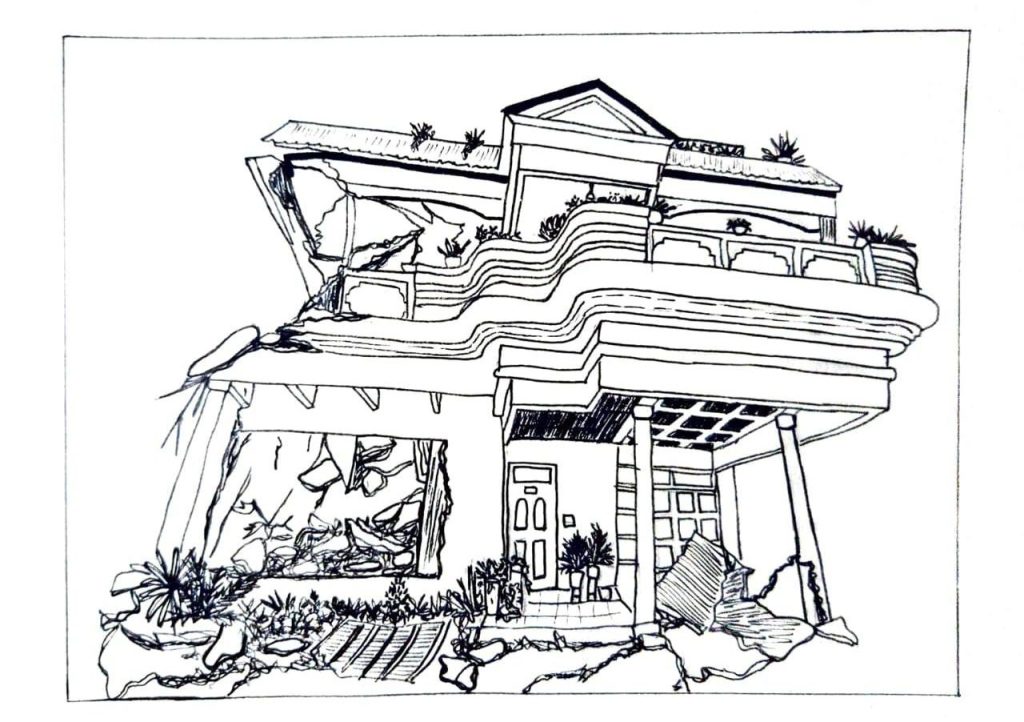
I chose to sketch each site for the demolition profiles instead of relying solely on photographs and illustrations for the research essays. It began as a practical decision; there were already too many images of broken walls, splintered doors, lives reduced to debris, but it became something more intimate. Drawing slowed me down; it required me to sit with the remains, to notice what the camera often flattened: the curve of a threshold, the stubborn uprightness of a single wall, the way a window frame still held the memory of a home. In translating rubble into lines, I found a way to hold grief without reproducing its spectacle. The sketches were not an attempt to soften the violence, but to witness it differently, to insist that even in ruins, there were textures of life that refused to be erased. In that sense, illustrating became both a method of documentation and a quiet act of resistance against the easy consumption of destruction.
On a personal note, what remains standing for me is a sense of purpose. My previous plan for life crumbled along with my house; I had imagined I’d complete a doctorate and settle into a quiet academic career. Instead, I became an unwitting chronicler of state terror. And oddly, I am at peace with that change. Each time a reader tells us, “I had no idea this was happening at this scale; now I’ll pay attention,” it rebuilds a bit of my faith in why I did this. Survival itself became knowledge, as I noted earlier, and sharing that knowledge became a mission.
Finally, what stands tallest is our refusal: refusal to be erased, refusal to be silent, and refusal to lose hope. Rubble often remains in place for months or years, and those broken heaps become unintended monuments. They say that something happened here that should not have. Some families leave a portion of the debris untouched as a memorial, a way of saying that the loss will not be swept away.
In writing and curating these stories, we are preserving truths for the next generation. Where a home once stood, the ground remembers, and through us, people must remember. What remains, above all, is memory. If a single wildflower can grow from a cracked slab, that is enough proof that life continues. The bulldozers failed to crush our humanity, our care for one another, and our determination to seek justice. What is left is us, scarred but standing.
Remembrance as Resistance
After completing the project, I stood once again on my demolished doorstep, where the rubble had now been covered with wildflowers and plants from my mother’s garden, and I felt the two sides of my journey collapse into one. The personal and the political, the subject and the researcher were no longer separate in me.
I often think of the essay I once wrote: We, Muslims of India, unbelong to our own homes. The word “unbelong” captures a feeling that had been growing long before the first bulldozer arrived: the ache of being estranged in your own land, of having your citizenship perpetually questioned, and your loyalties doubted. The bulldozers are a violent culmination of that condition, made to turn unbelonging into something visible and physical. Yet even in that wreckage, I held on to something else: stubbornness, faith, and the ember of resistance that refused to die. When I visited the ruins of someone’s home, I often found that amidst the tears, defiance remained. “Yeh zulm bardasht nahin kiya jayega”—this injustice will not be tolerated, my little sister once said in a family conversation, with a steel in her voice that belied her wet eyes. The government can raze our homes, but it cannot raze our hope for justice or our will to rebuild so easily. I have seen families start erecting a tin shack on the very plot where their house was demolished, even as their court case was pending, simply because they refused to be uprooted. For every act meant to crush our spirit, there is a quiet act of resilience that rekindles it.
As I stood on what used to be my doorstep, the day was ending, and the sky was tinted orange and smoke-grey–a palette that reminds me of both sunset and ash. In the distance, I heard the call to prayer from a mosque nearby. That call, so familiar and steady, reassured me that some things endure. I said a small prayer under my breath for myself and for everyone I have met on this journey. I prayed for strength to continue, for wisdom to honor their stories, and for justice, however long in coming, to prevail. Before leaving, I knelt and picked up a broken piece of the nameplate that once greeted visitors at the gate, a piece of home to carry with me. It almost fit in my hands, the edges sharp, the paint of the wall still visible on one side. I will keep it as I keep every testimony, every photograph, every scrap of evidence of what has been done to us.
Let this piece remind me of what has been lost and what must be reclaimed. The state wanted to reduce us to dust and oblivion, but memory is a powerful weapon. I refuse to let these shattered walls be forgotten; I refuse to let the world look away. In bearing witness, I choose to remember, and in remembering, I choose to resist. The rubble at my feet is not an end but a beginning, a foundation upon which we are building our resistance. This is my home, even now that it is gone.
We will remember, and we will resist. Those of us who lost homes found homes in each other, found courage in despair, found purpose in pain. We stand for the inevitability of justice. In this final invocation, I raise a silent prayer that such injustices cease. But until they do, there will always be witnesses like us to document and resist. To you, dear reader, I say: carry this story forward. Let the wildflowers of truth and justice grow, no matter how much concrete the forces of hatred try to pour over them. I have written our survival into history so that we refuse to be erased. And that refusal, like a stubborn flower through the cracks, is what will always be left standing.
This is the final installment in researcher Afreen Fatima’s three-part series of essays on how she shaped The Demolitions Project while navigating the personal and the political. Read the first essay here and the second here.

Writing from the Rubble: On Researching the Violence of Demolition That Broke My Own Home

Illustration by Afreen Fatima for the Polis Project.
Editor’s Note: Afreen Fatima spent around two years documenting the punitive demolitions of Muslim homes across North India, writing other people’s stories of loss and displacement. This is the first time she has written her own. In this autoethnographic essay, she turns the lens on herself: an Indian Muslim woman whose own home in Allahabad was reduced to rubble, whose reality became part of her research, and whose grief, until now, had no place in her writing. This is the final installment in Afreen’s three-part series of essays on how she shaped The Demolitions Project while navigating the personal and the political. Read the first essay here and the second here.
Prelude:
Holding the hands of my little sister, Sumaiya, I came back to the site of my demolished home two months after they had brought it down. The debris had settled into the ground as if it had always been there: chunks of brick, fragments of concrete beams, and rusted rods lying like broken limbs. The wreckage wasn’t cleared, nor was it cordoned off; it simply lay unattended. The streets around it hummed with the usual life of the neighborhood: rickshaws passing by, children playing.
The collapsed ceiling had created stacks of concrete slabs, leaving a low crawlspace I could fit under. It led me to where my room used to be—marked by a sliver of blue paint on a cracked wall and a fleck of purple from my parents’ bedroom. I climbed onto the fallen terrace, where I had once watched the River Yamuna swell each monsoon. I could not recall my home without the rubble superimposed on it — I could list every corner, but my mind refused to rebuild it in its entirety. The bulldozer not only destroyed the walls, it also tore through memory itself. That is the violence of demolition: the loss of property along with the erasure of belonging, and it is no accident.
Near where the front gate used to be, I spotted the remnant of our house nameplate half-buried in debris. I picked it up and wiped the dust: it read “Fatima”, from the whole “Kashana-e-Fatima” — the “House of Fatima”, the name my parents gave our home. On June 12, 2022, when the demolition team arrived with a contingent of police, one of the first things they did was break down our gate. The plaque with our house’s name fell with the first blow of the bulldozer and split into pieces. That morning, Kashana-e-Fatima, which had hung at our entrance for over 20 years, ceased to exist on the city map; all that remained was a pile of broken bricks and a family without shelter. Since that day, I have been grappling with a fundamental question: what is a home if it can be torn down in an instant by those in power? And what remains of us when the four walls that held our lives are reduced to dust?
I once believed a home was an inviolable refuge, the one place where you could shut the world out and feel safe. But for Indian Muslims today, even our most personal spaces are not off-limits to the state. For such a community, then, can the houses we inhabit ever truly be ours? If my home is not safe, nowhere is.
Method, or the Refusal of Method
This is not a story written from a distance. There have been days when all I did was stare at the screen, not knowing how to write about this loss that felt completely irreconcilable. It is a testimony from within a crisis. I remember fragments of people’s lives scattered amid rubble — a child’s broken toy or stray pages of books. Each fragment is a witness, and the writing that follows is an invocation of collective memory. It insists that what happened to us must not be forgotten or neatly ironed over by official euphemisms.
So, I built what we at The Polis Project call ‘The Demolitions Project’ – an archive of bulldozed homes across northern India. Over the span of one and a half years (2023-25), I traveled and documented instances of extrajudicial and punitive demolitions across Uttar Pradesh, Madhya Pradesh, Delhi, and Haryana. I collected data about demolitions carried out by the state from 2019 to 2024. I created a database, cross-checked each case against news reports, and verified it with lawyers, journalists, and activists on the ground. But no methodology in the social sciences fully prepared me for the nights I spent weeping after talking to a mother whose house was hit with a bulldozer while she and her grandchildren were still inside. Or the afternoons when I found myself trembling in rage outside a government office that refused to acknowledge what had been done to us.
Traditional anthropology often asks for detachment, but I am implicated in every story I write. Autoethnography thus became my method. It is not the anthropology of distance or of “objective” observation, but a methodology of proximity, of embeddedness, and risk. For those of us writing from the margins, from positions of structural vulnerability, autoethnography is both a research tool and a theory of survival. Our lives, bodies, wounds, and refusals become testimonies. In refusing to separate the personal from the political, one reclaims the right to analyze the systems that target them. Anthropologist Ruth Behar wrote in her 1996 book, ‘The Vulnerable Observer’, that “anthropology that doesn’t break your heart just isn’t worth doing anymore.” Behar argues that vulnerability can be methodologically sound, and sometimes the most truthful analysis comes through tears and trembling voices. From the ruins of a home, through the quiver of a survivor’s voice, I lean on that insistence that our emotions carry insight.
The usual tools of social science can feel woefully inadequate here. How do you “measure” the loss of a home? How do you “operationalize” fear? The answer is you don’t; instead, you refuse the pretense of objectivity and write from within the event. For communities under siege, surviving and remembering is a form of knowledge production.
Location of the Self
I write here as a survivor of the very phenomenon I am investigating.
As a young Muslim woman in India, born and raised in a modest house, home to me was where my family gathered for Eid, where the walls were etched with children’s pencil marks, and where the kitchen smelled of cardamom and fried onions every evening. That home was completely demolished by authorities as a form of punishment, ostensibly because of a legal violation. In the official narrative, we became residents of an “illegal construction” overnight. However, we were made examples of because of who my family and I are and what we represent.
In the eyes of the authorities, I faced scrutiny both as a woman and as a part of the Muslim community that is most frequently targeted by bulldozer demolitions. When the police arrived at my home, male officers and mediapersons rifled through my personal belongings with a kind of casual violation. It was a reminder that in the hierarchy of power, I was doubly “othered”.
As a person with a university education and social network, I also recognize the uncomfortable fact that I was, in some ways, relatively privileged even in my victimhood. Amid a spree of demolition, when I realized our house might be next, I could put out a video message—a desperate plea to the world that my home was under threat. People saw it and responded. My social location afforded me a spotlight that most victims of such demolitions do not receive. I often ask myself, for how many is this possible? Very few, and this realization influences what I choose to see, record, and highlight: stories that didn’t make the news ticker. My experience of having support contrasts with the isolation I have witnessed elsewhere. If a house comes down and the family is somewhat known, people seem to care. When the homes of the most vulnerable are reduced to dust, it often happens in a silence as thick as the dust itself. I carry that knowledge and write with a dual awareness: gratitude for the solidarity I received and determination to extend that solidarity to those who were less visible.
My identity also influenced how people responded to me. Some families found comfort in the fact that I was Muslim like them; they didn’t have to fear being judged as wrongdoers or “rioters”, which is how mainstream media often portrays them. I spoke their language; I prayed with them on occasion; I shared their meals. That insider status allowed for a certain intimacy and trust; it also meant I had to be extra cautious, as I was not an anonymous journalist who could parachute in and out. My ethical commitment was to do this research with integrity and care, never objectifying my community’s pain.
When we started publishing the Demolitions Project newsletters and profiles, I initially did so anonymously to safeguard the families I was writing about. I worried that if an essay carried my name, it might draw unwanted attention or even reprisal towards those featured.
So I foregrounded the collective voice over my own. Only now, in this autoethnographic mode, do I step out from behind the project’s name to say “I”. I took inspiration from my father, who was arrested on made-up charges in June 2022 following protests against BJP spokesperson Nupur Sharma and was released after months in jail. After his release, he said to a journalist, “Chup ho jaate toh aur bada zulm hota (Had we remained silent, the injustice would have been even greater).” It’s his conviction of continuing to speak the truth that emboldens me.
I write from a place of grief and defiance. I write as a Muslim, as a woman, and as a daughter of a family that watched their lives’ work be bulldozed and her father being put behind bars for standing up for his community. I write to honor the trust that demolition-affected families placed in me; they let me into their broken courtyards and their guarded hearts, believing that I might carry a piece of their story to the world. I carry those pieces with the awareness that I am telling our story, mine and theirs bound together. If I sometimes say “I” and “we” interchangeably, it is intentional. To locate myself is to locate us all in the shadow of the bulldozer.
Banishment by Bulldozer: Spatial Exclusion and Social Control
A critical yet often overlooked dimension of extrajudicial demolitions is their function as instruments of de facto banishment. Drawing on Ananya Roy’s theorization of racial banishment as a state-sanctioned mode of spatialized control, I extend her framework to the Indian context. In present-day India, punitive demolitions function as communal banishment: extra-legal, politically orchestrated exclusion targeting Muslims. Roy’s account of how urban governance disciplines racialized bodies helps clarify how demolition disciplines dissenting Muslim populations, often under the guise of legality.
This banishment is part of a political economy built under the Hindu nationalist BJP-RSS regime, which instrumentalizes state violence for ideological consolidation and electoral gain.
In BJP-governed states, demolitions are often framed as anti-encroachment drives or punitive measures against alleged rioters. These legal categories obscure the deeper political function of demolitions: producing precarity, rootlessness, and the erosion of Muslim socio-economic networks. Destroying a home is not merely a financial blow; it severs community ties and enacts a symbolic and material uprooting akin to banishment. This is most visible in Uttar Pradesh, Madhya Pradesh, Gujarat, and Assam, where bulldozers raze Muslim homes before courts establish culpability, often without due process like a notice or a hearing.
The bulldozer has become a weapon of annihilation. Its spectacle is repeated on social media, at political rallies, and in mainstream media, where demolitions are televised, celebrated, and normalized as law-and-order action. The neighborhoods targeted are working-class Muslim settlements built through decades of forced ghettoization: neglected by the government, denied formal housing rights, and heavily policed. Demolitions targeting Muslim-owned property after protests or communal violence embed spatial exclusion within majoritarian politics, aligning with broader projects of demographic engineering that push Muslims out of contested urban spaces. The looming threat of demolition itself deters Muslims from settling or investing in property, making fear and precarity become integral to the state’s repertoire of repression.
Each demolition also generates political capital, affirming the promise of a Hindu Rashtra purified of Muslim “encroachment”. In this imagination, a Muslim protester’s home is stripped of constitutional rights, and demolition is celebrated as justice for a majoritarian public conditioned by decades of Islamophobic propaganda. This architecture survives not through brute force alone but also through legal grey zones and bureaucratic complicity. Demolitions are carried out under a sanitized bureaucratic cover— backdated notices, post-facto justifications, and enforced silences. To frame these acts as mere administrative overreach misses their systemic character. Naming them as banishment matters because it holds the state accountable for targeting marginalized communities under a veil of legality, and because it places these demolitions within broader global patterns of settler colonialism, ethnic cleansing, and apartheid. The bulldozer, ultimately, is pedagogical: it teaches Muslims that their place in “the new India” is insecure, unwanted, and perpetually punishable. The question it forces is not about property, but about who has the right to inhabit space at all.
The Field as a Haunted Archive
Walking through the aftermath of a demolition felt like stepping into a haunted archive. The sites of destroyed homes held a history–almost palpable amid the debris and silence. Months after a house had been leveled, with only its skeleton remaining, I visited the site. The air was thick with the smell of pulverized concrete. Tiny parts of the wreckage crackled under my feet: shards of glass, bits of a teacup, and a child’s toy cracked open. I found myself whispering salaam under my breath, as if to ask for permission to enter their shattered world.
There was no roof above. In a corner where the bedroom probably once was, a single slipper lay upside down next to a broken mirror. On what was left of a wall, I saw the rectangular outline of where a picture frame had hung. I thought about how everything in that space was a scream frozen midair. And yet, some traces of that life persisted in defiance; a child’s school notebook, its lines filled with careful handwriting practice, peeped out of the rubble, declaring that a student once lived here.
Leaving such a site is always hard. You feel like you are intruding on grief that has no language, and when you step away, you carry that grief with you. After that particular visit, I sat on the sidewalk and cried. In my field notes from that day, I later found a stain where a tear had fallen on the page, right next to the description of the slipper and the absent picture frame’s outline. The archive of the field had merged with the archive of the self; the broken house had left its imprint on me.
I call these sites haunted not to mystify them, but to acknowledge the presence of the absent. The family may be gone, but their imprint remains, like ghosts who haven’t left because their quest for justice remains unresolved. In the process of building the Demolitions Project, I heeded Saidiya Hartman’s caution against sanitizing narratives of pain. Some pain resists language; some stories will remain jagged and unresolved. Hartman taught me to respect the silences, the gaps, the inchoate cries that cannot be fully translated into narrative.
One of the most harrowing aspects of this fieldwork has been encountering the silences that follow punitive demolitions. In many cases, families silence themselves as a survival strategy. There is the silence of fear, the silence of trauma, and the silence of dignity. I recall the silence of fear when I talked to a young woman from Jahangirpuri whose small shop had been bulldozed without warning. She sat in a tea shop she was running after the demolition, speaking in a monotone until I asked how she felt. She lowered her head and fell silent. Her daughter rubbed her back in slow circles. Eventually, she whispered, “We’ll talk about this later.” We never did, and I did not push her.
From dozens of such conversations, I learned that what gets left out of documentation is often as revealing as what is included. Official reports might capture the date, time, or legal pretext; but they miss the texture of the aftermath: the shame, the pride, the prayers, the curses, the long silence after the walls come down. This field is not just a scene of destruction; it is a library of silences and sounds, of cries and their echoes.
The Emotional Debris
Long after the bulldozers and news cameras departed, the emotional debris remained. In my own life, the Demolitions Project has blurred the boundaries between researcher and survivor. I had been collecting others’ grief while still processing my own.
After spending a day hearing families recount what they lost, I would return to the few belongings I had salvaged from my demolished home and feel anger and sorrow that I had suppressed during the interviews. One night, after hearing an especially gut-wrenching account from a woman my mother’s age, I broke down and screamed into a pillow. I was furious at the state, at the injustice, but also at myself. That night, I dreamt of bulldozers chasing me through empty streets. I woke up sweating, my heart pounding; for a moment, I had gone back to my bedroom while it was being crushed. There were also times when I felt numb, when I listened to someone’s pain with dry eyes even as they cried. I learned that feeling too much can shut the body down as surely as not feeling enough.
Spirituality became an anchor.
After losing our home, I found myself praying more. Often, after hours of writing late into the night, I’d hear the Fajr azan from a nearby mosque. That call to prayer would break through my exhaustion. I would wrap a scarf around me and pray. In those moments, I felt as if praying was rebuilding a home that no bulldozer could touch.
One verse from the Quran that I repeated to myself was, “And do not think that God is unaware of what the wrongdoers do. He only delays them for a Day…” It reminded me of a higher justice, deferred perhaps, but inevitable. It lent me sabr (patience). Many demolition survivors spoke of faith in similar ways. In one case, when I asked an elderly man what message he had for others, he said, “Sabr karein. Islam sabr sikhata hai. Sabr bohot zaroori hai (Have patience. Islam teaches patience. Patience is very important).” Hearing that from a man in his late 70s, whose entire life was suddenly upended, was humbling.
The Demolitions Project profoundly changed my relationship with safety and law. I understand why some people are silent; I know fear intimately now. I learned to be careful in how I conducted the work. I often refrained from taking photographs if they risked the family’s privacy, and I tried not to parachute in for spectacle and then vanish. I stayed in touch with many families, calling or messaging them at festivals and checking on their court cases. What emerged was a network of mutual empathy and care.
While safety is a crucial concern, if those of us who can speak don’t, then who will? That question returns to me whenever I think about the woman from the outskirts of Allahabad who had held my hand and said, “Aap likhna” (You should write it). It was a charge, not a request.
What I have come to see is that the emotional debris is not only a burden but also evidence. It shows that we loved, lost, and cared fiercely about our homes and each other. It taught me humility, because activism and writing cannot always repair what has been broken. It also taught me gratitude, for the roof I do have now and for the hearts that opened to me. In the end, this work is deeply personal and profoundly collective. Safety, I have learned, can be found in solidarity and in speaking the truth.
What is Left Standing?
When a home is reduced to rubble, one might think nothing is left standing. But even amid total physical destruction, some things endure: community, memory, solidarity, and refusal.
First, community. In many places, the attack on one family’s home galvanized an entire neighborhood.
I saw relatives, friends, and even strangers step in to offer shelter, console children, and help file petitions.
A man told me it gave him “great peace” that his extended family did not abandon him in his darkest hour. There are numerous unsung heroes in these tales: the neighbor who stored someone’s furniture so it wouldn’t be seized, the local mosque committee or an NGO that raised funds for a family’s legal fees, and the activist networks that arranged for temporary housing. In my own case, the outpouring of support was overwhelming. People I had never met offered help, and that solidarity became a scaffold when our walls fell. Displacement scattered people, but it also forged new alliances.
What also remains standing is memory. You can crush concrete, but you cannot so easily erase memory.
Another important development for the Demolitions Project was the translation and sharing of these stories across languages and regions. Early on, Polis Project partnered with a Tamil media collective, Maatru, to translate several of the pieces. Tamil readers, geographically far from North India, where most bulldozer incidents occurred, connected deeply with these accounts. The translators themselves found the process emotionally challenging but ultimately meaningful; they “wiped their tears and continued the work of translation,” driven by a resolve to spread the truth. This act of translation was a form of preservation and amplification. It ensured that what happened in a lane of Uttar Pradesh or a village in Madhya Pradesh would be heard by someone in Chennai. Why is this important? That mattered because it turned local wreckage into shared national witness. Each reader became another witness, and the more the witnesses, the harder it becomes to rewrite history. The archive of demolitions, the profiles, and the newsletters are all part of that record.
I chose to sketch each site for the demolition profiles instead of relying solely on photographs and illustrations for the research essays. It began as a practical decision; there were already too many images of broken walls, splintered doors, lives reduced to debris, but it became something more intimate. Drawing slowed me down; it required me to sit with the remains, to notice what the camera often flattened: the curve of a threshold, the stubborn uprightness of a single wall, the way a window frame still held the memory of a home. In translating rubble into lines, I found a way to hold grief without reproducing its spectacle. The sketches were not an attempt to soften the violence, but to witness it differently, to insist that even in ruins, there were textures of life that refused to be erased. In that sense, illustrating became both a method of documentation and a quiet act of resistance against the easy consumption of destruction.
On a personal note, what remains standing for me is a sense of purpose. My previous plan for life crumbled along with my house; I had imagined I’d complete a doctorate and settle into a quiet academic career. Instead, I became an unwitting chronicler of state terror. And oddly, I am at peace with that change. Each time a reader tells us, “I had no idea this was happening at this scale; now I’ll pay attention,” it rebuilds a bit of my faith in why I did this. Survival itself became knowledge, as I noted earlier, and sharing that knowledge became a mission.
Finally, what stands tallest is our refusal: refusal to be erased, refusal to be silent, and refusal to lose hope. Rubble often remains in place for months or years, and those broken heaps become unintended monuments. They say that something happened here that should not have. Some families leave a portion of the debris untouched as a memorial, a way of saying that the loss will not be swept away.
In writing and curating these stories, we are preserving truths for the next generation. Where a home once stood, the ground remembers, and through us, people must remember. What remains, above all, is memory. If a single wildflower can grow from a cracked slab, that is enough proof that life continues. The bulldozers failed to crush our humanity, our care for one another, and our determination to seek justice. What is left is us, scarred but standing.
Remembrance as Resistance
After completing the project, I stood once again on my demolished doorstep, where the rubble had now been covered with wildflowers and plants from my mother’s garden, and I felt the two sides of my journey collapse into one. The personal and the political, the subject and the researcher were no longer separate in me.
I often think of the essay I once wrote: We, Muslims of India, unbelong to our own homes. The word “unbelong” captures a feeling that had been growing long before the first bulldozer arrived: the ache of being estranged in your own land, of having your citizenship perpetually questioned, and your loyalties doubted. The bulldozers are a violent culmination of that condition, made to turn unbelonging into something visible and physical. Yet even in that wreckage, I held on to something else: stubbornness, faith, and the ember of resistance that refused to die. When I visited the ruins of someone’s home, I often found that amidst the tears, defiance remained. “Yeh zulm bardasht nahin kiya jayega”—this injustice will not be tolerated, my little sister once said in a family conversation, with a steel in her voice that belied her wet eyes. The government can raze our homes, but it cannot raze our hope for justice or our will to rebuild so easily. I have seen families start erecting a tin shack on the very plot where their house was demolished, even as their court case was pending, simply because they refused to be uprooted. For every act meant to crush our spirit, there is a quiet act of resilience that rekindles it.
As I stood on what used to be my doorstep, the day was ending, and the sky was tinted orange and smoke-grey–a palette that reminds me of both sunset and ash. In the distance, I heard the call to prayer from a mosque nearby. That call, so familiar and steady, reassured me that some things endure. I said a small prayer under my breath for myself and for everyone I have met on this journey. I prayed for strength to continue, for wisdom to honor their stories, and for justice, however long in coming, to prevail. Before leaving, I knelt and picked up a broken piece of the nameplate that once greeted visitors at the gate, a piece of home to carry with me. It almost fit in my hands, the edges sharp, the paint of the wall still visible on one side. I will keep it as I keep every testimony, every photograph, every scrap of evidence of what has been done to us.
Let this piece remind me of what has been lost and what must be reclaimed. The state wanted to reduce us to dust and oblivion, but memory is a powerful weapon. I refuse to let these shattered walls be forgotten; I refuse to let the world look away. In bearing witness, I choose to remember, and in remembering, I choose to resist. The rubble at my feet is not an end but a beginning, a foundation upon which we are building our resistance. This is my home, even now that it is gone.
We will remember, and we will resist. Those of us who lost homes found homes in each other, found courage in despair, found purpose in pain. We stand for the inevitability of justice. In this final invocation, I raise a silent prayer that such injustices cease. But until they do, there will always be witnesses like us to document and resist. To you, dear reader, I say: carry this story forward. Let the wildflowers of truth and justice grow, no matter how much concrete the forces of hatred try to pour over them. I have written our survival into history so that we refuse to be erased. And that refusal, like a stubborn flower through the cracks, is what will always be left standing.
This is the final installment in researcher Afreen Fatima’s three-part series of essays on how she shaped The Demolitions Project while navigating the personal and the political. Read the first essay here and the second here.