



Psychic Anesthesia: How the State’s Scapegoating of Muslims Makes Hatred Feel Inevitable, Numbing National Grief
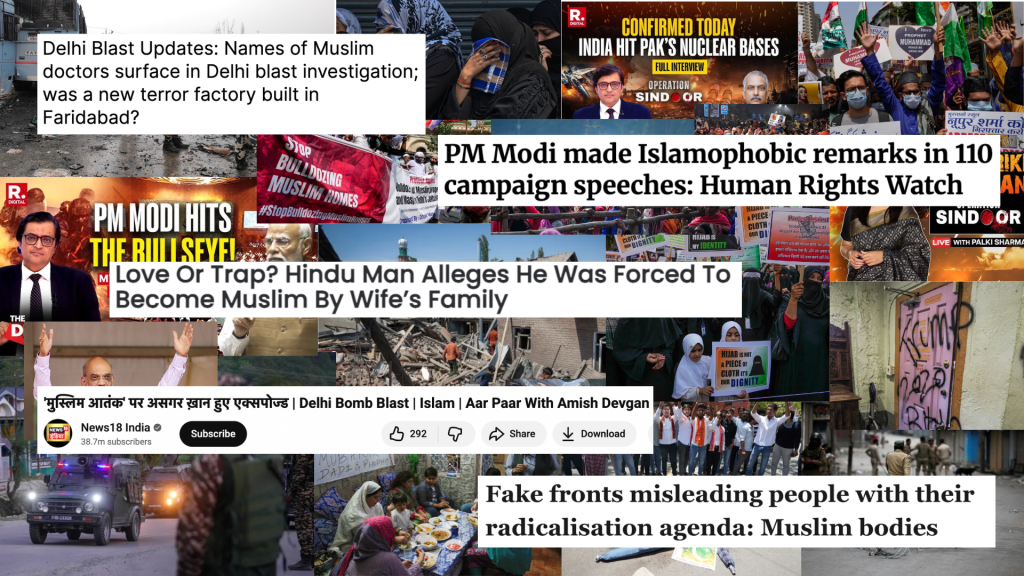
This time, the trigger was Pahalgam, Kashmir, 22 April 2025: an attack on tourists, Hindu tourists, whose religion made them victims of brutal violence. Videos and images of the attack began circulating on news channels and social media. Shock, horror, and grief spread fast.
But as it often happens, the grief was quickly displaced by something more familiar: suspicion, calls for retaliation, a psychic scramble for blame, activating an ecosystem of projection. “Enough is enough,” “How long do we tolerate this?” “They need to be taught a lesson” became common phrases in the language of the street and the state.
Grief rarely stays in sorrow’s register; it often turns into moral panic. National tragedies are processed through inherited scripts, which usually become about othering and making the “difference” suddenly hypervisible. Fear of the system gets displaced to the neighbor. When hatred covers up the fear, it is very addictive; it works to numb, instead of actually relieving.
In India, hatred is not a rupture; it is a predictable rhythm. The old binaries return before the new facts arrive: Hindu-Muslim, Good-Bad, Safe-Dangerous. The split thus precedes the mourning, and the blame is obvious. What ambiently circulates every day, then—a deep mistrust of the “ones who aren’t us”—finds its way into the headlines.
But this is not just about Muslims; it is about our national emotional life. The attack is devastating, but what follows is a psychic script: the state calls for action against the enemy, and the media amplifies this rage, in a cryptic voice that proclaims, “We all know who they are.” We, as citizens, join in this script with fears, silences, or enraged demands of vengeance. We are not allowed (or taught) to grieve: only the patriarchal response, to convert pain into nationalism, and mourning into a muscle to flex, through the hypermasculine, violent retaliation.
This script is also patriarchal. The nation teaches us how to “properly” mourn: not with trembling or uncertainty, but through hardness. Grief is allowed only to the vengeful (this is for the wives who have been widowed and for mothers who lost their sons!); pain must announce itself as resolve. To stay with pain alone is naive, anti-national.
Often, for minorities, in this case Muslims, the grief is doubled. We mourn with the nation, but also anticipate suspicion and awkward questions, the compulsion to prove that we agree on how horrific this is. A fear takes hold that our mourning will not be believed, that our presence will again be highlighted as a threat.
This emotional asymmetry invites another damage: the majority of us (based on class, caste, religion, and educational backgrounds) succumb to a numbness. We scroll past the constant updates and find the luxury of collapsing into fatigue. But the minorities must hold it all: the grief, the fear, the historical wounds, and the burden of calm articulation.
This fatigue—the deadness—is the point. By “psychic deadness,” I mean an inner shutdown—where feeling becomes dangerous, and numbness feels like the only way to survive. Imagine having to grieve every lynching, absorbing every slur, metabolizing every cruelty; it sounds unlivable. So the psyche splits. The nervous system compartmentalizes. We selectively grieve the dead. We sort the living by risk analysis of visible, suspicious, and forgettable.
The disquieting absence of feeling, then, is not because we, the people of India, don’t care, but because we have been taught not to feel (at least not towards everyone). It is not apathy—it is learning and conditioning. This national psychic anesthesia is a political strategy. It regulates which emotions matter, whose terror is valid, and whose pain is priced in. Numb psyches are obedient. A population that cannot feel is easier to govern, divide, and distract
Why Hatred Feels Like Relief
There is a grief that our psyches cannot hold. When this grief meets helplessness, the psyche splits. In psychoanalysis, “splitting” is a defense against ambivalence, mixed feelings, and contradictions. We tend to locate the “bad” in someone else so we can feel “clean,” and to the unbearable affect—and our own complicity—into binaries (good/bad, us/them, guilty/innocent).
It is easier to exile the pain onto someone else than to feel our own confusion and our own pain. It shows up in the smallest corners of our lives. A friend cancels a plan, and instead of feeling the sting of disappointment, the mind might shift to a definitive “they don’t care about me.” A mother’s sharp tone might make the child feel immediately unsafe with the person they love the most, because holding fear and love together is too much.
Splitting is the psyche’s shortcut for managing something unmanageable; a survival technique for bearing emotional intensity and complexity. Splitting is also a political technique. States and media orchestrate emotional governance by dehumanizing, scapegoating, and vilifying the “other,” sometimes in language, sometimes in policy building.
When systems and economies fail and collapse, when institutions are eroded, people are instructed by the state machinery to redirect their emotional overflow into blame—but not onto the state. Instead, we are taught to hate the scapegoat. The helplessness one might feel as a citizen is too large, and so it is displaced into rage against the other. Hatred gives us coherence.
The public call for Hindutva is thus not simply an ideology; it is a psychological offering that proposes that “we will make you feel whole.” This wholeness, consequently, demands the expulsion of all that is foreign, all that seems complex, all that seems Muslim. We have seen how the partition is portrayed. and how “love jihad” is whispered. In politics around beef, in the casual comments of “Go back to Pakistan.”
The figure of the Muslim has become a container for national anxiety.
This is the emotional architecture of communal violence. When “how could this happen” becomes unbearable, it is channeled into the most actionable policy: hatred. To hate someone, our minds require simplicity. To invite simplicity, we need splitting. Chants like “Goli maaro saalon ko” are not death wishes; they are psychic rituals. They offer the chanter a role, a direction for pain, an unbelievable sense of coherence.
This is not just “ordinary evil”—this is a normalized ordinary system of dissociation. But most people don’t become vigilantes. We become scrollers, numbed out, retreaters (perverse viewers, one might say). It gives way to create a system that rewards detachment and punishes nuance.
I am reminded of something Amit Shah said before the Delhi elections, “Press the [vote] button with such anger, that the current is felt in Shaheen Bagh.” This is not a call to vote, or even a call to vote for “a” party; it is a call to vote for “THE” party that can convert our helplessness into aggression. In that moment, Shaheen Bagh was made to carry what the State would not name: its failure to answer why people were protesting at all, and to meet their needs.
Instead of engaging with the fears and constitutional anxieties of the people, the State recast this protest as a site of disorder and a “national threat.” All the political disappointment and national uncertainty were displaced to Shaheen Bagh. A call for action and answers in a democracy was turned into an emotional dustbin for everything India did not want to feel about itself. Shaheen Bagh was not the source of a crisis, but was made to hold whatever felt unbearable.
Politically, the act of splitting becomes a spectacle. Instead of happening quietly in our minds, it is performed in rallies, TV debates, and Instagram reels so everyone knows where to place their anger. The spectacle is necessary to turn splitting into a collective ritual. It gives us all a script: locate your fear, rage, and hate towards “them.”
“They” are the problem, not the system. Sensational portrayal allows for a lack of complexity and nuance to choreograph hatred, not create it.
The enemy, then, is not just Muslims or Kashmiris or Dalits or women; the enemy is whoever relieves us of our powerlessness. Rage becomes easier than sorrow.
Prime Time Television as Emotional Training: When Outrage Replaces Understanding
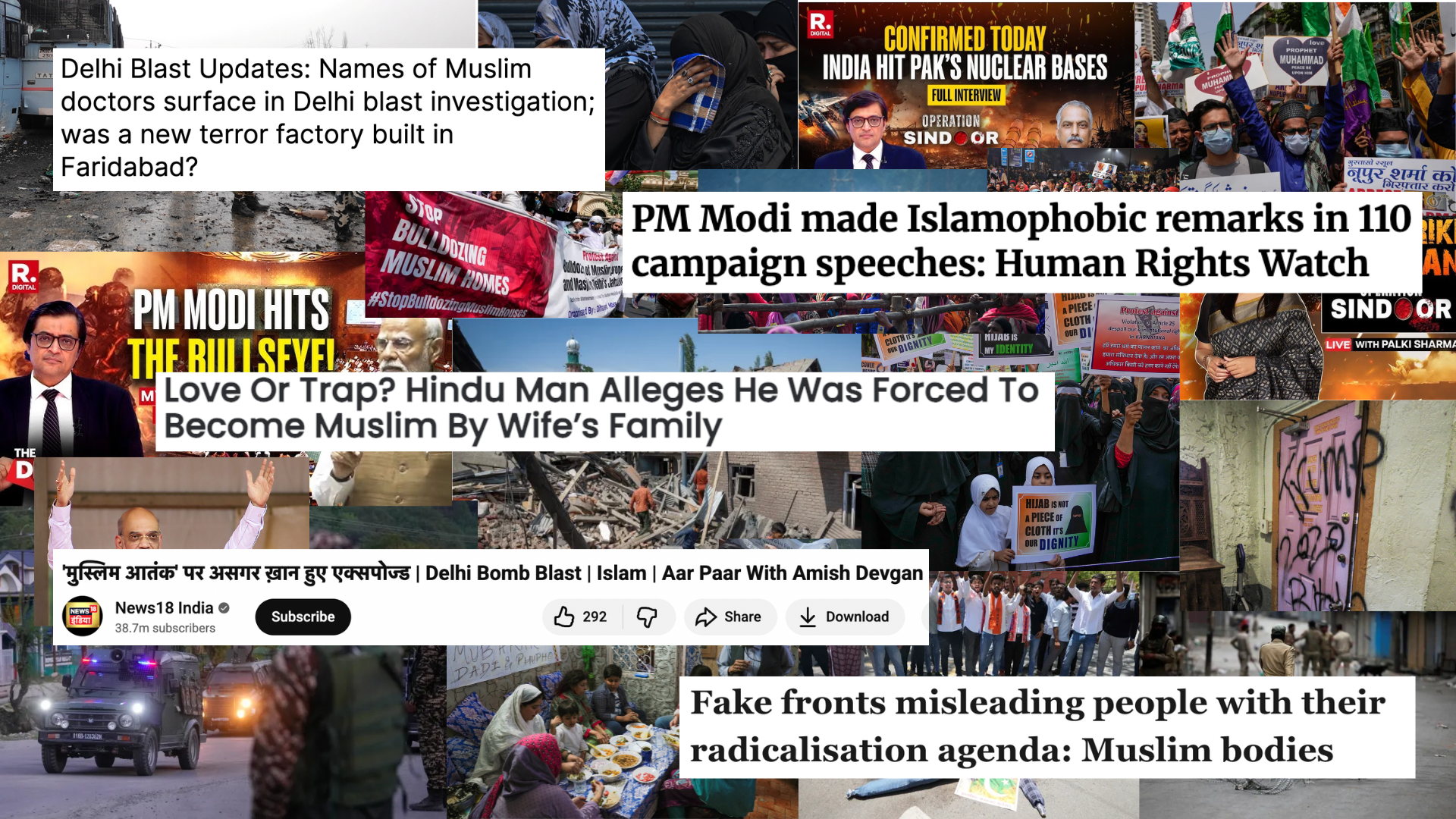
Violence does not start with bullets—it begins with words and erosion of humanity. In India, the media is not just an institution; it also sets the national mood. It regulates emotions much more than providing information. Night after night, prime time panels have turned Muslims into suspects and apologists and aggressors.
There is no third role. “Stone pelters,” “Anti-Nationals,” “Infiltrators” are not critical labels, they are affective instructions—not how to think, but how to feel. It not only instructs us to “find” these bad elements, but reminds us how to act.
The media is already neatly arranged along party lines, so we don’t consume news, we inherit affective language. A video uploaded by Republic TV on YouTube repeats the phrase “coward terrorist” or “cowards enter…” and the comments are filled with the public’s version of the word “coward.” The pre-packaged stance is predictable now. They don’t tell us what happened and analyze why it happened. They just tell us this happened, and this is how “real” Indians (should) feel about it.
We, as viewers (and citizens), are also now looking to the media for information and direction in uncertain times in the way that children turn to adults in such moments, looking for someone confident enough to name the dangers and lead the way. But when stories are told in binaries, the media normalizes splitting. We know the “good citizens,” “anti-nationals,” and the “enemy” before knowing what exactly is happening.
This is a practice in mood management. Repeated cycles that create coherence, affective uniformity with clear calls to action, each phrase streamlines the outrage and clearly tells us who the enemy is—“The Muslim”—and not what the enemy actually is: complexity.
“The Muslim” is not a person; someone you know. It is someone who procreates with dreams of Jihad; it is someone you need to manage, someone who is going to attack you, someone you need to watch, never trust, and most importantly, remove. This flattening teaches us cruelty as common sense. “They hate the country that feeds them.” Surveillance is veiled as safety, and discrimination is sold as a defense.
Violence doesn’t happen in a vacuum. It is rehearsed on news panels, in WhatsApp groups, in textbooks, and in our living rooms. The viral videos become our weapons. Lynchings are hidden or justified. Hate speech is not leaked but proudly circulated. This emotional conditioning removes aspects of horror and empathy; they demand affirmation.
So, one is not just watching a video but is expected to agree with the absolute sentiment around it. TV debates where everyone is shouting at each other (along with the host) is the performance of outrage. In such an environment, silence becomes noticeable: “How can you not say anything!” There is pressure to perform along with the masses, sans questioning.
That is psychic anesthesia. The body sees brutality and moves on. The mind hears a slur and shrugs. This engineered passivity is alive in how often we speak of “terrorist attacks” vs daily acts of violence against Muslims and Dalits. Language doesn’t just hurt the targets; it rewires the public. “Go to Pakistan” is about remapping intimacy and reminding us who belongs and who is worth loving. Language trains us to forget, fear, and flatten.
When fear becomes habitual, even boredom with violence becomes normal. This is the victory of this rhetoric; no outrage, only indifference.
The goal is not to get everyone to commit violence. The goal is to make violence seem inevitable, and this is where language makes the largest difference: not at the moment of the act, but in the years that lead up to it. In such a climate, the work of resistance is not purely political; it is emotional. To refuse simplifications, to interrupt these scripts, and to insist on seeing whatever the language tries to erase: personhood, grief, and ambiguity.
The Unequal Burden of Grief
Every society has a hierarchy in access to resources, and here the focus is on the “luxury” of feeling. One of the quiet cruelties of a majoritarian nation is that grief is publicly sanctioned for some, while others have to carry it in their silence. When we make a spectacle of tragedies, we are also pressured to perform our loyalties—all while mourning.
The majority and minority experiences of communal violence are radically asymmetrical. With a limited right to only feel selective emotions, Muslims live with the second blow too: The tightened tones in friendships and the unsaid suspicion that seeps in like humidity—an aftershock where all conversations acquire caution, and trust has to be earned.
The balance often looks sorrowful but not angry. Grateful, not political. Present, never provocative. It isn’t an emotional life; it is labor. In such moments, all grief becomes performative and a disguise. Every sorrow is softened to avoid appearing “anti-national.” This is not censorship, it is affective control.
In this psychic landscape, minorities begin to internalise the impossibility of being fully human. To survive, one must dissociate. We flatten ourselves, anticipating rejection. The grief is packed away, and the rage numbed. We become the version of citizens tolerable to the state: quiet and frightened.
This dissociation is not safe; it is an adaptation. When hate is normalized, we aren’t grieving the violence towards the “other” and slowly lose this ability for ourselves. When hatred covers up the fear, it is very addictive; it numbs the very thing it promises to relieve.
It is important to note that most Indians feel like second-class citizens, some blame Muslims, some blame reservations, and some blame the state: I point this out to also reflect on who feels safe then? In the therapy room, it sometimes looks like a Muslim patient feeling tense, and a Hindu patient feeling paranoid.
Physical dislocations to make up for emotional lacks by making the body do the work that psyches can’t hold. When feelings don’t have a safe language, they move into the body as vigilance, somatic complaints, or a persistent sense of bodily unease that replaces fear.
The uneven distribution of vulnerability is the trade-off of an emotional economy of the communal state.
Refusing the Script: Learning to Hold Grief, Uncertainty, and Complexity
“Bas ke dushvār hai har kaam ka āsān honā
Aadmī ko bhī mayassar nahīn insān honā.”
(It is difficult for every task to be easy —
Even to be human is no longer easily given.)
In a landscape where emotions are weaponized, what does it take to remain feeling: fully, unsanitized, uncaptured? To feel is not simply to resist with slogans or banners (necessarily), but to acknowledge the essential politics of inner lives. It is a quiet rebellion to choose sorrow over efficiency, ambiguity over binaries, and personal complexities over public performances.
To feel still begins with knowing. In the weeks after communal violence, many of us retreat into silence, convinced that words are useless. But reclaiming language means naming the terror in our bones, the tightness in our chests, and the tremors in our hands. Naming it means we recognize the feeling before automatically converting it to nationalist violence, silence, or suspicion.
In this context of attacks and violence, naming can be as simple as saying “I am scared,” or “I don’t know how to hold this grief,” or “This is very scary, but we need time to figure out what happened.”
Naming is a way of bringing disowned emotions—fear, sorrow—to the “self” instead of projecting them onto an outward “enemy.” It is about re-placing contradiction, complexity, and nuance at the heart of our lives, and avoiding their evacuation into others. It means to bear complicities: the moments we stayed silent, or when numbness or outrage felt safer than nuance. Complicity acknowledged is also complicity loosened.
Learning to hold contradictions is also about creating spaces of community that reject the impulse to collapse into a single feeling: anger or fear or apathy. In psychoanalytic terms, this is the work of integration: allowing the good and the bad to coexist in the single field of consciousness, to accept the risk of holding something that offers no neat closure. It is the only way to refuse the promise (and wish) of purity that communal ideologies offer.
To feel still demands witnessing and not simply consuming. In a digital age, violence is blurred into infinite loops of clips andeach replay dulls us a little more. To resist is not to avoid looking—but to look with intention. Concretely, it might mean limiting our exposure to perverse and graphic media and avoiding seeing it as “content,” something to scroll past or react to. When violence becomes “content,” we stop relating to the human event, and it transforms into entertainment/distraction/proof.
To resist this, we have to see the pain, feel it, and not use it, so we can let go of reactive rage for collective and deliberate action: solidarity > scapegoating and generation > destruction.
To feel still is to recognize our interdependence. My grief is bound up in my networks of family, friendships, and ancestry, my anger shadowed by their fears. This interdependence is risky and absolutely terrifying. What if my emotions hurt you? What happens to my sense of belonging, my place in this shared world, if we have differing opinions?
But this is where empathy can be birthed. When I notice your sorrow, I am invited into your inner world. This invitation is the foundation of finding political solidarity and redefining the growth and goals of a nation. It is this solidarity that denies your dehumanization in my mind.
Finally, to feel still is to also practice unfixability. To deny the need for clear narratives, a villain to punish, and victims to redeem. Real life is messy. In this practice, we see cracks in the system of engineered deadness. It allows us to form new pathways of belonging, to create a community ritual of repair instead of retribution.
This is not a note for passivity; it is a note for radicalization. It is to sustain our rage against the systems and not individuals; it is a refusal to numb our emotional lives and play games of purity and protection. It is to hold and create accountable systems and not scapegoats.
If Numbness Is the Goal, Feeling Is Refusal
Drawing on Amalendu Misra’s work on Identity and Religion, when religious identity becomes the foundational marker of national belonging, the ‘other’ is not merely tolerated or excluded—they are converted into a psychic threat, an impurity within. This impurity, once named, justifies every act that follows.
Yet, to refuse that logic is to stay emotionally alive in the face of it, is to insist on a different kind of belonging. The brutality of this time is not what is said, but what we have learned not to feel. This psychic deadness is not a side effect; it is sustained, structural, and definitely useful. A mind that is “dead”/numb is easier to steer. Emotional shutdowns are the best tools for political compliance.
Psychoanalysis reminds us that the capacity to feel is not private; it is political. The task is to reclaim the emotional inner worlds as a site of resistance. To recognize that softness is not naivety, and mourning is a learned skill. To hold complexity is a radical refusal of fascist oversimplifications.
In Psychoanalysis from the Indian Terroir (2018), the authors remind us that a postcolonial psychic life must wrestle with the debris of fractured continuity—the silences, the buried shame, the unfinished mourning. This is our work, in mourning what is lost and staying with the ache long enough to feel human again.
Because if deadness is the point, then our refusal to “die” is the beginning of repair, resistance, and our collective liberation.
Join us
Shaifila Ladhani is a psychotherapist and researcher working at the intersection of psychoanalysis, culture, and politics. Her work explores psychic deadness, affect, and how interior life is shaped by structural and state violence in contemporary India. She sees patients in her private practice in Delhi, India.
Related Posts


Psychic Anesthesia: How the State’s Scapegoating of Muslims Makes Hatred Feel Inevitable, Numbing National Grief
By Shaifila Ladhani
January 11, 2026
From terror attacks to TV debates, a familiar emotional script pushes grieving and mourning toward nationalism and communal violence.
This time, the trigger was Pahalgam, Kashmir, 22 April 2025: an attack on tourists, Hindu tourists, whose religion made them victims of brutal violence. Videos and images of the attack began circulating on news channels and social media. Shock, horror, and grief spread fast.
But as it often happens, the grief was quickly displaced by something more familiar: suspicion, calls for retaliation, a psychic scramble for blame, activating an ecosystem of projection. “Enough is enough,” “How long do we tolerate this?” “They need to be taught a lesson” became common phrases in the language of the street and the state.
Grief rarely stays in sorrow’s register; it often turns into moral panic. National tragedies are processed through inherited scripts, which usually become about othering and making the “difference” suddenly hypervisible. Fear of the system gets displaced to the neighbor. When hatred covers up the fear, it is very addictive; it works to numb, instead of actually relieving.
In India, hatred is not a rupture; it is a predictable rhythm. The old binaries return before the new facts arrive: Hindu-Muslim, Good-Bad, Safe-Dangerous. The split thus precedes the mourning, and the blame is obvious. What ambiently circulates every day, then—a deep mistrust of the “ones who aren’t us”—finds its way into the headlines.
But this is not just about Muslims; it is about our national emotional life. The attack is devastating, but what follows is a psychic script: the state calls for action against the enemy, and the media amplifies this rage, in a cryptic voice that proclaims, “We all know who they are.” We, as citizens, join in this script with fears, silences, or enraged demands of vengeance. We are not allowed (or taught) to grieve: only the patriarchal response, to convert pain into nationalism, and mourning into a muscle to flex, through the hypermasculine, violent retaliation.
This script is also patriarchal. The nation teaches us how to “properly” mourn: not with trembling or uncertainty, but through hardness. Grief is allowed only to the vengeful (this is for the wives who have been widowed and for mothers who lost their sons!); pain must announce itself as resolve. To stay with pain alone is naive, anti-national.
Often, for minorities, in this case Muslims, the grief is doubled. We mourn with the nation, but also anticipate suspicion and awkward questions, the compulsion to prove that we agree on how horrific this is. A fear takes hold that our mourning will not be believed, that our presence will again be highlighted as a threat.
This emotional asymmetry invites another damage: the majority of us (based on class, caste, religion, and educational backgrounds) succumb to a numbness. We scroll past the constant updates and find the luxury of collapsing into fatigue. But the minorities must hold it all: the grief, the fear, the historical wounds, and the burden of calm articulation.
This fatigue—the deadness—is the point. By “psychic deadness,” I mean an inner shutdown—where feeling becomes dangerous, and numbness feels like the only way to survive. Imagine having to grieve every lynching, absorbing every slur, metabolizing every cruelty; it sounds unlivable. So the psyche splits. The nervous system compartmentalizes. We selectively grieve the dead. We sort the living by risk analysis of visible, suspicious, and forgettable.
The disquieting absence of feeling, then, is not because we, the people of India, don’t care, but because we have been taught not to feel (at least not towards everyone). It is not apathy—it is learning and conditioning. This national psychic anesthesia is a political strategy. It regulates which emotions matter, whose terror is valid, and whose pain is priced in. Numb psyches are obedient. A population that cannot feel is easier to govern, divide, and distract
Why Hatred Feels Like Relief
There is a grief that our psyches cannot hold. When this grief meets helplessness, the psyche splits. In psychoanalysis, “splitting” is a defense against ambivalence, mixed feelings, and contradictions. We tend to locate the “bad” in someone else so we can feel “clean,” and to the unbearable affect—and our own complicity—into binaries (good/bad, us/them, guilty/innocent).
It is easier to exile the pain onto someone else than to feel our own confusion and our own pain. It shows up in the smallest corners of our lives. A friend cancels a plan, and instead of feeling the sting of disappointment, the mind might shift to a definitive “they don’t care about me.” A mother’s sharp tone might make the child feel immediately unsafe with the person they love the most, because holding fear and love together is too much.
Splitting is the psyche’s shortcut for managing something unmanageable; a survival technique for bearing emotional intensity and complexity. Splitting is also a political technique. States and media orchestrate emotional governance by dehumanizing, scapegoating, and vilifying the “other,” sometimes in language, sometimes in policy building.
When systems and economies fail and collapse, when institutions are eroded, people are instructed by the state machinery to redirect their emotional overflow into blame—but not onto the state. Instead, we are taught to hate the scapegoat. The helplessness one might feel as a citizen is too large, and so it is displaced into rage against the other. Hatred gives us coherence.
The public call for Hindutva is thus not simply an ideology; it is a psychological offering that proposes that “we will make you feel whole.” This wholeness, consequently, demands the expulsion of all that is foreign, all that seems complex, all that seems Muslim. We have seen how the partition is portrayed. and how “love jihad” is whispered. In politics around beef, in the casual comments of “Go back to Pakistan.”
The figure of the Muslim has become a container for national anxiety.
This is the emotional architecture of communal violence. When “how could this happen” becomes unbearable, it is channeled into the most actionable policy: hatred. To hate someone, our minds require simplicity. To invite simplicity, we need splitting. Chants like “Goli maaro saalon ko” are not death wishes; they are psychic rituals. They offer the chanter a role, a direction for pain, an unbelievable sense of coherence.
This is not just “ordinary evil”—this is a normalized ordinary system of dissociation. But most people don’t become vigilantes. We become scrollers, numbed out, retreaters (perverse viewers, one might say). It gives way to create a system that rewards detachment and punishes nuance.
I am reminded of something Amit Shah said before the Delhi elections, “Press the [vote] button with such anger, that the current is felt in Shaheen Bagh.” This is not a call to vote, or even a call to vote for “a” party; it is a call to vote for “THE” party that can convert our helplessness into aggression. In that moment, Shaheen Bagh was made to carry what the State would not name: its failure to answer why people were protesting at all, and to meet their needs.
Instead of engaging with the fears and constitutional anxieties of the people, the State recast this protest as a site of disorder and a “national threat.” All the political disappointment and national uncertainty were displaced to Shaheen Bagh. A call for action and answers in a democracy was turned into an emotional dustbin for everything India did not want to feel about itself. Shaheen Bagh was not the source of a crisis, but was made to hold whatever felt unbearable.
Politically, the act of splitting becomes a spectacle. Instead of happening quietly in our minds, it is performed in rallies, TV debates, and Instagram reels so everyone knows where to place their anger. The spectacle is necessary to turn splitting into a collective ritual. It gives us all a script: locate your fear, rage, and hate towards “them.”
“They” are the problem, not the system. Sensational portrayal allows for a lack of complexity and nuance to choreograph hatred, not create it.
The enemy, then, is not just Muslims or Kashmiris or Dalits or women; the enemy is whoever relieves us of our powerlessness. Rage becomes easier than sorrow.
Prime Time Television as Emotional Training: When Outrage Replaces Understanding
Violence does not start with bullets—it begins with words and erosion of humanity. In India, the media is not just an institution; it also sets the national mood. It regulates emotions much more than providing information. Night after night, prime time panels have turned Muslims into suspects and apologists and aggressors.
There is no third role. “Stone pelters,” “Anti-Nationals,” “Infiltrators” are not critical labels, they are affective instructions—not how to think, but how to feel. It not only instructs us to “find” these bad elements, but reminds us how to act.
The media is already neatly arranged along party lines, so we don’t consume news, we inherit affective language. A video uploaded by Republic TV on YouTube repeats the phrase “coward terrorist” or “cowards enter…” and the comments are filled with the public’s version of the word “coward.” The pre-packaged stance is predictable now. They don’t tell us what happened and analyze why it happened. They just tell us this happened, and this is how “real” Indians (should) feel about it.
We, as viewers (and citizens), are also now looking to the media for information and direction in uncertain times in the way that children turn to adults in such moments, looking for someone confident enough to name the dangers and lead the way. But when stories are told in binaries, the media normalizes splitting. We know the “good citizens,” “anti-nationals,” and the “enemy” before knowing what exactly is happening.
This is a practice in mood management. Repeated cycles that create coherence, affective uniformity with clear calls to action, each phrase streamlines the outrage and clearly tells us who the enemy is—“The Muslim”—and not what the enemy actually is: complexity.
“The Muslim” is not a person; someone you know. It is someone who procreates with dreams of Jihad; it is someone you need to manage, someone who is going to attack you, someone you need to watch, never trust, and most importantly, remove. This flattening teaches us cruelty as common sense. “They hate the country that feeds them.” Surveillance is veiled as safety, and discrimination is sold as a defense.
Violence doesn’t happen in a vacuum. It is rehearsed on news panels, in WhatsApp groups, in textbooks, and in our living rooms. The viral videos become our weapons. Lynchings are hidden or justified. Hate speech is not leaked but proudly circulated. This emotional conditioning removes aspects of horror and empathy; they demand affirmation.
So, one is not just watching a video but is expected to agree with the absolute sentiment around it. TV debates where everyone is shouting at each other (along with the host) is the performance of outrage. In such an environment, silence becomes noticeable: “How can you not say anything!” There is pressure to perform along with the masses, sans questioning.
That is psychic anesthesia. The body sees brutality and moves on. The mind hears a slur and shrugs. This engineered passivity is alive in how often we speak of “terrorist attacks” vs daily acts of violence against Muslims and Dalits. Language doesn’t just hurt the targets; it rewires the public. “Go to Pakistan” is about remapping intimacy and reminding us who belongs and who is worth loving. Language trains us to forget, fear, and flatten.
When fear becomes habitual, even boredom with violence becomes normal. This is the victory of this rhetoric; no outrage, only indifference.
The goal is not to get everyone to commit violence. The goal is to make violence seem inevitable, and this is where language makes the largest difference: not at the moment of the act, but in the years that lead up to it. In such a climate, the work of resistance is not purely political; it is emotional. To refuse simplifications, to interrupt these scripts, and to insist on seeing whatever the language tries to erase: personhood, grief, and ambiguity.
The Unequal Burden of Grief
Every society has a hierarchy in access to resources, and here the focus is on the “luxury” of feeling. One of the quiet cruelties of a majoritarian nation is that grief is publicly sanctioned for some, while others have to carry it in their silence. When we make a spectacle of tragedies, we are also pressured to perform our loyalties—all while mourning.
The majority and minority experiences of communal violence are radically asymmetrical. With a limited right to only feel selective emotions, Muslims live with the second blow too: The tightened tones in friendships and the unsaid suspicion that seeps in like humidity—an aftershock where all conversations acquire caution, and trust has to be earned.
The balance often looks sorrowful but not angry. Grateful, not political. Present, never provocative. It isn’t an emotional life; it is labor. In such moments, all grief becomes performative and a disguise. Every sorrow is softened to avoid appearing “anti-national.” This is not censorship, it is affective control.
In this psychic landscape, minorities begin to internalise the impossibility of being fully human. To survive, one must dissociate. We flatten ourselves, anticipating rejection. The grief is packed away, and the rage numbed. We become the version of citizens tolerable to the state: quiet and frightened.
This dissociation is not safe; it is an adaptation. When hate is normalized, we aren’t grieving the violence towards the “other” and slowly lose this ability for ourselves. When hatred covers up the fear, it is very addictive; it numbs the very thing it promises to relieve.
It is important to note that most Indians feel like second-class citizens, some blame Muslims, some blame reservations, and some blame the state: I point this out to also reflect on who feels safe then? In the therapy room, it sometimes looks like a Muslim patient feeling tense, and a Hindu patient feeling paranoid.
Physical dislocations to make up for emotional lacks by making the body do the work that psyches can’t hold. When feelings don’t have a safe language, they move into the body as vigilance, somatic complaints, or a persistent sense of bodily unease that replaces fear.
The uneven distribution of vulnerability is the trade-off of an emotional economy of the communal state.
Refusing the Script: Learning to Hold Grief, Uncertainty, and Complexity
“Bas ke dushvār hai har kaam ka āsān honā
Aadmī ko bhī mayassar nahīn insān honā.”
(It is difficult for every task to be easy —
Even to be human is no longer easily given.)
In a landscape where emotions are weaponized, what does it take to remain feeling: fully, unsanitized, uncaptured? To feel is not simply to resist with slogans or banners (necessarily), but to acknowledge the essential politics of inner lives. It is a quiet rebellion to choose sorrow over efficiency, ambiguity over binaries, and personal complexities over public performances.
To feel still begins with knowing. In the weeks after communal violence, many of us retreat into silence, convinced that words are useless. But reclaiming language means naming the terror in our bones, the tightness in our chests, and the tremors in our hands. Naming it means we recognize the feeling before automatically converting it to nationalist violence, silence, or suspicion.
In this context of attacks and violence, naming can be as simple as saying “I am scared,” or “I don’t know how to hold this grief,” or “This is very scary, but we need time to figure out what happened.”
Naming is a way of bringing disowned emotions—fear, sorrow—to the “self” instead of projecting them onto an outward “enemy.” It is about re-placing contradiction, complexity, and nuance at the heart of our lives, and avoiding their evacuation into others. It means to bear complicities: the moments we stayed silent, or when numbness or outrage felt safer than nuance. Complicity acknowledged is also complicity loosened.
Learning to hold contradictions is also about creating spaces of community that reject the impulse to collapse into a single feeling: anger or fear or apathy. In psychoanalytic terms, this is the work of integration: allowing the good and the bad to coexist in the single field of consciousness, to accept the risk of holding something that offers no neat closure. It is the only way to refuse the promise (and wish) of purity that communal ideologies offer.
To feel still demands witnessing and not simply consuming. In a digital age, violence is blurred into infinite loops of clips andeach replay dulls us a little more. To resist is not to avoid looking—but to look with intention. Concretely, it might mean limiting our exposure to perverse and graphic media and avoiding seeing it as “content,” something to scroll past or react to. When violence becomes “content,” we stop relating to the human event, and it transforms into entertainment/distraction/proof.
To resist this, we have to see the pain, feel it, and not use it, so we can let go of reactive rage for collective and deliberate action: solidarity > scapegoating and generation > destruction.
To feel still is to recognize our interdependence. My grief is bound up in my networks of family, friendships, and ancestry, my anger shadowed by their fears. This interdependence is risky and absolutely terrifying. What if my emotions hurt you? What happens to my sense of belonging, my place in this shared world, if we have differing opinions?
But this is where empathy can be birthed. When I notice your sorrow, I am invited into your inner world. This invitation is the foundation of finding political solidarity and redefining the growth and goals of a nation. It is this solidarity that denies your dehumanization in my mind.
Finally, to feel still is to also practice unfixability. To deny the need for clear narratives, a villain to punish, and victims to redeem. Real life is messy. In this practice, we see cracks in the system of engineered deadness. It allows us to form new pathways of belonging, to create a community ritual of repair instead of retribution.
This is not a note for passivity; it is a note for radicalization. It is to sustain our rage against the systems and not individuals; it is a refusal to numb our emotional lives and play games of purity and protection. It is to hold and create accountable systems and not scapegoats.
If Numbness Is the Goal, Feeling Is Refusal
Drawing on Amalendu Misra’s work on Identity and Religion, when religious identity becomes the foundational marker of national belonging, the ‘other’ is not merely tolerated or excluded—they are converted into a psychic threat, an impurity within. This impurity, once named, justifies every act that follows.
Yet, to refuse that logic is to stay emotionally alive in the face of it, is to insist on a different kind of belonging. The brutality of this time is not what is said, but what we have learned not to feel. This psychic deadness is not a side effect; it is sustained, structural, and definitely useful. A mind that is “dead”/numb is easier to steer. Emotional shutdowns are the best tools for political compliance.
Psychoanalysis reminds us that the capacity to feel is not private; it is political. The task is to reclaim the emotional inner worlds as a site of resistance. To recognize that softness is not naivety, and mourning is a learned skill. To hold complexity is a radical refusal of fascist oversimplifications.
In Psychoanalysis from the Indian Terroir (2018), the authors remind us that a postcolonial psychic life must wrestle with the debris of fractured continuity—the silences, the buried shame, the unfinished mourning. This is our work, in mourning what is lost and staying with the ache long enough to feel human again.
Because if deadness is the point, then our refusal to “die” is the beginning of repair, resistance, and our collective liberation.
SUPPORT US
We like bringing the stories that don’t get told to you. For that, we need your support. However small, we would appreciate it.
Shaifila Ladhani is a psychotherapist and researcher working at the intersection of psychoanalysis, culture, and politics. Her work explores psychic deadness, affect, and how interior life is shaped by structural and state violence in contemporary India. She sees patients in her private practice in Delhi, India.
Related Posts