



The inaugural stop on a weekend escapade to Jaipur is often the new Rastafarian-themed rooftop cafés mushrooming within the pink-brick walls of its Old City, right in the heart of Tripolia Bazaar. One of the city’s oldest markets, it still has lanes that belong to legacy street food vendors offering kachoris, pakoras, and lassi. Perched above them, this breed of “Instagrammable” cafés and coffee shops has taken root, promising brunch menus and a brief reprieve from the bazaar below.
Serving a primarily tourist clientele, the menus promise an eclectic fusion of Mediterranean, British, and Middle Eastern cuisine—yet, notably absent is any sign of meat.
Asked if they had non-vegetarian food, one of the cafés’ managers shrugged. “Being Brahmins, we don’t feature non-vegetarian dishes in our menu,” he said rather brazenly. “You won’t be able to find many non-veg. outlets this side of the city. You should go to the ‘Muslim-concentrated’ areas like Ramganj.”
Walls Within the Walled City
Wandering through the bylanes of the Pink City can be like flipping through the pages of a history book: Maniharon ka Rasta, where Muslim artisans crafted colorful lac bangles by hand; Thateron ka Rasta, home to metalworkers who hammered brass and copper into utensils; Panni Gharon ka Rasta, where silversmiths beat silver into whisper-thin foils used to adorn sweets.
Each lane bears the name and legacy of its craft. Each lane also bears the name and legacy of its caste.
All of this unfolds within a blueprint first drawn in 1727 by Vidyadhar Bhattacharya at Maharaja Sawai Jai Singh II’s behest. The Char Diwari (Jaipur’s walled core) is laid out like a giant chaupar (an ancient Indian board game): four broad avenues and their branching lanes radiate from central squares, flanked by the Aravalli ridges on one side and guarded by gates such as Kishan Pol (Southern city gate) and Chand Pol (Moon Gate) on the other.
To populate the city with a thriving mercantile class, Jai Singh II specifically invited Baniya merchants and Jain trading houses from across India, including Delhi, Agra, and Multan. Through free land grants and tax concessions, he gave Baniya traders structural dominance, establishing distinct markets: Johari Bazar for jewellers and gem merchants, Tripolia Bazar for ironware and utensils, Kishanpole Bazar for textiles and tie-and-dye bandhani work.
Inside these walls today, Baniyas and Jains make up a significant share of the population, alongside smaller Muslim, Sikh, Sindhi, and Rajput communities. The dietary codes of these dominant trading communities—strictly vegetarian, governed by ritual purity—effectively became the commercial and social norm of the Walled City’s public life.
Tamegh Tanwar, a Dalit professor of history and conservation at the University of Rajasthan who has spent over two decades studying the city, explained that the Old City’s vegetarian character did not emerge organically; it was engineered. He presented the dichotomy of Muslim vendors and those from non-Brahminical castes selling meat openly at its fringes, while an entirely different code operates within.
“Even today, meat consumption for Brahminical castes like Rajputs, Brahmins, Jains, Oswals, and Agarwals remains a private affair,” he said. “It’s cooked in the confines of their homes, sometimes not even on the family stove, and mostly reserved for specific occasions. The meat-eating act has always been veiled, even if the appetite isn’t.”
Tale of Two Jaipurs: the Old and the Expanding
Every Saturday, the back courtyard of the house next door to Saurabh Prakash’s came alive. His neighbor, a Rajput police officer, would begin the weekly ritual that marked their evenings in the entire colony. Someone would be chopping onions, someone else peeling garlic, another cleaning dried chilis, while whole spices were being laid out for the marinade. After three hours of cooking it over a slow flame, his signature home-style Lal Maas (red mutton curry) was ready. Children from across the colony would drift toward the smell.
Prakash, an ex-government servant and long-time native of Jaipur, was among those children, although he knew, even as a child, that not everyone was. He grew up as a Kayastha (a meat-eating community).
The shared meal has long been one of the sharpest instruments of caste boundary-making in the subcontinent. As Ambedkar argued, the refusal to dine across caste lines has been central to sustaining the social order.
Jaipur’s schools were no exception to this rule. “In school, my Aggarwal and Jain classmates would round me up, asking, ‘Arre, tum non-veg khaatey ho?’ (“Hey, do you eat non-vegetarian food?”),” he recalled. “And if you did, they wouldn’t share their tiffin with you.” The back courtyard and the classroom operated on the same logic: one used food as an invitation, the other as a door firmly shut.
These distinctions were absorbed early. The children who learned to police food boundaries grew into adults who sustained them. As Prakash noted, some elders would not even drink water in a Rajput household, lest meat be cooked under that roof and their own purity compromised.
Then the ‘90s arrived, and with them, a different India. The liberalization of the Indian economy in 1991 opened local markets, rewiring appetites in the process. Until then, eating out had been largely restricted to a small cosmopolitan elite and the working classes, with government-supported eateries such as Indian Coffee House offering one of the few accessible public dining spaces. Now, when Indians began dining out, caste practices ensured they frequented only establishments that matched their dietary preferences.
International chains, cable television, and rising disposable incomes began to erode that insularity, at least on the surface. Cafe Coffee Day and Barista gave urban youth a new kind of social space; McDonald’s and Pizza Hut introduced a generation to food that arrived without caste markings.
In Pink City, the generational rupture came more quietly. Young people began sneaking out for chicken, eating away from the household gaze. Prakash recalled watching Brahmin men remove their Janeu (sacred thread worn by Hindu Brahmins) before a meal and replace it carefully afterward, a ritual of concealment that, as earlier media reports state, was far from unique to Jaipur. They could break caste food taboos in public, away from home, and revert once back within its walls.
As younger generations grew independent and moved into newer residential areas like Vaishali Nagar, Malviya Nagar, and Raja Park, non-vegetarian restaurants followed them outward. What counted as permissible was expanding, though not inside the Walled City.
City Beyond the Gates
At the edge of the towering façade of Ajmeri Gate sits Hotel Tandoori Dhaba, a fixture managed by Neeraj Khatri, a third-generation restaurateur who has watched the city’s meat geography shift across decades. His grandfather started the establishment as a tea kiosk in 1968, when meat-serving restaurants were so scarce that people traveled miles for mutton.
Opening a non-vegetarian outlet inside the Walled City remains difficult even today, Khatri noted. “Not because of any law, but because of the social consensus of the Marwari and Baniya communities who dominate its commercial spaces. The Pavitra Bhojnalayas (pure vegetarian community eateries) that still line the Old City’s lanes make a statement that the food served inside is nothing but ‘pure’ in nature.”

But the absence of meat from the Walled City’s public life has never meant its absence from private life. Tanwar described a Rajputi tradition that has persisted quietly across generations: a goat is slaughtered at home, its organs consumed first because they spoil fastest, and the rest is slow-cooked in ghee and preserved enough to last two to three months in winter.
It is worth sitting with those who are doing the veiling and why. Tanwar, who is a Scheduled Caste (SC), expressed how there is remarkably little documented account of what Dalit and marginalized caste communities in Rajasthan actually eat. Their food cultures have largely been rendered invisible in the same stroke that rendered their social lives marginal.
In fact, these hierarchies were historically enforced through violence. In 1936, in the village of Chakwara in what was then Jaipur State, a Dalit host was beaten by an armed mob for serving ghee at a feast. The offense, as Dr. B.R. Ambedkar documented in Annihilation of Caste, was that he had presumed to eat food that signaled social dignity.
In Why I Am Not a Hindu, Dalit scholar Kancha Ilaiah Shepherd recalled how, as a child, his friendships with boys from other castes would rupture precisely at mealtimes—sitting slightly apart, not touching each other’s food, reverting to caste insults before returning to play as if nothing had happened. The rules, he wrote, were never taught explicitly, but they structured who could eat with whom and under what conditions. The foods historically available to Dalit communities—such as pork, beef, offal, and wild greens—are precisely the foods Brahminical culture branded impure.
Just beyond the gate, on Mirza Ismail (MI) Road, Handi restaurant has drawn loyal diners for over four decades. Kunal Kucchal, whose parents started with two tables and four chairs, remembers its early years as difficult. “It wasn’t a government ruling,” he said, “just a mutual understanding.” 46 years on, MI Road has transformed—multi-cuisine outlets, jewelry stores, every imaginable street snack—but the mutual understanding hasn’t entirely dissolved. Upper-caste Rajput families still tend to avoid Muslim-run eateries like MM Khan or Islami Kullu Hotel in Ramganj, gravitating instead toward places like Handi or Spice Court.
Rajasthan consistently ranks among the most vegetarian states in India, as nearly 75% of its people report never eating meat, chicken, or fish, according to a 2019 National Family Health Survey. But that figure should be treated with caution.
Researchers Balmurli Natrajan and Suraj Jacob have shown that data on vegetarianism in India largely reflects who feels safe reporting what they actually eat. Many marginalized castes and Dalit respondents systematically underreport meat consumption due to social stigma. The data reflects not only consumption patterns but the social conditions under which they are disclosed.
Who Gets to Define ‘Heritage’
Today, Jaipur’s heritage hotels, many converted from ancestral Rajput palaces, have made Laal Maas and Safed Maas (mutton in white cashew nut gravy) central to their tourist offerings, presenting slow-cooked mutton as the authentic taste of Rajasthan. What goes unremarked in this presentation is where these dishes actually come from.
Rajasthani cuisine was largely shaped by the warlike lifestyles of its inhabitants and the availability of ingredients in an arid region, and mutton was, specifically, Rajput food. Laal Maas was traditionally prepared by Rajput royalty during hunts as camp food cooked over open fires with minimal ingredients, such as Mathania chillies to mask the gamey odor of wild boar and venison. It spread to wedding feasts across the region over subsequent centuries before making its way into restaurant menus.
In practice, mutton has been losing ground. As anthropologist James Staples documents in Sacred Cows and Chicken Manchurian, with the growing production of affordable broiler chickens and the emergence of Indo-Chinese fan favourites like Chicken Manchurian (or Chilli Chicken as it is colloquially known) and Chicken 65, urban youth are redefining meat consumption patterns across India. In Jaipur’s newer restaurants and delivery apps, chicken has quietly overtaken traditional mutton gravies—cheaper, more accessible, and carrying none of the caste or ritual associations of goat meat.
The humble Dal Baati with nomadic roots has undergone a parallel flattening. Vinayak Agrawal, who has run the Jaipur Food Walks for the last eight years, said, “Originally, baati was a staple for common folk during wars, easily carried throughout the day and enjoyed with dal, ghee, garlic chutney, or even buttermilk. But nowadays, restaurants market it as a must-try touristy thaali, with the additions of Gatte ki Sabzi, Kadhi, and Churma.”
For Jaipur-based food researcher and founder of The Kindness Meal, Dipali Khandelwal, the city’s real culinary heritage lies not in its restaurants but in its home kitchens. “When people ask me where to find the real Jaipur food, I always tell them, ‘Come home,’” she said. She speaks warmly of Jeeman (seasonal communal feasts marking festivals and passages of time) and of Got picnics, where Bania and Jain households cook Dal Baati outdoors, maintaining traditions that have traveled across generations.
She is not wrong. But the communal feasts she describes belong to specific households and specific castes. The Jeeman is a Bania and Jain tradition. The heritage hotels serve a Rajput menu. What is celebrated as Jaipur’s culinary identity is, on closer examination, the food culture of its historically dominant communities; these are incidentally the same ones whose dietary codes have dictated the Walled City’s public life for three centuries.
Jaipur’s culinary heritage is real and worth celebrating, but has also been selectively constructed. What is left out, especially the food cultures of Dalit and other caste-marginalized communities, reveals as much about the city as what appears on the menu.


The Invisible Caste Lines of Jaipur’s Food Scene
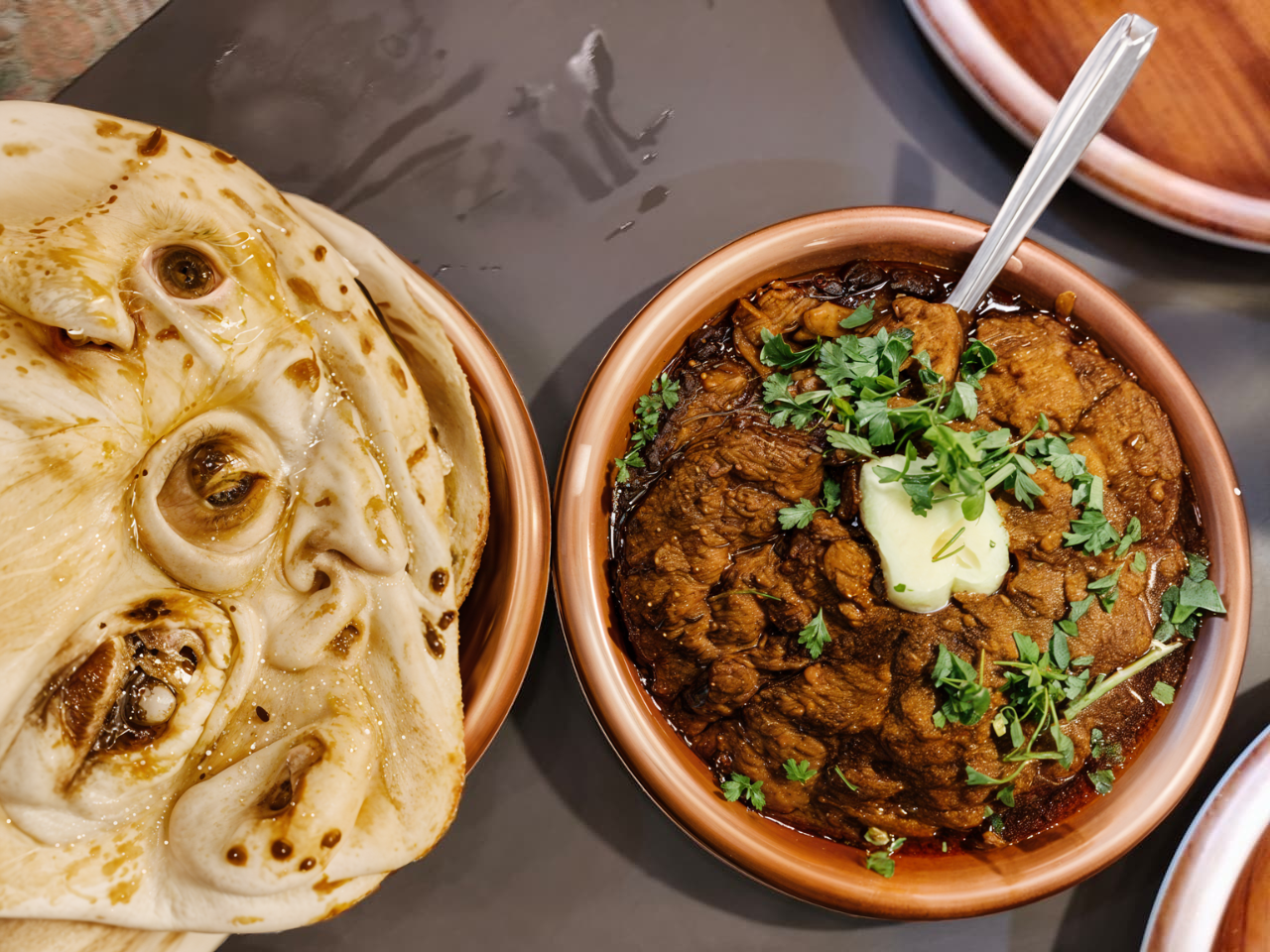
Lal Maas served at Dev Hotel. Photo courtesy of the author.
The inaugural stop on a weekend escapade to Jaipur is often the new Rastafarian-themed rooftop cafés mushrooming within the pink-brick walls of its Old City, right in the heart of Tripolia Bazaar. One of the city’s oldest markets, it still has lanes that belong to legacy street food vendors offering kachoris, pakoras, and lassi. Perched above them, this breed of “Instagrammable” cafés and coffee shops has taken root, promising brunch menus and a brief reprieve from the bazaar below.
Serving a primarily tourist clientele, the menus promise an eclectic fusion of Mediterranean, British, and Middle Eastern cuisine—yet, notably absent is any sign of meat.
Asked if they had non-vegetarian food, one of the cafés’ managers shrugged. “Being Brahmins, we don’t feature non-vegetarian dishes in our menu,” he said rather brazenly. “You won’t be able to find many non-veg. outlets this side of the city. You should go to the ‘Muslim-concentrated’ areas like Ramganj.”
Walls Within the Walled City
Wandering through the bylanes of the Pink City can be like flipping through the pages of a history book: Maniharon ka Rasta, where Muslim artisans crafted colorful lac bangles by hand; Thateron ka Rasta, home to metalworkers who hammered brass and copper into utensils; Panni Gharon ka Rasta, where silversmiths beat silver into whisper-thin foils used to adorn sweets.
Each lane bears the name and legacy of its craft. Each lane also bears the name and legacy of its caste.
All of this unfolds within a blueprint first drawn in 1727 by Vidyadhar Bhattacharya at Maharaja Sawai Jai Singh II’s behest. The Char Diwari (Jaipur’s walled core) is laid out like a giant chaupar (an ancient Indian board game): four broad avenues and their branching lanes radiate from central squares, flanked by the Aravalli ridges on one side and guarded by gates such as Kishan Pol (Southern city gate) and Chand Pol (Moon Gate) on the other.
To populate the city with a thriving mercantile class, Jai Singh II specifically invited Baniya merchants and Jain trading houses from across India, including Delhi, Agra, and Multan. Through free land grants and tax concessions, he gave Baniya traders structural dominance, establishing distinct markets: Johari Bazar for jewellers and gem merchants, Tripolia Bazar for ironware and utensils, Kishanpole Bazar for textiles and tie-and-dye bandhani work.
Inside these walls today, Baniyas and Jains make up a significant share of the population, alongside smaller Muslim, Sikh, Sindhi, and Rajput communities. The dietary codes of these dominant trading communities—strictly vegetarian, governed by ritual purity—effectively became the commercial and social norm of the Walled City’s public life.
Tamegh Tanwar, a Dalit professor of history and conservation at the University of Rajasthan who has spent over two decades studying the city, explained that the Old City’s vegetarian character did not emerge organically; it was engineered. He presented the dichotomy of Muslim vendors and those from non-Brahminical castes selling meat openly at its fringes, while an entirely different code operates within.
“Even today, meat consumption for Brahminical castes like Rajputs, Brahmins, Jains, Oswals, and Agarwals remains a private affair,” he said. “It’s cooked in the confines of their homes, sometimes not even on the family stove, and mostly reserved for specific occasions. The meat-eating act has always been veiled, even if the appetite isn’t.”
Tale of Two Jaipurs: the Old and the Expanding
Every Saturday, the back courtyard of the house next door to Saurabh Prakash’s came alive. His neighbor, a Rajput police officer, would begin the weekly ritual that marked their evenings in the entire colony. Someone would be chopping onions, someone else peeling garlic, another cleaning dried chilis, while whole spices were being laid out for the marinade. After three hours of cooking it over a slow flame, his signature home-style Lal Maas (red mutton curry) was ready. Children from across the colony would drift toward the smell.
Prakash, an ex-government servant and long-time native of Jaipur, was among those children, although he knew, even as a child, that not everyone was. He grew up as a Kayastha (a meat-eating community).
The shared meal has long been one of the sharpest instruments of caste boundary-making in the subcontinent. As Ambedkar argued, the refusal to dine across caste lines has been central to sustaining the social order.
Jaipur’s schools were no exception to this rule. “In school, my Aggarwal and Jain classmates would round me up, asking, ‘Arre, tum non-veg khaatey ho?’ (“Hey, do you eat non-vegetarian food?”),” he recalled. “And if you did, they wouldn’t share their tiffin with you.” The back courtyard and the classroom operated on the same logic: one used food as an invitation, the other as a door firmly shut.
These distinctions were absorbed early. The children who learned to police food boundaries grew into adults who sustained them. As Prakash noted, some elders would not even drink water in a Rajput household, lest meat be cooked under that roof and their own purity compromised.
Then the ‘90s arrived, and with them, a different India. The liberalization of the Indian economy in 1991 opened local markets, rewiring appetites in the process. Until then, eating out had been largely restricted to a small cosmopolitan elite and the working classes, with government-supported eateries such as Indian Coffee House offering one of the few accessible public dining spaces. Now, when Indians began dining out, caste practices ensured they frequented only establishments that matched their dietary preferences.
International chains, cable television, and rising disposable incomes began to erode that insularity, at least on the surface. Cafe Coffee Day and Barista gave urban youth a new kind of social space; McDonald’s and Pizza Hut introduced a generation to food that arrived without caste markings.
In Pink City, the generational rupture came more quietly. Young people began sneaking out for chicken, eating away from the household gaze. Prakash recalled watching Brahmin men remove their Janeu (sacred thread worn by Hindu Brahmins) before a meal and replace it carefully afterward, a ritual of concealment that, as earlier media reports state, was far from unique to Jaipur. They could break caste food taboos in public, away from home, and revert once back within its walls.
As younger generations grew independent and moved into newer residential areas like Vaishali Nagar, Malviya Nagar, and Raja Park, non-vegetarian restaurants followed them outward. What counted as permissible was expanding, though not inside the Walled City.
City Beyond the Gates
At the edge of the towering façade of Ajmeri Gate sits Hotel Tandoori Dhaba, a fixture managed by Neeraj Khatri, a third-generation restaurateur who has watched the city’s meat geography shift across decades. His grandfather started the establishment as a tea kiosk in 1968, when meat-serving restaurants were so scarce that people traveled miles for mutton.
Opening a non-vegetarian outlet inside the Walled City remains difficult even today, Khatri noted. “Not because of any law, but because of the social consensus of the Marwari and Baniya communities who dominate its commercial spaces. The Pavitra Bhojnalayas (pure vegetarian community eateries) that still line the Old City’s lanes make a statement that the food served inside is nothing but ‘pure’ in nature.”
But the absence of meat from the Walled City’s public life has never meant its absence from private life. Tanwar described a Rajputi tradition that has persisted quietly across generations: a goat is slaughtered at home, its organs consumed first because they spoil fastest, and the rest is slow-cooked in ghee and preserved enough to last two to three months in winter.
It is worth sitting with those who are doing the veiling and why. Tanwar, who is a Scheduled Caste (SC), expressed how there is remarkably little documented account of what Dalit and marginalized caste communities in Rajasthan actually eat. Their food cultures have largely been rendered invisible in the same stroke that rendered their social lives marginal.
In fact, these hierarchies were historically enforced through violence. In 1936, in the village of Chakwara in what was then Jaipur State, a Dalit host was beaten by an armed mob for serving ghee at a feast. The offense, as Dr. B.R. Ambedkar documented in Annihilation of Caste, was that he had presumed to eat food that signaled social dignity.
In Why I Am Not a Hindu, Dalit scholar Kancha Ilaiah Shepherd recalled how, as a child, his friendships with boys from other castes would rupture precisely at mealtimes—sitting slightly apart, not touching each other’s food, reverting to caste insults before returning to play as if nothing had happened. The rules, he wrote, were never taught explicitly, but they structured who could eat with whom and under what conditions. The foods historically available to Dalit communities—such as pork, beef, offal, and wild greens—are precisely the foods Brahminical culture branded impure.
Just beyond the gate, on Mirza Ismail (MI) Road, Handi restaurant has drawn loyal diners for over four decades. Kunal Kucchal, whose parents started with two tables and four chairs, remembers its early years as difficult. “It wasn’t a government ruling,” he said, “just a mutual understanding.” 46 years on, MI Road has transformed—multi-cuisine outlets, jewelry stores, every imaginable street snack—but the mutual understanding hasn’t entirely dissolved. Upper-caste Rajput families still tend to avoid Muslim-run eateries like MM Khan or Islami Kullu Hotel in Ramganj, gravitating instead toward places like Handi or Spice Court.
Rajasthan consistently ranks among the most vegetarian states in India, as nearly 75% of its people report never eating meat, chicken, or fish, according to a 2019 National Family Health Survey. But that figure should be treated with caution.
Researchers Balmurli Natrajan and Suraj Jacob have shown that data on vegetarianism in India largely reflects who feels safe reporting what they actually eat. Many marginalized castes and Dalit respondents systematically underreport meat consumption due to social stigma. The data reflects not only consumption patterns but the social conditions under which they are disclosed.
Who Gets to Define ‘Heritage’
Today, Jaipur’s heritage hotels, many converted from ancestral Rajput palaces, have made Laal Maas and Safed Maas (mutton in white cashew nut gravy) central to their tourist offerings, presenting slow-cooked mutton as the authentic taste of Rajasthan. What goes unremarked in this presentation is where these dishes actually come from.
Rajasthani cuisine was largely shaped by the warlike lifestyles of its inhabitants and the availability of ingredients in an arid region, and mutton was, specifically, Rajput food. Laal Maas was traditionally prepared by Rajput royalty during hunts as camp food cooked over open fires with minimal ingredients, such as Mathania chillies to mask the gamey odor of wild boar and venison. It spread to wedding feasts across the region over subsequent centuries before making its way into restaurant menus.
In practice, mutton has been losing ground. As anthropologist James Staples documents in Sacred Cows and Chicken Manchurian, with the growing production of affordable broiler chickens and the emergence of Indo-Chinese fan favourites like Chicken Manchurian (or Chilli Chicken as it is colloquially known) and Chicken 65, urban youth are redefining meat consumption patterns across India. In Jaipur’s newer restaurants and delivery apps, chicken has quietly overtaken traditional mutton gravies—cheaper, more accessible, and carrying none of the caste or ritual associations of goat meat.
The humble Dal Baati with nomadic roots has undergone a parallel flattening. Vinayak Agrawal, who has run the Jaipur Food Walks for the last eight years, said, “Originally, baati was a staple for common folk during wars, easily carried throughout the day and enjoyed with dal, ghee, garlic chutney, or even buttermilk. But nowadays, restaurants market it as a must-try touristy thaali, with the additions of Gatte ki Sabzi, Kadhi, and Churma.”
For Jaipur-based food researcher and founder of The Kindness Meal, Dipali Khandelwal, the city’s real culinary heritage lies not in its restaurants but in its home kitchens. “When people ask me where to find the real Jaipur food, I always tell them, ‘Come home,’” she said. She speaks warmly of Jeeman (seasonal communal feasts marking festivals and passages of time) and of Got picnics, where Bania and Jain households cook Dal Baati outdoors, maintaining traditions that have traveled across generations.
She is not wrong. But the communal feasts she describes belong to specific households and specific castes. The Jeeman is a Bania and Jain tradition. The heritage hotels serve a Rajput menu. What is celebrated as Jaipur’s culinary identity is, on closer examination, the food culture of its historically dominant communities; these are incidentally the same ones whose dietary codes have dictated the Walled City’s public life for three centuries.
Jaipur’s culinary heritage is real and worth celebrating, but has also been selectively constructed. What is left out, especially the food cultures of Dalit and other caste-marginalized communities, reveals as much about the city as what appears on the menu.