


“It’s really just scenes from my teenage years,” said Imran Perretta of his debut feature, Ish, which premiered at the 82nd Venice Film Festival—where it won the section’s People’s Choice Award—and later screened at the 69th BFI London Film Festival.
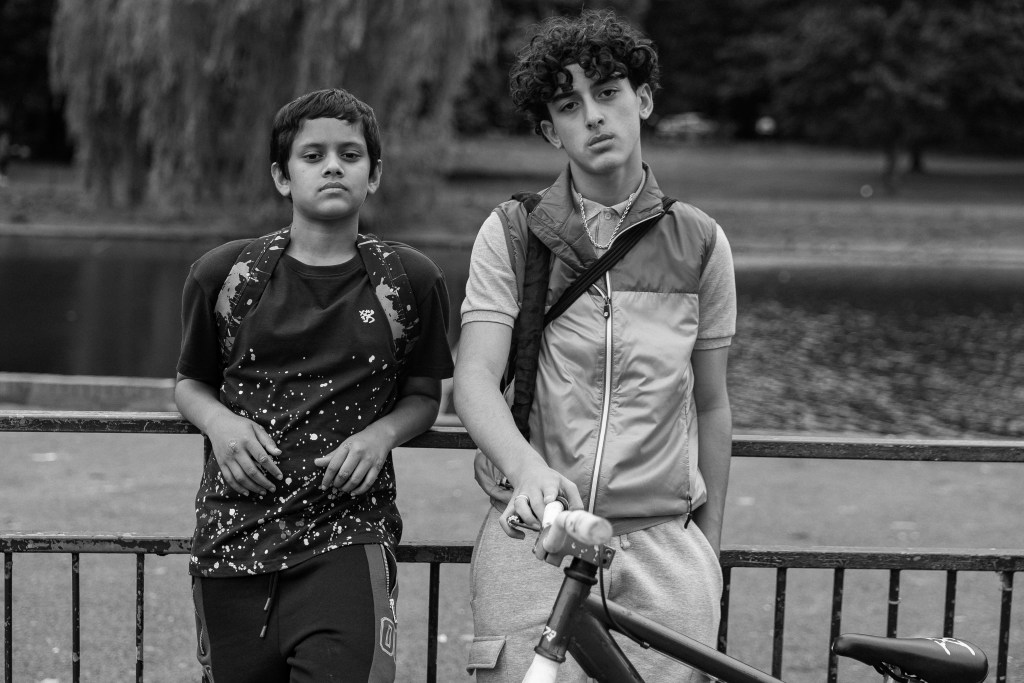
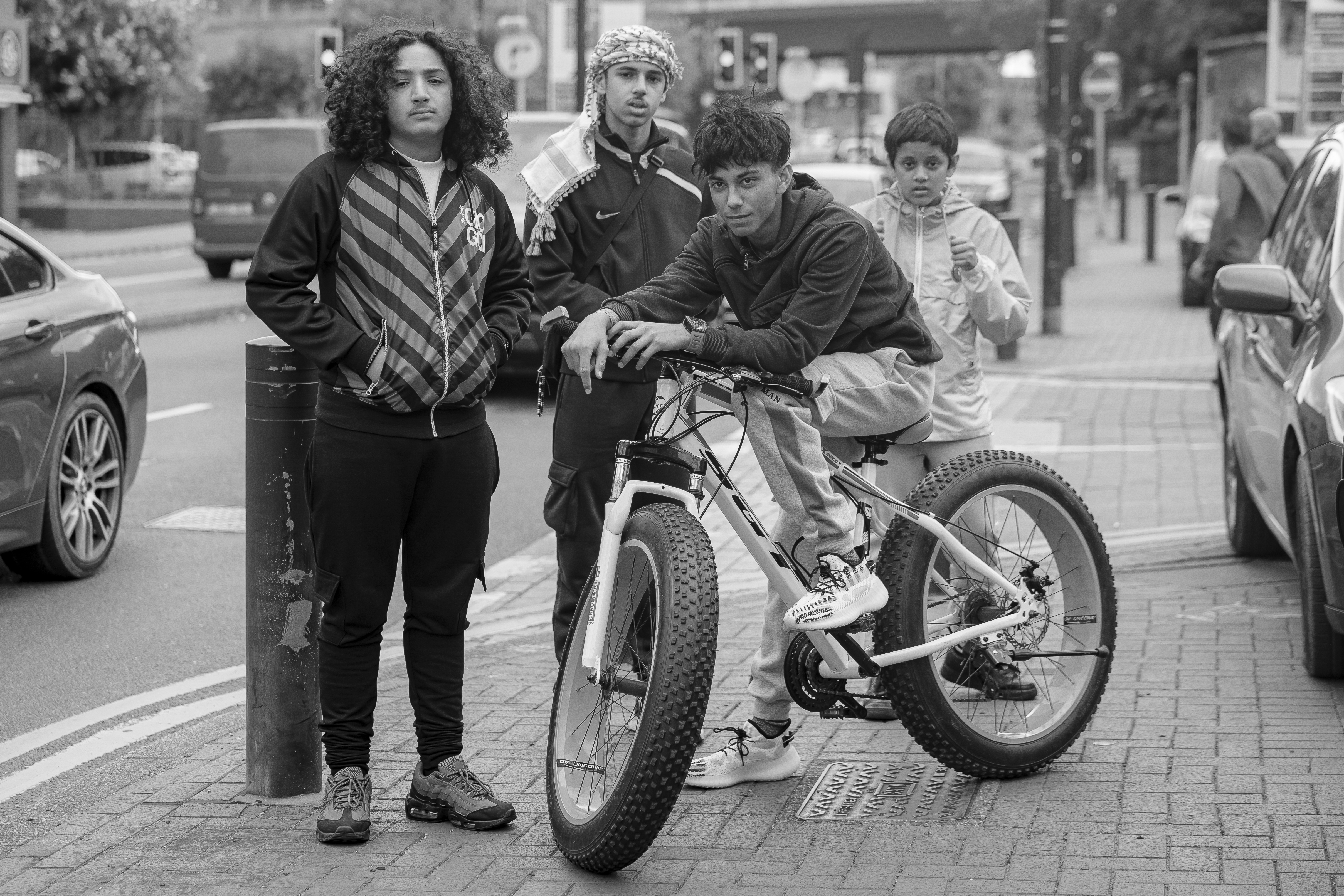
The film intimately observes the psychological toll of police violence on young Muslim boys in the UK. It follows the titular Ishmail—or “Ish” (Farhan Hasnat), who is grieving the loss of his mother—and his best friend, Maram (Yahya Kitana), during their summer vacation. Ish is Bangladeshi, and Maram is Palestinian. They live in the immigrant-populated town of Luton, on the outskirts of London, and spend their days leisurely around the expansive woodlands of Bedfordshire, until an encounter with the police irreversibly transforms their dynamic.
Perretta is the son of a Bangladeshi mother and an Italian father. The 37-year-old interdisciplinary artist, musician, and filmmaker grew up in South London, coming of age in a post-9/11 UK. His artworks, spanning moving image, sound, composition, performance art, and poetry, examine themes of migration, identity, and belonging, focusing on state violence, the repression of racialized communities, and contested public spaces.
When the opportunity arose to write a feature, Perretta naturally looked back to his teenage years that he described as “formative on several levels.” It was both a moment he became an adult and experienced political awakening, which, to him, felt contingent on each other.
Ish, which recently won a British Independent Film Award (BIFA) for Breakthrough Producer, is very much a continuation of Perretta’s practice. It’s a rare film that paints a deeply tender portrait of masculinity, friendship, and boyhood under a racist and Islamophobic carceral state.
A Black-and-White Film That Speaks to the Present Moment
“Luton is maybe one of the closest places to London that has such a concentrated South Asian community,” shared Perretta, whose in-laws live there as well. Luton has been portrayed in the British media as a hotbed of extremism and a focal point in national discussions about “radicalization” and “community tensions.” Through the 1990s-2010s, the town has been associated with the operations of the Islamist group al-Muhajiroun and the white supremacist English Defence League.
“It has had this bizarre status as contested ground in the UK,” Perretta said. However, local leaders and community groups have since pushed back against the “hotbed” label, emphasizing that Luton’s diverse population largely lives peacefully. “Nowadays,” Perretta noted, “it’s back to just being a bog-standard commuter town.”
Yet the police are incredibly present in Luton, and it’s one of the most surveilled communities in the UK. “Luton felt like exactly the right place to talk about all the political forces that we experience as South Asian Muslim men in the UK,” Perretta said.
Ish is rendered in black and white, which captures Luton’s post-war, industrial feel: the grey tones and concrete structures. Perretta felt that while color exaggerated the urban decay, monochrome made everything monumental and classical. “It made the concrete buildings feel like palaces,” he said. This grandeur reflects how Ish and Maram view Luton—a small town, which to them is their whole world.
While the black-and-white aesthetic also creates a sense of timelessness, Ish is set in the present time, established mainly through the constant news about the ongoing genocide in Gaza that the two friends keep listening to. For Perretta, this news “fills the air” in a way he had only experienced at the onset of the War on Terror and the Iraq War. “I felt like I had a lot of skin in the game,” Perretta reflected on being aged 13 post-9/11. “It feels like a similar thing for these boys now: we all have skin in the game. We’re watching a genocide unfold in front of our eyes, and for the boys, that’s the biggest news story of their lives.”
Perretta views the present moment—characterized by the complete collapse of international law and rising anti-immigrant, anti-Muslim, xenophobic racism globally—as a natural continuation of two key political events: 9/11 and the 2008 financial crash. “It’s a new generation that’s encountering all of the reverberations of those events,” he said, “and trying to survive it.”
State Violence and Carcerality Across Borders
“The function of the military, wherever it exists, is the same as the function of the police,” the filmmaker argued. “It’s about using state-sanctioned violence as a form of fear, control, and coercion.” Ish thus draws a parallel between the IDF’s occupation in Gaza and the police’s presence in Luton, highlighting the similarities between state violence and carcerality across borders.
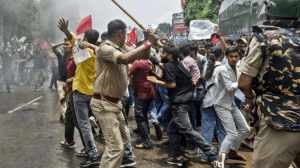
This parallel also mirrors Ish and Maram’s conception of the state’s carceral forces. “Their enemy is the IDF just as much as it is the police,” Perretta explained. “What they see in Gaza is people like themselves—brown people, Muslim people, marginalized people—being maimed and killed and traumatized by either the police or these occupying military forces.” This takes on additional meaning given the UK police’s brutal crackdown on those protesting the genocide in Gaza and the domestic ban on Palestine Action Group.
Ish and Maram are forced to come of age when an unmarked police facial recognition van suddenly stops behind them for a “routine” and “random” stop-and-search. They both run frantically, but only Ish gets away, while Maram is left behind to endure the traumatic ordeal on his own. Perretta stages this scene with flair, using handheld shots and close-ups. He never takes us into the van to see what happens to Maram. Instead, we stay outside with Ish, hiding and watching the van until his friend comes out, leaving the evident experience of police brutality to our informed imagination.
A counterexample of this scene is found in Neeraj Ghaywan’s Homebound. There, Shoaib, a Muslim migrant worker, is caught by the police during the COVID-19 lockdown. Upon hearing his name—and in turn, his religious identity—the police mercilessly beat him up, regurgitating Islamophobic conspiracy theories spread by mainstream media and politicians of the ruling party about Muslims deliberately spreading the coronavirus. Upon seeing this while hiding from the cops, Shoaib’s friend, Chandan, a Dalit migrant worker, finds the courage to step out to support his friend.
When the police ask his name, Chandan says, “Hassan Ali,” and thus gets beaten up as well for being Muslim. This radical act of solidarity sharply contrasts Ish’s inaction, perhaps reflecting the emotional difference between the adolescent boys in Ish and the men in Homebound. Indeed, as men from marginalized backgrounds, Shoaib and Chandan likely had to grow up much sooner than normal, as Ish and Maram do in Perretta’s film, which does not judge its titular character at all.
Instead, Ish locates its critique in the carceral system, which unfairly puts the young, racialized boys in such a painful position, and examines the damaging psychological consequences on them and their friendship. “They understand, in that moment, that they can’t be together,” Perretta explained. “That’s a reckoning for both of them.”
The Psychological Effects of State Violence
The film centers on Ish’s experience—the torment and sense of powerlessness he feels—but his grave betrayal is ultimately never reconciled. The boys don’t have the language or the space to unpack what that means, or how it feels. “Sometimes you have to say goodbye to your very best friend, your first love,” Perretta noted of how his protagonists come of age in the film. “I saw it as them both acknowledging in that moment that ‘we’re not gonna force ourselves to be friends. We’re just gonna amicably part.’ That feels like a really mature, adult thing to do.”
Ish is based, in fact, on an incident that happened to Perretta and his friend when they were adolescents, but only he was bundled into the police car, while his friend ran away. Even then, Perretta recalled, they both knew that running away was an understandable, instinctive reaction to danger. “It was too complicated for two young people to resolve,” recalled Perretta. “There was too much trauma, so we just had to be apart.”
Though the violence that the protagonists in Ish experience is practically banal and woven into the daily lives of racialized communities, its effects are seismic and life-altering. For Perretta, if that stop-and-search had not occurred, the friendship wouldn’t have broken up. This heartbreaking reality lies at the core of the film. “There is a direct line of causation from this intervention by the state—this act of aggression, violence towards children—and their ability to maintain a sense of self, and also to maintain relationships,” he explained.
The film’s gorgeous cinematography is complemented by a powerful score that adds grandeur and a sense of high-stakes drama. During post-production, the editor, Adam Biscubsky, put in temporary music for a sense of rhythm, emotion, and aesthetic. “He put English medieval choral music all over, all the scenes,” Perretta recalled. The music, layered over visuals of English boys with different ancestries, both reflects the aesthetic of Englishness and challenges its hegemony, thus complementing the themes and narratives of the film.

The Process of Casting—and Directing—Ish and Maram
Despite its heavy themes, Ish also carves out space for the boys, focusing on their joy, solidarity, and mutual support. The first half, especially, sets up their wonderful sense of intimacy, camaraderie, and boyish banter. One of the earliest scenes depicts the two of them hanging out in the woodlands, after which they return home on one bike. Maram is riding, and Ish is sitting in front, the wind blowing on them. It’s reminiscent of Sholay’s iconic song, “Yeh Dosti, hum nahi chhodenge” (“We will never leave this friendship”), with the protagonists riding on a motorbike with a sidecar attached.
As it turns out, the actors Yahya Kitana and Farhan Hasnat have been real-life friends since nursery school. In fact, Hasnat’s mother taught Kitana in primary school, which brought their families even closer. “We saw close to a thousand young boys from around Luton,” Perretta said, recalling the casting process. Part of the final round of casting involved putting different combinations of boys together, and Perretta would set them up with improvizations to gauge their chemistry.
With Kitana and Hasnat, the friendship he’d written on paper came alive in a way even he couldn’t have imagined. “They were incredible,” Perretta said. “All that chemistry, the texture of that friendship on screen, is based on real life.”
Peretta noted that Hasnat is gregarious and extroverted, in contrast to the quiet and diffident character of Ish. “I think he was able to find that more introverted, quieter spirit within himself,” Perretta said of Hasnat’s portrayal of Ish, a hybrid of a younger Perretta and a present-day Hasnat. “The character’s a great testament to our collaboration.”
While Ish deals with dark, complex themes of police violence, racialization, and masculinity, Perretta did not burden his young actors with this information during the shoot. Hasnat and Kitana were never allowed to read the whole script; only their parents did. During the shoot, the boys would receive their lines for the day only that morning. Perretta didn’t want them to think too much, and instead respond to things in the moment, the way one would when encountering traumatic events in real life—and then only reflect on them later.
The filmmaking process mirrored this structure, “a real-life, real-time rendering of these characters and these themes,” said Perretta. After they finished filming, Hasnat and Kitana were enrolled in an aftercare program run by We Are Bridge for young, untrained actors to decompress, process the experience of filming, and decide if they want to continue acting in the future.
Perretta’s Film References and Inspirations
Tonally, aesthetically, and thematically, Ish evokes Mathieu Kassovitz’s 1995 masterpiece La Haine, which explores police brutality and disaffected youth in low-income Parisian immigrant suburbs, by following three friends over 24 hours after a riot. “I remember watching it in French class, and we thought it was the fucking best thing we’d ever seen,” Perretta recalled. Yet, although this was likely a foundational influence on his style and worldview, Perretta said La Haine wasn’t an explicit reference for Ish.
He instead cited references from the canon: François Truffaut’s The 400 Blows (1959), Satyajit Ray’s Pather Panchali (1955), and The Bill Douglas Trilogy—including My Childhood (1972), My Ain Folk (1973), and My Way Home (1978). The rhythm and syntax of Ish draw on these films, which are also black-and-white, observational portraits of resilience amid social upheaval. More contemporary influences for Perretta include Clio Barnard’s coming-of-age drama, The Selfish Giant (2013), and Claire Denis’ Beau Travail (1999) for its examination of the intersection of masculinity and imperialism.
Beyond its exploration of the two protagonists, Ish is also a multifaceted portrait of immigrant communities and families, eschewing conventional tropes and stereotypes. Although the film doesn’t give them much screen time, it doesn’t box its supporting characters into any rigid categories, be it Ish’s father, who works at Luton airport (Avin Shah), or Ish’s sister, Samira (singer-songwriter Joy Crookes), who appears as a maternal figure in Ish’s life.
A standout is Ish’s grandmother, Nanu (Sudha Bhuchar), with whom the boy shares some beautiful scenes. She gives him space when he needs it, but offers much-needed wisdom and advice when he seeks it out. A secret smoker, her character is a refreshing deviation from the conventional tropes of a conservative immigrant grandmother.
“She’s just based on my Nanu,” Perretta said, elaborating on his discomfort towards the binary between first-generation migrants and their offspring and grandchildren. For him, this simplistic representation of a culture clash between the progressive and the regressive across generations doesn’t sufficiently capture the complexity of how values evolve and are negotiated in migrant communities.
Perretta’s own family, for instance, was heavily involved in the language and liberation movement in Bangladesh, but didn’t have the political or cultural capital to remain politically engaged when they came to England. While their migration engendered a degree of conservatism—born out of the need for survival and safety—their politics didn’t fundamentally change, even if its expression did.
Perretta exemplified how his grandparents, like many first-generation South Asian immigrants in the UK, survived two brutal Partitions—in 1947 and 1971—but still have a peculiar fondness and fascination for the British Monarchy, a duality he finds fascinating and hilarious. The character of Ish’s grandmother “speaks to the complex political and cultural identities of our elders,” Perretta said. “They’re not so easy to encapsulate as a lot of narratives around their stories would have us believe.”

Finding Hope Amid Rising Xenophobia
Perretta recognizes the importance of telling empathetic stories about immigrants in the UK. While the 1990s were far from perfect, he reflected positively on his childhood, and especially the narrative of embracing multiculturalism in Britain. For Perretta, this view has largely been replaced by an overwhelming commitment to a monoculture, born of Brexit, and in his words, a “return to a jingoistic imperialism in the mainstream discourse.”
Beyond the bubble of multicultural discourse with events like Black History Month, Perretta worries about the “raging kind of xenophobia, this pandering to the fear of immigrants, the fear of trans people, the fear of… name a bogeyman.” He is deeply critical of the UK government’s double standards: its emphasis on the idea of national identity and the right to self-determination while taking decades to recognize a Palestinian state. “They’re obsessed with statehood so long as it concretizes whiteness,” he said, pointing to how the British government has backed Ukraine, but didn’t back the Palestinians.
In such a climate, Ish feels particularly radical in its insistence on the humanity of its protagonists and their complex interior lives. Ish, Maram, and their friends are not reduced to perfect victims—Perretta lets them be brash, mischievous, and messy adolescents.
Yet, Perretta finds hope in the fact that the UK’s cultural diversity is undeniable and cannot be erased. Likewise, despite repression, he seeks solace in the grassroots political movements that are changing how people interact with their environment, with the state, and with each other: “all these people doing all hard work, holding up a conversation, a counter-argument, [to] what’s in the media,” he said—a category in which his own practice and Ish stand.
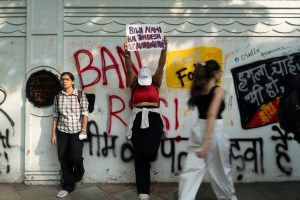
One of the most hopeful things for Perretta is the weekly pro-Palestine protests in London, to which he has taken his daughter several times. “That is one of the most beautiful things I’ve seen in my time,” he reflected. “Just the depth of love and solidarity for the Palestinian people and their struggle—from all different people.” That gives Perretta hope, because it is evidence of the strength of his convictions: that the number of people who believe in multiculturalism and justice outnumbers right-wing bigots.
“Our voices aren’t being amplified in the same way,” he continued, “but there’s plenty of us, and there’s not that many of them—and that is a comforting thought.”
Recently acquired by BFI Distribution, Ish is slated to release in theaters in the U.K. and Ireland in 2026.


Imran Perretta on His Debut Film, ‘Ish,’ Immigration, and the Psychological Impact of Routine State Violence
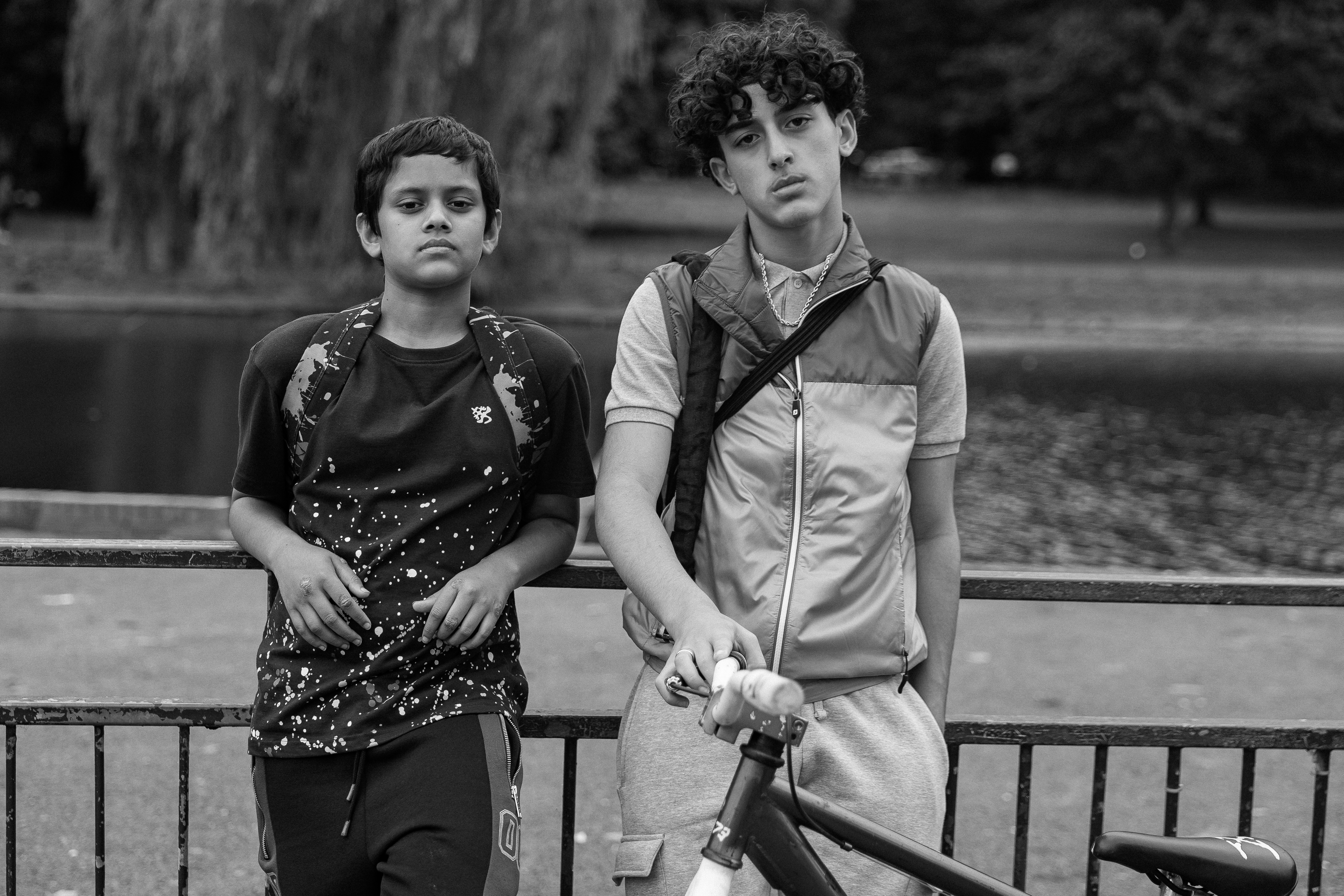
Farhan Hasnat as Ish (left) and Yahya Kitana as Maram (right).
“It’s really just scenes from my teenage years,” said Imran Perretta of his debut feature, Ish, which premiered at the 82nd Venice Film Festival—where it won the section’s People’s Choice Award—and later screened at the 69th BFI London Film Festival.
The film intimately observes the psychological toll of police violence on young Muslim boys in the UK. It follows the titular Ishmail—or “Ish” (Farhan Hasnat), who is grieving the loss of his mother—and his best friend, Maram (Yahya Kitana), during their summer vacation. Ish is Bangladeshi, and Maram is Palestinian. They live in the immigrant-populated town of Luton, on the outskirts of London, and spend their days leisurely around the expansive woodlands of Bedfordshire, until an encounter with the police irreversibly transforms their dynamic.
Perretta is the son of a Bangladeshi mother and an Italian father. The 37-year-old interdisciplinary artist, musician, and filmmaker grew up in South London, coming of age in a post-9/11 UK. His artworks, spanning moving image, sound, composition, performance art, and poetry, examine themes of migration, identity, and belonging, focusing on state violence, the repression of racialized communities, and contested public spaces.
When the opportunity arose to write a feature, Perretta naturally looked back to his teenage years that he described as “formative on several levels.” It was both a moment he became an adult and experienced political awakening, which, to him, felt contingent on each other.
Ish, which recently won a British Independent Film Award (BIFA) for Breakthrough Producer, is very much a continuation of Perretta’s practice. It’s a rare film that paints a deeply tender portrait of masculinity, friendship, and boyhood under a racist and Islamophobic carceral state.
A Black-and-White Film That Speaks to the Present Moment
“Luton is maybe one of the closest places to London that has such a concentrated South Asian community,” shared Perretta, whose in-laws live there as well. Luton has been portrayed in the British media as a hotbed of extremism and a focal point in national discussions about “radicalization” and “community tensions.” Through the 1990s-2010s, the town has been associated with the operations of the Islamist group al-Muhajiroun and the white supremacist English Defence League.
“It has had this bizarre status as contested ground in the UK,” Perretta said. However, local leaders and community groups have since pushed back against the “hotbed” label, emphasizing that Luton’s diverse population largely lives peacefully. “Nowadays,” Perretta noted, “it’s back to just being a bog-standard commuter town.”
Yet the police are incredibly present in Luton, and it’s one of the most surveilled communities in the UK. “Luton felt like exactly the right place to talk about all the political forces that we experience as South Asian Muslim men in the UK,” Perretta said.
Ish is rendered in black and white, which captures Luton’s post-war, industrial feel: the grey tones and concrete structures. Perretta felt that while color exaggerated the urban decay, monochrome made everything monumental and classical. “It made the concrete buildings feel like palaces,” he said. This grandeur reflects how Ish and Maram view Luton—a small town, which to them is their whole world.
While the black-and-white aesthetic also creates a sense of timelessness, Ish is set in the present time, established mainly through the constant news about the ongoing genocide in Gaza that the two friends keep listening to. For Perretta, this news “fills the air” in a way he had only experienced at the onset of the War on Terror and the Iraq War. “I felt like I had a lot of skin in the game,” Perretta reflected on being aged 13 post-9/11. “It feels like a similar thing for these boys now: we all have skin in the game. We’re watching a genocide unfold in front of our eyes, and for the boys, that’s the biggest news story of their lives.”
Perretta views the present moment—characterized by the complete collapse of international law and rising anti-immigrant, anti-Muslim, xenophobic racism globally—as a natural continuation of two key political events: 9/11 and the 2008 financial crash. “It’s a new generation that’s encountering all of the reverberations of those events,” he said, “and trying to survive it.”
State Violence and Carcerality Across Borders
“The function of the military, wherever it exists, is the same as the function of the police,” the filmmaker argued. “It’s about using state-sanctioned violence as a form of fear, control, and coercion.” Ish thus draws a parallel between the IDF’s occupation in Gaza and the police’s presence in Luton, highlighting the similarities between state violence and carcerality across borders.
This parallel also mirrors Ish and Maram’s conception of the state’s carceral forces. “Their enemy is the IDF just as much as it is the police,” Perretta explained. “What they see in Gaza is people like themselves—brown people, Muslim people, marginalized people—being maimed and killed and traumatized by either the police or these occupying military forces.” This takes on additional meaning given the UK police’s brutal crackdown on those protesting the genocide in Gaza and the domestic ban on Palestine Action Group.
Ish and Maram are forced to come of age when an unmarked police facial recognition van suddenly stops behind them for a “routine” and “random” stop-and-search. They both run frantically, but only Ish gets away, while Maram is left behind to endure the traumatic ordeal on his own. Perretta stages this scene with flair, using handheld shots and close-ups. He never takes us into the van to see what happens to Maram. Instead, we stay outside with Ish, hiding and watching the van until his friend comes out, leaving the evident experience of police brutality to our informed imagination.
A counterexample of this scene is found in Neeraj Ghaywan’s Homebound. There, Shoaib, a Muslim migrant worker, is caught by the police during the COVID-19 lockdown. Upon hearing his name—and in turn, his religious identity—the police mercilessly beat him up, regurgitating Islamophobic conspiracy theories spread by mainstream media and politicians of the ruling party about Muslims deliberately spreading the coronavirus. Upon seeing this while hiding from the cops, Shoaib’s friend, Chandan, a Dalit migrant worker, finds the courage to step out to support his friend.
When the police ask his name, Chandan says, “Hassan Ali,” and thus gets beaten up as well for being Muslim. This radical act of solidarity sharply contrasts Ish’s inaction, perhaps reflecting the emotional difference between the adolescent boys in Ish and the men in Homebound. Indeed, as men from marginalized backgrounds, Shoaib and Chandan likely had to grow up much sooner than normal, as Ish and Maram do in Perretta’s film, which does not judge its titular character at all.
Instead, Ish locates its critique in the carceral system, which unfairly puts the young, racialized boys in such a painful position, and examines the damaging psychological consequences on them and their friendship. “They understand, in that moment, that they can’t be together,” Perretta explained. “That’s a reckoning for both of them.”
The Psychological Effects of State Violence
The film centers on Ish’s experience—the torment and sense of powerlessness he feels—but his grave betrayal is ultimately never reconciled. The boys don’t have the language or the space to unpack what that means, or how it feels. “Sometimes you have to say goodbye to your very best friend, your first love,” Perretta noted of how his protagonists come of age in the film. “I saw it as them both acknowledging in that moment that ‘we’re not gonna force ourselves to be friends. We’re just gonna amicably part.’ That feels like a really mature, adult thing to do.”
Ish is based, in fact, on an incident that happened to Perretta and his friend when they were adolescents, but only he was bundled into the police car, while his friend ran away. Even then, Perretta recalled, they both knew that running away was an understandable, instinctive reaction to danger. “It was too complicated for two young people to resolve,” recalled Perretta. “There was too much trauma, so we just had to be apart.”
Though the violence that the protagonists in Ish experience is practically banal and woven into the daily lives of racialized communities, its effects are seismic and life-altering. For Perretta, if that stop-and-search had not occurred, the friendship wouldn’t have broken up. This heartbreaking reality lies at the core of the film. “There is a direct line of causation from this intervention by the state—this act of aggression, violence towards children—and their ability to maintain a sense of self, and also to maintain relationships,” he explained.
The film’s gorgeous cinematography is complemented by a powerful score that adds grandeur and a sense of high-stakes drama. During post-production, the editor, Adam Biscubsky, put in temporary music for a sense of rhythm, emotion, and aesthetic. “He put English medieval choral music all over, all the scenes,” Perretta recalled. The music, layered over visuals of English boys with different ancestries, both reflects the aesthetic of Englishness and challenges its hegemony, thus complementing the themes and narratives of the film.
The Process of Casting—and Directing—Ish and Maram
Despite its heavy themes, Ish also carves out space for the boys, focusing on their joy, solidarity, and mutual support. The first half, especially, sets up their wonderful sense of intimacy, camaraderie, and boyish banter. One of the earliest scenes depicts the two of them hanging out in the woodlands, after which they return home on one bike. Maram is riding, and Ish is sitting in front, the wind blowing on them. It’s reminiscent of Sholay’s iconic song, “Yeh Dosti, hum nahi chhodenge” (“We will never leave this friendship”), with the protagonists riding on a motorbike with a sidecar attached.
As it turns out, the actors Yahya Kitana and Farhan Hasnat have been real-life friends since nursery school. In fact, Hasnat’s mother taught Kitana in primary school, which brought their families even closer. “We saw close to a thousand young boys from around Luton,” Perretta said, recalling the casting process. Part of the final round of casting involved putting different combinations of boys together, and Perretta would set them up with improvizations to gauge their chemistry.
With Kitana and Hasnat, the friendship he’d written on paper came alive in a way even he couldn’t have imagined. “They were incredible,” Perretta said. “All that chemistry, the texture of that friendship on screen, is based on real life.”
Peretta noted that Hasnat is gregarious and extroverted, in contrast to the quiet and diffident character of Ish. “I think he was able to find that more introverted, quieter spirit within himself,” Perretta said of Hasnat’s portrayal of Ish, a hybrid of a younger Perretta and a present-day Hasnat. “The character’s a great testament to our collaboration.”
While Ish deals with dark, complex themes of police violence, racialization, and masculinity, Perretta did not burden his young actors with this information during the shoot. Hasnat and Kitana were never allowed to read the whole script; only their parents did. During the shoot, the boys would receive their lines for the day only that morning. Perretta didn’t want them to think too much, and instead respond to things in the moment, the way one would when encountering traumatic events in real life—and then only reflect on them later.
The filmmaking process mirrored this structure, “a real-life, real-time rendering of these characters and these themes,” said Perretta. After they finished filming, Hasnat and Kitana were enrolled in an aftercare program run by We Are Bridge for young, untrained actors to decompress, process the experience of filming, and decide if they want to continue acting in the future.
Perretta’s Film References and Inspirations
Tonally, aesthetically, and thematically, Ish evokes Mathieu Kassovitz’s 1995 masterpiece La Haine, which explores police brutality and disaffected youth in low-income Parisian immigrant suburbs, by following three friends over 24 hours after a riot. “I remember watching it in French class, and we thought it was the fucking best thing we’d ever seen,” Perretta recalled. Yet, although this was likely a foundational influence on his style and worldview, Perretta said La Haine wasn’t an explicit reference for Ish.
He instead cited references from the canon: François Truffaut’s The 400 Blows (1959), Satyajit Ray’s Pather Panchali (1955), and The Bill Douglas Trilogy—including My Childhood (1972), My Ain Folk (1973), and My Way Home (1978). The rhythm and syntax of Ish draw on these films, which are also black-and-white, observational portraits of resilience amid social upheaval. More contemporary influences for Perretta include Clio Barnard’s coming-of-age drama, The Selfish Giant (2013), and Claire Denis’ Beau Travail (1999) for its examination of the intersection of masculinity and imperialism.
Beyond its exploration of the two protagonists, Ish is also a multifaceted portrait of immigrant communities and families, eschewing conventional tropes and stereotypes. Although the film doesn’t give them much screen time, it doesn’t box its supporting characters into any rigid categories, be it Ish’s father, who works at Luton airport (Avin Shah), or Ish’s sister, Samira (singer-songwriter Joy Crookes), who appears as a maternal figure in Ish’s life.
A standout is Ish’s grandmother, Nanu (Sudha Bhuchar), with whom the boy shares some beautiful scenes. She gives him space when he needs it, but offers much-needed wisdom and advice when he seeks it out. A secret smoker, her character is a refreshing deviation from the conventional tropes of a conservative immigrant grandmother.
“She’s just based on my Nanu,” Perretta said, elaborating on his discomfort towards the binary between first-generation migrants and their offspring and grandchildren. For him, this simplistic representation of a culture clash between the progressive and the regressive across generations doesn’t sufficiently capture the complexity of how values evolve and are negotiated in migrant communities.
Perretta’s own family, for instance, was heavily involved in the language and liberation movement in Bangladesh, but didn’t have the political or cultural capital to remain politically engaged when they came to England. While their migration engendered a degree of conservatism—born out of the need for survival and safety—their politics didn’t fundamentally change, even if its expression did.
Perretta exemplified how his grandparents, like many first-generation South Asian immigrants in the UK, survived two brutal Partitions—in 1947 and 1971—but still have a peculiar fondness and fascination for the British Monarchy, a duality he finds fascinating and hilarious. The character of Ish’s grandmother “speaks to the complex political and cultural identities of our elders,” Perretta said. “They’re not so easy to encapsulate as a lot of narratives around their stories would have us believe.”
Finding Hope Amid Rising Xenophobia
Perretta recognizes the importance of telling empathetic stories about immigrants in the UK. While the 1990s were far from perfect, he reflected positively on his childhood, and especially the narrative of embracing multiculturalism in Britain. For Perretta, this view has largely been replaced by an overwhelming commitment to a monoculture, born of Brexit, and in his words, a “return to a jingoistic imperialism in the mainstream discourse.”
Beyond the bubble of multicultural discourse with events like Black History Month, Perretta worries about the “raging kind of xenophobia, this pandering to the fear of immigrants, the fear of trans people, the fear of… name a bogeyman.” He is deeply critical of the UK government’s double standards: its emphasis on the idea of national identity and the right to self-determination while taking decades to recognize a Palestinian state. “They’re obsessed with statehood so long as it concretizes whiteness,” he said, pointing to how the British government has backed Ukraine, but didn’t back the Palestinians.
In such a climate, Ish feels particularly radical in its insistence on the humanity of its protagonists and their complex interior lives. Ish, Maram, and their friends are not reduced to perfect victims—Perretta lets them be brash, mischievous, and messy adolescents.
Yet, Perretta finds hope in the fact that the UK’s cultural diversity is undeniable and cannot be erased. Likewise, despite repression, he seeks solace in the grassroots political movements that are changing how people interact with their environment, with the state, and with each other: “all these people doing all hard work, holding up a conversation, a counter-argument, [to] what’s in the media,” he said—a category in which his own practice and Ish stand.
One of the most hopeful things for Perretta is the weekly pro-Palestine protests in London, to which he has taken his daughter several times. “That is one of the most beautiful things I’ve seen in my time,” he reflected. “Just the depth of love and solidarity for the Palestinian people and their struggle—from all different people.” That gives Perretta hope, because it is evidence of the strength of his convictions: that the number of people who believe in multiculturalism and justice outnumbers right-wing bigots.
“Our voices aren’t being amplified in the same way,” he continued, “but there’s plenty of us, and there’s not that many of them—and that is a comforting thought.”
Recently acquired by BFI Distribution, Ish is slated to release in theaters in the U.K. and Ireland in 2026.