


Editor’s Note:
Peiman Salehi is an independent Iranian journalist based in Tehran. This dispatch was filed under significant constraints: internet access has been blocked across Iran since the beginning of the conflict. Salehi’s laptop was destroyed in the impact of a nearby strike in Tehran. He filed this piece through brief VPN connections. That blackout has consequences that extend well beyond Iran’s borders: it has made it functionally impossible for Iranian journalists, civil society voices, and ordinary citizens to report, document, or narrate what is happening on the ground in their own country. The result is an information vacuum.Western corporate media have once again abdicated their duty to cover the American War against Iran; its coverage has been stenographic and spineless, treating the war as inevitable. The danger is not just propaganda but habituation. War, when treated as routine, escapes scrutiny, and Iranian civilian experience remains almost entirely invisible.
Into that vacuum comes this dispatch. The editors have chosen to publish this account because eyewitness testimony from inside Iran during this period is exceptionally rare, and we believe its value, its insistence on human dignity, and what is being flattened into briefings and bomb-damage assessments outweigh the limitations imposed by circumstance.
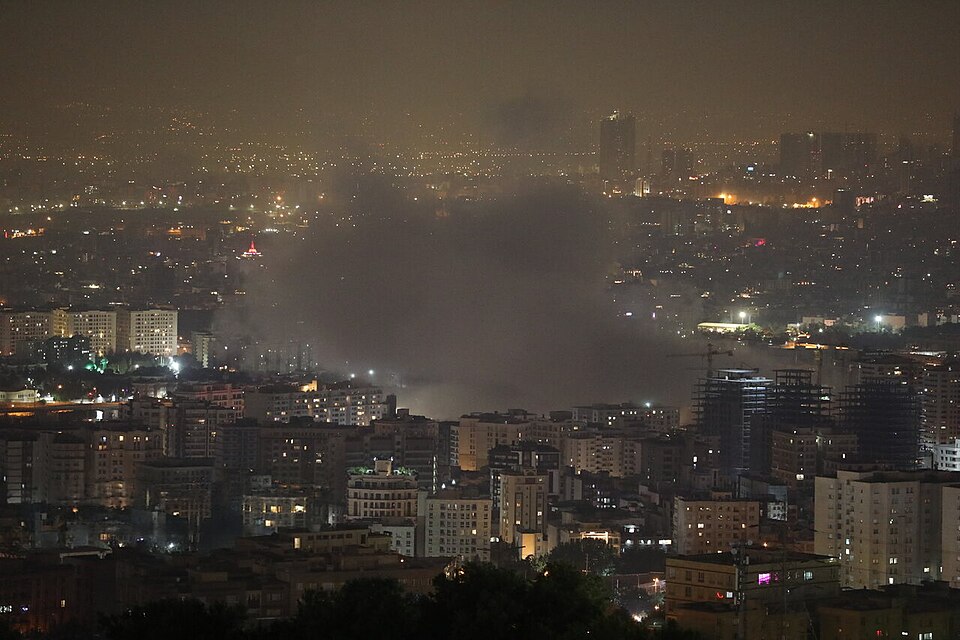
These nights in Tehran, we hear the sound of American and Israeli fighter jets almost constantly. Somewhere in the city, another explosion. A few days ago, a blast near our home in eastern Tehran shattered windows and damaged much of the interior. My laptop was among the things destroyed.
As it did during the January 2026 protests, the government moved quickly to shut down international internet access. In such conditions, we cannot hear the outside world, and perhaps the outside world cannot hear us. According to NetBlocks, a global internet monitor, 99% of people in Iran currently have no access to the global internet. On March 16, it said the internet blackout in Iran had entered its 17th day, lasting 384 hours. “Over the last day, a decline has been tracked in reserved telecoms network infrastructure, further reducing VPN availability.”
For an independent freelancer like me, this makes work extremely difficult. Now, during the day, I manage to connect to a VPN for a few minutes — enough to answer an email, enough to check what is happening beyond Iran’s borders. But without a computer, writing is a struggle, and writing is my only source of income.
The war has deepened the very economic crisis that had sparked mass protests. Families, who earlier struggled to survive on salaries that barely lasted the month, now face the war – only days before Nowruz, the Persian New Year. Nowruz is a time when families generally visit relatives, travel, buy new clothes, and renovate their homes. This year, the atmosphere is starkly different. Few people are thinking about celebrations. Instead, many ask whether the war will end soon or whether a ceasefire will simply lead to another attack later.
Alongside this dark week, there are scenes that even many of us inside Iran find surprising. Despite the risk of bombardment, people gather in the streets at night. At times, the scenes resemble something from a film. People hold Iranian flags as fighter jets fly overhead and chant slogans. But these slogans are different from those heard in recent years. In the past, many protests focused on reforms or criticism of domestic policies. What is heard in the streets now is mostly about resisting an external enemy.
Some analysts argue that one of Donald Trump’s miscalculations was assuming that Iran’s internal divisions meant the country would collapse if attacked; similar assumptions drove earlier interventions in other countries. But for many Iranians, the country is not simply a state; it is a civilisational identity that stretches back thousands of years.
While national security is currently a growing concern, economic frustrations remain widespread. Even in this moment, people ask difficult questions: Why should a society that rallies so strongly behind its country still face such economic hardship? Why do diabetic patients still wait in queues for insulin? Why do many parents worry every month whether their salary will be enough to support their families? These questions do not disappear simply because a war has begun.
Iranians Face Deepening Hardship
To understand today’s Iran, one must step back. The US and Israel’s war on Iran began at a moment when the country had already been under enormous economic pressure for years. After the United States withdrew from the nuclear agreement in 2018 and sweeping sanctions returned, Iran’s national currency steadily lost value. While one US dollar traded at about 34,000 rials in 2016 at the official rate, the rial depreciated much more sharply in the open or parallel market, where most transactions are effectively priced. By 2025, it had surpassed 1.3 million rials in the open market. During the same period, inflation often remained above 30 percent and at times exceeded 40 percent, leading to a sharp decline in purchasing power for many Iranian families.
These pressures gradually produced deeper social and political divisions. The society, which had largely united during the 1980s Iran-Iraq war, later faced a series of economic and social crises. Waves of protest, including the unrest of autumn 2022, reflected those tensions. Public participation in elections also declined. Turnout in the 2009 presidential election exceeded 80%. By the 2024 elections, it had fallen to about 49%.
Yet Iranian history shows that external threats can, at least briefly, pull a fractured society together. When tensions with the US and Israel escalated in June 2025, a degree of national cohesion briefly reappeared. Even some critics of the government argued that such unity should be preserved in the face of a foreign attack.
But that moment did not last long. In December 2025, Iranian authorities introduced one of the most controversial economic policies of recent years, removing several major subsidies. While framed as an effort to ease pressure on the state budget, the move triggered sharp price increases in essential goods and placed a greater financial strain on lower-income groups.
The result was a new wave of unrest. In the first weeks, many demonstrations were peaceful and driven by economic grievances. Protests spread rapidly to dozens of cities. But on January 8 and 9, violence broke out in several cities as state forces cracked down on protesters and the government imposed an internet shutdown. According to figures later released by the Iranian government, about three thousand people were killed. Western media outlets and human rights groups suggested even higher numbers.
These events deepened the political polarization of Iranian society. Some blamed the government for the worsening economic crisis. Others insisted that political stability had to be preserved despite the hardships. Yet, only months later, those divisions largely took a backseat in the face of the US-Israel attack.
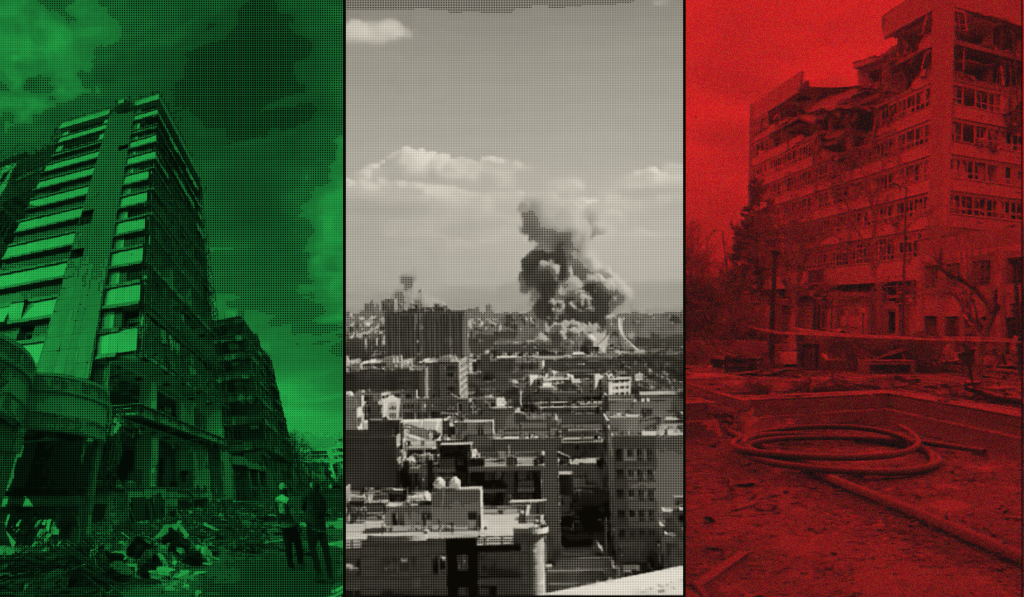
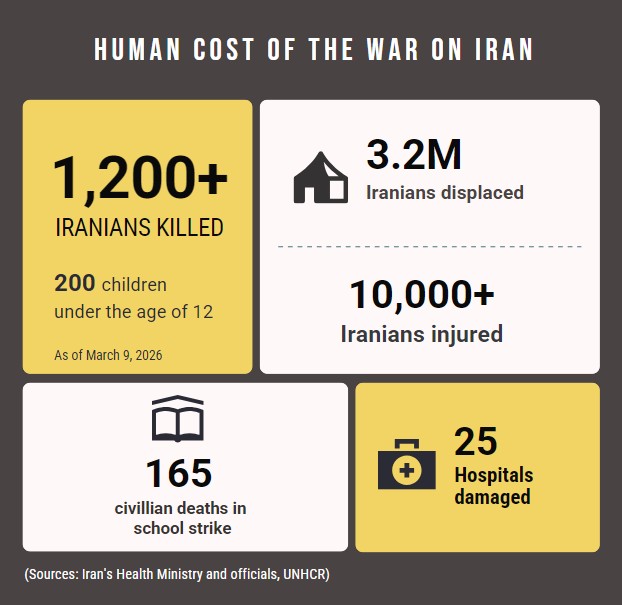
As I write these lines, Tehran is still under bombardment. Contrary to some Western narratives that say the strikes only target military sites or officials’ homes, the reality inside the city is different. The tragedy at the Shajareh Tayyebeh school in the southern city of Minab, where more than 160 teachers and schoolgirls were killed, convinced many Iranians that the line between military and civilian targets can easily disappear in a war.
Living in Tehran Under Bombs
In Tehran, the bombs do not seem to distinguish between neighborhoods. Areas such as Kamranieh, Niavaran, and the Sadr highway district, which are usually considered wealthier parts of the city, have also been hit. These neighborhoods are often home to Iran’s affluent classes, who frequently demand greater cultural and social freedoms and are sometimes critical of government policies.
At the same time, poorer districts suffer their own economic frustrations. Many of their complaints stem from unemployment, inflation, and declining living standards. Yet, for many, criticism of economic conditions does not necessarily mean rejection of the political system itself. People can be dissatisfied with economic realities while still feeling strongly about national security.
During the war, these social differences between neighborhoods appear less visible. One night, Niavaran or Kamranieh may be hit. Another night, explosions are reported in the eastern or southern districts.
So far, more than 1,300 Iranian civilians have been killed, according to Iran’s ambassador to the United Nations, Amir Saeid Iravani. Speaking on March 10, he said US-Israel strikes have destroyed 9,669 locations, including almost 8,000 residential homes as well as commercial centres, medical facilities, and schools. People watched in horror as buildings crumbled and attacks on oil depots caused toxic rain over Tehran.
Many people say their view of the outside world, especially the US, has changed over the years. Iranians I spoke to argue that their country signed the nuclear agreement, yet the US withdrew. Negotiations resumed in 2025, but attacks occurred during the talks. Even earlier this year, during negotiations mediated by Oman, another strike took place, and Iran’s Supreme Leader was assassinated. These are facts.
The killing of Ali Khamenei, who led Iran for 37 years, shocked a large number of people. Western media had long reported that he lived hidden underground. However, he was killed on the first day of the war along with family members, including young grandchildren.
Some Western analysts believed such a strike would trigger internal collapse. Instead, the reaction inside the country is different. Even the issue of succession produced an unexpected response. In the past, some predicted that if Mojtaba Khamenei succeeded his father, it would provoke public anger. Recent reports, including coverage from Al Jazeera, suggest that crowds on the streets of Tehran received the announcement without the anger many had predicted.
When I spoke with people on the streets, one young man named Amin told me he supported the new leadership because “Iran must remain strong”. He said his father’s generation had learned that without military power, the country could not rely on the West.
Many Iranians appear to have reached a similar conclusion. For a society that has endured years of sanctions and economic pressure, this shift in priorities is striking. At present, the central issue for them is security. People who previously debated economic policy, cultural rules, or social freedoms now mostly discuss the war. The questions heard in conversations are different: Did Iranian missiles reach Israel? Were American bases hit? Where will the next attack take place?
The most common sentence I hear in conversations is simple. People say they are tired. But they also state that if war is unavoidable, Iran must defend itself strongly. Iranian society today is neither fully unified nor as fragile as many outside observers assume. It is a complex mixture of dissatisfaction, national identity, historical memory, and everyday struggles.
So, life in Tehran continues even under the sound of warplanes. People still gather in the streets, talk with one another, and try to understand what the future might hold. Amid the explosions and conversations, one question keeps returning: Will this war fundamentally change Iran’s future, or will it simply become another chapter in the country’s long history of turmoil?

Dispatch from Tehran: Bombs and Hardship are Reshaping Iranian Society

Editor’s Note:
Peiman Salehi is an independent Iranian journalist based in Tehran. This dispatch was filed under significant constraints: internet access has been blocked across Iran since the beginning of the conflict. Salehi’s laptop was destroyed in the impact of a nearby strike in Tehran. He filed this piece through brief VPN connections. That blackout has consequences that extend well beyond Iran’s borders: it has made it functionally impossible for Iranian journalists, civil society voices, and ordinary citizens to report, document, or narrate what is happening on the ground in their own country. The result is an information vacuum.Western corporate media have once again abdicated their duty to cover the American War against Iran; its coverage has been stenographic and spineless, treating the war as inevitable. The danger is not just propaganda but habituation. War, when treated as routine, escapes scrutiny, and Iranian civilian experience remains almost entirely invisible.
Into that vacuum comes this dispatch. The editors have chosen to publish this account because eyewitness testimony from inside Iran during this period is exceptionally rare, and we believe its value, its insistence on human dignity, and what is being flattened into briefings and bomb-damage assessments outweigh the limitations imposed by circumstance.
These nights in Tehran, we hear the sound of American and Israeli fighter jets almost constantly. Somewhere in the city, another explosion. A few days ago, a blast near our home in eastern Tehran shattered windows and damaged much of the interior. My laptop was among the things destroyed.
As it did during the January 2026 protests, the government moved quickly to shut down international internet access. In such conditions, we cannot hear the outside world, and perhaps the outside world cannot hear us. According to NetBlocks, a global internet monitor, 99% of people in Iran currently have no access to the global internet. On March 16, it said the internet blackout in Iran had entered its 17th day, lasting 384 hours. “Over the last day, a decline has been tracked in reserved telecoms network infrastructure, further reducing VPN availability.”
For an independent freelancer like me, this makes work extremely difficult. Now, during the day, I manage to connect to a VPN for a few minutes — enough to answer an email, enough to check what is happening beyond Iran’s borders. But without a computer, writing is a struggle, and writing is my only source of income.
The war has deepened the very economic crisis that had sparked mass protests. Families, who earlier struggled to survive on salaries that barely lasted the month, now face the war – only days before Nowruz, the Persian New Year. Nowruz is a time when families generally visit relatives, travel, buy new clothes, and renovate their homes. This year, the atmosphere is starkly different. Few people are thinking about celebrations. Instead, many ask whether the war will end soon or whether a ceasefire will simply lead to another attack later.
Alongside this dark week, there are scenes that even many of us inside Iran find surprising. Despite the risk of bombardment, people gather in the streets at night. At times, the scenes resemble something from a film. People hold Iranian flags as fighter jets fly overhead and chant slogans. But these slogans are different from those heard in recent years. In the past, many protests focused on reforms or criticism of domestic policies. What is heard in the streets now is mostly about resisting an external enemy.
Some analysts argue that one of Donald Trump’s miscalculations was assuming that Iran’s internal divisions meant the country would collapse if attacked; similar assumptions drove earlier interventions in other countries. But for many Iranians, the country is not simply a state; it is a civilisational identity that stretches back thousands of years.
While national security is currently a growing concern, economic frustrations remain widespread. Even in this moment, people ask difficult questions: Why should a society that rallies so strongly behind its country still face such economic hardship? Why do diabetic patients still wait in queues for insulin? Why do many parents worry every month whether their salary will be enough to support their families? These questions do not disappear simply because a war has begun.
Iranians Face Deepening Hardship
To understand today’s Iran, one must step back. The US and Israel’s war on Iran began at a moment when the country had already been under enormous economic pressure for years. After the United States withdrew from the nuclear agreement in 2018 and sweeping sanctions returned, Iran’s national currency steadily lost value. While one US dollar traded at about 34,000 rials in 2016 at the official rate, the rial depreciated much more sharply in the open or parallel market, where most transactions are effectively priced. By 2025, it had surpassed 1.3 million rials in the open market. During the same period, inflation often remained above 30 percent and at times exceeded 40 percent, leading to a sharp decline in purchasing power for many Iranian families.
These pressures gradually produced deeper social and political divisions. The society, which had largely united during the 1980s Iran-Iraq war, later faced a series of economic and social crises. Waves of protest, including the unrest of autumn 2022, reflected those tensions. Public participation in elections also declined. Turnout in the 2009 presidential election exceeded 80%. By the 2024 elections, it had fallen to about 49%.
Yet Iranian history shows that external threats can, at least briefly, pull a fractured society together. When tensions with the US and Israel escalated in June 2025, a degree of national cohesion briefly reappeared. Even some critics of the government argued that such unity should be preserved in the face of a foreign attack.
But that moment did not last long. In December 2025, Iranian authorities introduced one of the most controversial economic policies of recent years, removing several major subsidies. While framed as an effort to ease pressure on the state budget, the move triggered sharp price increases in essential goods and placed a greater financial strain on lower-income groups.
The result was a new wave of unrest. In the first weeks, many demonstrations were peaceful and driven by economic grievances. Protests spread rapidly to dozens of cities. But on January 8 and 9, violence broke out in several cities as state forces cracked down on protesters and the government imposed an internet shutdown. According to figures later released by the Iranian government, about three thousand people were killed. Western media outlets and human rights groups suggested even higher numbers.
These events deepened the political polarization of Iranian society. Some blamed the government for the worsening economic crisis. Others insisted that political stability had to be preserved despite the hardships. Yet, only months later, those divisions largely took a backseat in the face of the US-Israel attack.
As I write these lines, Tehran is still under bombardment. Contrary to some Western narratives that say the strikes only target military sites or officials’ homes, the reality inside the city is different. The tragedy at the Shajareh Tayyebeh school in the southern city of Minab, where more than 160 teachers and schoolgirls were killed, convinced many Iranians that the line between military and civilian targets can easily disappear in a war.
Living in Tehran Under Bombs
In Tehran, the bombs do not seem to distinguish between neighborhoods. Areas such as Kamranieh, Niavaran, and the Sadr highway district, which are usually considered wealthier parts of the city, have also been hit. These neighborhoods are often home to Iran’s affluent classes, who frequently demand greater cultural and social freedoms and are sometimes critical of government policies.
At the same time, poorer districts suffer their own economic frustrations. Many of their complaints stem from unemployment, inflation, and declining living standards. Yet, for many, criticism of economic conditions does not necessarily mean rejection of the political system itself. People can be dissatisfied with economic realities while still feeling strongly about national security.
During the war, these social differences between neighborhoods appear less visible. One night, Niavaran or Kamranieh may be hit. Another night, explosions are reported in the eastern or southern districts.
So far, more than 1,300 Iranian civilians have been killed, according to Iran’s ambassador to the United Nations, Amir Saeid Iravani. Speaking on March 10, he said US-Israel strikes have destroyed 9,669 locations, including almost 8,000 residential homes as well as commercial centres, medical facilities, and schools. People watched in horror as buildings crumbled and attacks on oil depots caused toxic rain over Tehran.
Many people say their view of the outside world, especially the US, has changed over the years. Iranians I spoke to argue that their country signed the nuclear agreement, yet the US withdrew. Negotiations resumed in 2025, but attacks occurred during the talks. Even earlier this year, during negotiations mediated by Oman, another strike took place, and Iran’s Supreme Leader was assassinated. These are facts.
The killing of Ali Khamenei, who led Iran for 37 years, shocked a large number of people. Western media had long reported that he lived hidden underground. However, he was killed on the first day of the war along with family members, including young grandchildren.
Some Western analysts believed such a strike would trigger internal collapse. Instead, the reaction inside the country is different. Even the issue of succession produced an unexpected response. In the past, some predicted that if Mojtaba Khamenei succeeded his father, it would provoke public anger. Recent reports, including coverage from Al Jazeera, suggest that crowds on the streets of Tehran received the announcement without the anger many had predicted.
When I spoke with people on the streets, one young man named Amin told me he supported the new leadership because “Iran must remain strong”. He said his father’s generation had learned that without military power, the country could not rely on the West.
Many Iranians appear to have reached a similar conclusion. For a society that has endured years of sanctions and economic pressure, this shift in priorities is striking. At present, the central issue for them is security. People who previously debated economic policy, cultural rules, or social freedoms now mostly discuss the war. The questions heard in conversations are different: Did Iranian missiles reach Israel? Were American bases hit? Where will the next attack take place?
The most common sentence I hear in conversations is simple. People say they are tired. But they also state that if war is unavoidable, Iran must defend itself strongly. Iranian society today is neither fully unified nor as fragile as many outside observers assume. It is a complex mixture of dissatisfaction, national identity, historical memory, and everyday struggles.
So, life in Tehran continues even under the sound of warplanes. People still gather in the streets, talk with one another, and try to understand what the future might hold. Amid the explosions and conversations, one question keeps returning: Will this war fundamentally change Iran’s future, or will it simply become another chapter in the country’s long history of turmoil?