



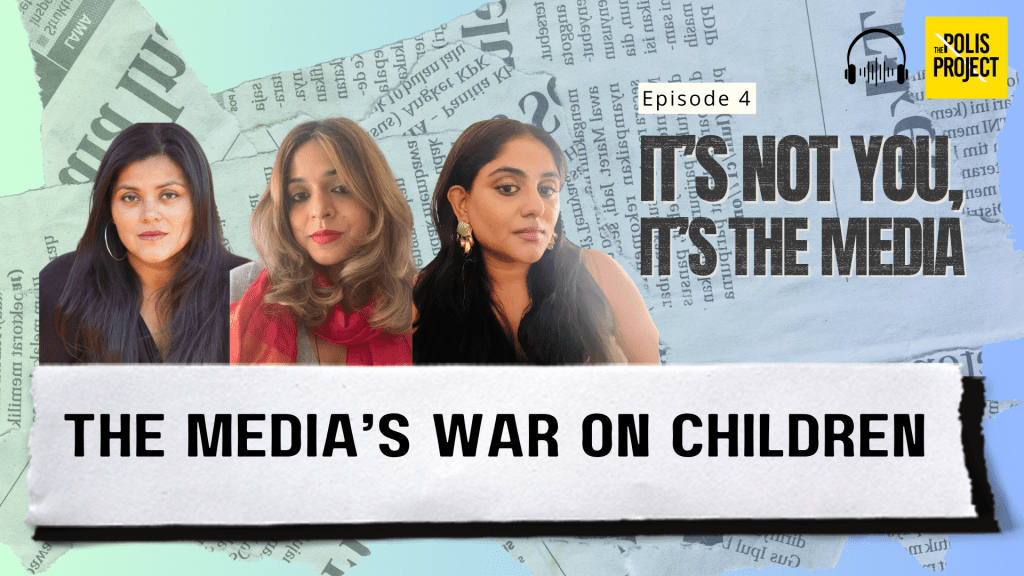
Episode 4: The Media’s War on Children
By Bhakti Shringarpure, Madhuri Sastry, Suchitra Vijayan
October 19, 2024

In this episode, Suchitra, Bhakti, and Madhuri delve into the media’s problematic portrayal of children, particularly in conflict zones. The episode asks: who gets to be a “child” in mainstream media? The coverage of children over the years reveals two broad themes:
1) the process of “un-childing” and
2) tendency towards saviorism that can produce troubling representations of children’s bodies, especially girls.
It addresses how language and representation shape perceptions of childhood, the impact of state policies on Black, brown, and Muslim children, as well as, the contradictions in society’s view of innocence. The conversation also highlights the role of the media in normalizing violence against children and maintaining a savior complex that often accompanies humanitarian narratives in non-white and conflict-zone countries. Ultimately, it emphasizes the need for hope and resilience in the face of despair.
-The media plays a significant role in shaping perceptions of childhood.
-Legal manipulation of language legitimizes comes first and enables the media to justify violence against children. -Palestinian children have historically been dehumanized in media coverage.
-The US has waged totalizing war against children seen in their coverage of police killings of Black youth and in their child services systems.
-The concept of ‘un-childing’ reflects a broader societal issue.
-State policies disproportionately affect non-white children. –
The basis of colonialism and the existence of the empire is in deliberately targeting family structures that are not deemed conventional or appropriate for them, examples are, removing children from parents, destroying indigenous family structures, etc.
-There is a contradiction in society’s view of childhood innocence.
-The notion of “genocide” in Palestine is debated in the media but analyzing the deliberate killing of children precisely proves this.
-Visuals of suffering children can evoke sympathy but also desensitize audiences. -Saviorism in humanitarian efforts can perpetuate colonial narratives.
-Hope and resilience are essential in the fight for justice.
-Resistance to totalizing logic of Palestinian annihilation and erasure is necessary.
SUPPORT US
We like bringing the stories that don’t get told to you. For that, we need your support. However small, we would appreciate it.
Bhakti Shringarpure is writer and editor who co-founded Warscapes magazine and is now creative director of the Radical Books Collective. She is the author of Cold War Assemblages: Decolonization to Digital and recently co-edited Insurgent Feminisms: Writing War.
Suchitra Vijayan is the founder and executive director of The Polis Project and the author of Midnight’s Borders: A People’s History of Modern India and How Long Can the Moon Be Caged? Voices of Indian Political Prisoners.
Related Posts

Episode 16: Why the Media Gets Migration Wrong
Bhakti Shringarpure, Madhuri Sastry, SuchitraV
Episode 14: Is Your Social Media Activism Working?
SuchitraV, Madhuri Sastry, Bhakti Shringarpure
- It's Not You, It's The Media
Episode 4: The Media’s War on Children
Bhakti Shringarpure is writer and editor who co-founded Warscapes magazine and is now creative director of the Radical Books Collective. She is the author of Cold War Assemblages: Decolonization to Digital and recently co-edited Insurgent Feminisms: Writing War.
Suchitra Vijayan is the founder and executive director of The Polis Project and the author of Midnight’s Borders: A People’s History of Modern India and How Long Can the Moon Be Caged? Voices of Indian Political Prisoners.